About the Report
Base Year 2024Middle East Short Term Vacation Rental Market Overview
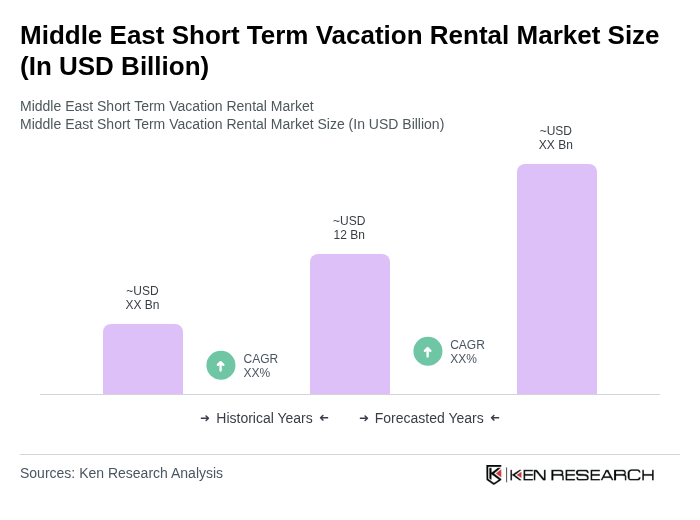
- The Middle East Short Term Vacation Rental Market is valued at USD 12 billion, based on a five-year historical analysis. This growth is primarily driven by the increasing influx of tourists, a rise in domestic travel, and the growing popularity of alternative accommodation options among travelers seeking unique experiences. The region’s expanding digital infrastructure and rising disposable incomes have further accelerated demand for short-term rentals, with travelers increasingly prioritizing personalized, tech-enabled stays and immersive local experiences .
- Key players in this market include the UAE, Saudi Arabia, and Egypt. The UAE stands out due to its robust tourism infrastructure, luxury offerings, and major events like Expo 2020. Saudi Arabia is rapidly expanding its tourism sector, particularly with initiatives like Vision 2030, while Egypt benefits from its rich historical sites and cultural tourism. Dubai and Riyadh have experienced significant inventory growth, with Dubai ranking among the top global cities for short-term rental supply and Riyadh witnessing a surge in new listings, reflecting the region’s dynamic expansion .
- In 2023, the UAE government implemented regulations requiring all short-term rental properties to be registered and licensed under the Dubai Tourism and Commerce Marketing (DTCM) Short-Term Rental Regulations, ensuring compliance with safety, quality, and operational standards. This initiative aims to enhance the overall guest experience and promote responsible tourism, thereby boosting the market's credibility and attractiveness .
Middle East Short Term Vacation Rental Market Segmentation
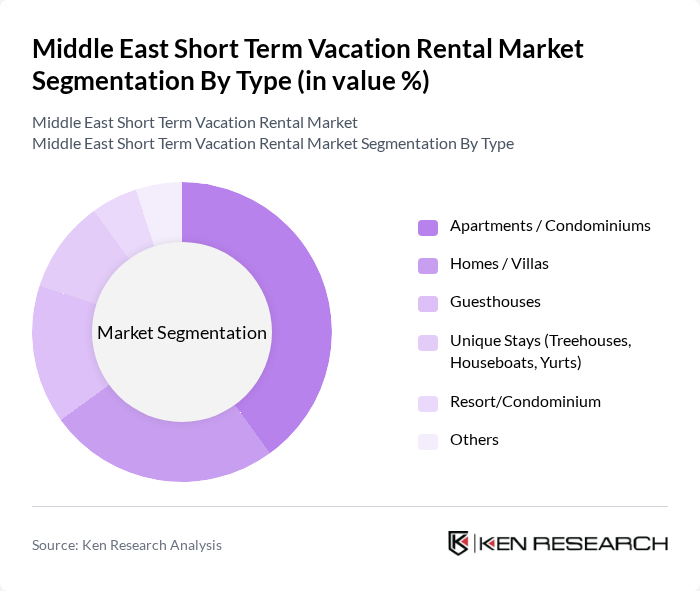
By Type:The market is segmented into various types of accommodations, including Apartments / Condominiums, Homes / Villas, Guesthouses, Unique Stays (Treehouses, Houseboats, Yurts), Resort/Condominium, and Others. Among these, Apartments / Condominiums are the most popular choice due to their affordability, convenience, and availability in prime locations. They cater to a wide range of travelers, from solo adventurers to families, making them a dominant segment in the market. Homes/Villas remain a key segment, especially for extended stays and group travel, while Unique Stays are gaining traction as travelers seek immersive and distinctive experiences .
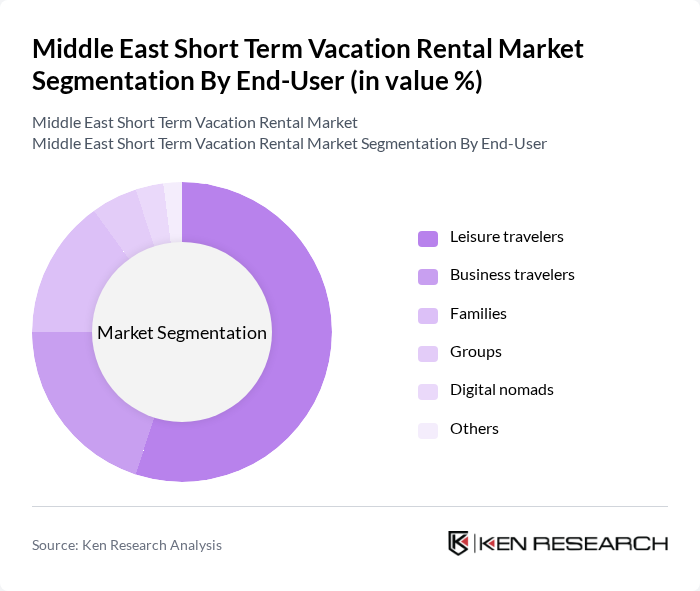
By End-User:The end-user segmentation includes Leisure travelers, Business travelers, Families, Groups, Digital nomads, and Others. Leisure travelers dominate the market, driven by the increasing trend of experiential travel and the desire for personalized accommodations. This segment's growth is fueled by the rise of social media, which encourages travelers to seek unique and memorable experiences. Business travelers and digital nomads are also emerging as important segments, with flexible work arrangements and remote work trends supporting longer stays and demand for fully equipped rentals .
Middle East Short Term Vacation Rental Market Competitive Landscape
The Middle East Short Term Vacation Rental Market is characterized by a dynamic mix of regional and international players. Leading participants such as Airbnb, Booking.com, Vrbo, HomeAway, OYO Rooms, Stella Stays, bnbme, Deluxe Holiday Homes, Kennedy Towers, Bayut, Dubizzle, Plum Guide, Sonder, Staycae, Driven Holiday Homes contribute to innovation, geographic expansion, and service delivery in this space.
Middle East Short Term Vacation Rental Market Industry Analysis
Growth Drivers
- Increasing Tourism and Travel Demand:The Middle East welcomed approximately 65 million international tourists in future, a significant increase from 50 million in 2022, according to the UNWTO. This surge is driven by major events like Expo 2020 in Dubai and the FIFA World Cup in Qatar, which have boosted travel interest. The region's diverse attractions, including historical sites and luxury resorts, are expected to further enhance tourism, leading to increased demand for short-term vacation rentals.
- Rise of Digital Platforms for Booking:The proliferation of digital booking platforms has transformed the vacation rental landscape in the Middle East. In future, online travel agencies (OTAs) accounted for approximately 70% of all vacation rental bookings, as reported by Statista. This shift towards digital solutions has made it easier for travelers to find and book accommodations, driving growth in the short-term rental market. Enhanced user experiences and competitive pricing on these platforms are key factors in this trend.
- Shift Towards Experiential Travel:A growing preference for experiential travel is reshaping the vacation rental market in the Middle East. According to a report by Airbnb, a majority of travelers now prioritize unique experiences over traditional sightseeing. This trend is particularly evident among millennials and Gen Z, who seek authentic local experiences. As a result, short-term rentals that offer cultural immersion and personalized services are increasingly in demand, driving market growth.
Market Challenges
- Regulatory Hurdles and Compliance Issues:The short-term vacation rental market in the Middle East faces significant regulatory challenges. In future, cities like Dubai and Abu Dhabi implemented stricter licensing requirements, with fines reaching up to $10,000 for non-compliance. These regulations aim to ensure safety and quality but can deter potential hosts from entering the market. Navigating these complex regulations remains a critical challenge for operators in the region.
- Intense Competition from Hotels and Traditional Lodging:The short-term rental market is experiencing fierce competition from established hotels and traditional lodging options. In future, hotel occupancy rates in major cities like Dubai reached approximately 75%, compared to 60% for vacation rentals, according to STR. This competition is intensified by hotels offering loyalty programs and bundled services, making it challenging for short-term rentals to attract guests. Operators must differentiate their offerings to remain competitive.
Middle East Short Term Vacation Rental Market Future Outlook
The future of the Middle East short-term vacation rental market appears promising, driven by ongoing tourism growth and evolving traveler preferences. As digital platforms continue to innovate, operators will likely leverage technology to enhance guest experiences. Additionally, the increasing focus on sustainability will push rental providers to adopt eco-friendly practices, appealing to a growing segment of environmentally conscious travelers. Overall, the market is poised for continued expansion, adapting to changing consumer demands and regulatory landscapes.
Market Opportunities
- Expansion into Underserved Regions:There is significant potential for growth in underserved areas of the Middle East, such as rural destinations and smaller cities. With a notable increase in domestic travel reported in future, operators can tap into this demand by offering unique accommodations that highlight local culture and attractions, thus diversifying their portfolios and increasing occupancy rates.
- Development of Luxury and Niche Offerings:The demand for luxury and niche vacation rentals is on the rise, with high-net-worth individuals seeking exclusive experiences. In future, luxury rentals have seen a significant increase in bookings, according to AirDNA. By developing high-end properties and specialized offerings, such as wellness retreats or adventure lodges, operators can cater to this affluent market segment and enhance profitability.
Scope of the Report
| Segment | Sub-Segments |
|---|---|
| By Type | Apartments / Condominiums Homes / Villas Guesthouses Unique Stays (Treehouses, Houseboats, Yurts) Resort/Condominium Others |
| By End-User | Leisure travelers Business travelers Families Groups Digital nomads Others |
| By Region | UAE Saudi Arabia Egypt Qatar South Africa Rest of Middle East & Africa |
| By Property Size | Studio apartments One-bedroom apartments Two-bedroom apartments Larger properties Others |
| By Booking Channel | Online travel agencies (OTAs) Direct bookings (host websites) Property management companies Offline channels Others |
| By Duration of Stay | Short-term (less than a week) Medium-term (1 week to 1 month) Long-term (more than 1 month) Others |
| By Amenities Offered | Wi-Fi Pool access Kitchen facilities Parking Pet-friendly Wellness facilities Others |
Key Target Audience
Investors and Venture Capitalist Firms
Government and Regulatory Bodies (e.g., Ministry of Tourism, Local Municipalities)
Real Estate Developers
Property Management Companies
Hospitality Industry Stakeholders
Tourism Boards
Online Travel Agencies (OTAs)
Insurance Providers
Players Mentioned in the Report:
Airbnb
Booking.com
Vrbo
HomeAway
OYO Rooms
Stella Stays
bnbme
Deluxe Holiday Homes
Kennedy Towers
Bayut
Dubizzle
Plum Guide
Sonder
Staycae
Driven Holiday Homes
Table of Contents
Market Assessment Phase
1. Executive Summary and Approach
2. Middle East Short Term Vacation Rental Market Overview
2.1 Key Insights and Strategic Recommendations
2.2 Middle East Short Term Vacation Rental Market Overview
2.3 Definition and Scope
2.4 Evolution of Market Ecosystem
2.5 Timeline of Key Regulatory Milestones
2.6 Value Chain & Stakeholder Mapping
2.7 Business Cycle Analysis
2.8 Policy & Incentive Landscape
3. Middle East Short Term Vacation Rental Market Analysis
3.1 Growth Drivers
3.1.1 Increasing tourism and travel demand
3.1.2 Rise of digital platforms for booking
3.1.3 Shift towards experiential travel
3.1.4 Growth in expatriate population
3.2 Market Challenges
3.2.1 Regulatory hurdles and compliance issues
3.2.2 Intense competition from hotels and traditional lodging
3.2.3 Fluctuating demand due to geopolitical factors
3.2.4 Seasonal variations in occupancy rates
3.3 Market Opportunities
3.3.1 Expansion into underserved regions
3.3.2 Development of luxury and niche offerings
3.3.3 Partnerships with local businesses for enhanced services
3.3.4 Adoption of sustainable practices to attract eco-conscious travelers
3.4 Market Trends
3.4.1 Increased use of technology in property management
3.4.2 Growth of remote work and long-term stays
3.4.3 Focus on health and safety protocols
3.4.4 Rise of personalized travel experiences
3.5 Government Regulation
3.5.1 Licensing requirements for short-term rentals
3.5.2 Taxation policies affecting rental income
3.5.3 Zoning laws impacting property usage
3.5.4 Safety and health regulations for rental properties
4. SWOT Analysis
5. Stakeholder Analysis
6. Porter's Five Forces Analysis
7. Middle East Short Term Vacation Rental Market Market Size, 2019-2024
7.1 By Value
7.2 By Volume
7.3 By Average Selling Price
8. Middle East Short Term Vacation Rental Market Segmentation
8.1 By Type
8.1.1 Apartments / Condominiums
8.1.2 Homes / Villas
8.1.3 Guesthouses
8.1.4 Unique Stays (Treehouses, Houseboats, Yurts)
8.1.5 Resort/Condominium
8.1.6 Others
8.2 By End-User
8.2.1 Leisure travelers
8.2.2 Business travelers
8.2.3 Families
8.2.4 Groups
8.2.5 Digital nomads
8.2.6 Others
8.3 By Region
8.3.1 UAE
8.3.2 Saudi Arabia
8.3.3 Egypt
8.3.4 Qatar
8.3.5 South Africa
8.3.6 Rest of Middle East & Africa
8.4 By Property Size
8.4.1 Studio apartments
8.4.2 One-bedroom apartments
8.4.3 Two-bedroom apartments
8.4.4 Larger properties
8.4.5 Others
8.5 By Booking Channel
8.5.1 Online travel agencies (OTAs)
8.5.2 Direct bookings (host websites)
8.5.3 Property management companies
8.5.4 Offline channels
8.5.5 Others
8.6 By Duration of Stay
8.6.1 Short-term (less than a week)
8.6.2 Medium-term (1 week to 1 month)
8.6.3 Long-term (more than 1 month)
8.6.4 Others
8.7 By Amenities Offered
8.7.1 Wi-Fi
8.7.2 Pool access
8.7.3 Kitchen facilities
8.7.4 Parking
8.7.5 Pet-friendly
8.7.6 Wellness facilities
8.7.7 Others
9. Middle East Short Term Vacation Rental Market Competitive Analysis
9.1 Market Share of Key Players
9.2 Cross Comparison of Key Players
9.2.1 Company Name
9.2.2 Group Size (Large, Medium, or Small as per industry convention)
9.2.3 Occupancy Rate (%)
9.2.4 Average Daily Rate (ADR, USD)
9.2.5 Revenue per Available Room (RevPAR, USD)
9.2.6 Customer Satisfaction Score (Net Promoter Score or equivalent)
9.2.7 Pricing Strategy (Dynamic, Fixed, Seasonal)
9.2.8 Market Penetration Rate (%)
9.2.9 Return on Investment (ROI, %)
9.2.10 Average Length of Stay (days)
9.2.11 Supply Growth Rate (%)
9.2.12 Distribution Channel Mix (%)
9.2.13 Cancellation Rate (%)
9.2.14 Geographic Coverage (Number of Cities/Countries)
9.3 SWOT Analysis of Top Players
9.4 Pricing Analysis
9.5 Detailed Profile of Major Companies
9.5.1 Airbnb
9.5.2 Booking.com
9.5.3 Vrbo
9.5.4 HomeAway
9.5.5 OYO Rooms
9.5.6 Stella Stays
9.5.7 bnbme
9.5.8 Deluxe Holiday Homes
9.5.9 Kennedy Towers
9.5.10 Bayut
9.5.11 Dubizzle
9.5.12 Plum Guide
9.5.13 Sonder
9.5.14 Staycae
9.5.15 Driven Holiday Homes
10. Middle East Short Term Vacation Rental Market End-User Analysis
10.1 Procurement Behavior of Key Ministries
10.1.1 Ministry of Tourism
10.1.2 Ministry of Housing
10.1.3 Ministry of Economic Development
10.1.4 Ministry of Interior
10.2 Corporate Spend on Infrastructure & Energy
10.2.1 Corporate travel budgets
10.2.2 Investment in short-term rental properties
10.2.3 Expenditure on marketing and promotions
10.2.4 Spending on technology and management systems
10.3 Pain Point Analysis by End-User Category
10.3.1 Difficulty in finding suitable properties
10.3.2 Concerns over safety and security
10.3.3 Issues with booking and cancellation policies
10.3.4 Lack of transparency in pricing
10.4 User Readiness for Adoption
10.4.1 Familiarity with online booking platforms
10.4.2 Acceptance of alternative accommodation types
10.4.3 Willingness to pay for premium services
10.4.4 Readiness to engage with property owners directly
10.5 Post-Deployment ROI and Use Case Expansion
10.5.1 Evaluation of rental performance metrics
10.5.2 Opportunities for upselling additional services
10.5.3 Expansion into new markets
10.5.4 Long-term partnerships with local businesses
11. Middle East Short Term Vacation Rental Market Future Size, 2025-2030
11.1 By Value
11.2 By Volume
11.3 By Average Selling Price
Go-To-Market Strategy Phase
1. Whitespace Analysis + Business Model Canvas
1.1 Market gaps and opportunities
1.2 Value proposition development
1.3 Revenue model exploration
1.4 Customer segmentation analysis
1.5 Competitive landscape overview
2. Marketing and Positioning Recommendations
2.1 Branding strategies
2.2 Product USPs
3. Distribution Plan
3.1 Urban retail vs rural NGO tie-ups
4. Channel & Pricing Gaps
4.1 Underserved routes
4.2 Pricing bands
5. Unmet Demand & Latent Needs
5.1 Category gaps
5.2 Consumer segments
6. Customer Relationship
6.1 Loyalty programs
6.2 After-sales service
7. Value Proposition
7.1 Sustainability
7.2 Integrated supply chains
8. Key Activities
8.1 Regulatory compliance
8.2 Branding
8.3 Distribution setup
9. Entry Strategy Evaluation
9.1 Domestic Market Entry Strategy
9.1.1 Product mix
9.1.2 Pricing band
9.1.3 Packaging
9.2 Export Entry Strategy
9.2.1 Target countries
9.2.2 Compliance roadmap
10. Entry Mode Assessment
10.1 JV
10.2 Greenfield
10.3 M&A
10.4 Distributor Model
11. Capital and Timeline Estimation
11.1 Capital requirements
11.2 Timelines
12. Control vs Risk Trade-Off
12.1 Ownership vs Partnerships
13. Profitability Outlook
13.1 Breakeven analysis
13.2 Long-term sustainability
14. Potential Partner List
14.1 Distributors
14.2 JVs
14.3 Acquisition targets
15. Execution Roadmap
15.1 Phased Plan for Market Entry
15.1.1 Market Setup
15.1.2 Market Entry
15.1.3 Growth Acceleration
15.1.4 Scale & Stabilize
15.2 Key Activities and Milestones
15.2.1 Activity timeline
15.2.2 Milestone tracking
Research Methodology
Phase 1: Approach1
Desk Research
- Analysis of tourism statistics from regional government tourism boards
- Review of market reports from real estate and hospitality research firms
- Examination of online platforms and booking data for short-term rentals
Primary Research
- Interviews with property owners and managers in key Middle Eastern cities
- Surveys with travelers to understand preferences and booking behaviors
- Focus groups with local tourism experts and real estate analysts
Validation & Triangulation
- Cross-validation of findings with data from industry associations and local chambers of commerce
- Triangulation of insights from primary interviews with secondary data trends
- Sanity checks through expert panel discussions and feedback sessions
Phase 2: Market Size Estimation1
Top-down Assessment
- Estimation of total tourism revenue and its allocation to short-term rentals
- Analysis of occupancy rates and average daily rates in major cities
- Incorporation of seasonal trends and events impacting rental demand
Bottom-up Modeling
- Collection of data on the number of active short-term rental listings
- Estimation of average rental income per property based on location
- Calculation of total market size by multiplying listings by average income
Forecasting & Scenario Analysis
- Multi-factor regression analysis incorporating economic indicators and travel trends
- Scenario modeling based on potential regulatory changes affecting short-term rentals
- Baseline, optimistic, and pessimistic forecasts through 2028
Phase 3: CATI Sample Composition1
| Scope Item/Segment | Sample Size | Target Respondent Profiles |
|---|---|---|
| Urban Short-Term Rentals | 75 | Property Owners, Rental Managers |
| Tourist Preferences | 60 | Travelers, Tour Operators |
| Regulatory Impact Assessment | 45 | Local Government Officials, Policy Makers |
| Market Trends Analysis | 50 | Real Estate Analysts, Market Researchers |
| Consumer Behavior Insights | 55 | Frequent Travelers, Vacation Rental Users |
Frequently Asked Questions
What is the current value of the Middle East Short Term Vacation Rental Market?
The Middle East Short Term Vacation Rental Market is valued at approximately USD 12 billion, driven by increasing tourism, domestic travel, and the popularity of alternative accommodations among travelers seeking unique experiences.
Which countries are the key players in the Middle East Short Term Vacation Rental Market?
What regulations govern short-term rentals in the UAE?
What types of accommodations are popular in the Middle East Short Term Vacation Rental Market?
Other Regional/Country Reports
Indonesia Short Term Vacation Rental Market
Malaysia Short Term Vacation Rental Market
KSA Short Term Vacation Rental Market
APAC Short Term Vacation Rental Market
SEA Short Term Vacation Rental Market
Other Adjacent Reports
Germany Hotel Accommodation Market
Philippines Online Travel Booking Market
Brazil Tourism Services Market
Kuwait Property Management Software Market Report Size Share Growth Drivers Trends Opportunities & Forecast 2025–2030Malaysia Real Estate Investment Market
Oman Vacation Ownership Market
Vietnam Hospitality Technology Market
Kuwait travel insurance market report size, share, growth drivers, trends, opportunities & forecast 2025–2030KSA Luxury Rental Market
Brazil Digital Nomad Accommodation Market
Why Buy From Us?

What makes us stand out is that our consultants follow Robust, Refine and Result (RRR) methodology. Robust for clear definitions, approaches and sanity checking, Refine for differentiating respondents' facts and opinions, and Result for presenting data with story.

We have set a benchmark in the industry by offering our clients with syndicated and customized market research reports featuring coverage of entire market as well as meticulous research and analyst insights.

While we don't replace traditional research, we flip the method upside down. Our dual approach of Top Bottom & Bottom Top ensures quality deliverable by not just verifying company fundamentals but also looking at the sector and macroeconomic factors.

With one step in the future, our research team constantly tries to show you the bigger picture. We help with some of the tough questions you may encounter along the way: How is the industry positioned? Best marketing channel? KPI's of competitors? By aligning every element, we help maximize success.

Our report gives you instant access to the answers and sources that other companies might choose to hide. We elaborate each steps of research methodology we have used and showcase you the sample size to earn your trust.

If you need any support, we are here! We pride ourselves on universe strength, data quality, and quick, friendly, and professional service.