Middle East Smart Air Conditioning Market Size Share Growth Drivers Trends Opportunities & Forecast 2025–2030

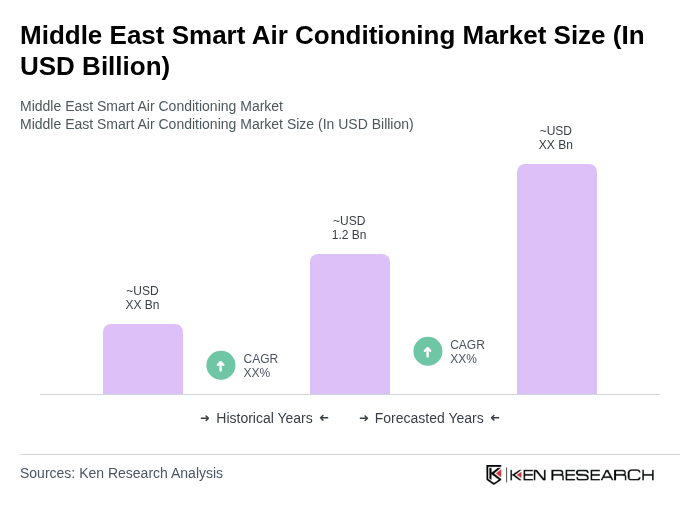
The Middle East smart air conditioning market, valued at USD 1.2 billion, is growing due to demand for IoT-integrated, energy-efficient systems amid extreme climates and urban development.

Region:Middle East

Author(s):Dev

Product Code:KRAB1886

Pages:93

Published On:January 2026
About the Report

Base Year 2024

Middle East Smart Air Conditioning Market Overview

  • The Middle East Smart Air Conditioning Market is valued at USD 1.2 billion, based on a five-year historical analysis of smart and connected air conditioning revenues in the broader Middle East and Africa region and their concentration in Gulf economies. This growth is primarily driven by increasing urbanization, rising temperatures, and a growing emphasis on energy efficiency and sustainability across major Gulf countries. The demand for smart air conditioning systems has surged as consumers and businesses seek advanced features such as remote control, energy management, IoT-based monitoring, and integration with smart home and smart building technologies.
  • Key country markets within the region include Saudi Arabia, the United Arab Emirates, and Qatar. Saudi Arabia and the UAE together account for a substantial share of total air conditioning system demand in the Middle East, supported by extreme climatic conditions, large-scale infrastructure and real estate projects, and rapid urban development. Qatar, along with other Gulf economies, is also investing in premium residential, commercial, and hospitality projects, which accelerates adoption of smart and connected AC solutions in both new-build and retrofit applications.
  • In the UAE, federal and emirate-level energy efficiency regulations mandate the use of high?efficiency air conditioning systems in new buildings and major renovations. The UAE building code (Part 6 – Energy Conservation) issued under the UAE Fire and Life Safety Code and related regulations by the Ministry of Energy and Infrastructure and local authorities require minimum energy performance and star?rated AC equipment, while Dubai’s Green Building Regulations and Specifications (Dubai Municipality, 2014, updated 2020) set mandatory efficiency, control, and commissioning requirements for HVAC systems in new constructions. These frameworks support the adoption of smart air conditioning technologies that comply with energy labeling schemes and building performance standards.
Middle East Smart Air Conditioning Market Size

Middle East Smart Air Conditioning Market Segmentation

By Product Type:The product type segmentation includes various categories of smart air conditioning systems. The dominant sub-segment is the Split Smart AC (Wall-Mounted), which is favored for its efficiency, relatively lower installation cost, and suitability for apartments, villas, and small commercial spaces, in line with the broader regional preference for ductless mini?split systems. Other notable sub-segments include Window Smart AC and VRF/VRV Smart Systems, which are gaining traction due to their advanced zoning, control capabilities, and energy-saving performance in mid- to large-scale commercial and mixed?use developments. The market is also witnessing a rise in demand for Smart AC Controllers & Retrofits as consumers and facility managers look to upgrade existing non?smart units with Wi?Fi modules, intelligent thermostats, and BMS-compatible controllers to improve comfort and reduce energy consumption without full system replacement.
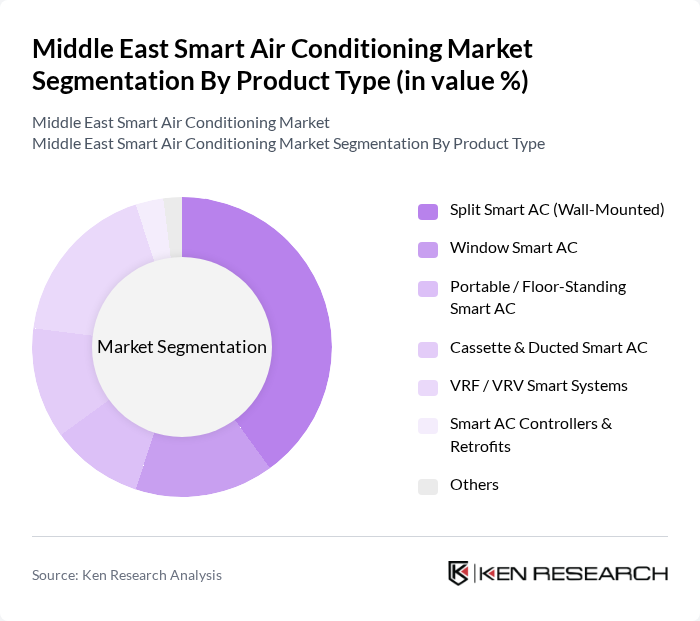
Middle East Smart Air Conditioning Market segmentation by Product Type.

By Connectivity & Control:The connectivity and control segmentation highlights the various technologies integrated into smart air conditioning systems. The leading sub-segment is Wi?Fi Enabled systems, which allow users to control their air conditioning remotely via smartphones and tablets and are increasingly embedded as standard in premium residential and light-commercial units. App-Controlled / Cloud-Connected systems are also gaining popularity, driven by the trend of smart home and smart building integration, enabling remote diagnostics, usage analytics, and energy optimization through IoT platforms. Voice-Assistant Integrated systems are emerging as a preferred choice among tech-savvy consumers, as compatibility with platforms such as Amazon Alexa and Google Assistant enhances user convenience and experience, while Building Management System (BMS)–integrated solutions are widely used in large commercial, hospitality, and institutional projects to centrally monitor and optimize HVAC performance.
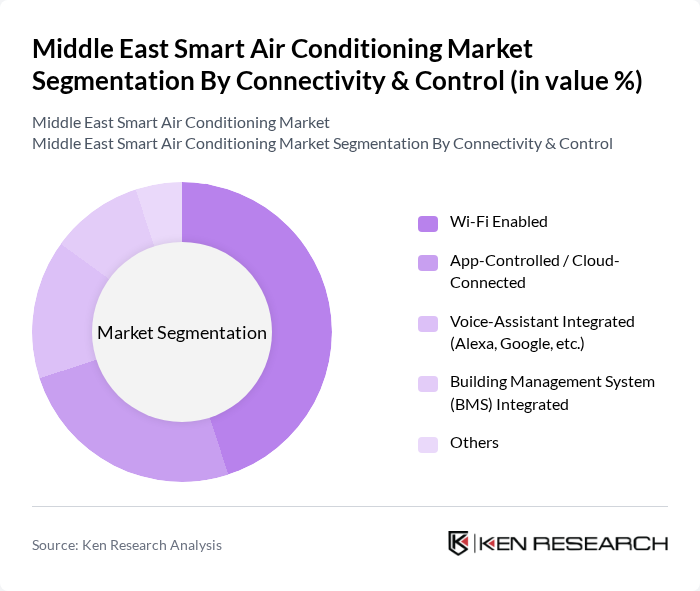
Middle East Smart Air Conditioning Market segmentation by Connectivity & Control.

Middle East Smart Air Conditioning Market Competitive Landscape

The Middle East Smart Air Conditioning Market is characterized by a dynamic mix of regional and international players. Leading participants such as Daikin Middle East & Africa FZE, LG Electronics Middle East & Africa, Mitsubishi Electric Corporation, Carrier Global Corporation, Trane Technologies plc, Samsung Electronics Co., Ltd., Honeywell International Inc., Panasonic Corporation, Gree Electric Appliances Inc. of Zhuhai, Fujitsu General Limited, Johnson Controls – York, Lennox International Inc., Bosch Thermotechnology (Robert Bosch GmbH), Electrolux AB, Midea Group Co., Ltd. contribute to innovation, geographic expansion, and service delivery in this space.

Daikin Middle East & Africa FZE

1924

Dubai, UAE

LG Electronics Middle East & Africa

1958

Dubai, UAE

Mitsubishi Electric Corporation

1921

Tokyo, Japan

Carrier Global Corporation

1915

Palm Beach Gardens, USA

Trane Technologies plc

1913

Dublin, Ireland

Company

Establishment Year

Headquarters

Regional Revenue (USD Million)

3-Year CAGR in Middle East Smart AC Revenue

EBITDA Margin (%) – Regional Operations

R&D Spend as % of Revenue (Smart & Connected Products)

Installed Base of Connected Units (000s)

Market Share in Smart AC Segment (%)

Middle East Smart Air Conditioning Market Industry Analysis

Growth Drivers

  • Increasing Demand for Energy-Efficient Solutions:The Middle East is experiencing a surge in energy-efficient air conditioning systems, driven by rising energy costs. In future, the region's energy consumption is projected to reach 1,300 terawatt-hours, with air conditioning accounting for approximately 60% of residential energy use. This demand is further fueled by the UAE's Energy Strategy 2050, which aims to reduce energy consumption by 40%, promoting smart technologies that enhance efficiency and reduce costs.
  • Rising Temperatures and Climate Change Impacts:The Middle East is witnessing an alarming increase in average temperatures, with projections indicating a rise to 50°C in some areas in future. This climate change effect is driving the need for advanced cooling solutions. The World Bank estimates that extreme heat could lead to a 25% increase in cooling demand, compelling consumers and businesses to invest in smart air conditioning systems that offer better climate control and energy savings.
  • Government Initiatives Promoting Smart Technologies:Governments across the Middle East are actively promoting smart technologies through various initiatives. For instance, Saudi Arabia's Vision 2030 emphasizes the adoption of smart solutions in urban planning. In future, the government is expected to allocate $2 billion towards smart city projects, which will include the integration of smart air conditioning systems, thereby enhancing energy efficiency and sustainability in urban environments.

Market Challenges

  • High Initial Investment Costs:One of the significant barriers to the adoption of smart air conditioning systems in the Middle East is the high initial investment required. The average cost of installing a smart air conditioning unit can exceed $3,500, which is substantially higher than traditional systems. This upfront cost deters many consumers, especially in a region where budget constraints are prevalent, limiting market penetration and growth potential.
  • Limited Consumer Awareness:Despite the benefits of smart air conditioning systems, consumer awareness remains low in the Middle East. A recent survey indicated that only 35% of consumers are familiar with smart air conditioning technologies. This lack of knowledge hampers market growth, as potential buyers are unaware of the energy savings and enhanced comfort these systems can provide, leading to slower adoption rates in the region.

Middle East Smart Air Conditioning Market Future Outlook

The future of the smart air conditioning market in the Middle East appears promising, driven by technological advancements and increasing environmental awareness. As urbanization accelerates, the demand for integrated smart home solutions will rise, leading to greater adoption of smart air conditioning systems. Additionally, the ongoing development of energy-efficient technologies and government incentives will further stimulate market growth, positioning the region as a leader in sustainable cooling solutions in future.

Market Opportunities

  • Integration of IoT and AI Technologies:The integration of Internet of Things (IoT) and artificial intelligence (AI) in air conditioning systems presents a significant opportunity. In future, the IoT market in the Middle East is expected to reach $10 billion, enabling smarter, more efficient air conditioning solutions that optimize energy use and enhance user experience through predictive maintenance and remote control capabilities.
  • Expansion into Untapped Rural Markets:There is a substantial opportunity for smart air conditioning systems in rural areas of the Middle East, where traditional systems dominate. With over 35% of the population living in rural regions, targeting these markets can lead to significant growth. In future, initiatives aimed at improving infrastructure and energy access in these areas could facilitate the introduction of smart technologies, enhancing overall market penetration.

Scope of the Report

SegmentSub-Segments
By Product Type

Split Smart AC (Wall-Mounted)

Window Smart AC

Portable / Floor-Standing Smart AC

Cassette & Ducted Smart AC

VRF / VRV Smart Systems

Smart AC Controllers & Retrofits

Others

By Connectivity & Control

Wi-Fi Enabled

App-Controlled / Cloud-Connected

Voice-Assistant Integrated (Alexa, Google, etc.)

Building Management System (BMS) Integrated

Others

By End-User

Residential

Commercial (Offices, Retail, Hospitality)

Industrial & Logistics Facilities

Government, Education & Healthcare

Others

By Technology Feature

Smart Thermostat & Temperature Control

Energy Management & Usage Analytics

AI / Machine-Learning Based Automation

Occupancy & Smart Sensors

Integrated Control (Multi-Zone / Whole-Building)

Others

By Application

New Construction

Retrofit & Replacement

By Sales Channel

Direct (Project / Key Accounts)

Retail & Dealer Networks

E-Commerce

System Integrators & ESCOs

Others

By Country

Saudi Arabia

United Arab Emirates

Qatar

Kuwait

Oman

Bahrain

Rest of Middle East

Key Target Audience

Investors and Venture Capitalist Firms

Government and Regulatory Bodies (e.g., Ministry of Climate Change and Environment, Saudi Energy Efficiency Center)

Manufacturers and Producers

Distributors and Retailers

Technology Providers

Industry Associations (e.g., Gulf Cooperation Council (GCC) HVAC Association)

Financial Institutions

Real Estate Developers

Players Mentioned in the Report:

Daikin Middle East & Africa FZE

LG Electronics Middle East & Africa

Mitsubishi Electric Corporation

Carrier Global Corporation

Trane Technologies plc

Samsung Electronics Co., Ltd.

Honeywell International Inc.

Panasonic Corporation

Gree Electric Appliances Inc. of Zhuhai

Fujitsu General Limited

Johnson Controls York

Lennox International Inc.

Bosch Thermotechnology (Robert Bosch GmbH)

Electrolux AB

Midea Group Co., Ltd.

Table of Contents

Market Assessment Phase

1. Executive Summary and Approach


2. Middle East Smart Air Conditioning Market Overview

2.1 Key Insights and Strategic Recommendations

2.2 Middle East Smart Air Conditioning Market Overview

2.3 Definition and Scope

2.4 Evolution of Market Ecosystem

2.5 Timeline of Key Regulatory Milestones

2.6 Value Chain & Stakeholder Mapping

2.7 Business Cycle Analysis

2.8 Policy & Incentive Landscape


3. Middle East Smart Air Conditioning Market Analysis

3.1 Growth Drivers

3.1.1 Increasing demand for energy-efficient solutions
3.1.2 Rising temperatures and climate change impacts
3.1.3 Government initiatives promoting smart technologies
3.1.4 Urbanization and infrastructure development

3.2 Market Challenges

3.2.1 High initial investment costs
3.2.2 Limited consumer awareness
3.2.3 Regulatory hurdles
3.2.4 Competition from traditional air conditioning systems

3.3 Market Opportunities

3.3.1 Integration of IoT and AI technologies
3.3.2 Expansion into untapped rural markets
3.3.3 Development of smart home ecosystems
3.3.4 Partnerships with tech companies for innovation

3.4 Market Trends

3.4.1 Increasing adoption of smart thermostats
3.4.2 Growth of mobile applications for control
3.4.3 Focus on sustainability and eco-friendly products
3.4.4 Shift towards subscription-based models

3.5 Government Regulation

3.5.1 Energy efficiency standards
3.5.2 Incentives for renewable energy integration
3.5.3 Regulations on refrigerants and emissions
3.5.4 Building codes promoting smart technologies

4. SWOT Analysis


5. Stakeholder Analysis


6. Porter's Five Forces Analysis


7. Middle East Smart Air Conditioning Market Market Size, 2019-2024

7.1 By Value

7.2 By Volume

7.3 By Average Selling Price


8. Middle East Smart Air Conditioning Market Segmentation

8.1 By Product Type

8.1.1 Split Smart AC (Wall-Mounted)
8.1.2 Window Smart AC
8.1.3 Portable / Floor-Standing Smart AC
8.1.4 Cassette & Ducted Smart AC
8.1.5 VRF / VRV Smart Systems
8.1.6 Smart AC Controllers & Retrofits
8.1.7 Others

8.2 By Connectivity & Control

8.2.1 Wi-Fi Enabled
8.2.2 App-Controlled / Cloud-Connected
8.2.3 Voice-Assistant Integrated (Alexa, Google, etc.)
8.2.4 Building Management System (BMS) Integrated
8.2.5 Others

8.3 By End-User

8.3.1 Residential
8.3.2 Commercial (Offices, Retail, Hospitality)
8.3.3 Industrial & Logistics Facilities
8.3.4 Government, Education & Healthcare
8.3.5 Others

8.4 By Technology Feature

8.4.1 Smart Thermostat & Temperature Control
8.4.2 Energy Management & Usage Analytics
8.4.3 AI / Machine-Learning Based Automation
8.4.4 Occupancy & Smart Sensors
8.4.5 Integrated Control (Multi-Zone / Whole-Building)
8.4.6 Others

8.5 By Application

8.5.1 New Construction
8.5.2 Retrofit & Replacement

8.6 By Sales Channel

8.6.1 Direct (Project / Key Accounts)
8.6.2 Retail & Dealer Networks
8.6.3 E-Commerce
8.6.4 System Integrators & ESCOs
8.6.5 Others

8.7 By Country

8.7.1 Saudi Arabia
8.7.2 United Arab Emirates
8.7.3 Qatar
8.7.4 Kuwait
8.7.5 Oman
8.7.6 Bahrain
8.7.7 Rest of Middle East

9. Middle East Smart Air Conditioning Market Competitive Analysis

9.1 Market Share of Key Players

9.2 Cross Comparison of Key Players

9.2.1 Company Name
9.2.2 Regional Revenue (USD Million)
9.2.3 3-Year CAGR in Middle East Smart AC Revenue
9.2.4 EBITDA Margin (%) – Regional Operations
9.2.5 R&D Spend as % of Revenue (Smart & Connected Products)
9.2.6 Installed Base of Connected Units (000s)
9.2.7 Market Share in Smart AC Segment (%)
9.2.8 Average Selling Price Positioning (Premium / Mid / Value)
9.2.9 Channel Mix (% Direct, Distributor, Online, Projects)
9.2.10 Customer Retention / Renewal Rate (%) for Service Contracts
9.2.11 Number of Countries Covered in the Middle East
9.2.12 After-Sales Network Coverage (Service Points / Technicians)

9.3 SWOT Analysis of Top Players

9.4 Pricing Analysis

9.5 Detailed Profile of Major Companies

9.5.1 Daikin Middle East & Africa FZE
9.5.2 LG Electronics Middle East & Africa
9.5.3 Mitsubishi Electric Corporation
9.5.4 Carrier Global Corporation
9.5.5 Trane Technologies plc
9.5.6 Samsung Electronics Co., Ltd.
9.5.7 Honeywell International Inc.
9.5.8 Panasonic Corporation
9.5.9 Gree Electric Appliances Inc. of Zhuhai
9.5.10 Fujitsu General Limited
9.5.11 Johnson Controls – York
9.5.12 Lennox International Inc.
9.5.13 Bosch Thermotechnology (Robert Bosch GmbH)
9.5.14 Electrolux AB
9.5.15 Midea Group Co., Ltd.

10. Middle East Smart Air Conditioning Market End-User Analysis

10.1 Procurement Behavior of Key Ministries

10.1.1 Government procurement policies
10.1.2 Budget allocation for smart technologies
10.1.3 Evaluation criteria for suppliers
10.1.4 Contracting processes

10.2 Corporate Spend on Infrastructure & Energy

10.2.1 Investment trends in smart air conditioning
10.2.2 Budgeting for energy efficiency projects
10.2.3 Corporate sustainability initiatives

10.3 Pain Point Analysis by End-User Category

10.3.1 Cost of installation and maintenance
10.3.2 Reliability and performance issues
10.3.3 Integration with existing systems
10.3.4 User training and support

10.4 User Readiness for Adoption

10.4.1 Awareness of smart technologies
10.4.2 Willingness to invest in smart solutions
10.4.3 Perceived benefits of smart air conditioning

10.5 Post-Deployment ROI and Use Case Expansion

10.5.1 Measurement of energy savings
10.5.2 User feedback and satisfaction
10.5.3 Opportunities for system upgrades

11. Middle East Smart Air Conditioning Market Future Size, 2025-2030

11.1 By Value

11.2 By Volume

11.3 By Average Selling Price


Go-To-Market Strategy Phase

1. Whitespace Analysis + Business Model Canvas

1.1 Market gaps and opportunities

1.2 Business model components


2. Marketing and Positioning Recommendations

2.1 Branding strategies

2.2 Product USPs


3. Distribution Plan

3.1 Urban retail vs rural NGO tie-ups


4. Channel & Pricing Gaps

4.1 Underserved routes

4.2 Pricing bands


5. Unmet Demand & Latent Needs

5.1 Category gaps

5.2 Consumer segments


6. Customer Relationship

6.1 Loyalty programs

6.2 After-sales service


7. Value Proposition

7.1 Sustainability

7.2 Integrated supply chains


8. Key Activities

8.1 Regulatory compliance

8.2 Branding

8.3 Distribution setup


9. Entry Strategy Evaluation

9.1 Domestic Market Entry Strategy

9.1.1 Product mix
9.1.2 Pricing band
9.1.3 Packaging

9.2 Export Entry Strategy

9.2.1 Target countries
9.2.2 Compliance roadmap

10. Entry Mode Assessment

10.1 JV, Greenfield, M&A, Distributor Model


11. Capital and Timeline Estimation

11.1 Capital requirements

11.2 Timelines


12. Control vs Risk Trade-Off

12.1 Ownership vs Partnerships


13. Profitability Outlook

13.1 Breakeven analysis

13.2 Long-term sustainability


14. Potential Partner List

14.1 Distributors

14.2 JVs

14.3 Acquisition targets


15. Execution Roadmap

15.1 Phased Plan for Market Entry

15.1.1 Market Setup
15.1.2 Market Entry
15.1.3 Growth Acceleration
15.1.4 Scale & Stabilize

15.2 Key Activities and Milestones

15.2.1 Milestone tracking
15.2.2 Activity scheduling

Research Methodology

ApproachModellingSample

Phase 1: Approach1

Desk Research

  • Market reports from industry associations and government publications on air conditioning trends in the Middle East
  • Analysis of import/export data and trade statistics from regional customs authorities
  • Review of academic journals and white papers focusing on energy efficiency and smart technologies in HVAC systems

Primary Research

  • Interviews with HVAC industry experts, including engineers and product managers from leading manufacturers
  • Surveys targeting end-users such as commercial property managers and residential homeowners
  • Focus groups with stakeholders in the construction and real estate sectors to understand demand drivers

Validation & Triangulation

  • Cross-validation of findings through multiple data sources, including sales data and market forecasts
  • Triangulation of insights from primary interviews with secondary data trends
  • Sanity checks conducted through expert panel reviews to ensure data reliability

Phase 2: Market Size Estimation1

Top-down Assessment

  • Estimation of market size based on national energy consumption statistics and HVAC penetration rates
  • Segmentation of the market by application areas such as residential, commercial, and industrial sectors
  • Incorporation of government initiatives promoting energy-efficient technologies in air conditioning

Bottom-up Modeling

  • Collection of sales data from key manufacturers and distributors in the smart air conditioning sector
  • Estimation of unit sales based on historical data and projected growth rates in the region
  • Cost analysis of smart air conditioning systems, including installation and maintenance expenses

Forecasting & Scenario Analysis

  • Multi-variable forecasting models incorporating economic indicators, climate change impacts, and urbanization trends
  • Scenario analysis based on varying levels of regulatory support and consumer adoption rates
  • Development of baseline, optimistic, and pessimistic market projections through 2030

Phase 3: CATI Sample Composition1

Scope Item/SegmentSample SizeTarget Respondent Profiles
Residential Smart Air Conditioning Users120Homeowners, Property Managers
Commercial HVAC Decision Makers100Facility Managers, Building Owners
Construction Industry Stakeholders80Architects, Project Managers
Energy Efficiency Advocates60Policy Makers, Environmental Consultants
Retail Sector HVAC Buyers90Procurement Officers, Store Managers

Frequently Asked Questions

What is the current value of the Middle East Smart Air Conditioning Market?

The Middle East Smart Air Conditioning Market is valued at approximately USD 1.2 billion, driven by urbanization, rising temperatures, and a focus on energy efficiency and sustainability in Gulf economies.

Which countries are leading in the Middle East Smart Air Conditioning Market?

What are the main drivers of growth in the Middle East Smart Air Conditioning Market?

What challenges does the Middle East Smart Air Conditioning Market face?

Other Regional/Country Reports

Indonesia Smart Air Conditioning Market

Malaysia Smart Air Conditioning Market

KSA Smart Air Conditioning Market

APAC Smart Air Conditioning Market

SEA Smart Air Conditioning Market

Vietnam Smart Air Conditioning Market

Why Buy From Us?

Refine Robust Result (RRR) Framework

What makes us stand out is that our consultants follow Robust, Refine and Result (RRR) methodology. Robust for clear definitions, approaches and sanity checking, Refine for differentiating respondents' facts and opinions, and Result for presenting data with story.

Our Reach Is Unmatched

We have set a benchmark in the industry by offering our clients with syndicated and customized market research reports featuring coverage of entire market as well as meticulous research and analyst insights.

Shifting the Research Paradigm

While we don't replace traditional research, we flip the method upside down. Our dual approach of Top Bottom & Bottom Top ensures quality deliverable by not just verifying company fundamentals but also looking at the sector and macroeconomic factors.

More Insights-Better Decisions

With one step in the future, our research team constantly tries to show you the bigger picture. We help with some of the tough questions you may encounter along the way: How is the industry positioned? Best marketing channel? KPI's of competitors? By aligning every element, we help maximize success.

Transparency and Trust

Our report gives you instant access to the answers and sources that other companies might choose to hide. We elaborate each steps of research methodology we have used and showcase you the sample size to earn your trust.

Round the Clock Support

If you need any support, we are here! We pride ourselves on universe strength, data quality, and quick, friendly, and professional service.

Why Clients Choose Us?

400000+
Reports in repository
150+
Consulting projects a year
100+
Analysts
8000+
Client Queries in 2022








