About the Report
Base Year 2024Middle East Steel Rebar Market Overview
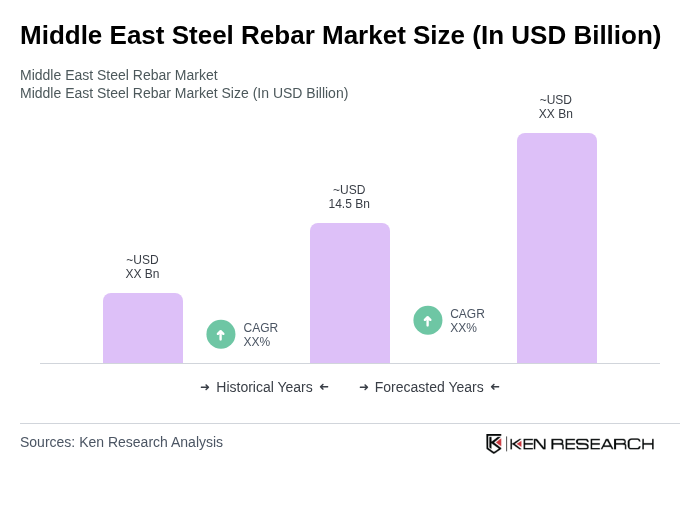
- The Middle East Steel Rebar Market is valued at USD 14.5 billion, based on a five-year historical analysis. This growth is primarily driven by the region's rapid urbanization, infrastructure development, and increasing investments in construction projects, in line with mega-programs such as Saudi Vision 2030 and the UAE’s ongoing real estate and infrastructure pipeline. The demand for steel rebar is significantly influenced by the booming construction sector, particularly in countries like Saudi Arabia and the UAE, where large-scale projects such as NEOM, Red Sea developments, metro expansions, and new housing initiatives are underway.
- Key players in this market include Saudi Arabia, the UAE, and Qatar, which dominate due to their substantial investments in infrastructure and construction. The GCC countries are experiencing a construction boom fueled by government initiatives and economic diversification efforts, making them pivotal in the steel rebar market. Additionally, the presence of major steel manufacturers such as Emirates Steel Arkan, Rajhi Steel, Watania Steel, Al-Rashed Steel, United Steel Industrial Co., and others in these regions further solidifies their market dominance through integrated production, regional distribution networks, and supply to flagship infrastructure and real-estate projects.
- In 2023, the Saudi government reinforced technical requirements for reinforcing steel through the Saudi Building Code and related standards, mandating the use of specified high-strength, certified reinforcing bars in structural applications. The Saudi Building Code SBC 304 “Concrete Structures Requirements”, issued by the Saudi Building Code National Committee under the Ministry of Municipal and Rural Affairs and Housing, sets binding requirements on design strengths, bar grades, mechanical properties, testing, and conformity assessment for reinforcing steel used in major construction projects. This framework aims to enhance the safety and durability of structures, ensure alignment with international codes such as ACI 318 and relevant ASTM standards, and is expected to support demand for advanced and value?added rebar products including higher?grade, corrosion?resistant, and earthquake?resistant steel rebar across the market.
Middle East Steel Rebar Market Segmentation
By Type:The market is segmented into various types of steel rebar, including Deformed Steel Rebar, Mild/Plain Steel Rebar, Carbon Steel Rebar, Epoxy-Coated Rebar, Stainless Steel Rebar, Galvanized Rebar, Corrosion-Resistant / Earthquake-Resistant Rebar, and Others (GFRP, Welded Wire Fabric, Expanded Metal). Each type serves different applications and is preferred based on specific project requirements, with value?added categories such as epoxy?coated, corrosion?resistant, and seismic?grade rebar gaining share in long?life infrastructure, marine structures, and high?performance buildings.
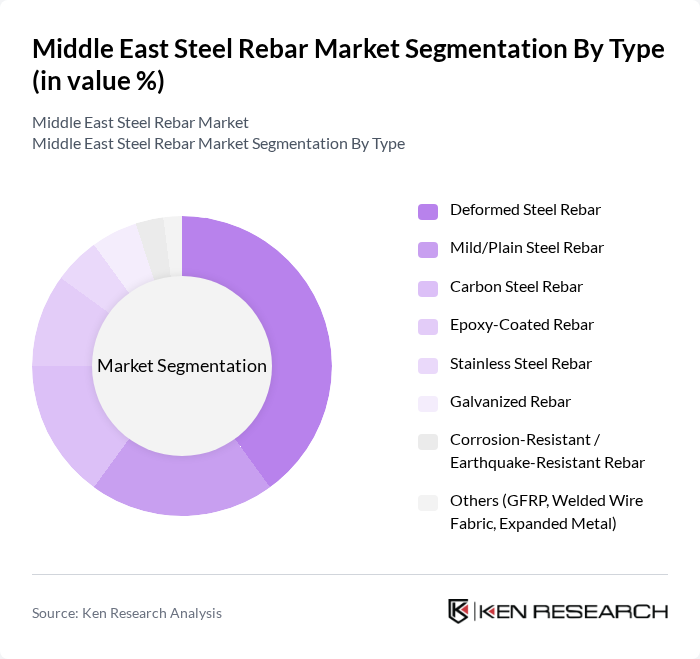
The Deformed Steel Rebar segment dominates the market due to its superior strength and performance characteristics, making it the preferred choice for construction projects requiring high tensile strength. This type of rebar is widely used in reinforced concrete structures, which are essential for high-rise buildings, bridges, industrial facilities, and transportation infrastructure projects across the region. The increasing focus on safety, service life, and structural resilience in construction practices, supported by stricter building codes and the adoption of higher grades such as Fe500 and Fe550, has further propelled the demand for deformed rebar, solidifying its position as the leading sub-segment in the market.
By End-User:The market is segmented by end-user applications, including Residential Buildings, Commercial & Institutional Buildings, Industrial & Manufacturing Facilities, Oil & Gas and Petrochemical Projects, Infrastructure Owners (Transport, Utilities), and Others. Each segment reflects the diverse applications of steel rebar in various construction and infrastructure projects, from high-density housing and mixed?use developments to roads, bridges, ports, power and water utilities, and industrial complexes across the Gulf and wider Middle East.
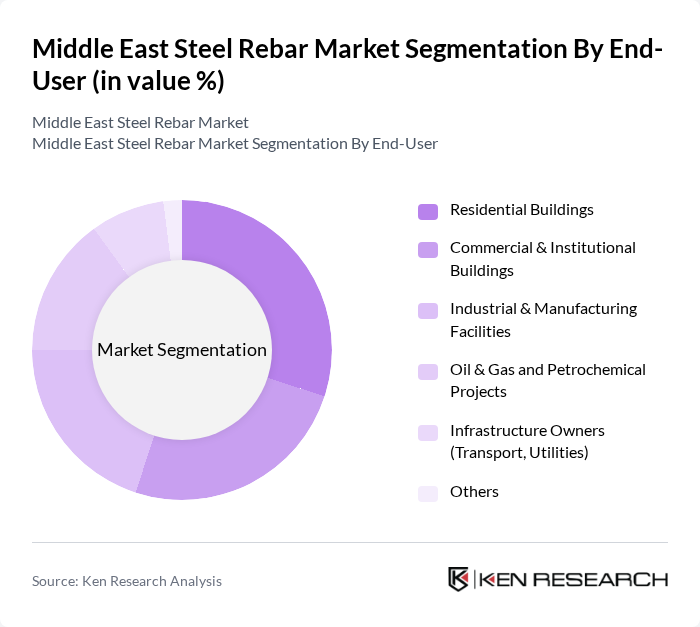
The Residential Buildings segment is the largest end-user category, driven by the increasing demand for housing in urban areas across the Middle East, supported by demographic growth and household formation in Gulf cities. Rapid population growth and urbanization have led to a surge in residential construction projects, including affordable housing, mid?income apartments, and large master?planned communities, making this segment a key driver of steel rebar consumption. Additionally, government initiatives aimed at promoting affordable and social housing, as well as mortgage and ownership programs in markets such as Saudi Arabia and the UAE, further bolster the demand for rebar in residential applications, establishing it as the leading end-user segment in the market.
Middle East Steel Rebar Market Competitive Landscape
The Middle East Steel Rebar Market is characterized by a dynamic mix of regional and international players. Leading participants such as Emirates Steel Arkan (UAE), Qatar Steel Company (Qatar), Union Iron and Steel Company (UAE), Saudi Iron & Steel Company – Hadeed (Saudi Arabia), Rajhi Steel Industries Co. (Saudi Arabia), Watania Steel Factory Corp. (Saudi Arabia), United Steel Industrial Company – KWT Steel (Kuwait), Hamriyah Steel FZC (UAE), Conares Metal Supply Ltd. (UAE), Emirates Rebar Limited (UAE), Star Steel International LLC (UAE), Ezz Steel (Egypt), Al Ghurair Iron & Steel LLC (UAE), Oman National Steel Co. LLC (Oman), Al Rashed Steel Products Co. (Saudi Arabia) contribute to innovation, geographic expansion, and service delivery in this space.
Middle East Steel Rebar Market Industry Analysis
Growth Drivers
- Increasing Infrastructure Development:The Middle East is witnessing a surge in infrastructure projects, with investments projected to reach $1 trillion in future. Major initiatives include the construction of roads, bridges, and airports, particularly in countries like Saudi Arabia and the UAE. This growth is driven by the need to support urban expansion and enhance connectivity, leading to a significant increase in demand for steel rebar, which is essential for structural integrity in these projects.
- Rising Urbanization:Urbanization in the Middle East is accelerating, with the urban population expected to grow from 83 million to 100 million in future. This rapid urban growth necessitates extensive housing and commercial developments, driving the demand for steel rebar. As cities expand, the need for durable construction materials becomes critical, positioning steel rebar as a vital component in meeting the housing and infrastructure demands of burgeoning urban centers.
- Government Investments in Construction:Governments in the Middle East are heavily investing in construction to diversify their economies away from oil dependency. For instance, Saudi Arabia's Vision 2030 aims to invest $500 billion in various sectors, including construction. This commitment translates into increased demand for steel rebar, as public projects such as schools, hospitals, and transportation networks require substantial quantities of this material to ensure structural stability and longevity.
Market Challenges
- Fluctuating Raw Material Prices:The steel rebar market faces challenges due to volatile raw material prices, particularly iron ore and scrap steel. In future, iron ore prices fluctuated between $90 and $140 per ton, impacting production costs for manufacturers. This volatility can lead to unpredictable pricing for end-users, making budgeting for construction projects more difficult and potentially stalling project timelines due to cost uncertainties.
- Regulatory Compliance Issues:Compliance with stringent regulations regarding quality and safety standards poses a significant challenge for steel rebar manufacturers. In future, the Middle East is expected to enforce stricter environmental regulations, requiring manufacturers to invest in cleaner production technologies. This compliance can increase operational costs, potentially leading to higher prices for consumers and affecting the overall competitiveness of the market.
Middle East Steel Rebar Market Future Outlook
The future of the Middle East steel rebar market appears promising, driven by ongoing infrastructure projects and urbanization trends. As governments continue to invest in construction, the demand for high-quality rebar is expected to rise. Additionally, the integration of smart technologies and eco-friendly practices in construction will likely shape the market landscape. Companies that adapt to these trends and invest in sustainable practices will be well-positioned to capitalize on emerging opportunities in the region.
Market Opportunities
- Expansion of Renewable Energy Projects:The Middle East is increasingly investing in renewable energy, with solar and wind projects projected to require substantial amounts of steel rebar for infrastructure. For instance, the UAE aims to generate 50% of its energy from renewable sources in future, creating a significant opportunity for rebar manufacturers to supply materials for these projects, thereby enhancing their market presence.
- Technological Advancements in Production:Innovations in steel production technology, such as automation and digitalization, present opportunities for efficiency improvements. By adopting advanced manufacturing techniques, companies can reduce production costs and improve product quality. This shift not only enhances competitiveness but also aligns with the growing demand for sustainable construction practices, positioning manufacturers favorably in the evolving market landscape.
Scope of the Report
| Segment | Sub-Segments |
|---|---|
| By Type | Deformed Steel Rebar Mild/Plain Steel Rebar Carbon Steel Rebar Epoxy-Coated Rebar Stainless Steel Rebar Galvanized Rebar Corrosion-Resistant / Earthquake-Resistant Rebar Others (GFRP, Welded Wire Fabric, Expanded Metal) |
| By End-User | Residential Buildings Commercial & Institutional Buildings Industrial & Manufacturing Facilities Oil & Gas and Petrochemical Projects Infrastructure Owners (Transport, Utilities) Others |
| By Region | GCC Countries (Saudi Arabia, UAE, Qatar, Kuwait, Oman, Bahrain) Levant (Jordan, Lebanon, Iraq, etc.) Iran Turkey Rest of Middle East |
| By Application | Building Construction (Residential & Commercial) Infrastructure (Roads, Bridges, Railways, Airports, Ports) Energy & Utilities (Power, Water, Desalination) Oil & Gas Facilities Others |
| By Manufacturing Process | Basic Oxygen Furnace (BOF) Electric Arc Furnace (EAF) Induction Furnace Others |
| By Distribution Channel | Direct Sales to End-Users and EPC Contractors Regional Distributors & Stockists Trading Houses & Service Centers Online & E-Procurement Platforms Others |
| By Pricing Strategy | Cost-Plus Pricing Linked to Scrap/Iron Ore Benchmarks Competitive / Market-Based Pricing Long-Term Contract Pricing (with Indexation/Formula) Value-Based Pricing for Premium Grades Others |
Key Target Audience
Investors and Venture Capitalist Firms
Government and Regulatory Bodies (e.g., Ministry of Industry and Advanced Technology, Ministry of Economy)
Manufacturers and Producers
Construction Companies and Contractors
Infrastructure Development Agencies
Steel Industry Associations
Logistics and Supply Chain Companies
Financial Institutions and Banks
Players Mentioned in the Report:
Emirates Steel Arkan (UAE)
Qatar Steel Company (Qatar)
Union Iron and Steel Company (UAE)
Saudi Iron & Steel Company Hadeed (Saudi Arabia)
Rajhi Steel Industries Co. (Saudi Arabia)
Watania Steel Factory Corp. (Saudi Arabia)
United Steel Industrial Company KWT Steel (Kuwait)
Hamriyah Steel FZC (UAE)
Conares Metal Supply Ltd. (UAE)
Emirates Rebar Limited (UAE)
Star Steel International LLC (UAE)
Ezz Steel (Egypt)
Al Ghurair Iron & Steel LLC (UAE)
Oman National Steel Co. LLC (Oman)
Al Rashed Steel Products Co. (Saudi Arabia)
Table of Contents
Market Assessment Phase
1. Executive Summary and Approach
2. Middle East Steel Rebar Market Overview
2.1 Key Insights and Strategic Recommendations
2.2 Middle East Steel Rebar Market Overview
2.3 Definition and Scope
2.4 Evolution of Market Ecosystem
2.5 Timeline of Key Regulatory Milestones
2.6 Value Chain & Stakeholder Mapping
2.7 Business Cycle Analysis
2.8 Policy & Incentive Landscape
3. Middle East Steel Rebar Market Analysis
3.1 Growth Drivers
3.1.1 Increasing Infrastructure Development
3.1.2 Rising Urbanization
3.1.3 Government Investments in Construction
3.1.4 Demand from the Oil and Gas Sector
3.2 Market Challenges
3.2.1 Fluctuating Raw Material Prices
3.2.2 Regulatory Compliance Issues
3.2.3 Competition from Alternative Materials
3.2.4 Economic Instability in the Region
3.3 Market Opportunities
3.3.1 Expansion of Renewable Energy Projects
3.3.2 Technological Advancements in Production
3.3.3 Increasing Demand for Sustainable Construction
3.3.4 Growth in Export Markets
3.4 Market Trends
3.4.1 Adoption of Smart Construction Technologies
3.4.2 Shift Towards Eco-Friendly Rebar Solutions
3.4.3 Increasing Use of High-Strength Rebar
3.4.4 Integration of Digital Solutions in Supply Chain
3.5 Government Regulation
3.5.1 Standards for Rebar Quality and Safety
3.5.2 Import Tariffs on Steel Products
3.5.3 Environmental Regulations for Production
3.5.4 Incentives for Local Manufacturing
4. SWOT Analysis
5. Stakeholder Analysis
6. Porter's Five Forces Analysis
7. Middle East Steel Rebar Market Market Size, 2019-2024
7.1 By Value
7.2 By Volume
7.3 By Average Selling Price
8. Middle East Steel Rebar Market Segmentation
8.1 By Type
8.1.1 Deformed Steel Rebar
8.1.2 Mild/Plain Steel Rebar
8.1.3 Carbon Steel Rebar
8.1.4 Epoxy-Coated Rebar
8.1.5 Stainless Steel Rebar
8.1.6 Galvanized Rebar
8.1.7 Corrosion-Resistant / Earthquake-Resistant Rebar
8.1.8 Others (GFRP, Welded Wire Fabric, Expanded Metal)
8.2 By End-User
8.2.1 Residential Buildings
8.2.2 Commercial & Institutional Buildings
8.2.3 Industrial & Manufacturing Facilities
8.2.4 Oil & Gas and Petrochemical Projects
8.2.5 Infrastructure Owners (Transport, Utilities)
8.2.6 Others
8.3 By Region
8.3.1 GCC Countries (Saudi Arabia, UAE, Qatar, Kuwait, Oman, Bahrain)
8.3.2 Levant (Jordan, Lebanon, Iraq, etc.)
8.3.3 Iran
8.3.4 Turkey
8.3.5 Rest of Middle East
8.4 By Application
8.4.1 Building Construction (Residential & Commercial)
8.4.2 Infrastructure (Roads, Bridges, Railways, Airports, Ports)
8.4.3 Energy & Utilities (Power, Water, Desalination)
8.4.4 Oil & Gas Facilities
8.4.5 Others
8.5 By Manufacturing Process
8.5.1 Basic Oxygen Furnace (BOF)
8.5.2 Electric Arc Furnace (EAF)
8.5.3 Induction Furnace
8.5.4 Others
8.6 By Distribution Channel
8.6.1 Direct Sales to End-Users and EPC Contractors
8.6.2 Regional Distributors & Stockists
8.6.3 Trading Houses & Service Centers
8.6.4 Online & E-Procurement Platforms
8.6.5 Others
8.7 By Pricing Strategy
8.7.1 Cost-Plus Pricing Linked to Scrap/Iron Ore Benchmarks
8.7.2 Competitive / Market-Based Pricing
8.7.3 Long-Term Contract Pricing (with Indexation/Formula)
8.7.4 Value-Based Pricing for Premium Grades
8.7.5 Others
9. Middle East Steel Rebar Market Competitive Analysis
9.1 Market Share of Key Players
9.2 Cross Comparison of Key Players
9.2.1 Company Name
9.2.2 Group Size (Large, Medium, or Small as per industry convention)
9.2.3 Regional Revenue from Steel Rebar (USD Million)
9.2.4 Steel Rebar Sales Volume in Middle East (kt/year)
9.2.5 Installed Rebar Production Capacity (kt/year)
9.2.6 Capacity Utilization Rate (%)
9.2.7 EBITDA Margin (%) for Steel Segment
9.2.8 Market Share in Key Countries (Saudi Arabia, UAE, Qatar, etc.)
9.2.9 Export Share in Total Rebar Sales (%)
9.2.10 Average Realization / ASP (USD per tonne)
9.2.11 Product Mix (Deformed vs Mild, Value-Added Grades) (%)
9.2.12 Backward Integration Level (Scrap, DRI, Billets)
9.2.13 Distribution Footprint (No. of Stockists / Service Centers)
9.2.14 Order Book Visibility / Contract Tenure (Months)
9.2.15 Capex Intensity & Ongoing Expansion Projects
9.3 SWOT Analysis of Top Players
9.4 Pricing Analysis
9.5 Detailed Profile of Major Companies
9.5.1 Emirates Steel Arkan (UAE)
9.5.2 Qatar Steel Company (Qatar)
9.5.3 Union Iron and Steel Company (UAE)
9.5.4 Saudi Iron & Steel Company – Hadeed (Saudi Arabia)
9.5.5 Rajhi Steel Industries Co. (Saudi Arabia)
9.5.6 Watania Steel Factory Corp. (Saudi Arabia)
9.5.7 United Steel Industrial Company – KWT Steel (Kuwait)
9.5.8 Hamriyah Steel FZC (UAE)
9.5.9 Conares Metal Supply Ltd. (UAE)
9.5.10 Emirates Rebar Limited (UAE)
9.5.11 Star Steel International LLC (UAE)
9.5.12 Ezz Steel (Egypt)
9.5.13 Al Ghurair Iron & Steel LLC (UAE)
9.5.14 Oman National Steel Co. LLC (Oman)
9.5.15 Al Rashed Steel Products Co. (Saudi Arabia)
10. Middle East Steel Rebar Market End-User Analysis
10.1 Procurement Behavior of Key Ministries
10.1.1 Ministry of Housing
10.1.2 Ministry of Transport
10.1.3 Ministry of Energy
10.1.4 Others
10.2 Corporate Spend on Infrastructure & Energy
10.2.1 Major Corporate Players
10.2.2 Investment Trends
10.2.3 Budget Allocations
10.2.4 Others
10.3 Pain Point Analysis by End-User Category
10.3.1 Construction Companies
10.3.2 Government Contractors
10.3.3 Private Developers
10.3.4 Others
10.4 User Readiness for Adoption
10.4.1 Awareness Levels
10.4.2 Training Needs
10.4.3 Technology Adoption Rates
10.4.4 Others
10.5 Post-Deployment ROI and Use Case Expansion
10.5.1 ROI Measurement Techniques
10.5.2 Case Studies
10.5.3 Future Use Cases
10.5.4 Others
11. Middle East Steel Rebar Market Future Size, 2025-2030
11.1 By Value
11.2 By Volume
11.3 By Average Selling Price
Go-To-Market Strategy Phase
1. Whitespace Analysis + Business Model Canvas
1.1 Market Gaps Identification
1.2 Business Model Framework
2. Marketing and Positioning Recommendations
2.1 Branding Strategies
2.2 Product USPs
3. Distribution Plan
3.1 Urban Retail vs Rural NGO Tie-Ups
4. Channel & Pricing Gaps
4.1 Underserved Routes
4.2 Pricing Bands
5. Unmet Demand & Latent Needs
5.1 Category Gaps
5.2 Consumer Segments
6. Customer Relationship
6.1 Loyalty Programs
6.2 After-Sales Service
7. Value Proposition
7.1 Sustainability
7.2 Integrated Supply Chains
8. Key Activities
8.1 Regulatory Compliance
8.2 Branding
8.3 Distribution Setup
9. Entry Strategy Evaluation
9.1 Domestic Market Entry Strategy
9.1.1 Product Mix
9.1.2 Pricing Band
9.1.3 Packaging
9.2 Export Entry Strategy
9.2.1 Target Countries
9.2.2 Compliance Roadmap
10. Entry Mode Assessment
10.1 JV
10.2 Greenfield
10.3 M&A
10.4 Distributor Model
11. Capital and Timeline Estimation
11.1 Capital Requirements
11.2 Timelines
12. Control vs Risk Trade-Off
12.1 Ownership vs Partnerships
13. Profitability Outlook
13.1 Breakeven Analysis
13.2 Long-Term Sustainability
14. Potential Partner List
14.1 Distributors
14.2 JVs
14.3 Acquisition Targets
15. Execution Roadmap
15.1 Phased Plan for Market Entry
15.1.1 Market Setup
15.1.2 Market Entry
15.1.3 Growth Acceleration
15.1.4 Scale & Stabilize
15.2 Key Activities and Milestones
15.2.1 Milestone Planning
15.2.2 Activity Tracking
Research Methodology
Phase 1: Approach1
Desk Research
- Analysis of industry reports from regional steel associations and trade bodies
- Review of government publications and economic reports related to construction and infrastructure
- Examination of market trends through academic journals and publications focused on the Middle East steel industry
Primary Research
- Interviews with key stakeholders including manufacturers, distributors, and construction firms
- Surveys targeting procurement managers and project engineers in the construction sector
- Field visits to steel production facilities and construction sites to gather firsthand insights
Validation & Triangulation
- Cross-validation of data through multiple sources including trade statistics and expert opinions
- Triangulation of findings from primary interviews with secondary data sources
- Sanity checks conducted through expert panel discussions to ensure data reliability
Phase 2: Market Size Estimation1
Top-down Assessment
- Estimation of total market size based on national construction expenditure and steel consumption rates
- Segmentation of the market by end-use applications such as residential, commercial, and infrastructure projects
- Incorporation of regional growth forecasts and government infrastructure initiatives
Bottom-up Modeling
- Collection of production data from major steel rebar manufacturers in the Middle East
- Analysis of sales volumes and pricing strategies across different market segments
- Estimation of market share based on production capacity and distribution networks
Forecasting & Scenario Analysis
- Development of forecasting models using historical data and projected growth rates in construction
- Scenario analysis based on potential economic fluctuations and regulatory changes impacting the steel industry
- Creation of multiple market scenarios including best-case, worst-case, and most likely outcomes through 2030
Phase 3: CATI Sample Composition1
| Scope Item/Segment | Sample Size | Target Respondent Profiles |
|---|---|---|
| Construction Sector Demand | 120 | Project Managers, Site Engineers |
| Manufacturing Insights | 110 | Production Managers, Quality Control Officers |
| Distribution Channel Analysis | 80 | Logistics Coordinators, Sales Directors |
| Regulatory Impact Assessment | 60 | Policy Makers, Industry Analysts |
| Market Trends and Innovations | 70 | Research & Development Managers, Market Strategists |
Frequently Asked Questions
What is the current value of the Middle East Steel Rebar Market?
The Middle East Steel Rebar Market is valued at approximately USD 14.5 billion, driven by rapid urbanization, infrastructure development, and significant investments in construction projects across the region, particularly in Saudi Arabia and the UAE.
What factors are driving the growth of the Middle East Steel Rebar Market?
Which countries are the major players in the Middle East Steel Rebar Market?
What types of steel rebar are available in the Middle East market?
Other Regional/Country Reports
Other Adjacent Reports
Egypt Steel Billets Market
Indonesia Scrap Metal Market
Singapore Cement Market
Brazil Concrete Admixtures Market
Malaysia Construction Equipment Market
South Korea Real Estate Development Market
KSA Infrastructure Construction Market
Germany Oil and Gas Infrastructure Market
Japan Renewable Energy Infrastructure Market
Kuwait Transportation Infrastructure Market
Why Buy From Us?

What makes us stand out is that our consultants follow Robust, Refine and Result (RRR) methodology. Robust for clear definitions, approaches and sanity checking, Refine for differentiating respondents' facts and opinions, and Result for presenting data with story.

We have set a benchmark in the industry by offering our clients with syndicated and customized market research reports featuring coverage of entire market as well as meticulous research and analyst insights.

While we don't replace traditional research, we flip the method upside down. Our dual approach of Top Bottom & Bottom Top ensures quality deliverable by not just verifying company fundamentals but also looking at the sector and macroeconomic factors.

With one step in the future, our research team constantly tries to show you the bigger picture. We help with some of the tough questions you may encounter along the way: How is the industry positioned? Best marketing channel? KPI's of competitors? By aligning every element, we help maximize success.

Our report gives you instant access to the answers and sources that other companies might choose to hide. We elaborate each steps of research methodology we have used and showcase you the sample size to earn your trust.

If you need any support, we are here! We pride ourselves on universe strength, data quality, and quick, friendly, and professional service.