Ken Research Logo

Middle East Stereotactic Surgery Devices Market Size, Share, Growth Drivers, Trends, Opportunities & Forecast 2025–2030

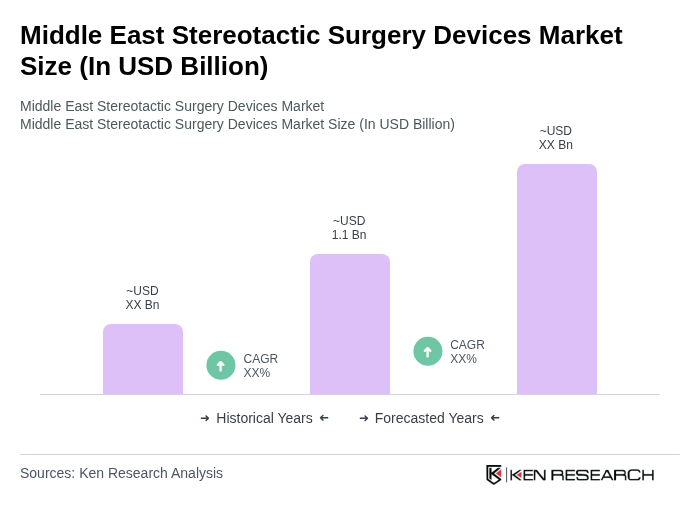
Middle East Stereotactic Surgery Devices Market, valued at USD 1.1 Bn, grows with robotic systems and image-guided tech in GCC countries like Saudi Arabia and UAE.

Region:Middle East

Author(s):Shubham

Product Code:KRAD5524

Pages:86

Published On:December 2025
About the Report

Base Year 2024

Middle East Stereotactic Surgery Devices Market Overview

  • The Middle East Stereotactic Surgery Devices Market is valued at USD 1.1 billion, based on a five-year historical analysis, aligning with the share of Middle East and Africa in the global stereotactic surgery devices market reported by major industry studies. This growth is primarily driven by advancements in medical technology, including robotic-assisted and image-guided stereotactic systems, the increasing prevalence of neurological disorders such as brain tumors, Parkinson’s disease and epilepsy, and the rising demand for minimally invasive surgical procedures. The market is also supported by the growing number of healthcare facilities adopting advanced surgical technologies, particularly in oncology and functional neurosurgery centers across key Gulf Cooperation Council (GCC) countries.
  • Key players in this market include Saudi Arabia and the United Arab Emirates, which dominate due to their well-established healthcare infrastructure, significant investments in medical technology, and a high rate of adoption of innovative surgical techniques. These countries are also home to leading hospitals and research institutions that contribute to the growth of the market, such as King Faisal Specialist Hospital & Research Centre in Saudi Arabia and Cleveland Clinic Abu Dhabi and Sheikh Shakhbout Medical City in the United Arab Emirates, where advanced stereotactic radiosurgery and image-guided neurosurgery platforms are increasingly deployed.
  • In the Kingdom of Saudi Arabia, the Government’s healthcare funding framework under the annual state budget has earmarked substantial allocations for health and social development, with around USD 36.8 billion directed to this sector in one recent budget cycle, reflecting a strong policy focus on upgrading hospital infrastructure and high?end medical equipment, including stereotactic and radiosurgery systems, to improve patient outcomes and reduce recovery times. Within this context, national initiatives under the Health Sector Transformation Program of Saudi Vision 2030 are driving capital investment in advanced surgical devices and digital technologies across tertiary care and specialist centers.
Middle East Stereotactic Surgery Devices Market Size

Middle East Stereotactic Surgery Devices Market Segmentation

By Type:The market is segmented into various types of stereotactic surgery devices, including frame-based stereotactic systems, frameless stereotactic systems, robotic stereotactic systems, stereotactic navigation and planning software, and stereotactic radiosurgery platforms. This typology is consistent with leading global market studies that group systems into hardware platforms, software and radiosurgical delivery equipment. Among these, robotic stereotactic systems and image-guided platforms are gaining traction due to their precision, ability to enhance surgical outcomes, and support for complex cranial and spinal procedures. The demand for frameless stereotactic and navigation-based systems is also increasing as they offer greater flexibility and comfort for patients, enable repeat imaging, and integrate more easily with intraoperative imaging and radiotherapy workflows in modern neurosurgical suites.

Middle East Stereotactic Surgery Devices Market segmentation by Type.

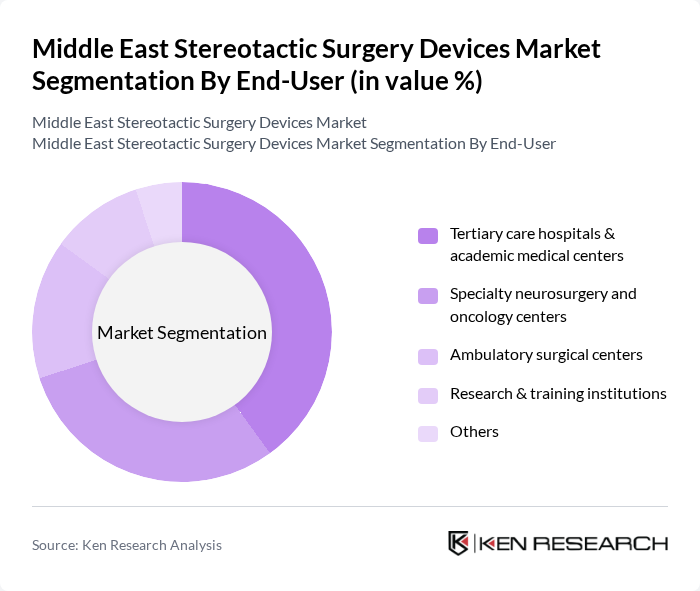
By End-User:The end-user segment includes tertiary care hospitals and academic medical centers, specialty neurosurgery and oncology centers, ambulatory surgical centers, research and training institutions, and others. This structure reflects the global deployment pattern of stereotactic systems, which are most commonly installed in large multispecialty hospitals, cancer centers and university hospitals due to the capital intensity and complexity of these technologies. Tertiary care hospitals are the leading end-users due to their advanced facilities, availability of hybrid operating rooms, integrated imaging, and specialized staff capable of performing complex stereotactic procedures in neurosurgery and radiosurgery. The increasing number of specialty centers focused on oncology, radiosurgery and movement disorder clinics in GCC countries is also contributing to market growth, as these institutions prioritize precision treatments and adopt high-end stereotactic platforms and planning software.
Middle East Stereotactic Surgery Devices Market segmentation by End-User.

Middle East Stereotactic Surgery Devices Market Competitive Landscape

The Middle East Stereotactic Surgery Devices Market is characterized by a dynamic mix of regional and international players. Leading participants such as Medtronic plc, Elekta AB, Varian Medical Systems, Inc. (Siemens Healthineers company), Brainlab AG, Accuray Incorporated, Siemens Healthineers AG, GE Healthcare Technologies Inc., Philips Healthcare (Koninklijke Philips N.V.), Canon Medical Systems Corporation, Hitachi Healthcare (Hitachi, Ltd.), Stryker Corporation, Monteris Medical Inc., Inomed Medizintechnik GmbH, Micromar Indústria e Comércio Ltda., Mizuho Medical Co., Ltd. contribute to innovation, geographic expansion, and service delivery in this space.

Medtronic plc

1949

Dublin, Ireland

Elekta AB

1972

Stockholm, Sweden

Varian Medical Systems, Inc.

1948

Palo Alto, California, USA

Brainlab AG

1989

Munich, Germany

Accuray Incorporated

1990

Sunnyvale, California, USA

Company

Establishment Year

Headquarters

Regional installed base (number of stereotactic systems in Middle East)

Middle East revenue and 3-year CAGR from stereotactic surgery devices

Product portfolio breadth (frame-based, frameless, radiosurgery, software, robotics)

Share of revenue from advanced technologies (robotic / image-guided / AI-enabled)

Average deal size and capital intensity per installation

Service and maintenance revenue share

Middle East Stereotactic Surgery Devices Market Industry Analysis

Growth Drivers

  • Increasing Prevalence of Neurological Disorders:The Middle East has witnessed a significant rise in neurological disorders, with an estimated 6 to 7 million cases of epilepsy and 1.2 million cases of Parkinson's disease reported in future. This growing patient population is driving the demand for advanced surgical interventions, including stereotactic surgery. The World Health Organization (WHO) projects that the prevalence of neurological disorders will continue to rise, necessitating innovative treatment options and increasing the market for stereotactic surgery devices.
  • Advancements in Surgical Technology:The Middle East is experiencing rapid advancements in surgical technology, with investments exceeding $1 billion in medical technology in future. Innovations such as enhanced imaging techniques and robotic-assisted surgery are improving the precision and outcomes of stereotactic procedures. These technological advancements are expected to enhance the efficiency of surgeries, thereby increasing the adoption of stereotactic surgery devices across the region's healthcare facilities.
  • Rising Demand for Minimally Invasive Procedures:The demand for minimally invasive surgical procedures is on the rise, with a reported 30% increase in such surgeries in the Middle East in future. Patients are increasingly opting for procedures that offer shorter recovery times and reduced hospital stays. This trend is propelling the growth of the stereotactic surgery devices market, as these devices are integral to performing minimally invasive surgeries effectively and safely.

Market Challenges

  • High Cost of Stereotactic Surgery Devices:The high cost associated with stereotactic surgery devices poses a significant challenge, with prices ranging from $100,000 to $500,000 per unit. This financial barrier limits accessibility for many healthcare facilities, particularly in developing regions of the Middle East. As a result, the adoption of these advanced devices is hindered, impacting the overall growth of the market.
  • Limited Awareness Among Healthcare Professionals:There is a notable lack of awareness and training regarding stereotactic surgery among healthcare professionals in the Middle East. A survey conducted in future indicated that only 40% of neurosurgeons are familiar with the latest stereotactic techniques. This knowledge gap restricts the effective implementation of these devices, ultimately affecting patient outcomes and market growth.

Middle East Stereotactic Surgery Devices Market Future Outlook

The future of the Middle East stereotactic surgery devices market appears promising, driven by ongoing technological advancements and increasing healthcare investments. As healthcare infrastructure expands, particularly in countries like Saudi Arabia and the UAE, the adoption of innovative surgical technologies is expected to rise. Furthermore, the integration of artificial intelligence and telemedicine into surgical practices will likely enhance the precision and accessibility of stereotactic procedures, fostering market growth in the coming years.

Market Opportunities

  • Expansion of Healthcare Infrastructure:The Middle East is investing heavily in healthcare infrastructure, with over $20 billion allocated for new hospitals and clinics in future. This expansion will create opportunities for the adoption of advanced stereotactic surgery devices, improving access to cutting-edge treatments for neurological disorders.
  • Increasing Investment in Research and Development:With R&D spending projected to reach $1.5 billion in future, the Middle East is poised to foster innovation in medical technologies. This investment will likely lead to the development of next-generation stereotactic devices, enhancing their effectiveness and driving market growth.

Scope of the Report

SegmentSub-Segments
By Type

Frame-based stereotactic systems

Frameless stereotactic systems

Robotic stereotactic systems

Stereotactic navigation & planning software

Stereotactic radiosurgery platforms (Gamma Knife, LINAC-based, CyberKnife, proton)

By End-User

Tertiary care hospitals & academic medical centers

Specialty neurosurgery and oncology centers

Ambulatory surgical centers

Research & training institutions

Others

By Application

Functional neurosurgery (Parkinson’s, movement disorders, epilepsy)

Intracranial tumors & brain metastases

Spine & orthopedic stereotactic procedures

Stereotactic body radiotherapy (SBRT) for extracranial tumors

Pain management & psychosurgery

Others

By Technology

Gamma Knife radiosurgery systems

LINAC-based stereotactic radiosurgery (SRS/SBRT)

Robotic radiosurgery systems (e.g., CyberKnife)

Image-guided stereotactic navigation (CT, MRI, PET, cone-beam CT)

Hybrid & multimodality platforms

Others

By Region

GCC Countries (Saudi Arabia, United Arab Emirates, Qatar, Kuwait, Oman, Bahrain)

Levant Region (Jordan, Lebanon, Iraq, others)

North Africa (Egypt, Morocco, Algeria, others)

Rest of Middle East & Africa

By Distribution Channel

Direct sales to healthcare providers

Regional distributors & agents

Group purchasing organizations (GPOs) and tenders

Others

By Pricing Model

Capital equipment sales

Lease and pay-per-use models

Service & maintenance contracts

Bundled pricing (systems, software, and upgrades)

Others

Key Target Audience

Investors and Venture Capitalist Firms

Government and Regulatory Bodies (e.g., Ministry of Health, Food and Drug Administration of

Manufacturers and Producers

Distributors and Retailers

Healthcare Providers and Hospitals

Medical Device Regulatory Authorities (e.g., Saudi Food and Drug Authority, UAE Ministry of Health and Prevention)

Industry Associations and Societies (e.g., Middle East Society of Stereotactic Surgery)

Financial Institutions and Investment Banks

Players Mentioned in the Report:

Medtronic plc

Elekta AB

Varian Medical Systems, Inc. (Siemens Healthineers company)

Brainlab AG

Accuray Incorporated

Siemens Healthineers AG

GE Healthcare Technologies Inc.

Philips Healthcare (Koninklijke Philips N.V.)

Canon Medical Systems Corporation

Hitachi Healthcare (Hitachi, Ltd.)

Stryker Corporation

Monteris Medical Inc.

Inomed Medizintechnik GmbH

Micromar Industria e Comercio Ltda.

Mizuho Medical Co., Ltd.

Table of Contents

Market Assessment Phase

1. Executive Summary and Approach


2. Middle East Stereotactic Surgery Devices Market Overview

2.1 Key Insights and Strategic Recommendations

2.2 Middle East Stereotactic Surgery Devices Market Overview

2.3 Definition and Scope

2.4 Evolution of Market Ecosystem

2.5 Timeline of Key Regulatory Milestones

2.6 Value Chain & Stakeholder Mapping

2.7 Business Cycle Analysis

2.8 Policy & Incentive Landscape


3. Middle East Stereotactic Surgery Devices Market Analysis

3.1 Growth Drivers

3.1.1 Increasing prevalence of neurological disorders
3.1.2 Advancements in surgical technology
3.1.3 Rising demand for minimally invasive procedures
3.1.4 Growing healthcare expenditure in the region

3.2 Market Challenges

3.2.1 High cost of stereotactic surgery devices
3.2.2 Limited awareness among healthcare professionals
3.2.3 Stringent regulatory requirements
3.2.4 Shortage of skilled professionals

3.3 Market Opportunities

3.3.1 Expansion of healthcare infrastructure
3.3.2 Increasing investment in research and development
3.3.3 Collaborations with technology firms
3.3.4 Rising demand for personalized medicine

3.4 Market Trends

3.4.1 Integration of AI in surgical procedures
3.4.2 Growth of telemedicine and remote surgeries
3.4.3 Increasing focus on patient-centric care
3.4.4 Adoption of robotic-assisted surgery

3.5 Government Regulation

3.5.1 Regulatory approvals for new devices
3.5.2 Compliance with international standards
3.5.3 Guidelines for training and certification
3.5.4 Policies promoting healthcare innovation

4. SWOT Analysis


5. Stakeholder Analysis


6. Porter's Five Forces Analysis


7. Middle East Stereotactic Surgery Devices Market Market Size, 2019-2024

7.1 By Value

7.2 By Volume

7.3 By Average Selling Price


8. Middle East Stereotactic Surgery Devices Market Segmentation

8.1 By Type

8.1.1 Frame-based stereotactic systems
8.1.2 Frameless stereotactic systems
8.1.3 Robotic stereotactic systems
8.1.4 Stereotactic navigation & planning software
8.1.5 Stereotactic radiosurgery platforms (Gamma Knife, LINAC-based, CyberKnife, proton)

8.2 By End-User

8.2.1 Tertiary care hospitals & academic medical centers
8.2.2 Specialty neurosurgery and oncology centers
8.2.3 Ambulatory surgical centers
8.2.4 Research & training institutions
8.2.5 Others

8.3 By Application

8.3.1 Functional neurosurgery (Parkinson’s, movement disorders, epilepsy)
8.3.2 Intracranial tumors & brain metastases
8.3.3 Spine & orthopedic stereotactic procedures
8.3.4 Stereotactic body radiotherapy (SBRT) for extracranial tumors
8.3.5 Pain management & psychosurgery
8.3.6 Others

8.4 By Technology

8.4.1 Gamma Knife radiosurgery systems
8.4.2 LINAC-based stereotactic radiosurgery (SRS/SBRT)
8.4.3 Robotic radiosurgery systems (e.g., CyberKnife)
8.4.4 Image-guided stereotactic navigation (CT, MRI, PET, cone-beam CT)
8.4.5 Hybrid & multimodality platforms
8.4.6 Others

8.5 By Region

8.5.1 GCC Countries (Saudi Arabia, United Arab Emirates, Qatar, Kuwait, Oman, Bahrain)
8.5.2 Levant Region (Jordan, Lebanon, Iraq, others)
8.5.3 North Africa (Egypt, Morocco, Algeria, others)
8.5.4 Rest of Middle East & Africa

8.6 By Distribution Channel

8.6.1 Direct sales to healthcare providers
8.6.2 Regional distributors & agents
8.6.3 Group purchasing organizations (GPOs) and tenders
8.6.4 Others

8.7 By Pricing Model

8.7.1 Capital equipment sales
8.7.2 Lease and pay-per-use models
8.7.3 Service & maintenance contracts
8.7.4 Bundled pricing (systems, software, and upgrades)
8.7.5 Others

9. Middle East Stereotactic Surgery Devices Market Competitive Analysis

9.1 Market Share of Key Players

9.2 Cross Comparison of Key Players

9.2.1 Company name
9.2.2 Regional installed base (number of stereotactic systems in Middle East)
9.2.3 Middle East revenue and 3-year CAGR from stereotactic surgery devices
9.2.4 Product portfolio breadth (frame-based, frameless, radiosurgery, software, robotics)
9.2.5 Share of revenue from advanced technologies (robotic / image-guided / AI-enabled)
9.2.6 Average deal size and capital intensity per installation
9.2.7 Service and maintenance revenue share
9.2.8 Average utilization rate (procedures per system per year)
9.2.9 Clinical partnerships and reference centers in the Middle East
9.2.10 Regulatory approvals and clearances across key Middle East markets
9.2.11 Distribution and channel strength (direct vs distributor coverage)
9.2.12 R&D intensity (R&D as % of revenue in neurosurgery/radiosurgery segment)

9.3 SWOT Analysis of Top Players

9.4 Pricing Analysis

9.5 Detailed Profile of Major Companies

9.5.1 Medtronic plc
9.5.2 Elekta AB
9.5.3 Varian Medical Systems, Inc. (Siemens Healthineers company)
9.5.4 Brainlab AG
9.5.5 Accuray Incorporated
9.5.6 Siemens Healthineers AG
9.5.7 GE Healthcare Technologies Inc.
9.5.8 Philips Healthcare (Koninklijke Philips N.V.)
9.5.9 Canon Medical Systems Corporation
9.5.10 Hitachi Healthcare (Hitachi, Ltd.)
9.5.11 Stryker Corporation
9.5.12 Monteris Medical Inc.
9.5.13 Inomed Medizintechnik GmbH
9.5.14 Micromar Indústria e Comércio Ltda.
9.5.15 Mizuho Medical Co., Ltd.

10. Middle East Stereotactic Surgery Devices Market End-User Analysis

10.1 Procurement Behavior of Key Ministries

10.1.1 Budget allocation for medical devices
10.1.2 Decision-making processes
10.1.3 Evaluation criteria for procurement
10.1.4 Supplier relationship management

10.2 Corporate Spend on Infrastructure & Energy

10.2.1 Investment in healthcare facilities
10.2.2 Funding for medical technology
10.2.3 Partnerships with private sector
10.2.4 Others

10.3 Pain Point Analysis by End-User Category

10.3.1 Challenges faced by hospitals
10.3.2 Issues in ambulatory surgical centers
10.3.3 Needs of research institutions
10.3.4 Others

10.4 User Readiness for Adoption

10.4.1 Training and education requirements
10.4.2 Technology acceptance levels
10.4.3 Infrastructure readiness
10.4.4 Others

10.5 Post-Deployment ROI and Use Case Expansion

10.5.1 Measurement of ROI
10.5.2 Case studies of successful implementations
10.5.3 Opportunities for expansion
10.5.4 Others

11. Middle East Stereotactic Surgery Devices Market Future Size, 2025-2030

11.1 By Value

11.2 By Volume

11.3 By Average Selling Price


Go-To-Market Strategy Phase

1. Whitespace Analysis + Business Model Canvas

1.1 Market gaps identification

1.2 Business model development

1.3 Value proposition analysis

1.4 Competitive landscape overview

1.5 Customer segmentation

1.6 Revenue stream identification

1.7 Cost structure analysis


2. Marketing and Positioning Recommendations

2.1 Branding strategies

2.2 Product USPs

2.3 Target audience identification

2.4 Communication strategies

2.5 Digital marketing tactics

2.6 Partnership opportunities

2.7 Market positioning framework


3. Distribution Plan

3.1 Urban retail strategies

3.2 Rural NGO tie-ups

3.3 Online distribution channels

3.4 Direct sales approach

3.5 Logistics and supply chain management

3.6 Distributor selection criteria

3.7 Performance metrics for distribution


4. Channel & Pricing Gaps

4.1 Underserved routes

4.2 Pricing bands analysis

4.3 Competitor pricing strategies

4.4 Customer willingness to pay

4.5 Value-based pricing opportunities

4.6 Discounting strategies

4.7 Pricing model innovation


5. Unmet Demand & Latent Needs

5.1 Category gaps identification

5.2 Consumer segments analysis

5.3 Emerging trends and needs

5.4 Product development opportunities

5.5 Market entry barriers

5.6 Customer feedback mechanisms

5.7 Future demand forecasting


6. Customer Relationship

6.1 Loyalty programs

6.2 After-sales service strategies

6.3 Customer engagement initiatives

6.4 Feedback and improvement processes

6.5 Relationship management tools

6.6 Customer satisfaction measurement

6.7 Retention strategies


7. Value Proposition

7.1 Sustainability initiatives

7.2 Integrated supply chains

7.3 Unique selling propositions

7.4 Customer-centric approaches

7.5 Competitive advantages

7.6 Value delivery mechanisms

7.7 Brand loyalty factors


8. Key Activities

8.1 Regulatory compliance

8.2 Branding strategies

8.3 Distribution setup

8.4 Marketing initiatives

8.5 Training and development

8.6 Performance monitoring

8.7 Stakeholder engagement


9. Entry Strategy Evaluation9.1 Domestic Market Entry Strategy9.1.1 Product mix considerations9.1.2 Pricing band analysis9.1.3 Packaging strategies9.1.4 Marketing approach9.1.5 Distribution channels9.1.6 Regulatory considerations9.1.7 Risk assessment9.2 Export Entry Strategy9.2.1 Target countries analysis9.2.2 Compliance roadmap9.2.3 Market entry barriers9.2.4 Distribution partnerships9.2.5 Marketing strategies9.2.6 Risk management9.2.7 Financial projections10. Entry Mode Assessment10.1 Joint Ventures10.2 Greenfield Investments10.3 Mergers & Acquisitions10.4 Distributor Model10.5 Strategic alliances10.6 Licensing agreements10.7 Market entry strategy evaluation11. Capital and Timeline Estimation11.1 Capital requirements11.2 Timelines for market entry11.3 Financial planning11.4 Resource allocation11.5 Risk assessment11.6 Milestone tracking11.7 Budgeting strategies12. Control vs Risk Trade-Off12.1 Ownership considerations12.2 Partnership dynamics12.3 Risk management strategies12.4 Control mechanisms12.5 Performance monitoring12.6 Exit strategies<


Research Methodology

ApproachModellingSample

Phase 1: Approach1

Desk Research

  • Analysis of market reports from healthcare associations and medical device regulatory bodies in the Middle East
  • Review of published articles and journals focusing on advancements in stereotactic surgery technologies
  • Examination of demographic and epidemiological data relevant to neurological disorders in the region

Primary Research

  • Interviews with neurosurgeons and medical professionals specializing in stereotactic surgery
  • Surveys conducted with hospital procurement departments to understand purchasing behavior
  • Focus groups with patients who have undergone stereotactic procedures to gather insights on experiences and outcomes

Validation & Triangulation

  • Cross-validation of findings through multiple expert interviews and industry reports
  • Triangulation of data from clinical studies, market trends, and regulatory updates
  • Sanity checks through feedback from a panel of medical device experts and market analysts

Phase 2: Market Size Estimation1

Top-down Assessment

  • Estimation of the total addressable market based on healthcare expenditure in the Middle East
  • Segmentation of the market by device type, including radiosurgery systems and biopsy devices
  • Incorporation of growth rates from regional healthcare initiatives and investments in surgical technologies

Bottom-up Modeling

  • Collection of sales data from leading manufacturers of stereotactic surgery devices
  • Estimation of market share based on unit sales and revenue figures from hospitals and clinics
  • Analysis of pricing strategies and reimbursement policies affecting device adoption

Forecasting & Scenario Analysis

  • Multi-variable forecasting using historical growth rates and projected healthcare trends
  • Scenario analysis based on potential regulatory changes and technological advancements
  • Development of baseline, optimistic, and pessimistic market projections through 2030

Phase 3: CATI Sample Composition1

Scope Item/SegmentSample SizeTarget Respondent Profiles
Neurosurgeons in Major Hospitals100Neurosurgeons, Surgical Directors
Medical Device Procurement Managers80Procurement Managers, Supply Chain Officers
Healthcare Policy Makers50Health Administrators, Policy Analysts
Patients with Stereotactic Surgery Experience70Patients, Caregivers
Clinical Researchers in Neurosurgery60Clinical Researchers, Medical Professors

Frequently Asked Questions

What is the current value of the Middle East Stereotactic Surgery Devices Market?

The Middle East Stereotactic Surgery Devices Market is valued at approximately USD 1.1 billion, reflecting significant growth driven by advancements in medical technology and the increasing prevalence of neurological disorders.

What factors are driving the growth of the Stereotactic Surgery Devices Market in the Middle East?

Which countries are leading in the Middle East Stereotactic Surgery Devices Market?

What types of stereotactic surgery devices are available in the market?

Other Regional/Country Reports

Indonesia Stereotactic Surgery Devices Market

Malaysia Stereotactic Surgery Devices Market

KSA Stereotactic Surgery Devices Market

APAC Stereotactic Surgery Devices Market

SEA Stereotactic Surgery Devices Market

Vietnam Stereotactic Surgery Devices Market

Other Adjacent Reports

Qatar Neurosurgery Devices Market

GCC medical imaging systems market Size, Share, Growth Drivers, Trends, Opportunities & Forecast 2025–2030

Belgium Robotic Surgery Systems Market

Brazil Radiation Therapy Equipment Market

Malaysia Neurological Diagnostics Market

Vietnam Minimally Invasive Surgery Devices Market

KSA Oncology Treatment Devices Market

Philippines Surgical Navigation Systems Market Size, Share, Growth Drivers, Trends, Opportunities & Forecast 2025–2030

Malaysia Brain Tumor Therapy Market

Mexico Epilepsy Management Devices Market

Why Buy From Us?

Refine Robust Result (RRR) Framework

What makes us stand out is that our consultants follow Robust, Refine and Result (RRR) methodology. Robust for clear definitions, approaches and sanity checking, Refine for differentiating respondents' facts and opinions, and Result for presenting data with story.

Our Reach Is Unmatched

We have set a benchmark in the industry by offering our clients with syndicated and customized market research reports featuring coverage of entire market as well as meticulous research and analyst insights.

Shifting the Research Paradigm

While we don't replace traditional research, we flip the method upside down. Our dual approach of Top Bottom & Bottom Top ensures quality deliverable by not just verifying company fundamentals but also looking at the sector and macroeconomic factors.

More Insights-Better Decisions

With one step in the future, our research team constantly tries to show you the bigger picture. We help with some of the tough questions you may encounter along the way: How is the industry positioned? Best marketing channel? KPI's of competitors? By aligning every element, we help maximize success.

Transparency and Trust

Our report gives you instant access to the answers and sources that other companies might choose to hide. We elaborate each steps of research methodology we have used and showcase you the sample size to earn your trust.

Round the Clock Support

If you need any support, we are here! We pride ourselves on universe strength, data quality, and quick, friendly, and professional service.

Why Clients Choose Us?

400000+
Reports in repository
150+
Consulting projects a year
100+
Analysts
8000+
Client Queries in 2022








