About the Report
Base Year 2024Listen to the audio summary
Middle East Torque Vectoring Market Overview
- The Middle East Torque Vectoring Market is valued at USD 1.0 billion, based on a five-year historical analysis that aligns with the wider Middle East and Africa torque vectoring market size estimates. This growth is primarily driven by the increasing demand for advanced vehicle dynamics and enhanced driving performance, particularly in the luxury and high-performance vehicle segments, which are prominent across Gulf Cooperation Council (GCC) markets such as the United Arab Emirates and Saudi Arabia. The rising adoption of electric and hybrid vehicles, supported by national e?mobility programs and investments in charging infrastructure in the UAE and Saudi Arabia, coupled with ongoing technological advancements in automotive engineering and drivetrains, has further propelled market expansion.
- Key players in this market include the United Arab Emirates and Saudi Arabia, which dominate regional adoption of torque vectoring technology due to their strong luxury and premium vehicle demand, robust infrastructure spending, and higher penetration of advanced driver-assistance and performance systems. The UAE's strategic position as a trade and automotive re?export hub, along with government-backed electric vehicle charging and smart mobility initiatives, and Saudi Arabia's Vision 2030 program, which emphasizes industrial diversification, local vehicle manufacturing, and advanced mobility technologies, contribute significantly to their leadership in the Middle East torque vectoring market.
- Saudi Arabia and other GCC countries have progressively strengthened requirements around active and passive safety systems, including electronic stability control, anti-lock braking, and advanced driver assistance features, through technical regulations adopted under the Gulf Technical Regulation for Motor Vehicles and their Trailers (GSO 42:2015) issued by the Gulf Standardization Organization, as implemented in Saudi Arabia by the Saudi Standards, Metrology and Quality Organization (SASO). These frameworks mandate compliance with UN Regulations such as UN R13H (braking), UN R79 (steering equipment), and UN R140 (electronic stability control) for new vehicles, which indirectly drives the integration of advanced chassis-control solutions like torque vectoring systems in premium and performance segments to enhance vehicle stability, traction, and safety.

Middle East Torque Vectoring Market Segmentation
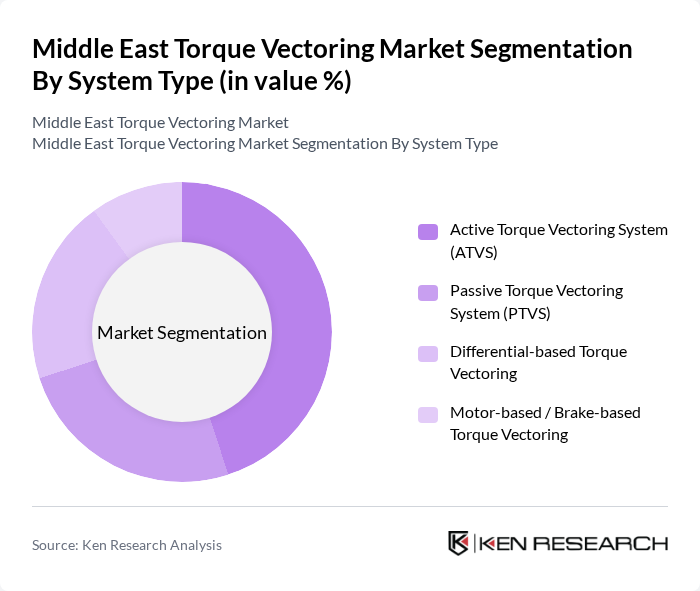
By System Type:The segmentation of the market by system type includes various technologies that enhance vehicle performance and handling. The subsegments are Active Torque Vectoring System (ATVS), Passive Torque Vectoring System (PTVS), Differential-based Torque Vectoring, and Motor-based / Brake-based Torque Vectoring. Among these, Active Torque Vectoring Systems are gaining traction due to their ability to provide real-time adjustments to torque distribution, significantly improving vehicle stability and handling, and they are increasingly specified in premium SUVs, crossovers, and performance-oriented electric vehicles in markets such as the UAE.
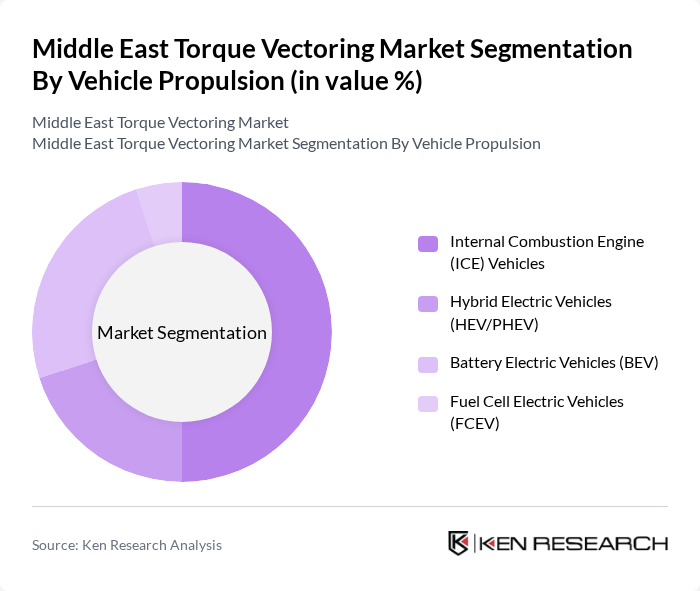
By Vehicle Propulsion:The market is segmented based on vehicle propulsion types, including Internal Combustion Engine (ICE) Vehicles, Hybrid Electric Vehicles (HEV/PHEV), Battery Electric Vehicles (BEV), and Fuel Cell Electric Vehicles (FCEV). The Internal Combustion Engine Vehicles segment remains dominant due to the established fuel distribution infrastructure, large on-road fleet, and continuing consumer preference for conventional vehicles in many Middle Eastern markets, while hybrid and electric propulsion are growing from a smaller base. At the same time, the BEV segment is rapidly gaining ground as electric mobility becomes more mainstream, supported by government incentives, fleet electrification targets, and investments in public charging networks in countries such as the UAE and Saudi Arabia, which accelerates the adoption of torque vectoring in high-performance and dual?motor electric models.
Middle East Torque Vectoring Market Competitive Landscape
The Middle East Torque Vectoring Market is characterized by a dynamic mix of regional and international players. Leading participants such as ZF Friedrichshafen AG, BorgWarner Inc., GKN Automotive Limited, Continental AG, Eaton Corporation plc, Aisin Corporation, Dana Incorporated, JTEKT Corporation, Hyundai Mobis Co., Ltd., Valeo SA, Ricardo plc, Magna International Inc., Robert Bosch GmbH, Toyota Motor Corporation, Nissan Motor Co., Ltd. contribute to innovation, geographic expansion, and service delivery in this space.
Middle East Torque Vectoring Market Industry Analysis
Growth Drivers
- Increasing Demand for Enhanced Vehicle Performance:The Middle East automotive sector is witnessing a surge in demand for high-performance vehicles, with a projected increase in sales from 1.5 million units to 1.8 million units. This growth is driven by consumer preferences for vehicles that offer superior handling and acceleration, which torque vectoring systems can provide. Enhanced vehicle performance is becoming a key differentiator in a competitive market, prompting manufacturers to invest in advanced technologies.
- Rising Adoption of Electric and Hybrid Vehicles:The electric vehicle (EV) market in the Middle East is expected to grow significantly, with sales projected to reach 300,000 units, up from 200,000. This shift towards EVs and hybrids is largely driven by government initiatives promoting sustainable transportation. Torque vectoring systems are increasingly integrated into these vehicles to enhance efficiency and performance, aligning with the region's commitment to reducing carbon emissions and promoting green technologies.
- Technological Advancements in Automotive Systems:The Middle East is experiencing rapid technological advancements in automotive systems, with R&D spending expected to exceed $1 billion. Innovations in torque vectoring technology are enhancing vehicle dynamics and control, making them more appealing to manufacturers. As automakers strive to incorporate cutting-edge features, the demand for sophisticated torque vectoring systems is anticipated to rise, further driving market growth in the region.
Market Challenges
- High Initial Costs of Torque Vectoring Systems:The implementation of torque vectoring systems involves significant upfront costs, estimated at around $1,500 to $3,000 per vehicle. This financial barrier can deter manufacturers from adopting these technologies, especially in a price-sensitive market like the Middle East. As a result, the high initial investment required for torque vectoring systems remains a critical challenge for widespread adoption in the region's automotive industry.
- Limited Awareness Among Consumers:Consumer awareness regarding the benefits of torque vectoring systems is relatively low in the Middle East, with only 30% of potential buyers familiar with the technology. This lack of understanding can hinder market growth, as consumers may prioritize other vehicle features over advanced driving dynamics. Educating consumers about the advantages of torque vectoring is essential for increasing demand and overcoming this challenge in the automotive sector.
Middle East Torque Vectoring Market Future Outlook
The Middle East torque vectoring market is poised for significant growth, driven by technological advancements and increasing consumer demand for high-performance vehicles. As automakers invest in R&D and collaborate with tech companies, innovations in torque vectoring systems will enhance vehicle dynamics and safety. Additionally, the rising adoption of electric and hybrid vehicles will further propel market expansion, aligning with regional sustainability goals and consumer preferences for eco-friendly solutions.
Market Opportunities
- Expansion of Automotive Manufacturing in the Region:The Middle East is witnessing a surge in automotive manufacturing, with investments expected to reach $5 billion. This growth presents opportunities for torque vectoring system integration, as manufacturers seek to enhance vehicle performance and meet consumer expectations for advanced technologies.
- Collaborations with Tech Companies for Innovation:Partnerships between automotive manufacturers and technology firms are on the rise, with over 50 collaborations anticipated. These alliances will drive innovation in torque vectoring systems, enabling the development of smarter, more efficient vehicles that cater to the evolving demands of consumers in the Middle East.
Scope of the Report
| Segment | Sub-Segments |
|---|---|
| By System Type | Active Torque Vectoring System (ATVS) Passive Torque Vectoring System (PTVS) Differential-based Torque Vectoring Motor-based / Brake-based Torque Vectoring |
| By Vehicle Propulsion | Internal Combustion Engine (ICE) Vehicles Hybrid Electric Vehicles (HEV/PHEV) Battery Electric Vehicles (BEV) Fuel Cell Electric Vehicles (FCEV) |
| By Vehicle Category | Passenger Cars (Sedans & Hatchbacks) SUVs & Crossovers Light Commercial Vehicles (LCVs) High-performance & Sports Cars |
| By Technology | Mechanical / Differential-based Systems Electronic / Software-based Torque Vectoring Hydraulic Clutch-based Torque Vectoring Integrated Vehicle Dynamics Control Systems |
| By Application | Stability & Traction Control Cornering & Handling Performance Off-road & All-terrain Capability Energy Efficiency & Range Optimization in EVs |
| By Sales Channel | OEM-fitted Systems OEM-backed Performance Packages Independent Aftermarket Upgrades Fleet & Specialty Vehicle Integrators |
| By Country | United Arab Emirates Saudi Arabia Qatar Kuwait Oman Bahrain Rest of Middle East |
Key Target Audience
Investors and Venture Capitalist Firms
Government and Regulatory Bodies (e.g., Ministry of Industry and Advanced Technology, Saudi Standards, Metrology and Quality Organization)
Automotive Manufacturers and Producers
Automotive Component Suppliers
Distributors and Retailers of Automotive Technologies
Technology Providers specializing in Torque Vectoring Systems
Industry Associations (e.g., Middle East Automotive Association)
Financial Institutions and Banks involved in automotive financing
Players Mentioned in the Report:
ZF Friedrichshafen AG
BorgWarner Inc.
GKN Automotive Limited
Continental AG
Eaton Corporation plc
Aisin Corporation
Dana Incorporated
JTEKT Corporation
Hyundai Mobis Co., Ltd.
Valeo SA
Ricardo plc
Magna International Inc.
Robert Bosch GmbH
Toyota Motor Corporation
Nissan Motor Co., Ltd.
Table of Contents
Market Assessment Phase
1. Executive Summary and Approach
2. Middle East Torque Vectoring Market Overview
2.1 Key Insights and Strategic Recommendations
2.2 Middle East Torque Vectoring Market Overview
2.3 Definition and Scope
2.4 Evolution of Market Ecosystem
2.5 Timeline of Key Regulatory Milestones
2.6 Value Chain & Stakeholder Mapping
2.7 Business Cycle Analysis
2.8 Policy & Incentive Landscape
3. Middle East Torque Vectoring Market Analysis
3.1 Growth Drivers
3.1.1 Increasing demand for enhanced vehicle performance
3.1.2 Rising adoption of electric and hybrid vehicles
3.1.3 Technological advancements in automotive systems
3.1.4 Growing focus on safety and stability in vehicles
3.2 Market Challenges
3.2.1 High initial costs of torque vectoring systems
3.2.2 Limited awareness among consumers
3.2.3 Complexity in integration with existing vehicle systems
3.2.4 Regulatory hurdles in automotive standards
3.3 Market Opportunities
3.3.1 Expansion of automotive manufacturing in the region
3.3.2 Increasing investments in R&D for automotive technologies
3.3.3 Collaborations with tech companies for innovation
3.3.4 Growing demand for luxury and performance vehicles
3.4 Market Trends
3.4.1 Shift towards autonomous driving technologies
3.4.2 Integration of AI in vehicle dynamics
3.4.3 Focus on sustainability and eco-friendly solutions
3.4.4 Customization and personalization in vehicle features
3.5 Government Regulation
3.5.1 Emission standards for automotive manufacturers
3.5.2 Safety regulations for vehicle performance
3.5.3 Incentives for electric vehicle adoption
3.5.4 Standards for automotive technology integration
4. SWOT Analysis
5. Stakeholder Analysis
6. Porter's Five Forces Analysis
7. Middle East Torque Vectoring Market Market Size, 2019-2024
7.1 By Value
7.2 By Volume
7.3 By Average Selling Price
8. Middle East Torque Vectoring Market Segmentation
8.1 By System Type
8.1.1 Active Torque Vectoring System (ATVS)
8.1.2 Passive Torque Vectoring System (PTVS)
8.1.3 Differential-based Torque Vectoring
8.1.4 Motor-based / Brake-based Torque Vectoring
8.2 By Vehicle Propulsion
8.2.1 Internal Combustion Engine (ICE) Vehicles
8.2.2 Hybrid Electric Vehicles (HEV/PHEV)
8.2.3 Battery Electric Vehicles (BEV)
8.2.4 Fuel Cell Electric Vehicles (FCEV)
8.3 By Vehicle Category
8.3.1 Passenger Cars (Sedans & Hatchbacks)
8.3.2 SUVs & Crossovers
8.3.3 Light Commercial Vehicles (LCVs)
8.3.4 High-performance & Sports Cars
8.4 By Technology
8.4.1 Mechanical / Differential-based Systems
8.4.2 Electronic / Software-based Torque Vectoring
8.4.3 Hydraulic Clutch-based Torque Vectoring
8.4.4 Integrated Vehicle Dynamics Control Systems
8.5 By Application
8.5.1 Stability & Traction Control
8.5.2 Cornering & Handling Performance
8.5.3 Off-road & All-terrain Capability
8.5.4 Energy Efficiency & Range Optimization in EVs
8.6 By Sales Channel
8.6.1 OEM-fitted Systems
8.6.2 OEM-backed Performance Packages
8.6.3 Independent Aftermarket Upgrades
8.6.4 Fleet & Specialty Vehicle Integrators
8.7 By Country
8.7.1 United Arab Emirates
8.7.2 Saudi Arabia
8.7.3 Qatar
8.7.4 Kuwait
8.7.5 Oman
8.7.6 Bahrain
8.7.7 Rest of Middle East
9. Middle East Torque Vectoring Market Competitive Analysis
9.1 Market Share of Key Players
9.2 Cross Comparison of Key Players
9.2.1 Company Name
9.2.2 Installed Base in Middle East (thousand vehicles with torque vectoring)
9.2.3 Middle East Torque Vectoring Revenue (USD million)
9.2.4 Middle East Revenue CAGR (Historical & Forecast)
9.2.5 Share of Sales to Premium & Performance Segments (%)
9.2.6 Penetration in SUV & Crossover Sales (%)
9.2.7 OEM Relationships in the Region (Number of active OEM programs)
9.2.8 Technology Breadth (Mechanical / Electronic / EV motor-based coverage)
9.2.9 New Program Wins & Launches in Last 3 Years (count)
9.2.10 Average Content per Vehicle (USD per vehicle in torque vectoring hardware/software)
9.3 SWOT Analysis of Top Players
9.4 Pricing Analysis
9.5 Detailed Profile of Major Companies
9.5.1 ZF Friedrichshafen AG
9.5.2 BorgWarner Inc.
9.5.3 GKN Automotive Limited
9.5.4 Continental AG
9.5.5 Eaton Corporation plc
9.5.6 Aisin Corporation
9.5.7 Dana Incorporated
9.5.8 JTEKT Corporation
9.5.9 Hyundai Mobis Co., Ltd.
9.5.10 Valeo SA
9.5.11 Ricardo plc
9.5.12 Magna International Inc.
9.5.13 Robert Bosch GmbH
9.5.14 Toyota Motor Corporation
9.5.15 Nissan Motor Co., Ltd.
10. Middle East Torque Vectoring Market End-User Analysis
10.1 Procurement Behavior of Key Ministries
10.1.1 Government Procurement Policies
10.1.2 Budget Allocations for Automotive Technologies
10.1.3 Decision-Making Processes
10.1.4 Supplier Selection Criteria
10.2 Corporate Spend on Infrastructure & Energy
10.2.1 Investment Trends in Automotive Sector
10.2.2 Budgeting for R&D in Torque Vectoring
10.2.3 Corporate Partnerships and Collaborations
10.2.4 Spending on Technology Upgrades
10.3 Pain Point Analysis by End-User Category
10.3.1 Challenges Faced by OEMs
10.3.2 Issues in Aftermarket Services
10.3.3 Consumer Concerns Regarding Performance
10.3.4 Regulatory Compliance Challenges
10.4 User Readiness for Adoption
10.4.1 Awareness Levels Among Consumers
10.4.2 Readiness of OEMs to Integrate Technology
10.4.3 Training and Support Needs
10.4.4 Market Perception of Torque Vectoring
10.5 Post-Deployment ROI and Use Case Expansion
10.5.1 Measurement of Performance Improvements
10.5.2 Customer Feedback and Satisfaction
10.5.3 Expansion into New Use Cases
10.5.4 Long-term Value Assessment
11. Middle East Torque Vectoring Market Future Size, 2025-2030
11.1 By Value
11.2 By Volume
11.3 By Average Selling Price
Go-To-Market Strategy Phase
1. Whitespace Analysis + Business Model Canvas
1.1 Market Gaps Identification
1.2 Business Model Development
2. Marketing and Positioning Recommendations
2.1 Branding Strategies
2.2 Product USPs
3. Distribution Plan
3.1 Urban Retail Strategies
3.2 Rural NGO Tie-ups
4. Channel & Pricing Gaps
4.1 Underserved Routes
4.2 Pricing Bands Analysis
5. Unmet Demand & Latent Needs
5.1 Category Gaps
5.2 Consumer Segments
6. Customer Relationship
6.1 Loyalty Programs
6.2 After-sales Service
7. Value Proposition
7.1 Sustainability Initiatives
7.2 Integrated Supply Chains
8. Key Activities
8.1 Regulatory Compliance
8.2 Branding Efforts
8.3 Distribution Setup
9. Entry Strategy Evaluation
9.1 Domestic Market Entry Strategy
9.1.1 Product Mix Considerations
9.1.2 Pricing Band Strategy
9.1.3 Packaging Solutions
9.2 Export Entry Strategy
9.2.1 Target Countries Identification
9.2.2 Compliance Roadmap Development
10. Entry Mode Assessment
10.1 Joint Ventures
10.2 Greenfield Investments
10.3 Mergers & Acquisitions
10.4 Distributor Model Evaluation
11. Capital and Timeline Estimation
11.1 Capital Requirements Analysis
11.2 Timelines for Market Entry
12. Control vs Risk Trade-Off
12.1 Ownership Considerations
12.2 Partnerships Evaluation
13. Profitability Outlook
13.1 Breakeven Analysis
13.2 Long-term Sustainability Assessment
14. Potential Partner List
14.1 Distributors Identification
14.2 Joint Ventures Opportunities
14.3 Acquisition Targets
15. Execution Roadmap
15.1 Phased Plan for Market Entry
15.1.1 Market Setup
15.1.2 Market Entry
15.1.3 Growth Acceleration
15.1.4 Scale & Stabilize
15.2 Key Activities and Milestones
15.2.1 Milestone Planning
15.2.2 Activity Tracking
Research Methodology
Phase 1: Approach1
Desk Research
- Industry reports from automotive and technology associations in the Middle East
- Market analysis publications focusing on torque vectoring technologies
- Government publications and policy documents related to automotive innovation
Primary Research
- Interviews with automotive engineers specializing in drivetrain technologies
- Surveys with automotive manufacturers and OEMs in the region
- Field interviews with automotive industry analysts and consultants
Validation & Triangulation
- Cross-validation of data from multiple industry sources and reports
- Triangulation of insights from primary interviews and secondary data
- Sanity checks through expert panels comprising industry veterans
Phase 2: Market Size Estimation1
Top-down Assessment
- Analysis of the overall automotive market size in the Middle East
- Segmentation of torque vectoring market by vehicle type and application
- Incorporation of regional automotive sales forecasts and trends
Bottom-up Modeling
- Estimation of torque vectoring system adoption rates among new vehicle models
- Cost analysis based on component pricing and installation expenses
- Volume projections based on historical sales data of vehicles equipped with torque vectoring
Forecasting & Scenario Analysis
- Multi-variable regression analysis considering economic indicators and consumer preferences
- Scenario modeling based on technological advancements and regulatory changes
- Baseline, optimistic, and pessimistic forecasts through 2030
Phase 3: CATI Sample Composition1
| Scope Item/Segment | Sample Size | Target Respondent Profiles |
|---|---|---|
| Passenger Vehicle Manufacturers | 100 | Product Development Managers, Engineering Leads |
| Commercial Vehicle OEMs | 80 | Fleet Managers, Technical Directors |
| Automotive Component Suppliers | 70 | Supply Chain Managers, Sales Directors |
| Automotive Research Institutions | 50 | Research Analysts, Automotive Engineers |
| Regulatory Bodies and Associations | 40 | Policy Makers, Industry Advocates |
Frequently Asked Questions
What is the current value of the Middle East Torque Vectoring Market?
The Middle East Torque Vectoring Market is valued at approximately USD 1.0 billion, reflecting a significant growth trend driven by the demand for advanced vehicle dynamics and enhanced driving performance, particularly in luxury and high-performance vehicle segments.
What factors are driving the growth of the Torque Vectoring Market in the Middle East?
Which countries are leading in the adoption of torque vectoring technology in the Middle East?
What are the main types of torque vectoring systems available in the market?
Other Regional/Country Reports
Indonesia Torque Vectoring Market
Malaysia Torque Vectoring Market
KSA Torque Vectoring Market
APAC Torque Vectoring Market
SEA Torque Vectoring Market
Vietnam Torque Vectoring Market
Other Adjacent Reports
Kuwait Automotive Differential Market
Belgium Vehicle Stability Control Market
Global Electric Powertrain Market Size, Share & Forecast, By Component, Vehicle Type & Propulsion Type, 2026-2031Belgium Hybrid Vehicle Technology Market
India Advanced Driver Assistance Systems Market Size, Share & Forecast, By Solution Type, Vehicle Type & Technology, 2026-2031Global Automotive Brake Systems Market Size, Share & Forecast, By Vehicle Type, Technology & Sales Channel, 2026-2031Thailand All-Wheel Drive Systems Market
Japan Automotive Suspension Systems Market
Brazil Electric Vehicle Battery Management Market
Belgium Autonomous Vehicle Sensors Market
Why Buy From Us?

What makes us stand out is that our consultants follow Robust, Refine and Result (RRR) methodology. Robust for clear definitions, approaches and sanity checking, Refine for differentiating respondents' facts and opinions, and Result for presenting data with story.

We have set a benchmark in the industry by offering our clients with syndicated and customized market research reports featuring coverage of entire market as well as meticulous research and analyst insights.

While we don't replace traditional research, we flip the method upside down. Our dual approach of Top Bottom & Bottom Top ensures quality deliverable by not just verifying company fundamentals but also looking at the sector and macroeconomic factors.

With one step in the future, our research team constantly tries to show you the bigger picture. We help with some of the tough questions you may encounter along the way: How is the industry positioned? Best marketing channel? KPI's of competitors? By aligning every element, we help maximize success.

Our report gives you instant access to the answers and sources that other companies might choose to hide. We elaborate each steps of research methodology we have used and showcase you the sample size to earn your trust.

If you need any support, we are here! We pride ourselves on universe strength, data quality, and quick, friendly, and professional service.