Region:Middle East
Author(s):Shubham
Product Code:KRAA8787
Pages:99
Published On:November 2025
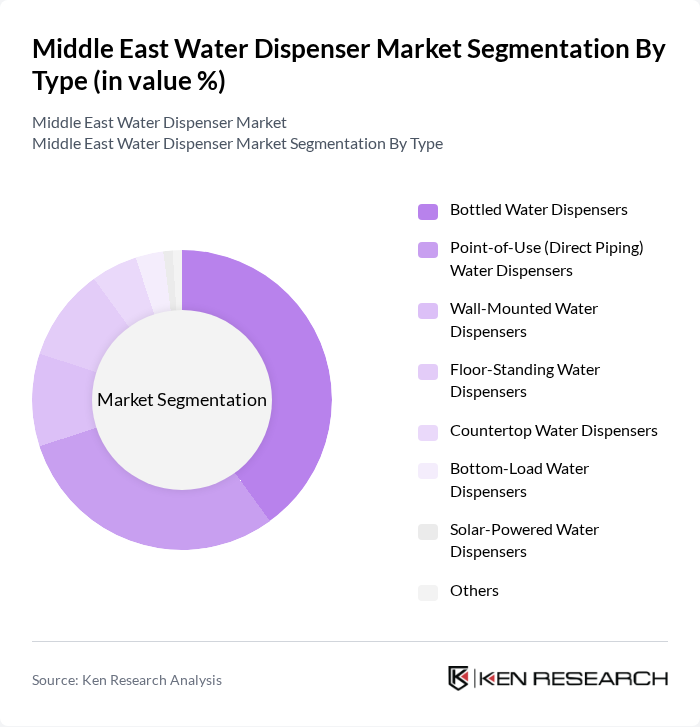
By Type:The market is segmented into various types of water dispensers, including Bottled Water Dispensers, Point-of-Use (Direct Piping) Water Dispensers, Wall-Mounted Water Dispensers, Floor-Standing Water Dispensers, Countertop Water Dispensers, Bottom-Load Water Dispensers, Solar-Powered Water Dispensers, and Others. Bottled Water Dispensers remain the most popular due to their convenience and ease of use, particularly in residential settings. However, Point-of-Use Water Dispensers are gaining traction in commercial spaces, driven by cost-effectiveness, reduced environmental impact, and the increasing adoption of advanced filtration technologies.
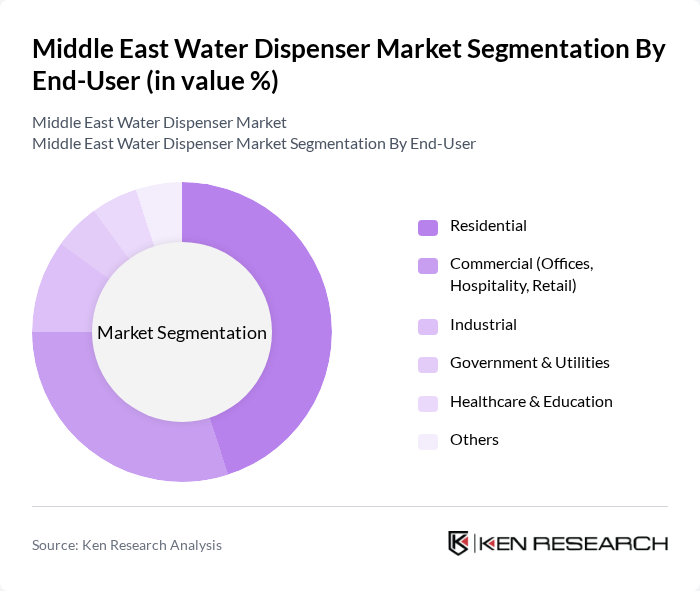
By End-User:The market is categorized by end-users, including Residential, Commercial (Offices, Hospitality, Retail), Industrial, Government & Utilities, Healthcare & Education, and Others. The Residential segment leads the market, driven by increasing health awareness, urbanization, and the need for convenient access to clean drinking water at home. The Commercial segment is also significant, as businesses seek efficient solutions to provide drinking water for employees and customers, with hospitality and office sectors showing robust adoption rates.
The Middle East Water Dispenser Market is characterized by a dynamic mix of regional and international players. Leading participants such as AquaCool, Waterlogic, Al Haramain Water Dispensers, Oasis Water, Pure Water Technology, Al Ain Water, Nestlé Waters, Culligan International, Blue Star Limited, Midea Group, Brio Water Technology, A.O. Smith Corporation, Honeywell International Inc., Whirlpool Corporation, Primo Water Corporation contribute to innovation, geographic expansion, and service delivery in this space.
The future of the Middle East water dispenser market appears promising, driven by increasing health awareness and urbanization trends. As consumers prioritize clean drinking water, the demand for innovative and sustainable water dispensing solutions is expected to rise. Companies are likely to invest in advanced technologies, such as IoT-enabled dispensers, to enhance user experience. Furthermore, partnerships with local governments to improve water access in underserved areas will play a crucial role in shaping the market landscape, fostering growth and sustainability in the sector.
| Segment | Sub-Segments |
|---|---|
| By Type | Bottled Water Dispensers Point-of-Use (Direct Piping) Water Dispensers Wall-Mounted Water Dispensers Floor-Standing Water Dispensers Countertop Water Dispensers Bottom-Load Water Dispensers Solar-Powered Water Dispensers Others |
| By End-User | Residential Commercial (Offices, Hospitality, Retail) Industrial Government & Utilities Healthcare & Education Others |
| By Region | GCC Countries (Saudi Arabia, UAE, Qatar, Kuwait, Oman, Bahrain) Levant Region (Jordan, Lebanon, Iraq, Syria, Palestine) North Africa (Egypt, Libya, Algeria, Morocco, Tunisia) Others (Turkey, Iran, Israel, etc.) |
| By Application | Home Use Office Use Public Places (Airports, Malls, Parks) Events and Gatherings Others |
| By Distribution Channel | Online Retail Supermarkets/Hypermarkets Specialty Stores Direct Sales Distributors Others |
| By Price Range | Budget Mid-Range Premium Others |
| By Technology | Reverse Osmosis (RO) UV Filtration Activated Carbon Filtration Filter-Free Others |
| Scope Item/Segment | Sample Size | Target Respondent Profiles |
|---|---|---|
| Residential Water Dispenser Users | 100 | Homeowners, Renters |
| Commercial Water Dispenser Users | 80 | Office Managers, Facility Managers |
| Retail Sector Insights | 60 | Store Managers, Purchasing Agents |
| Health Sector Water Usage | 50 | Healthcare Administrators, Facility Coordinators |
| Environmental Impact Perspectives | 40 | Sustainability Officers, Environmental Consultants |
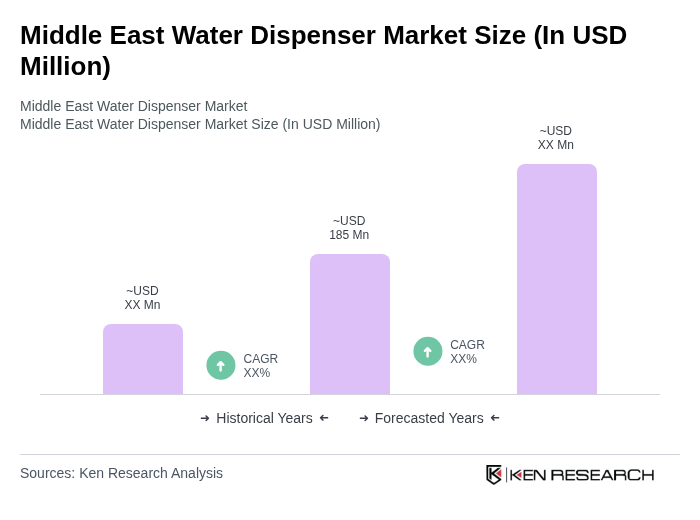
The Middle East Water Dispenser Market is valued at approximately USD 185 million, reflecting a five-year historical analysis. This growth is driven by urbanization, health consciousness, and the demand for convenient drinking water solutions.

What makes us stand out is that our consultants follow Robust, Refine and Result (RRR) methodology. Robust for clear definitions, approaches and sanity checking, Refine for differentiating respondents' facts and opinions, and Result for presenting data with story.

We have set a benchmark in the industry by offering our clients with syndicated and customized market research reports featuring coverage of entire market as well as meticulous research and analyst insights.

While we don't replace traditional research, we flip the method upside down. Our dual approach of Top Bottom & Bottom Top ensures quality deliverable by not just verifying company fundamentals but also looking at the sector and macroeconomic factors.

With one step in the future, our research team constantly tries to show you the bigger picture. We help with some of the tough questions you may encounter along the way: How is the industry positioned? Best marketing channel? KPI's of competitors? By aligning every element, we help maximize success.

Our report gives you instant access to the answers and sources that other companies might choose to hide. We elaborate each steps of research methodology we have used and showcase you the sample size to earn your trust.

If you need any support, we are here! We pride ourselves on universe strength, data quality, and quick, friendly, and professional service.













