Netherlands Semiconductor Equipment Manufacturing Market

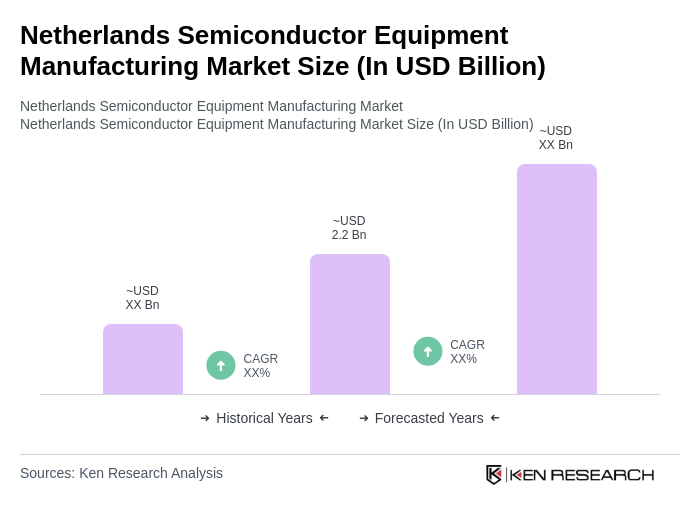
Netherlands semiconductor equipment manufacturing market, valued at USD 2.2 Bn, grows due to innovations in photolithography and government support like EUR 1 Bn funding.

Region:Europe

Author(s):Rebecca

Product Code:KRAB2919

Pages:94

Published On:October 2025
About the Report

Base Year 2024

Netherlands Semiconductor Equipment Manufacturing Market Overview

  • The Netherlands Semiconductor Equipment Manufacturing Market is valued at USD 2.2 billion, based on a five-year historical analysis. This estimate is derived from the Netherlands’ share within the broader European market, which is valued at about USD 22.4 billion, with the Netherlands representing a significant but not dominant portion due to the concentration of major equipment manufacturers such as ASML and BESI in the country. Growth is primarily driven by increasing demand for advanced semiconductor technologies, especially in automotive, consumer electronics, and data center applications. The proliferation of electric vehicles, AI, IoT, and high-performance computing continues to fuel investments in cutting-edge semiconductor manufacturing equipment.
  • Key innovation hubs in the Netherlands include Eindhoven and Amsterdam. Eindhoven is home to leading semiconductor companies such as ASML, NXP Semiconductors, and BESI, as well as prominent research institutions and technical universities. Amsterdam serves as a center for technology startups, venture capital, and collaborative R&D, fostering a vibrant ecosystem for semiconductor development and commercialization.
  • The Dutch government strengthened the semiconductor supply chain’s resilience with the “National Growth Fund – Chip Technology Program,” issued by the Ministry of Economic Affairs and Climate Policy in 2023. This binding regulation includes a EUR 1 billion funding initiative to support research, development, and commercialization of advanced semiconductor technologies. The program mandates compliance with innovation, sustainability, and supply chain security standards for participating organizations.
Netherlands Semiconductor Equipment Manufacturing Market Size

Netherlands Semiconductor Equipment Manufacturing Market Segmentation

By Type:The market is segmented into Photolithography Equipment, Etching Equipment, Deposition Equipment, Cleaning Equipment, Inspection Equipment, Test Equipment, and Wafer Handling & Packaging Equipment. Photolithography Equipment remains the most dominant segment, accounting for the largest share due to its critical role in fabricating advanced integrated circuits. The transition to smaller process nodes, EUV lithography, and 3D architectures has amplified demand for high-precision photolithography tools. Etching and deposition equipment also see robust growth, driven by the complexity of semiconductor designs and the need for atomic-level accuracy in chip manufacturing.
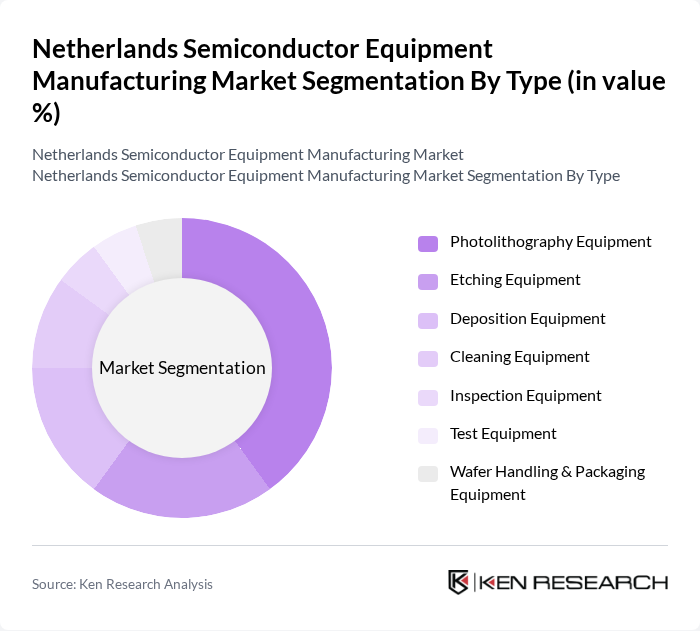
Netherlands Semiconductor Equipment Manufacturing Market segmentation by Type.

By End-User:The end-user segmentation includes Integrated Device Manufacturers (IDMs), Foundries, Outsourced Semiconductor Assembly and Test (OSAT) Companies, Research & Development Institutes, Universities & Academic Labs, and Others. Integrated Device Manufacturers (IDMs) dominate this segment, reflecting their substantial investments in advanced equipment to produce a wide range of electronic devices. The surge in demand for automotive electronics, consumer devices, and industrial automation is driving IDMs and foundries to upgrade their manufacturing capabilities with state-of-the-art equipment. OSAT companies, research institutes, and academic labs also contribute to market growth, focusing on innovation and prototyping.
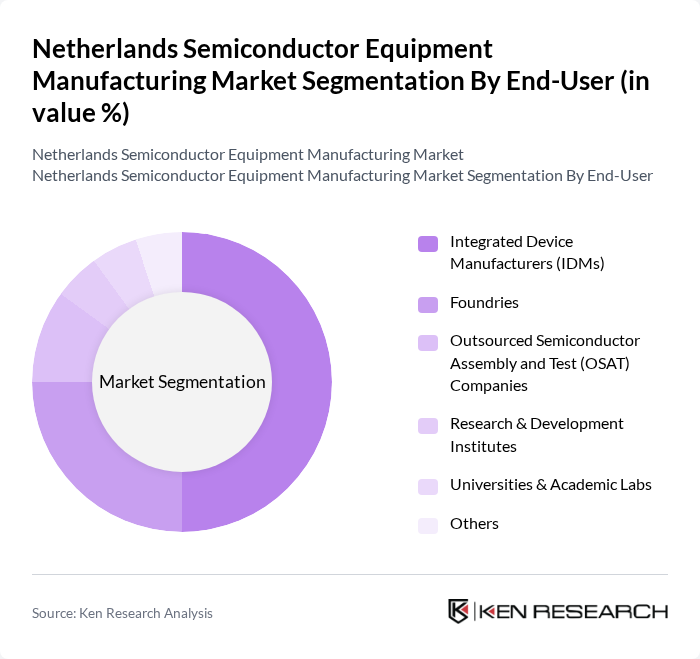
Netherlands Semiconductor Equipment Manufacturing Market segmentation by End-User.

Netherlands Semiconductor Equipment Manufacturing Market Competitive Landscape

The Netherlands Semiconductor Equipment Manufacturing Market is characterized by a dynamic mix of regional and international players. Leading participants such as ASML Holding N.V., ASM International N.V., NXP Semiconductors N.V., BESI (BE Semiconductor Industries N.V.), VDL Enabling Technologies Group, Philips N.V., Sioux Technologies B.V., Kulicke & Soffa Netherlands B.V., Thermo Fisher Scientific (FEI Company), SUSS MicroTec SE, Lam Research Corporation, KLA Corporation, Applied Materials, Inc., Tokyo Electron Limited, Advantest Corporation, Hitachi High-Tech Corporation, Onto Innovation Inc., Ultratech, a division of Veeco Instruments Inc. contribute to innovation, geographic expansion, and service delivery in this space.

ASML Holding N.V.

1984

Veldhoven

ASM International N.V.

1968

Almere

NXP Semiconductors N.V.

2006

Eindhoven

BESI (BE Semiconductor Industries N.V.)

1995

Duiven

VDL Enabling Technologies Group

2010

Eindhoven

Company

Establishment Year

Headquarters

Company Headquarters Location

Group Size (Large, Medium, or Small as per industry convention)

Total Revenue (EUR, Most Recent Fiscal Year)

Revenue Growth Rate (3-Year CAGR)

Market Share Percentage (Netherlands Equipment Market)

R&D Investment as a Percentage of Revenue

Netherlands Semiconductor Equipment Manufacturing Market Industry Analysis

Growth Drivers

  • Increasing Demand for Advanced Electronics:The Netherlands semiconductor equipment manufacturing sector is experiencing robust growth, driven by a surge in demand for advanced electronics. In future, the global electronics market is projected to reach approximately €1.3 trillion, with the Netherlands contributing significantly due to its strong technological base. The increasing integration of semiconductors in consumer electronics, automotive, and industrial applications is expected to drive production, leading to an estimated 9% increase in semiconductor equipment sales in the region.
  • Government Support for Semiconductor Innovation:The Dutch government has committed over €1 billion to support semiconductor innovation through initiatives like the National Growth Fund. This funding aims to enhance research and development capabilities, fostering collaboration between academia and industry. In future, the government’s investment is expected to catalyze advancements in semiconductor technologies, potentially increasing the local industry's output by 16%, thereby solidifying the Netherlands' position as a leader in semiconductor manufacturing.
  • Expansion of 5G Infrastructure:The rollout of 5G technology is a significant growth driver for the semiconductor equipment market in the Netherlands. With an investment of approximately €3.5 billion in 5G infrastructure expected in future, the demand for high-performance semiconductors will rise sharply. This expansion is anticipated to create a market for advanced semiconductor manufacturing equipment, with projections indicating a 22% increase in demand for related technologies, further boosting the local economy.

Market Challenges

  • Supply Chain Disruptions:The semiconductor industry in the Netherlands faces significant challenges due to ongoing supply chain disruptions. In future, global semiconductor supply chains are projected to remain strained, with lead times extending up to 18 weeks for critical components. This situation can hinder production capabilities and delay the delivery of semiconductor equipment, potentially resulting in a loss of revenue estimated at €600 million for local manufacturers if disruptions persist.
  • High Capital Expenditure:The high capital expenditure required for semiconductor manufacturing poses a challenge for companies in the Netherlands. In future, the average investment needed to set up a semiconductor fabrication facility is estimated at €1.8 billion. This financial burden can deter new entrants and limit the expansion of existing firms, potentially stifling innovation and competitiveness in a rapidly evolving market landscape, where agility is crucial for success.

Netherlands Semiconductor Equipment Manufacturing Market Future Outlook

The future of the Netherlands semiconductor equipment manufacturing market appears promising, driven by technological advancements and increasing demand for innovative solutions. As the industry adapts to rapid changes, companies are likely to invest in automation and AI-driven processes to enhance efficiency. Additionally, the focus on sustainable practices will shape manufacturing strategies, aligning with global environmental goals. The anticipated growth in automotive and IoT applications will further stimulate demand, positioning the Netherlands as a key player in the global semiconductor landscape.

Market Opportunities

  • Growth in Automotive Electronics:The automotive sector is increasingly adopting semiconductor technologies, with an expected market value of €450 billion in future. This growth presents significant opportunities for semiconductor equipment manufacturers in the Netherlands to cater to the rising demand for electric vehicles and advanced driver-assistance systems, potentially increasing local production capacity by 12%.
  • Adoption of AI and Machine Learning:The integration of AI and machine learning in semiconductor manufacturing processes is set to revolutionize the industry. By future, investments in AI technologies are projected to exceed €2.5 billion in the Netherlands, creating opportunities for equipment manufacturers to develop innovative solutions that enhance production efficiency and reduce costs, thereby capturing a larger market share.

Scope of the Report

SegmentSub-Segments
By Type

Photolithography Equipment

Etching Equipment

Deposition Equipment

Cleaning Equipment

Inspection Equipment

Test Equipment

Wafer Handling & Packaging Equipment

By End-User

Integrated Device Manufacturers (IDMs)

Foundries

Outsourced Semiconductor Assembly and Test (OSAT) Companies

Research & Development Institutes

Universities & Academic Labs

Others

By Component

Hardware

Software

Services

By Sales Channel

Direct Sales

Distributors

Online Sales

By Distribution Mode

Wholesale

Retail

By Price Range

Premium

Mid-Range

Budget

By Application

Integrated Circuits

Sensors

Microprocessors

Memory Devices

Power Devices

Others

Key Target Audience

Investors and Venture Capitalist Firms

Government and Regulatory Bodies (e.g., Netherlands Enterprise Agency, Ministry of Economic Affairs and Climate Policy)

Semiconductor Equipment Manufacturers

Supply Chain Partners

Industry Associations (e.g., Dutch Semiconductor Industry Association)

Technology Providers and Innovators

Financial Institutions and Banks

Trade Organizations and Export Promotion Agencies

Players Mentioned in the Report:

ASML Holding N.V.

ASM International N.V.

NXP Semiconductors N.V.

BESI (BE Semiconductor Industries N.V.)

VDL Enabling Technologies Group

Philips N.V.

Sioux Technologies B.V.

Kulicke & Soffa Netherlands B.V.

Thermo Fisher Scientific (FEI Company)

SUSS MicroTec SE

Lam Research Corporation

KLA Corporation

Applied Materials, Inc.

Tokyo Electron Limited

Advantest Corporation

Hitachi High-Tech Corporation

Onto Innovation Inc.

Ultratech, a division of Veeco Instruments Inc.

Table of Contents

Market Assessment Phase

1. Executive Summary and Approach


2. Netherlands Semiconductor Equipment Manufacturing Market Overview

2.1 Key Insights and Strategic Recommendations

2.2 Netherlands Semiconductor Equipment Manufacturing Market Overview

2.3 Definition and Scope

2.4 Evolution of Market Ecosystem

2.5 Timeline of Key Regulatory Milestones

2.6 Value Chain & Stakeholder Mapping

2.7 Business Cycle Analysis

2.8 Policy & Incentive Landscape


3. Netherlands Semiconductor Equipment Manufacturing Market Analysis

3.1 Growth Drivers

3.1.1 Increasing Demand for Advanced Electronics
3.1.2 Government Support for Semiconductor Innovation
3.1.3 Expansion of 5G Infrastructure
3.1.4 Rising Investment in R&D

3.2 Market Challenges

3.2.1 Supply Chain Disruptions
3.2.2 High Capital Expenditure
3.2.3 Rapid Technological Changes
3.2.4 Global Competition

3.3 Market Opportunities

3.3.1 Growth in Automotive Electronics
3.3.2 Adoption of AI and Machine Learning
3.3.3 Development of Sustainable Manufacturing Practices
3.3.4 Expansion into Emerging Markets

3.4 Market Trends

3.4.1 Miniaturization of Semiconductor Devices
3.4.2 Increased Focus on Cybersecurity
3.4.3 Integration of IoT in Semiconductor Manufacturing
3.4.4 Shift Towards Localized Production

3.5 Government Regulation

3.5.1 Compliance with EU Environmental Standards
3.5.2 Export Control Regulations
3.5.3 Investment Incentives for R&D
3.5.4 Safety and Health Regulations in Manufacturing

4. SWOT Analysis


5. Stakeholder Analysis


6. Porter's Five Forces Analysis


7. Netherlands Semiconductor Equipment Manufacturing Market Market Size, 2019-2024

7.1 By Value

7.2 By Volume

7.3 By Average Selling Price


8. Netherlands Semiconductor Equipment Manufacturing Market Segmentation

8.1 By Type

8.1.1 Photolithography Equipment
8.1.2 Etching Equipment
8.1.3 Deposition Equipment
8.1.4 Cleaning Equipment
8.1.5 Inspection Equipment
8.1.6 Test Equipment
8.1.7 Wafer Handling & Packaging Equipment

8.2 By End-User

8.2.1 Integrated Device Manufacturers (IDMs)
8.2.2 Foundries
8.2.3 Outsourced Semiconductor Assembly and Test (OSAT) Companies
8.2.4 Research & Development Institutes
8.2.5 Universities & Academic Labs
8.2.6 Others

8.3 By Component

8.3.1 Hardware
8.3.2 Software
8.3.3 Services

8.4 By Sales Channel

8.4.1 Direct Sales
8.4.2 Distributors
8.4.3 Online Sales

8.5 By Distribution Mode

8.5.1 Wholesale
8.5.2 Retail

8.6 By Price Range

8.6.1 Premium
8.6.2 Mid-Range
8.6.3 Budget

8.7 By Application

8.7.1 Integrated Circuits
8.7.2 Sensors
8.7.3 Microprocessors
8.7.4 Memory Devices
8.7.5 Power Devices
8.7.6 Others

9. Netherlands Semiconductor Equipment Manufacturing Market Competitive Analysis

9.1 Market Share of Key Players

9.2 Cross Comparison of Key Players

9.2.1 Company Name
9.2.2 Company Headquarters Location
9.2.3 Group Size (Large, Medium, or Small as per industry convention)
9.2.4 Total Revenue (EUR, Most Recent Fiscal Year)
9.2.5 Revenue Growth Rate (3-Year CAGR)
9.2.6 Market Share Percentage (Netherlands Equipment Market)
9.2.7 R&D Investment as a Percentage of Revenue
9.2.8 Number of Patents Filed (Last 3 Years)
9.2.9 Installed Base (Number of Systems in Operation in NL/EU)
9.2.10 Production Efficiency (Units per Employee or Output per Capex)
9.2.11 Export Ratio (Exports as % of Total Sales)
9.2.12 Customer Concentration (Top 5 Customers as % of Revenue)
9.2.13 ESG Performance Score (If Available)
9.2.14 Average Deal Size
9.2.15 Pricing Strategy

9.3 SWOT Analysis of Top Players

9.4 Pricing Analysis

9.5 Detailed Profile of Major Companies

9.5.1 ASML Holding N.V.
9.5.2 ASM International N.V.
9.5.3 NXP Semiconductors N.V.
9.5.4 BESI (BE Semiconductor Industries N.V.)
9.5.5 VDL Enabling Technologies Group
9.5.6 Philips N.V.
9.5.7 Sioux Technologies B.V.
9.5.8 Kulicke & Soffa Netherlands B.V.
9.5.9 Thermo Fisher Scientific (FEI Company)
9.5.10 SUSS MicroTec SE
9.5.11 Lam Research Corporation
9.5.12 KLA Corporation
9.5.13 Applied Materials, Inc.
9.5.14 Tokyo Electron Limited
9.5.15 Advantest Corporation
9.5.16 Hitachi High-Tech Corporation
9.5.17 Onto Innovation Inc.
9.5.18 Ultratech, a division of Veeco Instruments Inc.

10. Netherlands Semiconductor Equipment Manufacturing Market End-User Analysis

10.1 Procurement Behavior of Key Ministries

10.1.1 Ministry of Economic Affairs
10.1.2 Ministry of Education, Culture and Science
10.1.3 Ministry of Infrastructure and Water Management

10.2 Corporate Spend on Infrastructure & Energy

10.2.1 Investment in Semiconductor Facilities
10.2.2 Budget Allocation for R&D
10.2.3 Expenditure on Technology Upgrades

10.3 Pain Point Analysis by End-User Category

10.3.1 Supply Chain Reliability
10.3.2 Cost Management
10.3.3 Technology Integration Challenges

10.4 User Readiness for Adoption

10.4.1 Awareness of New Technologies
10.4.2 Training and Skill Development
10.4.3 Infrastructure Readiness

10.5 Post-Deployment ROI and Use Case Expansion

10.5.1 Measurement of Performance Metrics
10.5.2 Case Studies of Successful Implementations
10.5.3 Future Use Case Scenarios

11. Netherlands Semiconductor Equipment Manufacturing Market Future Size, 2025-2030

11.1 By Value

11.2 By Volume

11.3 By Average Selling Price


Go-To-Market Strategy Phase

1. Whitespace Analysis + Business Model Canvas

1.1 Market Gaps Identification

1.2 Value Proposition Development

1.3 Revenue Streams Analysis

1.4 Customer Segmentation

1.5 Key Partnerships

1.6 Cost Structure

1.7 Channels of Distribution


2. Marketing and Positioning Recommendations

2.1 Branding Strategies

2.2 Product USPs


3. Distribution Plan

3.1 Urban Retail Strategies

3.2 Rural NGO Tie-ups


4. Channel & Pricing Gaps

4.1 Underserved Routes

4.2 Pricing Bands Analysis


5. Unmet Demand & Latent Needs

5.1 Category Gaps

5.2 Consumer Segments


6. Customer Relationship

6.1 Loyalty Programs

6.2 After-sales Service


7. Value Proposition

7.1 Sustainability Initiatives

7.2 Integrated Supply Chains


8. Key Activities

8.1 Regulatory Compliance

8.2 Branding Efforts

8.3 Distribution Setup


9. Entry Strategy Evaluation

9.1 Domestic Market Entry Strategy

9.1.1 Product Mix Considerations
9.1.2 Pricing Band Strategy
9.1.3 Packaging Options

9.2 Export Entry Strategy

9.2.1 Target Countries
9.2.2 Compliance Roadmap

10. Entry Mode Assessment

10.1 Joint Ventures

10.2 Greenfield Investments

10.3 Mergers & Acquisitions

10.4 Distributor Model


11. Capital and Timeline Estimation

11.1 Capital Requirements

11.2 Timelines for Implementation


12. Control vs Risk Trade-Off

12.1 Ownership vs Partnerships


13. Profitability Outlook

13.1 Breakeven Analysis

13.2 Long-term Sustainability


14. Potential Partner List

14.1 Distributors

14.2 Joint Ventures

14.3 Acquisition Targets


15. Execution Roadmap

15.1 Phased Plan for Market Entry

15.1.1 Market Setup
15.1.2 Market Entry
15.1.3 Growth Acceleration
15.1.4 Scale & Stabilize

15.2 Key Activities and Milestones

15.2.1 Milestone Planning
15.2.2 Activity Tracking

Research Methodology

ApproachModellingSample

Phase 1: Approach1

Desk Research

  • Industry reports from semiconductor associations and trade bodies in the Netherlands
  • Market analysis publications from government agencies and research institutions
  • Technical papers and white papers from leading semiconductor equipment manufacturers

Primary Research

  • Interviews with R&D heads at major semiconductor fabrication plants
  • Surveys with procurement managers in the semiconductor equipment sector
  • Field interviews with engineers and technicians involved in equipment maintenance

Validation & Triangulation

  • Cross-validation of data through multiple industry sources and reports
  • Triangulation of findings from primary interviews and secondary data
  • Sanity checks conducted through expert panels comprising industry veterans

Phase 2: Market Size Estimation1

Top-down Assessment

  • Analysis of national semiconductor market size and growth trends
  • Segmentation by equipment type, application, and end-user industries
  • Incorporation of government initiatives supporting semiconductor manufacturing

Bottom-up Modeling

  • Volume estimates based on production capacities of key semiconductor fabs
  • Cost analysis derived from pricing models of semiconductor equipment
  • Estimation of market share based on sales data from leading manufacturers

Forecasting & Scenario Analysis

  • Multi-variable regression analysis incorporating technological advancements and market demand
  • Scenario planning based on potential regulatory changes and global supply chain dynamics
  • Development of baseline, optimistic, and pessimistic forecasts through 2030

Phase 3: CATI Sample Composition1

Scope Item/SegmentSample SizeTarget Respondent Profiles
Semiconductor Fabrication Equipment100Production Managers, Equipment Engineers
Wafer Processing Equipment60R&D Managers, Process Engineers
Inspection and Metrology Tools50Quality Assurance Managers, Technical Specialists
Assembly and Packaging Equipment40Supply Chain Managers, Operations Managers
Market Trends and Innovations70Industry Analysts, Market Researchers

Frequently Asked Questions

What is the current value of the Netherlands Semiconductor Equipment Manufacturing Market?

The Netherlands Semiconductor Equipment Manufacturing Market is valued at approximately USD 2.2 billion, representing a significant portion of the broader European market, which is valued at around USD 22.4 billion. This market is primarily driven by advancements in semiconductor technologies.

What are the key growth drivers for the Netherlands Semiconductor Equipment Manufacturing Market?

Which companies are leading the Netherlands Semiconductor Equipment Manufacturing Market?

What types of equipment are included in the Netherlands Semiconductor Equipment Manufacturing Market?

Other Regional/Country Reports

Indonesia Semiconductor Equipment Manufacturing Market

Malaysia Semiconductor Equipment Manufacturing Market

KSA Semiconductor Equipment Manufacturing Market

APAC Semiconductor Equipment Manufacturing Market

SEA Semiconductor Equipment Manufacturing Market

Vietnam Semiconductor Equipment Manufacturing Market

Other Adjacent Reports

UAE Semiconductor Materials Market

Japan Integrated Circuit Design Market

Belgium Wafer Fabrication Market

UAE Chip Packaging Market

Oman Electronics Testing Equipment Market

Global Automotive Semiconductor Market Outlook to 2030New Zealand Consumer Electronics Market Size Share Growth Drivers Trends Opportunities & Forecast 2025–2030

Malaysia Data Center Hardware Market

South Korea AI Chip Market

UAE Optoelectronics Market

Why Buy From Us?

Refine Robust Result (RRR) Framework

What makes us stand out is that our consultants follow Robust, Refine and Result (RRR) methodology. Robust for clear definitions, approaches and sanity checking, Refine for differentiating respondents' facts and opinions, and Result for presenting data with story.

Our Reach Is Unmatched

We have set a benchmark in the industry by offering our clients with syndicated and customized market research reports featuring coverage of entire market as well as meticulous research and analyst insights.

Shifting the Research Paradigm

While we don't replace traditional research, we flip the method upside down. Our dual approach of Top Bottom & Bottom Top ensures quality deliverable by not just verifying company fundamentals but also looking at the sector and macroeconomic factors.

More Insights-Better Decisions

With one step in the future, our research team constantly tries to show you the bigger picture. We help with some of the tough questions you may encounter along the way: How is the industry positioned? Best marketing channel? KPI's of competitors? By aligning every element, we help maximize success.

Transparency and Trust

Our report gives you instant access to the answers and sources that other companies might choose to hide. We elaborate each steps of research methodology we have used and showcase you the sample size to earn your trust.

Round the Clock Support

If you need any support, we are here! We pride ourselves on universe strength, data quality, and quick, friendly, and professional service.

Why Clients Choose Us?

400000+
Reports in repository
150+
Consulting projects a year
100+
Analysts
8000+
Client Queries in 2022








