About the Report
Base Year 2024New Zealand Aromatherapy Market Overview
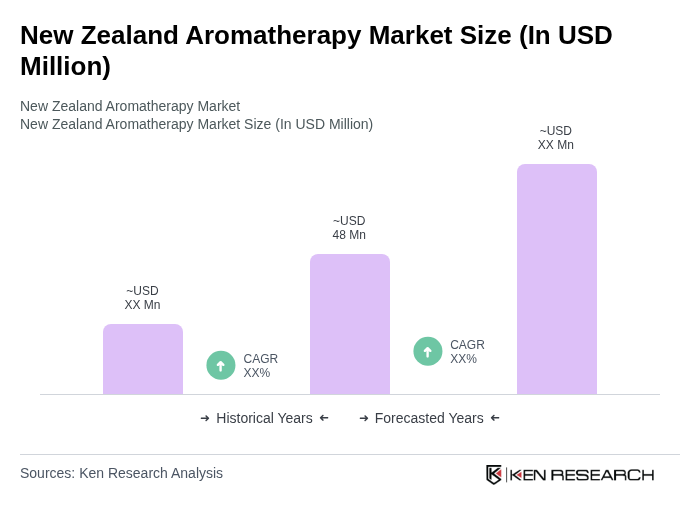
- The New Zealand Aromatherapy Market is valued at USD 48 million, based on a five-year historical analysis. This growth is primarily driven by increasing consumer awareness of natural wellness solutions, the rising popularity of holistic health practices, and the growing demand for essential oils in personal care and wellness products.
- Auckland, Wellington, and Christchurch are the dominant cities in the New Zealand Aromatherapy Market. Auckland leads due to its larger population and higher concentration of wellness centers and spas, while Wellington and Christchurch follow closely with their growing health-conscious communities and increasing retail presence of aromatherapy products.
- The New Zealand government enforces quality and safety standards for essential oils and aromatherapy products through mandatory labeling requirements and adherence to safety protocols, aimed at protecting consumers and promoting the responsible use of natural products in the wellness industry.
New Zealand Aromatherapy Market Segmentation
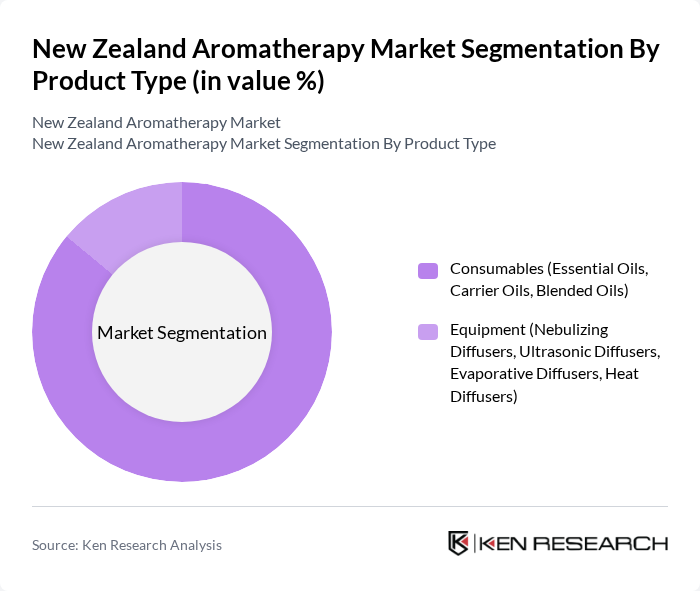
By Product Type:The product type segmentation includes consumables and equipment. Consumables consist of essential oils, carrier oils, and blended oils, while equipment includes various types of diffusers such as nebulizing, ultrasonic, evaporative, and heat diffusers. The consumables segment is currently dominating the market due to the increasing consumer preference for natural and organic products, with consumables expected to account for approximately 86 percent of the market share.
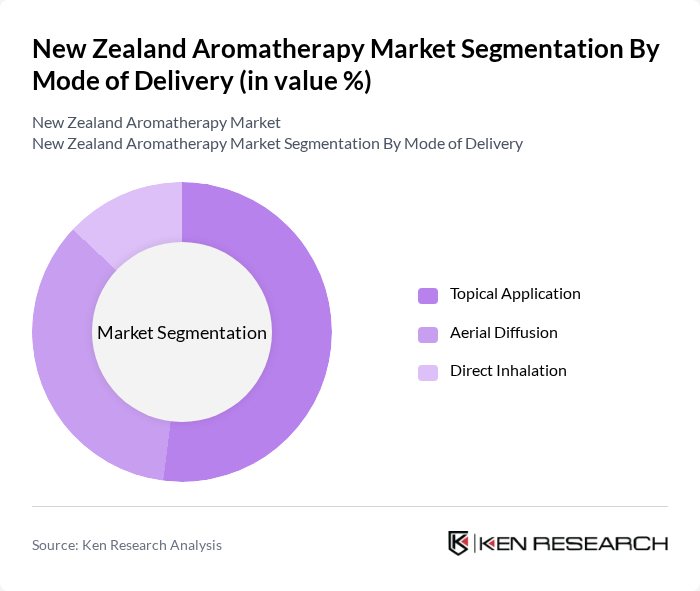
By Mode of Delivery:The mode of delivery segmentation includes topical application, aerial diffusion, and direct inhalation. Topical application is the most popular method among consumers, as it allows for direct skin benefits and is widely used in personal care products, commanding approximately 52 percent market share. Aerial diffusion is also gaining traction in wellness spaces, while direct inhalation is preferred for therapeutic purposes.
New Zealand Aromatherapy Market Competitive Landscape
The New Zealand Aromatherapy Market is characterized by a dynamic mix of regional and international players. Leading participants such as doTERRA International LLC, Rocky Mountain Oils LLC, Plant Therapy Essential Oils, Edens Garden, EO Products, Sparoom, Biolandes SAS, Frontier Cooperative, Stadler Aktiengesellschaft, Ryohin Keikaku Co. Ltd, Pure Essential Oils, Living Nature, Aroha Oils, The Herb Farm, Essence of New Zealand contribute to innovation, geographic expansion, and service delivery in this space.
New Zealand Aromatherapy Market Industry Analysis
Growth Drivers
- Increasing Consumer Awareness of Health Benefits:The New Zealand aromatherapy market is experiencing a surge in consumer awareness regarding the health benefits of essential oils. According to the Ministry of Health, approximately 70% of New Zealanders are now aware of the therapeutic properties of essential oils, leading to a significant increase in demand. This heightened awareness is supported by a growing body of research, with over 250 studies published in the last five years highlighting the efficacy of aromatherapy in stress relief and overall well-being.
- Rising Demand for Natural and Organic Products:The trend towards natural and organic products is reshaping the New Zealand aromatherapy market. In future, the organic personal care market is projected to reach NZD 400 million, with aromatherapy products comprising a significant portion. This shift is driven by consumer preferences for sustainable and chemical-free options, as evidenced by a 50% increase in sales of organic essential oils over the past two years, reflecting a broader global trend towards health-conscious purchasing.
- Expansion of E-commerce Platforms:The growth of e-commerce platforms is revolutionizing the distribution of aromatherapy products in New Zealand. In future, online sales are expected to account for 45% of total aromatherapy sales, up from 30% in the previous period. This shift is facilitated by increased internet penetration, which reached 98% recently, and the convenience of online shopping, allowing consumers to access a wider range of products and brands, thus driving market growth.
Market Challenges
- Regulatory Compliance Complexities:Navigating the regulatory landscape poses significant challenges for the New Zealand aromatherapy market. The Ministry of Health has stringent guidelines regarding the labeling and safety of essential oils, which can complicate product launches. In future, compliance costs are estimated to reach NZD 6 million for small to medium enterprises, potentially hindering innovation and market entry for new players, thereby impacting overall market growth.
- High Competition from Alternative Therapies:The aromatherapy market faces intense competition from alternative therapies such as acupuncture and herbal medicine. In future, the alternative therapy market in New Zealand is projected to be valued at NZD 500 million, overshadowing the aromatherapy segment. This competitive pressure can limit market share and growth opportunities for aromatherapy brands, as consumers often opt for more established therapies with proven efficacy and broader acceptance.
New Zealand Aromatherapy Market Future Outlook
The New Zealand aromatherapy market is poised for significant growth, driven by increasing consumer interest in holistic health and wellness. As more individuals seek natural remedies, the demand for innovative product formulations and personalized solutions is expected to rise. Additionally, the integration of technology in aromatherapy devices will enhance user experience, while sustainability trends will push brands towards eco-friendly practices. These factors collectively indicate a vibrant future for the aromatherapy sector, with opportunities for expansion and diversification.
Market Opportunities
- Development of Innovative Product Formulations:There is a growing opportunity for brands to create unique product formulations that cater to specific consumer needs, such as stress relief or sleep enhancement. With the New Zealand wellness market projected to reach NZD 1.5 billion in future, innovative aromatherapy products can capture a significant share, appealing to health-conscious consumers seeking tailored solutions.
- Collaborations with Wellness Centers:Partnering with wellness centers and spas presents a lucrative opportunity for aromatherapy brands. By integrating aromatherapy into wellness programs, brands can enhance their visibility and credibility. In future, wellness tourism in New Zealand is expected to generate NZD 600 million, providing a substantial market for aromatherapy products and services, thereby fostering growth through strategic collaborations.
Scope of the Report
| Segment | Sub-Segments |
|---|---|
| By Product Type | Consumables (Essential Oils, Carrier Oils, Blended Oils) Equipment (Nebulizing Diffusers, Ultrasonic Diffusers, Evaporative Diffusers, Heat Diffusers) |
| By Mode of Delivery | Topical Application Aerial Diffusion Direct Inhalation |
| By Application | Relaxation Skin & Hair Care Pain Management Cold & Cough Insomnia Scar Management Other Remedies |
| By End-User | Home Use Spa & Wellness Centers Hospitals & Clinics Yoga & Meditation Centers |
| By Distribution Channel | Direct-to-Consumer (DTC) Business-to-Business (B2B) Online Retail Specialty Stores Supermarkets/Hypermarkets Pharmacies |
Key Target Audience
Investors and Venture Capitalist Firms
Government and Regulatory Bodies (e.g., Ministry of Health, Environmental Protection Authority)
Manufacturers and Producers
Distributors and Retailers
Natural Health Product Associations
Wellness and Spa Industry Stakeholders
Importers and Exporters of Essential Oils
Health and Wellness Influencers
Players Mentioned in the Report:
doTERRA International LLC
Rocky Mountain Oils LLC
Plant Therapy Essential Oils
Edens Garden
EO Products
Sparoom
Biolandes SAS
Frontier Cooperative
Stadler Aktiengesellschaft
Ryohin Keikaku Co. Ltd
Pure Essential Oils
Living Nature
Aroha Oils
The Herb Farm
Essence of New Zealand
Table of Contents
Market Assessment Phase
1. Executive Summary and Approach
2. New Zealand Aromatherapy Market Overview
2.1 Key Insights and Strategic Recommendations
2.2 New Zealand Aromatherapy Market Overview
2.3 Definition and Scope
2.4 Evolution of Market Ecosystem
2.5 Timeline of Key Regulatory Milestones
2.6 Value Chain & Stakeholder Mapping
2.7 Business Cycle Analysis
2.8 Policy & Incentive Landscape
3. New Zealand Aromatherapy Market Analysis
3.1 Growth Drivers
3.1.1 Increasing consumer awareness of health benefits
3.1.2 Rising demand for natural and organic products
3.1.3 Growth in wellness tourism
3.1.4 Expansion of e-commerce platforms
3.2 Market Challenges
3.2.1 Regulatory compliance complexities
3.2.2 High competition from alternative therapies
3.2.3 Limited consumer education on product usage
3.2.4 Supply chain disruptions
3.3 Market Opportunities
3.3.1 Development of innovative product formulations
3.3.2 Collaborations with wellness centers
3.3.3 Expansion into international markets
3.3.4 Increasing popularity of DIY aromatherapy kits
3.4 Market Trends
3.4.1 Growth of subscription-based models
3.4.2 Integration of technology in aromatherapy devices
3.4.3 Focus on sustainability and eco-friendly packaging
3.4.4 Rise of personalized aromatherapy solutions
3.5 Government Regulation
3.5.1 Standards for essential oil purity
3.5.2 Labeling requirements for aromatherapy products
3.5.3 Import regulations for essential oils
3.5.4 Health and safety guidelines for product usage
4. SWOT Analysis
5. Stakeholder Analysis
6. Porter's Five Forces Analysis
7. New Zealand Aromatherapy Market Market Size, 2019-2024
7.1 By Value
7.2 By Volume
7.3 By Average Selling Price
8. New Zealand Aromatherapy Market Segmentation
8.1 By Product Type
8.1.1 Consumables (Essential Oils, Carrier Oils, Blended Oils)
8.1.2 Equipment (Nebulizing Diffusers, Ultrasonic Diffusers, Evaporative Diffusers, Heat Diffusers)
8.2 By Mode of Delivery
8.2.1 Topical Application
8.2.2 Aerial Diffusion
8.2.3 Direct Inhalation
8.3 By Application
8.3.1 Relaxation
8.3.2 Skin & Hair Care
8.3.3 Pain Management
8.3.4 Cold & Cough
8.3.5 Insomnia
8.3.6 Scar Management
8.3.7 Other Remedies
8.4 By End-User
8.4.1 Home Use
8.4.2 Spa & Wellness Centers
8.4.3 Hospitals & Clinics
8.4.4 Yoga & Meditation Centers
8.5 By Distribution Channel
8.5.1 Direct-to-Consumer (DTC)
8.5.2 Business-to-Business (B2B)
8.5.3 Online Retail
8.5.4 Specialty Stores
8.5.5 Supermarkets/Hypermarkets
8.5.6 Pharmacies
9. New Zealand Aromatherapy Market Competitive Analysis
9.1 Market Share of Key Players
9.2 Cross Comparison of Key Players
9.2.1 Company Name
9.2.2 Revenue (USD Million)
9.2.3 Year-over-Year Revenue Growth Rate (%)
9.2.4 Market Share (%)
9.2.5 Product Portfolio Breadth (Number of SKUs)
9.2.6 Geographic Presence (Number of Countries)
9.2.7 Distribution Channel Diversity Index
9.2.8 Customer Acquisition Cost (CAC)
9.2.9 Customer Lifetime Value (CLV)
9.2.10 Net Promoter Score (NPS)
9.3 SWOT Analysis of Top Players
9.4 Pricing Analysis
9.5 Detailed Profile of Major Companies
9.5.1 doTERRA International LLC
9.5.2 Rocky Mountain Oils LLC
9.5.3 Plant Therapy Essential Oils
9.5.4 Edens Garden
9.5.5 EO Products
9.5.6 Sparoom
9.5.7 Biolandes SAS
9.5.8 Frontier Cooperative
9.5.9 Stadler Aktiengesellschaft
9.5.10 Ryohin Keikaku Co. Ltd
9.5.11 Pure Essential Oils
9.5.12 Living Nature
9.5.13 Aroha Oils
9.5.14 The Herb Farm
9.5.15 Essence of New Zealand
10. New Zealand Aromatherapy Market End-User Analysis
10.1 Procurement Behavior of Key Ministries
10.1.1 Budget Allocation for Wellness Programs
10.1.2 Preference for Local Suppliers
10.1.3 Evaluation Criteria for Product Selection
10.1.4 Frequency of Procurement Cycles
10.2 Corporate Spend on Infrastructure & Energy
10.2.1 Investment in Wellness Facilities
10.2.2 Spending on Employee Wellness Programs
10.2.3 Budget for Aromatherapy Products
10.3 Pain Point Analysis by End-User Category
10.3.1 Lack of Awareness about Benefits
10.3.2 Accessibility of Quality Products
10.3.3 High Costs of Premium Products
10.4 User Readiness for Adoption
10.4.1 Familiarity with Aromatherapy
10.4.2 Willingness to Experiment with New Products
10.4.3 Availability of Information and Resources
10.5 Post-Deployment ROI and Use Case Expansion
10.5.1 Measurement of Effectiveness
10.5.2 Feedback Mechanisms for Improvement
10.5.3 Opportunities for Product Line Expansion
11. New Zealand Aromatherapy Market Future Size, 2025-2030
11.1 By Value
11.2 By Volume
11.3 By Average Selling Price
Go-To-Market Strategy Phase
12. Whitespace Analysis + Business Model Canvas
12.1 Market Gaps Identification
12.2 Value Proposition Development
12.3 Revenue Streams Analysis
12.4 Cost Structure Evaluation
12.5 Key Partnerships Exploration
12.6 Customer Segments Definition
12.7 Channels Strategy
13. Marketing and Positioning Recommendations
13.1 Branding Strategies
13.2 Product USPs
14. Distribution Plan
14.1 Urban Retail vs Rural NGO Tie-ups
15. Channel & Pricing Gaps
15.1 Underserved Routes
15.2 Pricing Bands
16. Unmet Demand & Latent Needs
16.1 Category Gaps
16.2 Consumer Segments
17. Customer Relationship
17.1 Loyalty Programs
17.2 After-sales Service
18. Value Proposition
18.1 Sustainability
18.2 Integrated Supply Chains
19. Key Activities
19.1 Regulatory Compliance
19.2 Branding
19.3 Distribution Setup
20. Entry Strategy Evaluation
20.1 Domestic Market Entry Strategy
20.1.1 Product Mix
20.1.2 Pricing Band
20.1.3 Packaging
20.2 Export Entry Strategy
20.2.1 Target Countries
20.2.2 Compliance Roadmap
21. Entry Mode Assessment
21.1 JV
21.2 Greenfield
21.3 M&A
21.4 Distributor Model
22. Capital and Timeline Estimation
22.1 Capital Requirements
22.2 Timelines
23. Control vs Risk Trade-Off
23.1 Ownership vs Partnerships
24. Profitability Outlook
24.1 Breakeven Analysis
24.2 Long-term Sustainability
25. Potential Partner List
25.1 Distributors
25.2 JVs
25.3 Acquisition Targets
26. Execution Roadmap
26.1 Phased Plan for Market Entry
26.1.1 Market Setup
26.1.2 Market Entry
26.1.3 Growth Acceleration
26.1.4 Scale & Stabilize
26.2 Key Activities and Milestones
26.2.1 Milestone Planning
26.2.2 Activity Tracking
27. Disclaimer
Research Methodology
Phase 1: Approach1
Desk Research
- Analysis of industry reports from New Zealand's Ministry of Health and Aromatherapy Association
- Review of market trends and consumer behavior studies published by local universities
- Examination of import/export data and trade statistics from New Zealand Customs
Primary Research
- Interviews with key stakeholders in the aromatherapy industry, including manufacturers and distributors
- Surveys conducted with aromatherapy practitioners and wellness center owners
- Focus groups with consumers to understand preferences and purchasing behavior
Validation & Triangulation
- Cross-validation of findings through multiple data sources, including sales data and consumer feedback
- Triangulation of insights from industry experts and market analysts
- Sanity checks through peer reviews and expert panel discussions
Phase 2: Market Size Estimation1
Top-down Assessment
- Estimation of market size based on national health and wellness spending trends
- Segmentation of the market by product type, including essential oils, diffusers, and related accessories
- Incorporation of demographic data to assess potential market growth among different age groups
Bottom-up Modeling
- Collection of sales data from leading aromatherapy product retailers and online platforms
- Estimation of average transaction values and purchase frequencies among consumers
- Volume estimates based on production capacities of local manufacturers
Forecasting & Scenario Analysis
- Multi-variable forecasting using trends in wellness tourism and holistic health practices
- Scenario analysis based on potential regulatory changes affecting essential oil usage
- Development of baseline, optimistic, and pessimistic market growth projections through 2030
Phase 3: CATI Sample Composition1
| Scope Item/Segment | Sample Size | Target Respondent Profiles |
|---|---|---|
| Aromatherapy Product Retailers | 100 | Store Managers, Product Buyers |
| Wellness Centers and Spas | 80 | Wellness Practitioners, Spa Managers |
| Consumers of Aromatherapy Products | 120 | Health-Conscious Individuals, Aromatherapy Users |
| Manufacturers of Essential Oils | 60 | Production Managers, Quality Control Officers |
| Distributors and Wholesalers | 70 | Sales Representatives, Distribution Managers |
Frequently Asked Questions
What is the current value of the New Zealand Aromatherapy Market?
The New Zealand Aromatherapy Market is valued at approximately USD 48 million, reflecting a growing consumer interest in natural wellness solutions and holistic health practices, particularly in major cities like Auckland, Wellington, and Christchurch.
What factors are driving the growth of the New Zealand Aromatherapy Market?
Which cities are the largest markets for aromatherapy in New Zealand?
What are the main product types in the New Zealand Aromatherapy Market?
Other Regional/Country Reports
Other Adjacent Reports
KSA Wellness and Spa Market
New Zealand Natural Personal Care Market Size Share Growth Drivers Trends Opportunities & Forecast 2025–2030South Korea Organic Beauty Products Market
Germany Holistic Health Services Market
Qatar Alternative Therapies Market
KSA herbal medicine market report size, share, growth drivers, trends, opportunities & forecast 2025–2030Vietnam Health Supplements Market Outlook to 2030Bahrain E-commerce Wellness Products Market
Belgium Aromatherapy Equipment Market
Why Buy From Us?

What makes us stand out is that our consultants follow Robust, Refine and Result (RRR) methodology. Robust for clear definitions, approaches and sanity checking, Refine for differentiating respondents' facts and opinions, and Result for presenting data with story.

We have set a benchmark in the industry by offering our clients with syndicated and customized market research reports featuring coverage of entire market as well as meticulous research and analyst insights.

While we don't replace traditional research, we flip the method upside down. Our dual approach of Top Bottom & Bottom Top ensures quality deliverable by not just verifying company fundamentals but also looking at the sector and macroeconomic factors.

With one step in the future, our research team constantly tries to show you the bigger picture. We help with some of the tough questions you may encounter along the way: How is the industry positioned? Best marketing channel? KPI's of competitors? By aligning every element, we help maximize success.

Our report gives you instant access to the answers and sources that other companies might choose to hide. We elaborate each steps of research methodology we have used and showcase you the sample size to earn your trust.

If you need any support, we are here! We pride ourselves on universe strength, data quality, and quick, friendly, and professional service.