About the Report
Base Year 2024New Zealand Diaphragm Pump Market Overview
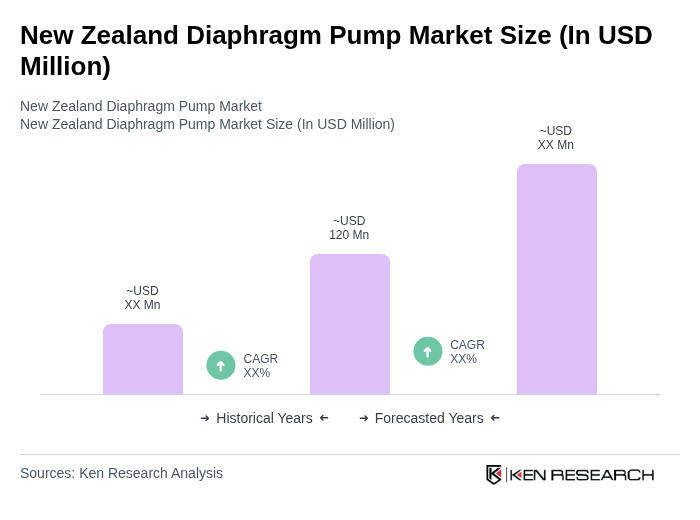
- The New Zealand Diaphragm Pump Market is valued at USD 120 million, based on a five-year historical analysis and New Zealand’s share within the broader regional pumps market. This growth is primarily driven by increasing demand from various industries, including water and wastewater management, food and beverage, chemicals, and pharmaceuticals, where diaphragm pumps are widely used for metering, dosing, and handling corrosive or abrasive fluids. The need for efficient fluid transfer solutions, stricter environmental and discharge standards in water and wastewater treatment, and a rising focus on energy efficiency and operational reliability have further propelled market expansion.
- Auckland and Wellington are the dominant cities in the New Zealand Diaphragm Pump Market due to their robust industrial and commercial base and significant investments in infrastructure and water projects, including upgrades to water and wastewater treatment facilities and pipeline networks. These cities host numerous manufacturing, food and beverage processing, chemical, and municipal utilities operations, which require reliable pumping solutions for dosing, transfer, and sludge handling, thereby driving demand for diaphragm pumps in the region.
- Energy performance requirements for pumps and motor-driven systems in New Zealand are guided by the Energy Efficiency (Energy Using Products) Regulations 2002 administered by the Ministry of Business, Innovation and Employment, together with referenced standards such as AS/NZS 1359 for electric motors and ISO/ASME pump efficiency standards, which drive the selection of more energy-efficient pumping equipment in industrial and infrastructure applications. These regulatory and policy frameworks, along with national greenhouse gas reduction and energy-efficiency targets, are encouraging end users to adopt advanced diaphragm pump technologies with higher efficiency, improved controls, and lower lifecycle energy consumption.
New Zealand Diaphragm Pump Market Segmentation
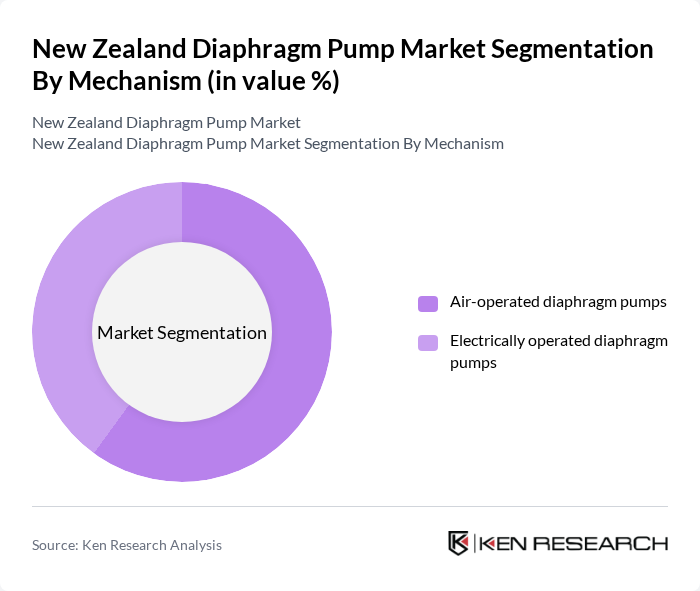
By Mechanism:The diaphragm pump market can be segmented based on the mechanism into two primary types: air-operated diaphragm pumps and electrically operated diaphragm pumps. This aligns with global diaphragm pump classifications, where air-operated (pneumatic) and electrically driven designs are the main categories used across industries. Air-operated diaphragm pumps are widely used due to their versatility, ability to handle slurries, viscous, and chemically aggressive fluids, dry-run capability, and intrinsic safety in hazardous or explosive environments. Electrically operated diaphragm pumps are preferred for their higher energy efficiency, more precise flow control, and ease of integration into automated and continuous process systems, particularly in water treatment, pharmaceuticals, and general manufacturing.
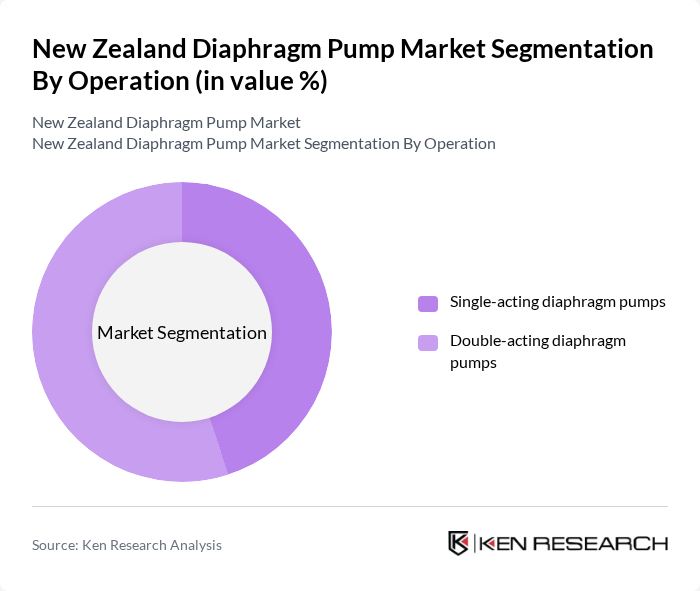
By Operation:The diaphragm pump market is also segmented by operation into single-acting and double-acting diaphragm pumps, consistent with international market breakdowns. Single-acting diaphragm pumps are commonly used for low to moderate pressure applications and intermittent or dosing duties, where simpler construction and lower cost are beneficial. Double-acting diaphragm pumps are favored for their higher volumetric efficiency, smoother discharge flow, and ability to handle larger volumes and more demanding industrial duties such as continuous transfer in chemicals, mining, and water and wastewater treatment.
New Zealand Diaphragm Pump Market Competitive Landscape
The New Zealand Diaphragm Pump Market is characterized by a dynamic mix of regional and international players. Leading participants such as Graco Inc., Ingersoll Rand (ARO), Xylem Inc., Verder Group, PSG Dover (Pump Solutions Group), Wanner Engineering Inc., SANDPIPER Pumps, ProMinent Group, Ebsray Pumps, Haskel International, Watson-Marlow Fluid Technology Solutions, Celeros Flow Technology, Tapflo Group, Yamada Corporation, and local New Zealand suppliers contribute to innovation, geographic expansion, and service delivery in this space.
New Zealand Diaphragm Pump Market Industry Analysis
Growth Drivers
- Increasing Demand for Efficient Fluid Transfer Solutions:The New Zealand diaphragm pump market is experiencing a surge in demand due to the need for efficient fluid transfer solutions across various sectors. In future, the industrial sector is projected to contribute approximately NZD 34 billion to the economy, driving the need for reliable pumping systems. This demand is further supported by the anticipated growth in manufacturing output, which is expected to reach NZD 29 billion, emphasizing the importance of effective fluid management in production processes.
- Rising Industrial Automation and Process Optimization:The trend towards industrial automation is significantly influencing the diaphragm pump market in New Zealand. With an expected increase in automation investments to NZD 1.8 billion in future, industries are seeking advanced pumping solutions that enhance operational efficiency. This shift is driven by the need to reduce labor costs and improve productivity, with automated systems projected to increase output by 22% across key sectors, including manufacturing and food processing.
- Growth in Wastewater Treatment and Environmental Regulations:The New Zealand government is intensifying its focus on wastewater treatment, with an investment of NZD 600 million earmarked for infrastructure improvements in future. This regulatory push is driven by stringent environmental standards aimed at reducing pollution levels. Consequently, the demand for diaphragm pumps, which are essential for effective wastewater management, is expected to rise, as industries comply with these regulations and seek sustainable solutions for fluid handling.
Market Challenges
- High Initial Investment Costs:One of the significant challenges facing the diaphragm pump market in New Zealand is the high initial investment required for advanced pumping systems. The average cost of a diaphragm pump can range from NZD 2,200 to NZD 11,000, depending on specifications. This financial barrier can deter small and medium-sized enterprises from adopting these technologies, limiting market growth and innovation in fluid transfer solutions.
- Competition from Alternative Pumping Technologies:The diaphragm pump market faces stiff competition from alternative pumping technologies, such as centrifugal and peristaltic pumps. These alternatives often come with lower upfront costs and simpler maintenance requirements. In future, it is estimated that alternative pumping technologies will capture approximately 42% of the market share, posing a challenge for diaphragm pump manufacturers to differentiate their products and demonstrate their unique advantages in specific applications.
New Zealand Diaphragm Pump Market Future Outlook
The future of the New Zealand diaphragm pump market appears promising, driven by technological advancements and increasing environmental awareness. As industries continue to prioritize energy efficiency and sustainability, diaphragm pumps are likely to evolve, incorporating smart technologies and IoT capabilities. Furthermore, the expansion of the food and beverage sector, alongside stringent environmental regulations, will create new opportunities for diaphragm pump applications, ensuring their relevance in a rapidly changing industrial landscape.
Market Opportunities
- Technological Advancements in Pump Design:Innovations in diaphragm pump design, such as enhanced materials and energy-efficient motors, present significant market opportunities. These advancements can lead to improved performance and reduced operational costs, appealing to industries focused on optimizing their fluid transfer processes and minimizing downtime.
- Increasing Focus on Sustainability and Eco-Friendly Products:The growing emphasis on sustainability is driving demand for eco-friendly diaphragm pumps. Manufacturers that prioritize sustainable practices and materials can tap into a market segment increasingly concerned with environmental impact, potentially increasing their market share and customer loyalty in the process.
Scope of the Report
| Segment | Sub-Segments |
|---|---|
| By Mechanism | Air-operated diaphragm pumps Electrically operated diaphragm pumps |
| By Operation | Single-acting diaphragm pumps Double-acting diaphragm pumps |
| By Discharge Pressure | Up to 80 bar –200 bar Above 200 bar |
| By End-User Industry | Water & wastewater Oil & gas Chemicals & petrochemicals Food & beverage Pharmaceuticals & biotechnology Other industries (power generation, mining, pulp & paper, paints & coatings) |
| By Application | Transfer and circulation Metering and dosing Sludge and slurry handling Chemical injection Others |
| By Material of Construction | Metallic diaphragm pumps Non-metallic (plastic/composite) diaphragm pumps Lined and specialty alloy pumps |
| By Distribution Channel | Direct sales (OEMs and large key accounts) Industrial distributors and dealers Online and catalog sales Systems integrators and EPC contractors |
Key Target Audience
Investors and Venture Capitalist Firms
Government and Regulatory Bodies (e.g., Environmental Protection Authority, Ministry of Business, Innovation and Employment)
Manufacturers and Producers
Distributors and Retailers
Industrial Equipment Suppliers
Water and Wastewater Management Authorities
Construction and Infrastructure Development Companies
Mining and Resource Extraction Companies
Players Mentioned in the Report:
Graco Inc.
Ingersoll Rand (ARO)
Xylem Inc.
Verder Group
PSG Dover (Pump Solutions Group)
Wanner Engineering Inc.
SANDPIPER Pumps
ProMinent Group
Ebsray Pumps
Haskel International
Watson-Marlow Fluid Technology Solutions
Celeros Flow Technology
Tapflo Group
Yamada Corporation
Local and regional New Zealand suppliers (overview)
Table of Contents
Market Assessment Phase
1. Executive Summary and Approach
2. New Zealand Diaphragm Pump Market Overview
2.1 Key Insights and Strategic Recommendations
2.2 New Zealand Diaphragm Pump Market Overview
2.3 Definition and Scope
2.4 Evolution of Market Ecosystem
2.5 Timeline of Key Regulatory Milestones
2.6 Value Chain & Stakeholder Mapping
2.7 Business Cycle Analysis
2.8 Policy & Incentive Landscape
3. New Zealand Diaphragm Pump Market Analysis
3.1 Growth Drivers
3.1.1 Increasing demand for efficient fluid transfer solutions
3.1.2 Rising industrial automation and process optimization
3.1.3 Growth in wastewater treatment and environmental regulations
3.1.4 Expansion of the food and beverage industry
3.2 Market Challenges
3.2.1 High initial investment costs
3.2.2 Competition from alternative pumping technologies
3.2.3 Limited awareness of diaphragm pump benefits
3.2.4 Supply chain disruptions affecting availability
3.3 Market Opportunities
3.3.1 Technological advancements in pump design
3.3.2 Growing demand for energy-efficient solutions
3.3.3 Expansion into emerging markets
3.3.4 Increasing focus on sustainability and eco-friendly products
3.4 Market Trends
3.4.1 Shift towards smart and connected pumping solutions
3.4.2 Rising adoption of maintenance-free diaphragm pumps
3.4.3 Integration of IoT in pump monitoring and management
3.4.4 Customization and modular designs gaining popularity
3.5 Government Regulation
3.5.1 Compliance with environmental standards
3.5.2 Regulations on energy efficiency
3.5.3 Safety standards for industrial equipment
3.5.4 Incentives for sustainable manufacturing practices
4. SWOT Analysis
5. Stakeholder Analysis
6. Porter's Five Forces Analysis
7. New Zealand Diaphragm Pump Market Market Size, 2019-2024
7.1 By Value
7.2 By Volume
7.3 By Average Selling Price
8. New Zealand Diaphragm Pump Market Segmentation
8.1 By Mechanism
8.1.1 Air-operated diaphragm pumps
8.1.2 Electrically operated diaphragm pumps
8.2 By Operation
8.2.1 Single-acting diaphragm pumps
8.2.2 Double-acting diaphragm pumps
8.3 By Discharge Pressure
8.3.1 Up to 80 bar
8.3.2 81–200 bar
8.3.3 Above 200 bar
8.4 By End-User Industry
8.4.1 Water & wastewater
8.4.2 Oil & gas
8.4.3 Chemicals & petrochemicals
8.4.4 Food & beverage
8.4.5 Pharmaceuticals & biotechnology
8.4.6 Other industries (power generation, mining, pulp & paper, paints & coatings)
8.5 By Application
8.5.1 Transfer and circulation
8.5.2 Metering and dosing
8.5.3 Sludge and slurry handling
8.5.4 Chemical injection
8.5.5 Others
8.6 By Material of Construction
8.6.1 Metallic diaphragm pumps
8.6.2 Non-metallic (plastic/composite) diaphragm pumps
8.6.3 Lined and specialty alloy pumps
8.7 By Distribution Channel
8.7.1 Direct sales (OEMs and large key accounts)
8.7.2 Industrial distributors and dealers
8.7.3 Online and catalog sales
8.7.4 Systems integrators and EPC contractors
9. New Zealand Diaphragm Pump Market Competitive Analysis
9.1 Market Share of Key Players
9.2 Cross Comparison of Key Players
9.2.1 Company name
9.2.2 Group size (large, medium, or small as per industry convention)
9.2.3 New Zealand diaphragm pump revenue (NZD, latest year)
9.2.4 3-year New Zealand revenue CAGR (%)
9.2.5 New Zealand market share (%)
9.2.6 Revenue share from diaphragm pumps (%)
9.2.7 EBITDA margin from diaphragm pump business (%)
9.2.8 R&D intensity (% of revenue)
9.2.9 Capex intensity (% of revenue)
9.2.10 Average selling price positioning (vs market benchmark)
9.2.11 Installed base in New Zealand (units)
9.2.12 Order backlog / book-to-bill ratio
9.2.13 Customer concentration (top 5 customers’ revenue share %)
9.2.14 Aftermarket / service revenue share (%)
9.2.15 On-time delivery rate (%)
9.3 SWOT Analysis of Top Players
9.4 Pricing Analysis
9.5 Detailed Profile of Major Companies
9.5.1 Graco Inc.
9.5.2 Ingersoll Rand (ARO)
9.5.3 Xylem Inc.
9.5.4 Verder Group
9.5.5 PSG Dover (Pump Solutions Group)
9.5.6 Wanner Engineering Inc.
9.5.7 SANDPIPER Pumps
9.5.8 ProMinent Group
9.5.9 Ebsray Pumps
9.5.10 Haskel International
9.5.11 Watson-Marlow Fluid Technology Solutions
9.5.12 Celeros Flow Technology
9.5.13 Tapflo Group
9.5.14 Yamada Corporation
9.5.15 Local and regional New Zealand suppliers (overview)
10. New Zealand Diaphragm Pump Market End-User Analysis
10.1 Procurement Behavior of Key Ministries
10.1.1 Government procurement policies
10.1.2 Budget allocation for infrastructure projects
10.1.3 Evaluation criteria for suppliers
10.1.4 Contract management practices
10.2 Corporate Spend on Infrastructure & Energy
10.2.1 Investment trends in infrastructure
10.2.2 Energy efficiency initiatives
10.2.3 Budgeting for maintenance and upgrades
10.2.4 Corporate sustainability goals
10.3 Pain Point Analysis by End-User Category
10.3.1 Challenges in fluid handling
10.3.2 Downtime and maintenance issues
10.3.3 Cost management concerns
10.3.4 Compliance with regulations
10.4 User Readiness for Adoption
10.4.1 Awareness of diaphragm pump benefits
10.4.2 Training and support requirements
10.4.3 Financial readiness for investment
10.4.4 Technological readiness for integration
10.5 Post-Deployment ROI and Use Case Expansion
10.5.1 Measurement of operational efficiency gains
10.5.2 Expansion into new applications
10.5.3 Long-term cost savings analysis
10.5.4 User feedback and improvement cycles
11. New Zealand Diaphragm Pump Market Future Size, 2025-2030
11.1 By Value
11.2 By Volume
11.3 By Average Selling Price
Go-To-Market Strategy Phase
1. Whitespace Analysis + Business Model Canvas
1.1 Market gaps and opportunities
2. Marketing and Positioning Recommendations
2.1 Branding strategies
2.2 Product USPs
3. Distribution Plan
3.1 Urban retail vs rural NGO tie-ups
4. Channel & Pricing Gaps
4.1 Underserved routes
4.2 Pricing bands
5. Unmet Demand & Latent Needs
5.1 Category gaps
5.2 Consumer segments
6. Customer Relationship
6.1 Loyalty programs
6.2 After-sales service
7. Value Proposition
7.1 Sustainability
7.2 Integrated supply chains
8. Key Activities
8.1 Regulatory compliance
8.2 Branding
8.3 Distribution setup
9. Entry Strategy Evaluation
9.1 Domestic Market Entry Strategy
9.1.1 Product mix
9.1.2 Pricing band
9.1.3 Packaging
9.2 Export Entry Strategy
9.2.1 Target countries
9.2.2 Compliance roadmap
10. Entry Mode Assessment
10.1 JV
10.2 Greenfield
10.3 M&A
10.4 Distributor Model
11. Capital and Timeline Estimation
11.1 Capital requirements
11.2 Timelines
12. Control vs Risk Trade-Off
12.1 Ownership vs Partnerships
13. Profitability Outlook
13.1 Breakeven analysis
13.2 Long-term sustainability
14. Potential Partner List
14.1 Distributors
14.2 JVs
14.3 Acquisition targets
15. Execution Roadmap
15.1 Phased Plan for Market Entry
15.1.1 Market Setup
15.1.2 Market Entry
15.1.3 Growth Acceleration
15.1.4 Scale & Stabilize
15.2 Key Activities and Milestones
15.2.1 Milestone tracking
15.2.2 Activity scheduling
Research Methodology
Phase 1: Approach1
Desk Research
- Industry reports from New Zealand's Ministry of Business, Innovation and Employment
- Market analysis publications from local trade associations related to diaphragm pumps
- Statistical data from New Zealand's Environmental Protection Authority on pump usage and regulations
Primary Research
- Interviews with key stakeholders in the diaphragm pump manufacturing sector
- Surveys conducted with end-users in industries such as wastewater treatment and food processing
- Field visits to manufacturing plants and distribution centers to gather firsthand insights
Validation & Triangulation
- Cross-validation of findings through multiple data sources including government and industry reports
- Triangulation of market trends with insights from industry experts and practitioners
- Sanity checks through feedback from a panel of experts in fluid dynamics and pump technology
Phase 2: Market Size Estimation1
Top-down Assessment
- Analysis of national industrial output and its correlation with diaphragm pump demand
- Segmentation of the market by application areas such as agriculture, pharmaceuticals, and construction
- Incorporation of government initiatives promoting sustainable practices in pump usage
Bottom-up Modeling
- Collection of sales data from leading diaphragm pump manufacturers in New Zealand
- Estimation of market size based on unit sales and average selling prices across different sectors
- Volume and revenue projections based on historical growth rates and emerging market trends
Forecasting & Scenario Analysis
- Multi-variable regression analysis incorporating economic indicators and industry growth rates
- Scenario planning based on potential regulatory changes and technological advancements
- Development of baseline, optimistic, and pessimistic forecasts through 2030
Phase 3: CATI Sample Composition1
| Scope Item/Segment | Sample Size | Target Respondent Profiles |
|---|---|---|
| Industrial Applications of Diaphragm Pumps | 120 | Plant Managers, Operations Directors |
| Agricultural Pump Usage | 75 | Agronomists, Farm Equipment Managers |
| Water Treatment Facilities | 65 | Environmental Engineers, Facility Managers |
| Food and Beverage Processing | 55 | Quality Control Managers, Production Supervisors |
| Construction and Mining Applications | 85 | Site Managers, Equipment Procurement Officers |
Frequently Asked Questions
What is the current value of the New Zealand Diaphragm Pump Market?
The New Zealand Diaphragm Pump Market is valued at approximately USD 120 million, reflecting a robust demand driven by various industries such as water management, food and beverage, chemicals, and pharmaceuticals.
What factors are driving the growth of the diaphragm pump market in New Zealand?
Which cities are the primary markets for diaphragm pumps in New Zealand?
What are the main types of diaphragm pumps available in New Zealand?
Other Regional/Country Reports
Other Adjacent Reports
Japan Centrifugal Pump Market
Vietnam Peristaltic Pump Market
UAE metering pump market report size, share, growth drivers, trends, opportunities & forecast 2025–2030Bahrain Dosing Pump Market
UAE Wastewater Treatment Market
Japan Chemical Processing Market
UAE Pharmaceutical Equipment MarketBahrain Food and Beverage Processing Market
United States Industrial Automation Market Outlook to 2030: Size, Share, Growth and TrendsIndonesia Fluid Handling Systems Market
Why Buy From Us?

What makes us stand out is that our consultants follow Robust, Refine and Result (RRR) methodology. Robust for clear definitions, approaches and sanity checking, Refine for differentiating respondents' facts and opinions, and Result for presenting data with story.

We have set a benchmark in the industry by offering our clients with syndicated and customized market research reports featuring coverage of entire market as well as meticulous research and analyst insights.

While we don't replace traditional research, we flip the method upside down. Our dual approach of Top Bottom & Bottom Top ensures quality deliverable by not just verifying company fundamentals but also looking at the sector and macroeconomic factors.

With one step in the future, our research team constantly tries to show you the bigger picture. We help with some of the tough questions you may encounter along the way: How is the industry positioned? Best marketing channel? KPI's of competitors? By aligning every element, we help maximize success.

Our report gives you instant access to the answers and sources that other companies might choose to hide. We elaborate each steps of research methodology we have used and showcase you the sample size to earn your trust.

If you need any support, we are here! We pride ourselves on universe strength, data quality, and quick, friendly, and professional service.