About the Report
Base Year 2024New Zealand Elevator Escalator Market Overview
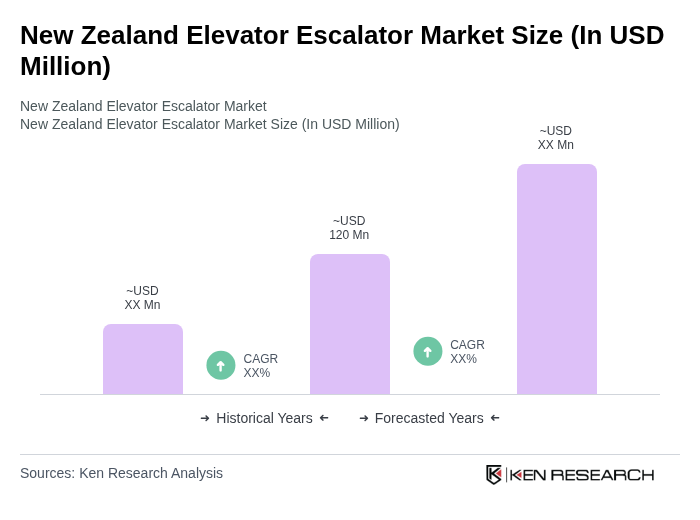
- The New Zealand Elevator Escalator Market is valued at USD 110 million, based on a five-year historical analysis. This growth is primarily driven by urbanization, increased construction activities, rising demand for efficient vertical transportation solutions in both residential and commercial sectors, and a focus on energy-efficient and smart technologies in high-rise buildings.
- Auckland, Wellington, and Christchurch are the dominant cities in the New Zealand Elevator Escalator Market. Their dominance is attributed to significant infrastructure development, population growth, and a high concentration of commercial buildings, which necessitate advanced elevator and escalator systems.
- The Building Code of Australia and New Zealand Building Code, administered by the Ministry of Business, Innovation and Employment (MBIE), 2022, mandates compliance with energy performance standards including Clause H1 Energy Efficiency for elevators and escalators in new buildings, requiring minimum energy ratings and operational efficiency thresholds for lighting, standby power, and regenerative drives. This initiative aims to enhance energy conservation and reduce carbon emissions, aligning with the country's sustainability goals.
New Zealand Elevator Escalator Market Segmentation
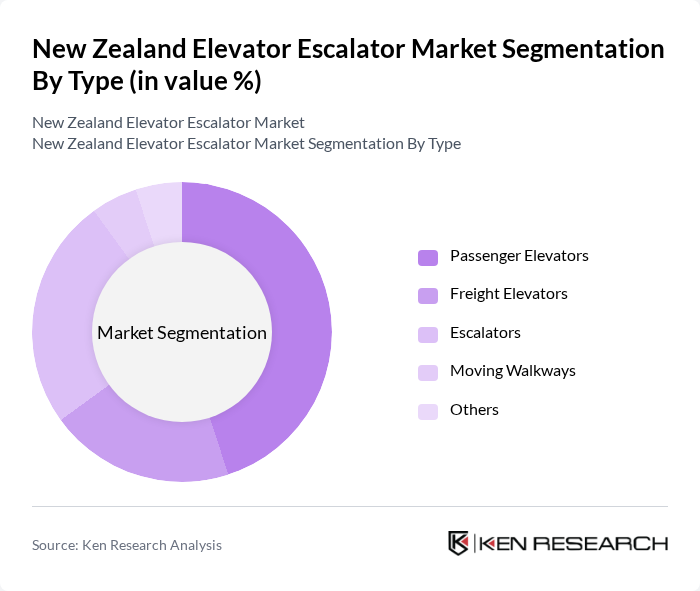
By Type:The market is segmented into various types, including Elevators, Passenger Elevators, Cargo Elevators, Home Elevators, Escalators, and Moving Walkways. Among these, Passenger Elevators dominate the market due to their widespread use in commercial and residential buildings. The increasing number of high-rise buildings and the demand for efficient transportation solutions in urban areas have significantly contributed to the growth of this segment. Escalators and Moving Walkways are also gaining traction, particularly in shopping malls and airports, where high foot traffic necessitates efficient movement.
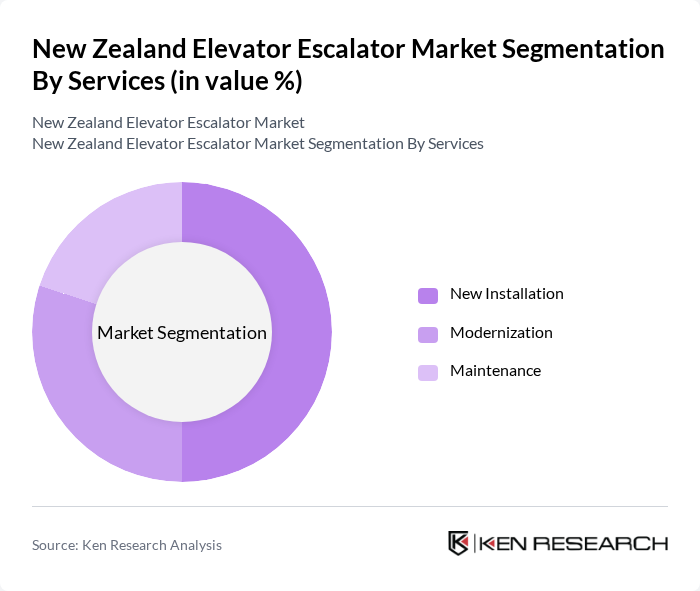
By Services:The services segment includes New Installation, Modernization, and Maintenance. New Installation is the leading service type, driven by the ongoing construction of residential and commercial buildings. The modernization of existing systems is also gaining importance as building owners seek to upgrade to energy-efficient models. Maintenance services are crucial for ensuring the longevity and safety of elevator and escalator systems, contributing to the overall market growth.
New Zealand Elevator Escalator Market Competitive Landscape
The New Zealand Elevator Escalator Market is characterized by a dynamic mix of regional and international players. Leading participants such as Otis Elevator Company, Schindler Group, KONE Corporation, TK Elevator, Mitsubishi Electric Corporation, Fujitec Co., Ltd., Hitachi, Ltd., Johnson Lifts, Aritco Lift AB, Express Elevators, Schmitt + Sohn Aufzüge GmbH, Canny Elevator, Eita Elevator, Stannah Lifts, Thyssenkrupp Access contribute to innovation, geographic expansion, and service delivery in this space.
New Zealand Elevator Escalator Market Industry Analysis
Growth Drivers
- Urbanization and Infrastructure Development:New Zealand's urban population is projected to reach 87% in future, driving demand for elevators and escalators in high-rise buildings. The government has allocated NZD 15 billion for infrastructure projects, including urban transport and commercial developments. This investment is expected to create a robust environment for elevator and escalator installations, particularly in Auckland and Wellington, where urban density is increasing significantly, necessitating efficient vertical transportation solutions.
- Technological Advancements in Elevators and Escalators:The integration of advanced technologies, such as AI and IoT, is revolutionizing the elevator and escalator market in New Zealand. In future, it is estimated that 35% of new installations will feature smart technology, enhancing operational efficiency and user experience. Companies are investing in R&D, with NZD 160 million projected for innovation in safety and energy efficiency, making modern systems more appealing to consumers and businesses alike.
- Increased Demand for Energy-Efficient Solutions:With New Zealand's commitment to reducing carbon emissions by 30% in future, the demand for energy-efficient elevators and escalators is surging. The market for eco-friendly systems is expected to grow, with an estimated NZD 250 million in investments in future. This shift is driven by both regulatory pressures and consumer preferences for sustainable solutions, prompting manufacturers to innovate and offer greener alternatives that comply with energy efficiency regulations.
Market Challenges
- High Initial Investment Costs:The upfront costs associated with installing elevators and escalators can be prohibitive, often exceeding NZD 120,000 for commercial projects. This financial barrier can deter potential buyers, particularly small businesses and developers. As a result, many projects face delays or cancellations, impacting overall market growth. The need for financing options and incentives is critical to overcoming this challenge and stimulating market activity.
- Regulatory Compliance and Safety Standards:Navigating the complex landscape of regulatory compliance poses a significant challenge for the elevator and escalator market. New Zealand's stringent safety standards require regular inspections and certifications, which can incur costs upwards of NZD 12,000 annually for maintenance. Companies must invest in training and compliance measures, which can strain resources and slow down project timelines, ultimately affecting market competitiveness.
New Zealand Elevator Escalator Market Future Outlook
The New Zealand elevator and escalator market is poised for significant growth, driven by urbanization, technological advancements, and a shift towards energy-efficient solutions. As infrastructure projects gain momentum, particularly in urban centers, the demand for modern vertical transportation systems will increase. Additionally, the integration of smart technologies and eco-friendly designs will enhance user experience and operational efficiency, positioning the market for robust expansion in the coming years, despite existing challenges.
Market Opportunities
- Expansion in Commercial Real Estate:The commercial real estate sector is expected to grow by NZD 6 billion in future, creating substantial opportunities for elevator and escalator installations. As new office buildings and shopping centers emerge, the demand for efficient vertical transport solutions will rise, providing a lucrative market for manufacturers and service providers.
- Adoption of Smart Technologies:The increasing adoption of smart technologies in building management systems presents a significant opportunity. In future, it is anticipated that 45% of new installations will incorporate IoT features, enhancing operational efficiency and user experience. This trend will drive innovation and create competitive advantages for companies that invest in smart solutions.
Scope of the Report
| Segment | Sub-Segments |
|---|---|
| By Type | Elevators Passenger Elevators Cargo Elevators Home Elevators Escalators Moving Walkways |
| By Services | New Installation Modernization Maintenance |
| By End-User | Residential Commercial Industrial |
| By Elevator Technology | Traction Elevators Machine Room-Less Elevators Hydraulic Elevators |
| By Region | North Island South Island |
Key Target Audience
Investors and Venture Capitalist Firms
Government and Regulatory Bodies (e.g., Ministry of Business, Innovation and Employment)
Manufacturers and Producers
Distributors and Retailers
Construction and Real Estate Developers
Facility Management Companies
Industry Associations (e.g., Elevator and Escalator Association of New Zealand)
Financial Institutions
Players Mentioned in the Report:
Otis Elevator Company
Schindler Group
KONE Corporation
TK Elevator
Mitsubishi Electric Corporation
Fujitec Co., Ltd.
Hitachi, Ltd.
Johnson Lifts
Aritco Lift AB
Express Elevators
Schmitt + Sohn Aufzuge GmbH
Canny Elevator
Eita Elevator
Stannah Lifts
Thyssenkrupp Access
Table of Contents
Market Assessment Phase
1. Executive Summary and Approach
2. New Zealand Elevator Escalator Market Overview
2.1 Key Insights and Strategic Recommendations
2.2 New Zealand Elevator Escalator Market Overview
2.3 Definition and Scope
2.4 Evolution of Market Ecosystem
2.5 Timeline of Key Regulatory Milestones
2.6 Value Chain & Stakeholder Mapping
2.7 Business Cycle Analysis
2.8 Policy & Incentive Landscape
3. New Zealand Elevator Escalator Market Analysis
3.1 Growth Drivers
3.1.1 Urbanization and Infrastructure Development
3.1.2 Technological Advancements in Elevators and Escalators
3.1.3 Increased Demand for Energy-Efficient Solutions
3.1.4 Government Initiatives for Smart Cities
3.2 Market Challenges
3.2.1 High Initial Investment Costs
3.2.2 Regulatory Compliance and Safety Standards
3.2.3 Competition from Alternative Transportation Solutions
3.2.4 Maintenance and Operational Costs
3.3 Market Opportunities
3.3.1 Expansion in Commercial Real Estate
3.3.2 Adoption of Smart Technologies
3.3.3 Growth in the Tourism Sector
3.3.4 Sustainable and Green Building Initiatives
3.4 Market Trends
3.4.1 Integration of IoT in Elevator Systems
3.4.2 Rise of Eco-Friendly Elevators
3.4.3 Customization and Personalization of Services
3.4.4 Focus on Safety and Security Features
3.5 Government Regulation
3.5.1 Building Code Compliance
3.5.2 Safety Standards for Elevators and Escalators
3.5.3 Energy Efficiency Regulations
3.5.4 Accessibility Standards
4. SWOT Analysis
5. Stakeholder Analysis
6. Porter's Five Forces Analysis
7. New Zealand Elevator Escalator Market Market Size, 2019-2024
7.1 By Value
7.2 By Volume
7.3 By Average Selling Price
8. New Zealand Elevator Escalator Market Segmentation
8.1 By Type
8.1.1 Elevators
8.1.2 Passenger Elevators
8.1.3 Cargo Elevators
8.1.4 Home Elevators
8.1.5 Escalators
8.1.6 Moving Walkways
8.2 By Services
8.2.1 New Installation
8.2.2 Modernization
8.2.3 Maintenance
8.3 By End-User
8.3.1 Residential
8.3.2 Commercial
8.3.3 Industrial
8.4 By Elevator Technology
8.4.1 Traction Elevators
8.4.2 Machine Room-Less Elevators
8.4.3 Hydraulic Elevators
8.5 By Region
8.5.1 North Island
8.5.2 South Island
9. New Zealand Elevator Escalator Market Competitive Analysis
9.1 Market Share of Key Players
9.2 Cross Comparison of Key Players
9.2.1 **Revenue Growth (CAGR 2020-2024)**
9.2.2 **EBITDA Margin**
9.2.3 **Market Share %**
9.2.4 **New Installations Volume**
9.2.5 **Maintenance Contract Value**
9.2.6 **Average Selling Price (NZD/unit)**
9.2.7 **R&D Investment % of Revenue**
9.2.8 **Customer Acquisition Cost**
9.2.9 **Net Promoter Score (NPS)**
9.2.10 **Total Addressable Market Penetration**
9.3 SWOT Analysis of Top Players
9.4 Pricing Analysis
9.5 Detailed Profile of Major Companies
9.5.1 Otis Elevator Company
9.5.2 Schindler Group
9.5.3 KONE Corporation
9.5.4 TK Elevator
9.5.5 Mitsubishi Electric Corporation
9.5.6 Fujitec Co., Ltd.
9.5.7 Hitachi, Ltd.
9.5.8 Johnson Lifts
9.5.9 Aritco Lift AB
9.5.10 Express Elevators
9.5.11 Schmitt + Sohn Aufzüge GmbH
9.5.12 Canny Elevator
9.5.13 Eita Elevator
9.5.14 Stannah Lifts
9.5.15 Thyssenkrupp Access
10. New Zealand Elevator Escalator Market End-User Analysis
10.1 Procurement Behavior of Key Ministries
10.1.1 Key Procurement Processes
10.1.2 Budget Allocation Trends
10.1.3 Decision-Making Criteria
10.1.4 Supplier Evaluation Metrics
10.2 Corporate Spend on Infrastructure & Energy
10.2.1 Investment Trends in Infrastructure
10.2.2 Energy Efficiency Initiatives
10.2.3 Budgeting for Elevator and Escalator Solutions
10.3 Pain Point Analysis by End-User Category
10.3.1 Residential Sector Challenges
10.3.2 Commercial Sector Challenges
10.3.3 Industrial Sector Challenges
10.3.4 Government Sector Challenges
10.4 User Readiness for Adoption
10.4.1 Awareness of New Technologies
10.4.2 Willingness to Invest
10.4.3 Training and Support Needs
10.5 Post-Deployment ROI and Use Case Expansion
10.5.1 Measurement of ROI
10.5.2 Case Studies of Successful Implementations
10.5.3 Future Use Case Opportunities
11. New Zealand Elevator Escalator Market Future Size, 2025-2030
11.1 By Value
11.2 By Volume
11.3 By Average Selling Price
Go-To-Market Strategy Phase
1. Whitespace Analysis + Business Model Canvas
1.1 Market Gaps Identification
1.2 Value Proposition Development
1.3 Revenue Streams Analysis
1.4 Cost Structure Evaluation
1.5 Key Partnerships Exploration
1.6 Customer Segmentation
1.7 Channels of Distribution
2. Marketing and Positioning Recommendations
2.1 Branding Strategies
2.2 Product USPs
3. Distribution Plan
3.1 Urban Retail vs Rural NGO Tie-Ups
4. Channel & Pricing Gaps
4.1 Underserved Routes
4.2 Pricing Bands
5. Unmet Demand & Latent Needs
5.1 Category Gaps
5.2 Consumer Segments
6. Customer Relationship
6.1 Loyalty Programs
6.2 After-Sales Service
7. Value Proposition
7.1 Sustainability
7.2 Integrated Supply Chains
8. Key Activities
8.1 Regulatory Compliance
8.2 Branding
8.3 Distribution Setup
9. Entry Strategy Evaluation
9.1 Domestic Market Entry Strategy
9.1.1 Product Mix
9.1.2 Pricing Band
9.1.3 Packaging
9.2 Export Entry Strategy
9.2.1 Target Countries
9.2.2 Compliance Roadmap
10. Entry Mode Assessment
10.1 JV
10.2 Greenfield
10.3 M&A
10.4 Distributor Model
11. Capital and Timeline Estimation
11.1 Capital Requirements
11.2 Timelines
12. Control vs Risk Trade-Off
12.1 Ownership vs Partnerships
13. Profitability Outlook
13.1 Breakeven Analysis
13.2 Long-Term Sustainability
14. Potential Partner List
14.1 Distributors
14.2 JVs
14.3 Acquisition Targets
15. Execution Roadmap
15.1 Phased Plan for Market Entry
15.1.1 Market Setup
15.1.2 Market Entry
15.1.3 Growth Acceleration
15.1.4 Scale & Stabilize
15.2 Key Activities and Milestones
15.2.1 Activity Planning
15.2.2 Milestone Tracking
Research Methodology
Phase 1: Approach1
Desk Research
- Analysis of industry reports from New Zealand's Ministry of Business, Innovation and Employment
- Review of market studies published by local elevator and escalator associations
- Examination of trade publications and journals focusing on the construction and infrastructure sectors
Primary Research
- Interviews with key stakeholders in the elevator and escalator manufacturing sector
- Surveys conducted with building managers and facility operators across commercial and residential properties
- Field interviews with engineers and technicians involved in installation and maintenance services
Validation & Triangulation
- Cross-validation of data through multiple sources including government statistics and industry reports
- Triangulation of findings from primary interviews with secondary data insights
- Sanity checks performed through expert panel discussions with industry veterans
Phase 2: Market Size Estimation1
Top-down Assessment
- Estimation of market size based on national construction spending and infrastructure development plans
- Segmentation of the market by product type (elevators vs. escalators) and application (commercial vs. residential)
- Incorporation of government initiatives promoting vertical transportation solutions in urban areas
Bottom-up Modeling
- Collection of sales data from leading elevator and escalator manufacturers operating in New Zealand
- Operational cost analysis based on installation and maintenance service pricing
- Volume estimates derived from project tenders and contracts awarded in the last five years
Forecasting & Scenario Analysis
- Multi-factor regression analysis incorporating urbanization rates and population growth trends
- Scenario modeling based on potential regulatory changes and technological advancements in vertical transport
- Development of baseline, optimistic, and pessimistic market projections through 2030
Phase 3: CATI Sample Composition1
| Scope Item/Segment | Sample Size | Target Respondent Profiles |
|---|---|---|
| Commercial Building Elevators | 45 | Building Managers, Facility Directors |
| Residential Elevator Installations | 40 | Homeowners, Property Developers |
| Escalator Usage in Retail Spaces | 42 | Retail Managers, Operations Supervisors |
| Maintenance Services for Elevators | 41 | Service Technicians, Maintenance Managers |
| Regulatory Compliance in Vertical Transport | 40 | Compliance Officers, Safety Inspectors |
Frequently Asked Questions
What is the current value of the New Zealand Elevator Escalator Market?
The New Zealand Elevator Escalator Market is valued at approximately USD 110 million, driven by urbanization, increased construction activities, and a demand for efficient vertical transportation solutions in both residential and commercial sectors.
Which cities dominate the New Zealand Elevator Escalator Market?
What are the key growth drivers for the New Zealand Elevator Escalator Market?
What types of elevators and escalators are available in the New Zealand market?
Other Regional/Country Reports
Other Adjacent Reports
UAE Building Construction Market
Smart Building Technology MarketQatar Energy-Efficient Systems Market
Saudi Arabia Commercial Real Estate MarketKSA Infrastructure Development Market
Belgium IoT Solutions Market
U.S. HVAC Systems Market Size, Share & Forecast, By Equipment Type, End-Use Industry & Technology, 2026-2031UAE Fire Safety Systems MarketVietnam Access Control Systems Market
Malaysia Maintenance Services Market
Why Buy From Us?

What makes us stand out is that our consultants follow Robust, Refine and Result (RRR) methodology. Robust for clear definitions, approaches and sanity checking, Refine for differentiating respondents' facts and opinions, and Result for presenting data with story.

We have set a benchmark in the industry by offering our clients with syndicated and customized market research reports featuring coverage of entire market as well as meticulous research and analyst insights.

While we don't replace traditional research, we flip the method upside down. Our dual approach of Top Bottom & Bottom Top ensures quality deliverable by not just verifying company fundamentals but also looking at the sector and macroeconomic factors.

With one step in the future, our research team constantly tries to show you the bigger picture. We help with some of the tough questions you may encounter along the way: How is the industry positioned? Best marketing channel? KPI's of competitors? By aligning every element, we help maximize success.

Our report gives you instant access to the answers and sources that other companies might choose to hide. We elaborate each steps of research methodology we have used and showcase you the sample size to earn your trust.

If you need any support, we are here! We pride ourselves on universe strength, data quality, and quick, friendly, and professional service.