About the Report
Base Year 2024New Zealand Intent Based Networking Market Overview
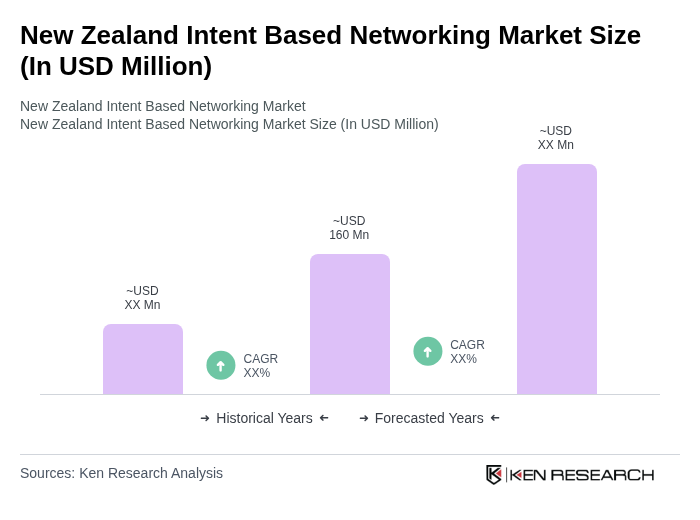
- The New Zealand Intent Based Networking Market is valued at USD 160 million, based on a five-year historical analysis. This growth is primarily driven by the increasing demand for network automation, enhanced security measures, and the need for efficient network management solutions, in line with global trends in intent-based networking and network automation. Organizations are increasingly adopting intent-based networking to improve operational efficiency, reduce configuration errors, and minimize downtime, particularly as they modernize enterprise and data center networks and support cloud, SDN, and zero-trust security initiatives.
- Auckland and Wellington are the dominant cities in the New Zealand Intent Based Networking Market due to their status as major business and government hubs, and their concentration of ICT-intensive sectors. Auckland accounts for a substantial share of New Zealand’s information media and telecommunications enterprises and related employment, while Wellington hosts a large concentration of central government agencies and technology-intensive professional services, driving higher adoption of advanced networking technologies among enterprises and public sector networks. The concentration of skilled digital workforce, cloud and data center infrastructure, and innovation-driven environments in these two cities further contributes to their market dominance in adopting network automation and intent-based networking solutions.
- The Telecommunications (Interception Capability and Security) Act 2013, administered by the Ministry of Business, Innovation and Employment, sets out interception capability and network security obligations for network operators in New Zealand, including requirements to notify and mitigate network security risks that could affect lawful interception or national security. Under this framework, telecommunications providers must work with the Government Communications Security Bureau and the New Zealand Police to ensure that networks are designed and operated with sufficient security, resilience, and visibility, which encourages investment in advanced automation, policy-based control, and analytics capabilities consistent with intent-based networking approaches among service providers and critical network operators.
New Zealand Intent Based Networking Market Segmentation
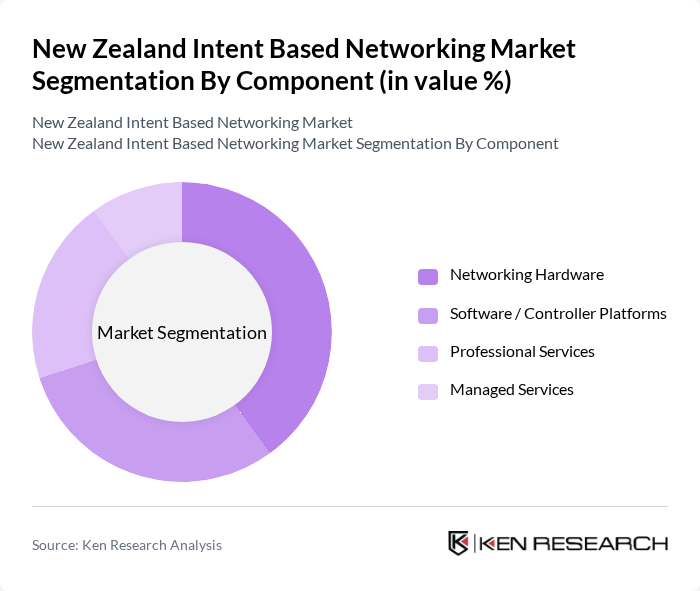
By Component:The components of the market include Networking Hardware, Software / Controller Platforms, Professional Services, and Managed Services. Networking Hardware is crucial as it forms the backbone of the infrastructure, including advanced switches, routers, and data center fabrics that expose telemetry and automation hooks required for intent-driven control. Software / Controller Platforms enable automation and orchestration by translating high-level business intent into network policies, performing closed-loop assurance, and integrating with SDN controllers and security platforms. Professional Services are essential for design, integration, and migration from legacy networks to policy-based and software-defined architectures, while Managed Services provide ongoing management, optimization, and security policy governance for enterprises that prefer to outsource day-to-day network operations.
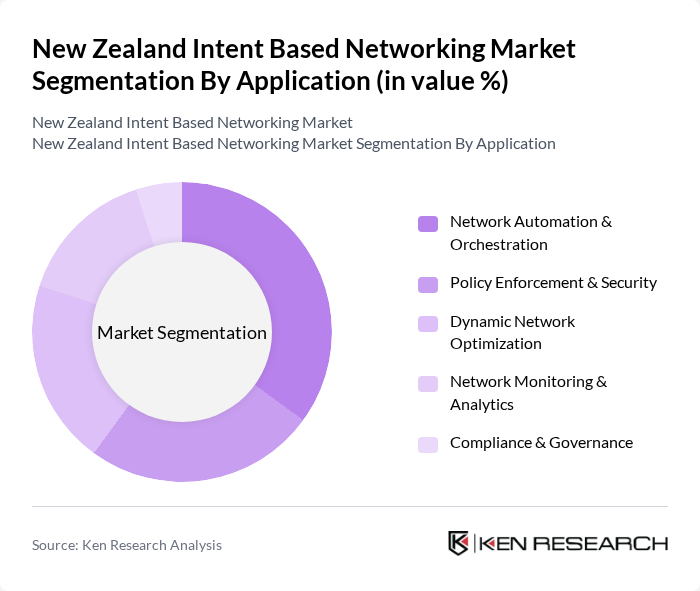
By Application:The applications in the market include Network Automation & Orchestration, Policy Enforcement & Security, Dynamic Network Optimization, Network Monitoring & Analytics, and Compliance & Governance. Network Automation & Orchestration is leading due to the increasing need for streamlined operations, intent-driven provisioning, and rapid change management across hybrid cloud and on-premises environments as networks become more software-defined and complex. Policy Enforcement & Security is critical for safeguarding networks against threats, enabling centralized, intent-based security policies, segmentation, and zero-trust controls that can be automatically verified and remediated using IBN platforms. Dynamic Network Optimization leverages real-time telemetry and analytics to continuously adjust paths, bandwidth, and quality-of-service parameters to meet application performance objectives, while Network Monitoring & Analytics focuses on translating high-volume network data into insights for assurance and troubleshooting. Compliance & Governance applications support auditability, policy consistency, and adherence to security and data-handling requirements across regulated sectors such as government, financial services, and healthcare.
New Zealand Intent Based Networking Market Competitive Landscape
The New Zealand Intent Based Networking Market is characterized by a dynamic mix of regional and international players. Leading participants such as Cisco Systems, Inc., Juniper Networks, Inc., Arista Networks, Inc., VMware, Inc., Hewlett Packard Enterprise (HPE), Extreme Networks, Inc., Nokia Corporation, International Business Machines Corporation (IBM), NETGEAR, Inc., Fortinet, Inc., Palo Alto Networks, Inc., Cato Networks Ltd., Riverbed Technology, Inc., Check Point Software Technologies Ltd., Zscaler, Inc. contribute to innovation, geographic expansion, and service delivery in this space, leveraging their global intent-based networking, SDN, and security portfolios and adapting them to the requirements of New Zealand enterprises and service providers.
New Zealand Intent Based Networking Market Industry Analysis
Growth Drivers
- Increasing Demand for Network Automation:The New Zealand market is witnessing a surge in demand for network automation, driven by the need for operational efficiency. In future, the automation market is projected to reach NZD 1.3 billion, reflecting a 15% increase from the previous year. This growth is fueled by businesses seeking to reduce manual processes and enhance productivity, as 60% of organizations report that automation has significantly improved their operational workflows, according to the New Zealand Business Automation Report.
- Rise in Cybersecurity Threats:Cybersecurity threats are escalating, with New Zealand experiencing a 35% increase in reported incidents recently. The government allocated NZD 120 million for cybersecurity initiatives in future, emphasizing the urgency for robust network security solutions. Organizations are increasingly adopting intent-based networking to enhance their security posture, as 70% of IT leaders cite cybersecurity as a top priority, according to the Cybersecurity New Zealand Report.
- Growth of Cloud-Based Services:The cloud services market in New Zealand is expected to reach NZD 3 billion in future, growing at a rate of 20% annually. This growth is driven by businesses migrating to cloud platforms for scalability and flexibility. As 80% of enterprises plan to increase their cloud investments, the demand for intent-based networking solutions that optimize cloud performance is rising, according to the New Zealand Cloud Adoption Survey.
Market Challenges
- High Implementation Costs:The initial costs associated with implementing intent-based networking solutions can be prohibitive for many organizations. In future, the average expenditure for deployment is estimated at NZD 600,000 per organization, which can deter small to medium enterprises from adopting these technologies. This financial barrier is compounded by the need for ongoing maintenance and updates, making it a significant challenge for market penetration.
- Complexity of Integration with Existing Systems:Integrating intent-based networking solutions with legacy systems poses a significant challenge. Approximately 70% of organizations report difficulties in achieving seamless integration, which can lead to operational disruptions. The complexity of existing IT infrastructures often results in extended deployment timelines, with an average integration period of 6-12 months, according to the New Zealand IT Integration Report.
New Zealand Intent Based Networking Market Future Outlook
The future of the New Zealand intent-based networking market appears promising, driven by technological advancements and increasing digital transformation initiatives. As organizations prioritize automation and cybersecurity, the adoption of AI and machine learning in networking will likely accelerate. Furthermore, the expansion of 5G networks is expected to enhance connectivity and performance, enabling businesses to leverage advanced networking solutions. This evolving landscape will create new opportunities for innovation and collaboration among technology providers and enterprises.
Market Opportunities
- Expansion of IoT Applications:The Internet of Things (IoT) market in New Zealand is projected to reach NZD 1.2 billion in future, creating significant opportunities for intent-based networking solutions. As more devices connect to networks, the demand for automated and intelligent networking will increase, allowing businesses to optimize their operations and enhance data management capabilities.
- Increasing Investments in Digital Transformation:With NZD 1.8 billion allocated for digital transformation initiatives in future, organizations are seeking innovative networking solutions to support their strategies. This investment will drive the adoption of intent-based networking, as companies look to enhance their agility and responsiveness in a rapidly changing market environment.
Scope of the Report
| Segment | Sub-Segments |
|---|---|
| By Component | Networking Hardware Software / Controller Platforms Professional Services Managed Services |
| By Application | Network Automation & Orchestration Policy Enforcement & Security Dynamic Network Optimization Network Monitoring & Analytics Compliance & Governance |
| By Deployment Model | On-Premises Cloud Hybrid |
| By End-User Industry | IT & Telecom Operators BFSI Government & Public Sector Healthcare Manufacturing Education & Research Retail & E?commerce Others (Energy & Utilities, Media & Entertainment, etc.) |
| By Network Domain | Data Center Networks Campus & Enterprise LAN WAN & Branch Networks Cloud & Multi?Cloud Networks |
| By Organization Size | Large Enterprises Small & Medium Enterprises (SMEs) |
Key Target Audience
Investors and Venture Capitalist Firms
Government and Regulatory Bodies (e.g., New Zealand Ministry of Business, Innovation and Employment)
Telecommunications Service Providers
Network Equipment Manufacturers
Cloud Service Providers
Cybersecurity Firms
Industry Associations (e.g., Telecommunications Carriers Forum)
Financial Institutions
Players Mentioned in the Report:
Cisco Systems, Inc.
Juniper Networks, Inc.
Arista Networks, Inc.
VMware, Inc.
Hewlett Packard Enterprise (HPE)
Extreme Networks, Inc.
Nokia Corporation
International Business Machines Corporation (IBM)
NETGEAR, Inc.
Fortinet, Inc.
Palo Alto Networks, Inc.
Cato Networks Ltd.
Riverbed Technology, Inc.
Check Point Software Technologies Ltd.
Zscaler, Inc.
Table of Contents
Market Assessment Phase
1. Executive Summary and Approach
2. New Zealand Intent Based Networking Market Overview
2.1 Key Insights and Strategic Recommendations
2.2 New Zealand Intent Based Networking Market Overview
2.3 Definition and Scope
2.4 Evolution of Market Ecosystem
2.5 Timeline of Key Regulatory Milestones
2.6 Value Chain & Stakeholder Mapping
2.7 Business Cycle Analysis
2.8 Policy & Incentive Landscape
3. New Zealand Intent Based Networking Market Analysis
3.1 Growth Drivers
3.1.1 Increasing demand for network automation
3.1.2 Rise in cybersecurity threats
3.1.3 Growth of cloud-based services
3.1.4 Need for improved network performance
3.2 Market Challenges
3.2.1 High implementation costs
3.2.2 Complexity of integration with existing systems
3.2.3 Limited awareness among potential users
3.2.4 Regulatory compliance issues
3.3 Market Opportunities
3.3.1 Expansion of IoT applications
3.3.2 Increasing investments in digital transformation
3.3.3 Development of 5G networks
3.3.4 Partnerships with technology providers
3.4 Market Trends
3.4.1 Adoption of AI and machine learning in networking
3.4.2 Shift towards hybrid cloud environments
3.4.3 Emphasis on data privacy and security
3.4.4 Growth of managed networking services
3.5 Government Regulation
3.5.1 Data protection regulations
3.5.2 Telecommunications Act compliance
3.5.3 Cybersecurity frameworks
3.5.4 Environmental regulations for technology deployment
4. SWOT Analysis
5. Stakeholder Analysis
6. Porter's Five Forces Analysis
7. New Zealand Intent Based Networking Market Market Size, 2019-2024
7.1 By Value
7.2 By Volume
7.3 By Average Selling Price
8. New Zealand Intent Based Networking Market Segmentation
8.1 By Component
8.1.1 Networking Hardware
8.1.2 Software / Controller Platforms
8.1.3 Professional Services
8.1.4 Managed Services
8.2 By Application
8.2.1 Network Automation & Orchestration
8.2.2 Policy Enforcement & Security
8.2.3 Dynamic Network Optimization
8.2.4 Network Monitoring & Analytics
8.2.5 Compliance & Governance
8.3 By Deployment Model
8.3.1 On-Premises
8.3.2 Cloud
8.3.3 Hybrid
8.4 By End-User Industry
8.4.1 IT & Telecom Operators
8.4.2 BFSI
8.4.3 Government & Public Sector
8.4.4 Healthcare
8.4.5 Manufacturing
8.4.6 Education & Research
8.4.7 Retail & E?commerce
8.4.8 Others (Energy & Utilities, Media & Entertainment, etc.)
8.5 By Network Domain
8.5.1 Data Center Networks
8.5.2 Campus & Enterprise LAN
8.5.3 WAN & Branch Networks
8.5.4 Cloud & Multi?Cloud Networks
8.6 By Organization Size
8.6.1 Large Enterprises
8.6.2 Small & Medium Enterprises (SMEs)
9. New Zealand Intent Based Networking Market Competitive Analysis
9.1 Market Share of Key Players
9.2 Cross Comparison of Key Players
9.2.1 Company Name
9.2.2 New Zealand IBN Revenue (NZD, Latest FY)
9.2.3 3-Year Revenue CAGR in New Zealand (%)
9.2.4 New IBN Contract Wins per Year (Count)
9.2.5 Average Deal Size (NZD per Deployment)
9.2.6 Gross Margin on IBN Solutions (%)
9.2.7 R&D Spend on Automation / IBN (% of Revenue)
9.2.8 IBN Penetration in Existing Customer Base (%)
9.2.9 Churn Rate for IBN Customers (%)
9.2.10 Net Promoter Score (NPS) – IBN Customers
9.3 SWOT Analysis of Top Players
9.4 Pricing Analysis
9.5 Detailed Profile of Major Companies
9.5.1 Cisco Systems, Inc.
9.5.2 Juniper Networks, Inc.
9.5.3 Arista Networks, Inc.
9.5.4 VMware, Inc.
9.5.5 Hewlett Packard Enterprise (HPE)
9.5.6 Extreme Networks, Inc.
9.5.7 Nokia Corporation
9.5.8 International Business Machines Corporation (IBM)
9.5.9 NETGEAR, Inc.
9.5.10 Fortinet, Inc.
9.5.11 Palo Alto Networks, Inc.
9.5.12 Cato Networks Ltd.
9.5.13 Riverbed Technology, Inc.
9.5.14 Check Point Software Technologies Ltd.
9.5.15 Zscaler, Inc.
10. New Zealand Intent Based Networking Market End-User Analysis
10.1 Procurement Behavior of Key Ministries
10.1.1 Ministry of Education
10.1.2 Ministry of Health
10.1.3 Ministry of Transport
10.1.4 Ministry of Business, Innovation and Employment
10.2 Corporate Spend on Infrastructure & Energy
10.2.1 Telecommunications Sector
10.2.2 Healthcare Sector
10.2.3 Education Sector
10.2.4 Government Sector
10.3 Pain Point Analysis by End-User Category
10.3.1 Telecommunications
10.3.2 Healthcare
10.3.3 Education
10.3.4 Government
10.4 User Readiness for Adoption
10.4.1 Awareness Levels
10.4.2 Training Needs
10.4.3 Infrastructure Readiness
10.4.4 Budget Allocations
10.5 Post-Deployment ROI and Use Case Expansion
10.5.1 Performance Metrics
10.5.2 Cost Savings
10.5.3 User Satisfaction
10.5.4 Future Expansion Plans
11. New Zealand Intent Based Networking Market Future Size, 2025-2030
11.1 By Value
11.2 By Volume
11.3 By Average Selling Price
Go-To-Market Strategy Phase
1. Whitespace Analysis + Business Model Canvas
1.1 Market Gaps Identification
1.2 Business Model Development
2. Marketing and Positioning Recommendations
2.1 Branding Strategies
2.2 Product USPs
3. Distribution Plan
3.1 Urban Retail Strategies
3.2 Rural NGO Tie-Ups
4. Channel & Pricing Gaps
4.1 Underserved Routes
4.2 Pricing Bands
5. Unmet Demand & Latent Needs
5.1 Category Gaps
5.2 Consumer Segments
6. Customer Relationship
6.1 Loyalty Programs
6.2 After-Sales Service
7. Value Proposition
7.1 Sustainability
7.2 Integrated Supply Chains
8. Key Activities
8.1 Regulatory Compliance
8.2 Branding
8.3 Distribution Setup
9. Entry Strategy Evaluation
9.1 Domestic Market Entry Strategy
9.1.1 Product Mix
9.1.2 Pricing Band
9.1.3 Packaging
9.2 Export Entry Strategy
9.2.1 Target Countries
9.2.2 Compliance Roadmap
10. Entry Mode Assessment
10.1 Joint Ventures
10.2 Greenfield Investments
10.3 Mergers & Acquisitions
10.4 Distributor Model
11. Capital and Timeline Estimation
11.1 Capital Requirements
11.2 Timelines
12. Control vs Risk Trade-Off
12.1 Ownership vs Partnerships
13. Profitability Outlook
13.1 Breakeven Analysis
13.2 Long-Term Sustainability
14. Potential Partner List
14.1 Distributors
14.2 Joint Ventures
14.3 Acquisition Targets
15. Execution Roadmap
15.1 Phased Plan for Market Entry
15.1.1 Market Setup
15.1.2 Market Entry
15.1.3 Growth Acceleration
15.1.4 Scale & Stabilize
15.2 Key Activities and Milestones
15.2.1 Activity Planning
15.2.2 Milestone Tracking
Research Methodology
Phase 1: Approach1
Desk Research
- Analysis of industry reports from New Zealand's telecommunications and networking authorities
- Review of white papers and case studies on Intent Based Networking (IBN) from leading technology firms
- Examination of market trends and forecasts published by local research institutions and think tanks
Primary Research
- Interviews with IT managers and network architects in New Zealand enterprises
- Surveys targeting decision-makers in telecommunications companies and service providers
- Field interviews with technology consultants specializing in networking solutions
Validation & Triangulation
- Cross-validation of findings through multiple data sources including industry publications and expert opinions
- Triangulation of market data with insights from technology adoption trends and user feedback
- Sanity checks conducted through expert panel reviews comprising industry veterans and analysts
Phase 2: Market Size Estimation1
Top-down Assessment
- Estimation of the IBN market size based on overall IT spending in New Zealand
- Segmentation of the market by industry verticals such as healthcare, finance, and education
- Incorporation of government initiatives promoting digital transformation and smart technologies
Bottom-up Modeling
- Collection of data on IBN adoption rates from key enterprises and service providers
- Operational cost analysis based on pricing models of IBN solutions
- Volume and pricing estimates derived from customer contracts and service agreements
Forecasting & Scenario Analysis
- Multi-factor regression analysis incorporating factors like cloud adoption and cybersecurity needs
- Scenario modeling based on varying levels of technology investment and regulatory changes
- Development of baseline, optimistic, and pessimistic forecasts through 2030
Phase 3: CATI Sample Composition1
| Scope Item/Segment | Sample Size | Target Respondent Profiles |
|---|---|---|
| Enterprise Network Management | 120 | IT Managers, Network Administrators |
| Telecommunications Service Providers | 90 | Product Managers, Technical Directors |
| Cloud Service Adoption | 80 | Cloud Architects, IT Strategy Officers |
| Cybersecurity Integration | 70 | Security Analysts, Compliance Officers |
| SME Networking Solutions | 100 | Business Owners, IT Consultants |
Frequently Asked Questions
What is the current value of the New Zealand Intent Based Networking Market?
The New Zealand Intent Based Networking Market is valued at approximately USD 160 million, reflecting a five-year historical analysis. This growth is driven by increasing demand for network automation, enhanced security, and efficient network management solutions.
Which cities are leading in the New Zealand Intent Based Networking Market?
What are the key components of the New Zealand Intent Based Networking Market?
What applications are driving the New Zealand Intent Based Networking Market?
Other Regional/Country Reports
Other Adjacent Reports
Bahrain Data Center Infrastructure Market
MEA Network Security Market Size, Share & Forecast, By Component, Deployment Mode, Organization Size & Industry Vertical, 2026-2032Mexico Managed IT Services Market
Indonesia Zero-Trust Security Market
Middle East Network Analytics Market Size Share Growth Drivers Trends Opportunities & Forecast 2025–2030Why Buy From Us?

What makes us stand out is that our consultants follow Robust, Refine and Result (RRR) methodology. Robust for clear definitions, approaches and sanity checking, Refine for differentiating respondents' facts and opinions, and Result for presenting data with story.

We have set a benchmark in the industry by offering our clients with syndicated and customized market research reports featuring coverage of entire market as well as meticulous research and analyst insights.

While we don't replace traditional research, we flip the method upside down. Our dual approach of Top Bottom & Bottom Top ensures quality deliverable by not just verifying company fundamentals but also looking at the sector and macroeconomic factors.

With one step in the future, our research team constantly tries to show you the bigger picture. We help with some of the tough questions you may encounter along the way: How is the industry positioned? Best marketing channel? KPI's of competitors? By aligning every element, we help maximize success.

Our report gives you instant access to the answers and sources that other companies might choose to hide. We elaborate each steps of research methodology we have used and showcase you the sample size to earn your trust.

If you need any support, we are here! We pride ourselves on universe strength, data quality, and quick, friendly, and professional service.