New Zealand Residential Ductwork Design Software Market Report Size Share Growth Drivers Trends Opportunities & Forecast 2025–2030

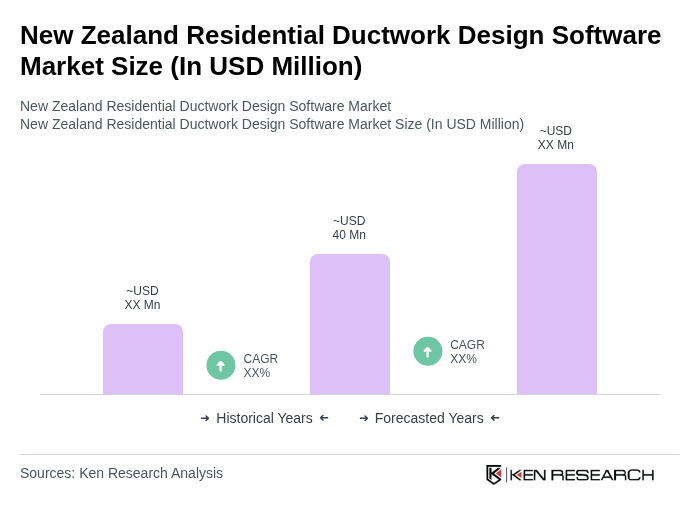
New Zealand Residential Ductwork Design Software Market at USD 40M, fueled by energy efficiency regulations, BIM adoption, and urban growth in Auckland, Wellington, Christchurch.

Region:Global

Author(s):Shubham

Product Code:KRAD2549

Pages:97

Published On:January 2026
About the Report

Base Year 2024

New Zealand Residential Ductwork Design Software Market Overview

  • The New Zealand Residential Ductwork Design Software Market is valued at USD 40 million, based on a five-year historical analysis and its share within the wider Australia and New Zealand HVAC market, which is valued in the low billions of USD for combined equipment and services. This growth is primarily driven by the increasing demand for energy-efficient HVAC systems and the rising trend of smart home technologies, aligned with growing adoption of advanced HVAC controls and smart HVAC solutions globally. The software solutions are essential for optimizing ductwork design, ensuring better airflow, and enhancing overall energy efficiency in residential buildings, supporting compliance with modern HVAC efficiency and indoor air quality expectations.
  • Key cities such as Auckland, Wellington, and Christchurch dominate the market due to their significant residential construction activities and urban development projects, in line with the concentration of HVAC demand in major urban centers in Australia and New Zealand. The concentration of architectural and engineering firms in these cities further fuels the demand for advanced ductwork design software, as project stakeholders increasingly rely on BIM and digital HVAC design tools to improve design accuracy, coordination, and project efficiency.
  • The regulatory environment also supports the use of energy?efficient designs in residential buildings. The Energy Efficiency and Conservation Act 2000, issued by the New Zealand Parliament, establishes the framework for promoting energy efficiency and conservation, while the Building Code clause H1 (Energy Efficiency) administered under the Building Act 2004 specifies mandatory requirements for thermal performance and efficient services in new residential buildings and major alterations. These instruments encourage the adoption of advanced ductwork design software to demonstrate compliance with energy efficiency performance requirements, optimise HVAC system sizing, and reduce overall energy consumption in homes.
New Zealand Residential Ductwork Design Software Market Size

New Zealand Residential Ductwork Design Software Market Segmentation

By Software Type:The software type segment includes various solutions tailored for ductwork design, each catering to different user needs. Standalone ductwork design software is popular among smaller HVAC contracting and design firms for its simplicity and focused functionality. Integrated HVAC design suites are favored by larger multidisciplinary firms for their comprehensive features, including load calculation, duct sizing, and system simulation in a single environment, reflecting broader trends in HVAC design digitalization. BIM-integrated software is gaining traction due to the increasing adoption of Building Information Modeling in construction projects across Australia and New Zealand, which drives demand for coordinated 3D models and clash-free services design. Plug-ins for CAD/BIM platforms also play a significant role, allowing users to enhance existing tools with specialized ductwork functionalities and automated routing. The "Others" category includes niche software solutions that cater to specific market needs, such as custom residential energy-modelling tools and region-specific HVAC design applications.
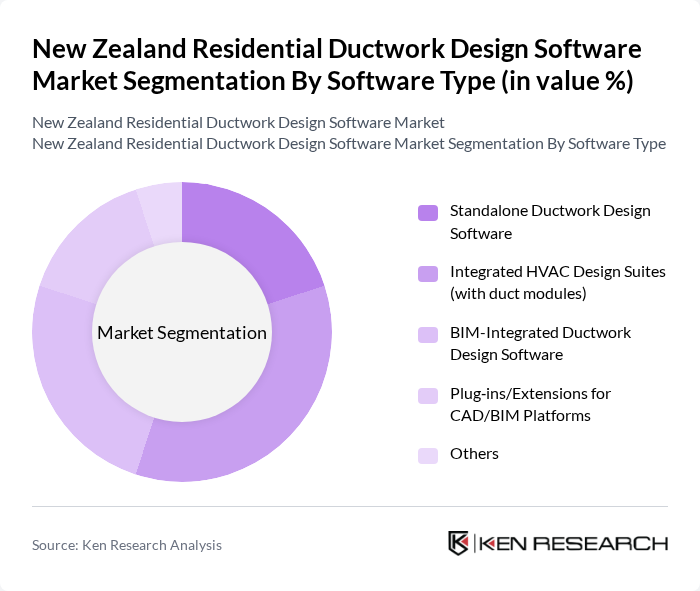
New Zealand Residential Ductwork Design Software Market segmentation by Software Type.

By Deployment Model:The deployment model segment encompasses various methods of software delivery, including on-premise, cloud-based, and hybrid solutions. On-premise solutions are preferred by larger organizations and firms with strict IT and data-governance requirements that require complete control over their software environment. Cloud-based solutions are increasingly popular due to their flexibility, lower upfront costs, remote-access capabilities, and ease of subscription-based scaling, mirroring the broader move of HVAC and construction software toward Software-as-a-Service models. Hybrid solutions combine the benefits of both models, allowing users to host sensitive data locally while leveraging cloud services for collaboration and updates. The "Others" category includes less common deployment methods that cater to specific user requirements, such as privately hosted virtualized environments or regional hosting arrangements for compliance or latency reasons.
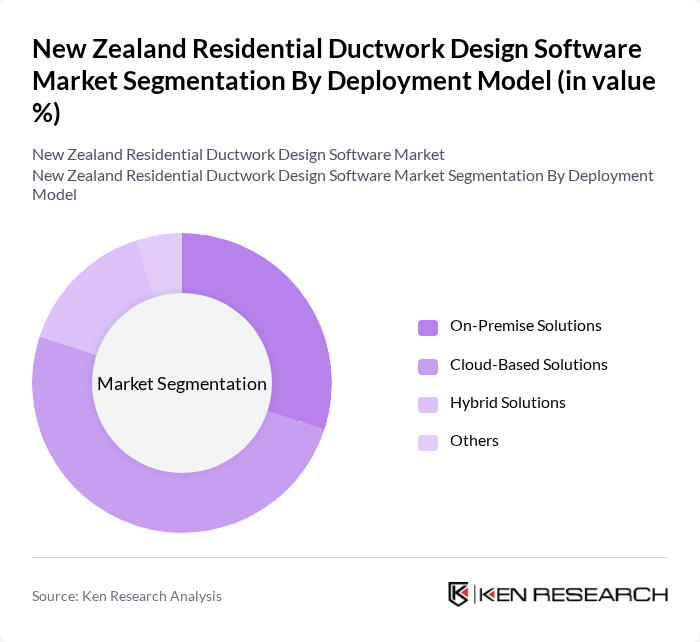
New Zealand Residential Ductwork Design Software Market segmentation by Deployment Model.

New Zealand Residential Ductwork Design Software Market Competitive Landscape

The New Zealand Residential Ductwork Design Software Market is characterized by a dynamic mix of regional and international players. Leading participants such as Autodesk, Inc., Trimble Inc., MagiCAD Group, Trimble – SketchUp (Layout & Extensions), Graphisoft (Archicad), Dassault Systèmes (SOLIDWORKS, CATIA), Bentley Systems, Incorporated, Siemens Digital Industries Software, Honeywell Building Technologies, Johnson Controls International plc, Daikin Applied / Daikin Industries Ltd. (design tools), Fujitsu General Limited (HVAC design tools), Carrier Global Corporation (HVAC system design software), Local/New Zealand-Based HVAC Design Software Providers, Other Regional Niche Ductwork Design Software Vendors contribute to innovation, geographic expansion, and service delivery in this space.

Autodesk, Inc.

1982

San Rafael, California, USA

Trimble Inc.

1978

Westminster, Colorado, USA

MagiCAD Group

1990

Turku, Finland

Graphisoft

1982

Budapest, Hungary

Siemens Digital Industries Software

2007

Plano, Texas, USA

Company

Establishment Year

Headquarters

Segment Focus (Residential / Mixed)

New Zealand Residential Ductwork Design Software Revenue

New Zealand Residential Revenue CAGR

Number of Active Residential NZ Customers

Average Revenue per User (ARPU) – Residential NZ

Customer Acquisition Cost (CAC)

New Zealand Residential Ductwork Design Software Market Industry Analysis

Growth Drivers

  • Increasing Demand for Energy-Efficient Homes:The New Zealand government aims to reduce greenhouse gas emissions by 50% by 2030, driving the demand for energy-efficient homes. In future, the residential construction sector is projected to grow by NZD 1.5 billion, reflecting a shift towards sustainable building practices. This trend is supported by the Energy Efficiency and Conservation Authority (EECA), which reported that energy-efficient homes can reduce energy consumption by up to 30%, further boosting the ductwork design software market.
  • Technological Advancements in Design Software:The integration of advanced technologies such as Building Information Modeling (BIM) is revolutionizing ductwork design. In future, the software market is expected to see a 20% increase in adoption rates due to enhanced functionalities. According to a report by the New Zealand Institute of Architects, 75% of architects are now using BIM, which allows for more precise and efficient ductwork designs, ultimately improving project outcomes and reducing costs.
  • Government Incentives for Sustainable Building Practices:The New Zealand government has introduced various incentives, including tax rebates and grants, to promote sustainable building practices. In future, an estimated NZD 200 million will be allocated to support energy-efficient renovations. This financial backing encourages homeowners and builders to invest in modern ductwork design software, as it aligns with government goals to enhance energy efficiency and reduce environmental impact.

Market Challenges

  • High Initial Investment Costs:The upfront costs associated with implementing advanced ductwork design software can be a significant barrier for small contractors. In future, the average cost of software solutions is projected to be around NZD 15,000, which may deter smaller firms from adopting these technologies. This challenge is compounded by the need for ongoing training and support, which can further strain limited budgets, hindering market growth.
  • Limited Awareness Among Small Contractors:Many small contractors remain unaware of the benefits of modern ductwork design software. A survey conducted by the New Zealand Contractors Federation in future revealed that only 30% of small contractors utilize advanced design tools. This lack of awareness can lead to reliance on traditional methods, which are often less efficient and can result in higher operational costs, ultimately stunting market expansion.

New Zealand Residential Ductwork Design Software Market Future Outlook

The New Zealand residential ductwork design software market is poised for significant growth as technological advancements and sustainability initiatives converge. By future, the increasing integration of AI and cloud-based solutions will enhance design efficiency and user experience. Additionally, the growing emphasis on indoor air quality will drive demand for innovative software solutions. As the market evolves, collaboration with HVAC manufacturers and the development of mobile applications will further expand opportunities, ensuring a robust future for the industry.

Market Opportunities

  • Expansion into Smart Home Integration:The rise of smart home technologies presents a lucrative opportunity for ductwork design software. By future, the smart home market in New Zealand is expected to reach NZD 1 billion, creating demand for integrated solutions that optimize HVAC systems. This integration can enhance energy efficiency and user comfort, positioning software providers to capitalize on this growing trend.
  • Development of Mobile Applications for Design:The increasing reliance on mobile technology offers a unique opportunity for software developers. In future, mobile app usage in the construction industry is projected to grow by 25%. By creating mobile applications for ductwork design, companies can provide contractors with on-the-go access to design tools, improving efficiency and responsiveness to client needs, thus driving market growth.

Scope of the Report

SegmentSub-Segments
By Software Type

Standalone Ductwork Design Software

Integrated HVAC Design Suites (with duct modules)

BIM-Integrated Ductwork Design Software

Plug?ins/Extensions for CAD/BIM Platforms

Others

By Deployment Model

On-Premise Solutions

Cloud-Based Solutions

Hybrid Solutions

Others

By End-User

HVAC Contractors and Installers

Mechanical/HVAC Consulting Engineers

Architectural and Design Firms

Homebuilders and Residential Developers

Training Institutions and Others

By Application

New Residential Construction

Retrofit and Renovation Projects

System Upgrades and Optimization

Maintenance Planning and Diagnostics

By Pricing Model

Subscription (SaaS) Licensing

Perpetual Licensing

Usage-Based / Pay-Per-Project

Freemium and Tiered Plans

By Organization Size

Individual Professionals and Micro Businesses

Small Enterprises

Medium Enterprises

Large Enterprises

By Region

North Island

South Island

Others

Key Target Audience

Investors and Venture Capitalist Firms

Government and Regulatory Bodies (e.g., Ministry of Business, Innovation and Employment)

Manufacturers and Producers of Ductwork Systems

Distributors and Retailers of HVAC Equipment

Building Contractors and Construction Firms

Architectural and Engineering Firms

Industry Associations (e.g., Heating, Ventilation and Air Conditioning Association of New Zealand)

Financial Institutions and Banks

Players Mentioned in the Report:

Autodesk, Inc.

Trimble Inc.

MagiCAD Group

Trimble SketchUp (Layout & Extensions)

Graphisoft (Archicad)

Dassault Systemes (SOLIDWORKS, CATIA)

Bentley Systems, Incorporated

Siemens Digital Industries Software

Honeywell Building Technologies

Johnson Controls International plc

Daikin Applied / Daikin Industries Ltd. (design tools)

Fujitsu General Limited (HVAC design tools)

Carrier Global Corporation (HVAC system design software)

Local/New Zealand-Based HVAC Design Software Providers

Other Regional Niche Ductwork Design Software Vendors

Table of Contents

Market Assessment Phase

1. Executive Summary and Approach


2. New Zealand Residential Ductwork Design Software Market Overview

2.1 Key Insights and Strategic Recommendations

2.2 New Zealand Residential Ductwork Design Software Market Overview

2.3 Definition and Scope

2.4 Evolution of Market Ecosystem

2.5 Timeline of Key Regulatory Milestones

2.6 Value Chain & Stakeholder Mapping

2.7 Business Cycle Analysis

2.8 Policy & Incentive Landscape


3. New Zealand Residential Ductwork Design Software Market Analysis

3.1 Growth Drivers

3.1.1 Increasing demand for energy-efficient homes
3.1.2 Technological advancements in design software
3.1.3 Government incentives for sustainable building practices
3.1.4 Rising awareness of indoor air quality

3.2 Market Challenges

3.2.1 High initial investment costs
3.2.2 Limited awareness among small contractors
3.2.3 Competition from traditional design methods
3.2.4 Regulatory compliance complexities

3.3 Market Opportunities

3.3.1 Expansion into smart home integration
3.3.2 Development of mobile applications for design
3.3.3 Partnerships with HVAC manufacturers
3.3.4 Customization options for diverse residential needs

3.4 Market Trends

3.4.1 Shift towards cloud-based software solutions
3.4.2 Increasing use of AI in design optimization
3.4.3 Growing focus on user-friendly interfaces
3.4.4 Adoption of virtual reality for design visualization

3.5 Government Regulation

3.5.1 Energy Efficiency Standards
3.5.2 Building Code Compliance
3.5.3 Environmental Impact Assessments
3.5.4 Licensing Requirements for Software Providers

4. SWOT Analysis


5. Stakeholder Analysis


6. Porter's Five Forces Analysis


7. New Zealand Residential Ductwork Design Software Market Size, 2019-2024

7.1 By Value

7.2 By Volume

7.3 By Average Selling Price


8. New Zealand Residential Ductwork Design Software Market Segmentation

8.1 By Software Type

8.1.1 Standalone Ductwork Design Software
8.1.2 Integrated HVAC Design Suites (with duct modules)
8.1.3 BIM-Integrated Ductwork Design Software
8.1.4 Plug?ins/Extensions for CAD/BIM Platforms
8.1.5 Others

8.2 By Deployment Model

8.2.1 On-Premise Solutions
8.2.2 Cloud-Based Solutions
8.2.3 Hybrid Solutions
8.2.4 Others

8.3 By End-User

8.3.1 HVAC Contractors and Installers
8.3.2 Mechanical/HVAC Consulting Engineers
8.3.3 Architectural and Design Firms
8.3.4 Homebuilders and Residential Developers
8.3.5 Training Institutions and Others

8.4 By Application

8.4.1 New Residential Construction
8.4.2 Retrofit and Renovation Projects
8.4.3 System Upgrades and Optimization
8.4.4 Maintenance Planning and Diagnostics

8.5 By Pricing Model

8.5.1 Subscription (SaaS) Licensing
8.5.2 Perpetual Licensing
8.5.3 Usage-Based / Pay-Per-Project
8.5.4 Freemium and Tiered Plans

8.6 By Organization Size

8.6.1 Individual Professionals and Micro Businesses
8.6.2 Small Enterprises
8.6.3 Medium Enterprises
8.6.4 Large Enterprises

8.7 By Region

8.7.1 North Island
8.7.2 South Island
8.7.3 Others

9. New Zealand Residential Ductwork Design Software Market Competitive Analysis

9.1 Market Share of Key Players

9.2 Cross Comparison of Key Players

9.2.1 Company Name
9.2.2 Segment Focus (Residential / Mixed)
9.2.3 New Zealand Residential Ductwork Design Software Revenue
9.2.4 New Zealand Residential Revenue CAGR
9.2.5 Number of Active Residential NZ Customers
9.2.6 Average Revenue per User (ARPU) – Residential NZ
9.2.7 Customer Acquisition Cost (CAC)
9.2.8 Customer Lifetime Value (CLV)
9.2.9 Churn Rate (Logo and Revenue)
9.2.10 Average Contract Length (Months/Years)
9.2.11 Feature Release Velocity (Major Releases per Year)
9.2.12 Share of Revenue from Cloud / SaaS

9.3 SWOT Analysis of Top Players

9.4 Pricing Analysis

9.5 Detailed Profile of Major Companies

9.5.1 Autodesk, Inc.
9.5.2 Trimble Inc.
9.5.3 MagiCAD Group
9.5.4 Trimble – SketchUp (Layout & Extensions)
9.5.5 Graphisoft (Archicad)
9.5.6 Dassault Systèmes (SOLIDWORKS, CATIA)
9.5.7 Bentley Systems, Incorporated
9.5.8 Siemens Digital Industries Software
9.5.9 Honeywell Building Technologies
9.5.10 Johnson Controls International plc
9.5.11 Daikin Applied / Daikin Industries Ltd. (design tools)
9.5.12 Fujitsu General Limited (HVAC design tools)
9.5.13 Carrier Global Corporation (HVAC system design software)
9.5.14 Local/New Zealand-Based HVAC Design Software Providers
9.5.15 Other Regional Niche Ductwork Design Software Vendors

10. New Zealand Residential Ductwork Design Software Market End-User Analysis

10.1 Procurement Behavior of Key Ministries

10.1.1 Budget Allocation Trends
10.1.2 Decision-Making Processes
10.1.3 Preferred Procurement Channels
10.1.4 Contracting Practices

10.2 Corporate Spend on Infrastructure & Energy

10.2.1 Investment Trends in Ductwork Design
10.2.2 Budgeting for Software Solutions
10.2.3 Long-term Financial Commitments
10.2.4 Cost-Benefit Analysis Practices

10.3 Pain Point Analysis by End-User Category

10.3.1 Homeowners
10.3.2 Contractors
10.3.3 Architects
10.3.4 Engineers

10.4 User Readiness for Adoption

10.4.1 Training and Support Needs
10.4.2 Technology Adoption Barriers
10.4.3 User Experience Expectations
10.4.4 Feedback Mechanisms

10.5 Post-Deployment ROI and Use Case Expansion

10.5.1 Measurement of ROI
10.5.2 Case Studies of Successful Implementations
10.5.3 Future Use Case Scenarios
10.5.4 Customer Feedback on Expansion Opportunities

11. New Zealand Residential Ductwork Design Software Market Future Size, 2025-2030

11.1 By Value

11.2 By Volume

11.3 By Average Selling Price


Go-To-Market Strategy Phase

1. Whitespace Analysis + Business Model Canvas

1.1 Market Gaps Identification

1.2 Business Model Framework


2. Marketing and Positioning Recommendations

2.1 Branding Strategies

2.2 Product USPs


3. Distribution Plan

3.1 Urban Retail Strategies

3.2 Rural NGO Tie-Ups


4. Channel & Pricing Gaps

4.1 Underserved Routes

4.2 Pricing Bands


5. Unmet Demand & Latent Needs

5.1 Category Gaps

5.2 Consumer Segments


6. Customer Relationship

6.1 Loyalty Programs

6.2 After-Sales Service


7. Value Proposition

7.1 Sustainability Initiatives

7.2 Integrated Supply Chains


8. Key Activities

8.1 Regulatory Compliance

8.2 Branding Efforts

8.3 Distribution Setup


9. Entry Strategy Evaluation

9.1 Domestic Market Entry Strategy

9.1.1 Product Mix Considerations
9.1.2 Pricing Band Analysis
9.1.3 Packaging Strategies

9.2 Export Entry Strategy

9.2.1 Target Countries
9.2.2 Compliance Roadmap

10. Entry Mode Assessment

10.1 Joint Ventures

10.2 Greenfield Investments

10.3 Mergers & Acquisitions

10.4 Distributor Model


11. Capital and Timeline Estimation

11.1 Capital Requirements

11.2 Timelines for Implementation


12. Control vs Risk Trade-Off

12.1 Ownership Considerations

12.2 Partnerships Evaluation


13. Profitability Outlook

13.1 Breakeven Analysis

13.2 Long-Term Sustainability


14. Potential Partner List

14.1 Distributors

14.2 Joint Ventures

14.3 Acquisition Targets


15. Execution Roadmap

15.1 Phased Plan for Market Entry

15.1.1 Market Setup
15.1.2 Market Entry
15.1.3 Growth Acceleration
15.1.4 Scale & Stabilize

15.2 Key Activities and Milestones

15.2.1 Milestone Planning
15.2.2 Activity Tracking

Research Methodology

ApproachModellingSample

Phase 1: Approach1

Desk Research

  • Analysis of industry reports from New Zealand's HVAC associations and building councils
  • Review of government publications on residential construction trends and energy efficiency standards
  • Examination of academic journals focusing on ductwork design and installation methodologies

Primary Research

  • Interviews with HVAC engineers and ductwork design specialists in New Zealand
  • Surveys targeting residential builders and contractors regarding ductwork preferences
  • Field visits to residential projects to observe ductwork installation practices

Validation & Triangulation

  • Cross-validation of findings through multiple expert interviews and industry reports
  • Triangulation of data from government sources, industry experts, and market surveys
  • Sanity checks conducted through peer reviews with HVAC industry professionals

Phase 2: Market Size Estimation1

Top-down Assessment

  • Estimation of market size based on national residential construction spending and HVAC system adoption rates
  • Segmentation of the market by residential property types (e.g., single-family homes, multi-family units)
  • Incorporation of energy efficiency regulations impacting ductwork design and installation

Bottom-up Modeling

  • Collection of data on ductwork installation costs from leading contractors and suppliers
  • Estimation of market volume based on the number of residential units and average ductwork systems per unit
  • Cost analysis based on material types and installation complexity across different regions

Forecasting & Scenario Analysis

  • Multi-variable forecasting using trends in residential construction and energy efficiency initiatives
  • Scenario analysis based on potential regulatory changes and market demand fluctuations
  • Development of baseline, optimistic, and pessimistic market growth projections through 2030

Phase 3: CATI Sample Composition1

Scope Item/SegmentSample SizeTarget Respondent Profiles
Residential Builders60Project Managers, Site Supervisors
HVAC Contractors50Installation Technicians, Business Owners
Energy Efficiency Consultants40Energy Auditors, Sustainability Advisors
Homeowners with Recent Renovations45Homeowners, Property Managers
Architects and Designers40Architects, Interior Designers

Frequently Asked Questions

What is the current value of the New Zealand Residential Ductwork Design Software Market?

The New Zealand Residential Ductwork Design Software Market is valued at approximately USD 40 million, reflecting its share within the broader Australia and New Zealand HVAC market, which is valued in the low billions of USD.

What factors are driving growth in the ductwork design software market in New Zealand?

Which cities in New Zealand are key markets for ductwork design software?

How does the regulatory environment impact the ductwork design software market in New Zealand?

Other Adjacent Reports

KSA HVAC Design Software Market

Bahrain Building Information Modeling Market

South Korea Energy Management Software Market

Qatar Smart Home Technology Market

South Africa Residential Construction Software Market

India CAD Software Market Outlook to 2030

Indonesia Indoor Air Quality Software Market

Oman Cloud-Based Construction Software Market

Brazil Architectural Design Software Market

Qatar Building Simulation Software Market

Why Buy From Us?

Refine Robust Result (RRR) Framework

What makes us stand out is that our consultants follow Robust, Refine and Result (RRR) methodology. Robust for clear definitions, approaches and sanity checking, Refine for differentiating respondents' facts and opinions, and Result for presenting data with story.

Our Reach Is Unmatched

We have set a benchmark in the industry by offering our clients with syndicated and customized market research reports featuring coverage of entire market as well as meticulous research and analyst insights.

Shifting the Research Paradigm

While we don't replace traditional research, we flip the method upside down. Our dual approach of Top Bottom & Bottom Top ensures quality deliverable by not just verifying company fundamentals but also looking at the sector and macroeconomic factors.

More Insights-Better Decisions

With one step in the future, our research team constantly tries to show you the bigger picture. We help with some of the tough questions you may encounter along the way: How is the industry positioned? Best marketing channel? KPI's of competitors? By aligning every element, we help maximize success.

Transparency and Trust

Our report gives you instant access to the answers and sources that other companies might choose to hide. We elaborate each steps of research methodology we have used and showcase you the sample size to earn your trust.

Round the Clock Support

If you need any support, we are here! We pride ourselves on universe strength, data quality, and quick, friendly, and professional service.

Why Clients Choose Us?

400000+
Reports in repository
150+
Consulting projects a year
100+
Analysts
8000+
Client Queries in 2022








