Bahrain Residential Ductwork Design Software Market Report Size Share Growth Drivers Trends Opportunities & Forecast 2025–2030

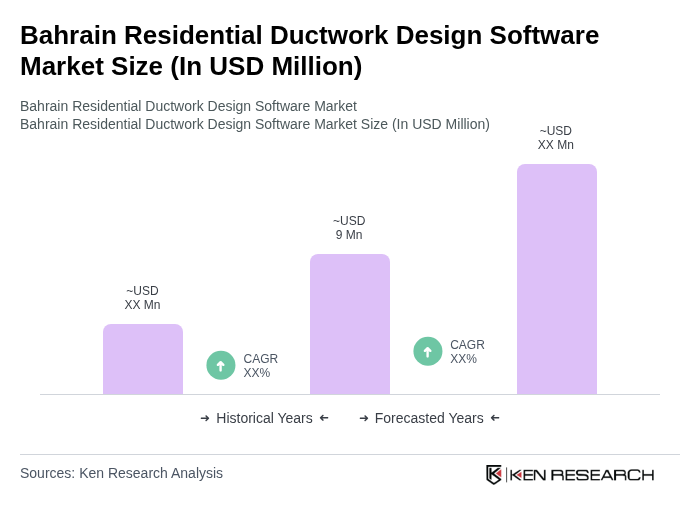
The Bahrain residential ductwork design software market, worth USD 9 million, is growing due to rising energy-efficient HVAC needs, smart homes, and government sustainability initiatives.

Region:Middle East

Author(s):Shubham

Product Code:KRAD2546

Pages:97

Published On:January 2026
About the Report

Base Year 2024

Bahrain Residential Ductwork Design Software Market Overview

  • The Bahrain Residential Ductwork Design Software Market is valued at USD 9 million, based on a five-year historical analysis and benchmarked against the wider Bahrain construction design software market, which is valued at around USD 20 million. This growth is primarily driven by the increasing demand for energy-efficient HVAC systems and the rising trend of smart home technologies in the kingdom, supported by the broader expansion of HVAC and heating & cooling markets in Bahrain and the GCC region. The market is also supported by the expansion of the construction sector, where residential projects are a key part of Bahrain’s construction pipeline and drive adoption of digital design solutions, including BIM and CAD-based tools used for ductwork and HVAC design.
  • Key cities such as Manama and Muharraq dominate the market due to their rapid urbanization and significant investments in residential infrastructure, as these areas host most of Bahrain’s large-scale residential, mixed-use, and urban development projects. The concentration of construction activities and the presence of major HVAC and construction stakeholders in these regions further enhance their market position, making them pivotal areas for ductwork design software adoption, particularly for projects using BIM and advanced construction design software.
  • In 2014, the Bahraini government approved the Bahrain Building Code, and in 2019 the Gulf Cooperation Council (GCC) issued the GCC Unified Building Code, which Bahrain applies to new buildings; these instruments mandate minimum energy performance standards and efficiency requirements for building systems, including HVAC, in new constructions. These codes aim to reduce energy consumption and promote sustainable building practices by specifying design, insulation, ventilation, and equipment efficiency criteria that must be met at the permitting stage, thereby increasing the demand for advanced ductwork design software capable of supporting compliant load calculations, air distribution design, and coordination with BIM-based workflows.
Bahrain Residential Ductwork Design Software Market Size

Bahrain Residential Ductwork Design Software Market Segmentation

By Software Type:The software type segmentation includes various categories that cater to different user needs in the ductwork design process. The leading sub-segment is the HVAC Suite with Ductwork Design Module, which integrates multiple functionalities such as load calculations, duct sizing, equipment selection, and report generation, making it a preferred choice among HVAC contractors and design consultants seeking end-to-end project workflows. This segment benefits from the growing trend of integrated solutions that streamline workflows, support BIM interoperability, and enhance productivity across design, coordination, and site execution.
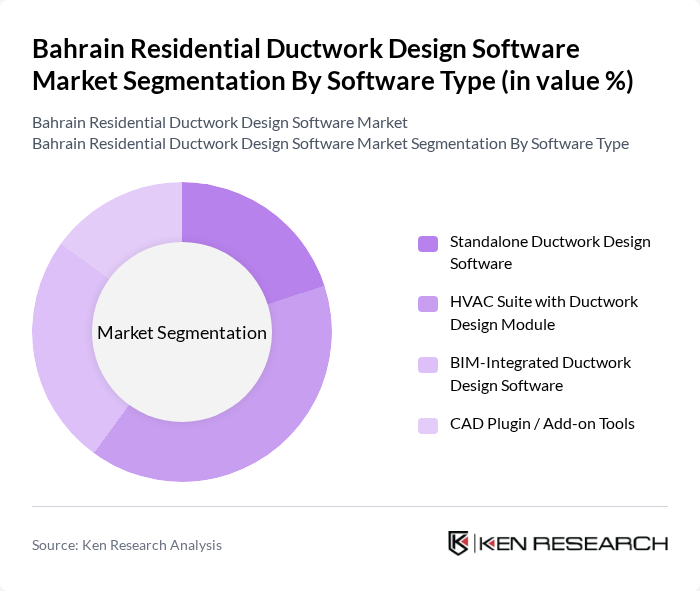
Bahrain Residential Ductwork Design Software Market segmentation by Software Type.

By Residential Application:The residential application segmentation highlights the various types of projects utilizing ductwork design software. The New-Build Villas and Townhouses segment is currently the most dominant, driven by the increasing number of high-specification and luxury residential projects in Bahrain that require centralized air-conditioning and carefully engineered duct systems. This segment is characterized by a demand for customized and efficient ductwork solutions that enhance comfort and energy efficiency in high-end homes, often designed using BIM and advanced HVAC design tools to optimize space utilization, airflow distribution, and energy performance.
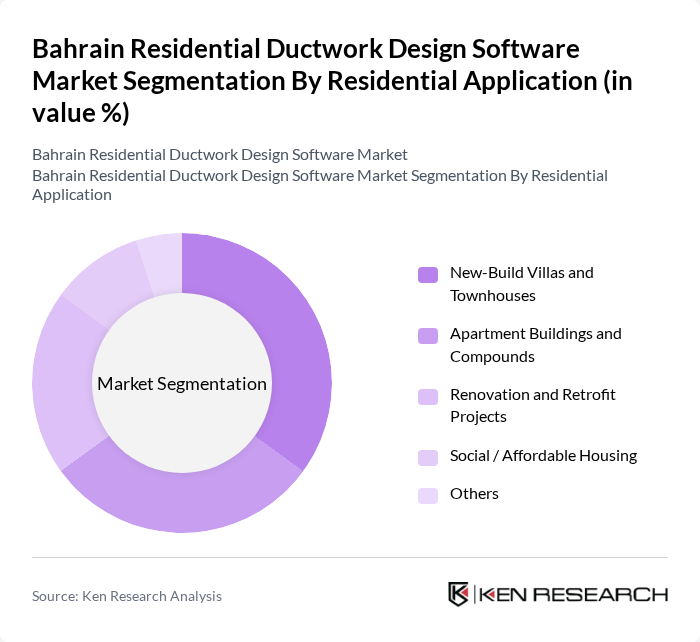
Bahrain Residential Ductwork Design Software Market segmentation by Residential Application.

Bahrain Residential Ductwork Design Software Market Competitive Landscape

The Bahrain Residential Ductwork Design Software Market is characterized by a dynamic mix of regional and international players. Leading participants such as Autodesk, Trimble, Carrier, Daikin, Mitsubishi Electric, Honeywell, Johnson Controls, Siemens, Schneider Electric, Rheem Manufacturing, Lennox International, Fujitsu General, Panasonic, York, Goodman Manufacturing contribute to innovation, geographic expansion, and service delivery in this space, with many of these vendors offering BIM platforms, CAD tools, and HVAC design or configuration software that are used in residential ductwork projects either directly or via integration with local engineering practices.

Autodesk

1982

San Rafael, California, USA

Trimble

1978

Sunnyvale, California, USA

Carrier

1915

Palm Beach Gardens, Florida, USA

Daikin

1924

Osaka, Japan

Mitsubishi Electric

1921

Tokyo, Japan

Company

Establishment Year

Headquarters

Group Size (Large, Medium, or Small as per industry convention)

Bahrain Residential Ductwork Design Software Revenue (USD Million)

Revenue CAGR in Bahrain Residential Segment (%)

EBITDA Margin (%)

Recurring Revenue Share (% of Total)

Active Paid Users / Seats in Bahrain

Bahrain Residential Ductwork Design Software Market Industry Analysis

Growth Drivers

  • Increasing Demand for Energy-Efficient HVAC Systems:The Bahrain government aims to reduce energy consumption by 20% in future, driving the demand for energy-efficient HVAC systems. The residential sector is projected to account for 45% of total energy consumption, highlighting the need for advanced ductwork design software that optimizes energy use. This shift is supported by a growing awareness of environmental sustainability, with 55% of homeowners expressing interest in energy-efficient solutions, thus propelling software adoption.
  • Government Initiatives Promoting Sustainable Building Practices:Bahrain's Vision 2030 emphasizes sustainable development, with the government investing approximately $1.2 billion in green building initiatives. This includes incentives for using energy-efficient materials and technologies in residential construction. As a result, the demand for ductwork design software that complies with these sustainable practices is expected to rise, with an estimated 25% increase in software adoption among contractors in future, driven by regulatory support.
  • Technological Advancements in Design Software:The introduction of advanced features such as AI-driven simulations and real-time collaboration tools is transforming ductwork design software. In future, the market is expected to see a 20% increase in the adoption of cloud-based solutions, which enhance accessibility and efficiency. These technological advancements are crucial for meeting the growing complexity of residential projects, as 60% of contractors report a need for more sophisticated design tools to streamline their workflows.

Market Challenges

  • High Initial Investment Costs for Software Adoption:The upfront costs associated with implementing advanced ductwork design software can be prohibitive, particularly for small contractors. Initial investments can range from $12,000 to $45,000, depending on the software's capabilities. This financial barrier limits access to innovative solutions, with only 35% of small firms currently utilizing such software, thereby hindering overall market growth in Bahrain's residential sector.
  • Limited Awareness Among Small Contractors:A significant portion of small contractors in Bahrain remains unaware of the benefits of modern ductwork design software. Approximately 50% of these contractors rely on traditional methods, which can lead to inefficiencies and increased costs. This lack of awareness is a critical challenge, as it prevents the widespread adoption of innovative solutions that could enhance project outcomes and sustainability in the residential construction market.

Bahrain Residential Ductwork Design Software Market Future Outlook

The Bahrain residential ductwork design software market is poised for significant growth, driven by increasing demand for energy-efficient solutions and government support for sustainable practices. As technological advancements continue to reshape the industry, the integration of AI and cloud-based platforms will enhance design capabilities. Furthermore, the growing trend of smart home technologies will likely create new avenues for software applications, fostering collaboration between contractors and technology providers to meet evolving consumer expectations.

Market Opportunities

  • Expansion of Smart Home Technologies:The rise of smart home technologies presents a lucrative opportunity for ductwork design software. With an estimated 30% of new homes in Bahrain incorporating smart systems in future, software that integrates with these technologies can enhance energy management and user experience, driving demand for innovative design solutions.
  • Integration with Building Information Modeling (BIM):The increasing adoption of BIM in construction projects offers a significant opportunity for ductwork design software. As BIM usage is projected to grow by 25% in Bahrain's residential sector in future, software that seamlessly integrates with BIM can improve collaboration and efficiency, positioning itself as a vital tool for contractors and architects alike.

Scope of the Report

SegmentSub-Segments
By Software Type

Standalone Ductwork Design Software

HVAC Suite with Ductwork Design Module

BIM-Integrated Ductwork Design Software

CAD Plugin / Add-on Tools

By Residential Application

New-Build Villas and Townhouses

Apartment Buildings and Compounds

Renovation and Retrofit Projects

Social / Affordable Housing

Others

By Deployment Model

On-Premise Solutions

Cloud-Based Solutions

Hybrid Deployment

Mobile / Web-Based Tools

By Functional Features

D/3D Duct Layout and Modeling

Load Calculation and Airflow Simulation

Energy Efficiency and Cost Optimization

BIM / CAD Integration and Collaboration

Code Compliance and Documentation

By Licensing & Pricing Model

Subscription (SaaS) – Monthly/Annual

Perpetual License

Pay-Per-Use / Project-Based

Enterprise Agreements

By Customer Type

HVAC Contractors and Installers

MEP Design Consultants

Architectural and Engineering Firms

Developers and Facility Owners

Educational and Training Institutions

By Region in Bahrain

Capital Governorate (Manama)

Muharraq Governorate

Northern Governorate

Southern Governorate

Key Target Audience

Investors and Venture Capitalist Firms

Government and Regulatory Bodies (e.g., Ministry of Housing, Bahrain Economic Development Board)

Manufacturers and Producers of Ductwork Systems

HVAC Contractors and Service Providers

Building and Construction Companies

Real Estate Developers

Technology Providers for Building Information Modeling (BIM)

Industry Associations related to HVAC and Construction

Players Mentioned in the Report:

Autodesk

Trimble

Carrier

Daikin

Mitsubishi Electric

Honeywell

Johnson Controls

Siemens

Schneider Electric

Rheem Manufacturing

Lennox International

Fujitsu General

Panasonic

York

Goodman Manufacturing

Table of Contents

Market Assessment Phase

1. Executive Summary and Approach


2. Bahrain Residential Ductwork Design Software Market Overview

2.1 Key Insights and Strategic Recommendations

2.2 Bahrain Residential Ductwork Design Software Market Overview

2.3 Definition and Scope

2.4 Evolution of Market Ecosystem

2.5 Timeline of Key Regulatory Milestones

2.6 Value Chain & Stakeholder Mapping

2.7 Business Cycle Analysis

2.8 Policy & Incentive Landscape


3. Bahrain Residential Ductwork Design Software Market Analysis

3.1 Growth Drivers

3.1.1 Increasing demand for energy-efficient HVAC systems
3.1.2 Government initiatives promoting sustainable building practices
3.1.3 Technological advancements in design software
3.1.4 Rising construction activities in residential sectors

3.2 Market Challenges

3.2.1 High initial investment costs for software adoption
3.2.2 Limited awareness among small contractors
3.2.3 Competition from traditional design methods
3.2.4 Regulatory compliance complexities

3.3 Market Opportunities

3.3.1 Expansion of smart home technologies
3.3.2 Integration with Building Information Modeling (BIM)
3.3.3 Growing trend of remote work and virtual consultations
3.3.4 Potential for partnerships with construction firms

3.4 Market Trends

3.4.1 Shift towards cloud-based software solutions
3.4.2 Increasing focus on user-friendly interfaces
3.4.3 Adoption of AI and machine learning in design processes
3.4.4 Emphasis on real-time collaboration features

3.5 Government Regulation

3.5.1 Energy efficiency standards for residential buildings
3.5.2 Building codes mandating ductwork design compliance
3.5.3 Incentives for using sustainable materials
3.5.4 Regulations promoting software certification

4. SWOT Analysis


5. Stakeholder Analysis


6. Porter's Five Forces Analysis


7. Bahrain Residential Ductwork Design Software Market Market Size, 2019-2024

7.1 By Value

7.2 By Volume

7.3 By Average Selling Price


8. Bahrain Residential Ductwork Design Software Market Segmentation

8.1 By Software Type

8.1.1 Standalone Ductwork Design Software
8.1.2 HVAC Suite with Ductwork Design Module
8.1.3 BIM-Integrated Ductwork Design Software
8.1.4 CAD Plugin / Add-on Tools

8.2 By Residential Application

8.2.1 New-Build Villas and Townhouses
8.2.2 Apartment Buildings and Compounds
8.2.3 Renovation and Retrofit Projects
8.2.4 Social / Affordable Housing
8.2.5 Others

8.3 By Deployment Model

8.3.1 On-Premise Solutions
8.3.2 Cloud-Based Solutions
8.3.3 Hybrid Deployment
8.3.4 Mobile / Web-Based Tools

8.4 By Functional Features

8.4.1 2D/3D Duct Layout and Modeling
8.4.2 Load Calculation and Airflow Simulation
8.4.3 Energy Efficiency and Cost Optimization
8.4.4 BIM / CAD Integration and Collaboration
8.4.5 Code Compliance and Documentation

8.5 By Licensing & Pricing Model

8.5.1 Subscription (SaaS) – Monthly/Annual
8.5.2 Perpetual License
8.5.3 Pay-Per-Use / Project-Based
8.5.4 Enterprise Agreements

8.6 By Customer Type

8.6.1 HVAC Contractors and Installers
8.6.2 MEP Design Consultants
8.6.3 Architectural and Engineering Firms
8.6.4 Developers and Facility Owners
8.6.5 Educational and Training Institutions

8.7 By Region in Bahrain

8.7.1 Capital Governorate (Manama)
8.7.2 Muharraq Governorate
8.7.3 Northern Governorate
8.7.4 Southern Governorate

9. Bahrain Residential Ductwork Design Software Market Competitive Analysis

9.1 Market Share of Key Players

9.2 Cross Comparison of Key Players

9.2.1 Company Name
9.2.2 Group Size (Large, Medium, or Small as per industry convention)
9.2.3 Bahrain Residential Ductwork Design Software Revenue (USD Million)
9.2.4 Revenue CAGR in Bahrain Residential Segment (%)
9.2.5 EBITDA Margin (%)
9.2.6 Recurring Revenue Share (% of Total)
9.2.7 Active Paid Users / Seats in Bahrain
9.2.8 Customer Retention / Renewal Rate (%)
9.2.9 Average Revenue per User (ARPU)
9.2.10 Sales Pipeline Conversion Rate (%)
9.2.11 Average Contract Value (ACV)
9.2.12 R&D Spend as % of Revenue
9.2.13 Time-to-Deploy / Implementation Cycle

9.3 SWOT Analysis of Top Players

9.4 Pricing Analysis

9.5 Detailed Profile of Major Companies

9.5.1 Autodesk
9.5.2 Trimble
9.5.3 Carrier
9.5.4 Daikin
9.5.5 Mitsubishi Electric
9.5.6 Honeywell
9.5.7 Johnson Controls
9.5.8 Siemens
9.5.9 Schneider Electric
9.5.10 Rheem Manufacturing
9.5.11 Lennox International
9.5.12 Fujitsu General
9.5.13 Panasonic
9.5.14 York
9.5.15 Goodman Manufacturing

10. Bahrain Residential Ductwork Design Software Market End-User Analysis

10.1 Procurement Behavior of Key Ministries

10.1.1 Key Decision-Making Factors
10.1.2 Budget Allocation Trends
10.1.3 Preferred Vendors
10.1.4 Procurement Timelines

10.2 Corporate Spend on Infrastructure & Energy

10.2.1 Investment Trends
10.2.2 Budget Prioritization
10.2.3 Spending Forecasts
10.2.4 Key Projects

10.3 Pain Point Analysis by End-User Category

10.3.1 Common Challenges Faced
10.3.2 Software Limitations
10.3.3 Support and Maintenance Issues
10.3.4 Others

10.4 User Readiness for Adoption

10.4.1 Training Needs
10.4.2 Technology Acceptance Levels
10.4.3 Barriers to Adoption
10.4.4 Others

10.5 Post-Deployment ROI and Use Case Expansion

10.5.1 ROI Measurement Techniques
10.5.2 Use Case Success Stories
10.5.3 Future Expansion Plans
10.5.4 Others

11. Bahrain Residential Ductwork Design Software Market Future Size, 2025-2030

11.1 By Value

11.2 By Volume

11.3 By Average Selling Price


Go-To-Market Strategy Phase

1. Whitespace Analysis + Business Model Canvas

1.1 Market Gaps Identification

1.2 Business Model Components


2. Marketing and Positioning Recommendations

2.1 Branding Strategies

2.2 Product USPs


3. Distribution Plan

3.1 Urban Retail Strategies

3.2 Rural NGO Tie-Ups


4. Channel & Pricing Gaps

4.1 Underserved Routes

4.2 Pricing Bands


5. Unmet Demand & Latent Needs

5.1 Category Gaps

5.2 Consumer Segments


6. Customer Relationship

6.1 Loyalty Programs

6.2 After-Sales Service


7. Value Proposition

7.1 Sustainability Initiatives

7.2 Integrated Supply Chains


8. Key Activities

8.1 Regulatory Compliance

8.2 Branding Efforts

8.3 Distribution Setup


9. Entry Strategy Evaluation

9.1 Domestic Market Entry Strategy

9.1.1 Product Mix Considerations
9.1.2 Pricing Band Analysis
9.1.3 Packaging Strategies

9.2 Export Entry Strategy

9.2.1 Target Countries
9.2.2 Compliance Roadmap

10. Entry Mode Assessment

10.1 Joint Ventures

10.2 Greenfield Investments

10.3 Mergers & Acquisitions

10.4 Distributor Model


11. Capital and Timeline Estimation

11.1 Capital Requirements

11.2 Timelines for Implementation


12. Control vs Risk Trade-Off

12.1 Ownership Considerations

12.2 Partnership Dynamics


13. Profitability Outlook

13.1 Breakeven Analysis

13.2 Long-Term Sustainability


14. Potential Partner List

14.1 Distributors

14.2 Joint Ventures

14.3 Acquisition Targets


15. Execution Roadmap

15.1 Phased Plan for Market Entry

15.1.1 Market Setup
15.1.2 Market Entry
15.1.3 Growth Acceleration
15.1.4 Scale & Stabilize

15.2 Key Activities and Milestones

15.2.1 Milestone Planning
15.2.2 Activity Tracking

Research Methodology

ApproachModellingSample

Phase 1: Approach1

Desk Research

  • Analysis of industry reports from Bahrain's construction and HVAC sectors
  • Review of government publications on building regulations and energy efficiency standards
  • Examination of academic journals focusing on ductwork design and residential HVAC systems

Primary Research

  • Interviews with HVAC engineers and ductwork design specialists in Bahrain
  • Surveys conducted with residential builders and contractors regarding ductwork preferences
  • Field visits to residential projects to observe ductwork installation practices

Validation & Triangulation

  • Cross-validation of findings through multiple expert interviews and industry reports
  • Triangulation of data from government sources, industry experts, and market surveys
  • Sanity checks through feedback from a panel of HVAC industry professionals

Phase 2: Market Size Estimation1

Top-down Assessment

  • Estimation of total residential construction spending in Bahrain as a market driver
  • Segmentation of ductwork demand by residential building types and sizes
  • Incorporation of trends in energy efficiency and smart home technologies

Bottom-up Modeling

  • Collection of data on ductwork installation costs from local contractors
  • Estimation of market size based on average ductwork volume per residential unit
  • Analysis of historical growth rates in the HVAC sector to project future demand

Forecasting & Scenario Analysis

  • Multi-variable forecasting using economic indicators and housing market trends
  • Scenario analysis based on potential regulatory changes and environmental policies
  • Development of baseline, optimistic, and pessimistic market growth scenarios through 2030

Phase 3: CATI Sample Composition1

Scope Item/SegmentSample SizeTarget Respondent Profiles
Residential Ductwork Installations120HVAC Engineers, Installation Contractors
Energy Efficiency Compliance90Building Inspectors, Energy Auditors
Smart Home Integration75Home Automation Specialists, Electrical Engineers
Market Trends in HVAC100Market Analysts, Industry Consultants
Consumer Preferences in Ductwork Design70Homeowners, Interior Designers

Frequently Asked Questions

What is the current value of the Bahrain Residential Ductwork Design Software Market?

The Bahrain Residential Ductwork Design Software Market is valued at approximately USD 9 million, based on a five-year historical analysis. This market is part of the broader Bahrain construction design software market, which is valued at around USD 20 million.

What factors are driving the growth of the ductwork design software market in Bahrain?

Which cities in Bahrain are leading in the ductwork design software market?

How do government regulations impact the ductwork design software market in Bahrain?

Other Adjacent Reports

Why Buy From Us?

Refine Robust Result (RRR) Framework

What makes us stand out is that our consultants follow Robust, Refine and Result (RRR) methodology. Robust for clear definitions, approaches and sanity checking, Refine for differentiating respondents' facts and opinions, and Result for presenting data with story.

Our Reach Is Unmatched

We have set a benchmark in the industry by offering our clients with syndicated and customized market research reports featuring coverage of entire market as well as meticulous research and analyst insights.

Shifting the Research Paradigm

While we don't replace traditional research, we flip the method upside down. Our dual approach of Top Bottom & Bottom Top ensures quality deliverable by not just verifying company fundamentals but also looking at the sector and macroeconomic factors.

More Insights-Better Decisions

With one step in the future, our research team constantly tries to show you the bigger picture. We help with some of the tough questions you may encounter along the way: How is the industry positioned? Best marketing channel? KPI's of competitors? By aligning every element, we help maximize success.

Transparency and Trust

Our report gives you instant access to the answers and sources that other companies might choose to hide. We elaborate each steps of research methodology we have used and showcase you the sample size to earn your trust.

Round the Clock Support

If you need any support, we are here! We pride ourselves on universe strength, data quality, and quick, friendly, and professional service.

Why Clients Choose Us?

400000+
Reports in repository
150+
Consulting projects a year
100+
Analysts
8000+
Client Queries in 2022








