About the Report
Base Year 2024New Zealand Teleradiology Market Overview
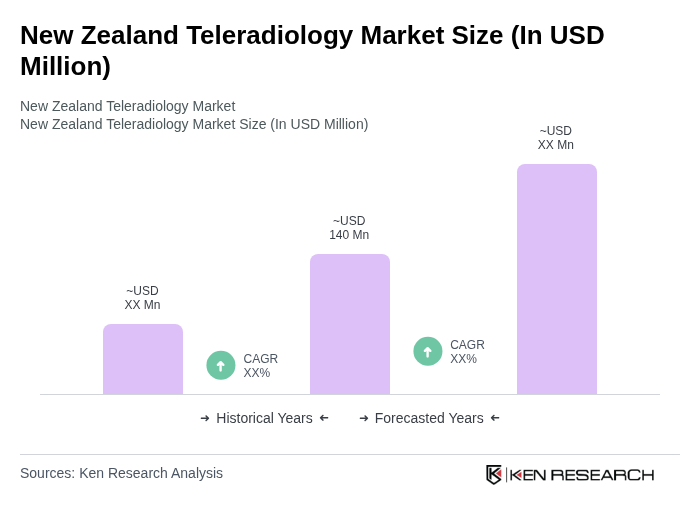
- The New Zealand Teleradiology Market is valued at USD 140 million, based on a five-year historical analysis and considering its share within the broader New Zealand pathology and diagnostic imaging services industry, which exceeds USD 1 billion in annual revenue. This growth is primarily driven by the increasing demand for remote diagnostic services to address radiologist shortages, advancements in digital imaging and cloud-based PACS, and the rising prevalence of chronic and age-related diseases that require timely radiological assessments.
- Auckland, Wellington, and Christchurch are the dominant cities in the New Zealand Teleradiology Market. These cities have well-established public and private hospital networks, high concentrations of radiology providers such as Pacific Radiology, Mercy Radiology, and Auckland Radiology Group, and strong digital health and broadband infrastructure, making them key hubs for teleradiology service delivery and coordination.
- In 2023, the New Zealand government further strengthened the regulatory and policy framework for telehealth and tele-imaging services, including teleradiology, by building on requirements under the Health Practitioners Competence Assurance Act 2003 administered by the Ministry of Health (now Manat? Hauora) and the Medical Council of New Zealand’s Statement on Telehealth, which sets standards for clinical quality, patient safety, consent, privacy, and cross-border practice for remote radiology reporting.
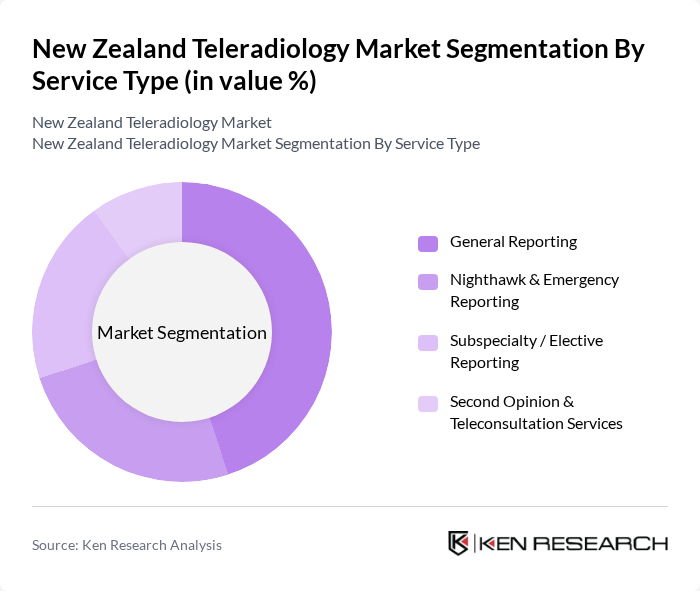
New Zealand Teleradiology Market Segmentation
By Service Type:The service type segmentation includes General Reporting, Nighthawk & Emergency Reporting, Subspecialty / Elective Reporting, and Second Opinion & Teleconsultation Services. Among these, General Reporting is the most widely utilized service due to its essential role in routine diagnostics and the increasing volume of imaging studies processed through hospital and community imaging providers. Nighthawk & Emergency Reporting is also gaining traction, particularly in urban and regional hospitals where after-hours coverage is needed to manage acute cases and mitigate radiologist shortages. The demand for Subspecialty Reporting is rising as healthcare providers seek specialized interpretations for complex oncology, neurology, and musculoskeletal cases, often leveraging global subspecialty networks. Second Opinion & Teleconsultation services are becoming popular among patients and referring clinicians seeking validation of complex diagnoses and access to subspecialist expertise via secure telehealth platforms.
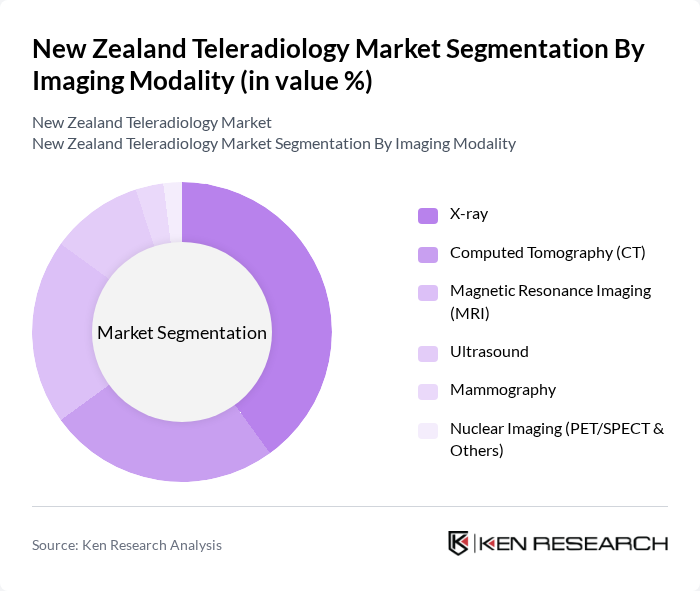
By Imaging Modality:The imaging modality segmentation encompasses X-ray, Computed Tomography (CT), Magnetic Resonance Imaging (MRI), Ultrasound, Mammography, and Nuclear Imaging (PET/SPECT & Others). X-ray remains the most commonly used modality in teleradiology globally and in New Zealand due to its cost-effectiveness, high procedure volumes, and speed, making it a staple in emergency and routine diagnostics. CT and MRI are increasingly utilized for their detailed cross?sectional imaging capabilities, particularly in oncology, neurology, trauma, and cardiology, and form a major share of advanced teleradiology reporting workloads. Ultrasound is favored for its non-invasive nature, lack of ionizing radiation, and real-time imaging, and is widely used in obstetrics, abdominal, and vascular assessments that can be reported remotely. Mammography is essential for breast cancer screening, which is supported in New Zealand through organized screening programs that increasingly rely on digital image transfer and remote reading. Nuclear Imaging (PET/SPECT & Others) is gaining traction for its ability to provide functional and metabolic information, particularly in oncology and cardiology, and is progressively incorporated into specialist teleradiology networks.
New Zealand Teleradiology Market Competitive Landscape
The New Zealand Teleradiology Market is characterized by a dynamic mix of regional and international players. Leading participants such as Everlight Radiology, Pacific Radiology Group, Mercy Radiology, Canopy Cancer Care (Imaging Partnerships), Auckland Radiology Group, TRG Imaging (The Radiology Group), Horizon Radiology, Teleradiology Australia, Telemedicine Clinic (TMC), Medica Group, Zed Technologies (Imaging Platform Partner), IDXtelerad, Global Diagnostics, vRad (Virtual Radiologic), and other emerging local teleradiology providers in New Zealand contribute to innovation, geographic expansion, and service delivery in this space.
New Zealand Teleradiology Market Industry Analysis
Growth Drivers
- Increasing Demand for Remote Diagnostics:The New Zealand healthcare system is witnessing a significant rise in the demand for remote diagnostics, driven by a growing population of approximately 5.3 million. With an estimated 30% of patients in rural areas lacking access to specialized care, teleradiology offers a solution. The Ministry of Health reported that telehealth consultations increased by 150% during the pandemic, highlighting the urgent need for remote diagnostic services to bridge healthcare gaps.
- Advancements in Imaging Technology:The teleradiology market is propelled by rapid advancements in imaging technology, with the global medical imaging market projected to reach NZD 1.5 billion. Innovations such as high-resolution imaging and portable devices enhance diagnostic accuracy and efficiency. The integration of cloud-based solutions allows for seamless data sharing, enabling radiologists to interpret images remotely, thus improving patient outcomes and reducing turnaround times significantly.
- Shortage of Radiologists in Rural Areas:New Zealand faces a critical shortage of radiologists, particularly in rural regions, where the ratio is approximately 1 radiologist per 100,000 people compared to 5 per 100,000 in urban areas. This disparity creates a pressing need for teleradiology services to ensure timely diagnoses. The government has recognized this issue, allocating NZD 20 million to enhance telehealth infrastructure, thereby addressing the workforce gap and improving access to radiological services.
Market Challenges
- Data Privacy and Security Concerns:The teleradiology market in New Zealand faces significant challenges related to data privacy and security. With healthcare data breaches increasing by 25%, concerns over patient confidentiality are paramount. Compliance with the Health Information Privacy Code is essential, yet many providers struggle to implement robust cybersecurity measures, risking sensitive patient information and potentially leading to legal repercussions and loss of trust in telehealth services.
- High Initial Setup Costs:The initial setup costs for teleradiology services can be prohibitive, often exceeding NZD 100,000 for small healthcare facilities. This includes investments in advanced imaging equipment, software, and training for staff. Many rural healthcare providers, operating on tight budgets, find it challenging to allocate funds for such investments. Consequently, this financial barrier limits the adoption of teleradiology solutions, hindering the overall growth of the market in these underserved areas.
New Zealand Teleradiology Market Future Outlook
The future of the New Zealand teleradiology market appears promising, driven by technological advancements and increasing healthcare demands. As the population ages, the need for efficient diagnostic services will grow, prompting healthcare providers to adopt innovative solutions. The integration of artificial intelligence in radiology workflows is expected to enhance diagnostic accuracy and efficiency. Additionally, the expansion of telehealth services will likely facilitate greater access to specialized care, particularly in rural areas, fostering a more equitable healthcare landscape.
Market Opportunities
- Expansion of Telehealth Services:The ongoing expansion of telehealth services presents a significant opportunity for teleradiology. With the New Zealand government investing NZD 15 million in telehealth initiatives, healthcare providers can leverage this funding to enhance their teleradiology capabilities, improving access to diagnostic services for patients in remote areas and ultimately increasing patient satisfaction and outcomes.
- Development of AI-Driven Diagnostic Tools:The development of AI-driven diagnostic tools offers a transformative opportunity for the teleradiology market. With AI technology projected to reduce diagnostic errors by up to 30%, healthcare providers can enhance their diagnostic accuracy and efficiency. Collaborations between tech companies and healthcare institutions can accelerate the integration of these tools, leading to improved patient care and streamlined radiology workflows.
Scope of the Report
| Segment | Sub-Segments |
|---|---|
| By Service Type | General Reporting Nighthawk & Emergency Reporting Subspecialty / Elective Reporting Second Opinion & Teleconsultation Services |
| By Imaging Modality | X-ray Computed Tomography (CT) Magnetic Resonance Imaging (MRI) Ultrasound Mammography Nuclear Imaging (PET/SPECT & Others) |
| By Clinical Application | Oncology Neurology Cardiology Musculoskeletal & Orthopedics Other Applications |
| By Technology Platform | Cloud-based Teleradiology Platforms Web-based / On-premise PACS & RIS Hybrid Deployments AI-enabled Workflow Solutions |
| By Service Delivery Model | In-house Teleradiology Onshore Outsourced Services (Within New Zealand) Offshore Outsourced Services Cross-border Reporting Partnerships |
| By End-User | Public Hospitals / District Health Boards Private Hospitals & Health Systems Independent Diagnostic Imaging Centers Specialist Clinics & Primary Care Networks Others (Mobile Imaging Providers, Corporate Health, etc.) |
| By Geographic Coverage (Within New Zealand) | Metropolitan & Urban Catchments Regional & Secondary Cities Rural & Remote Communities Inter-island & Cross-border Coverage |
Key Target Audience
Investors and Venture Capitalist Firms
Government and Regulatory Bodies (e.g., Ministry of Health, Health Quality & Safety Commission)
Healthcare Providers and Hospitals
Radiology Practices and Clinics
Health Insurance Companies
Telecommunications Companies
Medical Device Manufacturers
Healthcare IT Solutions Providers
Players Mentioned in the Report:
Everlight Radiology
Pacific Radiology Group
Mercy Radiology
Canopy Cancer Care (Imaging Partnerships)
Auckland Radiology Group
TRG Imaging (The Radiology Group)
Horizon Radiology
Teleradiology Australia
Telemedicine Clinic (TMC)
Medica Group
Zed Technologies (Imaging Platform Partner)
IDXtelerad
Global Diagnostics
vRad (Virtual Radiologic)
Other Emerging Local Teleradiology Providers in New Zealand
Table of Contents
Market Assessment Phase
1. Executive Summary and Approach
2. New Zealand Teleradiology Market Overview
2.1 Key Insights and Strategic Recommendations
2.2 New Zealand Teleradiology Market Overview
2.3 Definition and Scope
2.4 Evolution of Market Ecosystem
2.5 Timeline of Key Regulatory Milestones
2.6 Value Chain & Stakeholder Mapping
2.7 Business Cycle Analysis
2.8 Policy & Incentive Landscape
3. New Zealand Teleradiology Market Analysis
3.1 Growth Drivers
3.1.1 Increasing demand for remote diagnostics
3.1.2 Advancements in imaging technology
3.1.3 Shortage of radiologists in rural areas
3.1.4 Rising healthcare expenditure
3.2 Market Challenges
3.2.1 Data privacy and security concerns
3.2.2 High initial setup costs
3.2.3 Regulatory compliance complexities
3.2.4 Limited awareness among healthcare providers
3.3 Market Opportunities
3.3.1 Expansion of telehealth services
3.3.2 Partnerships with healthcare institutions
3.3.3 Development of AI-driven diagnostic tools
3.3.4 Increasing focus on patient-centered care
3.4 Market Trends
3.4.1 Growth of cloud-based teleradiology solutions
3.4.2 Integration of AI in radiology workflows
3.4.3 Shift towards value-based care models
3.4.4 Rising patient demand for convenience
3.5 Government Regulation
3.5.1 Health Information Privacy Code
3.5.2 Medical Device Regulations
3.5.3 Telehealth Guidelines
3.5.4 Radiology Reporting Standards
4. SWOT Analysis
5. Stakeholder Analysis
6. Porter's Five Forces Analysis
7. New Zealand Teleradiology Market Market Size, 2019-2024
7.1 By Value
7.2 By Volume
7.3 By Average Selling Price
8. New Zealand Teleradiology Market Segmentation
8.1 By Service Type
8.1.1 General Reporting
8.1.2 Nighthawk & Emergency Reporting
8.1.3 Subspecialty / Elective Reporting
8.1.4 Second Opinion & Teleconsultation Services
8.2 By Imaging Modality
8.2.1 X-ray
8.2.2 Computed Tomography (CT)
8.2.3 Magnetic Resonance Imaging (MRI)
8.2.4 Ultrasound
8.2.5 Mammography
8.2.6 Nuclear Imaging (PET/SPECT & Others)
8.3 By Clinical Application
8.3.1 Oncology
8.3.2 Neurology
8.3.3 Cardiology
8.3.4 Musculoskeletal & Orthopedics
8.3.5 Other Applications
8.4 By Technology Platform
8.4.1 Cloud-based Teleradiology Platforms
8.4.2 Web-based / On-premise PACS & RIS
8.4.3 Hybrid Deployments
8.4.4 AI-enabled Workflow Solutions
8.5 By Service Delivery Model
8.5.1 In-house Teleradiology
8.5.2 Onshore Outsourced Services (Within New Zealand)
8.5.3 Offshore Outsourced Services
8.5.4 Cross-border Reporting Partnerships
8.6 By End-User
8.6.1 Public Hospitals / District Health Boards
8.6.2 Private Hospitals & Health Systems
8.6.3 Independent Diagnostic Imaging Centers
8.6.4 Specialist Clinics & Primary Care Networks
8.6.5 Others (Mobile Imaging Providers, Corporate Health, etc.)
8.7 By Geographic Coverage (Within New Zealand)
8.7.1 Metropolitan & Urban Catchments
8.7.2 Regional & Secondary Cities
8.7.3 Rural & Remote Communities
8.7.4 Inter-island & Cross-border Coverage
9. New Zealand Teleradiology Market Competitive Analysis
9.1 Market Share of Key Players
9.2 Cross Comparison of Key Players
9.2.1 Company Name
9.2.2 Ownership / Group Size (Independent, Regional Group, Global Group)
9.2.3 Annual Teleradiology Revenue (NZD)
9.2.4 Historical Revenue CAGR (3–5 Years)
9.2.5 Exam Volume per Year (Number of Studies Reported)
9.2.6 Average Report Turnaround Time (Minutes)
9.2.7 On-time Delivery Rate (% Reports Within SLA)
9.2.8 Average Revenue per Study (NZD per Exam)
9.2.9 EBITDA Margin from Teleradiology Business (%)
9.2.10 Customer Retention Rate (% of Contracts Renewed)
9.2.11 New Contract Wins per Year (Number of New Provider Accounts)
9.2.12 Geographic Footprint (Number of Sites / Regions Served)
9.2.13 Radiologist Capacity (FTE Radiologists & Subspecialists)
9.2.14 Technology Adoption Index (Cloud, AI, Integration Level)
9.3 SWOT Analysis of Top Players
9.4 Pricing Analysis
9.5 Detailed Profile of Major Companies
9.5.1 Everlight Radiology
9.5.2 Pacific Radiology Group
9.5.3 Mercy Radiology
9.5.4 Canopy Cancer Care (Imaging Partnerships)
9.5.5 Auckland Radiology Group
9.5.6 TRG Imaging (The Radiology Group)
9.5.7 Horizon Radiology
9.5.8 Teleradiology Australia
9.5.9 Telemedicine Clinic (TMC)
9.5.10 Medica Group
9.5.11 Zed Technologies (Imaging Platform Partner)
9.5.12 IDXtelerad
9.5.13 Global Diagnostics
9.5.14 vRad (Virtual Radiologic)
9.5.15 Other Emerging Local Teleradiology Providers in New Zealand
10. New Zealand Teleradiology Market End-User Analysis
10.1 Procurement Behavior of Key Ministries
10.1.1 Budget Allocation for Teleradiology
10.1.2 Decision-Making Process
10.1.3 Preferred Service Providers
10.1.4 Contract Duration and Terms
10.2 Corporate Spend on Infrastructure & Energy
10.2.1 Investment in Teleradiology Infrastructure
10.2.2 Spending on Technology Upgrades
10.2.3 Budget for Training and Development
10.2.4 Others
10.3 Pain Point Analysis by End-User Category
10.3.1 Access to Quality Radiology Services
10.3.2 Timeliness of Reports
10.3.3 Integration with Existing Systems
10.3.4 Others
10.4 User Readiness for Adoption
10.4.1 Awareness of Teleradiology Benefits
10.4.2 Training Needs
10.4.3 Infrastructure Readiness
10.4.4 Others
10.5 Post-Deployment ROI and Use Case Expansion
10.5.1 Measurement of ROI
10.5.2 Expansion into New Use Cases
10.5.3 User Feedback and Improvement
10.5.4 Others
11. New Zealand Teleradiology Market Future Size, 2025-2030
11.1 By Value
11.2 By Volume
11.3 By Average Selling Price
Go-To-Market Strategy Phase
1. Whitespace Analysis + Business Model Canvas
1.1 Market Gaps Identification
1.2 Business Model Development
2. Marketing and Positioning Recommendations
2.1 Branding Strategies
2.2 Product USPs
3. Distribution Plan
3.1 Urban Retail vs Rural NGO Tie-ups
4. Channel & Pricing Gaps
4.1 Underserved Routes
4.2 Pricing Bands
5. Unmet Demand & Latent Needs
5.1 Category Gaps
5.2 Consumer Segments
6. Customer Relationship
6.1 Loyalty Programs
6.2 After-Sales Service
7. Value Proposition
7.1 Sustainability
7.2 Integrated Supply Chains
8. Key Activities
8.1 Regulatory Compliance
8.2 Branding
8.3 Distribution Setup
9. Entry Strategy Evaluation
9.1 Domestic Market Entry Strategy
9.1.1 Product Mix
9.1.2 Pricing Band
9.1.3 Packaging
9.2 Export Entry Strategy
9.2.1 Target Countries
9.2.2 Compliance Roadmap
10. Entry Mode Assessment
10.1 JV
10.2 Greenfield
10.3 M&A
10.4 Distributor Model
11. Capital and Timeline Estimation
11.1 Capital Requirements
11.2 Timelines
12. Control vs Risk Trade-Off
12.1 Ownership vs Partnerships
13. Profitability Outlook
13.1 Breakeven Analysis
13.2 Long-Term Sustainability
14. Potential Partner List
14.1 Distributors
14.2 JVs
14.3 Acquisition Targets
15. Execution Roadmap
15.1 Phased Plan for Market Entry
15.1.1 Market Setup
15.1.2 Market Entry
15.1.3 Growth Acceleration
15.1.4 Scale & Stabilize
15.2 Key Activities and Milestones
15.2.1 Milestone Planning
15.2.2 Activity Tracking
Research Methodology
Phase 1: Approach1
Desk Research
- Analysis of industry reports from New Zealand's Ministry of Health and Radiology Society
- Review of academic publications and white papers on teleradiology trends and technologies
- Examination of market statistics from healthcare databases and government health expenditure reports
Primary Research
- Interviews with radiologists and healthcare administrators in hospitals and clinics
- Surveys targeting teleradiology service providers and technology vendors
- Focus groups with healthcare professionals to understand user experience and needs
Validation & Triangulation
- Cross-validation of findings through multiple data sources including government and private sector reports
- Triangulation of qualitative insights from interviews with quantitative data from surveys
- Sanity checks conducted through expert panel reviews comprising industry veterans
Phase 2: Market Size Estimation1
Top-down Assessment
- Estimation of market size based on national healthcare spending and radiology service utilization rates
- Segmentation of the market by service type, including remote consultations and image transmission
- Incorporation of demographic data to assess the growth potential in rural and urban areas
Bottom-up Modeling
- Collection of service pricing data from leading teleradiology firms operating in New Zealand
- Volume estimates based on the number of imaging studies performed annually
- Cost analysis of technology infrastructure and operational expenses for service delivery
Forecasting & Scenario Analysis
- Multi-factor regression analysis incorporating factors such as population aging and chronic disease prevalence
- Scenario modeling based on potential regulatory changes and technological advancements
- Development of baseline, optimistic, and pessimistic forecasts through 2030
Phase 3: CATI Sample Composition1
| Scope Item/Segment | Sample Size | Target Respondent Profiles |
|---|---|---|
| Hospital Radiology Departments | 60 | Radiologists, Department Heads |
| Private Teleradiology Firms | 50 | Business Development Managers, Technical Leads |
| Healthcare IT Solutions Providers | 40 | Product Managers, IT Directors |
| General Practitioners Utilizing Teleradiology | 70 | General Practitioners, Clinic Managers |
| Healthcare Policy Makers | 40 | Health Policy Analysts, Government Officials |
Frequently Asked Questions
What is the current value of the New Zealand Teleradiology Market?
The New Zealand Teleradiology Market is valued at approximately USD 140 million, reflecting its significant role within the broader pathology and diagnostic imaging services industry, which exceeds USD 1 billion in annual revenue.
What factors are driving the growth of the New Zealand Teleradiology Market?
Which cities are the main hubs for teleradiology services in New Zealand?
What regulatory frameworks govern teleradiology in New Zealand?
Other Regional/Country Reports
Indonesia Teleradiology Market Report Size Share Growth Drivers Trends Opportunities & Forecast 2025–2030
Other Adjacent Reports
UAE Diagnostic Imaging Market
New Zealand Medical Imaging Market Report Size Share Growth Drivers Trends Opportunities & Forecast 2025–2030Philippines Radiology Services Market
KSA healthcare it market size, share, growth drivers, trends, opportunities & forecast 2025–2030USA Cloud Computing in Healthcare Market Outlook to 2030Vietnam Artificial Intelligence in Healthcare Market
UAE Picture Archiving and Communication System Market
UAE Remote Patient Monitoring Market Size, Share, Growth Drivers, Trends, Opportunities & Forecast 2025–2030UAE Pathology Services Market
Why Buy From Us?

What makes us stand out is that our consultants follow Robust, Refine and Result (RRR) methodology. Robust for clear definitions, approaches and sanity checking, Refine for differentiating respondents' facts and opinions, and Result for presenting data with story.

We have set a benchmark in the industry by offering our clients with syndicated and customized market research reports featuring coverage of entire market as well as meticulous research and analyst insights.

While we don't replace traditional research, we flip the method upside down. Our dual approach of Top Bottom & Bottom Top ensures quality deliverable by not just verifying company fundamentals but also looking at the sector and macroeconomic factors.

With one step in the future, our research team constantly tries to show you the bigger picture. We help with some of the tough questions you may encounter along the way: How is the industry positioned? Best marketing channel? KPI's of competitors? By aligning every element, we help maximize success.

Our report gives you instant access to the answers and sources that other companies might choose to hide. We elaborate each steps of research methodology we have used and showcase you the sample size to earn your trust.

If you need any support, we are here! We pride ourselves on universe strength, data quality, and quick, friendly, and professional service.