About the Report
Base Year 2024New Zealand Terrazzo Market Overview
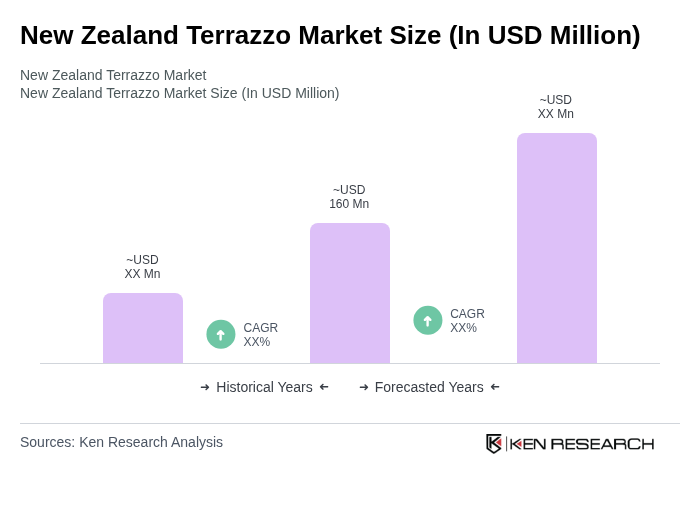
- The New Zealand Terrazzo Market is valued at USD 160 million, based on a five-year historical analysis of terrazzo flooring demand relative to global and Oceania market benchmarks and New Zealand’s share in regional construction output. This growth is primarily driven by the increasing demand for durable and aesthetically pleasing flooring solutions in both residential and commercial sectors, in line with global trends where terrazzo is favored for its longevity, low life-cycle cost, and design flexibility. The rise in construction and renovation activities, coupled with a growing preference for sustainable and low?maintenance materials (including the use of recycled aggregates and low?VOC binders in terrazzo systems), has significantly contributed to the market's expansion.
- Auckland stands out as the dominant city in the New Zealand Terrazzo Market due to its robust construction sector, population concentration, and large pipeline of residential, commercial, and public projects. Other key regions include Wellington and Christchurch, where ongoing infrastructure improvements, seismic strengthening programs, and a focus on modern architectural designs further bolster the demand for terrazzo products in high-traffic public, institutional, and premium residential developments.
- In 2023, the New Zealand government strengthened its focus on sustainable building practices through updates and implementation under the Building Act 2004 and the Building Code clause H1 Energy Efficiency, alongside the Building (Building Products and Methods, Modular Components, and Other Matters) Amendment Act 2021, which collectively promote higher performance, durability, and environmental outcomes in building materials and systems. In parallel, the Building for Climate Change programme led by the Ministry of Business, Innovation and Employment (MBIE) provides a policy framework to reduce operational and embodied carbon in buildings, encouraging the specification of long?life, low?maintenance and lower?emission materials. These measures support greater adoption of terrazzo flooring, which aligns with long service life, reduced replacement frequency, and the potential use of recycled aggregates, thereby enhancing its market appeal in sustainably designed projects.
New Zealand Terrazzo Market Segmentation
By Type:The market is segmented into various types of terrazzo, including Epoxy Terrazzo, Cement-based Terrazzo, Bonded / Sand Cushion / Monolithic Systems, and Other Terrazzo Types, which is consistent with global product classifications in terrazzo flooring. Among these, Epoxy Terrazzo is gaining traction due to its versatility, thin?set installation, rapid curing, wide color range, and ease of maintenance, making it a preferred choice for both residential and commercial applications, particularly in interiors and high?design spaces. Cement-based Terrazzo also holds a significant share, particularly in traditional, heavy?duty, and high?end installations, as well as exterior areas, appealing to consumers and specifiers seeking robustness, design authenticity, and compatibility with large?format or cast?in?situ solutions.

By End-Use Sector:The end-use sectors for terrazzo include Residential, Commercial, Industrial, and Public & Institutional (Education, Healthcare, Government), mirroring global demand patterns where residential and commercial applications are the main growth engines. The Residential sector is currently leading the market, driven by homeowners' increasing preference for stylish and durable flooring options, renovation activity, and interest in premium finishes that offer long-term performance and low maintenance. The Commercial sector follows closely, with businesses and developers opting for terrazzo for its aesthetic appeal, ability to support branding and custom patterns, and low life?cycle costs in high-traffic areas such as retail, offices, hospitality, airports, and education facilities.

New Zealand Terrazzo Market Competitive Landscape
The New Zealand Terrazzo Market is characterized by a dynamic mix of regional and international players. Leading participants such as Fletcher Building, Firth Industries (a Fletcher Building business), PeterFell, The Flooring Centre, Terrazzo & Stone Ltd, Terrazzo NZ Ltd, Venetian Terrazzo Ltd, Natural Stone & Terrazzo specialists, Habitat Floors, Heritage Tiles, Tile Warehouse, Jacobsen, Eco Outdoor New Zealand, CDK Stone New Zealand, Other Emerging Local Terrazzo Installers & Fabricators contribute to innovation, geographic expansion, and service delivery in this space, reflecting the broader global trend where both large building materials groups and specialized flooring contractors support terrazzo specification and installation.
New Zealand Terrazzo Market Industry Analysis
Growth Drivers
- Increasing Demand for Sustainable Flooring Solutions:The New Zealand construction sector is projected to grow by NZD 1.5 billion in future, driven by a heightened focus on sustainability. Terrazzo, made from recycled materials, aligns with this trend, appealing to environmentally conscious consumers. The government’s commitment to reducing carbon emissions by 50% in future further supports this demand, as builders seek eco-friendly materials that comply with new regulations, enhancing the market's growth potential.
- Rising Construction Activities in Residential and Commercial Sectors:In future, New Zealand's residential construction is expected to reach NZD 20 billion, fueled by a housing shortage and increased urbanization. This surge in construction activity directly benefits the terrazzo market, as builders and architects increasingly specify terrazzo for its durability and aesthetic appeal. Additionally, commercial projects, particularly in hospitality and retail, are projected to contribute NZD 5 billion, further driving demand for high-quality flooring solutions.
- Technological Advancements in Terrazzo Production:The introduction of advanced manufacturing techniques has reduced production costs by approximately 15% in recent years. Innovations such as digital printing and automated mixing processes enhance the quality and customization of terrazzo products. As a result, manufacturers can offer a wider range of designs and finishes, appealing to a broader customer base. This technological evolution is expected to significantly boost market competitiveness and attract new investments in future.
Market Challenges
- High Initial Installation Costs:The average installation cost for terrazzo flooring in New Zealand is around NZD 150 per square meter, which is significantly higher than alternatives like vinyl or laminate. This price point can deter potential customers, especially in a market where budget constraints are prevalent. As construction costs rise, consumers may opt for cheaper flooring solutions, posing a challenge for terrazzo market penetration in both residential and commercial sectors.
- Limited Awareness Among Consumers:Despite its benefits, consumer awareness of terrazzo remains low, with only 30% of homeowners familiar with its advantages. This lack of knowledge can hinder market growth, as potential buyers may not recognize terrazzo as a viable flooring option. Educational initiatives and marketing campaigns are essential to inform consumers about the durability, sustainability, and aesthetic appeal of terrazzo, which could significantly enhance market acceptance and demand.
New Zealand Terrazzo Market Future Outlook
The New Zealand terrazzo market is poised for significant growth, driven by increasing consumer demand for sustainable and aesthetically pleasing flooring solutions. As construction activities expand, particularly in urban areas, the market is likely to see a rise in innovative designs and applications. Collaborations with architects and designers will further enhance product offerings, while technological advancements will streamline production processes, making terrazzo more accessible to a wider audience. Overall, the future looks promising for the terrazzo industry in New Zealand.
Market Opportunities
- Expansion in the Eco-Friendly Building Materials Segment:With the New Zealand government promoting green building initiatives, there is a growing opportunity for terrazzo manufacturers to position their products as eco-friendly alternatives. This segment is expected to grow by NZD 500 million in future, providing a lucrative market for sustainable flooring solutions that meet environmental standards.
- Increasing Renovation and Remodeling Projects:The renovation market in New Zealand is projected to reach NZD 10 billion in future, driven by homeowners seeking to upgrade their living spaces. This trend presents a significant opportunity for terrazzo, as its unique aesthetic and durability make it an attractive choice for renovations, particularly in kitchens and bathrooms, where style and functionality are paramount.
Scope of the Report
| Segment | Sub-Segments |
|---|---|
| By Type | Epoxy Terrazzo Cement-based Terrazzo Bonded / Sand Cushion / Monolithic Systems Other Terrazzo Types |
| By End-Use Sector | Residential Commercial Industrial Public & Institutional (Education, Healthcare, Government) |
| By Region | North Island – Auckland North Island – Rest of North Island South Island – Canterbury South Island – Rest of South Island |
| By Application | Floors and Stairs Walls & Wall Cladding Countertops & Benchtops Outdoor & Landscape Features |
| By Material Composition | Marble Chips Glass Chips Quartz & Granite Aggregates Recycled & Other Materials |
| By Installation Method | In-situ (Poured-in-place) Terrazzo Precast Terrazzo Modular / Tile Terrazzo |
| By Market Channel | Direct Sales to Builders & Contractors Specialty Flooring & Tile Distributors DIY Retail & Home Improvement Stores Online & Omnichannel Platforms |
Key Target Audience
Investors and Venture Capitalist Firms
Government and Regulatory Bodies (e.g., Ministry of Business, Innovation and Employment)
Manufacturers and Producers
Distributors and Retailers
Architectural and Design Firms
Construction Companies
Real Estate Developers
Interior Design Firms
Players Mentioned in the Report:
Fletcher Building
Firth Industries (a Fletcher Building business)
PeterFell
The Flooring Centre
Terrazzo & Stone Ltd
Terrazzo NZ Ltd
Venetian Terrazzo Ltd
Natural Stone & Terrazzo specialists
Habitat Floors
Heritage Tiles
Tile Warehouse
Jacobsen
Eco Outdoor New Zealand
CDK Stone New Zealand
Other Emerging Local Terrazzo Installers & Fabricators
Table of Contents
Market Assessment Phase
1. Executive Summary and Approach
2. New Zealand Terrazzo Market Overview
2.1 Key Insights and Strategic Recommendations
2.2 New Zealand Terrazzo Market Overview
2.3 Definition and Scope
2.4 Evolution of Market Ecosystem
2.5 Timeline of Key Regulatory Milestones
2.6 Value Chain & Stakeholder Mapping
2.7 Business Cycle Analysis
2.8 Policy & Incentive Landscape
3. New Zealand Terrazzo Market Analysis
3.1 Growth Drivers
3.1.1 Increasing demand for sustainable flooring solutions
3.1.2 Rising construction activities in residential and commercial sectors
3.1.3 Technological advancements in terrazzo production
3.1.4 Growing consumer preference for aesthetic appeal and customization
3.2 Market Challenges
3.2.1 High initial installation costs
3.2.2 Limited awareness among consumers
3.2.3 Competition from alternative flooring materials
3.2.4 Supply chain disruptions affecting raw material availability
3.3 Market Opportunities
3.3.1 Expansion in the eco-friendly building materials segment
3.3.2 Increasing renovation and remodeling projects
3.3.3 Potential for export to neighboring markets
3.3.4 Collaborations with architects and designers for innovative designs
3.4 Market Trends
3.4.1 Shift towards sustainable and recycled materials
3.4.2 Customization and personalization in design
3.4.3 Integration of smart technology in flooring solutions
3.4.4 Growth of online platforms for product sales
3.5 Government Regulation
3.5.1 Compliance with environmental standards
3.5.2 Building code regulations affecting material use
3.5.3 Incentives for using sustainable materials
3.5.4 Regulations on waste management in construction
4. SWOT Analysis
5. Stakeholder Analysis
6. Porter's Five Forces Analysis
7. New Zealand Terrazzo Market Market Size, 2019-2024
7.1 By Value
7.2 By Volume
7.3 By Average Selling Price
8. New Zealand Terrazzo Market Segmentation
8.1 By Type
8.1.1 Epoxy Terrazzo
8.1.2 Cement-based Terrazzo
8.1.3 Bonded / Sand Cushion / Monolithic Systems
8.1.4 Other Terrazzo Types
8.2 By End-Use Sector
8.2.1 Residential
8.2.2 Commercial
8.2.3 Industrial
8.2.4 Public & Institutional (Education, Healthcare, Government)
8.3 By Region
8.3.1 North Island – Auckland
8.3.2 North Island – Rest of North Island
8.3.3 South Island – Canterbury
8.3.4 South Island – Rest of South Island
8.4 By Application
8.4.1 Floors and Stairs
8.4.2 Walls & Wall Cladding
8.4.3 Countertops & Benchtops
8.4.4 Outdoor & Landscape Features
8.5 By Material Composition
8.5.1 Marble Chips
8.5.2 Glass Chips
8.5.3 Quartz & Granite Aggregates
8.5.4 Recycled & Other Materials
8.6 By Installation Method
8.6.1 In-situ (Poured-in-place) Terrazzo
8.6.2 Precast Terrazzo
8.6.3 Modular / Tile Terrazzo
8.7 By Market Channel
8.7.1 Direct Sales to Builders & Contractors
8.7.2 Specialty Flooring & Tile Distributors
8.7.3 DIY Retail & Home Improvement Stores
8.7.4 Online & Omnichannel Platforms
9. New Zealand Terrazzo Market Competitive Analysis
9.1 Market Share of Key Players
9.2 Cross Comparison of Key Players
9.2.1 Company Name
9.2.2 Group Size (Large, Medium, or Small as per industry convention)
9.2.3 New Zealand Terrazzo Revenue (NZD, Latest FY)
9.2.4 3-Year Terrazzo Revenue CAGR (%)
9.2.5 Terrazzo Gross Margin (%)
9.2.6 New Zealand Market Share (%)
9.2.7 Project Pipeline / Backlog (NZD or Months of Work)
9.2.8 Average Project Size (NZD per Contract)
9.2.9 Win Rate in Competitive Bids (%)
9.2.10 Capacity Utilization Rate (%)
9.2.11 On-time Project Delivery Rate (%)
9.2.12 Customer Retention / Repeat Business Rate (%)
9.2.13 Health & Safety Incident Rate
9.2.14 R&D / Design & Innovation Spend (% of Revenue)
9.3 SWOT Analysis of Top Players
9.4 Pricing Analysis
9.5 Detailed Profile of Major Companies
9.5.1 Fletcher Building
9.5.2 Firth Industries (a Fletcher Building business)
9.5.3 PeterFell
9.5.4 The Flooring Centre
9.5.5 Terrazzo & Stone Ltd
9.5.6 Terrazzo NZ Ltd
9.5.7 Venetian Terrazzo Ltd
9.5.8 Natural Stone & Terrazzo specialists
9.5.9 Habitat Floors
9.5.10 Heritage Tiles
9.5.11 Tile Warehouse
9.5.12 Jacobsen
9.5.13 Eco Outdoor New Zealand
9.5.14 CDK Stone New Zealand
9.5.15 Other Emerging Local Terrazzo Installers & Fabricators
10. New Zealand Terrazzo Market End-User Analysis
10.1 Procurement Behavior of Key Ministries
10.1.1 Key Ministries Involved
10.1.2 Procurement Processes
10.1.3 Budget Allocations
10.1.4 Decision-Making Criteria
10.2 Corporate Spend on Infrastructure & Energy
10.2.1 Investment Trends
10.2.2 Major Projects
10.2.3 Budget Priorities
10.2.4 Future Spending Projections
10.3 Pain Point Analysis by End-User Category
10.3.1 Residential Users
10.3.2 Commercial Users
10.3.3 Industrial Users
10.3.4 Government Users
10.4 User Readiness for Adoption
10.4.1 Awareness Levels
10.4.2 Adoption Barriers
10.4.3 Training Needs
10.4.4 Support Requirements
10.5 Post-Deployment ROI and Use Case Expansion
10.5.1 ROI Metrics
10.5.2 Use Case Examples
10.5.3 Feedback Mechanisms
10.5.4 Future Expansion Opportunities
11. New Zealand Terrazzo Market Future Size, 2025-2030
11.1 By Value
11.2 By Volume
11.3 By Average Selling Price
Go-To-Market Strategy Phase
1. Whitespace Analysis + Business Model Canvas
1.1 Market Gaps Identification
1.2 Business Model Components
1.3 Value Proposition Development
1.4 Revenue Streams
1.5 Cost Structure Analysis
1.6 Key Partnerships
1.7 Customer Segments
2. Marketing and Positioning Recommendations
2.1 Branding Strategies
2.2 Product USPs
2.3 Target Audience Identification
2.4 Marketing Channels
2.5 Promotional Strategies
2.6 Customer Engagement Tactics
2.7 Performance Metrics
3. Distribution Plan
3.1 Urban Retail Strategies
3.2 Rural NGO Tie-Ups
3.3 Online Distribution Channels
3.4 Logistics and Supply Chain Management
3.5 Inventory Management
3.6 Distribution Partnerships
3.7 Performance Evaluation
4. Channel & Pricing Gaps
4.1 Underserved Routes
4.2 Pricing Bands
4.3 Competitive Pricing Analysis
4.4 Customer Perception of Value
4.5 Price Sensitivity Analysis
4.6 Pricing Strategy Recommendations
4.7 Performance Metrics
5. Unmet Demand & Latent Needs
5.1 Category Gaps
5.2 Consumer Segments
5.3 Product Development Opportunities
5.4 Market Entry Strategies
5.5 Customer Feedback Mechanisms
5.6 Performance Metrics
6. Customer Relationship
6.1 Loyalty Programs
6.2 After-sales Service
6.3 Customer Support Strategies
6.4 Feedback Collection Methods
6.5 Relationship Management Tools
6.6 Performance Metrics
7. Value Proposition
7.1 Sustainability Initiatives
7.2 Integrated Supply Chains
7.3 Customer-Centric Innovations
7.4 Competitive Advantages
7.5 Performance Metrics
8. Key Activities
8.1 Regulatory Compliance
8.2 Branding Initiatives
8.3 Distribution Setup
8.4 Training and Development
8.5 Performance Metrics
9. Entry Strategy Evaluation
9.1 Domestic Market Entry Strategy
9.1.1 Product Mix
9.1.2 Pricing Band
9.1.3 Packaging
9.2 Export Entry Strategy
9.2.1 Target Countries
9.2.2 Compliance Roadmap
10. Entry Mode Assessment
10.1 Joint Ventures
10.2 Greenfield Investments
10.3 Mergers & Acquisitions
10.4 Distributor Model
10.5 Performance Metrics
11. Capital and Timeline Estimation
11.1 Capital Requirements
11.2 Timelines
11.3 Risk Assessment
11.4 Performance Metrics
12. Control vs Risk Trade-Off
12.1 Ownership vs Partnerships
12.2 Risk Mitigation Strategies
12.3 Performance Metrics
13. Profitability Outlook
13.1 Breakeven Analysis
13.2 Long-term Sustainability
13.3 Performance Metrics
14. Potential Partner List
14.1 Distributors
14.2 Joint Ventures
14.3 Acquisition Targets
14.4 Performance Metrics
15. Execution Roadmap
15.1 Phased Plan for Market Entry
15.1.1 Market Setup
15.1.2 Market Entry
15.1.3 Growth Acceleration
15.1.4 Scale & Stabilize
15.2 Key Activities and Milestones
15.2.1 Milestone Planning
15.2.2 Performance Metrics
Research Methodology
Phase 1: Approach1
Desk Research
- Analysis of industry reports from New Zealand's construction and flooring sectors
- Review of market trends and forecasts from local trade associations and government publications
- Examination of historical sales data and pricing trends for terrazzo products
Primary Research
- Interviews with architects and interior designers specializing in commercial and residential projects
- Surveys with manufacturers and suppliers of terrazzo materials and installation services
- Field interviews with contractors and builders involved in terrazzo flooring projects
Validation & Triangulation
- Cross-validation of findings through multiple data sources, including trade publications and expert opinions
- Triangulation of market insights from primary interviews and secondary data analysis
- Sanity checks through expert panel reviews to ensure data accuracy and relevance
Phase 2: Market Size Estimation1
Top-down Assessment
- Estimation of the overall construction market size in New Zealand and its impact on terrazzo demand
- Segmentation of the market by application areas such as residential, commercial, and industrial
- Incorporation of government infrastructure projects and their influence on terrazzo usage
Bottom-up Modeling
- Collection of sales data from leading terrazzo manufacturers and distributors in New Zealand
- Estimation of installation volumes based on project sizes and average pricing per square meter
- Analysis of customer preferences and trends in terrazzo design and sustainability
Forecasting & Scenario Analysis
- Multi-factor regression analysis considering economic indicators, construction activity, and design trends
- Scenario modeling based on potential shifts in consumer preferences and regulatory changes
- Development of baseline, optimistic, and pessimistic forecasts through 2030
Phase 3: CATI Sample Composition1
| Scope Item/Segment | Sample Size | Target Respondent Profiles |
|---|---|---|
| Residential Terrazzo Installations | 120 | Homeowners, Interior Designers |
| Commercial Terrazzo Projects | 90 | Architects, Project Managers |
| Industrial Flooring Solutions | 60 | Facility Managers, Construction Supervisors |
| Terrazzo Material Suppliers | 50 | Sales Managers, Product Development Leads |
| Installation Contractors | 70 | Contractors, Estimators |
Frequently Asked Questions
What is the current value of the New Zealand Terrazzo Market?
The New Zealand Terrazzo Market is valued at approximately USD 160 million, reflecting a robust demand for durable and aesthetically pleasing flooring solutions in both residential and commercial sectors, driven by construction and renovation activities.
What factors are driving the growth of the New Zealand Terrazzo Market?
Which cities in New Zealand are leading in terrazzo demand?
What types of terrazzo are available in the New Zealand market?
Other Regional/Country Reports
Other Adjacent Reports
UAE Epoxy Flooring Market
Saudi Arabia Concrete Flooring Market Report Size Share Growth Drivers Trends Opportunities & Forecast 2025–2030Oman Vinyl Flooring MarketJapan Laminate Flooring Market
KSA Carpet Flooring Market
Oman Hardwood Flooring Market
Bahrain Sustainable Materials Market
KSA Construction Aggregates MarketWhy Buy From Us?

What makes us stand out is that our consultants follow Robust, Refine and Result (RRR) methodology. Robust for clear definitions, approaches and sanity checking, Refine for differentiating respondents' facts and opinions, and Result for presenting data with story.

We have set a benchmark in the industry by offering our clients with syndicated and customized market research reports featuring coverage of entire market as well as meticulous research and analyst insights.

While we don't replace traditional research, we flip the method upside down. Our dual approach of Top Bottom & Bottom Top ensures quality deliverable by not just verifying company fundamentals but also looking at the sector and macroeconomic factors.

With one step in the future, our research team constantly tries to show you the bigger picture. We help with some of the tough questions you may encounter along the way: How is the industry positioned? Best marketing channel? KPI's of competitors? By aligning every element, we help maximize success.

Our report gives you instant access to the answers and sources that other companies might choose to hide. We elaborate each steps of research methodology we have used and showcase you the sample size to earn your trust.

If you need any support, we are here! We pride ourselves on universe strength, data quality, and quick, friendly, and professional service.