About the Report
Base Year 2024Australia Terrazzo Market Overview
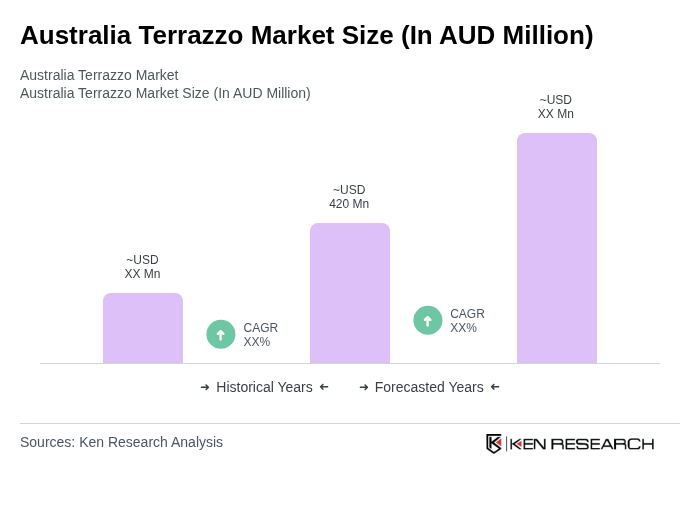
- The Australia Terrazzo Market is valued at AUD 420 million, based on a five-year historical analysis and its share within the global terrazzo flooring market, which is driven by rising adoption of terrazzo across residential, commercial, and institutional projects. This growth is primarily driven by the increasing demand for sustainable and aesthetically pleasing flooring solutions in both residential and commercial sectors. Global industry analysis highlights terrazzo’s strong appeal as a durable, low?maintenance, and design-flexible material made with recycled aggregates such as glass, marble, and granite, supporting its use in green building and interior design. The rise in construction and renovation activities in Australia, along with a growing preference for eco-friendly and long?life flooring and wall finishes, has significantly contributed to the market's expansion.
- Key cities such as Sydney, Melbourne, and Brisbane dominate the Australia Terrazzo Market due to their robust construction and renovation activities. These urban centers are characterized by a high concentration of commercial, institutional, and high-density residential projects, which fuels the demand for terrazzo flooring and precast terrazzo elements in lobbies, retail spaces, transport hubs, and premium apartments. Additionally, the presence of leading manufacturers and suppliers in these regions enhances market accessibility and growth, with Australia recognized as one of the key Asia-Pacific markets in global terrazzo reports.
- In 2023, the Australian government implemented regulations aimed at promoting sustainable building practices, including the use of eco-friendly materials like terrazzo. A key driver is the National Construction Code (NCC) 2022 issued by the Australian Building Codes Board, which strengthens energy efficiency and performance requirements for new buildings and major renovations and supports the use of durable, low?maintenance, and environmentally responsible materials within compliant designs. This framework encourages builders, designers, and contractors to adopt sustainable flooring solutions such as terrazzo—particularly where high durability, low lifecycle costs, and compatibility with green building targets (including Green Star and NABERS-rated projects) are required—thereby increasing the demand for terrazzo products in various construction projects.
Australia Terrazzo Market Segmentation
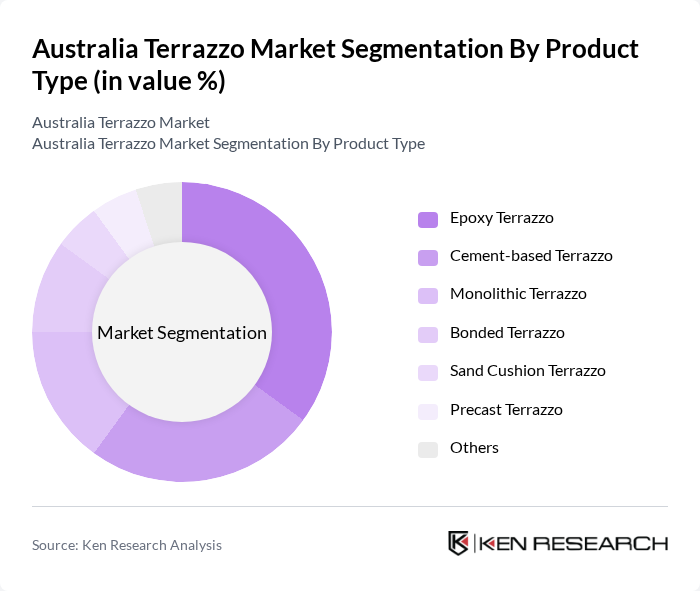
By Product Type:The product type segmentation includes various forms of terrazzo, each catering to different aesthetic and functional needs. The subsegments are Epoxy Terrazzo, Cement-based Terrazzo, Monolithic Terrazzo, Bonded Terrazzo, Sand Cushion Terrazzo, Precast Terrazzo, and Others. Global and regional terrazzo flooring studies indicate that epoxy terrazzo has become the dominant product type due to its high strength-to-thickness ratio, faster installation, extensive color and design options, and suitability for complex patterns and commercial interiors. As a result, Epoxy Terrazzo is gaining strong traction in the Australia market for modern interiors in offices, retail, education, healthcare, and high-end residential applications, while cement-based and traditional sand?cushion systems remain prevalent in heavy-duty and heritage-style projects.
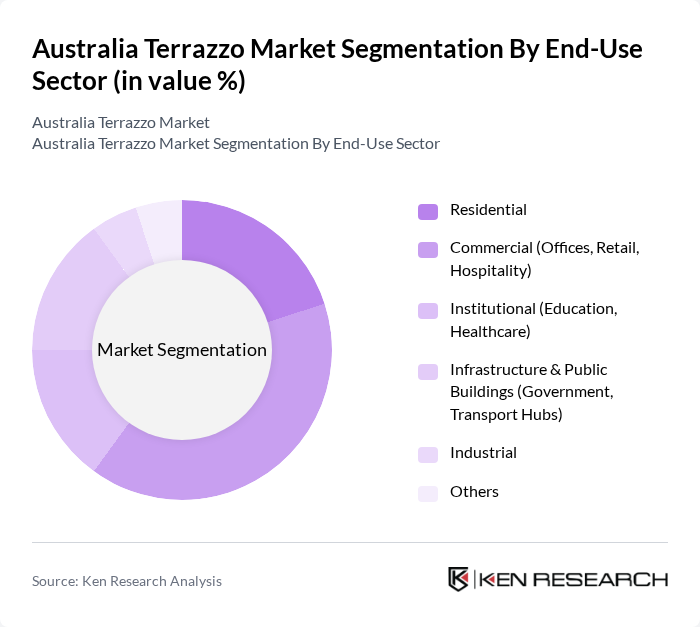
By End-Use Sector:The end-use sector segmentation encompasses various applications of terrazzo in different environments. The subsegments include Residential, Commercial (Offices, Retail, Hospitality), Institutional (Education, Healthcare), Infrastructure & Public Buildings (Government, Transport Hubs), Industrial, and Others. Global terrazzo flooring research shows that commercial and institutional developments account for a major share of terrazzo installations, especially in high-traffic spaces such as airports, shopping centres, schools, universities, and hospitals, where durability, hygiene, and lifecycle performance are critical. In Australia, the Commercial sector is currently leading due to the increasing trend of using terrazzo in high-traffic areas for its durability, seamless finish, and aesthetic appeal, while institutional and public infrastructure projects (including transport hubs and civic buildings) represent a significant and growing end-use segment.
Australia Terrazzo Market Competitive Landscape
The Australia Terrazzo Market is characterized by a dynamic mix of regional and international players. Leading participants such as Terrazzo Australian Marble Pty Ltd, Fibonacci Stone, Terrazzo Tiles Pty Ltd, Holcim Australia, Boral Limited, Hanson Australia, CSR Limited, Brickworks Building Products, Mapei Australia, Sika Australia, Ardex Australia, Bostik Australia, RLA Polymers, EcoTerrazzo, and other emerging local terrazzo specialists contribute to innovation, geographic expansion, and service delivery in this space.
Australia Terrazzo Market Industry Analysis
Growth Drivers
- Increasing Demand for Sustainable Building Materials:The Australian construction sector is witnessing a significant shift towards sustainable materials, with a reported 32% increase in the use of eco-friendly products from recent years. This trend is driven by government initiatives promoting green building practices, which aim to reduce carbon footprints. The Australian government has allocated AUD 1.6 billion for sustainable infrastructure projects in future, further fueling the demand for terrazzo, known for its durability and recyclability.
- Rising Popularity of Decorative Flooring Solutions:The decorative flooring market in Australia has expanded, with a 27% increase in demand for unique flooring solutions over the past three years. Terrazzo, with its customizable designs and aesthetic appeal, has become a preferred choice among architects and designers. In future, the Australian interior design market is projected to reach AUD 2.3 billion, indicating a robust growth trajectory for decorative flooring, including terrazzo installations in residential and commercial spaces.
- Growth in Construction and Renovation Activities:The Australian construction industry is projected to grow by 5% in future, driven by a surge in both residential and commercial projects. The Australian Bureau of Statistics reported a 16% increase in building approvals in recent years, indicating a strong pipeline of construction activities. This growth is expected to boost the demand for terrazzo flooring, as builders and renovators seek durable and visually appealing materials for new developments and renovations.
Market Challenges
- High Initial Installation Costs:One of the significant barriers to terrazzo adoption is its high initial installation cost, which can range from AUD 110 to AUD 210 per square meter. This price point can deter budget-conscious consumers and builders, especially in a competitive market where cheaper alternatives are readily available. As the construction industry faces rising material costs, the affordability of terrazzo remains a critical challenge for wider market penetration.
- Limited Awareness Among Consumers:Despite its benefits, consumer awareness of terrazzo remains low, with only 37% of homeowners familiar with its advantages. This lack of knowledge can hinder market growth, as many consumers opt for more traditional flooring options. Industry stakeholders are investing in educational campaigns to raise awareness, but overcoming this challenge requires time and resources to effectively communicate terrazzo's unique benefits to potential buyers.
Australia Terrazzo Market Future Outlook
The future of the terrazzo market in Australia appears promising, driven by increasing consumer interest in sustainable and aesthetically pleasing flooring solutions. As the construction sector continues to expand, the demand for innovative and customizable flooring options is expected to rise. Additionally, the integration of smart technology in flooring solutions may further enhance the appeal of terrazzo, positioning it as a leading choice for modern residential and commercial spaces in future.
Market Opportunities
- Expansion in the Commercial Sector:The commercial construction sector is projected to grow by 6% in future, creating significant opportunities for terrazzo flooring. With businesses increasingly prioritizing aesthetics and sustainability, terrazzo's unique design capabilities can cater to this demand, positioning it as a preferred choice for office spaces, retail environments, and hospitality venues.
- Increasing Focus on Eco-Friendly Products:As consumer preferences shift towards eco-friendly products, the terrazzo market stands to benefit significantly. With a projected 22% increase in demand for sustainable building materials by future, manufacturers can capitalize on this trend by promoting terrazzo's environmentally friendly attributes, such as its recyclability and low maintenance requirements, appealing to environmentally conscious consumers.
Scope of the Report
| Segment | Sub-Segments |
|---|---|
| By Product Type | Epoxy Terrazzo Cement-based Terrazzo Monolithic Terrazzo Bonded Terrazzo Sand Cushion Terrazzo Precast Terrazzo Others |
| By End-Use Sector | Residential Commercial (Offices, Retail, Hospitality) Institutional (Education, Healthcare) Infrastructure & Public Buildings (Government, Transport Hubs) Industrial Others |
| By Application | Indoor Flooring Outdoor Flooring & Paving Wall Cladding Countertops & Vanities Staircases & Ramps Others |
| By Material Composition | Marble Chips Glass Chips Quartz & Granite Chips Recycled Aggregates Others |
| By Installation Method | In-situ (Poured-in-place) Terrazzo Precast Terrazzo Elements Tile-based Terrazzo Systems Others |
| By Region | New South Wales Victoria Queensland Western Australia South Australia Tasmania Australian Capital Territory & Northern Territory |
| By Distribution Channel | Specialty Flooring Contractors Building Material Distributors Direct-to-Project / Direct Sales Home Improvement & DIY Stores Online & Omnichannel Platforms Others |
Key Target Audience
Investors and Venture Capitalist Firms
Government and Regulatory Bodies (e.g., Australian Competition and Consumer Commission, Department of Industry, Science, Energy and Resources)
Manufacturers and Producers
Distributors and Retailers
Architectural and Design Firms
Construction Companies
Real Estate Developers
Interior Design Firms
Players Mentioned in the Report:
Terrazzo Australian Marble Pty Ltd
Fibonacci Stone
Terrazzo Tiles Pty Ltd
Holcim Australia
Boral Limited
Hanson Australia
CSR Limited
Brickworks Building Products
Mapei Australia
Sika Australia
Ardex Australia
Bostik Australia
RLA Polymers
EcoTerrazzo
Other Emerging Local Terrazzo Specialists
Table of Contents
Market Assessment Phase
1. Executive Summary and Approach
2. Australia Terrazzo Market Overview
2.1 Key Insights and Strategic Recommendations
2.2 Australia Terrazzo Market Overview
2.3 Definition and Scope
2.4 Evolution of Market Ecosystem
2.5 Timeline of Key Regulatory Milestones
2.6 Value Chain & Stakeholder Mapping
2.7 Business Cycle Analysis
2.8 Policy & Incentive Landscape
3. Australia Terrazzo Market Analysis
3.1 Growth Drivers
3.1.1 Increasing demand for sustainable building materials
3.1.2 Rising popularity of decorative flooring solutions
3.1.3 Growth in construction and renovation activities
3.1.4 Technological advancements in terrazzo production
3.2 Market Challenges
3.2.1 High initial installation costs
3.2.2 Limited awareness among consumers
3.2.3 Competition from alternative flooring materials
3.2.4 Supply chain disruptions
3.3 Market Opportunities
3.3.1 Expansion in the commercial sector
3.3.2 Increasing focus on eco-friendly products
3.3.3 Potential for innovation in design and customization
3.3.4 Growth in online sales channels
3.4 Market Trends
3.4.1 Shift towards minimalist and modern aesthetics
3.4.2 Integration of smart technology in flooring solutions
3.4.3 Emphasis on durability and low maintenance
3.4.4 Rise of DIY projects among homeowners
3.5 Government Regulation
3.5.1 Building Code compliance requirements
3.5.2 Environmental regulations on material sourcing
3.5.3 Safety standards for flooring materials
3.5.4 Incentives for sustainable construction practices
4. SWOT Analysis
5. Stakeholder Analysis
6. Porter's Five Forces Analysis
7. Australia Terrazzo Market Market Size, 2019-2024
7.1 By Value
7.2 By Volume
7.3 By Average Selling Price
8. Australia Terrazzo Market Segmentation
8.1 By Product Type
8.1.1 Epoxy Terrazzo
8.1.2 Cement-based Terrazzo
8.1.3 Monolithic Terrazzo
8.1.4 Bonded Terrazzo
8.1.5 Sand Cushion Terrazzo
8.1.6 Precast Terrazzo
8.1.7 Others
8.2 By End-Use Sector
8.2.1 Residential
8.2.2 Commercial (Offices, Retail, Hospitality)
8.2.3 Institutional (Education, Healthcare)
8.2.4 Infrastructure & Public Buildings (Government, Transport Hubs)
8.2.5 Industrial
8.2.6 Others
8.3 By Application
8.3.1 Indoor Flooring
8.3.2 Outdoor Flooring & Paving
8.3.3 Wall Cladding
8.3.4 Countertops & Vanities
8.3.5 Staircases & Ramps
8.3.6 Others
8.4 By Material Composition
8.4.1 Marble Chips
8.4.2 Glass Chips
8.4.3 Quartz & Granite Chips
8.4.4 Recycled Aggregates
8.4.5 Others
8.5 By Installation Method
8.5.1 In-situ (Poured-in-place) Terrazzo
8.5.2 Precast Terrazzo Elements
8.5.3 Tile-based Terrazzo Systems
8.5.4 Others
8.6 By Region
8.6.1 New South Wales
8.6.2 Victoria
8.6.3 Queensland
8.6.4 Western Australia
8.6.5 South Australia
8.6.6 Tasmania
8.6.7 Australian Capital Territory & Northern Territory
8.7 By Distribution Channel
8.7.1 Specialty Flooring Contractors
8.7.2 Building Material Distributors
8.7.3 Direct-to-Project / Direct Sales
8.7.4 Home Improvement & DIY Stores
8.7.5 Online & Omnichannel Platforms
8.7.6 Others
9. Australia Terrazzo Market Competitive Analysis
9.1 Market Share of Key Players
9.2 Cross Comparison of Key Players
9.2.1 Company Name
9.2.2 Group Size (Large, Medium, or Small as per industry convention)
9.2.3 Australia Terrazzo Revenue (AUD Million)
9.2.4 3-year CAGR in Terrazzo Revenue
9.2.5 EBITDA Margin (%) from Terrazzo Operations
9.2.6 Market Share in Australia Terrazzo Market (%)
9.2.7 Average Realized Price per m² (AUD)
9.2.8 Order Backlog / Book-to-Bill Ratio
9.2.9 Win Rate in Competitive Bids (%)
9.2.10 Capacity Utilization Rate (%)
9.2.11 On-time Project Delivery Rate (%)
9.2.12 Customer Retention Rate (%)
9.2.13 R&D / Innovation Spend as % of Revenue
9.2.14 ESG / Green Project Revenue Share (%)
9.3 SWOT Analysis of Top Players
9.4 Pricing Analysis
9.5 Detailed Profile of Major Companies
9.5.1 Terrazzo Australian Marble Pty Ltd
9.5.2 Fibonacci Stone
9.5.3 Terrazzo Tiles Pty Ltd
9.5.4 Holcim Australia
9.5.5 Boral Limited
9.5.6 Hanson Australia
9.5.7 CSR Limited
9.5.8 Brickworks Building Products
9.5.9 Mapei Australia
9.5.10 Sika Australia
9.5.11 Ardex Australia
9.5.12 Bostik Australia
9.5.13 RLA Polymers
9.5.14 EcoTerrazzo
9.5.15 Other Emerging Local Terrazzo Specialists
10. Australia Terrazzo Market End-User Analysis
10.1 Procurement Behavior of Key Ministries
10.1.1 Government procurement policies
10.1.2 Budget allocation for construction projects
10.1.3 Preference for sustainable materials
10.1.4 Evaluation criteria for suppliers
10.2 Corporate Spend on Infrastructure & Energy
10.2.1 Investment trends in commercial buildings
10.2.2 Spending on renovation projects
10.2.3 Budgeting for sustainable practices
10.2.4 Corporate social responsibility initiatives
10.3 Pain Point Analysis by End-User Category
10.3.1 Cost concerns
10.3.2 Quality and durability issues
10.3.3 Availability of skilled labor
10.3.4 Design limitations
10.4 User Readiness for Adoption
10.4.1 Awareness of terrazzo benefits
10.4.2 Willingness to invest in quality
10.4.3 Trends in consumer preferences
10.4.4 Feedback from early adopters
10.5 Post-Deployment ROI and Use Case Expansion
10.5.1 Performance metrics
10.5.2 Cost savings analysis
10.5.3 User satisfaction surveys
10.5.4 Opportunities for upselling
11. Australia Terrazzo Market Future Size, 2025-2030
11.1 By Value
11.2 By Volume
11.3 By Average Selling Price
Go-To-Market Strategy Phase
1. Whitespace Analysis + Business Model Canvas
1.1 Market gaps identification
1.2 Value proposition development
1.3 Revenue model exploration
1.4 Customer segmentation analysis
1.5 Competitive landscape overview
1.6 Key partnerships identification
1.7 Risk assessment
2. Marketing and Positioning Recommendations
2.1 Branding strategies
2.2 Product USPs
2.3 Target audience definition
2.4 Marketing channels selection
2.5 Messaging framework
2.6 Campaign planning
2.7 Performance metrics
3. Distribution Plan
3.1 Urban retail strategies
3.2 Rural NGO tie-ups
3.3 E-commerce integration
3.4 Logistics optimization
3.5 Inventory management
3.6 Distribution partnerships
3.7 Channel performance evaluation
4. Channel & Pricing Gaps
4.1 Underserved routes
4.2 Pricing bands analysis
4.3 Competitor pricing comparison
4.4 Customer willingness to pay
4.5 Pricing strategy recommendations
4.6 Discounting strategies
4.7 Price elasticity assessment
5. Unmet Demand & Latent Needs
5.1 Category gaps identification
5.2 Consumer segments analysis
5.3 Product development opportunities
5.4 Market entry barriers
5.5 Customer feedback incorporation
5.6 Future trends forecasting
5.7 Strategic recommendations
6. Customer Relationship
6.1 Loyalty programs
6.2 After-sales service
6.3 Customer engagement strategies
6.4 Feedback mechanisms
6.5 Relationship management tools
6.6 Retention strategies
6.7 Customer satisfaction metrics
7. Value Proposition
7.1 Sustainability initiatives
7.2 Integrated supply chains
7.3 Unique selling points
7.4 Customer-centric approach
7.5 Competitive advantages
7.6 Value delivery mechanisms
7.7 Market differentiation strategies
8. Key Activities
8.1 Regulatory compliance
8.2 Branding efforts
8.3 Distribution setup
8.4 Marketing initiatives
8.5 Training and development
8.6 Performance monitoring
8.7 Stakeholder engagement
9. Entry Strategy Evaluation
9.1 Domestic Market Entry Strategy
9.1.1 Product mix considerations
9.1.2 Pricing band analysis
9.1.3 Packaging strategies
9.2 Export Entry Strategy
9.2.1 Target countries identification
9.2.2 Compliance roadmap development
10. Entry Mode Assessment
10.1 Joint Ventures
10.2 Greenfield Investments
10.3 Mergers & Acquisitions
10.4 Distributor Model
10.5 Risk assessment
10.6 Strategic fit evaluation
10.7 Long-term sustainability considerations
11. Capital and Timeline Estimation
11.1 Capital requirements
11.2 Timelines for market entry
11.3 Financial projections
11.4 Funding sources
11.5 Budget allocation
11.6 Cost management strategies
11.7 Risk mitigation plans
12. Control vs Risk Trade-Off
12.1 Ownership considerations
12.2 Partnership dynamics
12.3 Risk assessment frameworks
12.4 Control mechanisms
12.5 Strategic alignment
12.6 Long-term implications
12.7 Exit strategies
13. Profitability Outlook
13.1 Breakeven analysis
13.2 Long-term sustainability
13.3 Profit margin projections
13.4 Cost structure analysis
13.5 Revenue growth strategies
13.6 Financial health indicators
13.7 Investment return expectations
14. Potential Partner List
14.1 Distributors
14.2 Joint Ventures
14.3 Acquisition targets
14.4 Strategic alliances
14.5 Supplier partnerships
14.6 Industry collaborations
14.7 Networking opportunities
15. Execution Roadmap
15.1 Phased Plan for Market Entry
15.1.1 Market Setup
15.1.2 Market Entry
15.1.3 Growth Acceleration
15.1.4 Scale & Stabilize
15.2 Key Activities and Milestones
15.2.1 Timeline for key activities
15.2.2 Milestone tracking
15.2.3 Performance evaluation
15.2.4 Adjustments and pivots
Research Methodology
Phase 1: Approach1
Desk Research
- Industry reports from Australian construction and flooring associations
- Market analysis publications focusing on terrazzo materials and applications
- Government publications on building regulations and sustainability initiatives
Primary Research
- Interviews with architects and interior designers specializing in terrazzo installations
- Surveys with contractors and flooring specialists regarding material preferences
- Field interviews with suppliers and distributors of terrazzo products
Validation & Triangulation
- Cross-validation of market data through multiple industry sources
- Triangulation of insights from primary interviews and secondary data
- Sanity checks through expert panel discussions and feedback
Phase 2: Market Size Estimation1
Top-down Assessment
- Analysis of total construction spending in Australia as a basis for terrazzo market size
- Segmentation by residential, commercial, and industrial applications
- Incorporation of trends in sustainable building materials and design preferences
Bottom-up Modeling
- Volume estimates based on historical sales data from leading terrazzo manufacturers
- Cost analysis of terrazzo installation versus alternative flooring options
- Estimation of market share based on regional demand and supply dynamics
Forecasting & Scenario Analysis
- Multi-factor regression analysis incorporating economic indicators and construction trends
- Scenario modeling based on potential shifts in consumer preferences and regulations
- Baseline, optimistic, and pessimistic forecasts through 2030
Phase 3: CATI Sample Composition1
| Scope Item/Segment | Sample Size | Target Respondent Profiles |
|---|---|---|
| Residential Terrazzo Installations | 120 | Homeowners, Interior Designers |
| Commercial Flooring Projects | 90 | Project Managers, Architects |
| Industrial Applications of Terrazzo | 70 | Facility Managers, Construction Supervisors |
| Supplier and Distributor Insights | 60 | Sales Managers, Product Line Managers |
| Sustainability Trends in Flooring | 80 | Sustainability Consultants, Building Inspectors |
Frequently Asked Questions
What is the current value of the Australia Terrazzo Market?
The Australia Terrazzo Market is valued at approximately AUD 420 million, reflecting a significant share within the global terrazzo flooring market. This growth is driven by increasing demand for sustainable and aesthetically pleasing flooring solutions across various sectors.
What factors are driving the growth of the terrazzo market in Australia?
Which cities in Australia are leading in terrazzo market demand?
What are the main product types in the Australia Terrazzo Market?
Other Regional/Country Reports
Other Adjacent Reports
South Korea Sustainable Building Materials Market
India Construction Materials Market Outlook to 2030Global interior design market report size, share, growth drivers, trends, opportunities & forecast 2025–2030UAE Green Building MarketWhy Buy From Us?

What makes us stand out is that our consultants follow Robust, Refine and Result (RRR) methodology. Robust for clear definitions, approaches and sanity checking, Refine for differentiating respondents' facts and opinions, and Result for presenting data with story.

We have set a benchmark in the industry by offering our clients with syndicated and customized market research reports featuring coverage of entire market as well as meticulous research and analyst insights.

While we don't replace traditional research, we flip the method upside down. Our dual approach of Top Bottom & Bottom Top ensures quality deliverable by not just verifying company fundamentals but also looking at the sector and macroeconomic factors.

With one step in the future, our research team constantly tries to show you the bigger picture. We help with some of the tough questions you may encounter along the way: How is the industry positioned? Best marketing channel? KPI's of competitors? By aligning every element, we help maximize success.

Our report gives you instant access to the answers and sources that other companies might choose to hide. We elaborate each steps of research methodology we have used and showcase you the sample size to earn your trust.

If you need any support, we are here! We pride ourselves on universe strength, data quality, and quick, friendly, and professional service.