Nigeria AI in Real Estate Rental Marketplaces Market

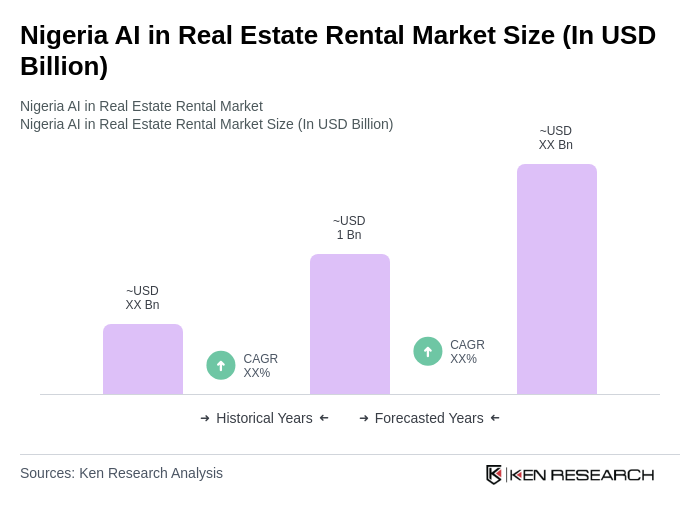
Nigeria AI in Real Estate Rental Market, valued at USD 1 Bn, grows via AI-driven platforms enhancing efficiency, transparency, and demand in urban areas like Lagos and Abuja.

Region:Africa

Author(s):Rebecca

Product Code:KRAB3482

Pages:88

Published On:October 2025
About the Report

Base Year 2024

Nigeria AI in Real Estate Rental Market Overview

  • The Nigeria AI in Real Estate Rental Market is valued at USD 1 billion, based on a five-year historical analysis. This growth is primarily driven by the increasing adoption of technology in real estate transactions, enhanced customer experiences through AI-driven and proptech platforms, and the rising demand for rental properties in urban areas. The integration of AI and digital technologies has streamlined processes, making property searches and transactions more efficient, while also improving transparency and reducing fraud through verified listings and smart contracts .
  • Lagos, Abuja, and Port Harcourt are the dominant cities in the Nigeria AI in Real Estate Rental Market. Lagos, as the commercial hub, attracts a large population seeking rental properties, while Abuja serves as the political center with a growing expatriate and professional community. Port Harcourt, known for its oil industry, also sees significant demand for rentals, driven by professionals and corporate relocations .
  • The National Housing Policy, 2023 issued by the Federal Ministry of Works and Housing, mandates the use of digital platforms and technology to enhance access to affordable housing. The policy encourages the integration of AI and proptech solutions in real estate platforms to improve transparency, efficiency, and accountability in rental transactions, and sets operational standards for digital property listings, tenant screening, and transaction documentation .
Nigeria AI in Real Estate Rental Marketplaces Market Size

Nigeria AI in Real Estate Rental Market Segmentation

By Type:The market is segmented into Residential Rentals, Commercial Rentals, Short-Term Rentals, Long-Term Rentals, Luxury Rentals, Affordable Housing Rentals, and Others. Among these, Residential Rentals dominate the market due to high demand in urban areas, driven by rapid population growth, urbanization, and a significant housing deficit. The increasing preference for rental properties over home ownership, especially among millennials and young professionals, is reinforced by flexible payment options and digital rental platforms .
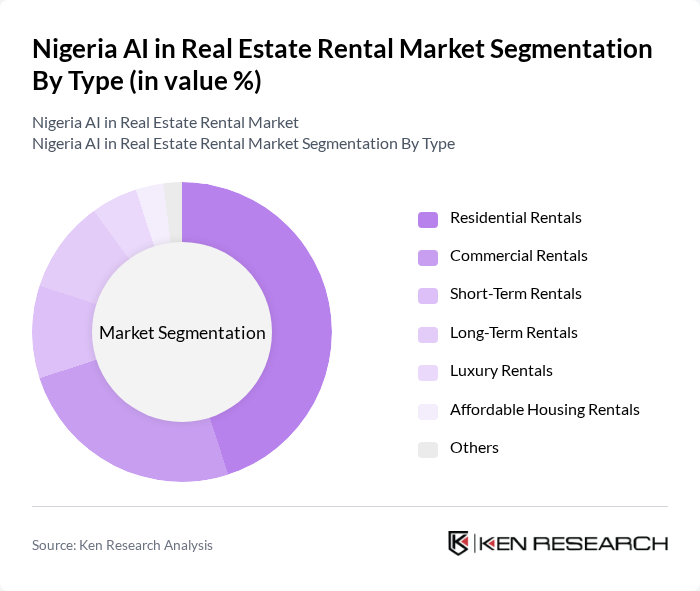
Nigeria AI in Real Estate Rental Market segmentation by Type.

By End-User:The end-user segmentation includes Individual Renters, Corporates, Government Agencies, and NGOs. Individual Renters represent the largest segment, driven by the growing population, urban migration, and the increasing number of young professionals and students seeking rental accommodations in urban centers. Corporates also play a vital role, as companies seek rental properties for employees, particularly in major cities .
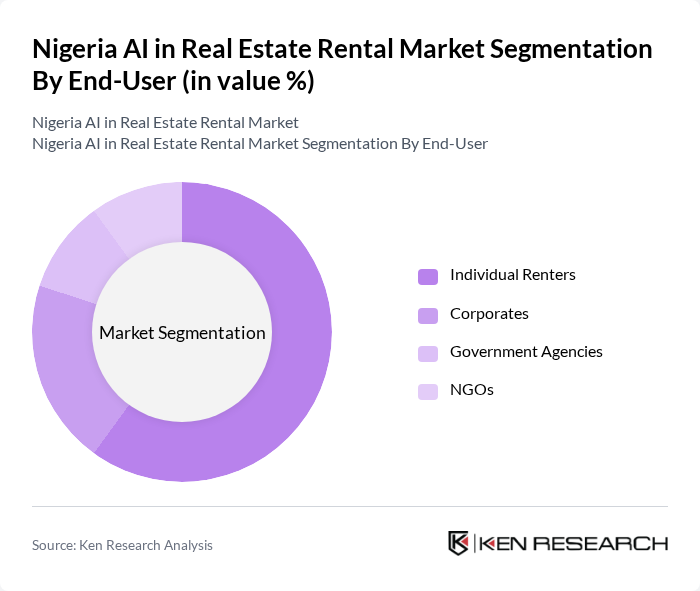
Nigeria AI in Real Estate Rental Market segmentation by End-User.

Nigeria AI in Real Estate Rental Market Competitive Landscape

The Nigeria AI in Real Estate Rental Market is characterized by a dynamic mix of regional and international players. Leading participants such as PropertyPro.ng, Jumia House (now part of PropertyPro.ng), RentSmallSmall, ToLet.com.ng (now PropertyPro.ng), Nigeria Property Centre, Landlord.ng, MyProperty.ng, Property24 Nigeria, Bungalow.ng, Hutbay, Real Estate Mall, PrivateProperty.com.ng, Rent.ng, Homestead.ng, and Estate Intel contribute to innovation, geographic expansion, and service delivery in this space.

PropertyPro.ng

2013

Lagos, Nigeria

RentSmallSmall

2018

Lagos, Nigeria

Nigeria Property Centre

2011

Lagos, Nigeria

PrivateProperty.com.ng

2011

Lagos, Nigeria

ToLet.com.ng

2012

Lagos, Nigeria

Company

Establishment Year

Headquarters

Group Size (Large, Medium, or Small as per industry convention)

Revenue Growth Rate

Customer Acquisition Cost

Customer Retention Rate

Market Penetration Rate

Pricing Strategy

Nigeria AI in Real Estate Rental Market Industry Analysis

Growth Drivers

  • Increasing Urbanization:Nigeria's urban population is projected to reach 250 million by in future, up from 200 million in 2021, according to the World Bank. This rapid urbanization drives demand for rental properties, as more individuals migrate to cities for employment and better living conditions. The urbanization rate is expected to be around 4.3% annually, leading to a significant increase in the need for efficient property management solutions powered by AI technologies.
  • Rising Demand for Rental Properties:The rental market in Nigeria is experiencing a surge, with an estimated 35% increase in rental demand expected in future. This growth is fueled by a young population, with over 60% under the age of 25, seeking affordable housing options. Additionally, the average household size is projected to grow, further intensifying the need for rental accommodations, thereby creating opportunities for AI-driven platforms to streamline property searches and management.
  • Technological Advancements in Property Management:The integration of AI technologies in property management is transforming the real estate landscape in Nigeria. By in future, it is estimated that 50% of property management tasks will be automated through AI solutions, enhancing efficiency and reducing operational costs. This shift is supported by a growing number of tech startups in Nigeria, which are leveraging AI to provide innovative solutions for property listings, tenant screening, and maintenance management.

Market Challenges

  • Regulatory Hurdles:The real estate sector in Nigeria faces significant regulatory challenges, with over 50 different laws governing property transactions. These regulations can create barriers for new entrants and complicate the operational landscape for existing players. The lack of a unified regulatory framework often leads to inconsistencies in enforcement, which can deter investment and slow down the adoption of AI technologies in property management.
  • High Competition Among Market Players:The Nigerian real estate rental market is highly competitive, with over 1,200 registered real estate agencies operating in major cities. This saturation leads to price wars and reduced profit margins, making it challenging for companies to invest in AI technologies. As a result, many players struggle to differentiate their services, which can hinder the overall growth of AI adoption in the sector.

Nigeria AI in Real Estate Rental Market Future Outlook

The future of the Nigeria AI in real estate rental market appears promising, driven by technological advancements and increasing urbanization. As more consumers embrace digital solutions, the demand for AI-driven platforms is expected to rise significantly. Additionally, the integration of smart home technologies and digital payment solutions will enhance the rental experience, making it more efficient and user-friendly. This evolving landscape presents opportunities for innovative startups and established players to capitalize on emerging trends and improve service delivery.

Market Opportunities

  • Growth of Smart Home Technologies:The adoption of smart home technologies is projected to increase by 30% by in future, creating opportunities for rental properties to integrate AI solutions. This trend will enhance tenant experiences through improved security, energy efficiency, and convenience, making properties more attractive to potential renters.
  • Expansion of Digital Payment Solutions:With over 60% of Nigerians expected to use digital payment methods by in future, the integration of these solutions in rental transactions will streamline processes. This shift will facilitate quicker payments and enhance transparency, encouraging more landlords to adopt AI-driven platforms for managing rental agreements and payments.

Scope of the Report

SegmentSub-Segments
By Type

Residential Rentals

Commercial Rentals

Short-Term Rentals

Long-Term Rentals

Luxury Rentals

Affordable Housing Rentals

Others

By End-User

Individual Renters

Corporates

Government Agencies

NGOs

By Property Size

Studio Apartments

One-Bedroom Apartments

Two-Bedroom Apartments

Three-Bedroom Apartments

Villas

Commercial Spaces

Others

By Rental Duration

Daily Rentals

Weekly Rentals

Monthly Rentals

Yearly Rentals

By Location

Urban Areas

Suburban Areas

Rural Areas

Tourist Destinations

By Rental Price Range

Low-End Rentals

Mid-Range Rentals

High-End Rentals

By Technology Utilization

AI-Enabled Platforms

Traditional Platforms

Hybrid Platforms

Key Target Audience

Investors and Venture Capitalist Firms

Government and Regulatory Bodies (e.g., National Housing Fund, Federal Ministry of Works and Housing)

Real Estate Developers

Property Management Companies

Real Estate Agents and Brokers

Technology Providers (e.g., AI Software Developers)

Financial Institutions (e.g., Banks, Mortgage Lenders)

Real Estate Investment Trusts (REITs)

Players Mentioned in the Report:

PropertyPro.ng

Jumia House (now part of PropertyPro.ng)

RentSmallSmall

ToLet.com.ng (now PropertyPro.ng)

Nigeria Property Centre

Landlord.ng

MyProperty.ng

Property24 Nigeria

Bungalow.ng

Hutbay

Real Estate Mall

PrivateProperty.com.ng

Rent.ng

Homestead.ng

Estate Intel

Table of Contents

Market Assessment Phase

1. Executive Summary and Approach


2. Nigeria AI in Real Estate Rental Market Overview

2.1 Key Insights and Strategic Recommendations

2.2 Nigeria AI in Real Estate Rental Market Overview

2.3 Definition and Scope

2.4 Evolution of Market Ecosystem

2.5 Timeline of Key Regulatory Milestones

2.6 Value Chain & Stakeholder Mapping

2.7 Business Cycle Analysis

2.8 Policy & Incentive Landscape


3. Nigeria AI in Real Estate Rental Market Analysis

3.1 Growth Drivers

3.1.1 Increasing Urbanization
3.1.2 Rising Demand for Rental Properties
3.1.3 Technological Advancements in Property Management
3.1.4 Enhanced Data Analytics for Market Insights

3.2 Market Challenges

3.2.1 Regulatory Hurdles
3.2.2 High Competition Among Market Players
3.2.3 Limited Access to Financing
3.2.4 Data Privacy Concerns

3.3 Market Opportunities

3.3.1 Growth of Smart Home Technologies
3.3.2 Expansion of Digital Payment Solutions
3.3.3 Increasing Foreign Investment
3.3.4 Development of AI-Driven Platforms

3.4 Market Trends

3.4.1 Adoption of Virtual Tours
3.4.2 Integration of AI in Customer Service
3.4.3 Shift Towards Sustainable Rentals
3.4.4 Growth of Peer-to-Peer Rental Platforms

3.5 Government Regulation

3.5.1 Rent Control Policies
3.5.2 Tax Incentives for Real Estate Investments
3.5.3 Data Protection Regulations
3.5.4 Licensing Requirements for Rental Agencies

4. SWOT Analysis


5. Stakeholder Analysis


6. Porter's Five Forces Analysis


7. Nigeria AI in Real Estate Rental Market Market Size, 2019-2024

7.1 By Value

7.2 By Volume

7.3 By Average Selling Price


8. Nigeria AI in Real Estate Rental Market Segmentation

8.1 By Type

8.1.1 Residential Rentals
8.1.2 Commercial Rentals
8.1.3 Short-Term Rentals
8.1.4 Long-Term Rentals
8.1.5 Luxury Rentals
8.1.6 Affordable Housing Rentals
8.1.7 Others

8.2 By End-User

8.2.1 Individual Renters
8.2.2 Corporates
8.2.3 Government Agencies
8.2.4 NGOs

8.3 By Property Size

8.3.1 Studio Apartments
8.3.2 One-Bedroom Apartments
8.3.3 Two-Bedroom Apartments
8.3.4 Three-Bedroom Apartments
8.3.5 Villas
8.3.6 Commercial Spaces
8.3.7 Others

8.4 By Rental Duration

8.4.1 Daily Rentals
8.4.2 Weekly Rentals
8.4.3 Monthly Rentals
8.4.4 Yearly Rentals

8.5 By Location

8.5.1 Urban Areas
8.5.2 Suburban Areas
8.5.3 Rural Areas
8.5.4 Tourist Destinations

8.6 By Rental Price Range

8.6.1 Low-End Rentals
8.6.2 Mid-Range Rentals
8.6.3 High-End Rentals

8.7 By Technology Utilization

8.7.1 AI-Enabled Platforms
8.7.2 Traditional Platforms
8.7.3 Hybrid Platforms

9. Nigeria AI in Real Estate Rental Market Competitive Analysis

9.1 Market Share of Key Players

9.2 Cross Comparison of Key Players

9.2.1 Company Name
9.2.2 Group Size (Large, Medium, or Small as per industry convention)
9.2.3 Revenue Growth Rate
9.2.4 Customer Acquisition Cost
9.2.5 Customer Retention Rate
9.2.6 Market Penetration Rate
9.2.7 Pricing Strategy
9.2.8 Average Rental Yield
9.2.9 Technology Adoption Rate
9.2.10 Brand Recognition Score
9.2.11 AI-Driven Transaction Volume
9.2.12 Percentage of Listings with Virtual Tours
9.2.13 Automated Valuation Model (AVM) Accuracy
9.2.14 Average Time-to-Rent (Days)
9.2.15 On-Time Rent Collection Rate

9.3 SWOT Analysis of Top Players

9.4 Pricing Analysis

9.5 Detailed Profile of Major Companies

9.5.1 PropertyPro.ng
9.5.2 Jumia House (now part of PropertyPro.ng)
9.5.3 RentSmallSmall
9.5.4 ToLet.com.ng (now PropertyPro.ng)
9.5.5 Nigeria Property Centre
9.5.6 Landlord.ng
9.5.7 MyProperty.ng
9.5.8 Property24 Nigeria
9.5.9 Bungalow.ng
9.5.10 Hutbay
9.5.11 Real Estate Mall
9.5.12 PrivateProperty.com.ng
9.5.13 Rent.ng
9.5.14 Homestead.ng
9.5.15 Estate Intel

10. Nigeria AI in Real Estate Rental Market End-User Analysis

10.1 Procurement Behavior of Key Ministries

10.1.1 Budget Allocation for Rentals
10.1.2 Decision-Making Process
10.1.3 Preferred Rental Platforms

10.2 Corporate Spend on Infrastructure & Energy

10.2.1 Investment in Rental Properties
10.2.2 Trends in Corporate Leasing
10.2.3 Budgeting for AI Solutions

10.3 Pain Point Analysis by End-User Category

10.3.1 High Rental Costs
10.3.2 Lack of Transparency
10.3.3 Difficulty in Finding Suitable Properties

10.4 User Readiness for Adoption

10.4.1 Awareness of AI Solutions
10.4.2 Willingness to Pay for Technology
10.4.3 Training Needs

10.5 Post-Deployment ROI and Use Case Expansion

10.5.1 Measurement of ROI
10.5.2 Expansion into New Use Cases
10.5.3 Long-Term Benefits Realization

11. Nigeria AI in Real Estate Rental Market Future Size, 2025-2030

11.1 By Value

11.2 By Volume

11.3 By Average Selling Price


Go-To-Market Strategy Phase

1. Whitespace Analysis + Business Model Canvas

1.1 Market Gaps Identification

1.2 Value Proposition Development

1.3 Revenue Streams Analysis

1.4 Cost Structure Evaluation

1.5 Key Partnerships Exploration

1.6 Customer Segmentation

1.7 Channels of Distribution


2. Marketing and Positioning Recommendations

2.1 Branding Strategies

2.2 Product USPs

2.3 Target Audience Identification

2.4 Marketing Channels Selection

2.5 Campaign Planning

2.6 Performance Metrics


3. Distribution Plan

3.1 Urban Retail Strategies

3.2 Rural NGO Tie-Ups

3.3 Online vs Offline Distribution

3.4 Logistics and Supply Chain Management

3.5 Partnership with Local Agents


4. Channel & Pricing Gaps

4.1 Underserved Routes

4.2 Pricing Bands Analysis

4.3 Competitor Pricing Comparison

4.4 Customer Willingness to Pay

4.5 Dynamic Pricing Strategies


5. Unmet Demand & Latent Needs

5.1 Category Gaps Identification

5.2 Consumer Segments Analysis

5.3 Emerging Trends Exploration

5.4 Feedback Mechanisms


6. Customer Relationship

6.1 Loyalty Programs Development

6.2 After-Sales Service Strategies

6.3 Customer Engagement Initiatives

6.4 Feedback and Improvement Loops


7. Value Proposition

7.1 Sustainability Initiatives

7.2 Integrated Supply Chains

7.3 Customer-Centric Innovations

7.4 Competitive Differentiation


8. Key Activities

8.1 Regulatory Compliance

8.2 Branding Initiatives

8.3 Distribution Setup

8.4 Technology Integration

8.5 Training and Development


9. Entry Strategy Evaluation

9.1 Domestic Market Entry Strategy

9.1.1 Product Mix
9.1.2 Pricing Band
9.1.3 Packaging Strategies

9.2 Export Entry Strategy

9.2.1 Target Countries
9.2.2 Compliance Roadmap

10. Entry Mode Assessment

10.1 Joint Ventures

10.2 Greenfield Investments

10.3 Mergers & Acquisitions

10.4 Distributor Model


11. Capital and Timeline Estimation

11.1 Capital Requirements

11.2 Timelines for Implementation


12. Control vs Risk Trade-Off

12.1 Ownership vs Partnerships


13. Profitability Outlook

13.1 Breakeven Analysis

13.2 Long-Term Sustainability


14. Potential Partner List

14.1 Distributors

14.2 Joint Ventures

14.3 Acquisition Targets


15. Execution Roadmap

15.1 Phased Plan for Market Entry

15.1.1 Market Setup
15.1.2 Market Entry
15.1.3 Growth Acceleration
15.1.4 Scale & Stabilize

15.2 Key Activities and Milestones

15.2.1 Milestone Planning
15.2.2 Activity Tracking

Research Methodology

ApproachModellingSample

Phase 1: Approach1

Desk Research

  • Analysis of existing market reports on AI applications in real estate rental in Nigeria
  • Review of government publications and housing policies affecting the rental market
  • Examination of academic journals and white papers on AI technology trends in real estate

Primary Research

  • Interviews with real estate agents and property managers utilizing AI tools
  • Surveys targeting landlords and tenants to understand AI adoption and user experience
  • Focus groups with technology providers specializing in AI solutions for real estate

Validation & Triangulation

  • Cross-validation of findings through multiple data sources including industry reports and expert opinions
  • Triangulation of qualitative insights from interviews with quantitative data from surveys
  • Sanity checks through expert panel reviews comprising real estate analysts and AI specialists

Phase 2: Market Size Estimation1

Top-down Assessment

  • Estimation of the total rental market size in Nigeria and AI's penetration rate
  • Segmentation of the market by property type (residential, commercial, etc.) and geographic region
  • Incorporation of macroeconomic indicators such as GDP growth and urbanization rates

Bottom-up Modeling

  • Collection of data from leading real estate platforms on rental listings and AI usage
  • Estimation of average rental prices and occupancy rates across different segments
  • Calculation of AI-driven efficiencies in property management and tenant acquisition

Forecasting & Scenario Analysis

  • Multi-factor regression analysis incorporating technology adoption rates and market growth
  • Scenario modeling based on regulatory changes and economic conditions affecting real estate
  • Development of baseline, optimistic, and pessimistic forecasts through 2030

Phase 3: CATI Sample Composition1

Scope Item/SegmentSample SizeTarget Respondent Profiles
Residential Rental Market120Landlords, Tenants, Real Estate Agents
Commercial Rental Sector80Property Managers, Business Owners, Real Estate Developers
AI Technology Providers60Product Managers, Tech Developers, Sales Executives
Urban Planning and Policy50Urban Planners, Government Officials, Policy Analysts
Market Research Analysts55Market Researchers, Data Analysts, Industry Experts

Frequently Asked Questions

What is the current value of the Nigeria AI in Real Estate Rental Market?

The Nigeria AI in Real Estate Rental Market is valued at approximately USD 1 billion, reflecting significant growth driven by technology adoption in real estate transactions and the increasing demand for rental properties in urban areas.

Which cities dominate the Nigeria AI in Real Estate Rental Market?

What are the key growth drivers for the Nigeria AI in Real Estate Rental Market?

What challenges does the Nigeria AI in Real Estate Rental Market face?

Other Regional/Country Reports

Indonesia AI in Real Estate Rental Marketplaces Market

Malaysia AI in Real Estate Rental Marketplaces Market

KSA AI in Real Estate Rental Marketplaces Market

APAC AI in Real Estate Rental Marketplaces Market

SEA AI in Real Estate Rental Marketplaces Market

Vietnam AI in Real Estate Rental Marketplaces Market

Other Adjacent Reports

Malaysia PropTech Market

South Korea Real Estate Management Software Market

Qatar Smart Home Technology MarketBahrain digital payment solutions market size, share, growth drivers, trends, opportunities & forecast 2025–2030Vietnam property management services market report Size, Share, Growth Drivers, Trends, Opportunities & Forecast 2025–2030

Malaysia Urban Housing Development Market

Vietnam AI Property Valuation Market

Indonesia Virtual Reality Property Tours Market

Bahrain Tenant Screening Services Market

Philippines Real Estate Data Analytics Market

Why Buy From Us?

Refine Robust Result (RRR) Framework

What makes us stand out is that our consultants follow Robust, Refine and Result (RRR) methodology. Robust for clear definitions, approaches and sanity checking, Refine for differentiating respondents' facts and opinions, and Result for presenting data with story.

Our Reach Is Unmatched

We have set a benchmark in the industry by offering our clients with syndicated and customized market research reports featuring coverage of entire market as well as meticulous research and analyst insights.

Shifting the Research Paradigm

While we don't replace traditional research, we flip the method upside down. Our dual approach of Top Bottom & Bottom Top ensures quality deliverable by not just verifying company fundamentals but also looking at the sector and macroeconomic factors.

More Insights-Better Decisions

With one step in the future, our research team constantly tries to show you the bigger picture. We help with some of the tough questions you may encounter along the way: How is the industry positioned? Best marketing channel? KPI's of competitors? By aligning every element, we help maximize success.

Transparency and Trust

Our report gives you instant access to the answers and sources that other companies might choose to hide. We elaborate each steps of research methodology we have used and showcase you the sample size to earn your trust.

Round the Clock Support

If you need any support, we are here! We pride ourselves on universe strength, data quality, and quick, friendly, and professional service.

Why Clients Choose Us?

400000+
Reports in repository
150+
Consulting projects a year
100+
Analysts
8000+
Client Queries in 2022








