Region:Middle East
Author(s):Rebecca
Product Code:KRAD7542
Pages:94
Published On:December 2025
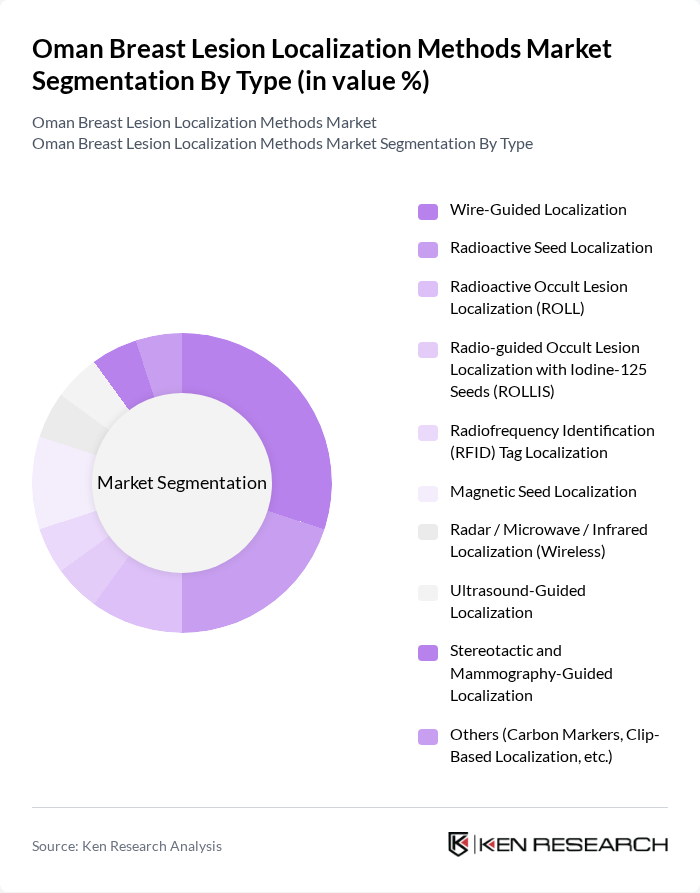
By Type:The market is segmented into various localization methods, including Wire-Guided Localization, Radioactive Seed Localization, Radioactive Occult Lesion Localization (ROLL), Radio-guided Occult Lesion Localization with Iodine-125 Seeds (ROLLIS), Radiofrequency Identification (RFID) Tag Localization, Magnetic Seed Localization, Radar / Microwave / Infrared Localization (Wireless), Ultrasound-Guided Localization, Stereotactic and Mammography-Guided Localization, and Others (Carbon Markers, Clip-Based Localization, etc.). This structure aligns with global segmentation used in leading market studies. Among these, Wire-Guided Localization is currently the leading sub-segment, consistent with its status as the most widely adopted technique globally due to its long-standing use in clinical practice, availability, and the familiarity of surgeons with this method. However, the adoption of newer technologies like Magnetic Seed Localization and wireless radar or radiofrequency tags is on the rise, in line with global trends driven by benefits in patient comfort, decoupling of surgery and localization days, and improved workflow efficiency in high-volume breast centers.
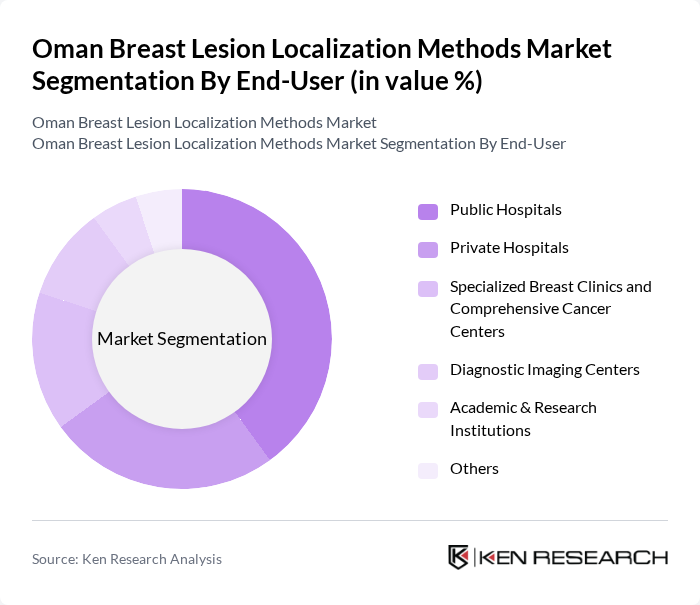
By End-User:The end-user segmentation includes Public Hospitals, Private Hospitals, Specialized Breast Clinics and Comprehensive Cancer Centers, Diagnostic Imaging Centers, Academic & Research Institutions, and Others. This breakdown is consistent with global reporting, where hospitals (public and private) and specialty breast centers account for the bulk of breast lesion localization procedures. Public Hospitals dominate the market in Oman due to their extensive reach in primary and tertiary care, the central role of Ministry of Health hospitals in providing oncology services, and the majority of breast cancer patients seeking diagnosis and treatment through these facilities. However, the growth of private hospitals and specialized clinics is notable, as they increasingly invest in advanced imaging suites, digital mammography, and minimally invasive surgical capabilities, attracting a segment of patients willing to pay for enhanced services and shorter waiting times.
The Oman Breast Lesion Localization Methods Market is characterized by a dynamic mix of regional and international players. Leading participants such as Hologic, Inc., Merit Medical Systems, Inc. (including SAVI SCOUT), BD (Becton, Dickinson and Company), Endomag Ltd., Faxitron Bioptics LLC (a Hologic Company), Laurane Medical S.A.S. (ROLL / ROLLIS Solutions), Mammotome (a division of Devicor Medical Products, Inc.), Cianna Medical, Inc. (a Hologic Company), GE HealthCare Technologies Inc., Siemens Healthineers AG, Koninklijke Philips N.V., Fujifilm Holdings Corporation, Canon Medical Systems Corporation, Bracco Imaging S.p.A., and local and regional distributors in Oman (e.g., Muscat Pharmacy & Stores LLC, Gulf Medical Co. LLC) supply core breast imaging, biopsy, and localization solutions across the Middle East and Africa market. These companies contribute to innovation, geographic expansion, and service delivery by introducing wireless localization platforms, integrating with digital mammography and tomosynthesis systems, and supporting training programs for radiologists and breast surgeons in the region.
The future of the Oman breast lesion localization methods market appears promising, driven by ongoing technological advancements and increased healthcare investments. As the government prioritizes women's health, initiatives aimed at enhancing healthcare infrastructure are expected to facilitate better access to localization methods. Furthermore, the integration of telemedicine is likely to expand the reach of these services, allowing for remote diagnostics and consultations, ultimately improving patient outcomes and accessibility across the region.
| Segment | Sub-Segments |
|---|---|
| By Type | Wire-Guided Localization Radioactive Seed Localization Radioactive Occult Lesion Localization (ROLL) Radio-guided Occult Lesion Localization with Iodine-125 Seeds (ROLLIS) Radiofrequency Identification (RFID) Tag Localization Magnetic Seed Localization Radar / Microwave / Infrared Localization (Wireless) Ultrasound-Guided Localization Stereotactic and Mammography-Guided Localization Others (Carbon Markers, Clip-Based Localization, etc.) |
| By End-User | Public Hospitals Private Hospitals Specialized Breast Clinics and Comprehensive Cancer Centers Diagnostic Imaging Centers Academic & Research Institutions Others |
| By Application | Breast-Conserving Surgery (Lumpectomy) Excisional Biopsy of Non-Palpable Lesions Preoperative Localization for Sentinel Lymph Node Surgery Localization in Neoadjuvant Therapy Response Assessment Localization of Microcalcifications and Architectural Distortions Clinical Research & Trials Others |
| By Imaging Guidance / Technology | Mammography-Guided Localization Ultrasound-Guided Localization Stereotactic-Guided Localization MRI-Guided Localization Tomosynthesis-Guided Localization Others (Hybrid / Multimodality Guidance) |
| By Region | Muscat Salalah Sohar Nizwa Sur Others |
| By Patient Demographics | Age Group (Under 40, 40–49, 50–64, 65 and Above) Gender (Female, Male) Omani Nationals vs Expatriates Insurance Coverage Status (Public, Private, Self-Pay) Others |
| By Distribution Channel | Direct Tenders to Public Hospitals and MOH Private Hospital & Clinic Procurement Local Medical Device Distributors / Importers E-Procurement Platforms & Group Purchasing Organizations Others |
| Scope Item/Segment | Sample Size | Target Respondent Profiles |
|---|---|---|
| Breast Cancer Treatment Centers | 120 | Oncologists, Radiologists |
| Hospitals with Surgical Departments | 100 | Surgeons, Hospital Administrators |
| Medical Device Distributors | 80 | Sales Managers, Product Specialists |
| Patient Advocacy Groups | 60 | Patient Representatives, Healthcare Advocates |
| Healthcare Policy Makers | 50 | Health Economists, Policy Analysts |
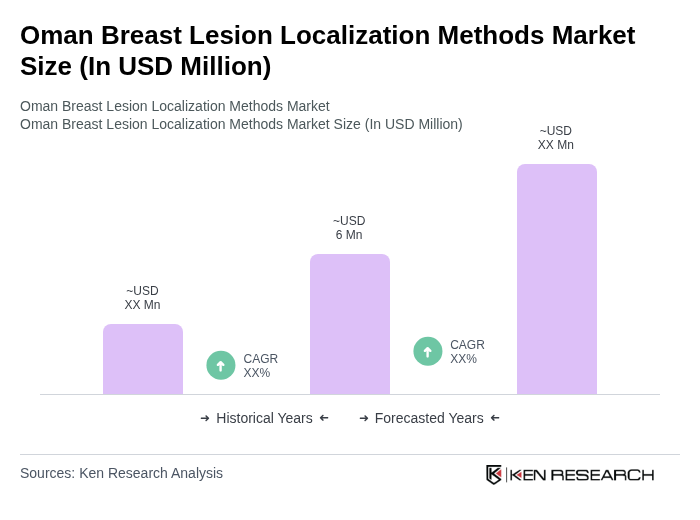
The Oman Breast Lesion Localization Methods Market is valued at approximately USD 6 million, representing its share within the broader Middle East and Africa market, which is valued at around USD 129 million. This growth is driven by increasing breast cancer incidence and advancements in localization technologies.

What makes us stand out is that our consultants follow Robust, Refine and Result (RRR) methodology. Robust for clear definitions, approaches and sanity checking, Refine for differentiating respondents' facts and opinions, and Result for presenting data with story.

We have set a benchmark in the industry by offering our clients with syndicated and customized market research reports featuring coverage of entire market as well as meticulous research and analyst insights.

While we don't replace traditional research, we flip the method upside down. Our dual approach of Top Bottom & Bottom Top ensures quality deliverable by not just verifying company fundamentals but also looking at the sector and macroeconomic factors.

With one step in the future, our research team constantly tries to show you the bigger picture. We help with some of the tough questions you may encounter along the way: How is the industry positioned? Best marketing channel? KPI's of competitors? By aligning every element, we help maximize success.

Our report gives you instant access to the answers and sources that other companies might choose to hide. We elaborate each steps of research methodology we have used and showcase you the sample size to earn your trust.

If you need any support, we are here! We pride ourselves on universe strength, data quality, and quick, friendly, and professional service.













