About the Report
Base Year 2024Oman Crab Market Overview
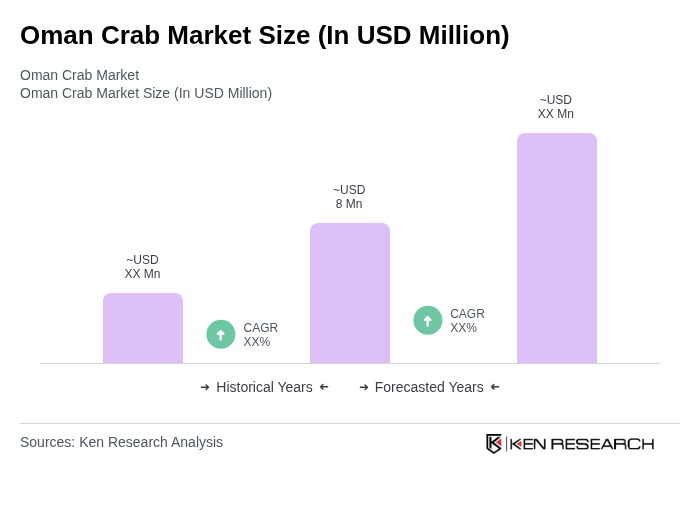
- The Oman Crab Market is valued at USD 8 million, based on the latest available data for crab and crab meat consumption and trade. Growth is primarily driven by rising consumer demand for seafood, especially crabs, due to their nutritional profile, increasing health consciousness, and the popularity of crab-based cuisine in both domestic and export markets. The market benefits from Oman’s rich marine biodiversity, established fishing traditions, and expanding cold-chain infrastructure, which support both local consumption and exports to regional markets such as the United Arab Emirates, Saudi Arabia, and Qatar .
- Key players in this market are concentrated in Muscat, Salalah, and Sohar, which serve as major hubs due to their strategic coastal locations and well-developed fisheries infrastructure. These cities facilitate efficient supply chains and provide access to both domestic consumers and international buyers, making them central to the distribution and export of crab products .
- The Ministerial Decision No. 230/2023 issued by the Ministry of Agriculture, Fisheries and Water Resources established a licensing system for crab fisheries in Oman. This regulation mandates that all commercial crab fishing operations obtain licenses, adhere to seasonal restrictions, and comply with catch size limits to promote sustainable resource management and protect marine ecosystems .
Oman Crab Market Segmentation
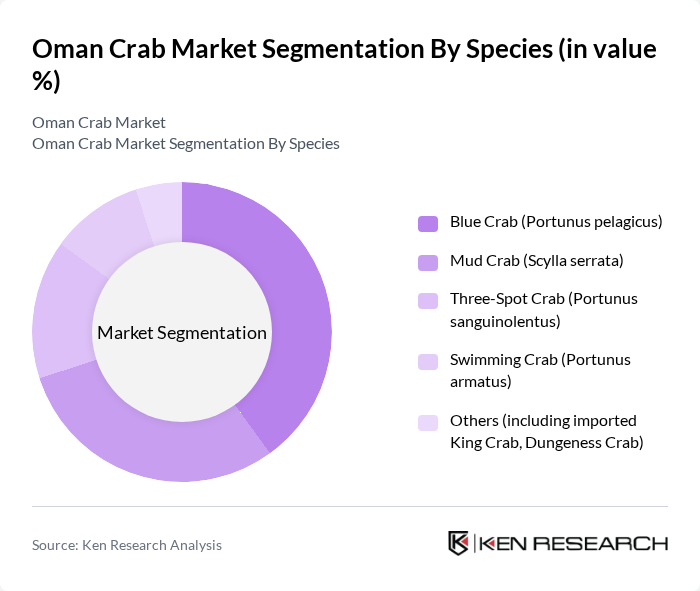
By Species:The species segment covers the main crab types harvested and traded in Oman. The dominant species are Blue Crab, Mud Crab, Three-Spot Crab, and Swimming CrabBlue Crab is widely preferred for its flavor and abundance, while Mud Crab is valued for its larger size and higher market price. The “Others” category includes limited imports of premium varieties such as King Crab and Dungeness Crab, which are primarily used in high-end food service and specialty retail .
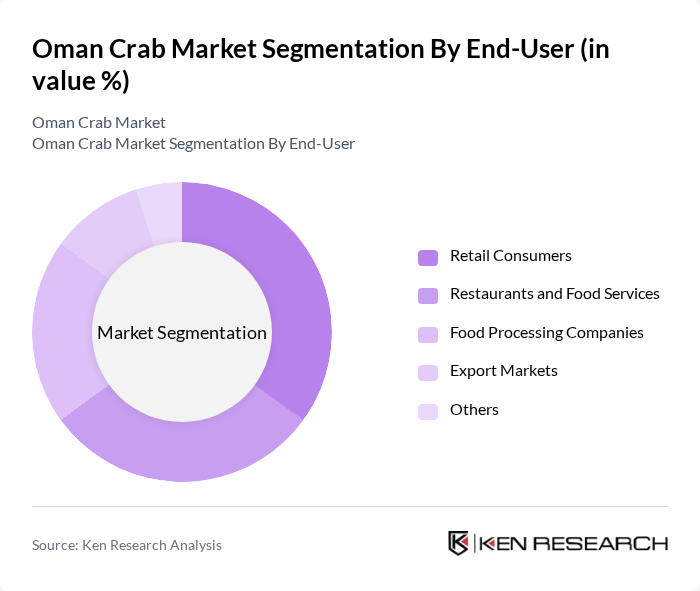
By End-User:The end-user segment includes retail consumers, restaurants and food services, food processing companies, export markets, and others. Retail consumers are increasingly purchasing fresh and processed crab for home cooking, supported by expanding supermarket and fish market channels. Restaurants and food services are broadening their seafood menus to cater to evolving consumer tastes, while food processing companies are incorporating crab meat into ready-to-eat and value-added products. Export markets remain a key outlet, particularly to neighboring Gulf countries .
Oman Crab Market Competitive Landscape
The Oman Crab Market is characterized by a dynamic mix of regional and international players. Leading participants such as Oman Fisheries Co SAOG, Al Bahja Group, Dhofar Fisheries Co LLC, Muscat Seafood LLC, Al Jazeera Fisheries LLC, Sea Harvest Oman LLC, Oman Marine Products Co LLC, Al Waha Fisheries LLC, Gulf Seafood LLC, Oman Aquaculture Co SAOC, Al Noor Fisheries LLC, Muscat Fish Market, Al Muna Fisheries LLC, Oman Seafood Exporters LLC, Blue Water LLC contribute to innovation, geographic expansion, and service delivery in this space.
Oman Crab Market Industry Analysis
Growth Drivers
- Increasing Consumer Demand for Seafood:The demand for seafood in Oman has surged, with consumption reaching approximately 70,000 tons in future. This trend is driven by a growing population and rising health consciousness, as seafood is recognized for its nutritional benefits. The World Bank projects that the seafood consumption in Oman will continue to rise, supported by an increase in disposable income, which is expected to reach $25,000 per capita in future, further fueling the crab market.
- Expansion of Aquaculture Practices:Oman’s aquaculture sector has seen significant growth, with production increasing from 7,000 tons in recent years to an estimated 20,000 tons in future. The government has invested over $60 million in aquaculture initiatives, aiming to enhance local crab farming. This expansion is crucial for meeting domestic demand and reducing reliance on wild catches, thereby promoting sustainability in the seafood industry as aquaculture practices become more advanced and efficient.
- Government Support for Sustainable Fishing:The Omani government has implemented various policies to promote sustainable fishing practices, allocating $15 million annually for marine conservation programs. These initiatives include establishing marine protected areas and enforcing fishing quotas, which have led to a 25% increase in crab populations in certain regions. Such support not only ensures the long-term viability of crab stocks but also enhances the market's reputation for sustainability, attracting environmentally conscious consumers.
Market Challenges
- Overfishing Concerns:Overfishing remains a significant challenge in the Oman crab market, with estimates indicating that 35% of crab species are currently overexploited. This has led to declining populations, threatening the sustainability of the industry. The Ministry of Agriculture and Fisheries has reported a 20% decrease in crab catches in recent years, prompting urgent calls for stricter regulations and better management practices to ensure the long-term health of crab stocks.
- Regulatory Compliance Issues:Navigating the complex regulatory landscape poses challenges for crab producers in Oman. Compliance with local and international fishing regulations can be costly and time-consuming, with fines for non-compliance reaching up to $150,000. Additionally, the introduction of new environmental laws in future may require further investments in sustainable practices, which could strain smaller operators and hinder their competitiveness in the market.
Oman Crab Market Future Outlook
The Oman crab market is poised for growth, driven by increasing consumer preferences for sustainable seafood and the expansion of aquaculture. As the government continues to support sustainable fishing practices, the market is likely to see a rise in both domestic consumption and export opportunities. Technological advancements in crab farming and processing will further enhance product quality and availability, positioning Oman as a key player in the regional seafood market, particularly in emerging markets in Asia and the Middle East.
Market Opportunities
- Development of Value-Added Crab Products:There is a growing opportunity for the development of value-added crab products, such as crab cakes and ready-to-eat meals. The market for processed seafood is projected to reach $1.5 billion in future, driven by consumer demand for convenience and quality. This trend presents a lucrative avenue for local producers to enhance profitability and cater to evolving consumer preferences.
- Eco-Tourism and Crab Fishing Experiences:The rise of eco-tourism in Oman offers unique opportunities for crab fishing experiences. With over 4 million tourists visiting annually, promoting sustainable crab fishing tours can attract eco-conscious travelers. This initiative not only supports local economies but also raises awareness about sustainable practices, creating a win-win scenario for both the environment and the tourism sector.
Scope of the Report
| Segment | Sub-Segments |
|---|---|
| By Species | Blue Crab (Portunus pelagicus) Mud Crab (Scylla serrata) Three-Spot Crab (Portunus sanguinolentus) Swimming Crab (Portunus armatus) Others (including imported King Crab, Dungeness Crab) |
| By End-User | Retail Consumers Restaurants and Food Services Food Processing Companies Export Markets Others |
| By Distribution Channel | Direct Sales (B2B/B2G) Online Retail Supermarkets and Hypermarkets Fish Markets Others |
| By Region | Muscat Salalah Sohar Sur Al Batinah Others |
| By Product Form | Live Crab Fresh Crab Frozen Crab Processed Crab Products (e.g., crab meat, value-added) Others |
| By Packaging Type | Bulk Packaging Retail Packaging Eco-Friendly Packaging Others |
| By Price Range | Premium Mid-Range Budget Others |
Key Target Audience
Investors and Venture Capitalist Firms
Government and Regulatory Bodies (e.g., Ministry of Agriculture, Fisheries and Water Resources)
Manufacturers and Producers
Distributors and Retailers
Exporters and Importers
Seafood Processing Companies
Industry Associations (e.g., Oman Fisheries Association)
Financial Institutions
Players Mentioned in the Report:
Oman Fisheries Co SAOG
Al Bahja Group
Dhofar Fisheries Co LLC
Muscat Seafood LLC
Al Jazeera Fisheries LLC
Sea Harvest Oman LLC
Oman Marine Products Co LLC
Al Waha Fisheries LLC
Gulf Seafood LLC
Oman Aquaculture Co SAOC
Al Noor Fisheries LLC
Muscat Fish Market
Al Muna Fisheries LLC
Oman Seafood Exporters LLC
Blue Water LLC
Table of Contents
Market Assessment Phase
1. Executive Summary and Approach
2. Oman Crab Market Overview
2.1 Key Insights and Strategic Recommendations
2.2 Oman Crab Market Overview
2.3 Definition and Scope
2.4 Evolution of Market Ecosystem
2.5 Timeline of Key Regulatory Milestones
2.6 Value Chain & Stakeholder Mapping
2.7 Business Cycle Analysis
2.8 Policy & Incentive Landscape
3. Oman Crab Market Analysis
3.1 Growth Drivers
3.1.1 Increasing consumer demand for seafood
3.1.2 Expansion of aquaculture practices
3.1.3 Government support for sustainable fishing
3.1.4 Rising export opportunities
3.2 Market Challenges
3.2.1 Overfishing concerns
3.2.2 Regulatory compliance issues
3.2.3 Competition from imported seafood
3.2.4 Environmental impacts on crab habitats
3.3 Market Opportunities
3.3.1 Development of value-added crab products
3.3.2 Eco-tourism and crab fishing experiences
3.3.3 Partnerships with local restaurants
3.3.4 Exporting to emerging markets
3.4 Market Trends
3.4.1 Shift towards organic and sustainable seafood
3.4.2 Increasing online seafood sales
3.4.3 Growing popularity of crab dishes in local cuisine
3.4.4 Technological advancements in crab farming
3.5 Government Regulation
3.5.1 Fishing quotas and licenses
3.5.2 Environmental protection laws
3.5.3 Health and safety standards for seafood
3.5.4 Export regulations and tariffs
4. SWOT Analysis
5. Stakeholder Analysis
6. Porter's Five Forces Analysis
7. Oman Crab Market Market Size, 2019-2024
7.1 By Value
7.2 By Volume
7.3 By Average Selling Price
8. Oman Crab Market Segmentation
8.1 By Species
8.1.1 Blue Crab (Portunus pelagicus)
8.1.2 Mud Crab (Scylla serrata)
8.1.3 Three-Spot Crab (Portunus sanguinolentus)
8.1.4 Swimming Crab (Portunus armatus)
8.1.5 Others (including imported King Crab, Dungeness Crab)
8.2 By End-User
8.2.1 Retail Consumers
8.2.2 Restaurants and Food Services
8.2.3 Food Processing Companies
8.2.4 Export Markets
8.2.5 Others
8.3 By Distribution Channel
8.3.1 Direct Sales (B2B/B2G)
8.3.2 Online Retail
8.3.3 Supermarkets and Hypermarkets
8.3.4 Fish Markets
8.3.5 Others
8.4 By Region
8.4.1 Muscat
8.4.2 Salalah
8.4.3 Sohar
8.4.4 Sur
8.4.5 Al Batinah
8.4.6 Others
8.5 By Product Form
8.5.1 Live Crab
8.5.2 Fresh Crab
8.5.3 Frozen Crab
8.5.4 Processed Crab Products (e.g., crab meat, value-added)
8.5.5 Others
8.6 By Packaging Type
8.6.1 Bulk Packaging
8.6.2 Retail Packaging
8.6.3 Eco-Friendly Packaging
8.6.4 Others
8.7 By Price Range
8.7.1 Premium
8.7.2 Mid-Range
8.7.3 Budget
8.7.4 Others
9. Oman Crab Market Competitive Analysis
9.1 Market Share of Key Players
9.2 Cross Comparison of Key Players
9.2.1 Company Name
9.2.2 Production Capacity (MT/year)
9.2.3 Revenue (OMR/USD, latest year)
9.2.4 Export Volume (MT/year)
9.2.5 Domestic Market Share (%)
9.2.6 Product Portfolio Breadth (number of crab SKUs)
9.2.7 Certifications (e.g., HACCP, MSC, ISO)
9.2.8 Supply Chain Integration Level
9.2.9 Distribution Network Coverage (regions/countries served)
9.2.10 Sustainability Initiatives (traceability, eco-labels, etc.)
9.3 SWOT Analysis of Top Players
9.4 Pricing Analysis
9.5 Detailed Profile of Major Companies
9.5.1 Oman Fisheries Co SAOG
9.5.2 Al Bahja Group
9.5.3 Dhofar Fisheries Co LLC
9.5.4 Muscat Seafood LLC
9.5.5 Al Jazeera Fisheries LLC
9.5.6 Sea Harvest Oman LLC
9.5.7 Oman Marine Products Co LLC
9.5.8 Al Waha Fisheries LLC
9.5.9 Gulf Seafood LLC
9.5.10 Oman Aquaculture Co SAOC
9.5.11 Al Noor Fisheries LLC
9.5.12 Muscat Fish Market
9.5.13 Al Muna Fisheries LLC
9.5.14 Oman Seafood Exporters LLC
9.5.15 Blue Water LLC
10. Oman Crab Market End-User Analysis
10.1 Procurement Behavior of Key Ministries
10.1.1 Ministry of Agriculture and Fisheries
10.1.2 Ministry of Commerce and Industry
10.1.3 Ministry of Environment and Climate Affairs
10.1.4 Others
10.2 Corporate Spend on Infrastructure & Energy
10.2.1 Investment in Cold Storage Facilities
10.2.2 Infrastructure for Processing Plants
10.2.3 Transportation and Logistics
10.2.4 Others
10.3 Pain Point Analysis by End-User Category
10.3.1 Supply Chain Disruptions
10.3.2 Quality Control Issues
10.3.3 Pricing Volatility
10.3.4 Others
10.4 User Readiness for Adoption
10.4.1 Awareness of Sustainable Practices
10.4.2 Training and Skill Development
10.4.3 Technology Adoption
10.4.4 Others
10.5 Post-Deployment ROI and Use Case Expansion
10.5.1 Measurement of Financial Returns
10.5.2 Expansion into New Markets
10.5.3 Customer Feedback and Adaptation
10.5.4 Others
11. Oman Crab Market Future Size, 2025-2030
11.1 By Value
11.2 By Volume
11.3 By Average Selling Price
Go-To-Market Strategy Phase
1. Whitespace Analysis + Business Model Canvas
1.1 Market Gaps Identification
1.2 Business Model Framework
2. Marketing and Positioning Recommendations
2.1 Branding Strategies
2.2 Product USPs
3. Distribution Plan
3.1 Urban Retail vs Rural NGO Tie-ups
4. Channel & Pricing Gaps
4.1 Underserved Routes
4.2 Pricing Bands
5. Unmet Demand & Latent Needs
5.1 Category Gaps
5.2 Consumer Segments
6. Customer Relationship
6.1 Loyalty Programs
6.2 After-sales Service
7. Value Proposition
7.1 Sustainability
7.2 Integrated Supply Chains
8. Key Activities
8.1 Regulatory Compliance
8.2 Branding
8.3 Distribution Setup
9. Entry Strategy Evaluation
9.1 Domestic Market Entry Strategy
9.1.1 Product Mix
9.1.2 Pricing Band
9.1.3 Packaging
9.2 Export Entry Strategy
9.2.1 Target Countries
9.2.2 Compliance Roadmap
10. Entry Mode Assessment
10.1 JV
10.2 Greenfield
10.3 M&A
10.4 Distributor Model
11. Capital and Timeline Estimation
11.1 Capital Requirements
11.2 Timelines
12. Control vs Risk Trade-Off
12.1 Ownership vs Partnerships
13. Profitability Outlook
13.1 Breakeven Analysis
13.2 Long-term Sustainability
14. Potential Partner List
14.1 Distributors
14.2 JVs
14.3 Acquisition Targets
15. Execution Roadmap
15.1 Phased Plan for Market Entry
15.1.1 Market Setup
15.1.2 Market Entry
15.1.3 Growth Acceleration
15.1.4 Scale & Stabilize
15.2 Key Activities and Milestones
15.2.1 Activity Timeline
15.2.2 Milestone Tracking
Research Methodology
Phase 1: Approach1
Desk Research
- Analysis of trade statistics from the Ministry of Agriculture and Fisheries Wealth in Oman
- Review of market reports and publications from local seafood associations
- Examination of academic journals and articles focusing on marine biology and fisheries economics
Primary Research
- Interviews with local crab fishermen and fishery managers to gather insights on catch volumes
- Surveys with seafood distributors and retailers to understand market dynamics and pricing
- Field visits to crab processing facilities to observe operational practices and quality control
Validation & Triangulation
- Cross-validation of data from interviews with secondary data sources to ensure accuracy
- Triangulation of findings from fishermen, retailers, and regulatory bodies
- Sanity checks through expert panel discussions with marine biologists and market analysts
Phase 2: Market Size Estimation1
Top-down Assessment
- Estimation of total crab consumption in Oman based on national seafood consumption statistics
- Segmentation of the market by species, including Blue Crab and Green Crab
- Incorporation of import/export data to assess the impact of international trade on local markets
Bottom-up Modeling
- Collection of sales data from major seafood retailers and wholesalers in Oman
- Estimation of average selling prices for different crab species across various market channels
- Volume estimates based on catch data and market demand trends
Forecasting & Scenario Analysis
- Multi-factor regression analysis incorporating factors such as tourism growth and local consumption trends
- Scenario modeling based on potential regulatory changes affecting fishing quotas and sustainability practices
- Development of baseline, optimistic, and pessimistic market projections through 2030
Phase 3: CATI Sample Composition1
| Scope Item/Segment | Sample Size | Target Respondent Profiles |
|---|---|---|
| Local Fishermen Insights | 100 | Crab Fishermen, Fishery Managers |
| Seafood Retail Market | 80 | Retail Managers, Seafood Buyers |
| Processing Facility Operations | 60 | Plant Managers, Quality Control Supervisors |
| Consumer Preferences | 120 | End Consumers, Seafood Enthusiasts |
| Regulatory Insights | 40 | Government Officials, Policy Makers |
Frequently Asked Questions
What is the current value of the Oman Crab Market?
The Oman Crab Market is valued at approximately USD 8 million, driven by increasing consumer demand for seafood, particularly crabs, due to their nutritional benefits and the popularity of crab-based cuisine in both domestic and export markets.
What species of crabs are primarily found in Oman?
How does the government support sustainable crab fishing in Oman?
What are the main challenges facing the Oman Crab Market?
Other Regional/Country Reports
Indonesia Crab Market Report Size, Share, Growth Drivers, Trends, Opportunities & Forecast 2025–2030
Malaysia Crab Market Report Size, Share, Growth Drivers, Trends, Opportunities & Forecast 2025–2030
KSA Crab Market Report Size, Share, Growth Drivers, Trends, Opportunities & Forecast 2025–2030
APAC Crab Market Report Size, Share, Growth Drivers, Trends, Opportunities & Forecast 2025–2030
SEA Crab Market Report Size, Share, Growth Drivers, Trends, Opportunities & Forecast 2025–2030
Vietnam Crab Market Report Size, Share, Growth Drivers, Trends, Opportunities & Forecast 2025–2030
Other Adjacent Reports
Kuwait Seafood Processing Market
Oman aquaculture market report Size, Share, Growth Drivers, Trends, Opportunities & Forecast 2025–2030Japan Cold Chain Logistics Market Size, Share & Forecast, By Service Type, Mode of Transport & End-Use Industry, 2025–2032Qatar Sustainable Fisheries Market
Qatar Seafood Export Market
Malaysia Marine Tourism Market
Indonesia Value-Added Seafood Market
Bahrain Fishing Equipment Market
New Zealand Marine Biotechnology Market Report Size, Share, Growth Drivers, Trends, Opportunities & Forecast 2025–2030Europe Food Service Market Size, Share & Forecast, By Service Type, Customer Type, Delivery Model & Geography, 2026-2032Why Buy From Us?

What makes us stand out is that our consultants follow Robust, Refine and Result (RRR) methodology. Robust for clear definitions, approaches and sanity checking, Refine for differentiating respondents' facts and opinions, and Result for presenting data with story.

We have set a benchmark in the industry by offering our clients with syndicated and customized market research reports featuring coverage of entire market as well as meticulous research and analyst insights.

While we don't replace traditional research, we flip the method upside down. Our dual approach of Top Bottom & Bottom Top ensures quality deliverable by not just verifying company fundamentals but also looking at the sector and macroeconomic factors.

With one step in the future, our research team constantly tries to show you the bigger picture. We help with some of the tough questions you may encounter along the way: How is the industry positioned? Best marketing channel? KPI's of competitors? By aligning every element, we help maximize success.

Our report gives you instant access to the answers and sources that other companies might choose to hide. We elaborate each steps of research methodology we have used and showcase you the sample size to earn your trust.

If you need any support, we are here! We pride ourselves on universe strength, data quality, and quick, friendly, and professional service.