About the Report
Base Year 2024Oman Hardware Security Modules Market Overview
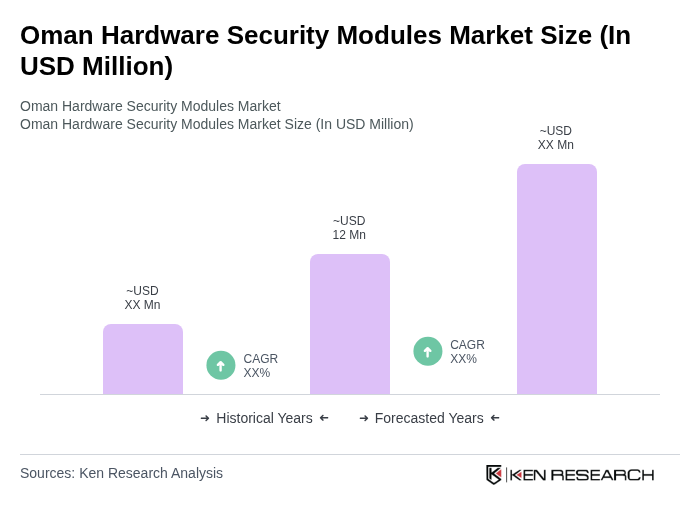
- The Oman Hardware Security Modules Market is valued at USD 12 million, based on a five-year historical analysis and proportional estimation from the Middle East & Africa regional market size. This growth is primarily driven by the increasing need for data security and compliance with stringent regulations across sectors such as banking, healthcare, and government. The surge in cyber threats, digital transformation initiatives, and demand for secure transactions have further accelerated the adoption of hardware security modules in Oman.
- Key cities such asMuscatandSalalahcontinue to dominate the market due to their strategic roles as economic and industrial hubs. Muscat, as the capital, hosts major financial institutions and government agencies requiring advanced security solutions. Salalah’s expanding industrial base, particularly in telecommunications and IT services, contributes significantly to the demand for hardware security modules.
- TheNational Cybersecurity Framework issued by the Ministry of Transport, Communications and Information Technology, Oman, in 2023mandates the implementation of hardware security modules for critical infrastructure and sensitive data processing. This regulation sets operational standards for encryption, key management, and compliance reporting, directly driving HSM adoption in sectors handling classified and personal data.
Oman Hardware Security Modules Market Segmentation
By Type:The market is segmented into USB-Based HSM, PCIe-Based HSM, LAN-Based/Network-Attached HSM, Cloud-Based HSM, and Others. Each type addresses distinct performance, scalability, and deployment requirements. USB-Based HSMs offer portability for small-scale applications, PCIe-Based HSMs deliver high-speed cryptographic processing for enterprise servers, LAN-Based/Network-Attached HSMs provide centralized, scalable security for multi-user environments, while Cloud-Based HSMs enable flexible, remote key management for organizations leveraging cloud infrastructure.
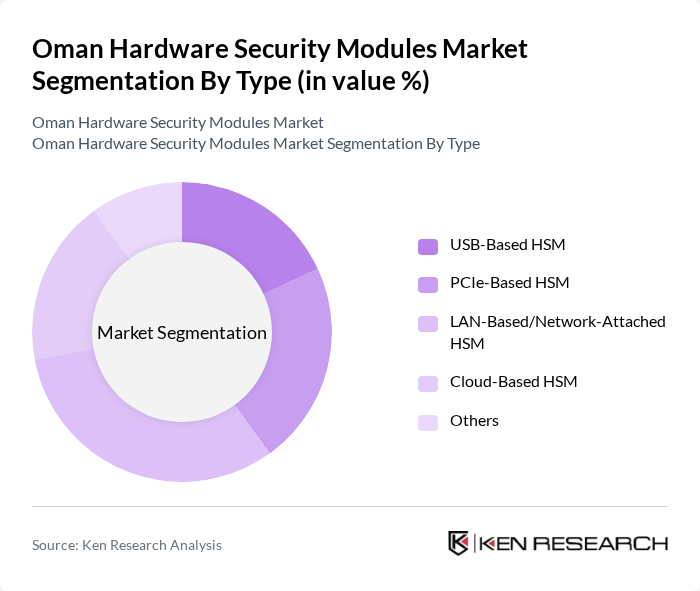
TheLAN-Based/Network-Attached HSMsegment leads the market, favored for its high performance and scalability in enterprise environments. This segment supports centralized security management and multi-user access, making it ideal for organizations undergoing digital transformation and seeking robust, networked cryptographic solutions. The rapid adoption of cloud-based HSMs is also notable, driven by the need for flexible, scalable security in remote and hybrid work settings.
By End-User:The market is segmented by end-user industries: Banking and Financial Services (BFSI), Government and Public Sector, Healthcare and Life Sciences, Telecommunications and IT Services, and Others. Each sector’s regulatory and operational requirements shape HSM adoption patterns.
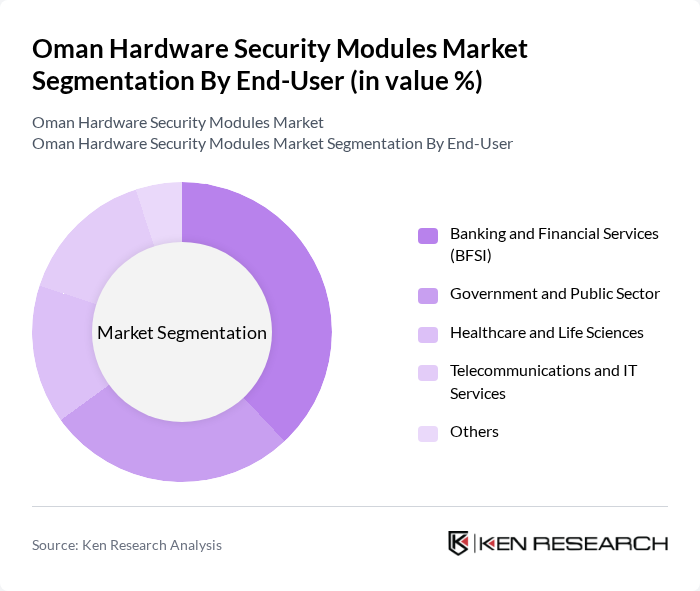
TheBanking and Financial Services (BFSI)sector remains the largest end-user, driven by strict regulatory requirements for data protection, high transaction volumes, and the need for secure payment processing and digital signature management. Government and public sector adoption is rising due to compliance mandates for critical infrastructure security, while healthcare and telecommunications sectors are investing in HSMs to protect sensitive patient and subscriber data.
Oman Hardware Security Modules Market Competitive Landscape
The Oman Hardware Security Modules Market features a diverse mix of regional and international providers. Leading participants include Thales Group, International Business Machines Corporation (IBM), Oracle Corporation, Utimaco GmbH, Amazon Web Services (AWS), Microsoft Corporation (Azure), Securosys AG, Yubico AB, Futurex Inc., nCipher Security (part of Thales), Entrust Corporation, Atos SE, Open Text Corporation, Micro Focus International PLC, and Google Cloud (Cloud HSM Services). These companies drive innovation, expand geographic reach, and enhance service delivery through advanced cryptographic solutions and compliance-focused offerings.
Oman Hardware Security Modules Market Industry Analysis
Growth Drivers
- Increasing Cybersecurity Threats:The surge in cyberattacks, with Oman experiencing a 30% increase in reported incidents in future, has heightened the demand for robust security solutions. The global cybersecurity market is projected to reach $345 billion in future, indicating a strong trend towards investing in hardware security modules (HSMs). This growing threat landscape compels organizations in Oman to adopt HSMs to safeguard sensitive data and maintain operational integrity.
- Rising Demand for Data Protection:With data breaches costing companies an average of $4.35 million in future, the urgency for data protection is paramount. In Oman, the data protection market is expected to grow significantly, driven by the increasing volume of sensitive information generated. The implementation of HSMs is crucial for organizations to comply with data protection regulations and to ensure the confidentiality and integrity of their data assets.
- Government Initiatives for Digital Transformation:The Omani government has allocated $1.5 billion for digital transformation initiatives in future, emphasizing the importance of cybersecurity. This investment aims to enhance the digital infrastructure, thereby increasing the adoption of HSMs across various sectors. As public and private entities align with national strategies, the demand for secure data management solutions will continue to rise, fostering a conducive environment for HSM market growth.
Market Challenges
- High Implementation Costs:The initial investment for deploying HSMs can be substantial, often exceeding $100,000 for comprehensive solutions. This financial barrier can deter small and medium-sized enterprises (SMEs) in Oman from adopting necessary security measures. As a result, many organizations may remain vulnerable to cyber threats, hindering overall market growth and the effective implementation of security protocols.
- Lack of Skilled Workforce:The shortage of cybersecurity professionals in Oman is a significant challenge, with an estimated 60% of organizations reporting difficulties in finding qualified personnel. This skills gap hampers the effective deployment and management of HSMs, as organizations struggle to maintain robust security postures. Addressing this challenge is crucial for the sustainable growth of the HSM market in the region.
Oman Hardware Security Modules Market Future Outlook
The Oman Hardware Security Modules market is poised for significant growth as organizations increasingly prioritize cybersecurity in response to escalating threats. The integration of advanced technologies, such as artificial intelligence and machine learning, will enhance the capabilities of HSMs, making them more effective against sophisticated attacks. Additionally, the ongoing digital transformation initiatives by the government will further drive the adoption of HSMs, ensuring compliance with evolving regulatory standards and fostering a secure digital environment.
Market Opportunities
- Growth in IoT Devices:The proliferation of IoT devices, projected to reach 75 billion globally in future, presents a significant opportunity for HSM adoption. As these devices generate vast amounts of sensitive data, the need for secure data management solutions becomes critical. Organizations in Oman can leverage HSMs to protect data integrity and enhance security across their IoT ecosystems.
- Expansion of Financial Services:The financial services sector in Oman is expected to grow by 8% annually in future, driven by digital banking and fintech innovations. This expansion necessitates robust security measures, creating a substantial market opportunity for HSM providers. Financial institutions can utilize HSMs to secure transactions and protect customer data, ensuring compliance with stringent regulatory requirements.
Scope of the Report
| Segment | Sub-Segments |
|---|---|
| By Type | USB-Based HSM PCIe-Based HSM LAN-Based/Network-Attached HSM Cloud-Based HSM Others |
| By End-User | Banking and Financial Services (BFSI) Government and Public Sector Healthcare and Life Sciences Telecommunications and IT Services Others |
| By Deployment Model | On-Premises Cloud-Based Hybrid Others |
| By Application | Payment Processing and Transaction Security Digital Signatures and Authentication Secure Key Management Data Encryption and SSL/TLS Others |
| By Industry Vertical | Retail and E-Commerce Energy and Utilities Education and Research Manufacturing and Industrial Others |
| By Region | Muscat Salalah Sohar Nizwa Others |
| By Security Compliance Level | FIPS 140-2 Certified FIPS 140-3 Certified Post-Quantum Cryptography Ready Others |
Key Target Audience
Investors and Venture Capitalist Firms
Government and Regulatory Bodies (e.g., Ministry of Transport, Communications and Information Technology)
Manufacturers and Producers
Distributors and Retailers
Telecommunications Companies
Financial Institutions
Cybersecurity Firms
Data Center Operators
Players Mentioned in the Report:
Thales Group
International Business Machines Corporation (IBM)
Oracle Corporation
Utimaco GmbH
Amazon Web Services (AWS)
Microsoft Corporation (Azure)
Securosys AG
Yubico AB
Futurex Inc.
nCipher Security (part of Thales)
Entrust Corporation
Atos SE
Open Text Corporation
Micro Focus International PLC
Google Cloud (Cloud HSM Services)
Table of Contents
Market Assessment Phase
1. Executive Summary and Approach
2. Oman Hardware Security Modules Market Overview
2.1 Key Insights and Strategic Recommendations
2.2 Oman Hardware Security Modules Market Overview
2.3 Definition and Scope
2.4 Evolution of Market Ecosystem
2.5 Timeline of Key Regulatory Milestones
2.6 Value Chain & Stakeholder Mapping
2.7 Business Cycle Analysis
2.8 Policy & Incentive Landscape
3. Oman Hardware Security Modules Market Analysis
3.1 Growth Drivers
3.1.1 Increasing Cybersecurity Threats
3.1.2 Rising Demand for Data Protection
3.1.3 Government Initiatives for Digital Transformation
3.1.4 Adoption of Cloud Services
3.2 Market Challenges
3.2.1 High Implementation Costs
3.2.2 Lack of Skilled Workforce
3.2.3 Regulatory Compliance Issues
3.2.4 Rapid Technological Changes
3.3 Market Opportunities
3.3.1 Growth in IoT Devices
3.3.2 Expansion of Financial Services
3.3.3 Increasing Awareness of Data Privacy
3.3.4 Strategic Partnerships and Collaborations
3.4 Market Trends
3.4.1 Shift Towards Cloud-Based HSM Solutions
3.4.2 Integration of AI in Security Solutions
3.4.3 Focus on Compliance and Regulatory Standards
3.4.4 Growing Demand for Multi-Cloud Environments
3.5 Government Regulation
3.5.1 Data Protection Laws
3.5.2 Cybersecurity Frameworks
3.5.3 Compliance with International Standards
3.5.4 Incentives for Technology Adoption
4. SWOT Analysis
5. Stakeholder Analysis
6. Porter's Five Forces Analysis
7. Oman Hardware Security Modules Market Size, 2019-2024
7.1 By Value
7.2 By Volume
7.3 By Average Selling Price
8. Oman Hardware Security Modules Market Segmentation
8.1 By Type
8.1.1 USB-Based HSM
8.1.2 PCIe-Based HSM
8.1.3 LAN-Based/Network-Attached HSM
8.1.4 Cloud-Based HSM
8.1.5 Others
8.2 By End-User
8.2.1 Banking and Financial Services (BFSI)
8.2.2 Government and Public Sector
8.2.3 Healthcare and Life Sciences
8.2.4 Telecommunications and IT Services
8.2.5 Others
8.3 By Deployment Model
8.3.1 On-Premises
8.3.2 Cloud-Based
8.3.3 Hybrid
8.3.4 Others
8.4 By Application
8.4.1 Payment Processing and Transaction Security
8.4.2 Digital Signatures and Authentication
8.4.3 Secure Key Management
8.4.4 Data Encryption and SSL/TLS
8.4.5 Others
8.5 By Industry Vertical
8.5.1 Retail and E-Commerce
8.5.2 Energy and Utilities
8.5.3 Education and Research
8.5.4 Manufacturing and Industrial
8.5.5 Others
8.6 By Region
8.6.1 Muscat
8.6.2 Salalah
8.6.3 Sohar
8.6.4 Nizwa
8.6.5 Others
8.7 By Security Compliance Level
8.7.1 FIPS 140-2 Certified
8.7.2 FIPS 140-3 Certified
8.7.3 Post-Quantum Cryptography Ready
8.7.4 Others
9. Oman Hardware Security Modules Market Competitive Analysis
9.1 Market Share of Key Players
9.2 Cross Comparison of Key Players
9.2.1 Company Name
9.2.2 Company Size (Enterprise, Mid-Market, or Specialized Provider)
9.2.3 Year-over-Year Revenue Growth Rate (%)
9.2.4 Market Penetration in Oman (%)
9.2.5 Customer Retention Rate (%)
9.2.6 Pricing Strategy (Premium, Mid-Range, or Cost-Competitive)
9.2.7 Product Innovation Index (New HSM Solutions Launched Annually)
9.2.8 Operational Efficiency (Support Response Time, Uptime SLA)
9.2.9 Brand Recognition in MENA Region
9.2.10 Customer Satisfaction Score (NPS or CSAT)
9.3 SWOT Analysis of Top Players
9.4 Pricing Analysis
9.5 Detailed Profile of Major Companies
9.5.1 Thales Group
9.5.2 International Business Machines Corporation (IBM)
9.5.3 Oracle Corporation
9.5.4 Utimaco GmbH
9.5.5 Amazon Web Services (AWS)
9.5.6 Microsoft Corporation (Azure)
9.5.7 Securosys AG
9.5.8 Yubico AB
9.5.9 Futurex Inc.
9.5.10 nCipher Security (part of Thales)
9.5.11 Entrust Corporation
9.5.12 Atos SE
9.5.13 Open Text Corporation
9.5.14 Micro Focus International PLC
9.5.15 Google Cloud (Cloud HSM Services)
10. Oman Hardware Security Modules Market End-User Analysis
10.1 Procurement Behavior of Key Government Entities
10.1.1 Ministry of Finance
10.1.2 Ministry of Health
10.1.3 Ministry of Education and Human Development
10.1.4 Ministry of Transport and Logistics
10.2 Corporate Spend on Cybersecurity Infrastructure
10.2.1 Investment in HSM and Cryptographic Solutions
10.2.2 Budget Allocation for Digital Transformation and Security
10.3 Pain Point Analysis by End-User Category
10.3.1 Security Breaches and Data Theft
10.3.2 Compliance Challenges with International Standards
10.3.3 High Costs of Security Solutions and Implementation
10.4 User Readiness for Adoption
10.4.1 Awareness of HSM Benefits and ROI
10.4.2 Training and Technical Support Requirements
10.5 Post-Deployment ROI and Use Case Expansion
10.5.1 Measurement of Security Effectiveness and Breach Prevention
10.5.2 Expansion into New Applications and Multi-Cloud Environments
11. Oman Hardware Security Modules Market Future Size, 2025-2030
11.1 By Value
11.2 By Volume
11.3 By Average Selling Price
Go-To-Market Strategy Phase
1. Whitespace Analysis + Business Model Canvas
1.1 Market Gaps Identification
1.2 Business Model Development
2. Marketing and Positioning Recommendations
2.1 Branding Strategies
2.2 Product USPs
3. Distribution Plan
3.1 Direct Sales vs Channel Partner Strategy
4. Channel & Pricing Gaps
4.1 Underserved Market Segments
4.2 Pricing Bands and Competitive Positioning
5. Unmet Demand & Latent Needs
5.1 Category Gaps in HSM Solutions
5.2 Customer Segments with Unmet Security Needs
6. Customer Relationship
6.1 Loyalty and Retention Programs
6.2 After-Sales Service and Technical Support
7. Value Proposition
7.1 Security and Compliance Excellence
7.2 Integrated Supply Chains and Ecosystem
8. Key Activities
8.1 Regulatory Compliance and Certification
8.2 Branding and Market Awareness
8.3 Distribution and Channel Setup
9. Entry Strategy Evaluation
9.1 Domestic Market Entry Strategy
9.1.1 Product Mix and HSM Solutions Portfolio
9.1.2 Pricing Band and Competitive Positioning
9.1.3 Packaging and Service Offerings
9.2 Regional Export Strategy
9.2.1 Target MENA Countries
9.2.2 Compliance and Certification Roadmap
10. Entry Mode Assessment
10.1 Joint Venture with Local Partners
10.2 Greenfield Investment
10.3 Mergers and Acquisitions
10.4 Distributor and Reseller Model
11. Capital and Timeline Estimation
11.1 Capital Requirements
11.2 Market Entry Timelines
12. Control vs Risk Trade-Off
12.1 Ownership Structure vs Partnership Models
13. Profitability Outlook
13.1 Breakeven Analysis
13.2 Long-Term Sustainability and Growth
14. Potential Partner List
14.1 Local Distributors and Resellers
14.2 Joint Venture Partners
14.3 Acquisition Targets
15. Execution Roadmap
15.1 Phased Plan for Market Entry
15.1.1 Market Setup and Infrastructure
15.1.2 Market Entry and Launch
15.1.3 Growth Acceleration Phase
15.1.4 Scale and Stabilize Operations
15.2 Key Activities and Milestones
15.2.1 Milestone Planning and Tracking
Research Methodology
Phase 1: Approach1
Desk Research
- Analysis of market reports from industry associations and government publications
- Review of academic journals and white papers on hardware security technologies
- Examination of trade publications and news articles related to cybersecurity trends in Oman
Primary Research
- Interviews with IT security managers in key sectors such as finance and government
- Surveys targeting hardware security module (HSM) vendors and distributors
- Field interviews with cybersecurity consultants and industry experts in Oman
Validation & Triangulation
- Cross-validation of findings through multiple data sources including market surveys and expert opinions
- Triangulation of data from primary interviews and secondary research findings
- Sanity checks conducted through expert panel reviews to ensure data accuracy
Phase 2: Market Size Estimation1
Top-down Assessment
- Estimation of the overall cybersecurity market size in Oman as a basis for HSM market potential
- Segmentation of the market by end-user industries such as banking, healthcare, and telecommunications
- Incorporation of government initiatives and regulations promoting cybersecurity investments
Bottom-up Modeling
- Collection of sales data from leading HSM manufacturers operating in Oman
- Estimation of market share based on unit sales and pricing strategies of key players
- Volume x price analysis to derive revenue projections for the HSM market
Forecasting & Scenario Analysis
- Multi-factor regression analysis incorporating factors such as digital transformation and regulatory changes
- Scenario planning based on potential shifts in cybersecurity threats and technology adoption rates
- Development of baseline, optimistic, and pessimistic forecasts through 2030
Phase 3: CATI Sample Composition1
| Scope Item/Segment | Sample Size | Target Respondent Profiles |
|---|---|---|
| Banking Sector HSM Usage | 60 | IT Security Managers, Compliance Officers |
| Healthcare Data Protection | 40 | Data Protection Officers, IT Administrators |
| Telecommunications Security Solutions | 45 | Network Security Engineers, Operations Managers |
| Government Cybersecurity Initiatives | 40 | Cybersecurity Policy Makers, IT Directors |
| Retail Sector Payment Security | 50 | Payment Security Analysts, IT Managers |
Frequently Asked Questions
What is the current value of the Oman Hardware Security Modules Market?
The Oman Hardware Security Modules Market is valued at approximately USD 12 million, reflecting a five-year historical analysis and proportional estimation from the broader Middle East & Africa market. This growth is driven by increasing data security needs and regulatory compliance.
What factors are driving the growth of the Hardware Security Modules Market in Oman?
Which cities in Oman are leading in Hardware Security Modules adoption?
What are the main types of Hardware Security Modules available in Oman?
Other Regional/Country Reports
Indonesia Hardware Security Modules Market
Malaysia Hardware Security Modules Market
KSA Hardware Security Modules Market
APAC Hardware Security Modules Market
SEA Hardware Security Modules Market
Other Adjacent Reports
Brazil Cybersecurity Solutions Market
Japan Data Encryption Market
Singapore Cloud Security Market
Vietnam Identity and Access Management Market
Kuwait Blockchain Security Market
United States IoT Security Market Outlook to 2030: Size, Share, Growth and TrendsMEA Network Security Market Size, Share & Forecast, By Component, Deployment Mode, Organization Size & Industry Vertical, 2026-2032Kuwait Secure Payment Systems Market
US public key infrastructure market report Size, Share, Growth Drivers, Trends, Opportunities & Forecast 2025–2030UAE Digital Forensics MarketWhy Buy From Us?

What makes us stand out is that our consultants follow Robust, Refine and Result (RRR) methodology. Robust for clear definitions, approaches and sanity checking, Refine for differentiating respondents' facts and opinions, and Result for presenting data with story.

We have set a benchmark in the industry by offering our clients with syndicated and customized market research reports featuring coverage of entire market as well as meticulous research and analyst insights.

While we don't replace traditional research, we flip the method upside down. Our dual approach of Top Bottom & Bottom Top ensures quality deliverable by not just verifying company fundamentals but also looking at the sector and macroeconomic factors.

With one step in the future, our research team constantly tries to show you the bigger picture. We help with some of the tough questions you may encounter along the way: How is the industry positioned? Best marketing channel? KPI's of competitors? By aligning every element, we help maximize success.

Our report gives you instant access to the answers and sources that other companies might choose to hide. We elaborate each steps of research methodology we have used and showcase you the sample size to earn your trust.

If you need any support, we are here! We pride ourselves on universe strength, data quality, and quick, friendly, and professional service.