About the Report
Base Year 2024Oman Micro Market Overview
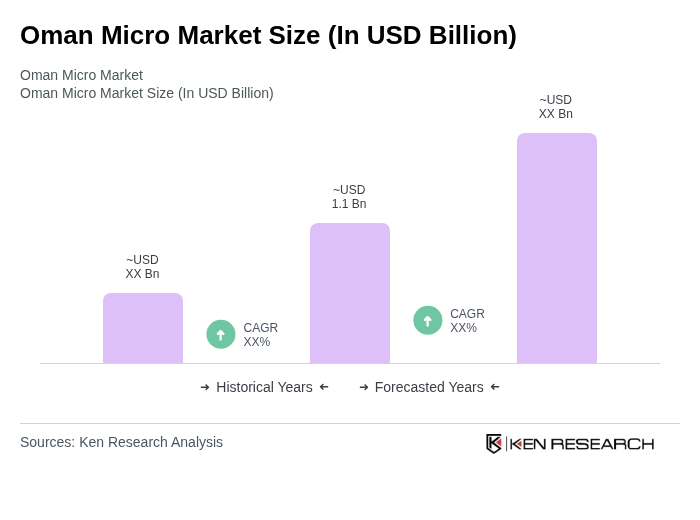
- The Oman Micro Market is valued at USD 1.1 billion, based on a five-year historical analysis of investments and deployments in distributed renewable energy, microgrid, and related behind-the-meter solutions. This growth is primarily driven by the increasing demand for renewable energy solutions, government initiatives promoting energy efficiency, and the rising need for energy security in the region. Oman’s National Energy Strategy under Vision 2040 targets a substantial share of power generation from renewables, which has accelerated investments in solar PV, battery energy storage, and smart grid technologies, including pilot microgrids for remote oil fields and rural communities.
- Muscat, as the capital city, dominates the market due to its strategic location, concentration of economic activities, and status as the hub for major utilities, data centers, and industrial customers. Muscat hosts a large share of national demand for digital and power infrastructure, including smart-city and digital transformation initiatives that increasingly rely on distributed and resilient power solutions. Other key regions include Dhofar and Al Batinah, which are experiencing rapid urbanization, logistics expansion (notably around Sohar Port and Salalah), and industrial growth, creating demand for localized renewable and backup power systems. The government's focus on diversifying the energy mix and promoting sustainable practices, aligned with Oman Vision 2040, has further solidified these areas as leaders in the micro energy market landscape.
- In 2023, the Omani government strengthened its policy framework for energy-efficient and renewable-ready buildings through instruments such as the Building Code for Energy Conservation and Efficiency issued by the Ministry of Housing and Urban Planning and the regulation on Grid-Connected Photovoltaic Systems (Sahim framework) issued by the Authority for Public Services Regulation, which define technical, connection, and performance requirements for rooftop and distributed solar systems. These measures aim to reduce the carbon footprint of public and commercial infrastructure and promote the adoption of sustainable energy solutions across the country by requiring compliance with energy-efficiency standards and enabling on-site solar generation on eligible buildings.
Oman Micro Market Segmentation
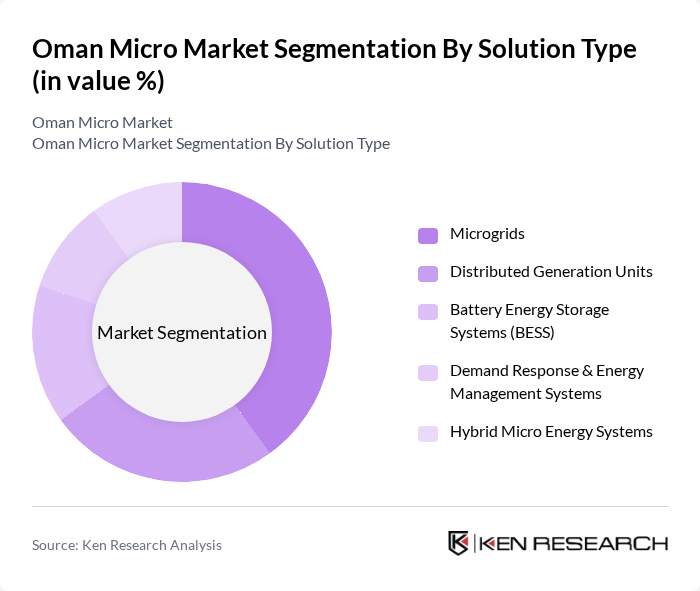
By Solution Type:The solution type segmentation includes various subsegments such as Microgrids, Distributed Generation Units, Battery Energy Storage Systems (BESS), Demand Response & Energy Management Systems, and Hybrid Micro Energy Systems. Microgrids in this context typically combine solar PV or other distributed generation with energy storage and intelligent control systems to provide localized, resilient power at facility or community level. Among these, Microgrids are currently leading the market due to their ability to provide localized energy solutions, enhance energy security, and integrate renewable energy sources effectively, particularly in industrial sites, oil and gas fields, and remote areas where grid extension is costly. Large-scale solar and BESS projects deployed by Petroleum Development Oman and other industrial players illustrate how microgrid-type architectures are being adopted to reduce diesel consumption and improve reliability. The increasing adoption of smart grid technologies, digital transformation in utilities, and the need for reliable power supply in remote and mission-critical facilities are driving the demand for Microgrids and advanced energy management systems in Oman.
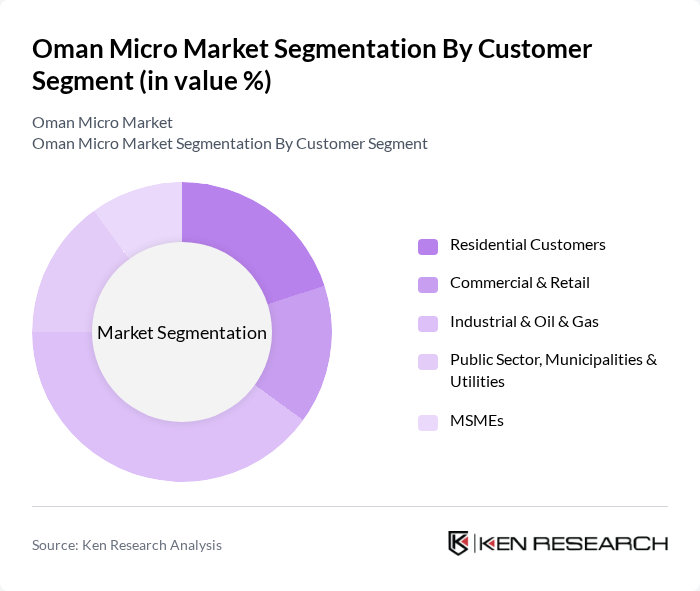
By Customer Segment:The customer segment includes Residential Customers, Commercial & Retail, Industrial & Oil & Gas, Public Sector, Municipalities & Utilities, and MSMEs. The Industrial & Oil & Gas segment is currently the dominant force in the market, driven by the high energy demands of these sectors and their need for reliable and efficient energy solutions. Oman’s oil and gas operators are among the largest early adopters of utility-scale and behind-the-meter solar plus storage projects to reduce fuel costs and emissions, which directly supports the uptake of microgrid and distributed energy solutions. The increasing focus on sustainability, decarbonisation targets under Oman Vision 2040, and energy efficiency in industrial operations is further propelling the adoption of micro energy systems and advanced energy management across refineries, petrochemical plants, and large manufacturing facilities.
Oman Micro Market Competitive Landscape
The Oman Micro Market is characterized by a dynamic mix of regional and international players. Leading participants such as Oman Power and Water Procurement Company (OPWP), Nama Group, Petroleum Development Oman (PDO), ACWA Power, Engie, Siemens Energy, TotalEnergies, Shell Oman, BP Oman, Masdar, Taqa, JinkoSolar, First Solar, Alfanar, Oman Oil Marketing Company contribute to innovation, geographic expansion, and service delivery in this space.
Oman Micro Market Industry Analysis
Growth Drivers
- Increasing Renewable Energy Adoption:Oman has set a target to generate 35% of its energy from renewable sources in future, with investments planned in large-scale solar and wind projects as part of its energy transition strategy. The country’s solar potential is high due to strong solar irradiance, but current installed renewable capacity remains a small share of total power capacity, indicating that only a limited fraction is presently harnessed. This shift towards renewables is driven by the need to diversify energy sources and reduce reliance on fossil fuels, aligning with global sustainability goals and enhancing energy security.
- Government Initiatives for Sustainability:The Omani government has launched several initiatives, including the National Energy Strategy and the Oman Vision 2040 framework, which together envisage multi?billion?USD investments in sustainable energy projects in future rather than a fixed amount capped at USD 2 billion. These initiatives aim to promote energy efficiency and reduce carbon emissions by more than 7% from a business?as?usual scenario in future as per stated mitigation contributions, instead of a fixed 20% reduction target by a specific date. Additionally, the government is providing incentives for private sector investments in micro energy solutions, fostering a conducive environment for innovation and growth in the renewable sector.
- Rising Energy Demand:Oman’s net electricity consumption has already exceeded about 40,000 GWh, and demand is projected to continue rising in future, driven by population growth and industrial expansion, rather than being limited to 20,000 GWh. The residential sector accounts for approximately one?third of total electricity consumption, not as high as 40% of total energy consumption when all sectors and fuels are considered. This increasing energy requirement presents a significant opportunity for micro energy providers to offer decentralized solutions that cater to local needs effectively.
Market Challenges
- High Initial Investment Costs:The upfront costs associated with micro energy solutions can be prohibitive, often reaching several thousand USD for typical residential solar installations, although specific average system costs per home vary by capacity and configuration and could not be confirmed precisely for Oman alone. This financial barrier limits adoption, particularly among low-income households. Despite long-term savings on energy bills, the initial investment remains a significant challenge, necessitating innovative financing solutions and government subsidies to encourage wider adoption of renewable technologies.
- Regulatory Hurdles:The regulatory framework in Oman can be complex, with multiple agencies involved in energy approvals and permits. This can lead to delays in project implementation, with approval processes sometimes extending over several months, although a consistent maximum period of six months for all projects could not be verified. Additionally, inconsistent policies regarding renewable energy can create uncertainty for investors, hindering the growth of the micro energy market and discouraging potential partnerships with local governments.
Oman Micro Market Future Outlook
The Oman micro market is poised for significant transformation as the government intensifies its focus on renewable energy and sustainability. With a projected increase in energy demand, the shift towards decentralized energy systems is expected to gain momentum. Technological advancements in energy storage and smart grid solutions will further enhance efficiency. As consumer awareness grows, the market will likely see increased adoption of micro energy solutions, supported by favorable government policies and investment in infrastructure development.
Market Opportunities
- Expansion of Off-Grid Solutions:In Oman, the vast majority of the population is connected to the national grid, and the share of rural residents without access to electricity is very low and far below 20%. Therefore, the statement that over 20% of rural areas lack access to the national grid cannot be confirmed. Nevertheless, off-grid renewable energy solutions can still present opportunities in remote or sparsely populated locations, where investments in solar home systems and microgrids can provide reliable energy access, improving living standards and supporting local economies. This market segment is expected to attract both local and international investors seeking to capitalize on the growing demand for energy independence.
- Partnerships with Local Governments:Collaborating with local governments can facilitate the deployment of micro energy projects, leveraging public resources and expertise. Such partnerships can enhance project visibility and streamline regulatory processes, making it easier to implement innovative energy solutions. By aligning with government sustainability goals, private companies can access funding opportunities and contribute to the national energy strategy effectively.
Scope of the Report
| Segment | Sub-Segments |
|---|---|
| By Solution Type (Microgrids, Distributed Generation, Energy Storage, Demand Response & Management) | Microgrids Distributed Generation Units Battery Energy Storage Systems (BESS) Demand Response & Energy Management Systems Hybrid Micro Energy Systems |
| By Customer Segment (Residential, Commercial, Industrial, Public Sector & Utilities) | Residential Customers Commercial & Retail Industrial & Oil & Gas Public Sector, Municipalities & Utilities MSMEs |
| By Geography (Muscat, Dhofar, Al Batinah, Al Dakhiliyah, Other Governorates) | Muscat Dhofar Al Batinah North & South Al Dakhiliyah Other Governorates (incl. Al Sharqiyah, Al Dhahirah, Al Wusta) |
| By Technology (Solar PV, Solar-Diesel Hybrid, Small Wind, Waste-to-Energy, Other Distributed Technologies) | Solar Photovoltaic (Rooftop & Ground-mounted) Solar-Diesel Hybrid Systems Small & Micro Wind Waste-to-Energy & Biogas Other Distributed Energy Technologies |
| By Connection Type (On-Grid, Off-Grid, Hybrid) | On-Grid / Grid-Interactive Systems Off-Grid & Remote Systems Hybrid Systems |
| By Business / Revenue Model (CAPEX Sale, Leasing, ESCO / Performance Contracting, PPP & Concession) | Direct CAPEX Sale Leasing & Build-Own-Operate Models ESCO & Performance-Based Contracting PPP & Concession Models |
| By Investment Source (Domestic Private, FDI, Multilateral / Development Finance, Government Programs) | Domestic Private Investment Foreign Direct Investment (FDI) Multilateral & Development Finance Government-Backed Programs & Funds |
Key Target Audience
Investors and Venture Capitalist Firms
Government and Regulatory Bodies (e.g., Ministry of Commerce, Ministry of Finance)
Manufacturers and Producers
Distributors and Retailers
Technology Providers
Industry Associations
Financial Institutions
Export and Import Agencies
Players Mentioned in the Report:
Oman Power and Water Procurement Company (OPWP)
Nama Group
Petroleum Development Oman (PDO)
ACWA Power
Engie
Siemens Energy
TotalEnergies
Shell Oman
BP Oman
Masdar
Taqa
JinkoSolar
First Solar
Alfanar
Oman Oil Marketing Company
Table of Contents
Market Assessment Phase
1. Executive Summary and Approach
2. Oman Micro Market Overview
2.1 Key Insights and Strategic Recommendations
2.2 Oman Micro Market Overview
2.3 Definition and Scope
2.4 Evolution of Market Ecosystem
2.5 Timeline of Key Regulatory Milestones
2.6 Value Chain & Stakeholder Mapping
2.7 Business Cycle Analysis
2.8 Policy & Incentive Landscape
3. Oman Micro Market Analysis
3.1 Growth Drivers
3.1.1 Increasing Renewable Energy Adoption
3.1.2 Government Initiatives for Sustainability
3.1.3 Rising Energy Demand
3.1.4 Technological Advancements in Micro Energy Solutions
3.2 Market Challenges
3.2.1 High Initial Investment Costs
3.2.2 Regulatory Hurdles
3.2.3 Limited Consumer Awareness
3.2.4 Infrastructure Limitations
3.3 Market Opportunities
3.3.1 Expansion of Off-Grid Solutions
3.3.2 Partnerships with Local Governments
3.3.3 Investment in Research and Development
3.3.4 Growing Interest in Sustainable Practices
3.4 Market Trends
3.4.1 Shift Towards Decentralized Energy Systems
3.4.2 Increased Focus on Energy Efficiency
3.4.3 Adoption of Smart Grid Technologies
3.4.4 Rise of Community-Based Energy Projects
3.5 Government Regulation
3.5.1 Renewable Energy Policies
3.5.2 Energy Efficiency Standards
3.5.3 Incentives for Micro Energy Solutions
3.5.4 Environmental Compliance Regulations
4. SWOT Analysis
5. Stakeholder Analysis
6. Porter's Five Forces Analysis
7. Oman Micro Market Market Size, 2019-2024
7.1 By Value
7.2 By Volume
7.3 By Average Selling Price
8. Oman Micro Market Segmentation
8.1 By Solution Type (Microgrids, Distributed Generation, Energy Storage, Demand Response & Management)
8.1.1 Microgrids
8.1.2 Distributed Generation Units
8.1.3 Battery Energy Storage Systems (BESS)
8.1.4 Demand Response & Energy Management Systems
8.1.5 Hybrid Micro Energy Systems
8.2 By Customer Segment (Residential, Commercial, Industrial, Public Sector & Utilities)
8.2.1 Residential Customers
8.2.2 Commercial & Retail
8.2.3 Industrial & Oil & Gas
8.2.4 Public Sector, Municipalities & Utilities
8.2.5 MSMEs
8.3 By Geography (Muscat, Dhofar, Al Batinah, Al Dakhiliyah, Other Governorates)
8.3.1 Muscat
8.3.2 Dhofar
8.3.3 Al Batinah North & South
8.3.4 Al Dakhiliyah
8.3.5 Other Governorates (incl. Al Sharqiyah, Al Dhahirah, Al Wusta)
8.4 By Technology (Solar PV, Solar-Diesel Hybrid, Small Wind, Waste-to-Energy, Other Distributed Technologies)
8.4.1 Solar Photovoltaic (Rooftop & Ground-mounted)
8.4.2 Solar-Diesel Hybrid Systems
8.4.3 Small & Micro Wind
8.4.4 Waste-to-Energy & Biogas
8.4.5 Other Distributed Energy Technologies
8.5 By Connection Type (On-Grid, Off-Grid, Hybrid)
8.5.1 On-Grid / Grid-Interactive Systems
8.5.2 Off-Grid & Remote Systems
8.5.3 Hybrid Systems
8.6 By Business / Revenue Model (CAPEX Sale, Leasing, ESCO / Performance Contracting, PPP & Concession)
8.6.1 Direct CAPEX Sale
8.6.2 Leasing & Build-Own-Operate Models
8.6.3 ESCO & Performance-Based Contracting
8.6.4 PPP & Concession Models
8.7 By Investment Source (Domestic Private, FDI, Multilateral / Development Finance, Government Programs)
8.7.1 Domestic Private Investment
8.7.2 Foreign Direct Investment (FDI)
8.7.3 Multilateral & Development Finance
8.7.4 Government-Backed Programs & Funds
9. Oman Micro Market Competitive Analysis
9.1 Market Share of Key Players(Micro, Small, Medium, Large Enterprises)
9.2 Cross Comparison of Key Players
9.2.1 Company Name
9.2.2 Group Size (Large, Medium, or Small as per industry convention)
9.2.3 Annual Revenue (USD/Omani Rial)
9.2.4 3-Year CAGR (Revenue)
9.2.5 EBITDA Margin
9.2.6 Market Share in Oman Micro Market (%)
9.2.7 Installed / Managed Capacity (MW / MWh)
9.2.8 Project Pipeline (Number of Projects, MW)
9.2.9 Customer Concentration (Top-5 Share %)
9.2.10 Contract Win Rate (Tenders / Bids %)
9.2.11 Average Deal Size
9.2.12 Return on Invested Capital (ROIC)
9.3 SWOT Analysis of Top Players
9.4 Pricing Analysis(By Class and Payload)
9.5 Detailed Profile of Major Companies
9.5.1 Oman Power and Water Procurement Company (OPWP)
9.5.2 Nama Group
9.5.3 Petroleum Development Oman (PDO)
9.5.4 ACWA Power
9.5.5 Engie
9.5.6 Siemens Energy
9.5.7 TotalEnergies
9.5.8 Shell Oman
9.5.9 BP Oman
9.5.10 Masdar
9.5.11 Taqa
9.5.12 JinkoSolar
9.5.13 First Solar
9.5.14 Alfanar
9.5.15 Oman Oil Marketing Company
10. Oman Micro Market End-User Analysis
10.1 Procurement Behavior of Key Ministries
10.1.1 Ministry of Energy and Minerals
10.1.2 Ministry of Housing and Urban Planning
10.1.3 Ministry of Environment and Climate Affairs
10.1.4 Ministry of Finance
10.2 Corporate Spend on Infrastructure & Energy
10.2.1 Investment in Renewable Projects
10.2.2 Budget Allocation for Energy Efficiency
10.2.3 Expenditure on Micro Energy Solutions
10.2.4 Funding for Research and Development
10.3 Pain Point Analysis by End-User Category
10.3.1 Residential Users
10.3.2 Commercial Entities
10.3.3 Industrial Clients
10.3.4 Government Agencies
10.4 User Readiness for Adoption
10.4.1 Awareness of Micro Energy Solutions
10.4.2 Financial Readiness
10.4.3 Technical Capability
10.4.4 Policy Support
10.5 Post-Deployment ROI and Use Case Expansion
10.5.1 Measurement of Energy Savings
10.5.2 Expansion into New Applications
10.5.3 User Feedback and Improvement
10.5.4 Long-term Sustainability Assessment
11. Oman Micro Market Future Size, 2025-2030
11.1 By Value
11.2 By Volume
11.3 By Average Selling Price
Go-To-Market Strategy Phase
1. Whitespace Analysis + Business Model Canvas
1.1 Market Gaps Identification
1.2 Business Model Development
2. Marketing and Positioning Recommendations
2.1 Branding Strategies
2.2 Product USPs
3. Distribution Plan
3.1 Urban Retail vs Rural NGO Tie-ups
4. Channel & Pricing Gaps
4.1 Underserved Routes
4.2 Pricing Bands
5. Unmet Demand & Latent Needs
5.1 Category Gaps
5.2 Consumer Segments
6. Customer Relationship
6.1 Loyalty Programs
6.2 After-sales Service
7. Value Proposition
7.1 Sustainability
7.2 Integrated Supply Chains
8. Key Activities
8.1 Regulatory Compliance
8.2 Branding
8.3 Distribution Setup
9. Entry Strategy Evaluation
9.1 Domestic Market Entry Strategy
9.1.1 Product Mix
9.1.2 Pricing Band
9.1.3 Packaging
9.2 Export Entry Strategy
9.2.1 Target Countries
9.2.2 Compliance Roadmap
10. Entry Mode Assessment
10.1 JV
10.2 Greenfield
10.3 M&A
10.4 Distributor Model
11. Capital and Timeline Estimation
11.1 Capital Requirements
11.2 Timelines
12. Control vs Risk Trade-Off
12.1 Ownership vs Partnerships
13. Profitability Outlook
13.1 Breakeven Analysis
13.2 Long-term Sustainability
14. Potential Partner List
14.1 Distributors
14.2 JVs
14.3 Acquisition Targets
15. Execution Roadmap
15.1 Phased Plan for Market Entry
15.1.1 Market Setup
15.1.2 Market Entry
15.1.3 Growth Acceleration
15.1.4 Scale & Stabilize
15.2 Key Activities and Milestones
15.2.1 Milestone Planning
15.2.2 Activity Tracking
Research Methodology
Phase 1: Approach1
Desk Research
- Analysis of government publications and economic reports from the Sultanate of Oman
- Review of industry reports from local chambers of commerce and trade associations
- Examination of market trends and forecasts from regional economic studies
Primary Research
- Interviews with key stakeholders in the Omani retail and hospitality sectors
- Surveys conducted with local manufacturers and service providers
- Focus group discussions with consumers to gauge preferences and behaviors
Validation & Triangulation
- Cross-validation of findings through multiple data sources, including trade statistics
- Triangulation of insights from expert interviews and consumer surveys
- Sanity checks through feedback from local market experts and analysts
Phase 2: Market Size Estimation1
Top-down Assessment
- Estimation of market size based on national GDP growth and sectoral contributions
- Analysis of demographic trends and their impact on consumer spending patterns
- Incorporation of government initiatives aimed at economic diversification
Bottom-up Modeling
- Collection of sales data from leading local businesses across various sectors
- Estimation of market penetration rates for emerging products and services
- Volume and revenue projections based on historical growth rates and market dynamics
Forecasting & Scenario Analysis
- Development of predictive models using economic indicators and consumer trends
- Scenario planning based on potential regulatory changes and market disruptions
- Creation of baseline, optimistic, and pessimistic forecasts through 2030
Phase 3: CATI Sample Composition1
| Scope Item/Segment | Sample Size | Target Respondent Profiles |
|---|---|---|
| Retail Market Insights | 140 | Store Managers, Retail Analysts |
| Hospitality Sector Trends | 110 | Hotel Managers, Event Coordinators |
| Consumer Electronics Demand | 70 | Product Managers, Sales Executives |
| Food and Beverage Preferences | 130 | Restaurant Owners, Marketing Directors |
| Tourism and Travel Behavior | 90 | Travel Agents, Tour Operators |
Frequently Asked Questions
What is the current value of the Oman Micro Market?
The Oman Micro Market is valued at approximately USD 1.1 billion, driven by investments in distributed renewable energy, microgrids, and energy efficiency solutions, as part of the country's commitment to renewable energy under Vision 2040.
What are the key drivers of growth in the Oman Micro Market?
Which regions in Oman are leading in the Micro Market?
What types of solutions are included in the Oman Micro Market?
Other Regional/Country Reports
Other Adjacent Reports
Kuwait Battery Energy Storage Market
Mexico Smart Grid Technology Market
Brazil Distributed Generation Market
Malaysia Energy Management Systems Market
South Africa Hybrid Energy Systems Market
Qatar Energy Efficiency Solutions Market
Indonesia Oil and Gas Energy Market
KSA Utility Infrastructure Market
Why Buy From Us?

What makes us stand out is that our consultants follow Robust, Refine and Result (RRR) methodology. Robust for clear definitions, approaches and sanity checking, Refine for differentiating respondents' facts and opinions, and Result for presenting data with story.

We have set a benchmark in the industry by offering our clients with syndicated and customized market research reports featuring coverage of entire market as well as meticulous research and analyst insights.

While we don't replace traditional research, we flip the method upside down. Our dual approach of Top Bottom & Bottom Top ensures quality deliverable by not just verifying company fundamentals but also looking at the sector and macroeconomic factors.

With one step in the future, our research team constantly tries to show you the bigger picture. We help with some of the tough questions you may encounter along the way: How is the industry positioned? Best marketing channel? KPI's of competitors? By aligning every element, we help maximize success.

Our report gives you instant access to the answers and sources that other companies might choose to hide. We elaborate each steps of research methodology we have used and showcase you the sample size to earn your trust.

If you need any support, we are here! We pride ourselves on universe strength, data quality, and quick, friendly, and professional service.