About the Report
Base Year 2024Indonesia Micro Market Overview
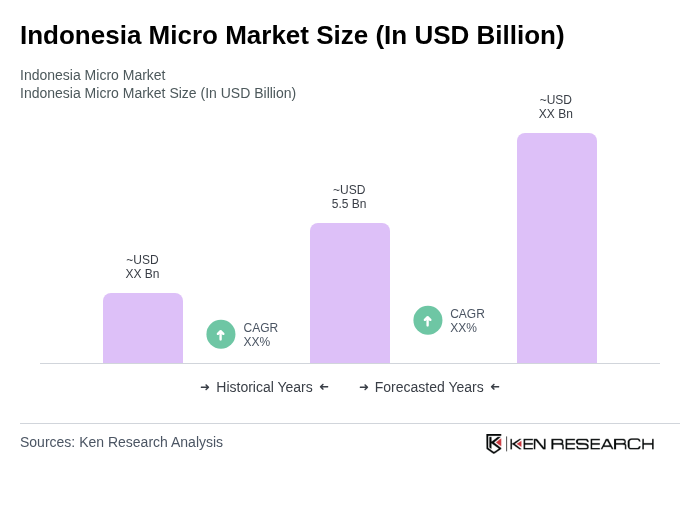
- The Indonesia Micro Market is valued at USD 5.5 billion, based on a five-year historical analysis, reflecting the strong expansion of the country’s e-commerce and digital economy. This growth is primarily driven by the rapid expansion of e-commerce, increasing urbanization, and the demand for faster delivery services, supported by Indonesia’s e-commerce market reaching well over USD 300 billion in value and continuing to expand at scale. The rise in consumer expectations for quick and efficient logistics solutions has led to the proliferation of micro-fulfillment centers, dark stores, and other last?mile nodes across major urban corridors, with players investing in same?day and instant delivery capabilities to serve densely populated areas on islands such as Java and Sumatra.
- Key cities dominating the market include Jakarta, Surabaya, and Bandung. Jakarta, as the capital, serves as a major economic hub with a high concentration of e-commerce activities and the highest share of Indonesia’s internet users, driven by dense population and purchasing power on the island of Java. Surabaya and Bandung follow closely due to their growing populations, rising middle class, and increasing internet penetration, making them attractive locations for logistics, micro-fulfillment operations, and urban micro?warehousing to support rapid order fulfillment.
- To strengthen logistics performance and support the digital economy, the Indonesian government has been implementing policies that encourage more efficient goods movement, standardization, and digitalization across the supply chain. A key instrument is the Government Regulation No. 31 of 2021 on the Implementation of the Trade Sector, issued by the Government of Indonesia, which operationalizes the Omnibus Law on Job Creation and sets requirements around licensing, warehousing, and distribution activities for trading businesses, including logistics service providers. These measures, alongside initiatives to improve logistics performance and digital infrastructure, indirectly promote the development of urban logistics facilities such as warehouses and distribution centers that can function as micro?fulfillment nodes to streamline last?mile delivery processes in major cities.
Indonesia Micro Market Segmentation
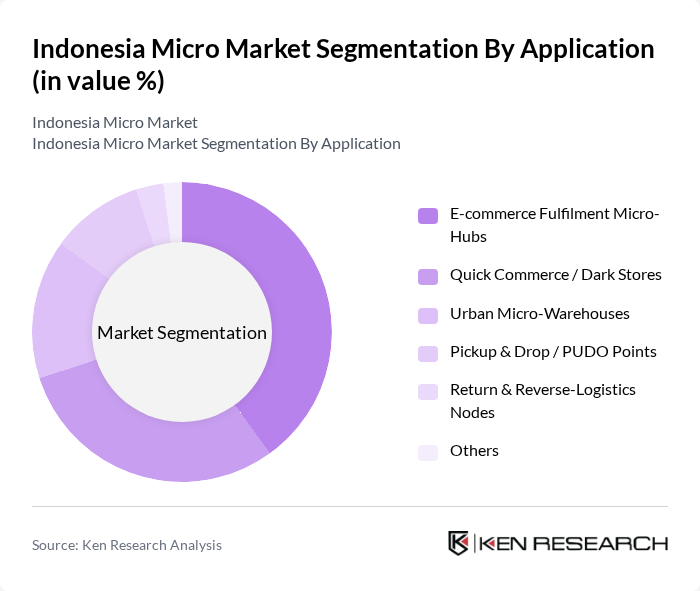
By Application:The application segment of the Indonesia Micro Market includes various sub-segments such as E-commerce Fulfilment Micro-Hubs, Quick Commerce / Dark Stores, Urban Micro-Warehouses, Pickup & Drop / PUDO Points, Return & Reverse-Logistics Nodes, and Others. Among these, E-commerce Fulfilment Micro-Hubs are leading the market due to the surge in online shopping and high order volumes from major marketplaces, which have necessitated the establishment of localized fulfillment centers close to demand clusters to meet consumer expectations for rapid delivery. Quick Commerce / Dark Stores are also gaining traction as they cater to the need for ultra-fast delivery services, particularly in urban areas, with grocery, food, and daily-need categories increasingly being fulfilled from small, high?velocity nodes rather than traditional large warehouses.
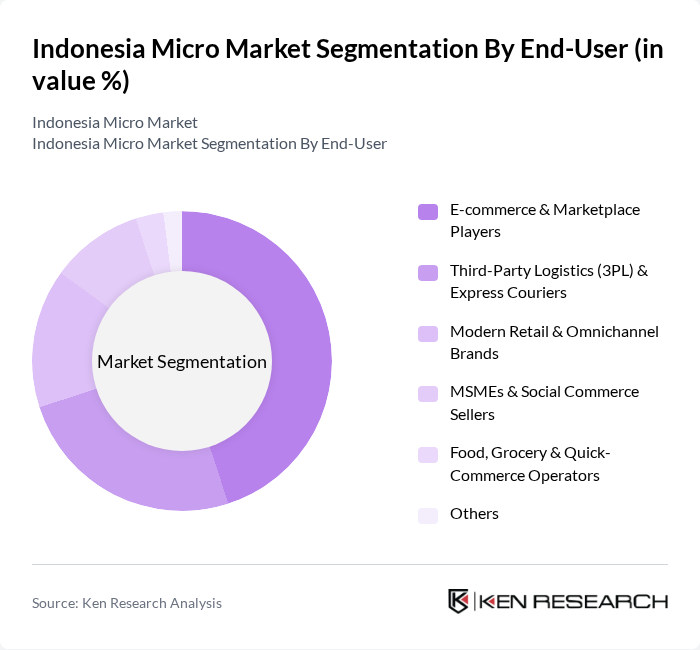
By End-User:This segment encompasses E-commerce & Marketplace Players, Third-Party Logistics (3PL) & Express Couriers, Modern Retail & Omnichannel Brands, MSMEs & Social Commerce Sellers, Food, Grocery & Quick-Commerce Operators, and Others. The E-commerce & Marketplace Players sub-segment is currently the most dominant, driven by the increasing number of online shoppers, high mobile internet usage, and the growing preference for home delivery services, particularly through large platforms such as Tokopedia, Shopee, Lazada, and Bukalapak. Third-Party Logistics (3PL) providers and express couriers are also significant players, as they facilitate the logistics needs of various e-commerce platforms and retailers, investing in dense delivery networks, micro-depots, and technology platforms to handle rising parcel volumes and enable faster, more reliable last?mile delivery.
Indonesia Micro Market Competitive Landscape
The Indonesia Micro Market is characterized by a dynamic mix of regional and international players. Leading participants such as Tokopedia, Shopee Indonesia, Lazada Indonesia, Bukalapak, Blibli, TikTok Shop Indonesia, J&T Express, JNE Express, SiCepat Ekspres, Ninja Xpress, IDexpress, Pos Indonesia, GrabExpress, GoSend (Gojek), SAP Express contribute to innovation, geographic expansion, and service delivery in this space, leveraging dense delivery networks, urban warehouses, and partnerships to improve service levels and coverage across key islands.
Indonesia Micro Market Industry Analysis
Growth Drivers
- Increasing Urbanization:Indonesia's urban population is projected to reach 63% in future, up from 57% in recent periods, according to the World Bank. This rapid urbanization drives demand for reliable energy sources, particularly in metropolitan areas where energy consumption is expected to rise significantly. The urban population's shift towards modern energy solutions creates a robust market for micro energy systems, as urban centers require efficient, localized energy production to meet their growing needs.
- Government Initiatives for Renewable Energy:The Indonesian government aims to increase the share of renewable energy in the national energy mix to 23% in future, as outlined in the National Energy Policy. This commitment translates into substantial investments, with the government indicating investment needs of around $36 billion for renewable energy development and related infrastructure. Such initiatives not only enhance energy security but also stimulate the micro energy market, encouraging the adoption of decentralized energy solutions across the country.
- Rising Energy Demand:Indonesia's final energy consumption has been growing at an average rate of around 2–3% annually in recent years, with total electricity generation exceeding 300 terawatt-hours (TWh), according to the International Energy Agency. The International Energy Agency (IEA) reports that growing demand necessitates innovative energy solutions, particularly in rural and underserved areas. Micro energy systems, including solar and wind, are positioned to fill this gap, providing sustainable energy access to millions of Indonesians who currently lack reliable electricity.
Market Challenges
- Regulatory Hurdles:The micro energy sector in Indonesia faces significant regulatory challenges, including complex licensing processes and evolving policies for grid connection and tariffs, as noted by the World Bank and other development partners. These regulatory barriers hinder investment and innovation in micro energy solutions, limiting the sector's growth potential and discouraging foreign investment in the Indonesian market.
- High Initial Investment Costs:The upfront costs associated with micro energy systems can be prohibitive, with recent international benchmarks indicating average utility-scale solar photovoltaic investment costs in the range of roughly $900 to $1,300 per kilowatt, depending on project scale and location. This financial barrier is particularly challenging for small businesses and low-income households, which often lack access to financing options. As a result, many potential users remain unable to invest in micro energy solutions, stifling market growth and limiting energy access in underserved regions.
Indonesia Micro Market Future Outlook
The future of Indonesia's micro energy market appears promising, driven by increasing urbanization and government support for renewable energy initiatives. As the country strives to meet its ambitious energy targets, the adoption of decentralized energy systems is likely to accelerate. Additionally, advancements in energy storage technologies will enhance the reliability of micro energy solutions, making them more attractive to consumers. Overall, the market is poised for significant growth, with a focus on sustainability and energy efficiency shaping its trajectory.
Market Opportunities
- Expansion of Off-Grid Solutions:With an estimated 6 million to 7 million Indonesians lacking access to electricity in recent data, off-grid micro energy solutions present a significant opportunity. The government’s commitment to electrifying remote areas in future, supported by dedicated budget allocations and programs such as Indonesia’s rural electrification initiatives, can facilitate the deployment of solar and wind systems, improving energy access and fostering economic development in rural communities.
- Partnerships with Local Governments:Collaborations between private companies and local governments can enhance the implementation of micro energy projects. By leveraging local knowledge and resources, these partnerships can streamline project approvals and financing. The government’s initiative to support public-private partnerships in infrastructure, including energy, through mechanisms such as the Committee for Acceleration of Priority Infrastructure Delivery (KPPIP) and viability gap funding can catalyze the growth of micro energy solutions, driving innovation and expanding market reach.
Scope of the Report
| Segment | Sub-Segments |
|---|---|
| By Application (Micro-Hubs, Dark Stores, Micro-Warehouses, Pickup & Drop Points) | E-commerce Fulfilment Micro-Hubs Quick Commerce / Dark Stores Urban Micro-Warehouses Pickup & Drop / PUDO Points Return & Reverse-Logistics Nodes Others |
| By End-User (E-commerce Platforms, 3PLs, Retailers, MSMEs, F&B & Grocery) | E-commerce & Marketplace Players Third-Party Logistics (3PL) & Express Couriers Modern Retail & Omnichannel Brands MSMEs & Social Commerce Sellers Food, Grocery & Quick-Commerce Operators Others |
| By Region (Tier-1, Tier-2, Tier-3 Cities & Emerging Clusters) | Greater Jakarta (Jabodetabek) Java Tier-1 Cities (e.g., Surabaya, Bandung, Semarang) Non-Java Tier-1 Cities (e.g., Medan, Makassar, Denpasar) Tier-2 Cities & Provincial Capitals Tier-3 Cities, Semi-Urban & Rural Clusters Special Economic & Industrial Zones |
| By Operating Model (Owned, Leased, Franchise, Partner-Operated) | Platform-Owned Micro Sites Leased Facilities Franchise / Network Partner Models Agency & Agent Network Models Hybrid Models Others |
| By Service Level (Same-Day, Next-Day, Standard, Scheduled) | Ultra-Fast (?2 Hours) & Same-Day Delivery Next-Day Delivery Standard (2–5 Days) Scheduled & Time-Window Deliveries Returns & Reverse Logistics Others |
| By Asset Type (Micro-DC, Cross-Dock, Lockers, PUDO, Dark Store) | Micro Distribution Centers (Micro-DCs) Cross-Docking & Transshipment Nodes Parcel Lockers Pickup & Drop-Outlets (PUDO) Dark Stores & Micro-Retail Others |
| By Investment Source (Platform-Led, 3PL-Led, Real Estate, VC/PE, Partnerships) | Platform & Marketplace Investments PL & Courier Investments Real Estate & Infrastructure Investors Venture Capital & Private Equity Public-Private Partnerships & Government Initiatives Others |
Key Target Audience
Investors and Venture Capitalist Firms
Government and Regulatory Bodies (e.g., Badan Koordinasi Penanaman Modal, Otoritas Jasa Keuangan)
Manufacturers and Producers
Distributors and Retailers
Technology Providers
Industry Associations (e.g., Asosiasi Pengusaha Indonesia)
Financial Institutions (e.g., Bank Indonesia)
Logistics and Supply Chain Companies
Players Mentioned in the Report:
Tokopedia
Shopee Indonesia
Lazada Indonesia
Bukalapak
Blibli
TikTok Shop Indonesia
J&T Express
JNE Express
SiCepat Ekspres
Ninja Xpress
IDexpress
Pos Indonesia
GrabExpress
GoSend (Gojek)
SAP Express
Table of Contents
Market Assessment Phase
1. Executive Summary and Approach
2. Indonesia Micro Market Overview
2.1 Key Insights and Strategic Recommendations
2.2 Indonesia Micro Market Overview
2.3 Definition and Scope
2.4 Evolution of Market Ecosystem
2.5 Timeline of Key Regulatory Milestones
2.6 Value Chain & Stakeholder Mapping
2.7 Business Cycle Analysis
2.8 Policy & Incentive Landscape
3. Indonesia Micro Market Analysis
3.1 Growth Drivers
3.1.1 Increasing Urbanization
3.1.2 Government Initiatives for Renewable Energy
3.1.3 Rising Energy Demand
3.1.4 Technological Advancements in Micro Energy Solutions
3.2 Market Challenges
3.2.1 Regulatory Hurdles
3.2.2 High Initial Investment Costs
3.2.3 Limited Consumer Awareness
3.2.4 Infrastructure Limitations
3.3 Market Opportunities
3.3.1 Expansion of Off-Grid Solutions
3.3.2 Partnerships with Local Governments
3.3.3 Investment in Smart Grid Technologies
3.3.4 Growing Interest in Sustainable Practices
3.4 Market Trends
3.4.1 Shift Towards Decentralized Energy Systems
3.4.2 Increased Adoption of Energy Storage Solutions
3.4.3 Focus on Energy Efficiency
3.4.4 Rise of Community-Based Energy Projects
3.5 Government Regulation
3.5.1 Renewable Energy Law Implementation
3.5.2 Feed-in Tariff Policies
3.5.4 Local Content Requirements
4. SWOT Analysis
5. Stakeholder Analysis
6. Porter's Five Forces Analysis
7. Indonesia Micro Market Market Size, 2019-2024
7.1 By Value
7.2 By Volume
7.3 By Average Selling Price
8. Indonesia Micro Market Segmentation
8.1 By Application (Micro-Hubs, Dark Stores, Micro-Warehouses, Pickup & Drop Points)
8.1.1 E-commerce Fulfilment Micro-Hubs
8.1.2 Quick Commerce / Dark Stores
8.1.3 Urban Micro-Warehouses
8.1.4 Pickup & Drop / PUDO Points
8.1.5 Return & Reverse-Logistics Nodes
8.1.6 Others
8.2 By End-User (E-commerce Platforms, 3PLs, Retailers, MSMEs, F&B & Grocery)
8.2.1 E-commerce & Marketplace Players
8.2.2 Third-Party Logistics (3PL) & Express Couriers
8.2.3 Modern Retail & Omnichannel Brands
8.2.4 MSMEs & Social Commerce Sellers
8.2.5 Food, Grocery & Quick-Commerce Operators
8.2.6 Others
8.3 By Region (Tier-1, Tier-2, Tier-3 Cities & Emerging Clusters)
8.3.1 Greater Jakarta (Jabodetabek)
8.3.2 Java Tier-1 Cities (e.g., Surabaya, Bandung, Semarang)
8.3.3 Non-Java Tier-1 Cities (e.g., Medan, Makassar, Denpasar)
8.3.4 Tier-2 Cities & Provincial Capitals
8.3.5 Tier-3 Cities, Semi-Urban & Rural Clusters
8.3.6 Special Economic & Industrial Zones
8.4 By Operating Model (Owned, Leased, Franchise, Partner-Operated)
8.4.1 Platform-Owned Micro Sites
8.4.2 Leased Facilities
8.4.3 Franchise / Network Partner Models
8.4.4 Agency & Agent Network Models
8.4.5 Hybrid Models
8.4.6 Others
8.5 By Service Level (Same-Day, Next-Day, Standard, Scheduled)
8.5.1 Ultra-Fast (?2 Hours) & Same-Day Delivery
8.5.2 Next-Day Delivery
8.5.3 Standard (2–5 Days)
8.5.4 Scheduled & Time-Window Deliveries
8.5.5 Returns & Reverse Logistics
8.5.6 Others
8.6 By Asset Type (Micro-DC, Cross-Dock, Lockers, PUDO, Dark Store)
8.6.1 Micro Distribution Centers (Micro-DCs)
8.6.2 Cross-Docking & Transshipment Nodes
8.6.3 Parcel Lockers
8.6.4 Pickup & Drop-Outlets (PUDO)
8.6.5 Dark Stores & Micro-Retail
8.6.6 Others
8.7 By Investment Source (Platform-Led, 3PL-Led, Real Estate, VC/PE, Partnerships)
8.7.1 Platform & Marketplace Investments
8.7.2 3PL & Courier Investments
8.7.3 Real Estate & Infrastructure Investors
8.7.4 Venture Capital & Private Equity
8.7.5 Public-Private Partnerships & Government Initiatives
8.7.6 Others
9. Indonesia Micro Market Competitive Analysis
9.1 Market Share of Key Players(Micro, Small, Medium, Large Enterprises)
9.2 Cross Comparison of Key Players
9.2.1 Company Name
9.2.2 Group Size (Large, Medium, or Small as per industry convention)
9.2.3 Annual Revenue (USD / IDR)
9.2.4 3-Year Revenue CAGR
9.2.5 EBITDA Margin
9.2.6 Capital Expenditure on Micro Infrastructure (% of Revenue)
9.2.7 Number of Micro Sites / Nodes Deployed
9.2.8 Average Throughput per Micro Site (Orders per Day)
9.2.9 On-Time Delivery Rate (% within SLA)
9.2.10 Average Delivery Time (Hours)
9.2.11 Cost per Order / Fulfilment Cost
9.2.12 Network Utilization Rate (%)
9.2.13 Market Share in Target Segments (%)
9.2.14 Return on Invested Capital (ROIC)
9.2.15 Customer NPS / Satisfaction Score
9.3 SWOT Analysis of Top Players
9.4 Pricing Analysis(By Class and Payload)
9.5 Detailed Profile of Major Companies
9.5.1 Tokopedia
9.5.2 Shopee Indonesia
9.5.3 Lazada Indonesia
9.5.4 Bukalapak
9.5.5 Blibli
9.5.6 TikTok Shop Indonesia
9.5.7 J&T Express
9.5.8 JNE Express
9.5.9 SiCepat Ekspres
9.5.10 Ninja Xpress
9.5.11 IDexpress
9.5.12 Pos Indonesia
9.5.13 GrabExpress
9.5.14 GoSend (Gojek)
9.5.15 SAP Express
10. Indonesia Micro Market End-User Analysis
10.1 Procurement Behavior of Key Ministries
10.1.1 Ministry of Energy and Mineral Resources
10.1.2 Ministry of Environment and Forestry
10.1.3 Ministry of Industry
10.1.4 Ministry of National Development Planning
10.2 Corporate Spend on Infrastructure & Energy
10.2.1 Investment in Renewable Energy Projects
10.2.2 Budget Allocation for Energy Efficiency Programs
10.2.3 Expenditure on Smart Grid Technologies
10.2.4 Funding for Research and Development
10.3 Pain Point Analysis by End-User Category
10.3.1 Residential Users
10.3.2 Commercial Users
10.3.3 Industrial Users
10.3.4 Government Entities
10.4 User Readiness for Adoption
10.4.1 Awareness of Renewable Energy Solutions
10.4.2 Financial Readiness
10.4.3 Technical Capability
10.4.4 Policy Support
10.5 Post-Deployment ROI and Use Case Expansion
10.5.1 Performance Metrics
10.5.2 User Satisfaction Levels
10.5.3 Scalability of Solutions
10.5.4 Future Investment Plans
11. Indonesia Micro Market Future Size, 2025-2030
11.1 By Value
11.2 By Volume
11.3 By Average Selling Price
Go-To-Market Strategy Phase
1. Whitespace Analysis + Business Model Canvas
1.1 Market Gaps Identification
1.2 Business Model Framework
2. Marketing and Positioning Recommendations
2.1 Branding Strategies
2.2 Product USPs
3. Distribution Plan
3.1 Urban Retail vs Rural NGO Tie-ups
4. Channel & Pricing Gaps
4.1 Underserved Routes
4.2 Pricing Bands
5. Unmet Demand & Latent Needs
5.1 Category Gaps
5.2 Consumer Segments
6. Customer Relationship
6.1 Loyalty Programs
6.2 After-sales Service
7. Value Proposition
7.1 Sustainability
7.2 Integrated Supply Chains
8. Key Activities
8.1 Regulatory Compliance
8.2 Branding
8.3 Distribution Setup
9. Entry Strategy Evaluation
9.1 Domestic Market Entry Strategy
9.1.1 Product Mix
9.1.2 Pricing Band
9.1.3 Packaging
9.2 Export Entry Strategy
9.2.1 Target Countries
9.2.2 Compliance Roadmap
10. Entry Mode Assessment
10.1 JV
10.2 Greenfield
10.3 M&A
10.4 Distributor Model
11. Capital and Timeline Estimation
11.1 Capital Requirements
11.2 Timelines
12. Control vs Risk Trade-Off
12.1 Ownership vs Partnerships
13. Profitability Outlook
13.1 Breakeven Analysis
13.2 Long-term Sustainability
14. Potential Partner List
14.1 Distributors
14.2 JVs
14.3 Acquisition Targets
15. Execution Roadmap
15.1 Phased Plan for Market Entry
15.1.1 Market Setup
15.1.2 Market Entry
15.1.3 Growth Acceleration
15.1.4 Scale & Stabilize
15.2 Key Activities and Milestones
15.2.1 Milestone Planning
15.2.2 Activity Tracking
Research Methodology
Phase 1: Approach1
Desk Research
- Analysis of government publications and economic reports from BPS (Badan Pusat Statistik)
- Review of industry reports from local trade associations and market research firms
- Examination of demographic and socio-economic data from World Bank and UN databases
Primary Research
- Interviews with key stakeholders in the microfinance sector, including bank executives and policy makers
- Surveys conducted with small business owners across various regions in Indonesia
- Focus group discussions with consumers to understand micro-market needs and preferences
Validation & Triangulation
- Cross-validation of findings through multiple data sources, including government and private sector reports
- Triangulation of qualitative insights from interviews with quantitative data from surveys
- Sanity checks through expert reviews from industry veterans and academic professionals
Phase 2: Market Size Estimation1
Top-down Assessment
- Estimation of market size based on national economic indicators and GDP contributions from micro-enterprises
- Segmentation of the market by industry verticals such as agriculture, retail, and services
- Incorporation of government initiatives aimed at promoting micro-businesses and financial inclusion
Bottom-up Modeling
- Collection of data on the number of micro-enterprises from local chambers of commerce
- Estimation of average revenue per micro-enterprise based on sector-specific benchmarks
- Calculation of total market size by aggregating revenue estimates across all identified micro-enterprises
Forecasting & Scenario Analysis
- Development of growth projections based on historical trends and economic forecasts
- Scenario analysis considering factors such as regulatory changes and economic shifts
- Creation of baseline, optimistic, and pessimistic forecasts through 2030
Phase 3: CATI Sample Composition1
| Scope Item/Segment | Sample Size | Target Respondent Profiles |
|---|---|---|
| Microfinance Institutions | 80 | Branch Managers, Loan Officers |
| Small Business Owners | 150 | Retailers, Service Providers |
| Consumer Insights | 120 | End-users, Community Leaders |
| Government Policy Makers | 60 | Regulatory Officials, Economic Advisors |
| Industry Experts | 40 | Consultants, Academics |
Frequently Asked Questions
What is the current value of the Indonesia Micro Market?
The Indonesia Micro Market is valued at approximately USD 5.5 billion, reflecting significant growth driven by the expansion of e-commerce, urbanization, and increasing consumer demand for efficient logistics solutions.
Which cities are key players in the Indonesia Micro Market?
What factors are driving the growth of the Indonesia Micro Market?
What are micro-fulfillment centers?
Other Regional/Country Reports
Other Adjacent Reports
Belgium Last-Mile Delivery Market
Vietnam quick commerce market report size, share, growth drivers, trends, opportunities & forecast 2025–2030Spain Warehousing Market Outlook to 2031Bahrain Third-Party Logistics Market
KSA Retail Market Outlook to 2030India Supply Chain Management Market Size, Share & Forecast, By Solution Type, Deployment Model & End-Use Industry, 2026-2031Indonesia Online Grocery Market Size, Share & Forecast, By Product Type, Fulfillment Model & Distribution Channel, 2026–2032China Express Delivery Market Size, Share & Forecast, By Service Type, Shipment Flow & End-Use Industry, 2026–2032Africa Reverse Logistics Market Size, Share & Forecast, By Service Type, Mode of Transport & End-Use Industry, 2026-2031Why Buy From Us?

What makes us stand out is that our consultants follow Robust, Refine and Result (RRR) methodology. Robust for clear definitions, approaches and sanity checking, Refine for differentiating respondents' facts and opinions, and Result for presenting data with story.

We have set a benchmark in the industry by offering our clients with syndicated and customized market research reports featuring coverage of entire market as well as meticulous research and analyst insights.

While we don't replace traditional research, we flip the method upside down. Our dual approach of Top Bottom & Bottom Top ensures quality deliverable by not just verifying company fundamentals but also looking at the sector and macroeconomic factors.

With one step in the future, our research team constantly tries to show you the bigger picture. We help with some of the tough questions you may encounter along the way: How is the industry positioned? Best marketing channel? KPI's of competitors? By aligning every element, we help maximize success.

Our report gives you instant access to the answers and sources that other companies might choose to hide. We elaborate each steps of research methodology we have used and showcase you the sample size to earn your trust.

If you need any support, we are here! We pride ourselves on universe strength, data quality, and quick, friendly, and professional service.