About the Report
Base Year 2024Philippines Micro Market Overview
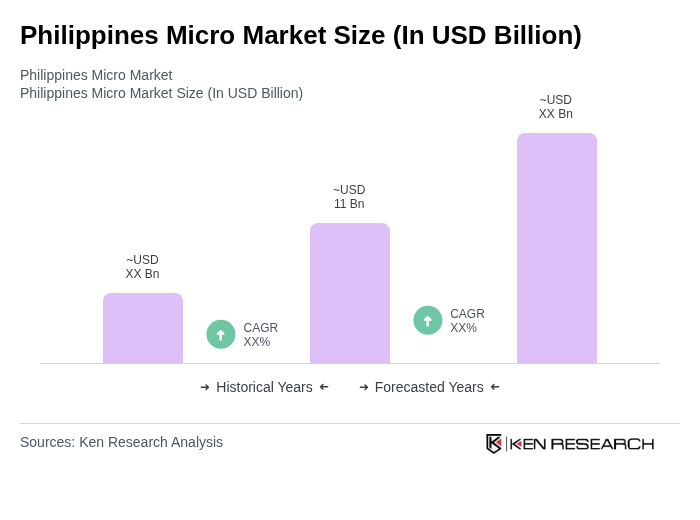
- The Philippines Micro Market is valued at approximately USD 11 billion, based on a five-year historical analysis of the contribution of micro, small, and medium enterprises (MSMEs) to overall enterprise activity and domestic demand. This growth is primarily driven by the increasing number of micro and small enterprises, which account for more than 99% of total business establishments and generate a significant share of private sector employment in the country. The rise in digital adoption, including mobile payments and e?commerce, along with government support for microfinance and credit guarantee programs (such as those implemented through Small Business Corporation and partner financial institutions), has further supported market expansion and enabled more entrepreneurs to formalize and scale their operations.
- Key cities such as Metro Manila, Cebu, and Davao dominate the market due to their high population density, concentration of enterprises, and economic activity. Metro Manila, as the capital region, serves as the primary hub for commerce, trade, retail, and services, while Cebu and Davao benefit from their strategic locations, logistics connectivity, and growing infrastructure, attracting both local and foreign investments in retail, food service, logistics, and support services that interface heavily with micro and small enterprises.
- The policy framework for micro enterprises is anchored in Republic Act No. 9501, the “Magna Carta for Micro, Small and Medium Enterprises”, as amended, issued by the Congress of the Philippines in 2008 and implemented by agencies such as the Department of Trade and Industry and Small Business Corporation. This law institutionalizes MSME development councils, mandates credit allocation targets from banks for MSMEs, and provides mechanisms for financing, training, technology transfer, market access, and business development services, thereby supporting the growth and sustainability of micro enterprises and promoting a more inclusive economic environment.
Philippines Micro Market Segmentation
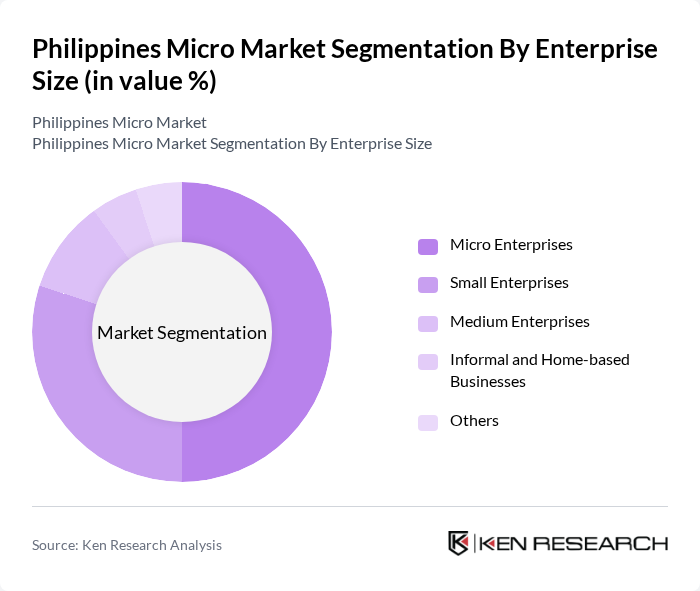
By Enterprise Size:The segmentation by enterprise size includes various categories that reflect the scale and operational capacity of businesses within the micro market. The subsegments are Micro Enterprises, Small Enterprises, Medium Enterprises, Informal and Home-based Businesses, and Others. Each of these categories plays a crucial role in the overall market dynamics, with micro enterprises being the most prevalent due to their accessibility and low entry barriers; in the Philippine context, micro enterprises dominate the MSME base in terms of establishment count and are typically characterized by low paid-in capital and fewer than 10 employees, often operating in retail trade and basic services.
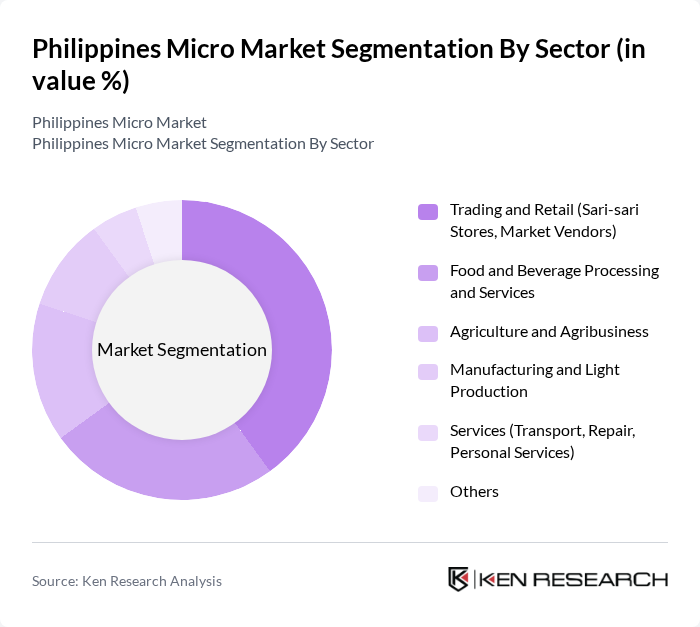
By Sector:The sector segmentation encompasses various industries that micro enterprises operate in, including Trading and Retail, Food and Beverage Processing and Services, Agriculture and Agribusiness, Manufacturing and Light Production, Services, and Others. This reflects the official MSME distribution in the Philippines, where a large majority of micro enterprises are engaged in wholesale and retail trade and repair of motor vehicles and motorcycles, followed by accommodation and food service activities, manufacturing, and other service activities. The Trading and Retail sector is particularly dominant, driven by consumer demand for local products and everyday goods, the prevalence of sari-sari stores and market vendors, and low capital requirements to enter these segments.
Philippines Micro Market Competitive Landscape
The Philippines Micro Market is characterized by a dynamic mix of regional and international players. Leading participants such as Jollibee Foods Corporation, San Miguel Corporation, Universal Robina Corporation, Puregold Price Club, Inc., Robinsons Retail Holdings, Inc., Metro Retail Stores Group, Inc., SM Investments Corporation, Ayala Corporation, Dole Philippines, Inc., Del Monte Philippines, Inc., Century Pacific Food, Inc., Liwayway Marketing Corporation, CDO Foodsphere, Inc., Monde Nissin Corporation, AgriNurture, Inc. contribute to innovation, geographic expansion, and service delivery in this space, particularly through supply chains, distribution networks, and retail formats that interface extensively with micro and small retailers, sari-sari stores, and neighborhood food outlets.
Philippines Micro Market Industry Analysis
Growth Drivers
- Increasing Urbanization:The Philippines is experiencing rapid urbanization, with urban areas projected to grow from 47% of the population in future to 56% in future. This shift is driving demand for micro enterprises, as urban consumers increasingly seek local products and services. The urban population is expected to reach approximately 66 million in future, creating a larger customer base for micro businesses. This trend is supported by the government's infrastructure investments, which enhance accessibility and connectivity in urban centers.
- Government Support for Micro Enterprises:The Philippine government has implemented various initiatives to support micro enterprises, including the Microfinance Act, which aims to provide access to financial services. In future, the government allocated ?2 billion for microfinance programs, benefiting over 1.5 million micro entrepreneurs. Additionally, the Department of Trade and Industry (DTI) has launched training programs to enhance the skills of micro business owners, fostering a more conducive environment for growth and sustainability in the sector.
- Rising Consumer Demand for Local Products:There is a notable increase in consumer preference for locally sourced products, driven by a growing awareness of sustainability and support for local economies. In future, local products are expected to account for 35% of total consumer spending in the Philippines, up from 25% in future. This trend is further fueled by the "Buy Local" campaigns, which encourage consumers to choose homegrown brands, thereby providing micro enterprises with a significant market opportunity to thrive.
Market Challenges
- Limited Access to Financing:Despite government initiatives, many micro enterprises still face significant barriers in accessing financing. Approximately 70% of micro businesses report difficulties in securing loans due to stringent requirements and high-interest rates. In future, the average loan amount for micro enterprises is expected to remain below ?60,000, limiting their ability to invest in growth and innovation. This financial constraint hampers their competitiveness in an increasingly dynamic market.
- Regulatory Compliance Burdens:Micro enterprises often struggle with the complexities of regulatory compliance, which can be overwhelming for small business owners. In future, it is estimated that compliance costs will consume up to 15% of a micro enterprise's annual revenue. This burden can deter new business formation and stifle growth, as entrepreneurs may lack the resources or knowledge to navigate the regulatory landscape effectively, leading to potential legal issues and fines.
Philippines Micro Market Future Outlook
The future of the Philippines micro market appears promising, driven by increasing urbanization and government support initiatives. As more consumers gravitate towards local products, micro enterprises are likely to benefit from enhanced market access and consumer loyalty. Additionally, the rise of digital platforms will facilitate greater connectivity between micro businesses and their customers, enabling them to scale operations. However, addressing financing challenges and regulatory burdens will be crucial for sustaining growth and fostering innovation in this sector.
Market Opportunities
- Expansion of E-commerce Platforms:The growth of e-commerce in the Philippines presents a significant opportunity for micro enterprises. With online sales projected to reach ?250 billion in future, micro businesses can leverage digital platforms to reach wider audiences, reduce operational costs, and enhance customer engagement. This shift towards online retailing can empower micro entrepreneurs to compete effectively in the market.
- Development of Sustainable Practices:As consumer interest in sustainability grows, micro enterprises can capitalize on this trend by adopting eco-friendly practices. In future, it is estimated that sustainable products will represent a ?60 billion market segment. By integrating sustainable practices into their operations, micro businesses can attract environmentally conscious consumers, differentiate themselves, and potentially access new funding opportunities focused on sustainability.
Scope of the Report
| Segment | Sub-Segments |
|---|---|
| By Enterprise Size | Micro Enterprises Small Enterprises Medium Enterprises Informal and Home-based Businesses Others |
| By Sector | Trading and Retail (Sari-sari Stores, Market Vendors) Food and Beverage Processing and Services Agriculture and Agribusiness Manufacturing and Light Production Services (Transport, Repair, Personal Services) Others |
| By Form of Enterprise | Sole Proprietorship Partnerships Cooperatives Informal / Unregistered Enterprises Others |
| By Geography | Metro Manila / NCR Luzon (ex-NCR) Visayas Mindanao Others (Isolated / Island Provinces) |
| By Market Orientation | Purely Local / Barangay-Level City and Provincial Markets National / Inter-island Markets Export-Oriented Micro Enterprises Tourism-Focused Micro Enterprises |
| By Access to Finance and Formalization | Banked vs Unbanked Enterprises Access to Microfinance / MFIs Government-supported (DTI, DSWD, LGU Programs) Digital Finance Users (e-wallets, fintech) Others |
| By Digital Adoption Level | Offline / Traditional Only Basic Mobile and Social Media Presence Active E-commerce and Platform-based Sellers Digitally Enabled Operations (POS, Inventory, Payments) Others |
Key Target Audience
Investors and Venture Capitalist Firms
Government and Regulatory Bodies (e.g., Department of Trade and Industry, National Economic and Development Authority)
Manufacturers and Producers
Distributors and Retailers
Technology Providers
Industry Associations
Financial Institutions
Export and Import Agencies (e.g., Bureau of Customs)
Players Mentioned in the Report:
Jollibee Foods Corporation
San Miguel Corporation
Universal Robina Corporation
Puregold Price Club, Inc.
Robinsons Retail Holdings, Inc.
Metro Retail Stores Group, Inc.
SM Investments Corporation
Ayala Corporation
Dole Philippines, Inc.
Del Monte Philippines, Inc.
Century Pacific Food, Inc.
Liwayway Marketing Corporation
CDO Foodsphere, Inc.
Monde Nissin Corporation
AgriNurture, Inc.
Table of Contents
Market Assessment Phase
1. Executive Summary and Approach
2. Philippines Micro Market Overview
2.1 Key Insights and Strategic Recommendations
2.2 Philippines Micro Market Overview
2.3 Definition and Scope
2.4 Evolution of Market Ecosystem
2.5 Timeline of Key Regulatory Milestones
2.6 Value Chain & Stakeholder Mapping
2.7 Business Cycle Analysis
2.8 Policy & Incentive Landscape
3. Philippines Micro Market Analysis
3.1 Growth Drivers
3.1.1 Increasing Urbanization
3.1.2 Government Support for Micro Enterprises
3.1.3 Rising Consumer Demand for Local Products
3.1.4 Technological Advancements in Production
3.2 Market Challenges
3.2.1 Limited Access to Financing
3.2.2 Regulatory Compliance Burdens
3.2.3 Competition from Larger Enterprises
3.2.4 Supply Chain Disruptions
3.3 Market Opportunities
3.3.1 Expansion of E-commerce Platforms
3.3.2 Development of Sustainable Practices
3.3.3 Collaboration with NGOs for Capacity Building
3.3.4 Access to International Markets
3.4 Market Trends
3.4.1 Shift Towards Digitalization
3.4.2 Growing Interest in Sustainable Products
3.4.3 Increasing Focus on Local Sourcing
3.4.4 Rise of Social Enterprises
3.5 Government Regulation
3.5.1 Microfinance Regulations
3.5.2 Tax Incentives for Small Businesses
3.5.3 Labor Laws Affecting Micro Enterprises
3.5.4 Environmental Compliance Standards
4. SWOT Analysis
5. Stakeholder Analysis
6. Porter's Five Forces Analysis
7. Philippines Micro Market Market Size, 2019-2024
7.1 By Value
7.2 By Volume
7.3 By Average Selling Price
8. Philippines Micro Market Segmentation
8.1 By Enterprise Size
8.1.1 Micro Enterprises
8.1.2 Small Enterprises
8.1.3 Medium Enterprises
8.1.4 Informal and Home-based Businesses
8.1.5 Others
8.2 By Sector
8.2.1 Trading and Retail (Sari-sari Stores, Market Vendors)
8.2.2 Food and Beverage Processing and Services
8.2.3 Agriculture and Agribusiness
8.2.4 Manufacturing and Light Production
8.2.5 Services (Transport, Repair, Personal Services)
8.2.6 Others
8.3 By Form of Enterprise
8.3.1 Sole Proprietorship
8.3.2 Partnerships
8.3.3 Cooperatives
8.3.4 Informal / Unregistered Enterprises
8.3.5 Others
8.4 By Geography
8.4.1 Metro Manila / NCR
8.4.2 Luzon (ex-NCR)
8.4.3 Visayas
8.4.4 Mindanao
8.4.5 Others (Isolated / Island Provinces)
8.5 By Market Orientation
8.5.1 Purely Local / Barangay-Level
8.5.2 City and Provincial Markets
8.5.3 National / Inter-island Markets
8.5.4 Export-Oriented Micro Enterprises
8.5.5 Tourism-Focused Micro Enterprises
8.6 By Access to Finance and Formalization
8.6.1 Banked vs Unbanked Enterprises
8.6.2 Access to Microfinance / MFIs
8.6.3 Government-supported (DTI, DSWD, LGU Programs)
8.6.4 Digital Finance Users (e-wallets, fintech)
8.6.5 Others
8.7 By Digital Adoption Level
8.7.1 Offline / Traditional Only
8.7.2 Basic Mobile and Social Media Presence
8.7.3 Active E-commerce and Platform-based Sellers
8.7.4 Digitally Enabled Operations (POS, Inventory, Payments)
8.7.5 Others
9. Philippines Micro Market Competitive Analysis
9.1 Market Share of Key Players
9.2 Cross Comparison of Key Players
9.2.1 Company Name
9.2.2 Group Size (Large, Medium, or Small as per industry convention)
9.2.3 Annual Revenue (PHP / USD)
9.2.4 Revenue CAGR (3–5 Years)
9.2.5 EBITDA Margin
9.2.6 Return on Invested Capital (ROIC)
9.2.7 Customer Acquisition Cost (CAC)
9.2.8 Customer Lifetime Value (CLV)
9.2.9 Market Penetration (Active Micro Clients / Outlets Covered)
9.2.10 Geographic Coverage (Regions / Provinces Served)
9.2.11 Digital Adoption Level (Share of Digital / Platform-based Transactions)
9.2.12 Portfolio Mix (Share of Revenue from Micro / MSME Segment)
9.3 SWOT Analysis of Top Players
9.4 Pricing Analysis
9.5 Detailed Profile of Major Companies
9.5.1 Jollibee Foods Corporation
9.5.2 San Miguel Corporation
9.5.3 Universal Robina Corporation
9.5.4 Puregold Price Club, Inc.
9.5.5 Robinsons Retail Holdings, Inc.
9.5.6 Metro Retail Stores Group, Inc.
9.5.7 SM Investments Corporation
9.5.8 Ayala Corporation
9.5.9 Dole Philippines, Inc.
9.5.10 Del Monte Philippines, Inc.
9.5.11 Century Pacific Food, Inc.
9.5.12 Liwayway Marketing Corporation
9.5.13 CDO Foodsphere, Inc.
9.5.14 Monde Nissin Corporation
9.5.15 AgriNurture, Inc.
10. Philippines Micro Market End-User Analysis
10.1 Procurement Behavior of Key Ministries
10.1.1 Budget Allocation Trends
10.1.2 Preferred Procurement Methods
10.1.3 Supplier Selection Criteria
10.1.4 Contract Management Practices
10.2 Corporate Spend on Infrastructure & Energy
10.2.1 Investment Priorities
10.2.2 Spending Patterns
10.2.3 Impact of Economic Conditions
10.2.4 Future Spending Projections
10.3 Pain Point Analysis by End-User Category
10.3.1 Common Challenges Faced
10.3.2 Service Gaps
10.3.3 Quality Concerns
10.3.4 Support Needs
10.4 User Readiness for Adoption
10.4.1 Awareness Levels
10.4.2 Training Requirements
10.4.3 Technology Acceptance
10.4.4 Financial Readiness
10.5 Post-Deployment ROI and Use Case Expansion
10.5.1 Measurement of Success
10.5.2 Case Studies of Successful Implementations
10.5.3 Future Use Cases
10.5.4 Feedback Mechanisms
11. Philippines Micro Market Future Size, 2025-2030
11.1 By Value
11.2 By Volume
11.3 By Average Selling Price
Go-To-Market Strategy Phase
1. Whitespace Analysis + Business Model Canvas
1.1 Market Gaps Identification
1.2 Value Proposition Development
1.3 Revenue Streams Analysis
1.4 Cost Structure Evaluation
1.5 Key Partnerships Exploration
1.6 Customer Segments Definition
1.7 Channels Strategy
2. Marketing and Positioning Recommendations
2.1 Branding Strategies
2.2 Product USPs
3. Distribution Plan
3.1 Urban Retail vs Rural NGO Tie-ups
4. Channel & Pricing Gaps
4.1 Underserved Routes
4.2 Pricing Bands
5. Unmet Demand & Latent Needs
5.1 Category Gaps
5.2 Consumer Segments
6. Customer Relationship
6.1 Loyalty Programs
6.2 After-sales Service
7. Value Proposition
7.1 Sustainability
7.2 Integrated Supply Chains
8. Key Activities
8.1 Regulatory Compliance
8.2 Branding
8.3 Distribution Setup
9. Entry Strategy Evaluation
9.1 Domestic Market Entry Strategy
9.1.1 Product Mix
9.1.2 Pricing Band
9.1.3 Packaging
9.2 Export Entry Strategy
9.2.1 Target Countries
9.2.2 Compliance Roadmap
10. Entry Mode Assessment
10.1 JV
10.2 Greenfield
10.3 M&A
10.4 Distributor Model
11. Capital and Timeline Estimation
11.1 Capital Requirements
11.2 Timelines
12. Control vs Risk Trade-Off
12.1 Ownership vs Partnerships
13. Profitability Outlook
13.1 Breakeven Analysis
13.2 Long-term Sustainability
14. Potential Partner List
14.1 Distributors
14.2 JVs
14.3 Acquisition Targets
15. Execution Roadmap
15.1 Phased Plan for Market Entry
15.1.1 Market Setup
15.1.2 Market Entry
15.1.3 Growth Acceleration
15.1.4 Scale & Stabilize
15.2 Key Activities and Milestones
15.2.1 Milestone Planning
15.2.2 Activity Tracking
Research Methodology
Phase 1: Approach1
Desk Research
- Analysis of government reports and publications from the Philippine Statistics Authority
- Review of industry white papers and market analysis reports from local research firms
- Examination of trade publications and news articles relevant to the micro market landscape
Primary Research
- In-depth interviews with industry experts and thought leaders in the Philippine micro market
- Surveys targeting small business owners and entrepreneurs across various sectors
- Focus group discussions with consumers to understand preferences and behaviors
Validation & Triangulation
- Cross-verification of findings through multiple data sources, including government and private sector reports
- Triangulation of qualitative insights from interviews with quantitative data from surveys
- Sanity checks conducted through expert panel reviews to ensure data reliability
Phase 2: Market Size Estimation1
Top-down Assessment
- Estimation of market size based on national economic indicators and sectoral contributions
- Segmentation of the market by key demographics and geographic regions
- Incorporation of macroeconomic trends and consumer spending patterns
Bottom-up Modeling
- Collection of sales data from a representative sample of micro enterprises
- Estimation of average transaction values and frequency of purchases
- Aggregation of data to derive total market potential across various segments
Forecasting & Scenario Analysis
- Development of growth projections based on historical data and emerging trends
- Scenario modeling to assess impacts of economic fluctuations and policy changes
- Creation of best-case, worst-case, and most-likely scenarios through 2030
Phase 3: CATI Sample Composition1
| Scope Item/Segment | Sample Size | Target Respondent Profiles |
|---|---|---|
| Small Retail Businesses | 120 | Store Owners, Retail Managers |
| Food and Beverage Startups | 90 | Founders, Operations Managers |
| Online Service Providers | 80 | Business Development Managers, Marketing Heads |
| Local Artisans and Craftsmen | 60 | Artisans, Product Designers |
| Health and Wellness Entrepreneurs | 70 | Business Owners, Health Coaches |
Frequently Asked Questions
What is the current value of the Philippines Micro Market?
The Philippines Micro Market is valued at approximately USD 11 billion, driven by the significant contribution of micro, small, and medium enterprises (MSMEs) to the economy, which account for over 99% of total business establishments in the country.
What role do micro enterprises play in the Philippines economy?
Which cities are key players in the Philippines Micro Market?
What government initiatives support micro enterprises in the Philippines?
Other Regional/Country Reports
Other Adjacent Reports
Brazil Retail Trade Market
Vietnam Food and Beverage MarketBahrain Agribusiness Market
Japan Manufacturing Services Market
Oman Business Development Market
Vietnam Digital Payments Market Size, Share & Forecast, By Product Type, Customer Segment & Distribution Channel, 2025–2032Bahrain Supply Chain Logistics Market
Kuwait Sustainable Products Market
Why Buy From Us?

What makes us stand out is that our consultants follow Robust, Refine and Result (RRR) methodology. Robust for clear definitions, approaches and sanity checking, Refine for differentiating respondents' facts and opinions, and Result for presenting data with story.

We have set a benchmark in the industry by offering our clients with syndicated and customized market research reports featuring coverage of entire market as well as meticulous research and analyst insights.

While we don't replace traditional research, we flip the method upside down. Our dual approach of Top Bottom & Bottom Top ensures quality deliverable by not just verifying company fundamentals but also looking at the sector and macroeconomic factors.

With one step in the future, our research team constantly tries to show you the bigger picture. We help with some of the tough questions you may encounter along the way: How is the industry positioned? Best marketing channel? KPI's of competitors? By aligning every element, we help maximize success.

Our report gives you instant access to the answers and sources that other companies might choose to hide. We elaborate each steps of research methodology we have used and showcase you the sample size to earn your trust.

If you need any support, we are here! We pride ourselves on universe strength, data quality, and quick, friendly, and professional service.