About the Report
Base Year 2024Oman Self Healing Grids Market Overview
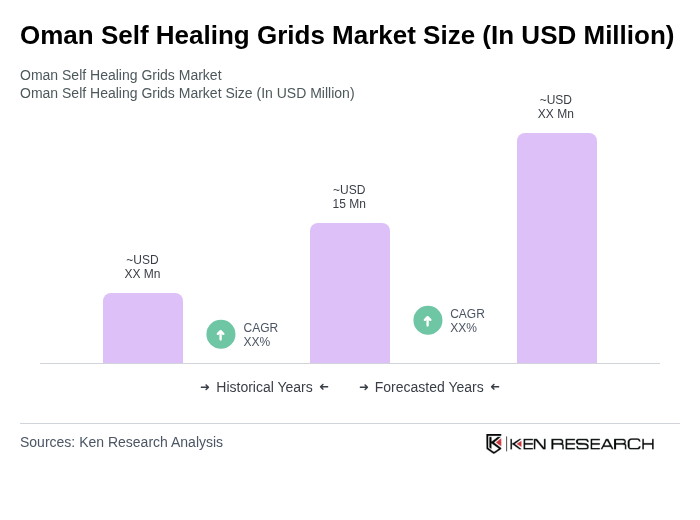
- The Oman Self Healing Grids Market is valued at USD 15 million, based on a five-year historical analysis. This growth is primarily driven by the increasing demand for reliable and efficient energy distribution systems, coupled with the government's commitment to enhancing energy infrastructure. The integration of advanced technologies such as IoT and AI in grid management has further propelled market expansion, ensuring minimal downtime and improved service delivery.
- Muscat, the capital city, is a dominant player in the market due to its strategic location and significant investments in energy projects. Other key regions include Salalah and Sohar, which are also witnessing rapid urbanization and industrial growth, leading to increased energy consumption. The government's focus on renewable energy initiatives in these areas has further solidified their positions in the self-healing grids market.
- The Ministerial Decision No. 61/2022 issued by the Ministry of Energy and Minerals mandates utilities to integrate advanced grid automation technologies, including self-healing capabilities, in transmission and distribution networks exceeding 132 kV. This regulation requires real-time fault detection, automated isolation, and power restoration within 60 seconds for compliance, applicable to all new and upgraded grid projects to ensure operational resilience and integration of renewables.
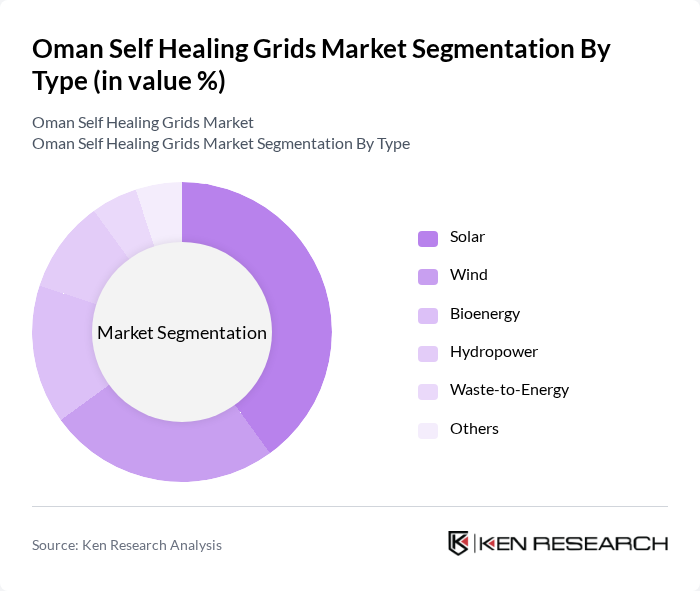
Oman Self Healing Grids Market Segmentation
By Type:The segmentation by type includes various energy sources that contribute to the self-healing grid systems. The subsegments are Solar, Wind, Bioenergy, Hydropower, Waste-to-Energy, and Others. Each of these types plays a crucial role in diversifying the energy mix and enhancing grid reliability.
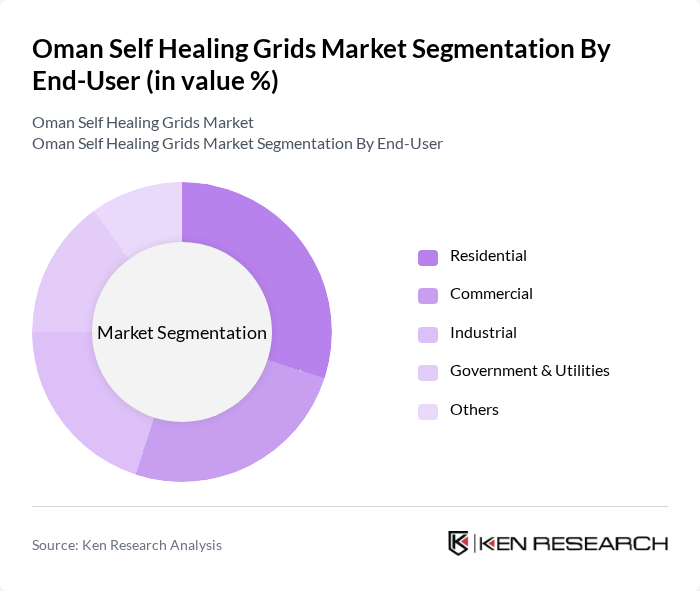
By End-User:The end-user segmentation includes Residential, Commercial, Industrial, Government & Utilities, and Others. Each segment represents different consumer needs and energy consumption patterns, influencing the overall market dynamics.
Oman Self Healing Grids Market Competitive Landscape
The Oman Self Healing Grids Market is characterized by a dynamic mix of regional and international players. Leading participants such as Oman Electricity and Transmission Company, Siemens Oman, ABB Oman, Schneider Electric Oman, GE Renewable Energy, Oman Power and Water Procurement Company, Engie Oman, First Solar Oman, JinkoSolar Oman, TotalEnergies Oman, ACWA Power Oman, Eni Oman, Vestas Oman, Canadian Solar Oman, Trina Solar Oman contribute to innovation, geographic expansion, and service delivery in this space.
Oman Self Healing Grids Market Industry Analysis
Growth Drivers
- Increasing Demand for Reliable Energy Supply:The demand for reliable energy supply in Oman is projected to reach 16,000 GWh in the future, driven by population growth and urbanization. The country's electricity consumption has increased by approximately 4% annually, necessitating the development of self-healing grids to enhance reliability. This demand is further supported by the government's commitment to improving energy infrastructure, which is expected to attract investments exceeding $1.2 billion in the future, facilitating the transition to advanced grid technologies.
- Government Initiatives for Smart Grid Implementation:The Omani government has allocated $600 million for smart grid initiatives as part of its Vision 2040 strategy. This funding aims to modernize the energy sector, focusing on integrating self-healing technologies. The Ministry of Energy and Minerals has set a target to implement smart grid solutions across 35% of the national grid in the future, enhancing operational efficiency and reducing outages, which currently average 9 hours per customer annually.
- Technological Advancements in Grid Management:Technological innovations in grid management are expected to reduce operational costs by 25% in the future. The integration of advanced sensors and real-time monitoring systems is projected to enhance grid resilience, allowing for quicker fault detection and restoration. With an estimated 65% of Oman's grid infrastructure being upgraded, these advancements will significantly improve service reliability and customer satisfaction, addressing the growing energy demands of urban areas.
Market Challenges
- High Initial Investment Costs:The initial investment required for implementing self-healing grids in Oman is estimated at $1.5 billion, posing a significant barrier to entry for many stakeholders. This high capital expenditure is primarily due to the need for advanced technology and infrastructure upgrades. Additionally, the return on investment may take several years, discouraging potential investors and slowing the adoption of necessary innovations in the energy sector.
- Limited Awareness Among Stakeholders:A significant challenge in the Oman self-healing grids market is the limited awareness among stakeholders, including utility companies and consumers. Approximately 45% of industry players lack knowledge about the benefits and functionalities of self-healing technologies. This gap in understanding can hinder collaboration and investment, ultimately delaying the transition to more resilient energy systems that are crucial for meeting future energy demands.
Oman Self Healing Grids Market Future Outlook
The future of the Oman self-healing grids market appears promising, driven by ongoing government initiatives and technological advancements. In the future, the integration of IoT and AI technologies is expected to enhance grid management, leading to improved reliability and efficiency. Additionally, the growing emphasis on sustainability will likely propel investments in renewable energy sources, further supporting the development of self-healing grids. As awareness increases, collaboration among stakeholders will be crucial for overcoming existing challenges and maximizing the potential of smart grid technologies.
Market Opportunities
- Expansion of Renewable Energy Projects:The Omani government aims to increase the share of renewable energy in its energy mix to 35% in the future. This ambitious target presents significant opportunities for self-healing grid technologies, which can efficiently manage the variability of renewable sources. Investments in solar and wind projects are expected to exceed $2.5 billion, creating a robust market for advanced grid solutions that enhance integration and reliability.
- Partnerships with Technology Providers:Collaborations between local utilities and technology providers are essential for advancing self-healing grid initiatives. In the future, partnerships are projected to facilitate the deployment of innovative solutions, enhancing grid resilience. These alliances can leverage expertise and resources, driving down costs and accelerating the implementation of smart technologies, ultimately benefiting both stakeholders and consumers in Oman.
Scope of the Report
| Segment | Sub-Segments |
|---|---|
| By Type (e.g., Solar, Wind, Bioenergy, Hydropower, Waste-to-Energy) | Solar Wind Bioenergy Hydropower Waste-to-Energy Others |
| By End-User (Residential, Commercial, Industrial, Government & Utilities) | Residential Commercial Industrial Government & Utilities Others |
| By Region (North Oman, South Oman, East Oman, West Oman) | North Oman South Oman East Oman West Oman |
| By Technology (Photovoltaic, CSP, Onshore/Offshore Wind, Biomass Gasification) | Photovoltaic CSP Onshore Wind Offshore Wind Biomass Gasification Others |
| By Application (Grid-Connected, Off-Grid, Rooftop Installations, Utility-Scale Projects) | Grid-Connected Off-Grid Rooftop Installations Utility-Scale Projects Others |
| By Investment Source (Domestic, FDI, PPP, Government Schemes) | Domestic FDI PPP Government Schemes Others |
| By Policy Support (Subsidies, Tax Exemptions, RECs) | Subsidies Tax Exemptions RECs Others |
Key Target Audience
Investors and Venture Capitalist Firms
Government and Regulatory Bodies (e.g., Ministry of Energy and Minerals, Oman Electricity Transmission Company)
Manufacturers and Producers of Self Healing Grid Technologies
Utility Companies and Service Providers
Energy Sector Policy Makers
Infrastructure Development Agencies
Environmental and Sustainability Organizations
Telecommunications and IoT Solution Providers
Players Mentioned in the Report:
Oman Electricity and Transmission Company
Siemens Oman
ABB Oman
Schneider Electric Oman
GE Renewable Energy
Oman Power and Water Procurement Company
Engie Oman
First Solar Oman
JinkoSolar Oman
TotalEnergies Oman
ACWA Power Oman
Eni Oman
Vestas Oman
Canadian Solar Oman
Trina Solar Oman
Table of Contents
Market Assessment Phase
1. Executive Summary and Approach
2. Oman Self Healing Grids Market Overview
2.1 Key Insights and Strategic Recommendations
2.2 Oman Self Healing Grids Market Overview
2.3 Definition and Scope
2.4 Evolution of Market Ecosystem
2.5 Timeline of Key Regulatory Milestones
2.6 Value Chain & Stakeholder Mapping
2.7 Business Cycle Analysis
2.8 Policy & Incentive Landscape
3. Oman Self Healing Grids Market Analysis
3.1 Growth Drivers
3.1.1 Increasing Demand for Reliable Energy Supply
3.1.2 Government Initiatives for Smart Grid Implementation
3.1.3 Technological Advancements in Grid Management
3.1.4 Rising Investment in Renewable Energy Sources
3.2 Market Challenges
3.2.1 High Initial Investment Costs
3.2.2 Limited Awareness Among Stakeholders
3.2.3 Regulatory Hurdles and Compliance Issues
3.2.4 Infrastructure Limitations in Remote Areas
3.3 Market Opportunities
3.3.1 Expansion of Renewable Energy Projects
3.3.2 Partnerships with Technology Providers
3.3.3 Development of Smart City Initiatives
3.3.4 Increasing Focus on Sustainability and Environmental Impact
3.4 Market Trends
3.4.1 Integration of IoT in Grid Management
3.4.2 Adoption of AI for Predictive Maintenance
3.4.3 Shift Towards Decentralized Energy Systems
3.4.4 Growing Consumer Demand for Energy Independence
3.5 Government Regulation
3.5.1 Renewable Energy Policies and Incentives
3.5.2 Standards for Grid Reliability and Safety
3.5.3 Environmental Regulations Impacting Energy Production
3.5.4 Tariff Structures for Renewable Energy Integration
4. SWOT Analysis
5. Stakeholder Analysis
6. Porter's Five Forces Analysis
7. Oman Self Healing Grids Market Market Size, 2019-2024
7.1 By Value
7.2 By Volume
7.3 By Average Selling Price
8. Oman Self Healing Grids Market Segmentation
8.1 By Type (e.g., Solar, Wind, Bioenergy, Hydropower, Waste-to-Energy)
8.1.1 Solar
8.1.2 Wind
8.1.3 Bioenergy
8.1.4 Hydropower
8.1.5 Waste-to-Energy
8.1.6 Others
8.2 By End-User (Residential, Commercial, Industrial, Government & Utilities)
8.2.1 Residential
8.2.2 Commercial
8.2.3 Industrial
8.2.4 Government & Utilities
8.2.5 Others
8.3 By Region (North Oman, South Oman, East Oman, West Oman)
8.3.1 North Oman
8.3.2 South Oman
8.3.3 East Oman
8.3.4 West Oman
8.4 By Technology (Photovoltaic, CSP, Onshore/Offshore Wind, Biomass Gasification)
8.4.1 Photovoltaic
8.4.2 CSP
8.4.3 Onshore Wind
8.4.4 Offshore Wind
8.4.5 Biomass Gasification
8.4.6 Others
8.5 By Application (Grid-Connected, Off-Grid, Rooftop Installations, Utility-Scale Projects)
8.5.1 Grid-Connected
8.5.2 Off-Grid
8.5.3 Rooftop Installations
8.5.4 Utility-Scale Projects
8.5.5 Others
8.6 By Investment Source (Domestic, FDI, PPP, Government Schemes)
8.6.1 Domestic
8.6.2 FDI
8.6.3 PPP
8.6.4 Government Schemes
8.6.5 Others
8.7 By Policy Support (Subsidies, Tax Exemptions, RECs)
8.7.1 Subsidies
8.7.2 Tax Exemptions
8.7.3 RECs
8.7.4 Others
9. Oman Self Healing Grids Market Competitive Analysis
9.1 Market Share of Key Players(Micro, Small, Medium, Large Enterprises)
9.2 Cross Comparison of Key Players
9.2.1 Company Name
9.2.2 Group Size (Large, Medium, or Small as per industry convention)
9.2.3 Revenue Growth Rate
9.2.4 Market Penetration Rate
9.2.5 Customer Retention Rate
9.2.6 Pricing Strategy
9.2.7 Operational Efficiency Ratio
9.2.8 Innovation Rate
9.2.9 Customer Satisfaction Score
9.2.10 Return on Investment (ROI)
9.3 SWOT Analysis of Top Players
9.4 Pricing Analysis(By Class and Payload)
9.5 Detailed Profile of Major Companies
9.5.1 Oman Electricity and Transmission Company
9.5.2 Siemens Oman
9.5.3 ABB Oman
9.5.4 Schneider Electric Oman
9.5.5 GE Renewable Energy
9.5.6 Oman Power and Water Procurement Company
9.5.7 Engie Oman
9.5.8 First Solar Oman
9.5.9 JinkoSolar Oman
9.5.10 TotalEnergies Oman
9.5.11 ACWA Power Oman
9.5.12 Eni Oman
9.5.13 Vestas Oman
9.5.14 Canadian Solar Oman
9.5.15 Trina Solar Oman
10. Oman Self Healing Grids Market End-User Analysis
10.1 Procurement Behavior of Key Ministries
10.1.1 Ministry of Energy and Minerals
10.1.2 Ministry of Housing and Urban Planning
10.1.3 Ministry of Environment and Climate Affairs
10.1.4 Ministry of Finance
10.2 Corporate Spend on Infrastructure & Energy
10.2.1 Investment Trends in Energy Sector
10.2.2 Budget Allocations for Renewable Projects
10.2.3 Corporate Partnerships with Energy Providers
10.2.4 Spending on Smart Grid Technologies
10.3 Pain Point Analysis by End-User Category
10.3.1 Residential Users
10.3.2 Commercial Users
10.3.3 Industrial Users
10.3.4 Government Entities
10.4 User Readiness for Adoption
10.4.1 Awareness Levels Among Users
10.4.2 Training and Support Needs
10.4.3 Financial Readiness for Investment
10.4.4 Technological Readiness
10.5 Post-Deployment ROI and Use Case Expansion
10.5.1 Measurement of ROI
10.5.2 Case Studies of Successful Implementations
10.5.3 Potential for Scaling Solutions
10.5.4 User Feedback and Improvement Areas
11. Oman Self Healing Grids Market Future Size, 2025-2030
11.1 By Value
11.2 By Volume
11.3 By Average Selling Price
Go-To-Market Strategy Phase
1. Whitespace Analysis + Business Model Canvas
1.1 Market Gaps and Opportunities
1.2 Business Model Components
2. Marketing and Positioning Recommendations
2.1 Branding Strategies
2.2 Product USPs
3. Distribution Plan
3.1 Urban Retail vs Rural NGO Tie-ups
4. Channel & Pricing Gaps
4.1 Underserved Routes
4.2 Pricing Bands
5. Unmet Demand & Latent Needs
5.1 Category Gaps
5.2 Consumer Segments
6. Customer Relationship
6.1 Loyalty Programs
6.2 After-sales Service
7. Value Proposition
7.1 Sustainability
7.2 Integrated Supply Chains
8. Key Activities
8.1 Regulatory Compliance
8.2 Branding
8.3 Distribution Setup
9. Entry Strategy Evaluation
9.1 Domestic Market Entry Strategy
9.1.1 Product Mix
9.1.2 Pricing Band
9.1.3 Packaging
9.2 Export Entry Strategy
9.2.1 Target Countries
9.2.2 Compliance Roadmap
10. Entry Mode Assessment
10.1 JV, Greenfield, M&A, Distributor Model
11. Capital and Timeline Estimation
11.1 Capital Requirements
11.2 Timelines
12. Control vs Risk Trade-Off
12.1 Ownership vs Partnerships
13. Profitability Outlook
13.1 Breakeven Analysis
13.2 Long-term Sustainability
14. Potential Partner List
14.1 Distributors
14.2 JVs
14.3 Acquisition Targets
15. Execution Roadmap
15.1 Phased Plan for Market Entry
15.1.1 Market Setup
15.1.2 Market Entry
15.1.3 Growth Acceleration
15.1.4 Scale & Stabilize
15.2 Key Activities and Milestones
15.2.1 Milestone Planning
15.2.2 Activity Tracking
Research Methodology
Phase 1: Approach1
Desk Research
- Analysis of market reports from local and international research firms focusing on self-healing technologies
- Review of academic publications and white papers on self-healing materials and their applications in Oman
- Examination of government publications and industry guidelines related to construction and infrastructure development in Oman
Primary Research
- Interviews with industry experts, including material scientists and engineers specializing in self-healing technologies
- Surveys with construction firms and contractors involved in innovative building materials
- Field visits to construction sites utilizing self-healing grids to gather firsthand insights
Validation & Triangulation
- Cross-validation of findings through multiple data sources, including trade publications and expert opinions
- Triangulation of market data with insights from industry conferences and seminars
- Sanity checks through feedback from a panel of experts in the field of construction and materials science
Phase 2: Market Size Estimation1
Top-down Assessment
- Estimation of the overall construction market size in Oman and its growth trajectory
- Segmentation of the market by application areas such as residential, commercial, and infrastructure projects
- Incorporation of government initiatives promoting sustainable construction practices
Bottom-up Modeling
- Collection of data on the volume of self-healing grid materials used in recent projects
- Cost analysis based on supplier pricing and installation expenses
- Estimation of market penetration rates based on current adoption levels in various sectors
Forecasting & Scenario Analysis
- Development of predictive models using historical data and market trends
- Scenario analysis based on potential regulatory changes and technological advancements
- Creation of multiple forecasts (baseline, optimistic, and pessimistic) through 2030
Phase 3: CATI Sample Composition1
| Scope Item/Segment | Sample Size | Target Respondent Profiles |
|---|---|---|
| Residential Construction Projects | 100 | Project Managers, Architects |
| Commercial Infrastructure Developments | 80 | Construction Supervisors, Procurement Managers |
| Government Infrastructure Initiatives | 60 | Policy Makers, Urban Planners |
| Research Institutions and Universities | 50 | Researchers, Professors in Material Science |
| Industry Associations and Regulatory Bodies | 40 | Association Leaders, Regulatory Officials |
Frequently Asked Questions
What is the current value of the Oman Self Healing Grids Market?
The Oman Self Healing Grids Market is valued at approximately USD 15 million, reflecting a five-year historical analysis. This growth is driven by the increasing demand for efficient energy distribution systems and government investments in energy infrastructure.
What factors are driving the growth of the Oman Self Healing Grids Market?
Which regions in Oman are significant for the Self Healing Grids Market?
What are the main types of energy sources in the Oman Self Healing Grids Market?
Other Regional/Country Reports
Other Adjacent Reports
Indonesia Grid Automation Market
North America Renewable Energy Market Outlook to 2030: Size, Share, Growth and TrendsMiddle East Solar Power MarketDenmark Wind Energy MarketKSA energy management systems market size, share, growth drivers, trends, opportunities & forecast 2025–2030Malaysia Power Transmission Market
Malaysia Power Distribution Market
Egypt IoT Energy Solutions Market
Thailand AI Grid Technology Market
Why Buy From Us?

What makes us stand out is that our consultants follow Robust, Refine and Result (RRR) methodology. Robust for clear definitions, approaches and sanity checking, Refine for differentiating respondents' facts and opinions, and Result for presenting data with story.

We have set a benchmark in the industry by offering our clients with syndicated and customized market research reports featuring coverage of entire market as well as meticulous research and analyst insights.

While we don't replace traditional research, we flip the method upside down. Our dual approach of Top Bottom & Bottom Top ensures quality deliverable by not just verifying company fundamentals but also looking at the sector and macroeconomic factors.

With one step in the future, our research team constantly tries to show you the bigger picture. We help with some of the tough questions you may encounter along the way: How is the industry positioned? Best marketing channel? KPI's of competitors? By aligning every element, we help maximize success.

Our report gives you instant access to the answers and sources that other companies might choose to hide. We elaborate each steps of research methodology we have used and showcase you the sample size to earn your trust.

If you need any support, we are here! We pride ourselves on universe strength, data quality, and quick, friendly, and professional service.