About the Report
Base Year 2024Listen to the audio summary
Philippines Automotive Optoelectronics Market Overview
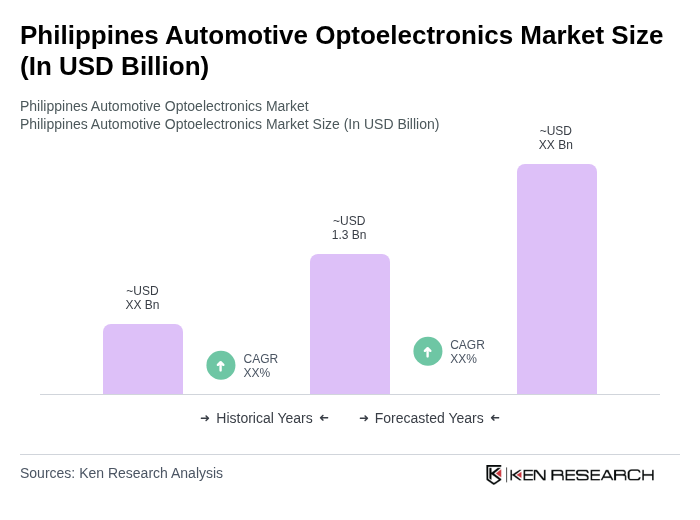
- The Philippines Automotive Optoelectronics Market is valued at approximately USD 1.3 billion, based on a five-year historical analysis. This growth is primarily driven by the increasing demand for advanced lighting systems, safety features, and energy-efficient technologies in vehicles. The rising adoption of electric vehicles and stringent regulations on vehicle emissions further propel the market, as manufacturers seek to integrate innovative optoelectronic components. Asia-Pacific remains the epicenter of optoelectronics manufacturing and rapid deployment, with leading vehicle manufacturers pioneering OLED displays for fully digital cockpits and leveraging local supply chains to streamline the integration of laser headlights.
- Metro Manila, Cebu, and Davao are the dominant regions in the Philippines Automotive Optoelectronics Market. Metro Manila, being the capital, serves as a hub for automotive manufacturing and technology development, while Cebu and Davao benefit from their strategic locations and growing industrial bases. These cities attract significant investments and foster collaborations between local and international companies, enhancing their market presence.
- The Philippine government has implemented the Comprehensive Automotive Resurgence Strategy (CARS) program, which aims to boost local automotive manufacturing. This initiative includes incentives for manufacturers to produce vehicles with advanced technologies, including optoelectronic components. The program is designed to enhance the competitiveness of the local automotive industry and promote sustainable practices. Government incentives promoting electric vehicle adoption are strengthening market growth in the Philippines, with accelerating EV adoption driving demand for advanced optoelectronic components in electrified powertrains.
Philippines Automotive Optoelectronics Market Segmentation
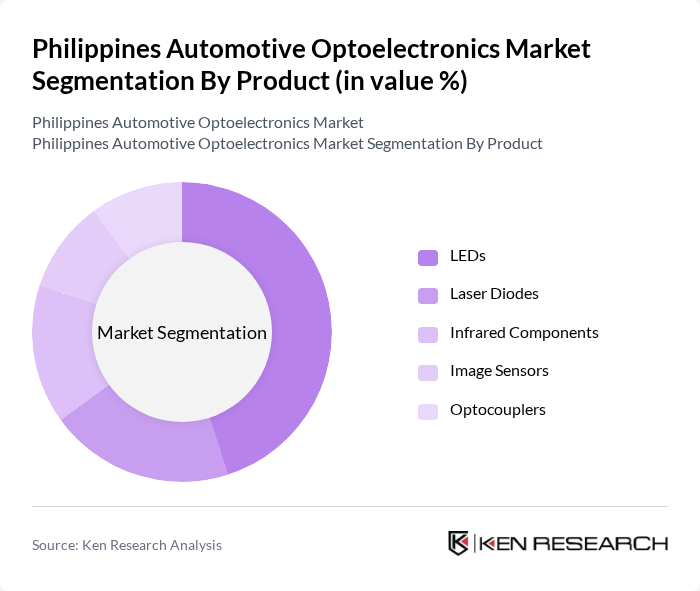
By Product:The product segmentation of the market includes various optoelectronic components that are essential for automotive applications. The key subsegments are LEDs, Laser Diodes, Infrared Components, Image Sensors, and Optocouplers. Among these, LEDs are the most widely used due to their energy efficiency and versatility in automotive lighting applications. The increasing demand for advanced lighting solutions in vehicles drives the growth of this segment. Technological advances such as infrared, laser, LED, and OLED are propagated across these segments, each offering distinct advantages in terms of wavelength specificity, energy consumption, and integration potential.
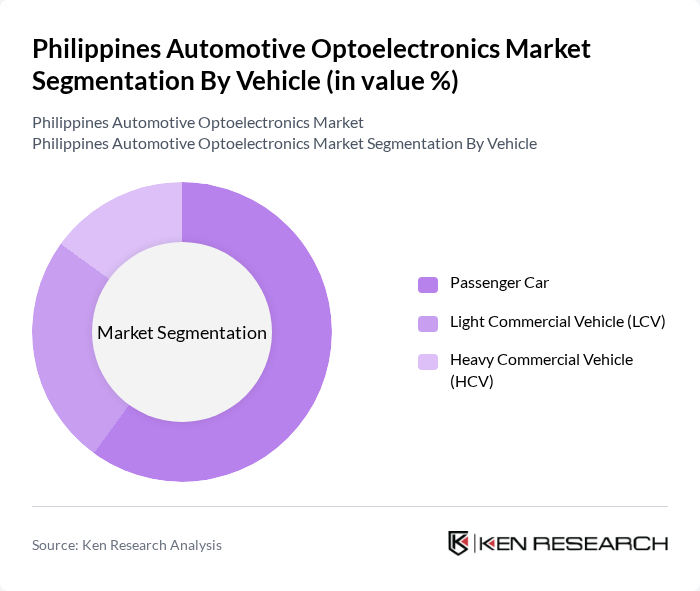
By Vehicle:The vehicle segmentation includes Passenger Cars, Light Commercial Vehicles (LCV), and Heavy Commercial Vehicles (HCV). The Passenger Car segment dominates the market due to the high volume of sales and the increasing integration of advanced technologies in personal vehicles. The growing consumer preference for safety and convenience features in passenger cars drives the demand for optoelectronic components. Across applications, illumination fulfills core visibility requirements, information display supports driver-vehicle interaction, sensing underpins active safety and autonomy, and signaling ensures communication with external road users.
Philippines Automotive Optoelectronics Market Competitive Landscape
The Philippines Automotive Optoelectronics Market is characterized by a dynamic mix of regional and international players. Leading participants such as Mitsubishi Electric Corporation, Texas Instruments, Osram Opto Semiconductors, Infineon Technologies, STMicroelectronics, NXP Semiconductors, ON Semiconductor, Cree, Inc., Philips Lighting, Valeo, Bosch, Denso Corporation, Continental AG, Aisin Seiki Co., Ltd., Hella KGaA Hueck & Co. contribute to innovation, geographic expansion, and service delivery in this space. The competitive landscape features a blend of established automotive suppliers, semiconductor giants, and specialized photonics innovators, with industry leaders differentiating through vertical integration strategies that span chip fabrication, optical module assembly, and system-level calibration.
Philippines Automotive Optoelectronics Market Industry Analysis
Growth Drivers
- Increasing Demand for Advanced Safety Features:The Philippines automotive sector is witnessing a surge in demand for advanced safety features, driven by a reported 30% increase in road accidents from 2020 to 2023. This has prompted manufacturers to integrate optoelectronic systems such as adaptive headlights and collision avoidance sensors. The government’s push for enhanced safety regulations, including the implementation of stricter vehicle safety standards, further supports this trend, with an estimated 15% of new vehicles expected to feature advanced safety technologies in future.
- Growth in Electric Vehicle Adoption:The electric vehicle (EV) market in the Philippines is projected to grow significantly, with sales expected to reach 50,000 units in future, up from 20,000 in 2022. This growth is fueled by government incentives, including tax exemptions and subsidies for EV buyers. The increasing availability of charging infrastructure, with over 1,000 charging stations planned by 2025, is also enhancing consumer confidence in EVs, thereby driving demand for optoelectronic components tailored for electric vehicles.
- Rising Consumer Preference for Smart Automotive Technologies:As of 2023, approximately 40% of Filipino consumers express a preference for smart automotive technologies, such as connected car systems and infotainment solutions. This trend is supported by the rapid growth of smartphone penetration, which reached 80% in 2023. The integration of optoelectronic devices, such as advanced display systems and sensors, is essential to meet this demand, with manufacturers investing heavily in R&D to develop innovative solutions that enhance user experience and vehicle functionality.
Market Challenges
- High Initial Investment Costs:The automotive optoelectronics sector faces significant challenges due to high initial investment costs, which can exceed PHP 100 million for new technology development. This financial barrier limits entry for smaller manufacturers and startups, hindering innovation and competition. Additionally, the need for advanced manufacturing facilities and skilled labor further escalates costs, making it difficult for local companies to compete with established global players who benefit from economies of scale.
- Regulatory Compliance Complexities:Navigating the regulatory landscape in the Philippines poses a challenge for automotive optoelectronics manufacturers. Compliance with safety and environmental regulations requires substantial resources, with companies spending an average of PHP 5 million annually on compliance-related activities. The complexity of these regulations can delay product launches and increase operational costs, creating a significant hurdle for companies aiming to introduce innovative optoelectronic solutions in the market.
Philippines Automotive Optoelectronics Market Future Outlook
The future of the Philippines automotive optoelectronics market appears promising, driven by technological advancements and increasing consumer demand for smart features. In future, the integration of artificial intelligence in vehicle systems is expected to enhance safety and efficiency, while the shift towards autonomous driving technologies will create new opportunities for optoelectronic applications. Additionally, the growing emphasis on sustainability will likely lead to innovations in energy-efficient lighting solutions, further shaping the market landscape in the coming years.
Market Opportunities
- Expansion of Automotive Manufacturing Hubs:The Philippine government is actively promoting the establishment of automotive manufacturing hubs, with plans to invest PHP 10 billion in infrastructure by 2025. This initiative aims to attract foreign investments and enhance local production capabilities, creating opportunities for optoelectronics manufacturers to supply components for both domestic and export markets.
- Collaborations with Tech Companies for Innovation:Partnerships between automotive manufacturers and technology firms are on the rise, with over 15 collaborations reported in 2023. These alliances focus on developing cutting-edge optoelectronic solutions, such as smart lighting and advanced driver-assistance systems. Such collaborations are expected to accelerate innovation and improve the competitiveness of the Philippine automotive sector in the global market.
Scope of the Report
| Segment | Sub-Segments |
|---|---|
| By Product | LEDs Laser Diodes Infrared Components Image Sensors Optocouplers |
| By Vehicle | Passenger Car Light Commercial Vehicle (LCV) Heavy Commercial Vehicle (HCV) |
| By Sales Channel | OEM Aftermarket |
| By Application | Position Sensors Convenience & Safety Backlight Control Others |
Key Target Audience
Investors and Venture Capitalist Firms
Government and Regulatory Bodies (e.g., Department of Trade and Industry, Department of Transportation)
Automotive Manufacturers
Optoelectronics Component Suppliers
Automotive Aftermarket Service Providers
Telecommunications Companies
Industry Associations (e.g., Chamber of Automotive Manufacturers of the Philippines, Inc.)
Financial Institutions and Banks
Players Mentioned in the Report:
Mitsubishi Electric Corporation
Texas Instruments
Osram Opto Semiconductors
Infineon Technologies
STMicroelectronics
NXP Semiconductors
ON Semiconductor
Cree, Inc.
Philips Lighting
Valeo
Bosch
Denso Corporation
Continental AG
Aisin Seiki Co., Ltd.
Hella KGaA Hueck & Co.
Table of Contents
Market Assessment Phase
1. Executive Summary and Approach
2. Philippines Automotive Optoelectronics Market Overview
2.1 Key Insights and Strategic Recommendations
2.2 Philippines Automotive Optoelectronics Market Overview
2.3 Definition and Scope
2.4 Evolution of Market Ecosystem
2.5 Timeline of Key Regulatory Milestones
2.6 Value Chain & Stakeholder Mapping
2.7 Business Cycle Analysis
2.8 Policy & Incentive Landscape
3. Philippines Automotive Optoelectronics Market Analysis
3.1 Growth Drivers
3.1.1 Increasing demand for advanced safety features
3.1.2 Growth in electric vehicle adoption
3.1.3 Rising consumer preference for smart automotive technologies
3.1.4 Government initiatives promoting automotive innovation
3.2 Market Challenges
3.2.1 High initial investment costs
3.2.2 Limited local manufacturing capabilities
3.2.3 Regulatory compliance complexities
3.2.4 Competition from established global players
3.3 Market Opportunities
3.3.1 Expansion of automotive manufacturing hubs
3.3.2 Collaborations with tech companies for innovation
3.3.3 Development of sustainable automotive solutions
3.3.4 Increasing investment in R&D for optoelectronic applications
3.4 Market Trends
3.4.1 Integration of AI in automotive optoelectronics
3.4.2 Shift towards autonomous driving technologies
3.4.3 Growing emphasis on vehicle connectivity
3.4.4 Adoption of energy-efficient lighting solutions
3.5 Government Regulation
3.5.1 Implementation of stricter safety standards
3.5.2 Incentives for electric vehicle production
3.5.3 Regulations on emissions and environmental impact
3.5.4 Support for local manufacturing initiatives
4. SWOT Analysis
5. Stakeholder Analysis
6. Porter's Five Forces Analysis
7. Philippines Automotive Optoelectronics Market Market Size, 2019-2024
7.1 By Value
7.2 By Volume
7.3 By Average Selling Price
8. Philippines Automotive Optoelectronics Market Segmentation
8.1 By Product
8.1.1 LEDs
8.1.2 Laser Diodes
8.1.3 Infrared Components
8.1.4 Image Sensors
8.1.5 Optocouplers
8.2 By Vehicle
8.2.1 Passenger Car
8.2.2 Light Commercial Vehicle (LCV)
8.2.3 Heavy Commercial Vehicle (HCV)
8.3 By Sales Channel
8.3.1 OEM
8.3.2 Aftermarket
8.4 By Application
8.4.1 Position Sensors
8.4.2 Convenience & Safety
8.4.3 Backlight Control
8.4.4 Others
9. Philippines Automotive Optoelectronics Market Competitive Analysis
9.1 Market Share of Key Players
9.2 Cross Comparison of Key Players
9.2.1 Company Name
9.2.2 Revenue (USD Billion)
9.2.3 EBITDA Margin (%)
9.2.4 Market Share (%)
9.2.5 CAGR (3-year, %)
9.2.6 R&D Investment (% of Revenue)
9.2.7 Patent Portfolio Size
9.2.8 Production Capacity (Million Units)
9.2.9 Global Presence (Countries)
9.2.10 Investor Confidence Score
9.3 SWOT Analysis of Top Players
9.4 Pricing Analysis
9.5 Detailed Profile of Major Companies
9.5.1 Mitsubishi Electric Corporation
9.5.2 Texas Instruments
9.5.3 Osram Opto Semiconductors
9.5.4 Infineon Technologies
9.5.5 STMicroelectronics
9.5.6 NXP Semiconductors
9.5.7 ON Semiconductor
9.5.8 Cree, Inc.
9.5.9 Philips Lighting
9.5.10 Valeo
9.5.11 Bosch
9.5.12 Denso Corporation
9.5.13 Continental AG
9.5.14 Aisin Seiki Co., Ltd.
9.5.15 Hella KGaA Hueck & Co.
10. Philippines Automotive Optoelectronics Market End-User Analysis
10.1 Procurement Behavior of Key Ministries
10.1.1 Budget Allocation Trends
10.1.2 Decision-Making Processes
10.1.3 Supplier Selection Criteria
10.1.4 Contract Management Practices
10.2 Corporate Spend on Infrastructure & Energy
10.2.1 Investment Priorities
10.2.2 Spending Patterns
10.2.3 Cost-Saving Initiatives
10.2.4 Future Spending Projections
10.3 Pain Point Analysis by End-User Category
10.3.1 Common Challenges Faced
10.3.2 Technology Adoption Barriers
10.3.3 Service and Support Issues
10.3.4 Regulatory Compliance Difficulties
10.4 User Readiness for Adoption
10.4.1 Awareness Levels
10.4.2 Training and Support Needs
10.4.3 Infrastructure Readiness
10.4.4 Adoption Timeline Expectations
10.5 Post-Deployment ROI and Use Case Expansion
10.5.1 Performance Metrics
10.5.2 User Feedback Mechanisms
10.5.3 Future Use Case Opportunities
10.5.4 ROI Measurement Techniques
11. Philippines Automotive Optoelectronics Market Future Size, 2025-2030
11.1 By Value
11.2 By Volume
11.3 By Average Selling Price
Go-To-Market Strategy Phase
1. Whitespace Analysis + Business Model Canvas
1.1 Market Gaps Identification
1.2 Business Model Development
2. Marketing and Positioning Recommendations
2.1 Branding Strategies
2.2 Product USPs
3. Distribution Plan
3.1 Urban Retail Strategies
3.2 Rural NGO Tie-ups
4. Channel & Pricing Gaps
4.1 Underserved Routes
4.2 Pricing Bands
5. Unmet Demand & Latent Needs
5.1 Category Gaps
5.2 Consumer Segments
6. Customer Relationship
6.1 Loyalty Programs
6.2 After-sales Service
7. Value Proposition
7.1 Sustainability Initiatives
7.2 Integrated Supply Chains
8. Key Activities
8.1 Regulatory Compliance
8.2 Branding Efforts
8.3 Distribution Setup
9. Entry Strategy Evaluation
9.1 Domestic Market Entry Strategy
9.1.1 Product Mix Considerations
9.1.2 Pricing Band Strategy
9.1.3 Packaging Approaches
9.2 Export Entry Strategy
9.2.1 Target Countries
9.2.2 Compliance Roadmap
10. Entry Mode Assessment
10.1 Joint Ventures
10.2 Greenfield Investments
10.3 Mergers & Acquisitions
10.4 Distributor Model
11. Capital and Timeline Estimation
11.1 Capital Requirements
11.2 Timelines for Implementation
12. Control vs Risk Trade-Off
12.1 Ownership Considerations
12.2 Partnerships Evaluation
13. Profitability Outlook
13.1 Breakeven Analysis
13.2 Long-term Sustainability Strategies
14. Potential Partner List
14.1 Distributors
14.2 Joint Ventures
14.3 Acquisition Targets
15. Execution Roadmap
15.1 Phased Plan for Market Entry
15.1.1 Market Setup Activities
15.1.2 Market Entry Steps
15.1.3 Growth Acceleration Tactics
15.1.4 Scale & Stabilize Actions
15.2 Key Activities and Milestones
15.2.1 Milestone Identification
15.2.2 Activity Scheduling
Research Methodology
Phase 1: Approach1
Desk Research
- Industry reports from automotive and optoelectronics associations in the Philippines
- Government publications on automotive manufacturing and technology adoption
- Market analysis from trade journals and academic papers focusing on optoelectronics
Primary Research
- Interviews with key stakeholders in automotive manufacturing firms
- Surveys with technology providers specializing in optoelectronic components
- Field interviews with automotive engineers and product development teams
Validation & Triangulation
- Cross-validation of data from multiple industry sources and expert opinions
- Triangulation of market trends with historical sales data and forecasts
- Sanity checks through feedback from industry panels and focus groups
Phase 2: Market Size Estimation1
Top-down Assessment
- Analysis of national automotive sales data to estimate optoelectronics demand
- Segmentation of the market by vehicle type and optoelectronic application
- Incorporation of government initiatives promoting smart automotive technologies
Bottom-up Modeling
- Volume estimates based on production data from leading automotive manufacturers
- Cost analysis of optoelectronic components used in various vehicle models
- Estimation of market share based on supplier contracts and partnerships
Forecasting & Scenario Analysis
- Multi-variable regression analysis incorporating economic indicators and consumer trends
- Scenario modeling based on technological advancements and regulatory changes
- Projections for market growth under different economic conditions through 2030
Phase 3: CATI Sample Composition1
| Scope Item/Segment | Sample Size | Target Respondent Profiles |
|---|---|---|
| Automotive Manufacturers | 100 | Production Managers, R&D Engineers |
| Optoelectronics Suppliers | 80 | Sales Directors, Product Managers |
| Automotive Component Distributors | 60 | Logistics Coordinators, Procurement Specialists |
| Regulatory Bodies | 40 | Policy Makers, Compliance Officers |
| Automotive Technology Innovators | 70 | CTOs, Innovation Managers |
Frequently Asked Questions
What is the current value of the Philippines Automotive Optoelectronics Market?
The Philippines Automotive Optoelectronics Market is valued at approximately USD 1.3 billion, reflecting a significant growth driven by the demand for advanced lighting systems, safety features, and energy-efficient technologies in vehicles.
What are the key drivers of growth in the Philippines Automotive Optoelectronics Market?
Which regions dominate the Philippines Automotive Optoelectronics Market?
What government initiatives support the automotive optoelectronics sector in the Philippines?
Other Regional/Country Reports
Other Adjacent Reports
South Korea Electric Vehicle Components Market
India Automotive Sensors Market Size, Share & Forecast, 2026–2032Kuwait Automotive Electronics (ECUs, Sensors, Controllers) Market Size, Share, Growth Drivers, Trends, Opportunities, Competitive Landscape & Forecast 2025–2030Mexico Semiconductor Components Market
Philippines LED Technology Market
India Advanced Driver Assistance Systems Market Size, Share & Forecast, By Solution Type, Vehicle Type & Technology, 2026-2031Bahrain Automotive Display Market
Kuwait Vehicle Safety Systems Market
Philippines Automotive Infotainment Market
Why Buy From Us?

What makes us stand out is that our consultants follow Robust, Refine and Result (RRR) methodology. Robust for clear definitions, approaches and sanity checking, Refine for differentiating respondents' facts and opinions, and Result for presenting data with story.

We have set a benchmark in the industry by offering our clients with syndicated and customized market research reports featuring coverage of entire market as well as meticulous research and analyst insights.

While we don't replace traditional research, we flip the method upside down. Our dual approach of Top Bottom & Bottom Top ensures quality deliverable by not just verifying company fundamentals but also looking at the sector and macroeconomic factors.

With one step in the future, our research team constantly tries to show you the bigger picture. We help with some of the tough questions you may encounter along the way: How is the industry positioned? Best marketing channel? KPI's of competitors? By aligning every element, we help maximize success.

Our report gives you instant access to the answers and sources that other companies might choose to hide. We elaborate each steps of research methodology we have used and showcase you the sample size to earn your trust.

If you need any support, we are here! We pride ourselves on universe strength, data quality, and quick, friendly, and professional service.