About the Report
Base Year 2024Philippines Flat Flexible Cables Market Overview
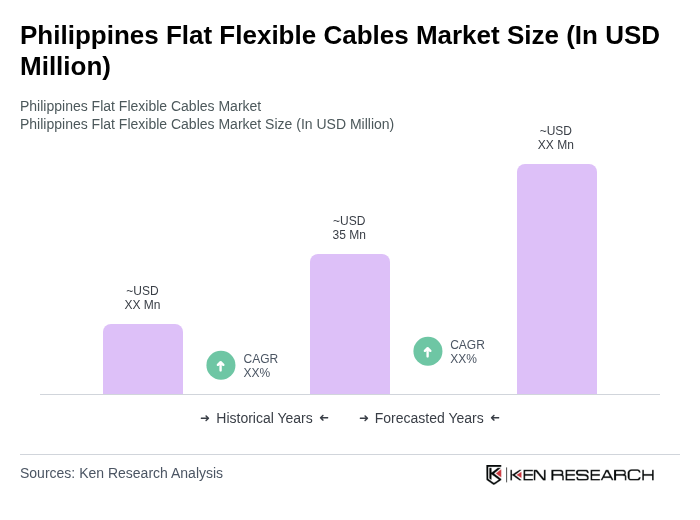
- The Philippines Flat Flexible Cables Market is valued at USD 35 million, based on a five-year historical analysis of the country’s role within the Asia Pacific and global flat flexible cables market, where Asia Pacific holds the largest regional share and includes the Philippines as a growing consumer electronics and electronics manufacturing location. This growth is primarily driven by the increasing demand for flexible cables in consumer electronics, automotive, and industrial applications, in line with global trends where consumer electronics and automotive electronics are among the leading end-use sectors for flat flexible cables. The rise in technological advancements, miniaturization of electronic devices, and the expansion of the electronics manufacturing and assembly sector in Asia Pacific, including the Philippines, have significantly contributed to the market's growth.
- Metro Manila, Cebu, and Davao are the dominant regions in the Philippines Flat Flexible Cables Market. Metro Manila, being the capital and primary urban and industrial center, hosts a large share of electronics manufacturers, EMS providers, and OEMs serving both domestic demand and export-oriented assembly. Cebu and Davao are emerging hubs for industrial, logistics, and automotive-related activities, supported by economic zones and growing manufacturing and services clusters, which underpin regional demand for flat flexible cables in equipment, machinery, and vehicles.
- The Philippine Electrical Code, Part 1: 2017 issued by the Department of Trade and Industry – Bureau of Philippine Standards (through PNS/IEC 60364 adoption) sets mandatory requirements for the use of safe and high-quality electrical materials and wiring methods in residential, commercial, and industrial installations, including performance and safety standards that apply to flexible cables used in equipment and control circuits. Compliance with the Philippine Electrical Code and related implementing rules under the Philippine Electrical Engineering Law (Republic Act No. 7920 and its Implementing Rules and Regulations) drives the use of certified, reliable cable products and supports the adoption of high-quality flat flexible cable solutions in critical applications.
Philippines Flat Flexible Cables Market Segmentation
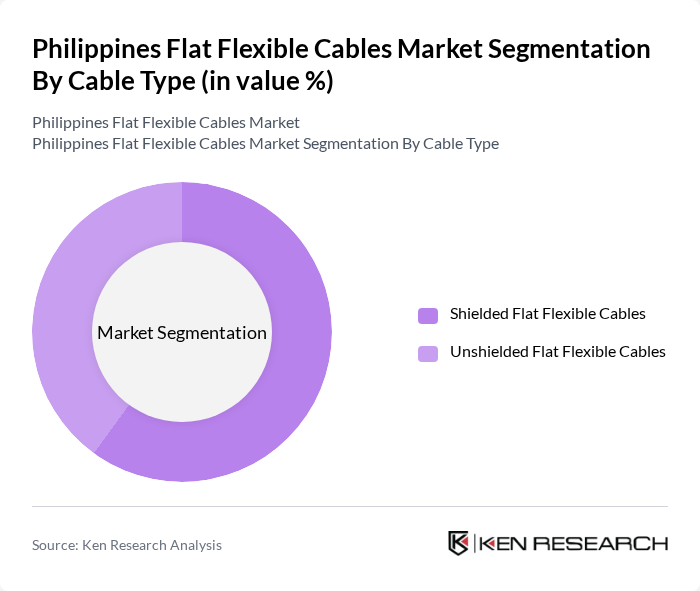
By Cable Type:The market is segmented into Shielded Flat Flexible Cables and Unshielded Flat Flexible Cables, in line with global flat flexible cable classifications. Shielded Flat Flexible Cables are gaining traction due to their ability to reduce electromagnetic interference and crosstalk, making them suitable for sensitive applications such as high-speed data transmission, automotive electronics, medical devices, and precision industrial equipment where signal integrity is critical. Unshielded Flat Flexible Cables, on the other hand, are preferred for general-purpose internal wiring and interconnections in consumer electronics and office equipment due to their cost-effectiveness, compact form factor, and high flexibility where the electromagnetic environment is less demanding.
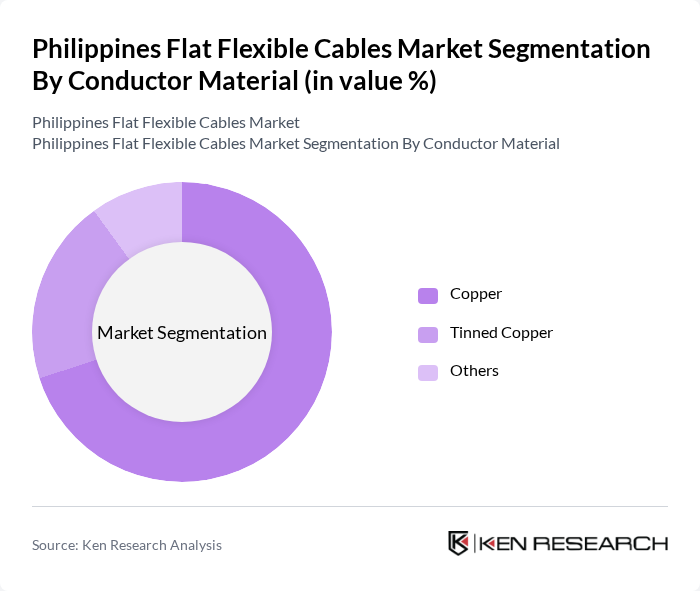
By Conductor Material:The market is categorized into Copper, Tinned Copper, and Others, consistent with conductor material usage patterns in flat flexible cables globally. Copper remains the dominant conductor material due to its excellent electrical conductivity, mechanical reliability, and widespread availability for mass production of consumer electronics and automotive components. Tinned Copper is also gaining popularity for its enhanced corrosion resistance and solderability, which is particularly beneficial in humid and tropical environments such as the Philippines and in applications requiring repeated flexing and reliable terminations. The "Others" category includes alternative materials and specialized alloys used in niche applications, such as high-temperature environments or specific industrial and medical use cases where customized electrical and mechanical properties are required.
Philippines Flat Flexible Cables Market Competitive Landscape
The Philippines Flat Flexible Cables Market is characterized by a dynamic mix of regional and international players. Leading participants such as Philippine Cable Company, Nexans, Southwire Company, LLC, Prysmian Group, Sumitomo Electric Industries, Ltd., Molex (Koch Industries), TE Connectivity, Samtec, Inc., Wurth Elektronik, Johnson Electric Holdings Limited, NICOMATIC, Local Philippines Cable & Wire Manufacturers, Regional Electronics EMS / Assembly Players, Distributors & Channel Partners in Philippines, Emerging Niche FFC / FPC Specialists contribute to innovation, geographic expansion, and service delivery in this space.
Philippines Flat Flexible Cables Market Industry Analysis
Growth Drivers
- Increasing Demand for Energy-Efficient Solutions:The Philippines is experiencing a surge in energy-efficient solutions, driven by a national goal to reduce energy consumption by 20% in future. The Department of Energy reported that energy-efficient technologies could save the country approximately 1,200 GWh annually. This demand is pushing manufacturers to innovate and produce flat flexible cables that meet these energy standards, thus enhancing market growth.
- Growth in Construction and Infrastructure Projects:The Philippine government allocated ?1.5 trillion for infrastructure development in future, focusing on roads, bridges, and public transport systems. This investment is expected to boost the demand for flat flexible cables, which are essential for electrical installations in these projects. The construction sector's growth is projected to contribute significantly to the overall economic growth rate of 6.8% in future, further driving cable demand.
- Rising Adoption of Renewable Energy Sources:The Philippines aims to increase its renewable energy capacity to 25,000 MW in future, as stated by the Renewable Energy Act. This shift towards solar, wind, and hydroelectric power is creating a robust demand for flat flexible cables, which are crucial for connecting renewable energy systems. The government’s commitment to renewable energy is expected to enhance market opportunities for cable manufacturers significantly.
Market Challenges
- Fluctuating Raw Material Prices:The volatility in the prices of copper and aluminum, key materials for flat flexible cables, poses a significant challenge. In recent periods, copper prices fluctuated between $9,000 and $11,000 per ton, impacting production costs. This unpredictability can lead to increased prices for end consumers, potentially stifling demand and affecting market stability in the Philippines.
- Stringent Regulatory Compliance Requirements:The Philippine government has implemented strict regulations regarding electrical safety and environmental standards. Compliance with these regulations can be costly and time-consuming for manufacturers. For instance, the implementation of the Philippine Electrical Code requires extensive testing and certification, which can delay product launches and increase operational costs, thereby challenging market growth.
Philippines Flat Flexible Cables Market Future Outlook
The future of the Philippines flat flexible cables market appears promising, driven by technological advancements and a growing emphasis on sustainability. As the government continues to invest in infrastructure and renewable energy, the demand for innovative cable solutions is expected to rise. Additionally, the integration of smart technologies in electrical systems will further enhance the market landscape, providing opportunities for manufacturers to develop high-performance, energy-efficient products tailored to evolving consumer needs.
Market Opportunities
- Expansion of Smart Grid Technologies:The Philippine government is investing ?15 billion in smart grid initiatives in future, which will enhance energy distribution efficiency. This investment presents a significant opportunity for flat flexible cable manufacturers to supply advanced cable solutions that support smart grid infrastructure, thereby increasing their market share.
- Government Initiatives Promoting Local Manufacturing:The Philippine government has launched programs to boost local manufacturing, aiming for a 35% increase in local production in future. This initiative encourages domestic cable manufacturers to innovate and expand their operations, creating a favorable environment for the growth of the flat flexible cables market in the region.
Scope of the Report
| Segment | Sub-Segments |
|---|---|
| By Cable Type | Shielded Flat Flexible Cables Unshielded Flat Flexible Cables |
| By Conductor Material | Copper Tinned Copper Others |
| By Insulation / Jacket Material | PVC Polyimide PET / Polyester Others |
| By Pitch Size | ? 0.50 mm –1.00 mm ? 1.00 mm |
| By Application | Consumer Electronics Automotive Electronics Industrial Automation & Equipment Medical Devices & Displays Telecommunications & IT Equipment Others |
| By End-User | Electronics Manufacturers / OEMs Automotive OEMs & Tier Suppliers Industrial Equipment Manufacturers Medical Device Manufacturers Others |
| By Distribution Channel | Direct Sales (Key Accounts / OEMs) Distributors & System Integrators Online & E-procurement Platforms Others |
Key Target Audience
Investors and Venture Capitalist Firms
Government and Regulatory Bodies (e.g., Department of Trade and Industry, Bureau of Customs)
Manufacturers and Producers
Distributors and Retailers
Telecommunications Companies
Construction and Infrastructure Firms
Electrical Equipment Suppliers
Energy Sector Companies
Players Mentioned in the Report:
Philippine Cable Company
Nexans
Southwire Company, LLC
Prysmian Group
Sumitomo Electric Industries, Ltd.
Molex (Koch Industries)
TE Connectivity
Samtec, Inc.
Wurth Elektronik
Johnson Electric Holdings Limited
NICOMATIC
Local Philippines Cable & Wire Manufacturers
Regional Electronics EMS / Assembly Players
Distributors & Channel Partners in Philippines
Emerging Niche FFC / FPC Specialists
Table of Contents
Market Assessment Phase
1. Executive Summary and Approach
2. Philippines Flat Flexible Cables Market Overview
2.1 Key Insights and Strategic Recommendations
2.2 Philippines Flat Flexible Cables Market Overview
2.3 Definition and Scope
2.4 Evolution of Market Ecosystem
2.5 Timeline of Key Regulatory Milestones
2.6 Value Chain & Stakeholder Mapping
2.7 Business Cycle Analysis
2.8 Policy & Incentive Landscape
3. Philippines Flat Flexible Cables Market Analysis
3.1 Growth Drivers
3.1.1 Increasing demand for energy-efficient solutions
3.1.2 Growth in construction and infrastructure projects
3.1.3 Rising adoption of renewable energy sources
3.1.4 Technological advancements in cable manufacturing
3.2 Market Challenges
3.2.1 Fluctuating raw material prices
3.2.2 Stringent regulatory compliance requirements
3.2.3 Competition from alternative cable solutions
3.2.4 Limited awareness among end-users
3.3 Market Opportunities
3.3.1 Expansion of smart grid technologies
3.3.2 Increasing investments in renewable energy
3.3.3 Development of new applications in various industries
3.3.4 Government initiatives promoting local manufacturing
3.4 Market Trends
3.4.1 Shift towards sustainable and eco-friendly materials
3.4.2 Growing preference for customized cable solutions
3.4.3 Integration of IoT in cable management systems
3.4.4 Rise in demand for high-performance cables
3.5 Government Regulation
3.5.1 Implementation of safety standards for electrical products
3.5.2 Regulations promoting energy efficiency
3.5.3 Compliance with environmental protection laws
3.5.4 Incentives for local manufacturing and innovation
4. SWOT Analysis
5. Stakeholder Analysis
6. Porter's Five Forces Analysis
7. Philippines Flat Flexible Cables Market Market Size, 2019-2024
7.1 By Value
7.2 By Volume
7.3 By Average Selling Price
8. Philippines Flat Flexible Cables Market Segmentation
8.1 By Cable Type
8.1.1 Shielded Flat Flexible Cables
8.1.2 Unshielded Flat Flexible Cables
8.2 By Conductor Material
8.2.1 Copper
8.2.2 Tinned Copper
8.2.3 Others
8.3 By Insulation / Jacket Material
8.3.1 PVC
8.3.2 Polyimide
8.3.3 PET / Polyester
8.3.4 Others
8.4 By Pitch Size
8.4.1 ? 0.50 mm
8.4.2 0.50–1.00 mm
8.4.3 ? 1.00 mm
8.5 By Application
8.5.1 Consumer Electronics
8.5.2 Automotive Electronics
8.5.3 Industrial Automation & Equipment
8.5.4 Medical Devices & Displays
8.5.5 Telecommunications & IT Equipment
8.5.6 Others
8.6 By End-User
8.6.1 Electronics Manufacturers / OEMs
8.6.2 Automotive OEMs & Tier Suppliers
8.6.3 Industrial Equipment Manufacturers
8.6.4 Medical Device Manufacturers
8.6.5 Others
8.7 By Distribution Channel
8.7.1 Direct Sales (Key Accounts / OEMs)
8.7.2 Distributors & System Integrators
8.7.3 Online & E-procurement Platforms
8.7.4 Others
9. Philippines Flat Flexible Cables Market Competitive Analysis
9.1 Market Share of Key Players
9.2 Cross Comparison of Key Players
9.2.1 Company Name
9.2.2 Philippines Flat Flexible Cable Revenue (Latest Year, USD Million)
9.2.3 3-year Revenue CAGR in Flat Flexible Cables (%)
9.2.4 Philippines Market Share in Flat Flexible Cables (%)
9.2.5 EBITDA Margin from Flat Flexible Cables Business (%)
9.2.6 Capex Intensity (Capex / Sales, %)
9.2.7 R&D Spend as % of Sales
9.2.8 Average Selling Price per Meter (PHP / Meter)
9.2.9 Installed Production Capacity in Philippines (km / year)
9.2.10 Capacity Utilization Rate (%)
9.2.11 Export Share of Sales (%)
9.2.12 Customer Concentration (Top-5 Customers’ Share, %)
9.2.13 On-time Delivery Rate (%)
9.2.14 Defect / Return Rate (PPM or % of Shipments)
9.3 SWOT Analysis of Top Players
9.4 Pricing Analysis
9.5 Detailed Profile of Major Companies
9.5.1 Philippine Cable Company
9.5.2 Nexans
9.5.3 Southwire Company, LLC
9.5.4 Prysmian Group
9.5.5 Sumitomo Electric Industries, Ltd.
9.5.6 Molex (Koch Industries)
9.5.7 TE Connectivity
9.5.8 Samtec, Inc.
9.5.9 Wurth Elektronik
9.5.10 Johnson Electric Holdings Limited
9.5.11 NICOMATIC
9.5.12 Local Philippines Cable & Wire Manufacturers
9.5.13 Regional Electronics EMS / Assembly Players
9.5.14 Distributors & Channel Partners in Philippines
9.5.15 Emerging Niche FFC / FPC Specialists
10. Philippines Flat Flexible Cables Market End-User Analysis
10.1 Procurement Behavior of Key Ministries
10.1.1 Ministry of Energy
10.1.2 Department of Public Works and Highways
10.1.3 Department of Education
10.1.4 Others
10.2 Corporate Spend on Infrastructure & Energy
10.2.1 Investment Trends in Infrastructure
10.2.2 Energy Sector Expenditure
10.2.3 Corporate Sustainability Initiatives
10.2.4 Others
10.3 Pain Point Analysis by End-User Category
10.3.1 Residential Users
10.3.2 Commercial Users
10.3.3 Industrial Users
10.3.4 Government Users
10.4 User Readiness for Adoption
10.4.1 Awareness Levels
10.4.2 Training and Support Needs
10.4.3 Financial Readiness
10.4.4 Others
10.5 Post-Deployment ROI and Use Case Expansion
10.5.1 Performance Metrics
10.5.2 User Satisfaction Levels
10.5.3 Future Expansion Plans
10.5.4 Others
11. Philippines Flat Flexible Cables Market Future Size, 2025-2030
11.1 By Value
11.2 By Volume
11.3 By Average Selling Price
Go-To-Market Strategy Phase
1. Whitespace Analysis + Business Model Canvas
1.1 Market Gaps Identification
1.2 Business Model Development
2. Marketing and Positioning Recommendations
2.1 Branding Strategies
2.2 Product USPs
3. Distribution Plan
3.1 Urban Retail Strategies
3.2 Rural NGO Tie-ups
4. Channel & Pricing Gaps
4.1 Underserved Routes
4.2 Pricing Bands
5. Unmet Demand & Latent Needs
5.1 Category Gaps
5.2 Consumer Segments
6. Customer Relationship
6.1 Loyalty Programs
6.2 After-sales Service
7. Value Proposition
7.1 Sustainability Initiatives
7.2 Integrated Supply Chains
8. Key Activities
8.1 Regulatory Compliance
8.2 Branding Efforts
8.3 Distribution Setup
9. Entry Strategy Evaluation
9.1 Domestic Market Entry Strategy
9.1.1 Product Mix
9.1.2 Pricing Band
9.1.3 Packaging
9.2 Export Entry Strategy
9.2.1 Target Countries
9.2.2 Compliance Roadmap
10. Entry Mode Assessment
10.1 Joint Ventures
10.2 Greenfield Investments
10.3 Mergers & Acquisitions
10.4 Distributor Model
11. Capital and Timeline Estimation
11.1 Capital Requirements
11.2 Timelines
12. Control vs Risk Trade-Off
12.1 Ownership vs Partnerships
13. Profitability Outlook
13.1 Breakeven Analysis
13.2 Long-term Sustainability
14. Potential Partner List
14.1 Distributors
14.2 Joint Ventures
14.3 Acquisition Targets
15. Execution Roadmap
15.1 Phased Plan for Market Entry
15.1.1 Market Setup
15.1.2 Market Entry
15.1.3 Growth Acceleration
15.1.4 Scale & Stabilize
15.2 Key Activities and Milestones
15.2.1 Milestone Planning
15.2.2 Activity Tracking
Research Methodology
Phase 1: Approach1
Desk Research
- Industry reports from the Philippine Electrical and Electronics Association
- Market analysis from government publications and trade associations
- Academic journals focusing on electrical engineering and materials science
Primary Research
- Interviews with key stakeholders in the flat flexible cable manufacturing sector
- Surveys targeting electrical engineers and product designers in various industries
- Field visits to manufacturing plants and distribution centers for firsthand insights
Validation & Triangulation
- Cross-validation of data from multiple industry sources and expert opinions
- Triangulation of market trends with historical sales data and production statistics
- Sanity checks through feedback from industry panels and focus groups
Phase 2: Market Size Estimation1
Top-down Assessment
- Analysis of national electrical equipment market size and growth rates
- Segmentation by application areas such as automotive, telecommunications, and consumer electronics
- Incorporation of government initiatives promoting local manufacturing and sustainability
Bottom-up Modeling
- Volume estimates based on production capacities of leading flat flexible cable manufacturers
- Cost analysis derived from raw material prices and manufacturing expenses
- Sales projections based on historical data and current market trends
Forecasting & Scenario Analysis
- Multi-variable forecasting using economic indicators and technological advancements
- Scenario planning based on potential regulatory changes and market disruptions
- Development of baseline, optimistic, and pessimistic market growth scenarios through 2030
Phase 3: CATI Sample Composition1
| Scope Item/Segment | Sample Size | Target Respondent Profiles |
|---|---|---|
| Automotive Industry Applications | 110 | Design Engineers, Procurement Managers |
| Consumer Electronics Manufacturing | 85 | Product Managers, Quality Assurance Specialists |
| Telecommunications Sector | 95 | Network Engineers, Operations Directors |
| Industrial Equipment Suppliers | 75 | Supply Chain Managers, Technical Sales Representatives |
| Construction and Infrastructure Projects | 65 | Project Managers, Electrical Contractors |
Frequently Asked Questions
What is the current value of the Philippines Flat Flexible Cables Market?
The Philippines Flat Flexible Cables Market is valued at approximately USD 35 million, reflecting its growing significance within the Asia Pacific region, particularly in consumer electronics and automotive sectors.
What are the main drivers of growth in the Philippines Flat Flexible Cables Market?
Which regions in the Philippines are leading in the Flat Flexible Cables Market?
What are the types of flat flexible cables available in the market?
Other Regional/Country Reports
Other Adjacent Reports
Belgium Renewable Energy Equipment Market
Kuwait Smart Grid Technology Market
Belgium Flexible Printed Circuit Market
Malaysia Wire Harness Market Size, Share & Forecast, By Product Type, End-Use Industry & Application, 2025-2032Germany Electrical Conductor Market
UAE Electronics Manufacturing Services MarketJapan Medical Device Components Market
Why Buy From Us?

What makes us stand out is that our consultants follow Robust, Refine and Result (RRR) methodology. Robust for clear definitions, approaches and sanity checking, Refine for differentiating respondents' facts and opinions, and Result for presenting data with story.

We have set a benchmark in the industry by offering our clients with syndicated and customized market research reports featuring coverage of entire market as well as meticulous research and analyst insights.

While we don't replace traditional research, we flip the method upside down. Our dual approach of Top Bottom & Bottom Top ensures quality deliverable by not just verifying company fundamentals but also looking at the sector and macroeconomic factors.

With one step in the future, our research team constantly tries to show you the bigger picture. We help with some of the tough questions you may encounter along the way: How is the industry positioned? Best marketing channel? KPI's of competitors? By aligning every element, we help maximize success.

Our report gives you instant access to the answers and sources that other companies might choose to hide. We elaborate each steps of research methodology we have used and showcase you the sample size to earn your trust.

If you need any support, we are here! We pride ourselves on universe strength, data quality, and quick, friendly, and professional service.