About the Report
Base Year 2024Kuwait Flat Flexible Cables Market Overview
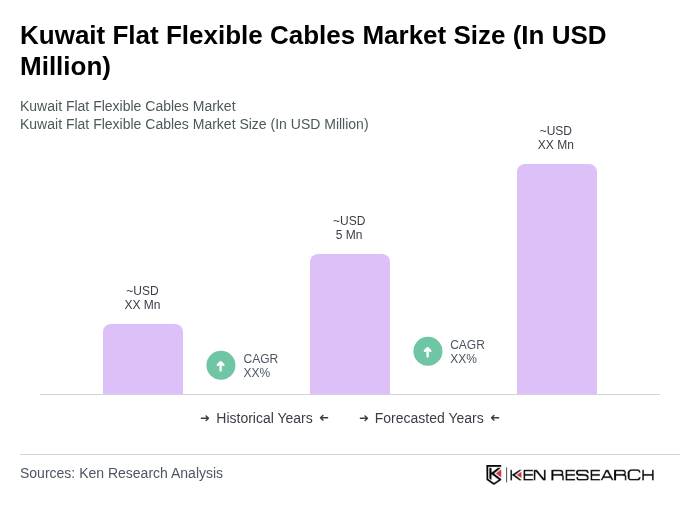
- The Kuwait Flat Flexible Cables Market is valued at USD 5 million, based on a five-year historical analysis, in line with the overall Middle East and Africa flat flexible cables market size where the region accounts for a small share of the global flat flexible cables industry. This growth is primarily driven by the increasing demand for flexible cables in various sectors, including consumer electronics, automotive, and industrial automation, reflecting the broader use of flat flexible cables in miniaturized electronics, automotive electronics, and automated industrial systems. The rise in construction activities and infrastructure development in Kuwait, supported by ongoing investments in power, industrial facilities, and commercial real estate, has further fueled the need for reliable and efficient electrical solutions and interconnect systems.
- Kuwait City is the dominant region in the market due to its status as the capital and economic hub of the country, attracting significant investments in infrastructure, utilities, and technology-driven projects that intensify demand for advanced cabling solutions. Other notable areas include Al Ahmadi and Hawalli, which are key industrial, oil-and-gas-related, and commercial centers, contributing to the overall demand for flat flexible cables in the region through applications in refining, petrochemicals, manufacturing, and commercial electronics.
- In 2023, the Kuwaiti government implemented regulations mandating the use of environmentally friendly materials in electrical installations. This initiative aligns with requirements such as the Kuwait Fire Department’s adoption of low-smoke, zero-halogen and flame-retardant cable specifications for building wiring and power distribution, as well as the Gulf Standardization Organization’s technical regulation GSO 1997/2012 for electric cables which specifies safety, insulation, and material performance criteria for cables used in member states including Kuwait. These measures aim to promote sustainability and reduce the environmental and fire-related impact of electrical products, thereby influencing manufacturers and importers to adapt their offerings to comply with these standards through the use of halogen-free, low-smoke materials and compliant insulation systems.
Kuwait Flat Flexible Cables Market Segmentation
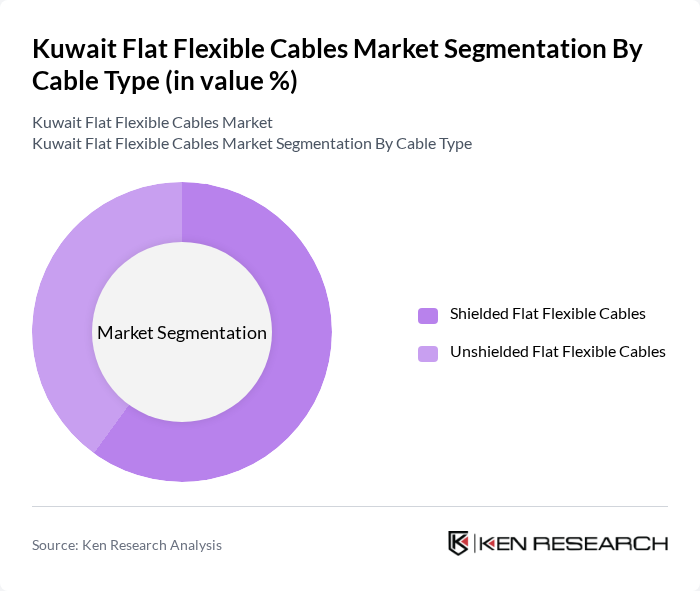
By Cable Type:The market is segmented into Shielded Flat Flexible Cables and Unshielded Flat Flexible Cables. Shielded cables are preferred in environments where electromagnetic interference is a concern, such as high-speed consumer electronics, automotive electronics, and industrial automation equipment, mirroring the global trend where shielded flat flexible cables hold the higher share due to better EMI immunity. Unshielded cables are commonly used in less sensitive applications, including basic consumer devices and internal connections where electrical noise is limited and cost efficiency is prioritized.
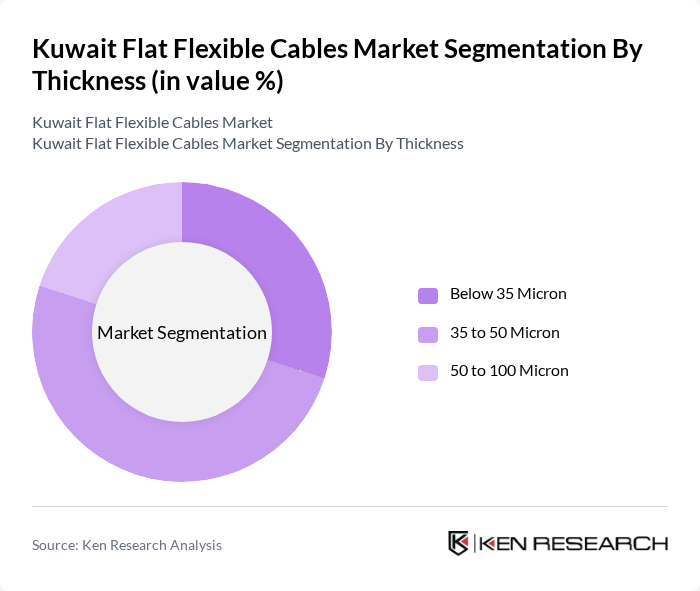
By Thickness:The thickness segmentation includes Below 35 Micron, 35 to 50 Micron, and 50 to 100 Micron. Cables below 35 microns are often used in compact electronic devices such as smartphones, laptops, wearables, and compact automotive modules, where very fine conductors and tight bending radii are required, consistent with regional trends in the Middle East and Africa where this segment is identified as the most lucrative for high-growth consumer and miniaturized applications. Thicker cables in the 35 to 50 micron and 50 to 100 micron ranges are preferred for industrial, automotive, and energy-sector applications requiring higher durability, current-carrying capacity, and mechanical robustness, with 50 to 100 micron identified as a key revenue-generating thickness in the wider regional market.
Kuwait Flat Flexible Cables Market Competitive Landscape
The Kuwait Flat Flexible Cables Market is characterized by a dynamic mix of regional and international players. Leading participants such as Gulf Cable & Electrical Industries Company K.S.C.P. (Kuwait), Kuwait Cable Vision Co., Prysmian Group, Nexans S.A., Sumitomo Electric Industries, Ltd., LS Cable & System Ltd., Saudi Cable Company, Elsewedy Electric, Riyadh Cables Group Company, Oman Cables Industry, Bahra Electric, TE Connectivity, Molex LLC, Fujikura Ltd., 3M Company contribute to innovation, geographic expansion, and service delivery in this space, in line with their broader roles in the global wires, cables, and flat flexible cable markets.
Kuwait Flat Flexible Cables Market Industry Analysis
Growth Drivers
- Increasing Demand for Energy-Efficient Solutions:The Kuwait government aims to reduce energy consumption by 30% by future, driving demand for energy-efficient products. The energy-efficient cable market is projected to grow significantly, with an estimated value of KWD 50 million in future. This shift is supported by the rising awareness of energy conservation among consumers and businesses, leading to increased adoption of flat flexible cables that meet energy efficiency standards.
- Expansion of Construction and Infrastructure Projects:Kuwait's construction sector is expected to reach KWD 5 billion in future, fueled by government initiatives to enhance infrastructure. Major projects, including the Kuwait City development and the new airport expansion, are set to increase the demand for flat flexible cables. This growth is further supported by the government's commitment to invest in infrastructure, which is projected to create thousands of jobs and stimulate economic growth.
- Rising Adoption of Renewable Energy Sources:Kuwait aims to generate 15% of its energy from renewable sources by future, translating to approximately 3,000 MW of renewable energy capacity. This transition is expected to boost the demand for specialized cables designed for solar and wind energy applications. The government's investment of KWD 1.5 billion in renewable energy projects will further enhance the market for flat flexible cables, aligning with global sustainability trends.
Market Challenges
- Fluctuating Raw Material Prices:The volatility in the prices of copper and aluminum, essential materials for cable manufacturing, poses a significant challenge. In future, copper prices fluctuated between KWD 2.5 and KWD 3.0 per kilogram, impacting production costs. This unpredictability can lead to increased prices for consumers and reduced profit margins for manufacturers, hindering market growth and investment in new technologies.
- Stringent Regulatory Requirements:Compliance with international safety and environmental standards is becoming increasingly complex. The Kuwait government has implemented regulations that require manufacturers to adhere to specific safety standards, which can increase operational costs. For instance, the new regulations mandate that all electrical products meet the IEC 60529 standard, which can require significant investment in testing and certification processes, potentially limiting market entry for smaller players.
Kuwait Flat Flexible Cables Market Future Outlook
The Kuwait Flat Flexible Cables market is poised for significant growth, driven by the increasing focus on energy efficiency and sustainability. As the government invests heavily in infrastructure and renewable energy projects, the demand for innovative cable solutions will rise. Additionally, the integration of smart technologies in construction and energy management systems will create new opportunities for manufacturers. Companies that adapt to these trends and invest in R&D will likely capture a larger market share in the coming years.
Market Opportunities
- Growth in Smart City Initiatives:The Kuwait government has allocated KWD 1 billion for smart city projects, which will require advanced cable solutions. This investment is expected to create a demand for flat flexible cables that support IoT applications, enhancing connectivity and efficiency in urban environments.
- Increasing Investments in Renewable Energy:With KWD 1.5 billion earmarked for renewable energy projects, there is a significant opportunity for flat flexible cables designed for solar and wind applications. This investment will drive demand for specialized cables that meet the unique requirements of renewable energy systems, fostering market growth.
Scope of the Report
| Segment | Sub-Segments |
|---|---|
| By Cable Type | Shielded Flat Flexible Cables Unshielded Flat Flexible Cables |
| By Thickness | Below 35 Micron to 50 Micron to 100 Micron |
| By Pitch Size | mm mm mm |
| By Application | Consumer Electronics Automotive Electronics Industrial Automation & Systems Telecommunications & IT Equipment Medical Devices & Displays Household Equipment Aerospace & Defense Electronics Others |
| By End-User | Electronics Manufacturers Automotive OEMs Industrial Equipment Manufacturers Medical Device Manufacturers Telecom Operators & ICT Providers Defense & Aerospace Contractors |
| By Material | Copper Tinned Copper Aluminum Others |
| By Region | Kuwait City & Capital Governorate Al Ahmadi Hawalli Al Farwaniyah Al Jahra Mubarak Al-Kabeer |
Key Target Audience
Investors and Venture Capitalist Firms
Government and Regulatory Bodies (e.g., Ministry of Electricity and Water, Kuwait Municipality)
Manufacturers and Producers
Distributors and Retailers
Construction and Infrastructure Companies
Telecommunications Providers
Energy and Utility Companies
Real Estate Developers
Players Mentioned in the Report:
Gulf Cable & Electrical Industries Company K.S.C.P. (Kuwait)
Kuwait Cable Vision Co.
Prysmian Group
Nexans S.A.
Sumitomo Electric Industries, Ltd.
LS Cable & System Ltd.
Saudi Cable Company
Elsewedy Electric
Riyadh Cables Group Company
Oman Cables Industry
Bahra Electric
TE Connectivity
Molex LLC
Fujikura Ltd.
3M Company
Table of Contents
Market Assessment Phase
1. Executive Summary and Approach
2. Kuwait Flat Flexible Cables Market Overview
2.1 Key Insights and Strategic Recommendations
2.2 Kuwait Flat Flexible Cables Market Overview
2.3 Definition and Scope
2.4 Evolution of Market Ecosystem
2.5 Timeline of Key Regulatory Milestones
2.6 Value Chain & Stakeholder Mapping
2.7 Business Cycle Analysis
2.8 Policy & Incentive Landscape
3. Kuwait Flat Flexible Cables Market Analysis
3.1 Growth Drivers
3.1.1 Increasing demand for energy-efficient solutions
3.1.2 Expansion of construction and infrastructure projects
3.1.3 Rising adoption of renewable energy sources
3.1.4 Technological advancements in cable manufacturing
3.2 Market Challenges
3.2.1 Fluctuating raw material prices
3.2.2 Stringent regulatory requirements
3.2.3 Competition from alternative cable solutions
3.2.4 Limited awareness of product benefits
3.3 Market Opportunities
3.3.1 Growth in smart city initiatives
3.3.2 Increasing investments in renewable energy
3.3.3 Expansion of the telecommunications sector
3.3.4 Development of innovative cable technologies
3.4 Market Trends
3.4.1 Shift towards sustainable and eco-friendly products
3.4.2 Integration of IoT in cable management systems
3.4.3 Customization of cable solutions for specific applications
3.4.4 Growth of e-commerce in cable distribution
3.5 Government Regulation
3.5.1 Compliance with international safety standards
3.5.2 Incentives for renewable energy projects
3.5.3 Regulations on waste management and recycling
3.5.4 Standards for energy efficiency in electrical products
4. SWOT Analysis
5. Stakeholder Analysis
6. Porter's Five Forces Analysis
7. Kuwait Flat Flexible Cables Market Market Size, 2019-2024
7.1 By Value
7.2 By Volume
7.3 By Average Selling Price
8. Kuwait Flat Flexible Cables Market Segmentation
8.1 By Cable Type
8.1.1 Shielded Flat Flexible Cables
8.1.2 Unshielded Flat Flexible Cables
8.2 By Thickness
8.2.1 Below 35 Micron
8.2.2 35 to 50 Micron
8.2.3 50 to 100 Micron
8.3 By Pitch Size
8.3.1 0.500 mm
8.3.2 1.00 mm
8.3.3 1.250 mm
8.4 By Application
8.4.1 Consumer Electronics
8.4.2 Automotive Electronics
8.4.3 Industrial Automation & Systems
8.4.4 Telecommunications & IT Equipment
8.4.5 Medical Devices & Displays
8.4.6 Household Equipment
8.4.7 Aerospace & Defense Electronics
8.4.8 Others
8.5 By End-User
8.5.1 Electronics Manufacturers
8.5.2 Automotive OEMs
8.5.3 Industrial Equipment Manufacturers
8.5.4 Medical Device Manufacturers
8.5.5 Telecom Operators & ICT Providers
8.5.6 Defense & Aerospace Contractors
8.6 By Material
8.6.1 Copper
8.6.2 Tinned Copper
8.6.3 Aluminum
8.6.4 Others
8.7 By Region
8.7.1 Kuwait City & Capital Governorate
8.7.2 Al Ahmadi
8.7.3 Hawalli
8.7.4 Al Farwaniyah
8.7.5 Al Jahra
8.7.6 Mubarak Al-Kabeer
9. Kuwait Flat Flexible Cables Market Competitive Analysis
9.1 Market Share of Key Players
9.2 Cross Comparison of Key Players
9.2.1 Company Name
9.2.2 Kuwait Flat Flexible Cables Revenue (USD Mn)
9.2.3 Kuwait Market Share (%)
9.2.4 3-Year Revenue CAGR in Kuwait (%)
9.2.5 EBITDA Margin (%) – Kuwait Operations
9.2.6 R&D Intensity (% of Revenue)
9.2.7 Capex-to-Sales Ratio (%)
9.2.8 Order Backlog / Book-to-Bill Ratio
9.2.9 Average Selling Price per Meter (USD)
9.2.10 Customer Concentration (Top-5 % of Revenue)
9.2.11 Kuwait Production Capacity Utilization (%)
9.2.12 Export Revenue Share from Kuwait (%)
9.3 SWOT Analysis of Top Players
9.4 Pricing Analysis
9.5 Detailed Profile of Major Companies
9.5.1 Gulf Cable & Electrical Industries Company K.S.C.P. (Kuwait)
9.5.2 Kuwait Cable Vision Co.
9.5.3 Prysmian Group
9.5.4 Nexans S.A.
9.5.5 Sumitomo Electric Industries, Ltd.
9.5.6 LS Cable & System Ltd.
9.5.7 Saudi Cable Company
9.5.8 Elsewedy Electric
9.5.9 Riyadh Cables Group Company
9.5.10 Oman Cables Industry
9.5.11 Bahra Electric
9.5.12 TE Connectivity
9.5.13 Molex LLC
9.5.14 Fujikura Ltd.
9.5.15 3M Company
10. Kuwait Flat Flexible Cables Market End-User Analysis
10.1 Procurement Behavior of Key Ministries
10.1.1 Ministry of Electricity and Water
10.1.2 Ministry of Public Works
10.1.3 Ministry of Commerce and Industry
10.1.4 Others
10.2 Corporate Spend on Infrastructure & Energy
10.2.1 Corporate Investments in Renewable Energy
10.2.2 Infrastructure Development Budgets
10.2.3 Energy Efficiency Initiatives
10.2.4 Others
10.3 Pain Point Analysis by End-User Category
10.3.1 Residential Sector Challenges
10.3.2 Commercial Sector Challenges
10.3.3 Industrial Sector Challenges
10.3.4 Government Sector Challenges
10.4 User Readiness for Adoption
10.4.1 Awareness of Flat Flexible Cables
10.4.2 Training and Support Needs
10.4.3 Financial Readiness
10.4.4 Others
10.5 Post-Deployment ROI and Use Case Expansion
10.5.1 ROI Measurement Techniques
10.5.2 Use Case Expansion Opportunities
10.5.3 Customer Feedback Mechanisms
10.5.4 Others
11. Kuwait Flat Flexible Cables Market Future Size, 2025-2030
11.1 By Value
11.2 By Volume
11.3 By Average Selling Price
Go-To-Market Strategy Phase
1. Whitespace Analysis + Business Model Canvas
1.1 Market Gaps Identification
1.2 Business Model Development
2. Marketing and Positioning Recommendations
2.1 Branding Strategies
2.2 Product USPs
3. Distribution Plan
3.1 Urban Retail Strategies
3.2 Rural NGO Tie-ups
4. Channel & Pricing Gaps
4.1 Underserved Routes
4.2 Pricing Bands Analysis
5. Unmet Demand & Latent Needs
5.1 Category Gaps
5.2 Consumer Segments
6. Customer Relationship
6.1 Loyalty Programs
6.2 After-sales Service
7. Value Proposition
7.1 Sustainability Initiatives
7.2 Integrated Supply Chains
8. Key Activities
8.1 Regulatory Compliance
8.2 Branding Efforts
8.3 Distribution Setup
9. Entry Strategy Evaluation
9.1 Domestic Market Entry Strategy
9.1.1 Product Mix Considerations
9.1.2 Pricing Band Strategy
9.1.3 Packaging Solutions
9.2 Export Entry Strategy
9.2.1 Target Countries Identification
9.2.2 Compliance Roadmap Development
10. Entry Mode Assessment
10.1 Joint Ventures
10.2 Greenfield Investments
10.3 Mergers & Acquisitions
10.4 Distributor Model Evaluation
11. Capital and Timeline Estimation
11.1 Capital Requirements Analysis
11.2 Timelines for Implementation
12. Control vs Risk Trade-Off
12.1 Ownership Considerations
12.2 Partnerships Evaluation
13. Profitability Outlook
13.1 Breakeven Analysis
13.2 Long-term Sustainability Strategies
14. Potential Partner List
14.1 Distributors Identification
14.2 Joint Ventures Opportunities
14.3 Acquisition Targets
15. Execution Roadmap
15.1 Phased Plan for Market Entry
15.1.1 Market Setup Activities
15.1.2 Market Entry Strategies
15.1.3 Growth Acceleration Plans
15.1.4 Scale & Stabilize Initiatives
15.2 Key Activities and Milestones
15.2.1 Milestone Identification
15.2.2 Activity Scheduling
Research Methodology
Phase 1: Approach1
Desk Research
- Industry reports from the Kuwait Chamber of Commerce and Industry
- Market analysis publications from regional electrical and electronics associations
- Government publications on infrastructure development and electrical standards
Primary Research
- Interviews with electrical engineers and project managers in construction firms
- Surveys with distributors and retailers of flat flexible cables
- Field interviews with end-users in the industrial and commercial sectors
Validation & Triangulation
- Cross-validation of market data through multiple industry sources
- Triangulation of findings from primary interviews and secondary data
- Sanity checks through expert panels comprising industry veterans
Phase 2: Market Size Estimation1
Top-down Assessment
- Analysis of national electrical infrastructure spending and growth trends
- Segmentation of the market by application areas such as residential, commercial, and industrial
- Incorporation of government initiatives promoting electrical safety and standards
Bottom-up Modeling
- Volume estimates based on sales data from leading cable manufacturers
- Cost analysis derived from pricing models of flat flexible cables
- Estimation of market share based on distribution channels and end-user demand
Forecasting & Scenario Analysis
- Multi-variable regression analysis considering economic growth and construction activity
- Scenario planning based on potential regulatory changes and technological advancements
- Development of baseline, optimistic, and pessimistic market forecasts through 2030
Phase 3: CATI Sample Composition1
| Scope Item/Segment | Sample Size | Target Respondent Profiles |
|---|---|---|
| Residential Electrical Installations | 120 | Homeowners, Electrical Contractors |
| Commercial Building Projects | 90 | Project Managers, Facility Managers |
| Industrial Applications | 80 | Operations Managers, Maintenance Supervisors |
| Retail Distribution Channels | 60 | Retail Managers, Supply Chain Coordinators |
| Government Infrastructure Projects | 70 | Government Officials, Procurement Officers |
Frequently Asked Questions
What is the current value of the Kuwait Flat Flexible Cables Market?
The Kuwait Flat Flexible Cables Market is valued at approximately USD 5 million, reflecting a small share of the overall Middle East and Africa flat flexible cables market, which is driven by increasing demand across various sectors such as consumer electronics and industrial automation.
What factors are driving the growth of the Kuwait Flat Flexible Cables Market?
Which regions in Kuwait are significant for the Flat Flexible Cables Market?
What are the types of flat flexible cables available in the Kuwait market?
Other Regional/Country Reports
Other Adjacent Reports
KSA Power Cable Market
Global Wires and Cables Market Size, Share & Forecast, By Product Type, Voltage & End-Use Industry, 2026–2031South Africa Renewable Energy Equipment Market
Malaysia Oil and Gas Equipment Market
India Construction Materials Market Size, Share & Forecast, By Material Type, Application & End User, 2026-2031Indonesia Electromagnetic Interference Shielding Market
Kuwait Smart City Technology Market
Why Buy From Us?

What makes us stand out is that our consultants follow Robust, Refine and Result (RRR) methodology. Robust for clear definitions, approaches and sanity checking, Refine for differentiating respondents' facts and opinions, and Result for presenting data with story.

We have set a benchmark in the industry by offering our clients with syndicated and customized market research reports featuring coverage of entire market as well as meticulous research and analyst insights.

While we don't replace traditional research, we flip the method upside down. Our dual approach of Top Bottom & Bottom Top ensures quality deliverable by not just verifying company fundamentals but also looking at the sector and macroeconomic factors.

With one step in the future, our research team constantly tries to show you the bigger picture. We help with some of the tough questions you may encounter along the way: How is the industry positioned? Best marketing channel? KPI's of competitors? By aligning every element, we help maximize success.

Our report gives you instant access to the answers and sources that other companies might choose to hide. We elaborate each steps of research methodology we have used and showcase you the sample size to earn your trust.

If you need any support, we are here! We pride ourselves on universe strength, data quality, and quick, friendly, and professional service.