About the Report
Base Year 2024Philippines Pearlescent Pigment Market Overview
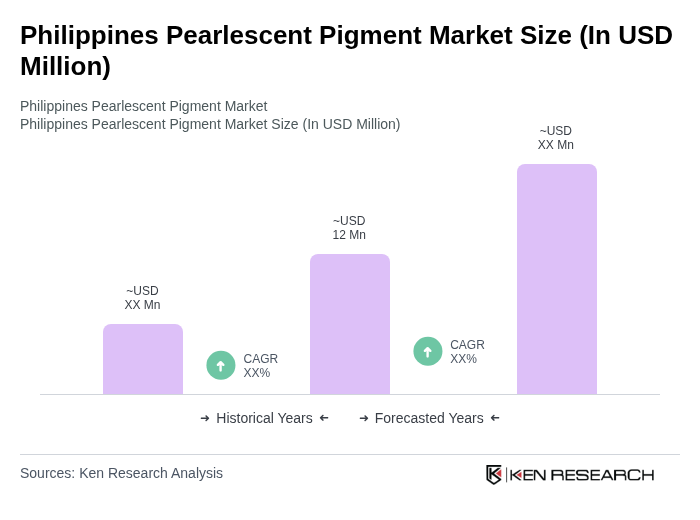
- The Philippines Pearlescent Pigment Market is valued at USD 12 million, based on a five-year historical analysis. This growth is primarily driven by the increasing demand for high-quality pigments in various applications, including automotive coatings, cosmetics, and packaging, in line with broader regional trends in Asia Pacific where pearlescent pigments are widely used in these sectors. The market is also influenced by the rising consumer preference for aesthetic products that enhance visual appeal and provide unique effects, supported by growing use of effect pigments in premium consumer goods and decorative coatings.
- Metro Manila and Cebu City are the dominant regions in the Philippines Pearlescent Pigment Market due to their robust industrial base and concentration of manufacturing and processing activities, including paints, plastics, printing, and cosmetics manufacturing. These urban centers host numerous companies involved in the import, formulation, and distribution of pigments and coatings and benefit from better logistics infrastructure, access to skilled labor, and proximity to key end-users in the automotive, construction, and personal care sectors.
- The Philippines government has introduced and updated regulations that promote safer and more sustainable practices for chemicals used in pigments and coatings, including requirements on hazardous substances, labeling, and environmental management. A key framework is the Philippine Chemicals Management Act and its implementing rules under the Department of Environment and Natural Resources (DENR), complemented by the Chemical Control Orders and the Revised Chemical Control Order for Mercury and related hazardous substances, which set controls on the use, importation, and disposal of certain chemicals used in pigment systems. In addition, compliance with the Philippines’ commitments under the Basel and Stockholm Conventions and DENR administrative orders on pollution control encourages manufacturers and importers to adopt eco-friendlier raw materials, implement waste minimization, and align with international environmental standards in pigment production and use.
Philippines Pearlescent Pigment Market Segmentation
By Type:The pearlescent pigment market can be segmented into various types, including Natural Pearl Essence, Titanium-dioxide coated mica pearlescent pigments, Ferric-oxide coated mica pearlescent pigments, Synthetic mica-based pearlescent pigments, Glass-flake and silica-based pearlescent pigments, and Others. This typology is consistent with global industry classification, where titanium dioxide mica and iron/ferric oxide mica are among the most widely used pearlescent pigment categories in coatings, plastics, and cosmetics.
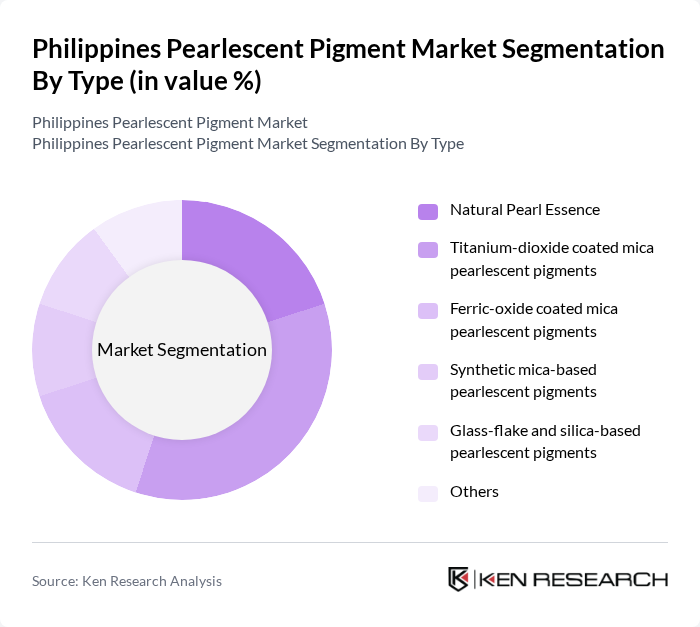
The Titanium-dioxide coated mica pearlescent pigments segment dominates the market due to their superior light-scattering properties, high hiding power, and versatility in applications such as automotive topcoats, industrial coatings, and color cosmetics, which is aligned with global product leadership of titanium dioxide mica in the pearlescent pigment market. This type of pigment is favored for its ability to provide vibrant colors, pearly luster, and a high-quality finish, matching consumer trends towards premium and visually differentiated products in both automotive finishes and beauty products. Additionally, the growing automotive and transportation coatings demand in the Philippines, supported by increasing vehicle sales and assembly activities, has contributed to higher consumption of special-effect and pearlescent coatings, thereby sustaining demand for titanium-dioxide coated mica pigments.
By End-User:The pearlescent pigment market is segmented by end-user industries, including Paints & Coatings (automotive, industrial, decorative), Personal Care & Cosmetics, Plastics & Packaging, Printing Inks, Building & Construction Materials, and Others. This segmentation reflects the core global application areas of pearlescent pigments, where paints and coatings, plastics, and cosmetics are consistently the largest demand centers.
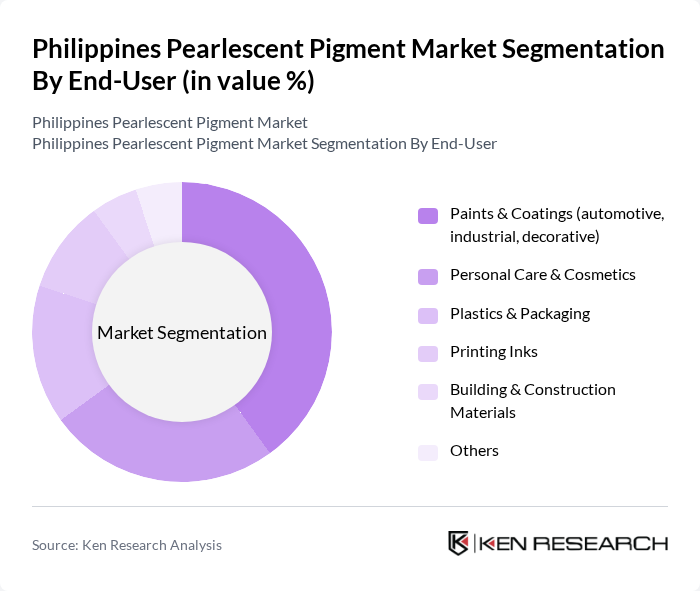
The Paints & Coatings segment is the leading end-user in the market, consistent with global patterns where coatings represent the largest application share for pearlescent pigments, particularly in automotive OEM and refinish, industrial, and decorative coatings. In the Philippines, growth in construction activity and infrastructure investment, together with rising demand for automotive and industrial coatings, supports higher consumption of effect pigments in paints and protective finishes. Additionally, the decorative coatings market is expanding as consumers increasingly favor paints and finishes that offer unique visual effects and enhanced durability, while the personal care and cosmetics segment benefits from strong social media and retail trends towards luminous and shimmering formulations that often rely on pearlescent pigments.
Philippines Pearlescent Pigment Market Competitive Landscape
The Philippines Pearlescent Pigment Market is characterized by a dynamic mix of regional and international players. Leading participants such as Merck KGaA (EMD Performance Materials / Effect Pigments), BASF SE, DIC Corporation, ECKART GmbH (ALTANA Group), Sudarshan Chemical Industries Ltd., Kuncai Pigment Co., Ltd., Clariant AG, The Shepherd Color Company, KOBO Products, Inc., Nabaltec AG, CQV Co., Ltd., Nippon Sheet Glass Co., Ltd. (glass-flake effect pigments), Venator Materials PLC, Guangzhou Yortay Fine Chemicals Co., Ltd., TKB Trading, LLC contribute to innovation, geographic expansion, and service delivery in this space.
Philippines Pearlescent Pigment Market Industry Analysis
Growth Drivers
- Increasing Demand in Automotive Coatings:The automotive sector in the Philippines is projected to grow significantly, with vehicle production expected to reach 300,000 units in future. This surge is driven by rising consumer demand for aesthetically appealing vehicles, leading to an increased use of pearlescent pigments in automotive coatings. The Philippine automotive market's value is estimated at PHP 200 billion, indicating a robust demand for high-quality coatings that enhance vehicle appearance and durability.
- Growth in Cosmetics and Personal Care Industry:The cosmetics and personal care market in the Philippines is anticipated to reach PHP 100 billion in future, fueled by a growing middle class and increased spending on beauty products. Pearlescent pigments are essential in this sector for creating vibrant and appealing cosmetic formulations. The rising trend of self-care and beauty consciousness among Filipinos is driving demand for innovative products that utilize these pigments, enhancing their market presence.
- Rising Interest in Eco-Friendly Products:The Philippines is witnessing a shift towards sustainable and eco-friendly products, with the government promoting green initiatives. In future, the market for eco-friendly products is expected to grow by 15%, driven by consumer awareness and regulatory support. Pearlescent pigments that are non-toxic and derived from sustainable sources are increasingly favored, aligning with the global trend towards environmentally responsible manufacturing practices, thus enhancing market growth.
Market Challenges
- High Production Costs:The production of pearlescent pigments involves complex processes and high-quality raw materials, leading to elevated production costs. In future, the average cost of production is projected to be PHP 1,500 per kilogram, which can hinder market competitiveness. Manufacturers face challenges in maintaining profit margins while ensuring product quality, making it difficult to penetrate price-sensitive segments of the market effectively.
- Limited Awareness Among End-Users:Despite the benefits of pearlescent pigments, there remains a significant knowledge gap among end-users in various industries. Approximately 60% of potential users in the automotive and cosmetics sectors are unaware of the advantages of these pigments. This lack of awareness can impede market growth, as companies may opt for traditional pigments due to familiarity, limiting the adoption of innovative solutions that enhance product appeal.
Philippines Pearlescent Pigment Market Future Outlook
The Philippines pearlescent pigment market is poised for significant growth, driven by increasing demand across various sectors, particularly automotive and cosmetics. As consumer preferences shift towards sustainable and innovative products, manufacturers are likely to invest in research and development to create eco-friendly pigments. Additionally, the rise of e-commerce platforms will facilitate broader market access, enabling companies to reach a wider audience and enhance their distribution channels, ultimately contributing to market expansion.
Market Opportunities
- Emerging Markets in Southeast Asia:The growing economies in Southeast Asia present lucrative opportunities for pearlescent pigment manufacturers. With a combined population of over 650 million, these markets are experiencing increased demand for automotive and cosmetic products, driving the need for high-quality pigments. Companies can leverage this growth by establishing partnerships and expanding their distribution networks in these regions.
- Innovations in Product Development:Continuous innovations in pigment formulations are creating opportunities for market players to differentiate their products. By investing in R&D, companies can develop new, high-performance pearlescent pigments that cater to specific industry needs, such as enhanced durability and eco-friendliness. This focus on innovation can lead to increased market share and customer loyalty in a competitive landscape.
Scope of the Report
| Segment | Sub-Segments |
|---|---|
| By Type | Natural Pearl Essence Titanium-dioxide coated mica pearlescent pigments Ferric-oxide coated mica pearlescent pigments Synthetic mica-based pearlescent pigments Glass-flake and silica-based pearlescent pigments Others |
| By End-User | Paints & Coatings (automotive, industrial, decorative) Personal Care & Cosmetics Plastics & Packaging Printing Inks Building & Construction Materials Others |
| By Application | Automotive OEM and refinish coatings Architectural and decorative coatings Industrial coatings and powder coatings Cosmetics (color cosmetics, skin care, personal wash) Plastics masterbatches and compounding Printing inks and packaging Others |
| By Distribution Channel | Direct sales to key accounts (OEMs and large converters) Local distributors and chemical traders Regional importers and agents Online and e-commerce channels Others |
| By Region | Luzon Visayas Mindanao |
| By Product Form | Powder Liquid dispersions Paste and slurry Granules Others |
| By Customer Type | B2B – coatings, plastics, and ink manufacturers B2B – cosmetics and personal care manufacturers B2C – DIY and small-scale users Others |
Key Target Audience
Investors and Venture Capitalist Firms
Government and Regulatory Bodies (e.g., Department of Trade and Industry, Environmental Management Bureau)
Manufacturers and Producers
Distributors and Retailers
Cosmetic and Personal Care Product Companies
Paint and Coatings Manufacturers
Plastics and Polymer Producers
Industry Associations (e.g., Philippine Chamber of Commerce and Industry)
Players Mentioned in the Report:
Merck KGaA (EMD Performance Materials / Effect Pigments)
BASF SE
DIC Corporation
ECKART GmbH (ALTANA Group)
Sudarshan Chemical Industries Ltd.
Kuncai Pigment Co., Ltd.
Clariant AG
The Shepherd Color Company
KOBO Products, Inc.
Nabaltec AG
CQV Co., Ltd.
Nippon Sheet Glass Co., Ltd. (glass-flake effect pigments)
Venator Materials PLC
Guangzhou Yortay Fine Chemicals Co., Ltd.
TKB Trading, LLC
Table of Contents
Market Assessment Phase
1. Executive Summary and Approach
2. Philippines Pearlescent Pigment Market Overview
2.1 Key Insights and Strategic Recommendations
2.2 Philippines Pearlescent Pigment Market Overview
2.3 Definition and Scope
2.4 Evolution of Market Ecosystem
2.5 Timeline of Key Regulatory Milestones
2.6 Value Chain & Stakeholder Mapping
2.7 Business Cycle Analysis
2.8 Policy & Incentive Landscape
3. Philippines Pearlescent Pigment Market Analysis
3.1 Growth Drivers
3.1.1 Increasing Demand in Automotive Coatings
3.1.2 Growth in Cosmetics and Personal Care Industry
3.1.3 Rising Interest in Eco-Friendly Products
3.1.4 Expansion of Construction Activities
3.2 Market Challenges
3.2.1 High Production Costs
3.2.2 Limited Awareness Among End-Users
3.2.3 Regulatory Compliance Issues
3.2.4 Competition from Alternative Pigments
3.3 Market Opportunities
3.3.1 Emerging Markets in Southeast Asia
3.3.2 Innovations in Product Development
3.3.3 Collaborations with Local Manufacturers
3.3.4 Increasing Export Potential
3.4 Market Trends
3.4.1 Shift Towards Sustainable Pigments
3.4.2 Technological Advancements in Production
3.4.3 Customization of Pigment Products
3.4.4 Growth of E-commerce in Pigment Sales
3.5 Government Regulation
3.5.1 Environmental Protection Standards
3.5.2 Import Tariffs on Pigment Products
3.5.3 Safety Regulations for Chemical Use
3.5.4 Incentives for Sustainable Practices
4. SWOT Analysis
5. Stakeholder Analysis
6. Porter's Five Forces Analysis
7. Philippines Pearlescent Pigment Market Market Size, 2019-2024
7.1 By Value
7.2 By Volume
7.3 By Average Selling Price
8. Philippines Pearlescent Pigment Market Segmentation
8.1 By Type
8.1.1 Natural Pearl Essence
8.1.2 Titanium-dioxide coated mica pearlescent pigments
8.1.3 Ferric-oxide coated mica pearlescent pigments
8.1.4 Synthetic mica-based pearlescent pigments
8.1.5 Glass-flake and silica-based pearlescent pigments
8.1.6 Others
8.2 By End-User
8.2.1 Paints & Coatings (automotive, industrial, decorative)
8.2.2 Personal Care & Cosmetics
8.2.3 Plastics & Packaging
8.2.4 Printing Inks
8.2.5 Building & Construction Materials
8.2.6 Others
8.3 By Application
8.3.1 Automotive OEM and refinish coatings
8.3.2 Architectural and decorative coatings
8.3.3 Industrial coatings and powder coatings
8.3.4 Cosmetics (color cosmetics, skin care, personal wash)
8.3.5 Plastics masterbatches and compounding
8.3.6 Printing inks and packaging
8.3.7 Others
8.4 By Distribution Channel
8.4.1 Direct sales to key accounts (OEMs and large converters)
8.4.2 Local distributors and chemical traders
8.4.3 Regional importers and agents
8.4.4 Online and e-commerce channels
8.4.5 Others
8.5 By Region
8.5.1 Luzon
8.5.2 Visayas
8.5.3 Mindanao
8.6 By Product Form
8.6.1 Powder
8.6.2 Liquid dispersions
8.6.3 Paste and slurry
8.6.4 Granules
8.6.5 Others
8.7 By Customer Type
8.7.1 B2B – coatings, plastics, and ink manufacturers
8.7.2 B2B – cosmetics and personal care manufacturers
8.7.3 B2C – DIY and small-scale users
8.7.4 Others
9. Philippines Pearlescent Pigment Market Competitive Analysis
9.1 Market Share of Key Players
9.2 Cross Comparison of Key Players
9.2.1 Company name and headquarters
9.2.2 Group size (global revenue and APAC footprint)
9.2.3 Pearlescent pigment revenue in the Philippines
9.2.4 3-year CAGR of pearlescent pigment sales in the Philippines
9.2.5 Market share in the Philippines pearlescent pigment market
9.2.6 Portfolio breadth (number of SKUs / color and effect range)
9.2.7 Share of sales to key end-use segments (coatings, plastics, cosmetics)
9.2.8 Share of imports vs. locally warehoused/processed volumes
9.2.9 Average price realization (USD/kg) by key product family
9.2.10 Local distribution strength (number of distributors / key accounts)
9.2.11 Lead time to Philippines customers (weeks)
9.2.12 R&D and new product launch intensity in ASEAN (launches per year)
9.3 SWOT Analysis of Top Players
9.4 Pricing Analysis
9.5 Detailed Profile of Major Companies
9.5.1 Merck KGaA (EMD Performance Materials / Effect Pigments)
9.5.2 BASF SE
9.5.3 DIC Corporation
9.5.4 ECKART GmbH (ALTANA Group)
9.5.5 Sudarshan Chemical Industries Ltd.
9.5.6 Kuncai Pigment Co., Ltd.
9.5.7 Clariant AG
9.5.8 The Shepherd Color Company
9.5.9 KOBO Products, Inc.
9.5.10 Nabaltec AG
9.5.11 CQV Co., Ltd.
9.5.12 Nippon Sheet Glass Co., Ltd. (glass-flake effect pigments)
9.5.13 Venator Materials PLC
9.5.14 Guangzhou Yortay Fine Chemicals Co., Ltd.
9.5.15 TKB Trading, LLC
10. Philippines Pearlescent Pigment Market End-User Analysis
10.1 Procurement Behavior of Key Ministries
10.1.1 Budget Allocation Trends
10.1.2 Procurement Processes
10.1.3 Supplier Selection Criteria
10.1.4 Contract Management Practices
10.2 Corporate Spend on Infrastructure & Energy
10.2.1 Investment Trends in Infrastructure
10.2.2 Energy Consumption Patterns
10.2.3 Budgeting for Sustainable Practices
10.2.4 Corporate Social Responsibility Initiatives
10.3 Pain Point Analysis by End-User Category
10.3.1 Quality Assurance Issues
10.3.2 Supply Chain Disruptions
10.3.3 Cost Management Challenges
10.3.4 Regulatory Compliance Difficulties
10.4 User Readiness for Adoption
10.4.1 Awareness Levels
10.4.2 Training and Support Needs
10.4.3 Technology Adoption Rates
10.4.4 Feedback Mechanisms
10.5 Post-Deployment ROI and Use Case Expansion
10.5.1 Measurement of ROI
10.5.2 Case Studies of Successful Implementations
10.5.3 Future Use Case Opportunities
10.5.4 Customer Satisfaction Metrics
11. Philippines Pearlescent Pigment Market Future Size, 2025-2030
11.1 By Value
11.2 By Volume
11.3 By Average Selling Price
Go-To-Market Strategy Phase
1. Whitespace Analysis + Business Model Canvas
1.1 Market Gaps Identification
1.2 Value Proposition Development
1.3 Revenue Streams Analysis
1.4 Cost Structure Evaluation
1.5 Key Partnerships Exploration
1.6 Customer Segmentation
1.7 Channels of Distribution
2. Marketing and Positioning Recommendations
2.1 Branding Strategies
2.2 Product USPs
2.3 Target Market Identification
2.4 Communication Strategies
2.5 Digital Marketing Approaches
3. Distribution Plan
3.1 Urban Retail Strategies
3.2 Rural NGO Tie-ups
3.3 Logistics and Supply Chain Management
3.4 Distribution Partnerships
4. Channel & Pricing Gaps
4.1 Underserved Routes
4.2 Pricing Bands Analysis
4.3 Competitor Pricing Strategies
5. Unmet Demand & Latent Needs
5.1 Category Gaps Identification
5.2 Consumer Segments Analysis
5.3 Product Development Opportunities
6. Customer Relationship
6.1 Loyalty Programs
6.2 After-sales Service
6.3 Customer Feedback Mechanisms
7. Value Proposition
7.1 Sustainability Initiatives
7.2 Integrated Supply Chains
7.3 Competitive Advantages
8. Key Activities
8.1 Regulatory Compliance
8.2 Branding Initiatives
8.3 Distribution Setup
9. Entry Strategy Evaluation
9.1 Domestic Market Entry Strategy
9.1.1 Product Mix Considerations
9.1.2 Pricing Band Strategy
9.1.3 Packaging Innovations
9.2 Export Entry Strategy
9.2.1 Target Countries Identification
9.2.2 Compliance Roadmap Development
10. Entry Mode Assessment
10.1 Joint Ventures
10.2 Greenfield Investments
10.3 Mergers & Acquisitions
10.4 Distributor Model Evaluation
11. Capital and Timeline Estimation
11.1 Capital Requirements Analysis
11.2 Timelines for Market Entry
12. Control vs Risk Trade-Off
12.1 Ownership vs Partnerships
12.2 Risk Management Strategies
13. Profitability Outlook
13.1 Breakeven Analysis
13.2 Long-term Sustainability Strategies
14. Potential Partner List
14.1 Distributors
14.2 Joint Ventures
14.3 Acquisition Targets
15. Execution Roadmap
15.1 Phased Plan for Market Entry
15.1.1 Market Setup
15.1.2 Market Entry
15.1.3 Growth Acceleration
15.1.4 Scale & Stabilize
15.2 Key Activities and Milestones
15.2.1 Milestone Planning
15.2.2 Activity Tracking
Research Methodology
Phase 1: Approach1
Desk Research
- Industry reports from local and international market research firms
- Trade publications and journals focusing on pigments and coatings
- Government publications and statistics from the Philippine Statistics Authority
Primary Research
- Interviews with key stakeholders in the pigments manufacturing sector
- Surveys targeting end-users in the cosmetics and automotive industries
- Field visits to production facilities and pigment distributors
Validation & Triangulation
- Cross-referencing data from multiple industry sources for accuracy
- Expert panel reviews to validate findings and assumptions
- Sanity checks against historical market trends and growth rates
Phase 2: Market Size Estimation1
Top-down Assessment
- Analysis of national economic indicators and their impact on pigment demand
- Segmentation of the market by application areas such as automotive, cosmetics, and plastics
- Incorporation of import/export data to gauge market dynamics
Bottom-up Modeling
- Volume estimates based on production capacities of local manufacturers
- Cost analysis derived from pricing strategies of key players
- Estimation of market share based on sales data from distributors
Forecasting & Scenario Analysis
- Utilization of time-series analysis to project future market trends
- Scenario modeling based on potential regulatory changes and environmental policies
- Development of best-case, worst-case, and most-likely market scenarios through 2030
Phase 3: CATI Sample Composition1
| Scope Item/Segment | Sample Size | Target Respondent Profiles |
|---|---|---|
| Automotive Coatings | 120 | Product Managers, Quality Control Engineers |
| Cosmetic Applications | 90 | Brand Managers, R&D Specialists |
| Plastics and Polymers | 80 | Procurement Managers, Production Supervisors |
| Construction Materials | 70 | Architects, Material Engineers |
| Specialty Coatings | 100 | Sales Directors, Technical Support Staff |
Frequently Asked Questions
What is the current value of the Philippines Pearlescent Pigment Market?
The Philippines Pearlescent Pigment Market is valued at approximately USD 12 million, reflecting a five-year historical analysis. This growth is driven by increasing demand across various sectors, including automotive coatings, cosmetics, and packaging.
Which regions dominate the Philippines Pearlescent Pigment Market?
What are the main applications of pearlescent pigments in the Philippines?
What types of pearlescent pigments are available in the market?
Other Regional/Country Reports
Malaysia Pearlescent Pigment Market
KSA Pearlescent Pigment Market
APAC Pearlescent Pigment Market
SEA Pearlescent Pigment Market
Vietnam Pearlescent Pigment Market
Other Adjacent Reports
South Africa Cosmetics Ingredients Market
United States Paints and Coatings Market Outlook to 2030: Size, Share, Growth and TrendsMalaysia Plastics Additives Market
Qatar printing inks market size, share, growth drivers, trends, opportunities & forecast 2025–2030India Construction Materials Market Outlook to 2030Indonesia Effect Pigments Market
MEA Specialty Chemicals Market Outlook to 2030: Size, Share, Growth and TrendsKSA packaging materials market report size, share, growth drivers, trends, opportunities & forecast 2025–2030Vietnam Personal Care Products Market Size, Share, Growth Drivers, Trends, Opportunities & Forecast 2025–2030Why Buy From Us?

What makes us stand out is that our consultants follow Robust, Refine and Result (RRR) methodology. Robust for clear definitions, approaches and sanity checking, Refine for differentiating respondents' facts and opinions, and Result for presenting data with story.

We have set a benchmark in the industry by offering our clients with syndicated and customized market research reports featuring coverage of entire market as well as meticulous research and analyst insights.

While we don't replace traditional research, we flip the method upside down. Our dual approach of Top Bottom & Bottom Top ensures quality deliverable by not just verifying company fundamentals but also looking at the sector and macroeconomic factors.

With one step in the future, our research team constantly tries to show you the bigger picture. We help with some of the tough questions you may encounter along the way: How is the industry positioned? Best marketing channel? KPI's of competitors? By aligning every element, we help maximize success.

Our report gives you instant access to the answers and sources that other companies might choose to hide. We elaborate each steps of research methodology we have used and showcase you the sample size to earn your trust.

If you need any support, we are here! We pride ourselves on universe strength, data quality, and quick, friendly, and professional service.