Region:Europe
Author(s):Geetanshi
Product Code:KRAA4532
Pages:92
Published On:September 2025
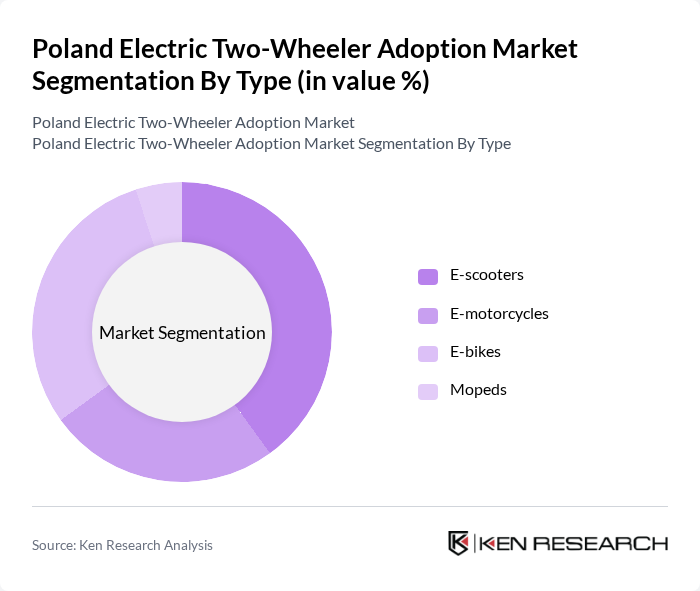
By Type:The market is segmented into various types of electric two-wheelers, including E-scooters, E-motorcycles, E-bikes, and Mopeds. Among these,E-scootershave gained significant popularity due to their convenience and ease of use in urban settings, especially for short-distance commuting.E-bikesare also witnessing a surge in demand as they cater to both recreational and commuting needs, supported by the expansion of shared mobility services and cycling infrastructure. The growing trend of shared mobility has further boosted the adoption of E-scooters and E-bikes, making them the leading subsegments in the market .
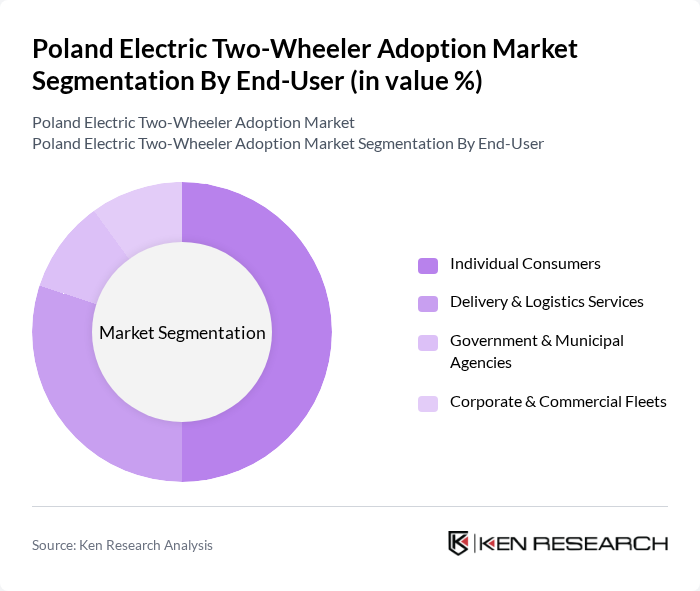
By End-User:The end-user segmentation includes Individual Consumers, Delivery & Logistics Services, Government & Municipal Agencies, and Corporate & Commercial Fleets.Individual Consumersrepresent the largest segment, driven by the increasing preference for personal electric mobility solutions and cost-effective commuting.Delivery & Logistics Servicesare expanding rapidly, as businesses seek to reduce operational costs and carbon footprints, with e-commerce growth accelerating demand for electric two-wheelers in urban delivery fleets. Government & Municipal Agencies and Corporate & Commercial Fleets are also adopting electric two-wheelers for sustainability initiatives and operational efficiency .
The Poland Electric Two-Wheeler Adoption Market is characterized by a dynamic mix of regional and international players. Leading participants such as Zipp, GreenWay Polska, Romet Motors, EcoBike, Vectrix, NIU Technologies, Super Soco, Yamaha Motor Poland, Piaggio Group, KTM AG, Honda Motor Co., Ltd., BMW Motorrad, Vespa (Piaggio), Energica Motor Company, Accell Group, Trek Bicycle Corporation, Specialized Bicycle Components contribute to innovation, geographic expansion, and service delivery in this space.
The future of the electric two-wheeler market in Poland appears promising, driven by increasing environmental awareness and government support. As urbanization continues, the demand for efficient and sustainable transportation solutions will likely rise. The expansion of charging infrastructure and technological advancements in battery efficiency will further enhance the appeal of electric two-wheelers. Additionally, the integration of smart technologies into electric vehicles is expected to attract tech-savvy consumers, fostering a more robust market environment in the coming years.
| Segment | Sub-Segments |
|---|---|
| By Type | E-scooters E-motorcycles E-bikes Mopeds |
| By End-User | Individual Consumers Delivery & Logistics Services Government & Municipal Agencies Corporate & Commercial Fleets |
| By Sales Channel | Online Retail Dealerships & Showrooms Direct Manufacturer Sales Rental & Sharing Platforms |
| By Price Range | Budget Segment (<5,000 PLN) Mid-Range Segment (5,000–12,000 PLN) Premium Segment (>12,000 PLN) |
| By Battery Type | Lithium-ion Lead-acid Nickel Metal Hydride & Others |
| By Usage Type | Personal Mobility Commercial/Delivery Use Shared Mobility Services |
| By Region | Central Poland (Mazowieckie, ?ódzkie) Northern Poland (Pomorskie, Warmi?sko-Mazurskie) Southern Poland (Ma?opolskie, ?l?skie) Western Poland (Wielkopolskie, Lubuskie) |
| Scope Item/Segment | Sample Size | Target Respondent Profiles |
|---|---|---|
| Potential Electric Two-Wheeler Buyers | 120 | Urban Commuters, Young Professionals |
| Current Electric Two-Wheeler Users | 80 | Existing Owners, Eco-conscious Consumers |
| Industry Experts and Analysts | 40 | Market Analysts, Industry Consultants |
| Government Officials and Policy Makers | 40 | Transport Policy Makers, Environmental Regulators |
| Dealers and Distributors of Electric Two-Wheelers | 60 | Sales Managers, Distribution Heads |
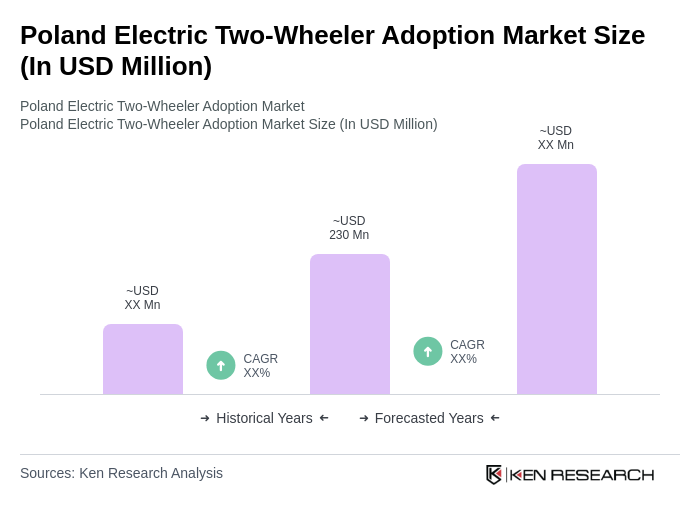
The Poland Electric Two-Wheeler Adoption Market is valued at approximately USD 230 million, reflecting a significant growth driven by urban congestion, government incentives, and increasing environmental awareness among consumers.

What makes us stand out is that our consultants follow Robust, Refine and Result (RRR) methodology. Robust for clear definitions, approaches and sanity checking, Refine for differentiating respondents' facts and opinions, and Result for presenting data with story.

We have set a benchmark in the industry by offering our clients with syndicated and customized market research reports featuring coverage of entire market as well as meticulous research and analyst insights.

While we don't replace traditional research, we flip the method upside down. Our dual approach of Top Bottom & Bottom Top ensures quality deliverable by not just verifying company fundamentals but also looking at the sector and macroeconomic factors.

With one step in the future, our research team constantly tries to show you the bigger picture. We help with some of the tough questions you may encounter along the way: How is the industry positioned? Best marketing channel? KPI's of competitors? By aligning every element, we help maximize success.

Our report gives you instant access to the answers and sources that other companies might choose to hide. We elaborate each steps of research methodology we have used and showcase you the sample size to earn your trust.

If you need any support, we are here! We pride ourselves on universe strength, data quality, and quick, friendly, and professional service.













