About the Report
Base Year 2024Portugal Real Estate and Housing Market Overview
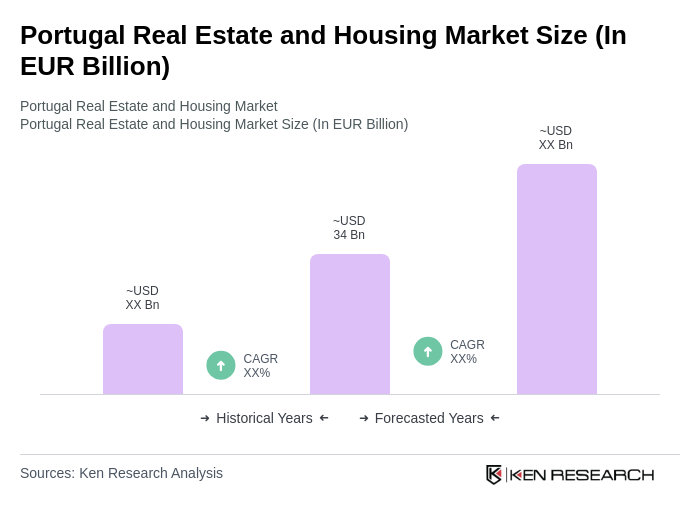
- The Portugal Real Estate and Housing Market is valued at approximately EUR 34 billion, based on a five-year historical analysis. This growth is primarily driven by increasing foreign investment, a booming tourism sector, and a growing demand for residential properties, particularly in urban areas. The market has seen a significant influx of international buyers, attracted by Portugal's favorable climate, lifestyle, and investment opportunities. Foreign buyers now account for over 80 percent of property investments, with foreign residents representing about 12 percent of the population .
- Key cities dominating the market include Lisbon, Porto, and the Algarve region. Lisbon stands out due to its vibrant culture, historical significance, and status as a tech hub, while Porto is known for its rich heritage and wine industry. The Algarve attracts both retirees and vacationers, making it a hotspot for luxury and vacation properties. These regions have seen pronounced price growth, with Lisbon and Porto recording average prices above EUR 3,000 per square metre, reflecting high demand among international investors .
- In 2023, the Portuguese government implemented the "Mais Habitação" (More Housing) Program, issued by the Assembleia da República, which aims to increase the availability of affordable housing. This initiative includes a commitment of EUR 1 billion to support the construction of social housing units and provide incentives for developers to focus on affordable projects, addressing the growing housing crisis in urban areas. The program mandates streamlined licensing, public-private partnerships, and direct subsidies for eligible developments .
Portugal Real Estate and Housing Market Segmentation
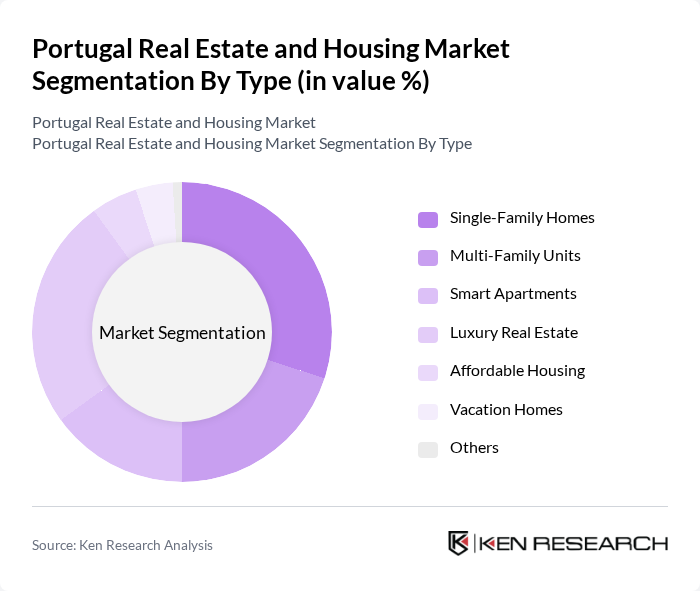
By Type:The market is segmented into various types, including Single-Family Homes, Multi-Family Units, Smart Apartments, Luxury Real Estate, Affordable Housing, Vacation Homes, and Others. Among these, Single-Family Homes and Luxury Real Estate are particularly popular due to the increasing demand for spacious living and high-end amenities. The trend towards Smart Apartments is also gaining traction as technology integration becomes a priority for modern buyers. Urban and coastal areas are seeing the fastest uptake of smart and luxury properties, while affordable housing remains a focus in government-backed projects .
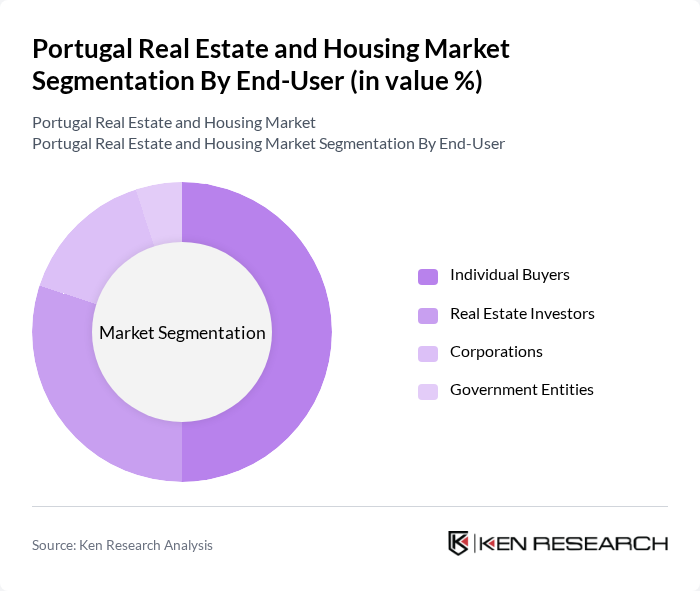
By End-User:The end-user segmentation includes Individual Buyers, Real Estate Investors, Corporations, and Government Entities. Individual Buyers and Real Estate Investors dominate the market, driven by the desire for home ownership and investment opportunities. The trend of purchasing properties for rental income has also surged, particularly in tourist-heavy areas, making this segment a key player in the market. Short-term rental demand and buy-to-let investments are especially strong in Lisbon, Porto, and the Algarve .
Portugal Real Estate and Housing Market Competitive Landscape
The Portugal Real Estate and Housing Market is characterized by a dynamic mix of regional and international players. Leading participants such as Remax Portugal, Century 21 Portugal, ERA Portugal, Sotheby's International Realty Portugal, Engel & Völkers Portugal, Predibisa, JLL Portugal, CBRE Portugal, Savills Portugal, Grupo Casais, Sonae Sierra, Mota-Engil Real Estate, Teixeira Duarte, Vanguard Properties, Habitat Invest, LUXIMO'S Christie's International Real Estate, Idealista, BPI Expresso Imobiliário, Cushman & Wakefield Portugal, Lx Living contribute to innovation, geographic expansion, and service delivery in this space.
Portugal Real Estate and Housing Market Industry Analysis
Growth Drivers
- Economic Recovery:The Portuguese economy is projected to grow by 2.4% in future, driven by increased consumer spending and a rebound in tourism, which is expected to reach 22 million visitors. This economic recovery enhances disposable income, leading to higher demand for housing. Additionally, the unemployment rate is forecasted to drop to 6.2%, further boosting consumer confidence and home purchasing power, thereby stimulating the real estate market.
- Foreign Investment Surge:In future, foreign direct investment (FDI) in Portugal's real estate sector is anticipated to exceed €3.5 billion, reflecting a growing interest from international buyers. The Golden Visa program continues to attract non-EU investors, with over 1,200 visas issued in the first half of future alone. This influx of capital not only supports property prices but also encourages new developments, enhancing the overall market landscape.
- Urbanization Trends:Urbanization in Portugal is accelerating, with over 67% of the population now residing in urban areas. This trend is expected to drive demand for housing in cities like Lisbon and Porto, where population growth is projected at 1.7% annually. The increasing preference for urban living, coupled with improved infrastructure and public transport, is likely to create a robust demand for residential properties, particularly in metropolitan regions.
Market Challenges
- Rising Property Prices:Property prices in Portugal have surged by approximately 8.5% year-on-year, with the average price per square meter in Lisbon reaching €4,000. This rapid increase poses affordability challenges for local buyers, particularly first-time homeowners. The disparity between income growth and housing costs is creating a barrier to entry for many, potentially leading to a slowdown in market activity if prices continue to escalate.
- Regulatory Hurdles:The real estate sector faces significant regulatory challenges, including complex zoning laws and lengthy approval processes for new developments. In future, it is estimated that over 35% of proposed projects face delays due to bureaucratic inefficiencies. These hurdles can deter investment and slow down the pace of new housing supply, exacerbating the existing housing shortage in key urban areas.
Portugal Real Estate and Housing Market Future Outlook
The future of the Portugal real estate market appears promising, driven by ongoing economic recovery and sustained foreign investment. As urbanization continues, demand for housing in metropolitan areas is expected to rise, particularly for affordable and sustainable options. However, addressing regulatory challenges and rising property prices will be crucial for maintaining market stability. The integration of technology in real estate transactions is likely to enhance efficiency, making the market more accessible to a broader range of buyers and investors.
Market Opportunities
- Growth in Rental Market:The rental market in Portugal is projected to expand significantly, with rental prices in Lisbon increasing by 7.5%. This growth is driven by a rising number of expatriates and digital nomads seeking temporary housing solutions. Investors can capitalize on this trend by developing rental properties that cater to this demographic, ensuring high occupancy rates and steady income streams.
- Development of Sustainable Housing:There is a growing demand for eco-friendly housing solutions, with over 45% of buyers expressing interest in sustainable properties. The government’s commitment to reducing carbon emissions by 55% by 2030 supports this trend. Developers focusing on green building practices can tap into this market, attracting environmentally conscious consumers and potentially benefiting from government incentives.
Scope of the Report
| Segment | Sub-Segments |
|---|---|
| By Type | Single-Family Homes Multi-Family Units Smart Apartments Luxury Real Estate Affordable Housing Vacation Homes Others |
| By End-User | Individual Buyers Real Estate Investors Corporations Government Entities |
| By Price Range | Low-End Properties Mid-Range Properties High-End Properties |
| By Location | Lisbon Metropolitan Area Porto and Northern Portugal Algarve Cascais and Portuguese Riviera Silver Coast and Comporta Braga and Inland Regions |
| By Property Size | Small Properties Medium Properties Large Properties |
| By Investment Type | Direct Purchases Real Estate Investment Trusts (REITs) Crowdfunding |
| By Development Stage | Pre-Construction Under Construction Completed |
Key Target Audience
Investors and Venture Capitalist Firms
Government and Regulatory Bodies (e.g., Instituto da Habitação e da Reabilitação Urbana, Câmara Municipal de Lisboa)
Real Estate Developers
Property Management Companies
Construction Firms
Financial Institutions (e.g., Banco de Portugal)
Real Estate Investment Trusts (REITs)
Local and Regional Planning Authorities
Players Mentioned in the Report:
Remax Portugal
Century 21 Portugal
ERA Portugal
Sotheby's International Realty Portugal
Engel & Volkers Portugal
Predibisa
JLL Portugal
CBRE Portugal
Savills Portugal
Grupo Casais
Sonae Sierra
Mota-Engil Real Estate
Teixeira Duarte
Vanguard Properties
Habitat Invest
LUXIMO'S Christie's International Real Estate
Idealista
BPI Expresso Imobiliario
Cushman & Wakefield Portugal
Lx Living
Table of Contents
Market Assessment Phase
1. Executive Summary and Approach
2. Portugal Real Estate and Housing Market Overview
2.1 Key Insights and Strategic Recommendations
2.2 Portugal Real Estate and Housing Market Overview
2.3 Definition and Scope
2.4 Evolution of Market Ecosystem
2.5 Timeline of Key Regulatory Milestones
2.6 Value Chain & Stakeholder Mapping
2.7 Business Cycle Analysis
2.8 Policy & Incentive Landscape
3. Portugal Real Estate and Housing Market Analysis
3.1 Growth Drivers
3.1.1 Economic Recovery and Growth
3.1.2 Increased Foreign Investment
3.1.3 Urbanization Trends
3.1.4 Government Incentives for Homebuyers
3.2 Market Challenges
3.2.1 Rising Property Prices
3.2.2 Regulatory Hurdles
3.2.3 Limited Housing Supply
3.2.4 Economic Uncertainty
3.3 Market Opportunities
3.3.1 Growth in Rental Market
3.3.2 Development of Sustainable Housing
3.3.3 Expansion of Smart Home Technologies
3.3.4 Increasing Demand for Vacation Rentals
3.4 Market Trends
3.4.1 Shift Towards Remote Work
3.4.2 Rise of Co-Living Spaces
3.4.3 Focus on Eco-Friendly Developments
3.4.4 Digital Transformation in Real Estate Transactions
3.5 Government Regulation3.5.1 Housing Tax Reforms3.5.2 Zoning Law Changes3.5.3 Rental Market Regulations3.5.4 Building Code Updates4. SWOT Analysis5. Stakeholder Analysis6. Porter's Five Forces Analysis7. Portugal Real Estate and Housing Market Market Size, 2019-20247.1 By Value7.2 By Volume7.3 By Average Selling Price8. Portugal Real Estate and Housing Market Segmentation8.1 By Type8.1.1 Single-Family Homes8.1.2 Multi-Family Units8.1.3 Smart Apartments8.1.4 Luxury Real Estate8.1.5 Affordable Housing8.1.6 Vacation Homes8.1.7 Others8.2 By End-User8.2.1 Individual Buyers8.2.2 Real Estate Investors8.2.3 Corporations8.2.4 Government Entities8.3 By Price Range8.3.1 Low-End Properties8.3.2 Mid-Range Properties8.3.3 High-End Properties8.4 By Location8.4.1 Lisbon Metropolitan Area8.4.2 Porto and Northern Portugal8.4.3 Algarve8.4.4 Cascais and Portuguese Riviera8.4.5 Silver Coast and Comporta8.4.6 Braga and Inland Regions8.5 By Property Size8.5.1 Small Properties8.5.2 Medium Properties8.5.3 Large Properties8.6 By Investment Type8.6.1 Direct Purchases8.6.2 Real Estate Investment Trusts (REITs)8.6.3 Crowdfunding8.7 By Development Stage8.7.1 Pre-Construction8.7.2 Under Construction8.7.3 Completed9. Portugal Real Estate and Housing Market Competitive Analysis9.1 Market Share of Key Players9.2 Cross Comparison of Key Players9.2.1 Company Name9.2.2 Group Size (Large, Medium, or Small as per industry convention)9.2.3 Revenue (EUR, latest available)9.2.4 Revenue Growth Rate (%)9.2.5 Market Share (%)9.2.6 Number of Transactions (Annual)9.2.7 Average Time on Market (Days)9.2.8 Average Price per Square Meter (EUR/m²)9.2.9 Return on Investment (ROI, %)9.2.10 Occupancy Rate (%)9.2.11 Customer Satisfaction Index (Net Promoter Score or equivalent)9.2.12 Geographic Coverage (Regions/Key Cities)9.2.13 Portfolio Mix (Residential, Commercial, etc.)9.2.14 Digitalization Level (e.g., PropTech adoption)9.3 SWOT Analysis of Top Players9.4 Pricing Analysis9.5 Detailed Profile of Major Companies9.5.1 Remax Portugal9.5.2 Century 21 Portugal9.5.3 ERA Portugal9.5.4 Sotheby's International Realty Portugal9.5.5 Engel & Völkers Portugal9.5.6 Predibisa9.5.7 JLL Portugal9.5.8 CBRE Portugal9.5.9 Savills Portugal9.5.10 Grupo Casais9.5.11 Sonae Sierra9.5.12 Mota-Engil Real Estate9.5.13 Teixeira Duarte9.5.14 Vanguard Properties9.5.15 Habitat Invest9.5.16 LUXIMO'S Christie's International Real Estate9.5.17 Idealista9.5.18 BPI Expresso Imobiliário9.5.19 Cushman & Wakefield Portugal9.5.20 Lx Living10. Portugal Real Estate and Housing Market End-User Analysis10.1 Procurement Behavior of Key Ministries10.1.1 Ministry of Infrastructure10.1.2 Ministry of Housing10.1.3 Ministry of Finance10.2 Corporate Spend on Infrastructure & Energy10.2.1 Corporate Real Estate Investments10.2.2 Public-Private Partnerships10.2.3 Infrastructure Development Projects10.3 Pain Point Analysis by End-User Category10.3.1 Homebuyers10.3.2 Real Estate Investors10.3.3 Developers10.4 User Readiness for Adoption10.4.1 Technology Adoption in Real Estate10.4.2 Market Awareness10.4.3 Financial Readiness10.5 Post-Deployment ROI and Use Case Expansion10.5.1 ROI Measurement Techniques10.5.2 Use Case Scenarios10.5.3 Long-Term Value Assessment11. Portugal Real Estate and Housing Market Future Size, 2025-203011.1 By Value11.2 By Volume11.3 By Average Selling PriceGo-To-Market Strategy Phase1. Whitespace Analysis + Business Model Canvas1.1 Market Gaps Identification1.2 Business Model Framework1.3 Value Proposition Canvas1.4 Competitive Landscape Analysis1.5 Customer Segmentation1.6 Revenue Streams1.7 Cost Structure2. Marketing and Positioning Recommendations2.1 Branding Strategies2.2 Product USPs2.3 Target Audience Identification2.4 Marketing Channels2.5 Communication Strategy2.6 Performance Metrics3. Distribution Plan3.1 Urban Retail Strategies3.2 Rural NGO Tie-Ups3.3 Online vs Offline Distribution3.4 Partnership Opportunities3.5 Logistics and Supply Chain4. Channel & Pricing Gaps4.1 Underserved Routes4.2 Pricing Bands4.3 Competitive Pricing Analysis4.4 Customer Perception of Value4.5 Price Sensitivity Analysis5. Unmet Demand & Latent Needs5.1 Category Gaps5.2 Consumer Segments5.3 Emerging Trends5.4 Future Demand Projections5.5 Customer Feedback Mechanisms6. Customer Relationship6.1 Loyalty Programs6.2 After-Sales Service6.3 Customer Engagement Strategies6.4 Feedback and Improvement Loops6.5 Relationship Management Tools7. Value Proposition7.1 Sustainability Initiatives7.2 Integrated Supply Chains7.3 Unique Selling Points7.4 Customer-Centric Innovations7.5 Competitive Advantages8. Key Activities8.1 Regulatory Compliance8.2 Branding Initiatives8.3 Distribution Setup8.4 Market Research Activities8.5 Training and Development9. Entry Strategy Evaluation9.1 Domestic Market Entry Strategy9.1.1 Product Mix9.1.2 Pricing Band9.1.3 Packaging9.2 Export Entry Strategy9.2.1 Target Countries9.2.2 Compliance Roadmap10. Entry Mode Assessment10.1 Joint Ventures10.2 Greenfield Investments10.3 Mergers & Acquisitions10.4 Distributor Model11. Capital and Timeline Estimation11.1 Capital Requirements11.2 Timelines12. Control vs Risk Trade-Off12.1 Ownership vs Partnerships13. Profitability Outlook13.1 Breakeven Analysis13.2 Long-Term Sustainability14. Potential Partner List14.1 Distributors14.2 Joint Ventures14.3 Acquisition Targets15. Execution Roadmap15.1 Phased Plan for Market Entry15.1.1 Market Setup15.1.2 Market Entry15.1.3 Growth Acceleration15.1.4 Scale & Stabilize15.2 Key Activities and Milestones15.2.1 Milestone Planning15.2.2 Activity TrackingDisclaimerContact Us```
Research Methodology
Phase 1: Approach1
Desk Research
- Analysis of national housing reports from the Instituto Nacional de Estatística (INE)
- Review of real estate market trends from the Portuguese Real Estate Association (APEMIP)
- Examination of economic indicators and forecasts from Banco de Portugal
Primary Research
- Interviews with real estate agents and brokers operating in key urban areas
- Surveys with property developers regarding current projects and market sentiment
- Focus groups with potential homebuyers to understand preferences and concerns
Validation & Triangulation
- Cross-validation of findings with data from local government housing initiatives
- Triangulation of market insights from real estate professionals and economic reports
- Sanity checks through expert panel discussions with economists and urban planners
Phase 2: Market Size Estimation1
Top-down Assessment
- Estimation of total housing stock based on national census data
- Analysis of housing demand driven by population growth and urbanization trends
- Incorporation of foreign investment trends in the Portuguese real estate market
Bottom-up Modeling
- Data collection on average property prices across different regions
- Estimation of transaction volumes based on historical sales data
- Calculation of market value by multiplying average prices with estimated sales
Forecasting & Scenario Analysis
- Multi-factor regression analysis incorporating interest rates, employment rates, and GDP growth
- Scenario modeling based on potential changes in housing policies and tax regulations
- Development of baseline, optimistic, and pessimistic market forecasts through 2030
Phase 3: CATI Sample Composition1
| Scope Item/Segment | Sample Size | Target Respondent Profiles |
|---|---|---|
| Urban Residential Market | 120 | Real Estate Agents, Homebuyers |
| Commercial Real Estate Sector | 60 | Property Developers, Investors |
| Rental Market Dynamics | 50 | Landlords, Property Managers |
| Foreign Investment Trends | 40 | International Investors, Real Estate Consultants |
| First-time Homebuyers Insights | 70 | Potential Homebuyers, Financial Advisors |
Frequently Asked Questions
What is the current value of the Portugal real estate market?
The Portugal real estate and housing market is valued at approximately EUR 34 billion, driven by increasing foreign investment, a booming tourism sector, and a growing demand for residential properties, particularly in urban areas.
Which cities are the most popular for real estate investment in Portugal?
How has foreign investment impacted the Portugal housing market?
What is the "Mais Habitação" program in Portugal?
Other Regional/Country Reports
Indonesia Real Estate and Housing Market
Malaysia Real Estate and Housing Market
APAC Real Estate and Housing Market
Other Adjacent Reports
Egypt Residential Construction Market
South Africa Commercial Real Estate Market
Vietnam Property Management Services Market
KSA Mortgage Finance Market
Egypt Home Insurance Market
Belgium Building Materials Market
Thailand Interior Design Market
Kuwait Sustainable Housing Development Market
UAE Tourism Accommodation Market
Belgium PropTech Solutions Market
Why Buy From Us?

What makes us stand out is that our consultants follow Robust, Refine and Result (RRR) methodology. Robust for clear definitions, approaches and sanity checking, Refine for differentiating respondents' facts and opinions, and Result for presenting data with story.

We have set a benchmark in the industry by offering our clients with syndicated and customized market research reports featuring coverage of entire market as well as meticulous research and analyst insights.

While we don't replace traditional research, we flip the method upside down. Our dual approach of Top Bottom & Bottom Top ensures quality deliverable by not just verifying company fundamentals but also looking at the sector and macroeconomic factors.

With one step in the future, our research team constantly tries to show you the bigger picture. We help with some of the tough questions you may encounter along the way: How is the industry positioned? Best marketing channel? KPI's of competitors? By aligning every element, we help maximize success.

Our report gives you instant access to the answers and sources that other companies might choose to hide. We elaborate each steps of research methodology we have used and showcase you the sample size to earn your trust.

If you need any support, we are here! We pride ourselves on universe strength, data quality, and quick, friendly, and professional service.