About the Report
Base Year 2024Qatar Aerospace Parts Manufacturing Market Overview
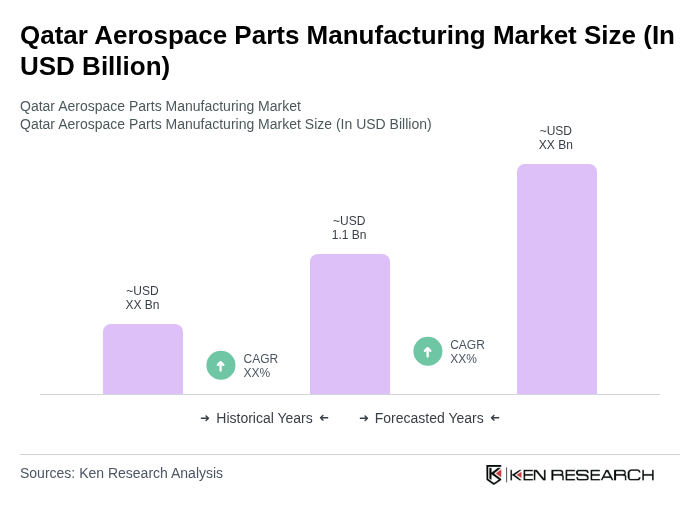
- The Qatar Aerospace Parts Manufacturing Market is valued at USD 1.1 billion, based on a five-year historical analysis, aligned with the broader growth of the global aerospace parts manufacturing industry and Qatar’s aviation expansion. This growth is primarily driven by the increasing demand for aircraft parts due to the expansion of the aviation sector, led by Qatar Airways’ fleet growth and Hamad International Airport’s hub role, coupled with government initiatives to enhance local manufacturing capabilities and reduce reliance on imports through industrial support, free-zone incentives, and SME programs.
- Key locations supporting this market include Doha, which serves as a central hub for international aviation through Hamad International Airport, and the Ras Bufontas Free Zone, strategically located adjacent to the airport. These locations benefit from advanced air?cargo and MRO infrastructure, skilled aviation and engineering labor, and favorable government policies such as 100% foreign ownership, customs duty exemptions, and long?term lease options for high?tech manufacturers that promote aerospace and advanced manufacturing activities.
- Qatar’s government is supporting local aerospace?related manufacturing through broader industrial and investment frameworks, including the Law on the Qatar Free Zones issued under Law No. 34 of 2005 by the State of Qatar, which empowers the Qatar Free Zones Authority to license manufacturing activities, grant customs and tax exemptions, and set technical and operational requirements for companies operating in zones such as Ras Bufontas and Umm Alhoul, thereby encouraging localization of high?value aerospace components and related supply?chain activities. While these frameworks promote local content and technology transfer, publicly available sources do not specify a mandatory fixed percentage such as a 30% local sourcing requirement for aerospace parts used in domestic aircraft; instead, incentives and program criteria are used to attract and develop manufacturing investments.
Qatar Aerospace Parts Manufacturing Market Segmentation
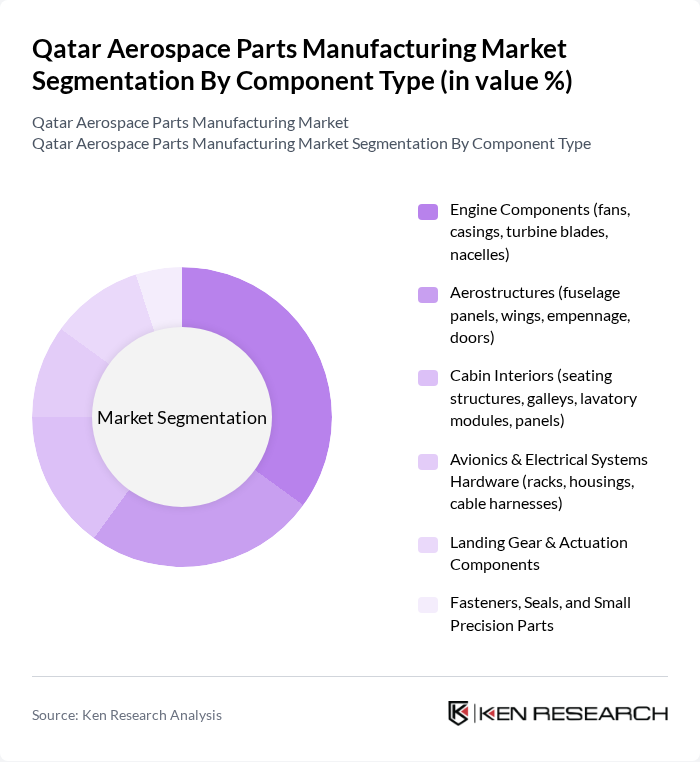
By Component Type:The component type segmentation includes various subsegments such as engine components, aerostructures, cabin interiors, avionics and electrical systems hardware, landing gear and actuation components, and fasteners, seals, and small precision parts. This structure is consistent with global aerospace parts manufacturing classifications, where major part families are typically grouped into engines, aerostructures, avionics, interiors, and landing gear/actuation systems. At a global level, aerostructures currently hold the largest share of the parts market, driven by extensive use of advanced composites and large structural assemblies; however, engine components remain a critical value?intensive subsegment due to high technology content and ongoing investment in fuel?efficient propulsion systems. In Qatar, the component mix is influenced by the country’s role as an aviation hub, the presence of engine and component logistics and repair flows via Qatar Airways Cargo’s Aerospace product, and incentives for advanced manufacturing, supporting activity across both engine?related parts and aerostructures, as well as high?specification interiors and avionics hardware.
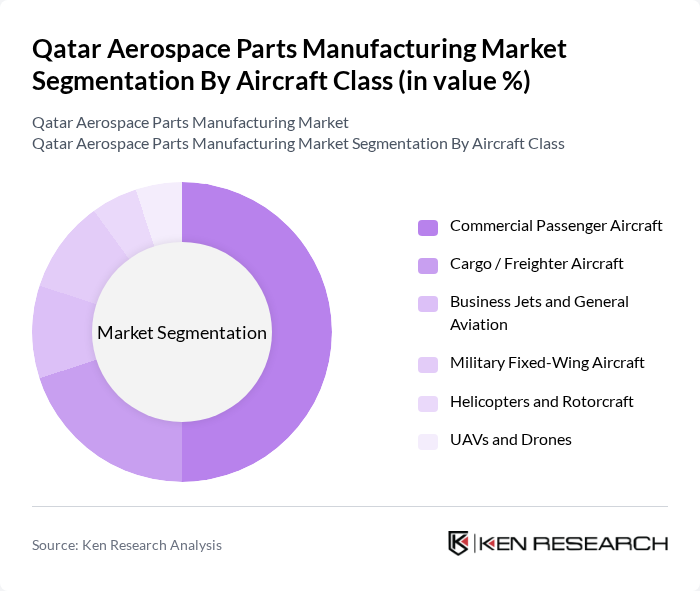
By Aircraft Class:The aircraft class segmentation encompasses commercial passenger aircraft, cargo/freighter aircraft, business jets and general aviation, military fixed-wing aircraft, helicopters and rotorcraft, and UAVs and drones. This segmentation aligns with global aerospace parts demand patterns in which commercial and cargo aircraft account for the majority of parts consumption, followed by military platforms and rotorcraft. In Qatar, the commercial passenger aircraft segment is leading the market, driven by the strong rebound and continued growth of international air travel through Hamad International Airport, Qatar Airways’ ongoing fleet optimization, and the country’s positioning as a long?haul transit hub. This segment's growth is further supported by the global shift toward more fuel?efficient and environmentally friendly aircraft, which increases demand for next?generation parts, lightweight materials, and upgraded systems supplied into fleets operating in and through Qatar.
Qatar Aerospace Parts Manufacturing Market Competitive Landscape
The Qatar Aerospace Parts Manufacturing Market is characterized by a dynamic mix of regional and international players. Leading participants such as Qatar Airways Group (including Qatar Airways and Qatar Airways Cargo – AEROSPACE product), Qatar Aviation Services, Gulf Helicopters Company, Qatar Aircraft Catering Company (QACC), Hamad International Airport (MATAR), Qatar Free Zones Authority (Ras Bufontas and Umm Alhoul), Qatar Science & Technology Park (QSTP), Qatar Development Bank (including Industrial and SME Support Programs), Qatar Civil Aviation Authority, Qatar Armed Forces / Barzan Holdings (defence and aerospace industrial initiatives), Milaha – Qatar Navigation Q.P.S.C. (industrial logistics and project cargo), GWC (Gulf Warehousing Company Q.P.S.C.), Qatar Industrial Manufacturing Company Q.P.S.C. (QIMC), Doha Cables / local precision metal and cable manufacturers serving aerospace projects, Selected International Aerospace OEMs and Tier?1s with Operations or Partnerships in Qatar (e.g., Collins Aerospace, Rolls?Royce, GE Aerospace – where present via service or JV structures) contribute to innovation, geographic expansion, and service delivery in this space.
Qatar Aerospace Parts Manufacturing Market Industry Analysis
Growth Drivers
- Increasing Demand for Aircraft Maintenance and Repair Services:The Qatar aerospace parts manufacturing market is significantly driven by the rising demand for aircraft maintenance and repair services, which is projected to reach QAR 1.8 billion in future. This growth is fueled by the increasing number of aircraft in operation, which is expected to exceed 350 in future, necessitating regular maintenance and parts replacement to ensure safety and compliance with international standards.
- Expansion of Qatar's Aviation Sector:Qatar's aviation sector is experiencing rapid expansion, with Hamad International Airport projected to handle over 60 million passengers annually in future. This growth is supported by Qatar Airways' fleet expansion, which aims to increase its fleet size to 300 aircraft. This surge in air traffic and fleet size directly correlates with the increased demand for aerospace parts manufacturing, creating a robust market environment.
- Government Investments in Aerospace Infrastructure:The Qatari government is heavily investing in aerospace infrastructure, with an estimated QAR 12 billion allocated for the development of new facilities and upgrades in future. This investment includes the establishment of aerospace parks and manufacturing hubs, which are expected to enhance local production capabilities and attract foreign investment, thereby stimulating the aerospace parts manufacturing market.
Market Challenges
- High Initial Capital Investment:One of the significant challenges facing the Qatar aerospace parts manufacturing market is the high initial capital investment required, estimated at around QAR 600 million for setting up a manufacturing facility. This financial barrier can deter new entrants and limit the growth of local manufacturers, as they struggle to secure funding and resources necessary for establishing competitive operations.
- Stringent Regulatory Compliance Requirements:The aerospace industry in Qatar is subject to stringent regulatory compliance requirements, including adherence to international aviation safety standards. Compliance costs can reach up to QAR 120 million for manufacturers, creating a significant burden on smaller firms. This regulatory landscape can hinder operational flexibility and increase the time to market for new aerospace parts.
Qatar Aerospace Parts Manufacturing Market Future Outlook
The future outlook for the Qatar aerospace parts manufacturing market appears promising, driven by ongoing advancements in technology and increasing regional air travel. The shift towards additive manufacturing and digital transformation is expected to enhance production efficiency and reduce costs. Additionally, the growing emphasis on sustainability will likely lead to the development of eco-friendly materials, positioning Qatar as a competitive player in the global aerospace supply chain in future.
Market Opportunities
- Partnerships with International Aerospace Firms:Collaborating with established international aerospace firms presents a significant opportunity for local manufacturers. Such partnerships can facilitate technology transfer and enhance local expertise, potentially increasing production capacity and market reach, thereby positioning Qatar as a key player in the global aerospace parts supply chain.
- Development of Eco-Friendly Aerospace Materials:The increasing focus on sustainability opens avenues for the development of eco-friendly aerospace materials. By investing in research and development of sustainable materials, local manufacturers can meet the growing demand for environmentally responsible products, enhancing their competitive edge and aligning with global industry trends towards sustainability.
Scope of the Report
| Segment | Sub-Segments |
|---|---|
| By Component Type | Engine Components (fans, casings, turbine blades, nacelles) Aerostructures (fuselage panels, wings, empennage, doors) Cabin Interiors (seating structures, galleys, lavatory modules, panels) Avionics & Electrical Systems Hardware (racks, housings, cable harnesses) Landing Gear & Actuation Components Fasteners, Seals, and Small Precision Parts |
| By Aircraft Class | Commercial Passenger Aircraft Cargo / Freighter Aircraft Business Jets and General Aviation Military Fixed-Wing Aircraft Helicopters and Rotorcraft UAVs and Drones |
| By Production & Service Application | OEM Production (line-fit parts) Licensed Parts Production (PMAs, OEM-approved) Maintenance, Repair and Overhaul (MRO) Parts Supply Retrofit & Upgrade Programs Prototyping & Low-Volume Custom Parts |
| By Material | Aluminum and Aluminum Alloys Titanium and High-Temperature Alloys Carbon-Fiber and Glass-Fiber Composites Steel and Nickel-Based Alloys High-Performance Polymers and Other Advanced Materials |
| By Manufacturing Technology | CNC Machining and Precision Milling Additive Manufacturing / 3D Printing Casting and Metal Injection Molding Forging and Extrusion Surface Treatment, Coating and Finishing |
| By Customer Type / Distribution Channel | Direct Supply to Airlines (e.g., Qatar Airways, foreign carriers) Supply to Global OEMs and Tier?1 Integrators Supply to MRO Providers and Engineering Service Firms Distributors and Trading Companies E?procurement and Online Platforms |
| By Location of Production / Industrial Zone | Ras Bufontas Free Zone (Adjacent to Hamad International Airport) Umm Alhoul Free Zone Mesaieed Industrial Area Other Industrial Estates within Qatar |
Key Target Audience
Investors and Venture Capitalist Firms
Government and Regulatory Bodies (e.g., Qatar Civil Aviation Authority, Qatar Investment Authority)
Aerospace Manufacturers and Producers
Suppliers and Distributors of Aerospace Components
Maintenance, Repair, and Overhaul (MRO) Service Providers
Aerospace Industry Associations
Financial Institutions and Banks
Logistics and Supply Chain Management Companies
Players Mentioned in the Report:
Qatar Airways Group (including Qatar Airways and Qatar Airways Cargo AEROSPACE product)
Qatar Aviation Services
Gulf Helicopters Company
Qatar Aircraft Catering Company (QACC)
Hamad International Airport (MATAR)
Qatar Free Zones Authority (Ras Bufontas and Umm Alhoul)
Qatar Science & Technology Park (QSTP)
Qatar Development Bank (including Industrial and SME Support Programs)
Qatar Civil Aviation Authority
Qatar Armed Forces / Barzan Holdings (defence and aerospace industrial initiatives)
Milaha Qatar Navigation Q.P.S.C. (industrial logistics and project cargo)
GWC (Gulf Warehousing Company Q.P.S.C.)
Qatar Industrial Manufacturing Company Q.P.S.C. (QIMC)
Doha Cables / local precision metal and cable manufacturers serving aerospace projects
Selected International Aerospace OEMs and Tier1s with Operations or Partnerships in Qatar (e.g., Collins Aerospace, RollsRoyce, GE Aerospace where present via service or JV structures)
Table of Contents
Market Assessment Phase
1. Executive Summary and Approach
2. Qatar Aerospace Parts Manufacturing Market Overview
2.1 Key Insights and Strategic Recommendations
2.2 Qatar Aerospace Parts Manufacturing Market Overview
2.3 Definition and Scope
2.4 Evolution of Market Ecosystem
2.5 Timeline of Key Regulatory Milestones
2.6 Value Chain & Stakeholder Mapping
2.7 Business Cycle Analysis
2.8 Policy & Incentive Landscape
3. Qatar Aerospace Parts Manufacturing Market Analysis
3.1 Growth Drivers
3.1.1 Increasing demand for aircraft maintenance and repair services
3.1.2 Expansion of Qatar's aviation sector
3.1.3 Government investments in aerospace infrastructure
3.1.4 Technological advancements in manufacturing processes
3.2 Market Challenges
3.2.1 High initial capital investment
3.2.2 Stringent regulatory compliance requirements
3.2.3 Limited skilled workforce
3.2.4 Supply chain disruptions
3.3 Market Opportunities
3.3.1 Growth in regional air travel
3.3.2 Partnerships with international aerospace firms
3.3.3 Development of eco-friendly aerospace materials
3.3.4 Expansion into emerging markets
3.4 Market Trends
3.4.1 Shift towards additive manufacturing
3.4.2 Increasing focus on sustainability
3.4.3 Digital transformation in manufacturing
3.4.4 Rise of unmanned aerial vehicles (UAVs)
3.5 Government Regulation
3.5.1 Compliance with international aviation safety standards
3.5.2 Local content requirements for manufacturing
3.5.3 Environmental regulations on emissions
3.5.4 Incentives for R&D in aerospace technologies
4. SWOT Analysis
5. Stakeholder Analysis
6. Porter's Five Forces Analysis
7. Qatar Aerospace Parts Manufacturing Market Size, 2019-2024
7.1 By Value
7.2 By Volume
7.3 By Average Selling Price
8. Qatar Aerospace Parts Manufacturing Market Segmentation
8.1 By Component Type
8.1.1 Engine Components (fans, casings, turbine blades, nacelles)
8.1.2 Aerostructures (fuselage panels, wings, empennage, doors)
8.1.3 Cabin Interiors (seating structures, galleys, lavatory modules, panels)
8.1.4 Avionics & Electrical Systems Hardware (racks, housings, cable harnesses)
8.1.5 Landing Gear & Actuation Components
8.1.6 Fasteners, Seals, and Small Precision Parts
8.2 By Aircraft Class
8.2.1 Commercial Passenger Aircraft
8.2.2 Cargo / Freighter Aircraft
8.2.3 Business Jets and General Aviation
8.2.4 Military Fixed-Wing Aircraft
8.2.5 Helicopters and Rotorcraft
8.2.6 UAVs and Drones
8.3 By Production & Service Application
8.3.1 OEM Production (line-fit parts)
8.3.2 Licensed Parts Production (PMAs, OEM-approved)
8.3.3 Maintenance, Repair and Overhaul (MRO) Parts Supply
8.3.4 Retrofit & Upgrade Programs
8.3.5 Prototyping & Low-Volume Custom Parts
8.4 By Material
8.4.1 Aluminum and Aluminum Alloys
8.4.2 Titanium and High-Temperature Alloys
8.4.3 Carbon-Fiber and Glass-Fiber Composites
8.4.4 Steel and Nickel-Based Alloys
8.4.5 High-Performance Polymers and Other Advanced Materials
8.5 By Manufacturing Technology
8.5.1 CNC Machining and Precision Milling
8.5.2 Additive Manufacturing / 3D Printing
8.5.3 Casting and Metal Injection Molding
8.5.4 Forging and Extrusion
8.5.5 Surface Treatment, Coating and Finishing
8.6 By Customer Type / Distribution Channel
8.6.1 Direct Supply to Airlines (e.g., Qatar Airways, foreign carriers)
8.6.2 Supply to Global OEMs and Tier?1 Integrators
8.6.3 Supply to MRO Providers and Engineering Service Firms
8.6.4 Distributors and Trading Companies
8.6.5 E?procurement and Online Platforms
8.7 By Location of Production / Industrial Zone
8.7.1 Ras Bufontas Free Zone (Adjacent to Hamad International Airport)
8.7.2 Umm Alhoul Free Zone
8.7.3 Mesaieed Industrial Area
8.7.4 Other Industrial Estates within Qatar
9. Qatar Aerospace Parts Manufacturing Market Competitive Analysis
9.1 Market Share of Key Players
9.2 Cross Comparison of Key Players
9.2.1 Company Name
9.2.2 Group Size (Global Tier?1, Tier?2, Local SME)
9.2.3 Regional Aerospace Revenue (Qatar / GCC, latest year)
9.2.4 3–5 Year Aerospace Revenue CAGR
9.2.5 Share of Revenue from Aerospace Parts Manufacturing
9.2.6 Installed Production Capacity in Qatar (tons or equivalent part output per year)
9.2.7 Capacity Utilization Rate
9.2.8 Order Backlog / Long?Term Supply Agreements (years of coverage)
9.2.9 Certification Footprint (AS9100, NADCAP, OEM approvals – number of valid certifications)
9.2.10 R&D Intensity (R&D as % of sales) and Number of Active Development Programs
9.2.11 On?Time Delivery (OTD) Performance and Lead Time (days) for Key Part Families
9.2.12 Local Value Addition in Qatar (% of total cost)
9.2.13 Exposure to Key End?Users (Qatar Airways, defence, business aviation) and Customer Concentration
9.3 SWOT Analysis of Top Players
9.4 Pricing Analysis
9.5 Detailed Profile of Major Companies
9.5.1 Qatar Airways Group (including Qatar Airways and Qatar Airways Cargo – AEROSPACE product)
9.5.2 Qatar Aviation Services
9.5.3 Gulf Helicopters Company
9.5.4 Qatar Aircraft Catering Company (QACC)
9.5.5 Hamad International Airport (MATAR)
9.5.6 Qatar Free Zones Authority (Ras Bufontas and Umm Alhoul)
9.5.7 Qatar Science & Technology Park (QSTP)
9.5.8 Qatar Development Bank (including Industrial and SME Support Programs)
9.5.9 Qatar Civil Aviation Authority
9.5.10 Qatar Armed Forces / Barzan Holdings (defence and aerospace industrial initiatives)
9.5.11 Milaha – Qatar Navigation Q.P.S.C. (industrial logistics and project cargo)
9.5.12 GWC (Gulf Warehousing Company Q.P.S.C.)
9.5.13 Qatar Industrial Manufacturing Company Q.P.S.C. (QIMC)
9.5.14 Doha Cables / local precision metal and cable manufacturers serving aerospace projects
9.5.15 Selected International Aerospace OEMs and Tier?1s with Operations or Partnerships in Qatar (e.g., Collins Aerospace, Rolls?Royce, GE Aerospace – where present via service or JV structures)
10. Qatar Aerospace Parts Manufacturing Market End-User Analysis
10.1 Procurement Behavior of Key Ministries
10.1.1 Ministry of Transport and Communications
10.1.2 Ministry of Defense
10.1.3 Ministry of Economy and Commerce
10.1.4 Others
10.2 Corporate Spend on Infrastructure & Energy
10.2.1 Investment in Aerospace Infrastructure
10.2.2 Budget Allocation for R&D
10.2.3 Expenditure on Maintenance Services
10.2.4 Others
10.3 Pain Point Analysis by End-User Category
10.3.1 Cost Management
10.3.2 Quality Assurance
10.3.3 Supply Chain Reliability
10.3.4 Others
10.4 User Readiness for Adoption
10.4.1 Awareness of New Technologies
10.4.2 Training and Skill Development
10.4.3 Financial Readiness
10.4.4 Others
10.5 Post-Deployment ROI and Use Case Expansion
10.5.1 Measurement of ROI
10.5.2 Expansion into New Applications
10.5.3 Customer Feedback and Adaptation
10.5.4 Others
11. Qatar Aerospace Parts Manufacturing Market Future Size, 2025-2030
11.1 By Value
11.2 By Volume
11.3 By Average Selling Price
Go-To-Market Strategy Phase
1. Whitespace Analysis + Business Model Canvas
1.1 Market Gaps Identification
1.2 Business Model Development
2. Marketing and Positioning Recommendations
2.1 Branding Strategies
2.2 Product USPs
3. Distribution Plan
3.1 Urban Retail vs Rural NGO Tie-ups
4. Channel & Pricing Gaps
4.1 Underserved Routes
4.2 Pricing Bands
5. Unmet Demand & Latent Needs
5.1 Category Gaps
5.2 Consumer Segments
6. Customer Relationship
6.1 Loyalty Programs
6.2 After-sales Service
7. Value Proposition
7.1 Sustainability
7.2 Integrated Supply Chains
8. Key Activities
8.1 Regulatory Compliance
8.2 Branding
8.3 Distribution Setup
9. Entry Strategy Evaluation
9.1 Domestic Market Entry Strategy
9.1.1 Product Mix
9.1.2 Pricing Band
9.1.3 Packaging
9.2 Export Entry Strategy
9.2.1 Target Countries
9.2.2 Compliance Roadmap
10. Entry Mode Assessment
10.1 JV
10.2 Greenfield
10.3 M&A
10.4 Distributor Model
11. Capital and Timeline Estimation
11.1 Capital Requirements
11.2 Timelines
12. Control vs Risk Trade-Off
12.1 Ownership vs Partnerships
13. Profitability Outlook
13.1 Breakeven Analysis
13.2 Long-term Sustainability
14. Potential Partner List
14.1 Distributors
14.2 JVs
14.3 Acquisition Targets
15. Execution Roadmap
15.1 Phased Plan for Market Entry
15.1.1 Market Setup
15.1.2 Market Entry
15.1.3 Growth Acceleration
15.1.4 Scale & Stabilize
15.2 Key Activities and Milestones
15.2.1 Activity Planning
15.2.2 Milestone Tracking
Research Methodology
Phase 1: Approach1
Desk Research
- Industry reports from aviation authorities and aerospace associations in Qatar
- Market analysis publications focusing on aerospace parts manufacturing trends
- Government publications and economic reports detailing Qatar's aerospace sector growth
Primary Research
- Interviews with executives from leading aerospace parts manufacturers in Qatar
- Surveys targeting procurement managers and supply chain professionals in the aerospace industry
- Field interviews with engineers and R&D specialists involved in aerospace parts development
Validation & Triangulation
- Cross-validation of data through multiple industry reports and expert opinions
- Triangulation of findings from primary interviews with secondary data sources
- Sanity checks conducted through expert panel discussions and feedback sessions
Phase 2: Market Size Estimation1
Top-down Assessment
- Analysis of Qatar's overall aerospace market size and growth trajectory
- Segmentation of the market by aerospace parts categories and applications
- Incorporation of government initiatives and investments in the aerospace sector
Bottom-up Modeling
- Collection of production data from key aerospace parts manufacturers in Qatar
- Estimation of operational costs based on industry benchmarks and pricing models
- Volume and revenue calculations based on production capacity and market demand
Forecasting & Scenario Analysis
- Multi-variable regression analysis incorporating economic indicators and industry trends
- Scenario modeling based on potential regulatory changes and technological advancements
- Development of baseline, optimistic, and pessimistic forecasts through 2030
Phase 3: CATI Sample Composition1
| Scope Item/Segment | Sample Size | Target Respondent Profiles |
|---|---|---|
| Aerospace Parts Manufacturing | 100 | Manufacturing Managers, Production Supervisors |
| Supply Chain Management in Aerospace | 80 | Supply Chain Directors, Logistics Coordinators |
| Quality Assurance in Aerospace Parts | 70 | Quality Control Managers, Compliance Officers |
| Research & Development in Aerospace | 60 | R&D Engineers, Product Development Managers |
| Regulatory Compliance in Aerospace Manufacturing | 40 | Regulatory Affairs Specialists, Legal Advisors |
Frequently Asked Questions
What is the current value of the Qatar Aerospace Parts Manufacturing Market?
The Qatar Aerospace Parts Manufacturing Market is valued at approximately USD 1.1 billion, reflecting the growth of the global aerospace industry and Qatar's expanding aviation sector, particularly driven by Qatar Airways and Hamad International Airport.
What factors are driving the growth of the aerospace parts manufacturing market in Qatar?
Which locations in Qatar are pivotal for aerospace parts manufacturing?
What types of components are manufactured in the Qatar Aerospace Parts Manufacturing Market?
Other Regional/Country Reports
Indonesia Aerospace Parts Manufacturing Market
Malaysia Aerospace Parts Manufacturing Market
Other Adjacent Reports
Bahrain Aircraft Maintenance Repair Overhaul Market
UAE Aerospace Composites MarketMexico Avionics Systems Market
Vietnam Aircraft Engine Components Market
South Africa Landing Gear Systems Market
UAE Cabin Interiors Market
Vietnam Aerospace Fasteners MarketSouth Korea Defense Aerospace Market
KSA UAV Manufacturing Market
KSA Aviation Logistics Market
Why Buy From Us?

What makes us stand out is that our consultants follow Robust, Refine and Result (RRR) methodology. Robust for clear definitions, approaches and sanity checking, Refine for differentiating respondents' facts and opinions, and Result for presenting data with story.

We have set a benchmark in the industry by offering our clients with syndicated and customized market research reports featuring coverage of entire market as well as meticulous research and analyst insights.

While we don't replace traditional research, we flip the method upside down. Our dual approach of Top Bottom & Bottom Top ensures quality deliverable by not just verifying company fundamentals but also looking at the sector and macroeconomic factors.

With one step in the future, our research team constantly tries to show you the bigger picture. We help with some of the tough questions you may encounter along the way: How is the industry positioned? Best marketing channel? KPI's of competitors? By aligning every element, we help maximize success.

Our report gives you instant access to the answers and sources that other companies might choose to hide. We elaborate each steps of research methodology we have used and showcase you the sample size to earn your trust.

If you need any support, we are here! We pride ourselves on universe strength, data quality, and quick, friendly, and professional service.