About the Report
Base Year 2024Qatar Agriculture Industry Market Overview
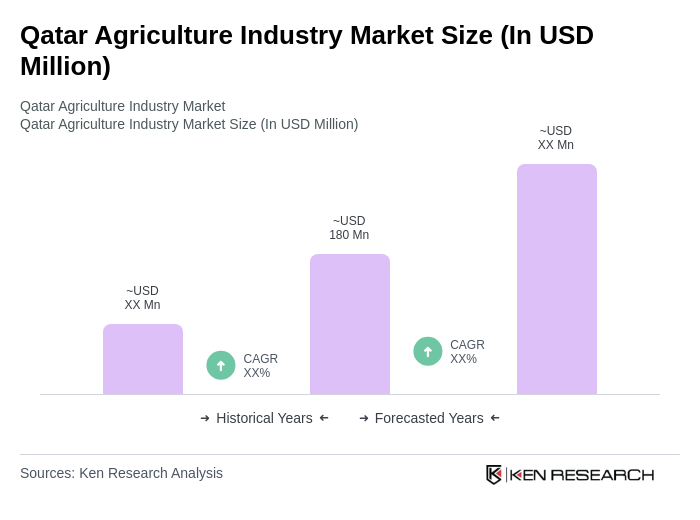
- The Qatar Agriculture Industry Market is valued at USD 180 million, based on a five-year historical analysis. This growth is primarily driven by a sustained focus on food security, strong government programs to boost local production, and adoption of controlled-environment agriculture, hydroponics, aquaponics, and automated irrigation to raise yields and resource efficiency.
- Key players in this market include Doha, Al Rayyan, and Umm Salal, which dominate due to their strategic locations, access to resources, and robust infrastructure. These cities are pivotal in agricultural production and distribution, benefiting from government support and investment in modern farming techniques, which further solidifies their leadership in the sector.
- Qatar has advanced agricultural policy through ongoing food security strategies and enabling measures (e.g., PPP frameworks, financial incentives for domestic producers, and technology adoption), though a specific “Agricultural Development Law” enacted in 2023 is not documented in authoritative sources; instead, policy support has been implemented via programs and incentives to improve water efficiency and farm economics.
Qatar Agriculture Industry Market Segmentation
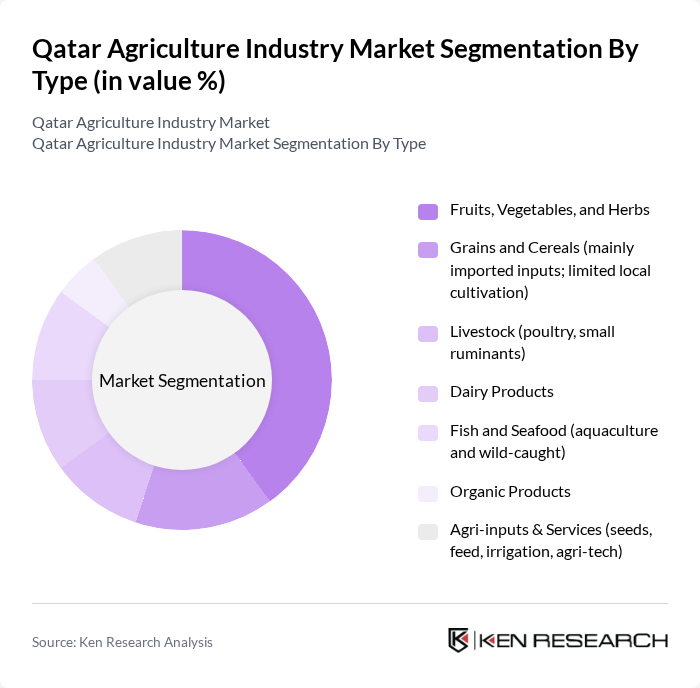
By Type:The agriculture market in Qatar is segmented into various types, including fruits, vegetables, grains, livestock, dairy products, fish and seafood, organic products, and agri-inputs & services. Among these, fruits, vegetables, and herbs are the most dominant sub-segment, driven by consumer demand for fresh produce and healthy diets, and supported by state-backed greenhouse, hydroponic, and vertical farming initiatives aimed at import substitution and self-sufficiency.
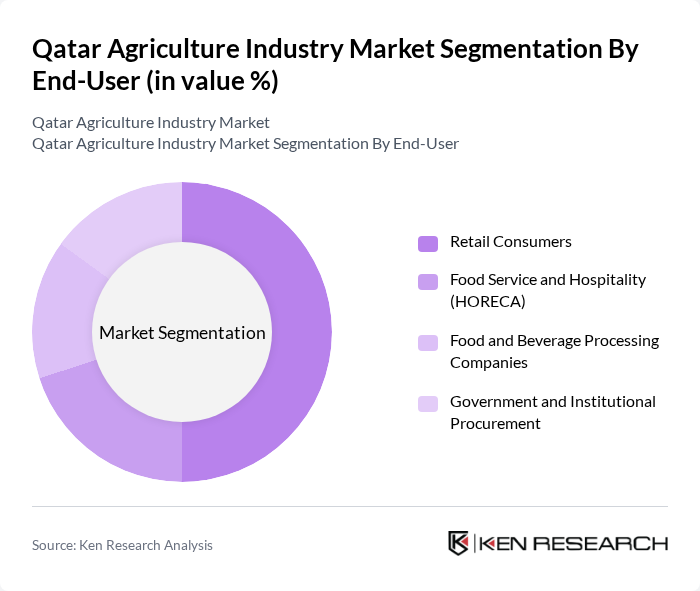
By End-User:The end-user segmentation of the agriculture market in Qatar includes retail consumers, food service and hospitality (HORECA), food and beverage processing companies, and government and institutional procurement. The retail consumer segment is the largest, driven by the growing population and increasing health consciousness among consumers, leading to a higher demand for fresh and organic produce.
Qatar Agriculture Industry Market Competitive Landscape
The Qatar Agriculture Industry Market is characterized by a dynamic mix of regional and international players. Leading participants such as Baladna Food Industries, Hassad Food, Widam Food, Al Meera Consumer Goods Company, Agrico Agricultural Development, Al Rayyan Agricultural, Mahaseel for Marketing and Agri Services, Qatarat Agricultural Development Company (QADCO), Aqua Gulf (Qatar) Aquaculture, Qatar Meat and Livestock Trading Company (Mawashi), Qatar National Food Security Program (policy body), Sidra Agriculture (Sidra Hydroponics), Al Sulaiteen Agricultural and Industrial Complex (SAIC), Qatar Fisheries Development Company, Dandy Company (Dandy Dairy) contribute to innovation, geographic expansion, and service delivery in this space.
Qatar Agriculture Industry Market Industry Analysis
Growth Drivers
- Increasing Demand for Local Produce:The demand for locally produced agricultural products in Qatar has surged, with a reported increase of 30% in local produce consumption from 2022 to 2023. This trend is driven by a growing population, which reached approximately 2.8 million in future, and a heightened awareness of food quality and safety. The government’s focus on reducing food imports, which accounted for 90% of food supply in 2022, further supports this growth, encouraging local farmers to meet consumer needs.
- Government Initiatives for Food Security:Qatar's government has invested over QAR 1 billion (approximately USD 275 million) in food security initiatives since 2020. These initiatives aim to enhance domestic agricultural production and reduce reliance on imports. The National Food Security Strategy outlines plans to increase local food production by 20% in future, which is crucial given that food imports constituted 90% of the total food supply in 2022, highlighting the urgency of these initiatives.
- Technological Advancements in Agriculture:The adoption of advanced agricultural technologies, such as hydroponics and precision farming, has increased significantly in Qatar. In future, investments in agri-tech reached QAR 500 million (approximately USD 137 million), facilitating improved crop yields and resource efficiency. These technologies are essential in a region where traditional farming faces limitations due to harsh climatic conditions, enabling farmers to produce more with less water and land, thus enhancing overall productivity.
Market Challenges
- Water Scarcity:Water scarcity remains a critical challenge for the agriculture sector in Qatar, where annual rainfall averages only 75 mm. The country relies heavily on desalination, which provides about 60% of its water supply. In future, agricultural water usage accounted for 80% of total water consumption, exacerbating the strain on limited resources. This challenge necessitates innovative water management solutions to ensure sustainable agricultural practices in the region.
- High Production Costs:The high cost of agricultural production in Qatar poses significant challenges for farmers. In future, the average cost of producing one kilogram of vegetables was estimated at QAR 10 (approximately USD 2.75), primarily due to high energy and labor costs. Additionally, the reliance on imported seeds and fertilizers, which increased by 15% in future, further elevates production expenses, making it difficult for local producers to compete with cheaper imports.
Qatar Agriculture Industry Market Future Outlook
The future of the Qatar agriculture industry appears promising, driven by ongoing government support and technological innovations. As the population continues to grow, the demand for local produce is expected to rise, prompting further investments in sustainable practices. Additionally, the focus on food security will likely lead to enhanced collaboration between the government and private sectors, fostering a more resilient agricultural ecosystem. The integration of smart agriculture technologies will also play a crucial role in optimizing resource use and improving productivity.
Market Opportunities
- Expansion of Organic Farming:The organic farming sector in Qatar is poised for growth, with a reported increase in organic produce sales by 25% in future. This trend is driven by rising consumer awareness and demand for healthier food options. The government’s support for organic certification and training programs for farmers presents a significant opportunity for local producers to tap into this lucrative market segment.
- Development of Agri-Tech Solutions:The agri-tech sector in Qatar is rapidly evolving, with investments projected to reach QAR 1 billion (approximately USD 275 million) in future. This growth is fueled by the need for innovative solutions to address local agricultural challenges. Startups focusing on smart irrigation, crop monitoring, and data analytics are well-positioned to capitalize on this trend, offering significant potential for growth and collaboration with established agricultural entities.
Scope of the Report
| Segment | Sub-Segments |
|---|---|
| By Type | Fruits, Vegetables, and Herbs Grains and Cereals (mainly imported inputs; limited local cultivation) Livestock (poultry, small ruminants) Dairy Products Fish and Seafood (aquaculture and wild-caught) Organic Products Agri-inputs & Services (seeds, feed, irrigation, agri-tech) |
| By End-User | Retail Consumers Food Service and Hospitality (HORECA) Food and Beverage Processing Companies Government and Institutional Procurement |
| By Distribution Channel | Direct Farm Sales and Contracts Supermarkets and Hypermarkets Online Grocery and E-commerce Wholesale Markets and Traders |
| By Production Method | Conventional Farming Organic Farming Hydroponics and Controlled-Environment Agriculture Aquaponics and Recirculating Aquaculture Systems |
| By Crop Type | Leafy Greens and Salad Crops Fruit Vegetables (tomato, cucumber, pepper) Root and Tuber Crops Forage and Fodder |
| By Investment Source | Private Investments Government Funding and Sovereign Vehicles International Partnerships and Aid |
| By Policy Support | Subsidies and Input Support Tax and Land-Use Incentives R&D Grants and Innovation Programs |
Key Target Audience
Investors and Venture Capitalist Firms
Government and Regulatory Bodies (e.g., Ministry of Municipality and Environment, Qatar Agricultural Development Company)
Manufacturers and Producers
Distributors and Retailers
Technology Providers
Industry Associations (e.g., Qatar Chamber of Commerce and Industry)
Financial Institutions
Export and Import Agencies (e.g., Qatar General Authority of Customs)
Players Mentioned in the Report:
Baladna Food Industries
Hassad Food
Widam Food
Al Meera Consumer Goods Company
Agrico Agricultural Development
Al Rayyan Agricultural
Mahaseel for Marketing and Agri Services
Qatarat Agricultural Development Company (QADCO)
Aqua Gulf (Qatar) Aquaculture
Qatar Meat and Livestock Trading Company (Mawashi)
Qatar National Food Security Program (policy body)
Sidra Agriculture (Sidra Hydroponics)
Al Sulaiteen Agricultural and Industrial Complex (SAIC)
Qatar Fisheries Development Company
Dandy Company (Dandy Dairy)
Table of Contents
Market Assessment Phase
1. Executive Summary and Approach
2. Qatar Agriculture Industry Market Overview
2.1 Key Insights and Strategic Recommendations
2.2 Qatar Agriculture Industry Market Overview
2.3 Definition and Scope
2.4 Evolution of Market Ecosystem
2.5 Timeline of Key Regulatory Milestones
2.6 Value Chain & Stakeholder Mapping
2.7 Business Cycle Analysis
2.8 Policy & Incentive Landscape
3. Qatar Agriculture Industry Market Analysis
3.1 Growth Drivers
3.1.1 Increasing Demand for Local Produce
3.1.2 Government Initiatives for Food Security
3.1.3 Technological Advancements in Agriculture
3.1.4 Investment in Sustainable Practices
3.2 Market Challenges
3.2.1 Water Scarcity
3.2.2 High Production Costs
3.2.3 Limited Arable Land
3.2.4 Dependence on Imported Inputs
3.3 Market Opportunities
3.3.1 Expansion of Organic Farming
3.3.2 Development of Agri-Tech Solutions
3.3.3 Export Potential to Neighboring Countries
3.3.4 Collaboration with Research Institutions
3.4 Market Trends
3.4.1 Rise of Vertical Farming
3.4.2 Adoption of Smart Agriculture Technologies
3.4.3 Increasing Consumer Preference for Organic Products
3.4.4 Focus on Sustainable Water Management
3.5 Government Regulation
3.5.1 Agricultural Subsidies
3.5.2 Import Regulations on Agricultural Products
3.5.3 Environmental Protection Laws
3.5.4 Food Safety Standards
4. SWOT Analysis
5. Stakeholder Analysis
6. Porter's Five Forces Analysis
7. Qatar Agriculture Industry Market Market Size, 2019-2024
7.1 By Value
7.2 By Volume
7.3 By Average Selling Price
8. Qatar Agriculture Industry Market Segmentation
8.1 By Type
8.1.1 Fruits, Vegetables, and Herbs
8.1.2 Grains and Cereals (mainly imported inputs; limited local cultivation)
8.1.3 Livestock (poultry, small ruminants)
8.1.4 Dairy Products
8.1.5 Fish and Seafood (aquaculture and wild-caught)
8.1.6 Organic Products
8.1.7 Agri-inputs & Services (seeds, feed, irrigation, agri-tech)
8.2 By End-User
8.2.1 Retail Consumers
8.2.2 Food Service and Hospitality (HORECA)
8.2.3 Food and Beverage Processing Companies
8.2.4 Government and Institutional Procurement
8.3 By Distribution Channel
8.3.1 Direct Farm Sales and Contracts
8.3.2 Supermarkets and Hypermarkets
8.3.3 Online Grocery and E-commerce
8.3.4 Wholesale Markets and Traders
8.4 By Production Method
8.4.1 Conventional Farming
8.4.2 Organic Farming
8.4.3 Hydroponics and Controlled-Environment Agriculture
8.4.4 Aquaponics and Recirculating Aquaculture Systems
8.5 By Crop Type
8.5.1 Leafy Greens and Salad Crops
8.5.2 Fruit Vegetables (tomato, cucumber, pepper)
8.5.3 Root and Tuber Crops
8.5.4 Forage and Fodder
8.6 By Investment Source
8.6.1 Private Investments
8.6.2 Government Funding and Sovereign Vehicles
8.6.3 International Partnerships and Aid
8.7 By Policy Support
8.7.1 Subsidies and Input Support
8.7.2 Tax and Land-Use Incentives
8.7.3 R&D Grants and Innovation Programs
9. Qatar Agriculture Industry Market Competitive Analysis
9.1 Market Share of Key Players
9.2 Cross Comparison of Key Players
9.2.1 Company Name
9.2.2 Scale Category (Large, Medium, Small)
9.2.3 Revenue Growth (YoY, %)
9.2.4 Domestic Market Share (% in relevant segment)
9.2.5 Production Capacity Utilization (% of installed)
9.2.6 Water Use Intensity (liters/kg output)
9.2.7 Yield per m² (CEA/hydroponics) or per head (livestock)
9.2.8 Biosecurity and Compliance Incidents (count/year)
9.2.9 Cold Chain Coverage (% SKUs under cold chain)
9.2.10 R&D/Capex Intensity (% of revenue)
9.2.11 Contract Coverage (no. of HORECA/retail contracts)
9.2.12 On-time Fulfillment Rate (% orders OTIF)
9.3 SWOT Analysis of Top Players
9.4 Pricing Analysis
9.5 Detailed Profile of Major Companies
9.5.1 Baladna Food Industries
9.5.2 Hassad Food
9.5.3 Widam Food
9.5.4 Al Meera Consumer Goods Company
9.5.5 Agrico Agricultural Development
9.5.6 Al Rayyan Agricultural
9.5.7 Mahaseel for Marketing and Agri Services
9.5.8 Qatarat Agricultural Development Company (QADCO)
9.5.9 Aqua Gulf (Qatar) Aquaculture
9.5.10 Qatar Meat and Livestock Trading Company (Mawashi)
9.5.11 Qatar National Food Security Program (policy body)
9.5.12 Sidra Agriculture (Sidra Hydroponics)
9.5.13 Al Sulaiteen Agricultural and Industrial Complex (SAIC)
9.5.14 Qatar Fisheries Development Company
9.5.15 Dandy Company (Dandy Dairy)
10. Qatar Agriculture Industry Market End-User Analysis
10.1 Procurement Behavior of Key Ministries
10.1.1 Ministry of Municipality and Environment
10.1.2 Ministry of Commerce and Industry
10.1.3 Ministry of Education and Higher Education
10.1.4 Ministry of Public Health
10.2 Corporate Spend on Infrastructure & Energy
10.2.1 Investment in Agricultural Infrastructure
10.2.2 Expenditure on Renewable Energy Solutions
10.2.3 Budget Allocation for Research and Development
10.3 Pain Point Analysis by End-User Category
10.3.1 Supply Chain Disruptions
10.3.2 Quality Control Issues
10.3.3 Regulatory Compliance Challenges
10.4 User Readiness for Adoption
10.4.1 Awareness of Sustainable Practices
10.4.2 Training and Skill Development Needs
10.5 Post-Deployment ROI and Use Case Expansion
10.5.1 Measurement of ROI in Agricultural Investments
10.5.2 Potential for Scaling Successful Models
11. Qatar Agriculture Industry Market Future Size, 2025-2030
11.1 By Value
11.2 By Volume
11.3 By Average Selling Price
Go-To-Market Strategy Phase
1. Whitespace Analysis + Business Model Canvas
1.1 Market Gaps Identification
1.2 Value Proposition Development
1.3 Revenue Streams Analysis
1.4 Cost Structure Evaluation
1.5 Key Partnerships Exploration
1.6 Customer Segmentation
1.7 Channels of Distribution
2. Marketing and Positioning Recommendations
2.1 Branding Strategies
2.2 Product USPs
2.3 Target Market Identification
2.4 Communication Strategy
3. Distribution Plan
3.1 Urban Retail Strategies
3.2 Rural NGO Tie-ups
3.3 Logistics and Supply Chain Management
4. Channel & Pricing Gaps
4.1 Underserved Routes
4.2 Pricing Bands Analysis
4.3 Competitive Pricing Strategies
5. Unmet Demand & Latent Needs
5.1 Category Gaps Identification
5.2 Consumer Segments Analysis
5.3 Emerging Trends Exploration
6. Customer Relationship
6.1 Loyalty Programs Development
6.2 After-sales Service Strategies
6.3 Customer Feedback Mechanisms
7. Value Proposition
7.1 Sustainability Initiatives
7.2 Integrated Supply Chains
7.3 Competitive Advantages
8. Key Activities
8.1 Regulatory Compliance
8.2 Branding Initiatives
8.3 Distribution Setup
9. Entry Strategy Evaluation
9.1 Domestic Market Entry Strategy
9.1.1 Product Mix Considerations
9.1.2 Pricing Band Strategy
9.1.3 Packaging Innovations
9.2 Export Entry Strategy
9.2.1 Target Countries Identification
9.2.2 Compliance Roadmap Development
10. Entry Mode Assessment
10.1 Joint Ventures
10.2 Greenfield Investments
10.3 Mergers & Acquisitions
10.4 Distributor Model Evaluation
11. Capital and Timeline Estimation
11.1 Capital Requirements Analysis
11.2 Timelines for Market Entry
12. Control vs Risk Trade-Off
12.1 Ownership vs Partnerships
12.2 Risk Management Strategies
13. Profitability Outlook
13.1 Breakeven Analysis
13.2 Long-term Sustainability Strategies
14. Potential Partner List
14.1 Distributors Identification
14.2 Joint Ventures Opportunities
14.3 Acquisition Targets
15. Execution Roadmap
15.1 Phased Plan for Market Entry
15.1.1 Market Setup
15.1.2 Market Entry
15.1.3 Growth Acceleration
15.1.4 Scale & Stabilize
15.2 Key Activities and Milestones
15.2.1 Milestone Planning
15.2.2 Activity Tracking
Research Methodology
Phase 1: Approach1
Desk Research
- Analysis of agricultural production statistics from the Ministry of Municipality and Environment
- Review of market reports from local agricultural associations and international organizations
- Examination of government policies and initiatives related to agriculture in Qatar
Primary Research
- Interviews with key stakeholders in the agricultural sector, including farmers and agronomists
- Surveys conducted with agricultural equipment suppliers and distributors
- Field visits to farms and agricultural research centers to gather firsthand insights
Validation & Triangulation
- Cross-validation of data through multiple sources, including trade publications and government reports
- Triangulation of findings from primary interviews with secondary data trends
- Sanity checks through expert panels comprising agribusiness consultants and academics
Phase 2: Market Size Estimation1
Top-down Assessment
- Estimation of total agricultural output based on national GDP contributions from the sector
- Segmentation of market size by crop types, livestock, and aquaculture
- Incorporation of import/export data to assess market dynamics and dependencies
Bottom-up Modeling
- Collection of production volume data from local farms and agricultural cooperatives
- Cost analysis of inputs such as seeds, fertilizers, and water resources
- Estimation of revenue based on average market prices for various agricultural products
Forecasting & Scenario Analysis
- Utilization of historical growth rates to project future agricultural output
- Scenario modeling based on climate change impacts and technological advancements
- Development of baseline, optimistic, and pessimistic forecasts through 2030
Phase 3: CATI Sample Composition1
| Scope Item/Segment | Sample Size | Target Respondent Profiles |
|---|---|---|
| Cereal Crop Producers | 100 | Farm Owners, Agronomists |
| Livestock Farmers | 80 | Livestock Managers, Veterinary Experts |
| Aquaculture Operators | 60 | Aquaculture Managers, Environmental Scientists |
| Agrochemical Suppliers | 70 | Sales Managers, Product Development Specialists |
| Government Agricultural Policy Makers | 50 | Policy Analysts, Agricultural Economists |
Frequently Asked Questions
What is the current value of the Qatar Agriculture Industry Market?
The Qatar Agriculture Industry Market is valued at approximately USD 180 million, reflecting a significant focus on food security, local production enhancement, and the adoption of advanced agricultural technologies such as hydroponics and automated irrigation systems.
What are the main drivers of growth in the Qatar Agriculture Industry?
Which cities are the key players in Qatar's agriculture sector?
What challenges does the Qatar Agriculture Industry face?
Other Regional/Country Reports
Indonesia Agriculture Industry Market
Malaysia Agriculture Industry Market
APAC Agriculture Industry Market
SEA Agriculture Industry Market
Why Buy From Us?

What makes us stand out is that our consultants follow Robust, Refine and Result (RRR) methodology. Robust for clear definitions, approaches and sanity checking, Refine for differentiating respondents' facts and opinions, and Result for presenting data with story.

We have set a benchmark in the industry by offering our clients with syndicated and customized market research reports featuring coverage of entire market as well as meticulous research and analyst insights.

While we don't replace traditional research, we flip the method upside down. Our dual approach of Top Bottom & Bottom Top ensures quality deliverable by not just verifying company fundamentals but also looking at the sector and macroeconomic factors.

With one step in the future, our research team constantly tries to show you the bigger picture. We help with some of the tough questions you may encounter along the way: How is the industry positioned? Best marketing channel? KPI's of competitors? By aligning every element, we help maximize success.

Our report gives you instant access to the answers and sources that other companies might choose to hide. We elaborate each steps of research methodology we have used and showcase you the sample size to earn your trust.

If you need any support, we are here! We pride ourselves on universe strength, data quality, and quick, friendly, and professional service.