About the Report
Base Year 2024United Arab Emirates Agriculture Industry Market Overview
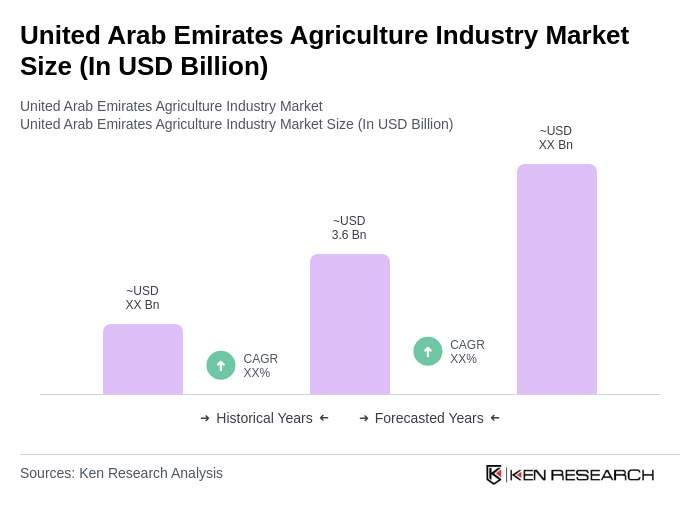
- The United Arab Emirates Agriculture Industry Market is valued at USD 3.6 billion, based on a five-year historical analysis. This growth is primarily driven by increasing investments in agri-tech, government initiatives to enhance food security, and a rising demand for locally sourced produce; leading analysts highlight drivers such as hydroponics and vertical farming adoption, water management innovation, and consumer preference for local and organic foods . The market has seen a shift towards sustainable practices and innovative farming methods, including controlled-environment agriculture and improved water-use efficiency, which have contributed to its expansion .
- Key players in this market include Dubai, Abu Dhabi, and Sharjah, which dominate due to their strategic locations, advanced infrastructure, and significant investments in agricultural technology. These cities are also home to numerous agricultural initiatives aimed at reducing food imports and promoting local production, making them pivotal in the UAE's agricultural landscape; Abu Dhabi programs such as Ag-Tech Parks and related incentives are specifically cited as catalysts for local production growth and innovation .
- In 2023, the UAE government implemented the National Food Security Strategy 2051, which aims to enhance the country's food security by promoting sustainable agricultural practices and increasing local production. This initiative includes investments in innovative technologies and infrastructure to support farmers and improve food supply chains, with explicit objectives to boost domestic output and reduce import dependence through sustainable agriculture programs .
United Arab Emirates Agriculture Industry Market Segmentation
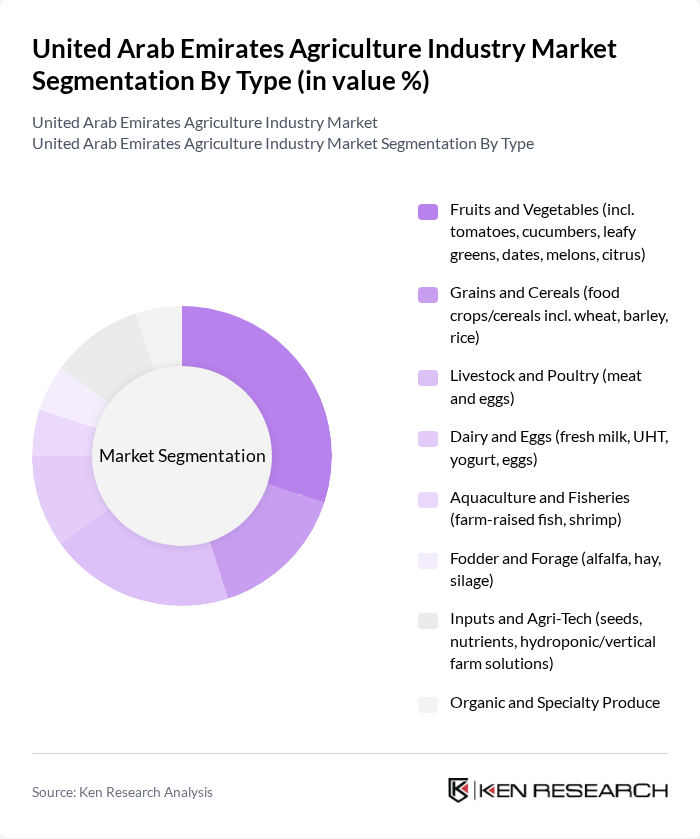
By Type:The agriculture industry in the UAE can be segmented into various types, including fruits and vegetables, grains and cereals, livestock and poultry, dairy and eggs, aquaculture and fisheries, fodder and forage, inputs and agri-tech, and organic and specialty produce. Each of these segments plays a crucial role in meeting the growing demand for food and agricultural products in the region; fruits and vegetables and specialty/high-value crops are emphasized in recent analyses due to the rise of hydroponics and controlled-environment systems supporting local fresh produce .
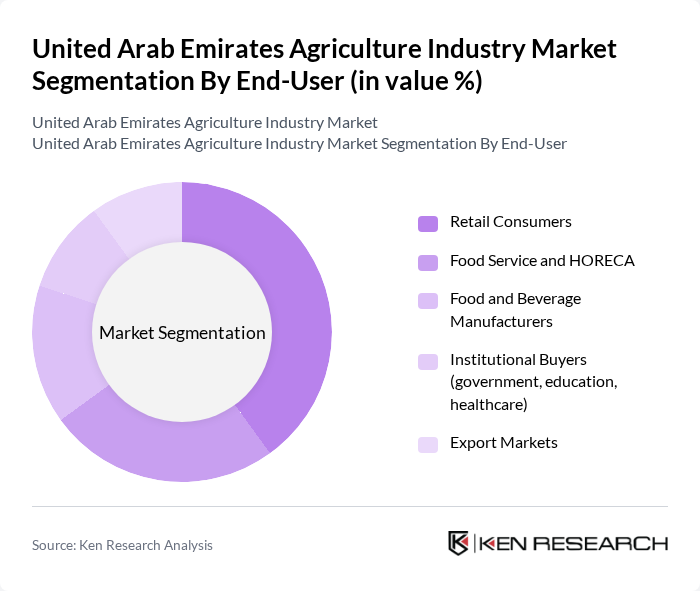
By End-User:The end-user segmentation of the agriculture industry includes retail consumers, food service and HORECA (hotels, restaurants, and catering), food and beverage manufacturers, institutional buyers (government, education, healthcare), and export markets. Each of these segments has unique requirements and contributes to the overall demand for agricultural products; retail and HORECA channels are prominent demand centers for fresh produce and animal products in the UAE’s import-reliant but increasingly localizing food ecosystem .
United Arab Emirates Agriculture Industry Market Competitive Landscape
The United Arab Emirates Agriculture Industry Market is characterized by a dynamic mix of regional and international players. Leading participants such as Al Ain Farms, Agthia Group PJSC, Al Dahra Holding, Al Rawabi Dairy Company, Emirates Bio Farm, Pure Harvest Smart Farms, Bustanica (Emirates Crop One), Silal (Abu Dhabi), NRTC Group (Nassar Al Refaee Trading Company), Emirates National Poultry Farms, Al Ghurair Foods, Elite Agro Holding, Dubai Municipality — Farmers’ Souq Program, Union Cooperative Society (Farm-to-shelf programs), Al Foah (dates) — part of Agthia Group contribute to innovation, geographic expansion, and service delivery in this space .
United Arab Emirates Agriculture Industry Market Industry Analysis
Growth Drivers
- Increasing Demand for Organic Produce:The UAE's organic food market is projected to reach AED 1.5 billion in future, driven by a growing consumer preference for healthy and sustainable food options. The government has reported a 20% annual increase in organic farming initiatives, with over 1,200 certified organic farms operating in the region. This shift towards organic produce is supported by rising health consciousness among consumers, further fueling market growth.
- Government Initiatives for Food Security:The UAE government has allocated AED 1 billion towards enhancing food security through various initiatives, including the National Food Security Strategy 2051. This strategy aims to increase local food production by 30% in future, focusing on innovative agricultural practices. The government’s commitment to food security is evident in its support for local farmers and investment in advanced agricultural technologies, ensuring a stable food supply.
- Technological Advancements in Farming:The adoption of smart farming technologies is transforming the UAE agriculture sector, with investments exceeding AED 600 million in agri-tech solutions. Technologies such as drones, IoT, and AI are enhancing crop yields and resource management. For instance, precision agriculture techniques have been shown to increase productivity by up to 40%, making farming more efficient and sustainable in the arid climate of the UAE.
Market Challenges
- Water Scarcity:The UAE faces significant water scarcity, with per capita water availability at just 500 cubic meters annually, far below the global average of 1,700 cubic meters. This scarcity poses a major challenge for agriculture, as 70% of the country’s water resources are used for irrigation. The reliance on desalination and treated wastewater for agricultural purposes adds to operational costs, impacting overall productivity and sustainability.
- High Operational Costs:The operational costs for farming in the UAE are among the highest globally, with average costs reaching AED 1,200 per hectare. Factors contributing to these costs include high energy prices, labor expenses, and the need for advanced technology. These financial pressures can deter new entrants into the market and limit the growth potential of existing agricultural businesses, hindering overall industry development.
United Arab Emirates Agriculture Industry Market Future Outlook
The future of the UAE agriculture industry appears promising, driven by ongoing technological innovations and government support for sustainable practices. As the demand for local and organic produce continues to rise, the sector is likely to see increased investment in hydroponics and vertical farming. Additionally, the focus on climate-resilient crops will enhance food security, ensuring that the industry adapts to environmental challenges while meeting consumer needs effectively.
Market Opportunities
- Expansion of Hydroponics and Vertical Farming:The hydroponics market in the UAE is expected to grow significantly, with investments projected to reach AED 300 million in future. This method allows for efficient water use and maximizes space, making it ideal for urban areas. The increasing urban population and demand for fresh produce create a ripe opportunity for innovative farming solutions.
- Growth in Agri-Tech Startups:The UAE is witnessing a surge in agri-tech startups, with over 50 new companies launched in the past year alone. These startups are focusing on innovative solutions such as AI-driven farming and sustainable practices. The government’s support through funding and incubator programs is expected to further accelerate this growth, creating a vibrant ecosystem for agricultural innovation.
Scope of the Report
| Segment | Sub-Segments |
|---|---|
| By Type | Fruits and Vegetables (incl. tomatoes, cucumbers, leafy greens, dates, melons, citrus) Grains and Cereals (food crops/cereals incl. wheat, barley, rice) Livestock and Poultry (meat and eggs) Dairy and Eggs (fresh milk, UHT, yogurt, eggs) Aquaculture and Fisheries (farm-raised fish, shrimp) Fodder and Forage (alfalfa, hay, silage) Inputs and Agri-Tech (seeds, nutrients, hydroponic/vertical farm solutions) Organic and Specialty Produce |
| By End-User | Retail Consumers Food Service and HORECA Food and Beverage Manufacturers Institutional Buyers (government, education, healthcare) Export Markets |
| By Distribution Channel | Supermarkets and Hypermarkets Online Grocery and E-commerce Farmers' Markets and Farm Shops Wholesale and Foodservice Distributors Direct-to-Consumer Subscriptions (CSA boxes, farm delivery) |
| By Crop Type | Field Crops (cereals, pulses) Horticultural Crops (fruits, vegetables, herbs) Forage and Fodder Crops Dates and Palm Products |
| By Farming Method | Conventional Open-Field Farming Organic Farming Controlled Environment Agriculture (Hydroponics) Controlled Environment Agriculture (Aquaponics) Vertical Farming and Greenhouse Cultivation |
| By Region | Abu Dhabi Dubai Sharjah Ajman Ras Al Khaimah Fujairah Umm Al Quwain |
| By Investment Source | Private Investments Government Funding Foreign Direct Investment (FDI) Public-Private Partnerships (PPP) Sovereign and Strategic Investment (e.g., ADQ, Mubadala) |
Key Target Audience
Investors and Venture Capitalist Firms
Government and Regulatory Bodies (e.g., Ministry of Climate Change and Environment, Abu Dhabi Agriculture and Food Safety Authority)
Agricultural Producers and Farmers' Cooperatives
Food Processing Companies
Logistics and Supply Chain Companies
Agri-tech Startups and Innovators
Retail Chains and Supermarkets
Non-Governmental Organizations (NGOs) focused on Food Security
Players Mentioned in the Report:
Al Ain Farms
Agthia Group PJSC
Al Dahra Holding
Al Rawabi Dairy Company
Emirates Bio Farm
Pure Harvest Smart Farms
Bustanica (Emirates Crop One)
Silal (Abu Dhabi)
NRTC Group (Nassar Al Refaee Trading Company)
Emirates National Poultry Farms
Al Ghurair Foods
Elite Agro Holding
Dubai Municipality Farmers Souq Program
Union Cooperative Society (Farm-to-shelf programs)
Al Foah (dates) part of Agthia Group
Table of Contents
Market Assessment Phase
1. Executive Summary and Approach
2. United Arab Emirates Agriculture Industry Market Overview
2.1 Key Insights and Strategic Recommendations
2.2 United Arab Emirates Agriculture Industry Market Overview
2.3 Definition and Scope
2.4 Evolution of Market Ecosystem
2.5 Timeline of Key Regulatory Milestones
2.6 Value Chain & Stakeholder Mapping
2.7 Business Cycle Analysis
2.8 Policy & Incentive Landscape
3. United Arab Emirates Agriculture Industry Market Analysis
3.1 Growth Drivers
3.1.1 Increasing Demand for Organic Produce
3.1.2 Government Initiatives for Food Security
3.1.3 Technological Advancements in Farming
3.1.4 Investment in Sustainable Agriculture
3.2 Market Challenges
3.2.1 Water Scarcity
3.2.2 High Operational Costs
3.2.3 Limited Arable Land
3.2.4 Regulatory Compliance Issues
3.3 Market Opportunities
3.3.1 Expansion of Hydroponics and Vertical Farming
3.3.2 Export Potential to Neighboring Regions
3.3.3 Growth in Agri-Tech Startups
3.3.4 Increased Consumer Awareness of Sustainability
3.4 Market Trends
3.4.1 Rise of Smart Farming Solutions
3.4.2 Shift Towards Local Sourcing
3.4.3 Adoption of Precision Agriculture
3.4.4 Focus on Climate-Resilient Crops
3.5 Government Regulation
3.5.1 Food Safety Standards
3.5.2 Agricultural Subsidies
3.5.3 Water Management Policies
3.5.4 Import Regulations for Agricultural Products
4. SWOT Analysis
5. Stakeholder Analysis
6. Porter's Five Forces Analysis
7. United Arab Emirates Agriculture Industry Market Market Size, 2019-2024
7.1 By Value
7.2 By Volume
7.3 By Average Selling Price
8. United Arab Emirates Agriculture Industry Market Segmentation
8.1 By Type
8.1.1 Fruits and Vegetables (incl. tomatoes, cucumbers, leafy greens, dates, melons, citrus)
8.1.2 Grains and Cereals (food crops/cereals incl. wheat, barley, rice)
8.1.3 Livestock and Poultry (meat and eggs)
8.1.4 Dairy and Eggs (fresh milk, UHT, yogurt, eggs)
8.1.5 Aquaculture and Fisheries (farm-raised fish, shrimp)
8.1.6 Fodder and Forage (alfalfa, hay, silage)
8.1.7 Inputs and Agri-Tech (seeds, nutrients, hydroponic/vertical farm solutions)
8.1.8 Organic and Specialty Produce
8.2 By End-User
8.2.1 Retail Consumers
8.2.2 Food Service and HORECA
8.2.3 Food and Beverage Manufacturers
8.2.4 Institutional Buyers (government, education, healthcare)
8.2.5 Export Markets
8.3 By Distribution Channel
8.3.1 Supermarkets and Hypermarkets
8.3.2 Online Grocery and E-commerce
8.3.3 Farmers' Markets and Farm Shops
8.3.4 Wholesale and Foodservice Distributors
8.3.5 Direct-to-Consumer Subscriptions (CSA boxes, farm delivery)
8.4 By Crop Type
8.4.1 Field Crops (cereals, pulses)
8.4.2 Horticultural Crops (fruits, vegetables, herbs)
8.4.3 Forage and Fodder Crops
8.4.4 Dates and Palm Products
8.5 By Farming Method
8.5.1 Conventional Open-Field Farming
8.5.2 Organic Farming
8.5.3 Controlled Environment Agriculture (Hydroponics)
8.5.4 Controlled Environment Agriculture (Aquaponics)
8.5.5 Vertical Farming and Greenhouse Cultivation
8.6 By Region
8.6.1 Abu Dhabi
8.6.2 Dubai
8.6.3 Sharjah
8.6.4 Ajman
8.6.5 Ras Al Khaimah
8.6.6 Fujairah
8.6.7 Umm Al Quwain
8.7 By Investment Source
8.7.1 Private Investments
8.7.2 Government Funding
8.7.3 Foreign Direct Investment (FDI)
8.7.4 Public-Private Partnerships (PPP)
8.7.5 Sovereign and Strategic Investment (e.g., ADQ, Mubadala)
9. United Arab Emirates Agriculture Industry Market Competitive Analysis
9.1 Market Share of Key Players
9.2 Cross Comparison of Key Players
9.2.1 Company Name
9.2.2 Segment Focus (e.g., dairy, dates, CEA/indoor, poultry, fodder)
9.2.3 UAE Revenues (latest FY) and 3-year Revenue CAGR
9.2.4 Production Capacity/Output (e.g., liters/day milk, tons/year produce)
9.2.5 Market Penetration (retail doors, HORECA accounts, emirate coverage)
9.2.6 CapEx Intensity (capex/revenue) and Recent Investments
9.2.7 Unit Economics (gross margin %, cost per kg/liter for key SKUs)
9.2.8 Supply Chain Footprint (farms, greenhouses, CEA sites, logistics hubs)
9.2.9 Pricing Positioning (value, mid, premium) and ASP by category
9.2.10 Sustainability KPIs (water use/L or kg, energy intensity, renewable share)
9.2.11 Import Substitution Ratio (share of sales replacing imports)
9.2.12 Innovation Pipeline (new SKUs, seeds/varieties, tech deployments)
9.3 SWOT Analysis of Top Players
9.4 Pricing Analysis
9.5 Detailed Profile of Major Companies
9.5.1 Al Ain Farms
9.5.2 Agthia Group PJSC
9.5.3 Al Dahra Holding
9.5.4 Al Rawabi Dairy Company
9.5.5 Emirates Bio Farm
9.5.6 Pure Harvest Smart Farms
9.5.7 Bustanica (Emirates Crop One)
9.5.8 Silal (Abu Dhabi)
9.5.9 NRTC Group (Nassar Al Refaee Trading Company)
9.5.10 Emirates National Poultry Farms
9.5.11 Al Ghurair Foods
9.5.12 Elite Agro Holding
9.5.13 Dubai Municipality — Farmers’ Souq Program
9.5.14 Union Cooperative Society (Farm-to-shelf programs)
9.5.15 Al Foah (dates) — part of Agthia Group
10. United Arab Emirates Agriculture Industry Market End-User Analysis
10.1 Procurement Behavior of Key Ministries
10.1.1 Ministry of Climate Change and Environment
10.1.2 Ministry of Agriculture and Fisheries
10.1.3 Ministry of Economy
10.2 Corporate Spend on Infrastructure & Energy
10.2.1 Investment in Agricultural Technology
10.2.2 Funding for Sustainable Practices
10.2.3 Expenditure on Water Management Systems
10.3 Pain Point Analysis by End-User Category
10.3.1 Cost of Inputs
10.3.2 Access to Markets
10.3.3 Regulatory Compliance
10.4 User Readiness for Adoption
10.4.1 Awareness of New Technologies
10.4.2 Training and Support Needs
10.4.3 Financial Readiness
10.5 Post-Deployment ROI and Use Case Expansion
10.5.1 Measurement of Yield Improvements
10.5.2 Cost Savings Analysis
10.5.3 Expansion into New Markets
11. United Arab Emirates Agriculture Industry Market Future Size, 2025-2030
11.1 By Value
11.2 By Volume
11.3 By Average Selling Price
Go-To-Market Strategy Phase
1. Whitespace Analysis + Business Model Canvas
1.1 Market Gaps Identification
1.2 Business Model Framework
2. Marketing and Positioning Recommendations
2.1 Branding Strategies
2.2 Product USPs
3. Distribution Plan
3.1 Urban Retail Strategies
3.2 Rural NGO Tie-ups
4. Channel & Pricing Gaps
4.1 Underserved Routes
4.2 Pricing Bands
5. Unmet Demand & Latent Needs
5.1 Category Gaps
5.2 Consumer Segments
6. Customer Relationship
6.1 Loyalty Programs
6.2 After-sales Service
7. Value Proposition
7.1 Sustainability Initiatives
7.2 Integrated Supply Chains
8. Key Activities
8.1 Regulatory Compliance
8.2 Branding Efforts
8.3 Distribution Setup
9. Entry Strategy Evaluation
9.1 Domestic Market Entry Strategy
9.1.1 Product Mix
9.1.2 Pricing Band
9.1.3 Packaging
9.2 Export Entry Strategy
9.2.1 Target Countries
9.2.2 Compliance Roadmap
10. Entry Mode Assessment
10.1 Joint Ventures
10.2 Greenfield Investments
10.3 Mergers & Acquisitions
10.4 Distributor Model
11. Capital and Timeline Estimation
11.1 Capital Requirements
11.2 Timelines
12. Control vs Risk Trade-Off
12.1 Ownership vs Partnerships
13. Profitability Outlook
13.1 Breakeven Analysis
13.2 Long-term Sustainability
14. Potential Partner List
14.1 Distributors
14.2 Joint Ventures
14.3 Acquisition Targets
15. Execution Roadmap
15.1 Phased Plan for Market Entry
15.1.1 Market Setup
15.1.2 Market Entry
15.1.3 Growth Acceleration
15.1.4 Scale & Stabilize
15.2 Key Activities and Milestones
15.2.1 Activity Timeline
15.2.2 Milestone Tracking
Research Methodology
Phase 1: Approach1
Desk Research
- Analysis of agricultural production statistics from the UAE Ministry of Climate Change and Environment
- Review of market reports from agricultural associations and trade bodies in the UAE
- Examination of academic journals and publications focusing on agricultural innovations and sustainability practices in the region
Primary Research
- Interviews with key stakeholders including farmers, agronomists, and agricultural technology providers
- Surveys targeting agricultural cooperatives and associations to gather insights on market trends and challenges
- Field visits to farms and agricultural exhibitions to observe practices and gather qualitative data
Validation & Triangulation
- Cross-validation of data from government reports and industry publications to ensure accuracy
- Triangulation of findings from primary interviews with secondary data sources
- Sanity checks through expert panel discussions with agricultural economists and market analysts
Phase 2: Market Size Estimation1
Top-down Assessment
- Estimation of total agricultural output based on national GDP contributions from the agriculture sector
- Segmentation of market size by crop types, livestock, and aquaculture sectors
- Incorporation of government initiatives aimed at enhancing food security and sustainability
Bottom-up Modeling
- Collection of data on production volumes from leading agricultural producers in the UAE
- Cost analysis of inputs such as seeds, fertilizers, and water resources
- Estimation of market size based on yield per hectare and total cultivated area
Forecasting & Scenario Analysis
- Multi-variable regression analysis incorporating climate change impacts and technological advancements
- Scenario modeling based on potential shifts in consumer preferences and government policies
- Development of baseline, optimistic, and pessimistic forecasts through 2035
Phase 3: CATI Sample Composition1
| Scope Item/Segment | Sample Size | Target Respondent Profiles |
|---|---|---|
| Cereal Crop Producers | 60 | Farm Owners, Agronomists |
| Livestock Farmers | 50 | Livestock Managers, Veterinary Experts |
| Aquaculture Operators | 40 | Aquaculture Managers, Environmental Scientists |
| Agri-tech Innovators | 50 | Product Developers, Technology Officers |
| Government Agricultural Policy Makers | 40 | Policy Analysts, Regulatory Officials |
Frequently Asked Questions
What is the current value of the United Arab Emirates agriculture industry market?
The United Arab Emirates agriculture industry market is valued at approximately USD 3.6 billion, reflecting a significant growth trend driven by investments in agri-tech, government initiatives for food security, and increasing consumer demand for locally sourced produce.
What are the main drivers of growth in the UAE agriculture industry?
How does the UAE government support food security in agriculture?
What challenges does the UAE agriculture industry face?
Other Regional/Country Reports
Indonesia Agriculture Industry Market
Malaysia Agriculture Industry Market
APAC Agriculture Industry Market
SEA Agriculture Industry Market
Why Buy From Us?

What makes us stand out is that our consultants follow Robust, Refine and Result (RRR) methodology. Robust for clear definitions, approaches and sanity checking, Refine for differentiating respondents' facts and opinions, and Result for presenting data with story.

We have set a benchmark in the industry by offering our clients with syndicated and customized market research reports featuring coverage of entire market as well as meticulous research and analyst insights.

While we don't replace traditional research, we flip the method upside down. Our dual approach of Top Bottom & Bottom Top ensures quality deliverable by not just verifying company fundamentals but also looking at the sector and macroeconomic factors.

With one step in the future, our research team constantly tries to show you the bigger picture. We help with some of the tough questions you may encounter along the way: How is the industry positioned? Best marketing channel? KPI's of competitors? By aligning every element, we help maximize success.

Our report gives you instant access to the answers and sources that other companies might choose to hide. We elaborate each steps of research methodology we have used and showcase you the sample size to earn your trust.

If you need any support, we are here! We pride ourselves on universe strength, data quality, and quick, friendly, and professional service.