About the Report
Base Year 2024Qatar AI Revenue Cycle Management Market Overview
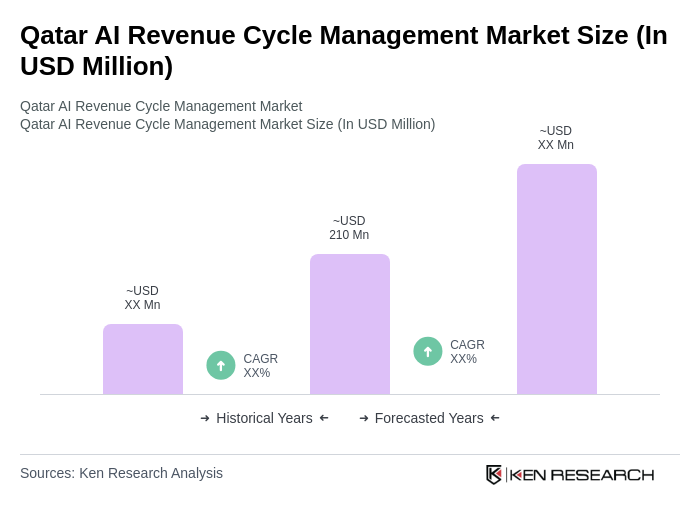
- The Qatar AI Revenue Cycle Management Market is valued at USD 210 million, based on a five-year historical analysis. This growth is primarily driven by the increasing adoption of AI technologies in healthcare, aimed at improving operational efficiency and reducing costs associated with billing and claims processing. The rising demand for automated solutions to enhance revenue cycle management has significantly contributed to the market's expansion.
- Doha is the dominant city in the Qatar AI Revenue Cycle Management Market, primarily due to its status as the capital and largest city, housing numerous healthcare facilities and institutions. The concentration of advanced healthcare services and a growing number of private hospitals in Doha have fostered a conducive environment for the adoption of AI-driven revenue cycle management solutions.
- There is no specific information available about a Qatari government regulation mandating the integration of AI technologies in healthcare billing processes. However, AI is transforming healthcare in Qatar through centralized EHRs and telemedicine, which could indirectly support the adoption of AI in RCM. For specific regulatory details, it is essential to consult official government sources.
Qatar AI Revenue Cycle Management Market Segmentation
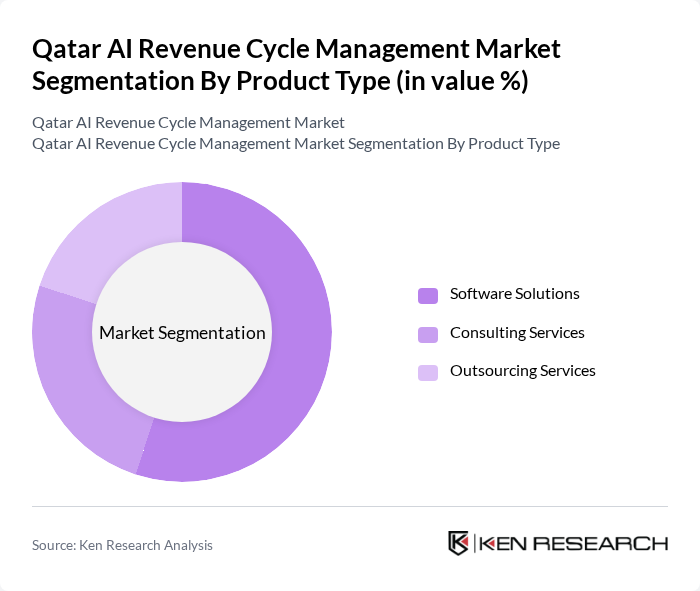
By Product Type:The product type segmentation includes Software Solutions, Consulting Services, and Outsourcing Services. Among these, Software Solutions are leading the market due to their ability to automate various aspects of revenue cycle management, thereby reducing manual errors and improving efficiency. The increasing need for real-time data analytics and reporting is driving healthcare providers to adopt software solutions that integrate AI capabilities.
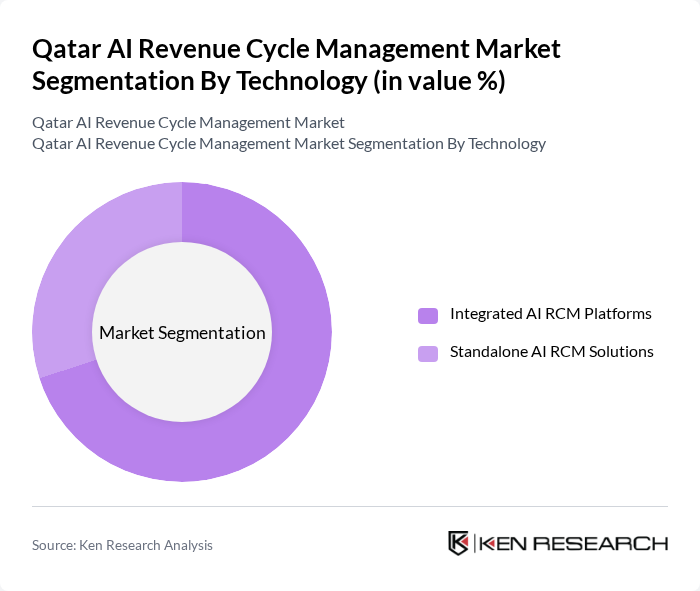
By Technology:The technology segmentation comprises Integrated AI RCM Platforms and Standalone AI RCM Solutions. Integrated AI RCM Platforms dominate the market as they offer comprehensive solutions that combine various functionalities into a single platform, enhancing user experience and operational efficiency. The trend towards holistic solutions that provide end-to-end revenue cycle management is driving the preference for integrated platforms over standalone solutions.
Qatar AI Revenue Cycle Management Market Competitive Landscape
The Qatar AI Revenue Cycle Management Market is characterized by a dynamic mix of regional and international players. Leading participants such as Optum Inc. (UnitedHealth Group), Change Healthcare Corporation, Cerner Corporation (Oracle Health), Allscripts Healthcare Solutions Inc., NextGen Healthcare Inc., Athenahealth Inc., McKesson Corporation, R1 RCM Inc., eClinicalWorks LLC, Imagine Software Inc., Maverick Medical AI, nThrive Inc., Conifer Health Solutions, Zotec Partners, AdvantEdge Healthcare Solutions contribute to innovation, geographic expansion, and service delivery in this space.
Qatar AI Revenue Cycle Management Market Industry Analysis
Growth Drivers
- Increasing Demand for Automation in Healthcare:The healthcare sector in Qatar is experiencing a significant shift towards automation, driven by the need for efficiency and accuracy. In future, healthcare spending in Qatar is projected to reach approximately QAR 35 billion, with a substantial portion allocated to technology investments. Automation in revenue cycle management can reduce administrative costs by up to QAR 1.8 billion annually, enhancing operational efficiency and patient satisfaction.
- Rising Healthcare Costs:Qatar's healthcare expenditure has been rising steadily, with a forecasted increase to QAR 35 billion. This surge in costs is prompting healthcare providers to seek innovative solutions to manage expenses effectively. AI-driven revenue cycle management can help reduce billing errors and improve collections, potentially saving the sector around QAR 1.2 billion annually, thus driving demand for these advanced solutions.
- Enhanced Data Analytics Capabilities:The integration of AI in revenue cycle management allows for advanced data analytics, enabling healthcare providers to make informed decisions. In future, the data analytics market in Qatar is expected to grow to QAR 1.5 billion, reflecting a 25% increase from the previous year. This growth is crucial for optimizing revenue cycles, as it enhances forecasting accuracy and operational performance, driving further adoption of AI solutions.
Market Challenges
- Data Privacy Concerns:As healthcare organizations in Qatar increasingly adopt AI technologies, data privacy remains a significant challenge. In future, the healthcare sector is expected to handle over 2 million patient records, raising concerns about compliance with data protection laws. The potential for data breaches could lead to financial penalties exceeding QAR 600 million, deterring organizations from fully embracing AI-driven revenue cycle management solutions.
- Integration with Legacy Systems:Many healthcare providers in Qatar still rely on outdated legacy systems, which complicate the integration of new AI technologies. In future, it is estimated that over 70% of healthcare facilities will face challenges in system interoperability. This lack of integration can lead to inefficiencies and increased operational costs, potentially exceeding QAR 1 billion annually, hindering the adoption of AI in revenue cycle management.
Qatar AI Revenue Cycle Management Market Future Outlook
The future of the Qatar AI revenue cycle management market appears promising, driven by technological advancements and a growing emphasis on patient-centric care. As healthcare providers increasingly adopt AI solutions, the focus will shift towards enhancing operational efficiency and improving patient outcomes. The integration of predictive analytics and real-time data processing will become essential, enabling organizations to optimize their revenue cycles and adapt to the evolving healthcare landscape, ultimately fostering a more sustainable healthcare system.
Market Opportunities
- Expansion of Telehealth Services:The rise of telehealth services in Qatar presents a significant opportunity for AI revenue cycle management. With telehealth consultations projected to increase by 50% in future, integrating AI can streamline billing processes, potentially increasing revenue collection by QAR 250 million, enhancing overall financial performance for healthcare providers.
- Growing Adoption of Cloud-Based Solutions:The shift towards cloud-based solutions in Qatar's healthcare sector is accelerating, with an expected market growth to QAR 1.5 billion in future. This trend offers a unique opportunity for AI revenue cycle management systems to leverage cloud technology, improving accessibility and scalability, which can enhance operational efficiency and reduce costs by up to QAR 400 million annually.
Scope of the Report
| Segment | Sub-Segments |
|---|---|
| By Product Type | Software Solutions Consulting Services Outsourcing Services |
| By Technology | Integrated AI RCM Platforms Standalone AI RCM Solutions |
| By Application | Claims Management Coding and Billing Denials Management Prior Authorization Patient Eligibility Verification Revenue Integrity |
| By Delivery Mode | Web-Based Cloud-Based |
| By End-User | Hospitals Physician Practices Diagnostic Laboratories Insurance Providers |
| By Service Model | Managed Services Professional Services |
| By Customer Size | Large Enterprises Small and Medium Enterprises |
| By Pricing Model | Subscription-Based (SaaS) Pay-Per-Use Perpetual License |
Key Target Audience
Investors and Venture Capitalist Firms
Government and Regulatory Bodies (e.g., Ministry of Public Health, Qatar Financial Centre Regulatory Authority)
Healthcare Providers and Hospitals
Insurance Companies and Payers
Healthcare IT Solution Providers
Billing and Coding Service Providers
Healthcare Management Organizations
Technology and Software Developers
Players Mentioned in the Report:
Optum Inc. (UnitedHealth Group)
Change Healthcare Corporation
Cerner Corporation (Oracle Health)
Allscripts Healthcare Solutions Inc.
NextGen Healthcare Inc.
Athenahealth Inc.
McKesson Corporation
R1 RCM Inc.
eClinicalWorks LLC
Imagine Software Inc.
Maverick Medical AI
nThrive Inc.
Conifer Health Solutions
Zotec Partners
AdvantEdge Healthcare Solutions
Table of Contents
Market Assessment Phase
1. Executive Summary and Approach
2. Qatar AI Revenue Cycle Management Market Overview
2.1 Key Insights and Strategic Recommendations
2.2 Qatar AI Revenue Cycle Management Market Overview
2.3 Definition and Scope
2.4 Evolution of Market Ecosystem
2.5 Timeline of Key Regulatory Milestones
2.6 Value Chain & Stakeholder Mapping
2.7 Business Cycle Analysis
2.8 Policy & Incentive Landscape
3. Qatar AI Revenue Cycle Management Market Analysis
3.1 Growth Drivers
3.1.1 Increasing Demand for Automation in Healthcare
3.1.2 Rising Healthcare Costs
3.1.3 Enhanced Data Analytics Capabilities
3.1.4 Government Initiatives for Digital Transformation
3.2 Market Challenges
3.2.1 Data Privacy Concerns
3.2.2 Integration with Legacy Systems
3.2.3 High Initial Investment Costs
3.2.4 Limited Awareness and Understanding of AI Solutions
3.3 Market Opportunities
3.3.1 Expansion of Telehealth Services
3.3.2 Growing Adoption of Cloud-Based Solutions
3.3.3 Partnerships with Technology Providers
3.3.4 Increasing Focus on Patient-Centric Care
3.4 Market Trends
3.4.1 Shift Towards Value-Based Care
3.4.2 Rise of Predictive Analytics in Revenue Cycle Management
3.4.3 Integration of AI with Blockchain Technology
3.4.4 Emphasis on Real-Time Data Processing
3.5 Government Regulation
3.5.1 Data Protection Laws
3.5.2 Healthcare Compliance Standards
3.5.3 Telehealth Regulations
3.5.4 AI Usage Guidelines in Healthcare
4. SWOT Analysis
5. Stakeholder Analysis
6. Porter's Five Forces Analysis
7. Qatar AI Revenue Cycle Management Market Size, 2019-2024
7.1 By Value
7.2 By Volume
7.3 By Average Selling Price
8. Qatar AI Revenue Cycle Management Market Segmentation
8.1 By Product Type
8.1.1 Software Solutions
8.1.2 Consulting Services
8.1.3 Outsourcing Services
8.2 By Technology
8.2.1 Integrated AI RCM Platforms
8.2.2 Standalone AI RCM Solutions
8.3 By Application
8.3.1 Claims Management
8.3.2 Coding and Billing
8.3.3 Denials Management
8.3.4 Prior Authorization
8.3.5 Patient Eligibility Verification
8.3.6 Revenue Integrity
8.4 By Delivery Mode
8.4.1 Web-Based
8.4.2 Cloud-Based
8.5 By End-User
8.5.1 Hospitals
8.5.2 Physician Practices
8.5.3 Diagnostic Laboratories
8.5.4 Insurance Providers
8.6 By Service Model
8.6.1 Managed Services
8.6.2 Professional Services
8.7 By Customer Size
8.7.1 Large Enterprises
8.7.2 Small and Medium Enterprises
8.8 By Pricing Model
8.8.1 Subscription-Based (SaaS)
8.8.2 Pay-Per-Use
8.8.3 Perpetual License
9. Qatar AI Revenue Cycle Management Market Competitive Analysis
9.1 Market Share of Key Players
9.2 Cross Comparison of Key Players
9.2.1 Company Name
9.2.2 Company Size (Large/Medium/Small)
9.2.3 Revenue Growth Rate (%)
9.2.4 Customer Retention Rate (%)
9.2.5 Average Contract Value (ACV)
9.2.6 Market Penetration Rate in Qatar (%)
9.2.7 Pricing Strategy (Competitive/Premium/Freemium)
9.2.8 Customer Satisfaction Score / NPS
9.2.9 Claims Processing Accuracy Rate (%)
9.2.10 AI Technology Maturity Level
9.3 SWOT Analysis of Top Players
9.4 Pricing Analysis
9.5 Detailed Profile of Major Companies
9.5.1 Optum Inc. (UnitedHealth Group)
9.5.2 Change Healthcare Corporation
9.5.3 Cerner Corporation (Oracle Health)
9.5.4 Allscripts Healthcare Solutions Inc.
9.5.5 NextGen Healthcare Inc.
9.5.6 Athenahealth Inc.
9.5.7 McKesson Corporation
9.5.8 R1 RCM Inc.
9.5.9 eClinicalWorks LLC
9.5.10 Imagine Software Inc.
9.5.11 Maverick Medical AI
9.5.12 nThrive Inc.
9.5.13 Conifer Health Solutions
9.5.14 Zotec Partners
9.5.15 AdvantEdge Healthcare Solutions
10. Qatar AI Revenue Cycle Management Market End-User Analysis
10.1 Procurement Behavior of Key Institutions
10.1.1 Ministry of Public Health
10.1.2 Hamad Medical Corporation (HMC)
10.1.3 Primary Health Care Corporation (PHCC)
10.2 Healthcare Infrastructure Investment Trends
10.2.1 Digital Health Infrastructure Investments
10.2.2 AI and Technology Adoption Budget
10.3 Pain Point Analysis by End-User Category
10.3.1 Billing Inefficiencies and Claim Denials
10.3.2 Regulatory Compliance Challenges
10.3.3 Manual Coding Errors and Revenue Leakage
10.4 User Readiness for Adoption
10.4.1 Training and Support Requirements
10.4.2 Technology Infrastructure Readiness
10.5 Post-Deployment ROI and Use Case Expansion
10.5.1 Cost Savings and Efficiency Gains
10.5.2 Revenue Recovery and Performance Metrics
11. Qatar AI Revenue Cycle Management Market Future Size, 2025-2030
11.1 By Value
11.2 By Volume
11.3 By Average Selling Price
Go-To-Market Strategy Phase
1. Whitespace Analysis + Business Model Canvas
1.1 Market Gaps Identification
1.2 Business Model Development
2. Marketing and Positioning Recommendations
2.1 Branding Strategies
2.2 Product USPs
3. Distribution Plan
3.1 Direct Sales to Healthcare Providers
3.2 Technology and Consulting Partner Networks
4. Channel & Pricing Gaps
4.1 Underserved Market Segments
4.2 Pricing Bands and Models
5. Unmet Demand & Latent Needs
5.1 AI RCM Capability Gaps in Qatar Market
5.2 End-User Segments and Requirements
6. Customer Relationship
6.1 Implementation Support and Training Programs
6.2 Ongoing Managed Services and Support
7. Value Proposition
7.1 Operational Efficiency and Cost Reduction
7.2 Regulatory Compliance and Data Security
8. Key Activities
8.1 Healthcare Regulatory Compliance
8.2 Local Market Positioning
8.3 Partnership and Distribution Setup
9. Entry Strategy Evaluation
9.1 Qatar Market Entry Strategy
9.1.1 Product Localization
9.1.2 Pricing Strategy for Qatar Market
9.1.3 Compliance and Certifications
9.2 Regional Expansion Strategy
9.2.1 Target Gulf Cooperation Council (GCC) Countries
9.2.2 Regional Compliance Roadmap
10. Entry Mode Assessment
10.1 Joint Ventures with Local Partners
10.2 Greenfield Investments and Offices
10.3 Strategic Acquisitions
10.4 Distributor and Reseller Model
11. Capital and Timeline Estimation
11.1 Capital Requirements
11.2 Market Entry Timeline
12. Control vs Risk Trade-Off
12.1 Ownership vs Partnership Models
13. Profitability Outlook
13.1 Breakeven Analysis
13.2 Long-Term Revenue Sustainability
14. Potential Partner List
14.1 Local Healthcare IT Distributors
14.2 Strategic Joint Venture Partners
14.3 Acquisition and Integration Targets
15. Execution Roadmap
15.1 Phased Plan for Market Entry
15.1.1 Pre-Market Entry Setup (Months 1-3)
15.1.2 Initial Market Entry and Pilot (Months 4-9)
15.1.3 Growth Acceleration Phase (Months 10-18)
15.1.4 Scale and Market Stabilization (Months 19+)
15.2 Key Activities and Milestones
15.2.1 Activity Planning and Resource Allocation
15.2.2 Milestone Tracking and KPI Monitoring
Research Methodology
Phase 1: Approach1
Desk Research
- Analysis of industry reports from healthcare analytics firms focusing on AI in revenue cycle management
- Review of government publications and healthcare regulations impacting AI adoption in Qatar
- Examination of academic journals and white papers on AI technologies in healthcare finance
Primary Research
- Interviews with CFOs and financial officers of hospitals and healthcare institutions in Qatar
- Surveys targeting IT managers and AI specialists within healthcare organizations
- Focus groups with healthcare consultants and revenue cycle management experts
Validation & Triangulation
- Cross-validation of findings through multiple data sources including market reports and expert opinions
- Triangulation of quantitative data from surveys with qualitative insights from interviews
- Sanity checks conducted through expert panel reviews to ensure data reliability
Phase 2: Market Size Estimation1
Top-down Assessment
- Estimation of total healthcare expenditure in Qatar as a basis for AI revenue cycle management market size
- Segmentation of the market by healthcare provider types, including hospitals, clinics, and telehealth services
- Incorporation of growth rates from AI technology adoption trends in the healthcare sector
Bottom-up Modeling
- Collection of firm-level data from leading healthcare providers implementing AI solutions
- Estimation of operational cost savings attributed to AI in revenue cycle management
- Volume of transactions processed through AI systems multiplied by average revenue per transaction
Forecasting & Scenario Analysis
- Multi-factor regression analysis incorporating variables such as healthcare digitization and policy changes
- Scenario modeling based on varying levels of AI adoption and regulatory impacts on healthcare finance
- Development of baseline, optimistic, and pessimistic forecasts through 2030
Phase 3: CATI Sample Composition1
| Scope Item/Segment | Sample Size | Target Respondent Profiles |
|---|---|---|
| Hospital Revenue Cycle Management | 100 | CFOs, Revenue Cycle Directors |
| AI Implementation in Clinics | 60 | IT Managers, Operations Directors |
| Telehealth Financial Management | 40 | Finance Managers, Telehealth Coordinators |
| Healthcare Analytics Providers | 50 | Product Managers, Data Analysts |
| Consulting Firms Specializing in Healthcare AI | 40 | Healthcare Consultants, Strategy Advisors |
Frequently Asked Questions
What is the current value of the Qatar AI Revenue Cycle Management Market?
The Qatar AI Revenue Cycle Management Market is valued at approximately USD 210 million, reflecting significant growth driven by the increasing adoption of AI technologies in healthcare to enhance operational efficiency and reduce costs associated with billing and claims processing.
Which city is the leading market for AI Revenue Cycle Management in Qatar?
What are the main product types in the Qatar AI Revenue Cycle Management Market?
What technologies are used in Qatar's AI Revenue Cycle Management?
Other Regional/Country Reports
Indonesia AI Revenue Cycle Management Market
Malaysia AI Revenue Cycle Management Market
KSA AI Revenue Cycle Management Market
APAC AI Revenue Cycle Management Market
SEA AI Revenue Cycle Management Market
Vietnam AI Revenue Cycle Management Market
Other Adjacent Reports
Bahrain Patient Management Solutions Market
Middle East Healthcare Consulting Services MarketPhilippines Predictive Analytics Market Size, Share, Growth Drivers, Trends, Opportunities & Forecast 2025–2030Why Buy From Us?

What makes us stand out is that our consultants follow Robust, Refine and Result (RRR) methodology. Robust for clear definitions, approaches and sanity checking, Refine for differentiating respondents' facts and opinions, and Result for presenting data with story.

We have set a benchmark in the industry by offering our clients with syndicated and customized market research reports featuring coverage of entire market as well as meticulous research and analyst insights.

While we don't replace traditional research, we flip the method upside down. Our dual approach of Top Bottom & Bottom Top ensures quality deliverable by not just verifying company fundamentals but also looking at the sector and macroeconomic factors.

With one step in the future, our research team constantly tries to show you the bigger picture. We help with some of the tough questions you may encounter along the way: How is the industry positioned? Best marketing channel? KPI's of competitors? By aligning every element, we help maximize success.

Our report gives you instant access to the answers and sources that other companies might choose to hide. We elaborate each steps of research methodology we have used and showcase you the sample size to earn your trust.

If you need any support, we are here! We pride ourselves on universe strength, data quality, and quick, friendly, and professional service.