About the Report
Base Year 2024Qatar Autonomous Last Mile Delivery Market Overview
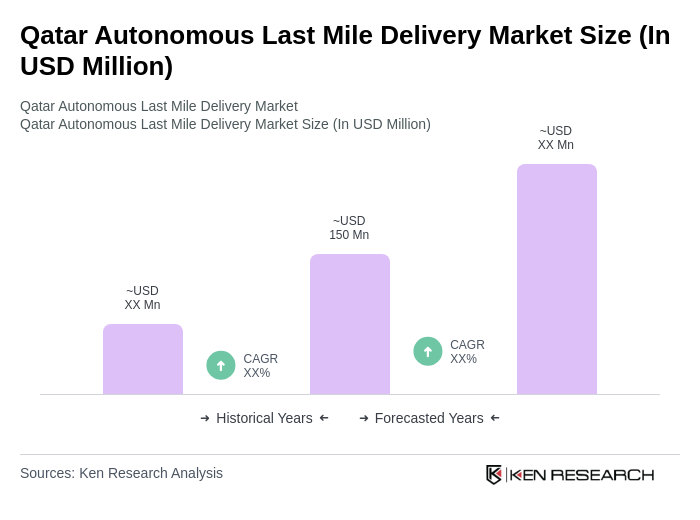
- The Qatar Autonomous Last Mile Delivery Market is valued at USD 150 million, based on a five-year historical analysis. This growth is primarily driven by the increasing demand for efficient and contactless delivery solutions, particularly in urban areas, as well as the rapid expansion of e-commerce and food-tech platforms. The adoption of artificial intelligence, 5G-enabled route optimization, and dynamic inventory placement are further accelerating operational efficiency and supporting the adoption of autonomous delivery technologies in Qatar’s logistics sector .
- Key urban centers such asDoha,Al Rayyan, andLusailremain dominant due to their high population density, significant commercial activities, and concentration of e-commerce and quick-commerce operations. These cities serve as primary hubs for last-mile delivery innovation, with micro-fulfillment centers and dark-store networks supporting rapid, on-demand delivery services .
- Regulation of autonomous delivery vehicles in Qatar is governed by theMinisterial Decision No. 18 of 2023 issued by the Ministry of Transport and Communications, which sets operational requirements for autonomous vehicle deployment, including mandatory safety certifications, real-time tracking, and compliance with urban mobility standards. The regulation covers pilot deployments in designated urban zones and requires service providers to obtain licensing for autonomous fleet operations, with compliance audits conducted annually.
Qatar Autonomous Last Mile Delivery Market Segmentation
By Type:The market is segmented into various types of delivery solutions, includingDelivery Drones,Autonomous Delivery Vehicles,Robotic Delivery Systems, andLocker-Based Delivery Solutions. Each of these subsegments addresses specific delivery needs and consumer preferences, with ground-based robots and autonomous vehicles gaining traction for their reliability and scalability in dense urban environments .
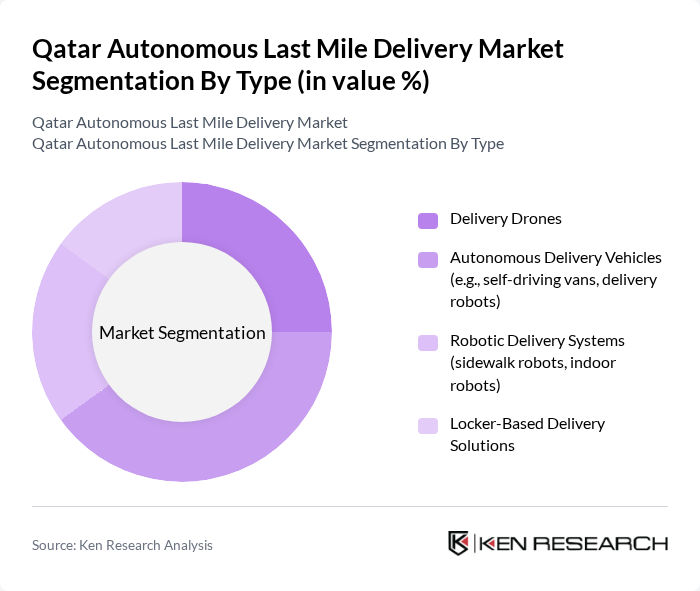
TheAutonomous Delivery Vehiclessegment is currently dominating the market due to its versatility and ability to manage a wide range of delivery tasks. These vehicles are increasingly preferred by businesses for their efficiency in navigating urban environments and their capacity to deliver larger volumes of goods compared to drones or robotic systems. The surge in e-commerce, coupled with consumer demand for rapid and contactless delivery, continues to drive the adoption of autonomous delivery vehicles .
By End-User:The market is segmented based on end-users, includingRetail & E-commerce,Food and Beverage,Healthcare, andLogistics & Courier Services. Each segment has unique requirements and preferences that influence the adoption of autonomous delivery solutions. Retail and e-commerce lead adoption due to the need for fast, reliable last-mile service, while healthcare and food delivery are rapidly expanding segments driven by demand for timely, temperature-controlled, and contactless deliveries .
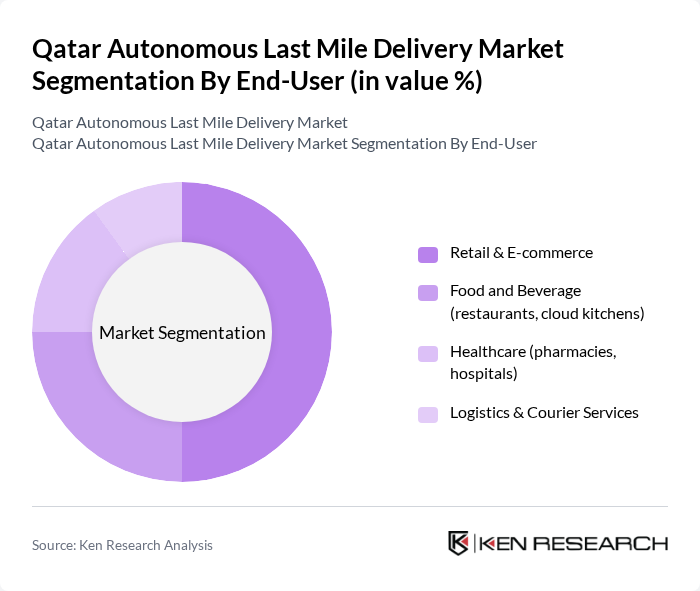
TheRetail & E-commercesegment is leading the market, driven by the surge in online shopping and consumer demand for rapid, reliable delivery services. Retailers and e-commerce operators are adopting autonomous delivery solutions to enhance customer satisfaction, streamline logistics, and reduce operational costs. The convenience and efficiency of these technologies are pivotal in meeting the expectations of modern consumers, making this segment a significant contributor to overall market growth .
Qatar Autonomous Last Mile Delivery Market Competitive Landscape
The Qatar Autonomous Last Mile Delivery Market is characterized by a dynamic mix of regional and international players. Leading participants such as Fetchr, Talabat, QDelivery, Careem NOW, DHL Express, Aramex, UPS, FedEx, Zajel, Noon, Amazon, Uber Eats, Starship Technologies, Qatar Post, Wing (Alphabet) contribute to innovation, geographic expansion, and service delivery in this space.
Qatar Autonomous Last Mile Delivery Market Industry Analysis
Growth Drivers
- Increasing Demand for E-commerce:The e-commerce sector in Qatar is projected to reach approximately QAR 12 billion in future, driven by a 15% to 20% annual growth rate. This surge in online shopping is creating a pressing need for efficient last-mile delivery solutions. As consumers increasingly prefer the convenience of home delivery, companies are investing in autonomous delivery systems to meet this demand, thereby enhancing operational efficiency and customer satisfaction.
- Technological Advancements in Robotics:Qatar's investment in robotics technology is expected to exceed QAR 1 billion in future, fostering innovation in autonomous delivery systems. The integration of AI and machine learning into delivery robots enhances their navigation and operational capabilities. This technological evolution not only improves delivery speed but also reduces operational costs, making autonomous solutions more attractive to logistics companies in the region.
- Government Support for Smart City Initiatives:The Qatari government has allocated approximately QAR 2 billion for smart city projects, which include autonomous delivery systems. This funding supports infrastructure development and regulatory frameworks that facilitate the deployment of autonomous vehicles. By promoting smart logistics solutions, the government aims to enhance urban mobility and reduce traffic congestion, creating a favorable environment for last-mile delivery innovations.
Market Challenges
- Regulatory Hurdles:The regulatory landscape for autonomous delivery in Qatar is still evolving, with existing laws not fully accommodating autonomous vehicles. As of future, there are no specific regulations governing the operation of delivery robots, leading to uncertainty for companies looking to invest. This lack of clear guidelines can hinder market entry and slow down the adoption of autonomous delivery solutions.
- Public Acceptance and Trust Issues:Public perception of autonomous delivery systems remains a significant challenge. A survey conducted in recent times indicated that only 40% of Qataris are comfortable with the idea of autonomous delivery vehicles. Concerns about safety, reliability, and job displacement contribute to this skepticism. Building public trust is essential for widespread acceptance and successful implementation of these technologies in the market.
Qatar Autonomous Last Mile Delivery Market Future Outlook
The future of the autonomous last mile delivery market in Qatar appears promising, driven by technological advancements and increasing urbanization. As the government continues to invest in smart city initiatives, the integration of autonomous delivery systems into existing logistics networks will likely accelerate. Additionally, the growing emphasis on sustainability will push companies to adopt eco-friendly delivery solutions, enhancing their competitive edge in the market. Overall, the landscape is set for significant transformation in future.
Market Opportunities
- Expansion into Underserved Areas:There is a significant opportunity for autonomous delivery services to penetrate underserved regions in Qatar, where traditional logistics face challenges. By targeting these areas, companies can tap into a new customer base, enhancing service accessibility and driving revenue growth.
- Partnerships with Local Businesses:Collaborating with local retailers and businesses presents a lucrative opportunity for autonomous delivery providers. By forming strategic partnerships, companies can leverage existing customer networks and enhance their service offerings, ultimately increasing market share and fostering community engagement.
Scope of the Report
| Segment | Sub-Segments |
|---|---|
| By Type | Delivery Drones Autonomous Delivery Vehicles (e.g., self-driving vans, delivery robots) Robotic Delivery Systems (sidewalk robots, indoor robots) Locker-Based Delivery Solutions |
| By End-User | Retail & E-commerce Food and Beverage (restaurants, cloud kitchens) Healthcare (pharmacies, hospitals) Logistics & Courier Services |
| By Application | Last Mile Parcel Delivery Grocery & Perishable Goods Delivery Prescription & Medical Supply Delivery On-Demand Delivery Services |
| By Distribution Mode | Direct-to-Consumer (D2C) Third-Party Logistics (3PL) Hybrid Distribution Models Click-and-Collect |
| By Pricing Strategy | Premium Pricing Competitive Pricing Value-Based Pricing Dynamic Pricing |
| By Customer Segment | Business-to-Business (B2B) Business-to-Consumer (B2C) Government & Institutional Contracts SMEs & Startups |
| By Service Model | Subscription-Based Services Pay-Per-Delivery On-Demand Services Integrated Logistics Solutions |
Key Target Audience
Investors and Venture Capitalist Firms
Government and Regulatory Bodies (e.g., Qatar Ministry of Transport and Communications)
Logistics and Supply Chain Companies
Urban Planning Authorities
Telecommunications Providers
Automotive Manufacturers
Technology Startups in Robotics and AI
Infrastructure Development Agencies
Players Mentioned in the Report:
Fetchr
Talabat
QDelivery
Careem NOW
DHL Express
Aramex
UPS
FedEx
Zajel
Noon
Amazon
Uber Eats
Starship Technologies
Qatar Post
Wing (Alphabet)
Table of Contents
Market Assessment Phase
1. Executive Summary and Approach
2. Qatar Autonomous Last Mile Delivery Market Overview
2.1 Key Insights and Strategic Recommendations
2.2 Qatar Autonomous Last Mile Delivery Market Overview
2.3 Definition and Scope
2.4 Evolution of Market Ecosystem
2.5 Timeline of Key Regulatory Milestones
2.6 Value Chain & Stakeholder Mapping
2.7 Business Cycle Analysis
2.8 Policy & Incentive Landscape
3. Qatar Autonomous Last Mile Delivery Market Analysis
3.1 Growth Drivers
3.1.1 Increasing Demand for E-commerce
3.1.2 Technological Advancements in Robotics
3.1.3 Urbanization and Traffic Congestion
3.1.4 Government Support for Smart City Initiatives
3.2 Market Challenges
3.2.1 Regulatory Hurdles
3.2.2 High Initial Investment Costs
3.2.3 Public Acceptance and Trust Issues
3.2.4 Infrastructure Limitations
3.3 Market Opportunities
3.3.1 Expansion into Underserved Areas
3.3.2 Partnerships with Local Businesses
3.3.3 Integration with Existing Logistics Networks
3.3.4 Development of Sustainable Delivery Solutions
3.4 Market Trends
3.4.1 Rise of Contactless Delivery Solutions
3.4.2 Increased Investment in AI and Machine Learning
3.4.3 Focus on Sustainability and Eco-Friendly Practices
3.4.4 Growth of Subscription-Based Delivery Services
3.5 Government Regulation
3.5.1 Autonomous Vehicle Legislation
3.5.2 Safety Standards for Delivery Robots
3.5.3 Data Privacy Regulations
3.5.4 Incentives for Green Technology Adoption
4. SWOT Analysis
5. Stakeholder Analysis
6. Porter's Five Forces Analysis
7. Qatar Autonomous Last Mile Delivery Market Market Size, 2019-2024
7.1 By Value
7.2 By Volume
7.3 By Average Selling Price
8. Qatar Autonomous Last Mile Delivery Market Segmentation
8.1 By Type
8.1.1 Delivery Drones
8.1.2 Autonomous Delivery Vehicles (e.g., self-driving vans, delivery robots)
8.1.3 Robotic Delivery Systems (sidewalk robots, indoor robots)
8.1.4 Locker-Based Delivery Solutions
8.2 By End-User
8.2.1 Retail & E-commerce
8.2.2 Food and Beverage (restaurants, cloud kitchens)
8.2.3 Healthcare (pharmacies, hospitals)
8.2.4 Logistics & Courier Services
8.3 By Application
8.3.1 Last Mile Parcel Delivery
8.3.2 Grocery & Perishable Goods Delivery
8.3.3 Prescription & Medical Supply Delivery
8.3.4 On-Demand Delivery Services
8.4 By Distribution Mode
8.4.1 Direct-to-Consumer (D2C)
8.4.2 Third-Party Logistics (3PL)
8.4.3 Hybrid Distribution Models
8.4.4 Click-and-Collect
8.5 By Pricing Strategy
8.5.1 Premium Pricing
8.5.2 Competitive Pricing
8.5.3 Value-Based Pricing
8.5.4 Dynamic Pricing
8.6 By Customer Segment
8.6.1 Business-to-Business (B2B)
8.6.2 Business-to-Consumer (B2C)
8.6.3 Government & Institutional Contracts
8.6.4 SMEs & Startups
8.7 By Service Model
8.7.1 Subscription-Based Services
8.7.2 Pay-Per-Delivery
8.7.3 On-Demand Services
8.7.4 Integrated Logistics Solutions
9. Qatar Autonomous Last Mile Delivery Market Competitive Analysis
9.1 Market Share of Key Players
9.2 Cross Comparison of Key Players
9.2.1 Company Name
9.2.2 Group Size (Large, Medium, or Small as per industry convention)
9.2.3 Revenue Growth Rate (YoY %)
9.2.4 Customer Acquisition Cost (QAR per customer)
9.2.5 Delivery Efficiency Rate (% of successful autonomous deliveries)
9.2.6 Market Penetration Rate (% of addressable market served in Qatar)
9.2.7 Customer Retention Rate (% repeat customers)
9.2.8 Pricing Strategy (premium, competitive, dynamic)
9.2.9 Average Delivery Time (minutes per last mile)
9.2.10 Service Coverage Area (number of districts/cities served)
9.2.11 Fleet Size (number of autonomous vehicles/robots/drones)
9.2.12 Technology Adoption Level (AI, robotics, IoT integration)
9.2.13 Sustainability Initiatives (electric fleet %, carbon reduction)
9.3 SWOT Analysis of Top Players
9.4 Pricing Analysis
9.5 Detailed Profile of Major Companies
9.5.1 Fetchr
9.5.2 Talabat
9.5.3 QDelivery
9.5.4 Careem NOW
9.5.5 DHL Express
9.5.6 Aramex
9.5.7 UPS
9.5.8 FedEx
9.5.9 Zajel
9.5.10 Noon
9.5.11 Amazon
9.5.12 Uber Eats
9.5.13 Starship Technologies
9.5.14 Qatar Post
9.5.15 Wing (Alphabet)
10. Qatar Autonomous Last Mile Delivery Market End-User Analysis
10.1 Procurement Behavior of Key Ministries
10.1.1 Ministry of Transport and Communications
10.1.2 Ministry of Municipality and Environment
10.1.3 Ministry of Commerce and Industry
10.2 Corporate Spend on Infrastructure & Energy
10.2.1 Investment in Smart Logistics
10.2.2 Funding for Autonomous Technology
10.2.3 Budget Allocation for Urban Mobility
10.3 Pain Point Analysis by End-User Category
10.3.1 Delivery Speed
10.3.2 Cost Efficiency
10.3.3 Reliability of Service
10.4 User Readiness for Adoption
10.4.1 Awareness of Autonomous Solutions
10.4.2 Trust in Technology
10.4.3 Willingness to Pay for Convenience
10.5 Post-Deployment ROI and Use Case Expansion
10.5.1 Cost Savings Analysis
10.5.2 Customer Satisfaction Metrics
10.5.3 Scalability of Solutions
11. Qatar Autonomous Last Mile Delivery Market Future Size, 2025-2030
11.1 By Value
11.2 By Volume
11.3 By Average Selling Price
Go-To-Market Strategy Phase
1. Whitespace Analysis + Business Model Canvas
1.1 Market Gaps Identification
1.2 Value Proposition Development
1.3 Revenue Streams Analysis
1.4 Cost Structure Evaluation
1.5 Key Partnerships Exploration
1.6 Customer Segmentation
1.7 Channels of Distribution
2. Marketing and Positioning Recommendations
2.1 Branding Strategies
2.2 Product USPs
3. Distribution Plan
3.1 Urban Retail vs Rural NGO Tie-ups
4. Channel & Pricing Gaps
4.1 Underserved Routes
4.2 Pricing Bands
5. Unmet Demand & Latent Needs
5.1 Category Gaps
5.2 Consumer Segments
6. Customer Relationship
6.1 Loyalty Programs
6.2 After-sales Service
7. Value Proposition
7.1 Sustainability
7.2 Integrated Supply Chains
8. Key Activities
8.1 Regulatory Compliance
8.2 Branding
8.3 Distribution Setup
9. Entry Strategy Evaluation
9.1 Domestic Market Entry Strategy
9.1.1 Product Mix
9.1.2 Pricing Band
9.1.3 Packaging
9.2 Export Entry Strategy
9.2.1 Target Countries
9.2.2 Compliance Roadmap
10. Entry Mode Assessment
10.1 JV
10.2 Greenfield
10.3 M&A
10.4 Distributor Model
11. Capital and Timeline Estimation
11.1 Capital Requirements
11.2 Timelines
12. Control vs Risk Trade-Off
12.1 Ownership vs Partnerships
13. Profitability Outlook
13.1 Breakeven Analysis
13.2 Long-term Sustainability
14. Potential Partner List
14.1 Distributors
14.2 JVs
14.3 Acquisition Targets
15. Execution Roadmap
15.1 Phased Plan for Market Entry
15.1.1 Market Setup
15.1.2 Market Entry
15.1.3 Growth Acceleration
15.1.4 Scale & Stabilize
15.2 Key Activities and Milestones
15.2.1 Milestone Planning
15.2.2 Activity Tracking
Research Methodology
Phase 1: Approach1
Desk Research
- Analysis of government publications and reports on autonomous delivery regulations in Qatar
- Review of industry reports and white papers on last mile delivery trends and technologies
- Examination of academic journals focusing on logistics, automation, and urban mobility in the Middle East
Primary Research
- Interviews with logistics and supply chain experts specializing in autonomous delivery systems
- Surveys targeting local businesses utilizing last mile delivery services
- Field interviews with technology providers and startups in the autonomous delivery space
Validation & Triangulation
- Cross-validation of findings through multiple data sources including government, industry, and academic insights
- Triangulation of market data with expert opinions to ensure accuracy and reliability
- Sanity checks through feedback from a panel of industry experts and stakeholders
Phase 2: Market Size Estimation1
Top-down Assessment
- Estimation of the total addressable market based on Qatar's logistics spending and urbanization trends
- Segmentation of the market by industry verticals such as retail, food delivery, and e-commerce
- Incorporation of government initiatives promoting smart city solutions and autonomous technologies
Bottom-up Modeling
- Collection of operational data from key players in the last mile delivery sector
- Estimation of delivery volumes and costs based on service pricing models and customer demand
- Analysis of technology adoption rates and their impact on operational efficiencies
Forecasting & Scenario Analysis
- Development of predictive models using historical data and market growth drivers
- Scenario analysis based on varying levels of technology adoption and regulatory changes
- Creation of baseline, optimistic, and pessimistic forecasts through 2030
Phase 3: CATI Sample Composition1
| Scope Item/Segment | Sample Size | Target Respondent Profiles |
|---|---|---|
| Retail Last Mile Delivery | 60 | Logistics Managers, Retail Operations Directors |
| Food Delivery Services | 50 | Operations Managers, Delivery Coordinators |
| E-commerce Fulfillment | 45 | eCommerce Managers, Supply Chain Analysts |
| Technology Providers in Autonomous Delivery | 40 | Product Development Managers, Business Development Executives |
| Government and Regulatory Bodies | 40 | Policy Makers, Urban Planning Officials |
Frequently Asked Questions
What is the current value of the Qatar Autonomous Last Mile Delivery Market?
The Qatar Autonomous Last Mile Delivery Market is valued at approximately USD 150 million, reflecting a significant growth driven by the increasing demand for efficient and contactless delivery solutions, particularly in urban areas.
What factors are driving the growth of the autonomous delivery market in Qatar?
Which urban centers in Qatar are most significant for last-mile delivery?
What types of autonomous delivery solutions are available in Qatar?
Other Regional/Country Reports
Indonesia autonomous last mile delivery market
Malaysia autonomous last mile delivery market
KSA autonomous last mile delivery market
APAC autonomous last mile delivery market
SEA autonomous last mile delivery market
Vietnam autonomous last mile delivery market
Other Adjacent Reports
UAE Autonomous Vehicle Technology Market
Oman Robotics in Supply Chain Market
Saudi Arabia Smart City Infrastructure MarketQatar Food Delivery Services Market
Vietnam warehouse automation market report size, share, growth drivers, trends, opportunities & forecast 2025–2030Japan Courier and Parcel Services Market
Oman Urban Mobility Solutions Market
KSA AI-Driven Route Optimization Market
Why Buy From Us?

What makes us stand out is that our consultants follow Robust, Refine and Result (RRR) methodology. Robust for clear definitions, approaches and sanity checking, Refine for differentiating respondents' facts and opinions, and Result for presenting data with story.

We have set a benchmark in the industry by offering our clients with syndicated and customized market research reports featuring coverage of entire market as well as meticulous research and analyst insights.

While we don't replace traditional research, we flip the method upside down. Our dual approach of Top Bottom & Bottom Top ensures quality deliverable by not just verifying company fundamentals but also looking at the sector and macroeconomic factors.

With one step in the future, our research team constantly tries to show you the bigger picture. We help with some of the tough questions you may encounter along the way: How is the industry positioned? Best marketing channel? KPI's of competitors? By aligning every element, we help maximize success.

Our report gives you instant access to the answers and sources that other companies might choose to hide. We elaborate each steps of research methodology we have used and showcase you the sample size to earn your trust.

If you need any support, we are here! We pride ourselves on universe strength, data quality, and quick, friendly, and professional service.