Region:Middle East
Author(s):Dev
Product Code:KRAA9684
Pages:92
Published On:November 2025
 Market.png "Qatar Battery Management System (BMS) Market Size")
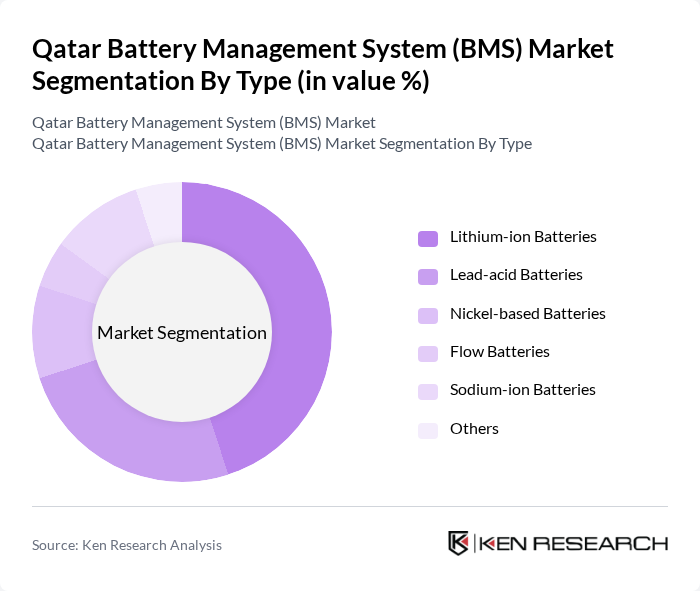
By Type:The market is segmented into various types of battery technologies, including Lithium-ion Batteries, Lead-acid Batteries, Nickel-based Batteries, Flow Batteries, Sodium-ion Batteries, and Others. Among these, Lithium-ion Batteries dominate the market due to their high energy density, efficiency, and widespread application in electric vehicles, stationary energy storage, and portable electronics. The increasing demand for renewable energy storage solutions and grid integration further boosts the adoption of Lithium-ion technology, making it the preferred choice for both consumers and manufacturers .
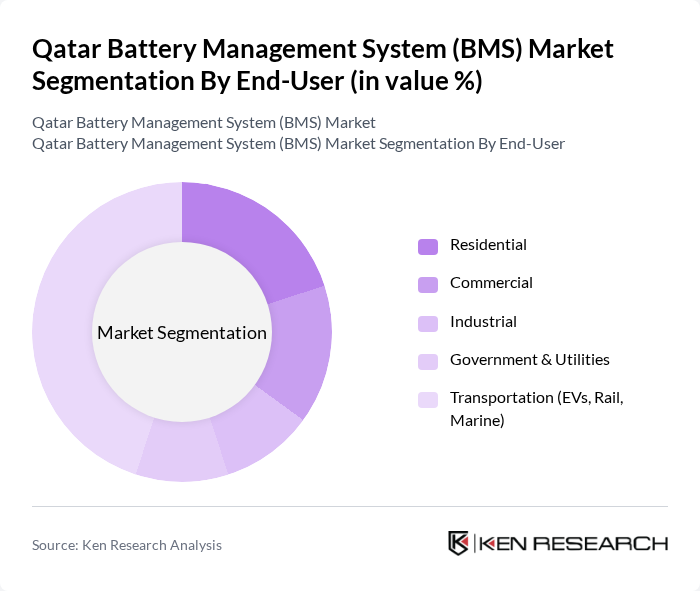
By End-User:The end-user segmentation includes Residential, Commercial, Industrial, Government & Utilities, and Transportation (EVs, Rail, Marine). The Transportation sector, particularly electric vehicles, is the leading segment due to the global shift towards sustainable transportation solutions. The increasing number of EVs on the road, expansion of charging infrastructure, and electrification of public transport significantly contribute to the demand for advanced battery management systems tailored for this sector. Additionally, government and utility-scale energy storage projects are driving BMS adoption in grid and distributed energy applications .
The Qatar Battery Management System (BMS) Market is characterized by a dynamic mix of regional and international players. Leading participants such as Siemens AG, LG Energy Solution, Panasonic Corporation, Tesla, Inc., BYD Company Limited, Samsung SDI, Nidec Industrial Solutions, Leclanché SA, ABB Ltd., Eaton Corporation, Schneider Electric, Enphase Energy, Trina Solar Limited, First Solar, Inc., JinkoSolar Holding Co., Ltd., Contemporary Amperex Technology Co., Limited (CATL), Johnson Controls International plc, Hitachi Energy, Qatar General Electricity & Water Corporation (KAHRAMAA), Al Kharsaah Solar Power Company contribute to innovation, geographic expansion, and service delivery in this space.
The future of the Qatar Battery Management System market appears promising, driven by increasing investments in renewable energy and electric vehicle infrastructure. As the government continues to implement policies supporting sustainability, the demand for efficient energy storage solutions will rise. Additionally, advancements in battery technology and smart grid integration will enhance BMS capabilities, making them essential for optimizing energy management in various sectors, including transportation and industrial applications.
| Segment | Sub-Segments |
|---|---|
| By Type | Lithium-ion Batteries Lead-acid Batteries Nickel-based Batteries Flow Batteries Sodium-ion Batteries Others |
| By End-User | Residential Commercial Industrial Government & Utilities Transportation (EVs, Rail, Marine) |
| By Region | Doha Al Rayyan Umm Salal Al Wakrah Others |
| By Technology | Battery Management Software Battery Monitoring Systems Battery Control Systems Modular BMS Centralized BMS Distributed BMS Others |
| By Application | Electric Vehicles Renewable Energy Systems Uninterruptible Power Supplies (UPS) Telecom Power Systems Industrial Automation Others |
| By Investment Source | Domestic Investments Foreign Direct Investments (FDI) Public-Private Partnerships (PPP) Government Schemes |
| By Policy Support | Subsidies Tax Exemptions Renewable Energy Certificates (RECs) Others |
| Scope Item/Segment | Sample Size | Target Respondent Profiles |
|---|---|---|
| Electric Vehicle Battery Management | 100 | Automotive Engineers, Product Development Managers |
| Renewable Energy Storage Solutions | 80 | Energy Consultants, Project Managers |
| Consumer Electronics Battery Systems | 60 | Product Managers, R&D Specialists |
| Industrial Battery Applications | 50 | Operations Managers, Supply Chain Directors |
| Battery Recycling and Sustainability | 40 | Sustainability Officers, Environmental Compliance Managers |
The Qatar Battery Management System (BMS) market is valued at approximately USD 135 million, driven by the increasing adoption of electric vehicles, renewable energy projects, and energy storage solutions in both residential and commercial sectors.

What makes us stand out is that our consultants follow Robust, Refine and Result (RRR) methodology. Robust for clear definitions, approaches and sanity checking, Refine for differentiating respondents' facts and opinions, and Result for presenting data with story.

We have set a benchmark in the industry by offering our clients with syndicated and customized market research reports featuring coverage of entire market as well as meticulous research and analyst insights.

While we don't replace traditional research, we flip the method upside down. Our dual approach of Top Bottom & Bottom Top ensures quality deliverable by not just verifying company fundamentals but also looking at the sector and macroeconomic factors.

With one step in the future, our research team constantly tries to show you the bigger picture. We help with some of the tough questions you may encounter along the way: How is the industry positioned? Best marketing channel? KPI's of competitors? By aligning every element, we help maximize success.

Our report gives you instant access to the answers and sources that other companies might choose to hide. We elaborate each steps of research methodology we have used and showcase you the sample size to earn your trust.

If you need any support, we are here! We pride ourselves on universe strength, data quality, and quick, friendly, and professional service.













