About the Report
Base Year 2024Qatar Bioprocess Validation Market Overview
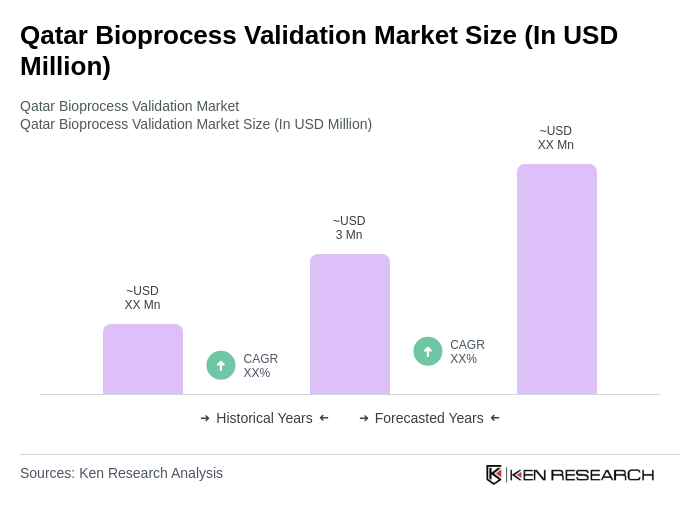
- The Qatar Bioprocess Validation Market is valued at USD 3 million, based on a five-year historical analysis. This growth is primarily driven by the increasing demand for biopharmaceuticals, stringent regulatory requirements, and advancements in bioprocessing technologies. The market is also supported by the rising investments in research and development activities within the biotechnology sector, which necessitate robust validation processes to ensure product quality and compliance. The adoption of single-use technologies and automated validation solutions has enhanced efficiency while maintaining compliance with international standards.
- Key players in this market include Doha, Al Rayyan, and Al Wakrah, which dominate due to their strategic investments in healthcare infrastructure and biopharmaceutical manufacturing. The presence of leading research institutions and a favorable regulatory environment further enhance their competitive edge, making these cities pivotal in the bioprocess validation landscape.
- The Ministry of Public Health in Qatar enforces the Qatar National Medicines Registration and Licensing Guidelines, 2020, which mandates that all biopharmaceutical products undergo comprehensive validation processes aligned with Good Manufacturing Practices (GMP) to ensure compliance with international quality standards. This regulatory framework requires pharmaceutical manufacturers to demonstrate that their bioprocesses consistently produce products meeting predetermined specifications through process validation, equipment qualification, and analytical method validation. Companies must obtain manufacturing licenses and submit validation documentation as part of the product registration process, with regular inspections conducted to verify ongoing compliance. This regulatory oversight aims to enhance the safety and efficacy of biopharmaceuticals produced within the country, thereby fostering consumer trust and promoting the growth of the local bioprocessing industry.
Qatar Bioprocess Validation Market Segmentation
By Type:The market is segmented into various types of validation services, including Process Validation, Cleaning Validation, Equipment Validation, Method Validation, Software Validation, Facility Validation, Extractables & Leachables Testing, Viral Clearance Testing, and Others. Each of these sub-segments plays a crucial role in ensuring the integrity and compliance of bioprocesses. The growing emphasis on regulatory compliance and the expansion of biologics and biosimilars production have intensified the need for comprehensive validation services across all process components.
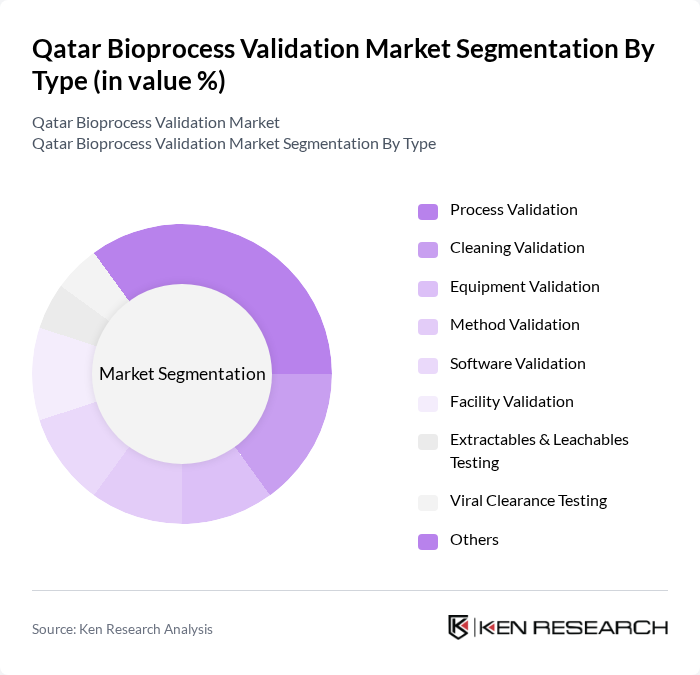
The Process Validation sub-segment is currently dominating the market due to its critical importance in ensuring that biopharmaceutical processes consistently produce products meeting predetermined specifications. This segment is driven by the increasing regulatory scrutiny and the need for compliance with Good Manufacturing Practices (GMP). Regulatory authorities including the FDA and EMA have intensified monitoring of process validation procedures, contributing to increased expenditure on validation services and technologies. The demand for Process Validation is further fueled by the growing biopharmaceutical sector in Qatar, which necessitates rigorous validation protocols to ensure product safety and efficacy.
By End-User:The market is segmented by end-users, including Pharmaceutical Companies, Biotechnology Firms, Contract Research Organizations (CROs), Contract Manufacturing Organizations (CMOs), Academic & Research Institutions, Government Agencies, and Others. Each end-user category has distinct validation needs based on their operational requirements and regulatory obligations. The growth in biosimilars production and the emergence of cell and gene therapy manufacturing have propelled demand for validation services across all end-user segments.
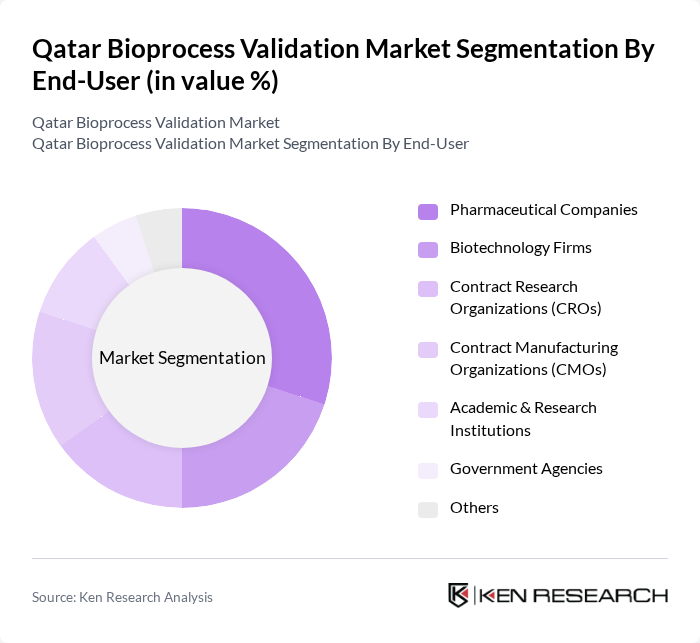
Pharmaceutical Companies are the leading end-users in the market, accounting for a significant share due to their extensive need for validation services to comply with stringent regulatory requirements. The increasing focus on drug safety and efficacy, coupled with the rising number of biopharmaceutical products entering the market, drives the demand for validation services among these companies. The trend toward outsourcing validation processes to specialized Contract Manufacturing Organizations and Contract Research Organizations has accelerated, particularly as these service providers have expanded their capabilities to address demand for advanced therapeutics including mRNA therapies and biosimilars. Additionally, the growing trend of outsourcing validation processes to specialized service providers is further enhancing the market dynamics.
Qatar Bioprocess Validation Market Competitive Landscape
The Qatar Bioprocess Validation Market is characterized by a dynamic mix of regional and international players. Leading participants such as Thermo Fisher Scientific, Merck KGaA, Sartorius AG, Charles River Laboratories, Bio-Rad Laboratories, Eppendorf AG, GE HealthCare, Agilent Technologies, Pall Corporation, Fujifilm Diosynth Biotechnologies, Lonza Group, WuXi AppTec, Catalent, Inc., SGS SA, Eurofins Scientific SE, Cobetter Filtration Equipment Co., Ltd., MEISSNER FILTRATION PRODUCTS, INC., ProBioGen AG, Pacific BioLabs, Nelson Laboratories, LLC contribute to innovation, geographic expansion, and service delivery in this space.
Qatar Bioprocess Validation Market Industry Analysis
Growth Drivers
- Increasing Demand for Biopharmaceuticals:The biopharmaceutical sector in Qatar is projected to reach a value of approximately QAR 1.5 billion by 2024, driven by a growing prevalence of chronic diseases. The World Health Organization reported that non-communicable diseases account for 73% of total deaths in Qatar. This rising demand for innovative therapies necessitates robust bioprocess validation to ensure product safety and efficacy, thereby propelling market growth significantly.
- Stringent Regulatory Requirements:Qatar's regulatory framework mandates compliance with international standards, including those set by the World Health Organization and the International Conference on Harmonisation. The Qatar Ministry of Public Health has increased its oversight, with 30% more inspections conducted in the recent past compared to previous years. This heightened regulatory scrutiny drives the need for comprehensive bioprocess validation, ensuring that biopharmaceuticals meet safety and quality benchmarks.
- Advancements in Bioprocessing Technologies:The introduction of innovative bioprocessing technologies, such as single-use systems and continuous manufacturing, is transforming the landscape in Qatar. The Qatar National Research Fund allocated QAR 200 million for biotechnology research in the recent past, fostering technological advancements. These innovations enhance efficiency and reduce time-to-market for biopharmaceuticals, necessitating rigorous validation processes to maintain product integrity and compliance with evolving standards.
Market Challenges
- High Costs of Bioprocess Validation:The financial burden associated with bioprocess validation can be significant, with costs reaching up to QAR 1 million per project. This high expenditure poses a challenge for smaller biotech firms in Qatar, limiting their ability to invest in necessary validation processes. As a result, many companies may struggle to meet regulatory requirements, potentially hindering their market entry and growth prospects.
- Limited Skilled Workforce:The bioprocess validation sector in Qatar faces a shortage of skilled professionals, with an estimated 40% of positions remaining unfilled in the recent past. This skills gap is exacerbated by the rapid technological advancements in the industry, which require specialized training. Consequently, the lack of qualified personnel can lead to delays in validation processes and increased operational risks for biopharmaceutical companies.
Qatar Bioprocess Validation Market Future Outlook
The future of the bioprocess validation market in Qatar appears promising, driven by ongoing investments in biotechnology and a commitment to regulatory compliance. As the demand for biopharmaceuticals continues to rise, companies are likely to adopt more advanced validation techniques, including automation and AI integration. Furthermore, the expansion of biomanufacturing facilities will enhance local production capabilities, positioning Qatar as a key player in the regional biopharmaceutical landscape.
Market Opportunities
- Expansion of Biomanufacturing Facilities:The establishment of new biomanufacturing facilities in Qatar is expected to create significant opportunities for bioprocess validation services. With an investment of QAR 500 million planned for the near future, these facilities will require comprehensive validation to ensure compliance with international standards, thereby driving demand for specialized services in the region.
- Collaborations with Research Institutions:Partnerships between biopharmaceutical companies and research institutions are on the rise, with over 15 collaborations initiated in the recent past alone. These alliances facilitate knowledge sharing and innovation, creating opportunities for enhanced bioprocess validation methodologies. Such collaborations can lead to the development of cutting-edge therapies, further stimulating market growth in Qatar.
Scope of the Report
| Segment | Sub-Segments |
|---|---|
| By Type | Process Validation Cleaning Validation Equipment Validation Method Validation Software Validation Facility Validation Extractables & Leachables Testing Viral Clearance Testing Others |
| By End-User | Pharmaceutical Companies Biotechnology Firms Contract Research Organizations (CROs) Contract Manufacturing Organizations (CMOs) Academic & Research Institutions Government Agencies Others |
| By Application | Drug Development Clinical Trials Quality Control Regulatory Compliance Biosimilar & Biologics Production Cell & Gene Therapy Manufacturing Others |
| By Service Type | Consulting Services Testing Services Training Services Documentation Services Digital Validation Solutions Others |
| By Region | Doha Al Rayyan Umm Salal Al Wakrah Others |
| By Compliance Level | Full Compliance Partial Compliance Non-Compliance |
| By Investment Source | Private Investments Government Funding International Grants Others |
Key Target Audience
Investors and Venture Capitalist Firms
Government and Regulatory Bodies (e.g., Qatar Ministry of Public Health, Qatar Biobank)
Biopharmaceutical Manufacturers
Contract Research Organizations (CROs)
Quality Assurance and Quality Control Departments
Biotechnology Firms
Pharmaceutical Supply Chain Managers
Healthcare Providers and Institutions
Players Mentioned in the Report:
Thermo Fisher Scientific
Merck KGaA
Sartorius AG
Charles River Laboratories
Bio-Rad Laboratories
Eppendorf AG
GE HealthCare
Agilent Technologies
Pall Corporation
Fujifilm Diosynth Biotechnologies
Lonza Group
WuXi AppTec
Catalent, Inc.
SGS SA
Eurofins Scientific SE
Cobetter Filtration Equipment Co., Ltd.
MEISSNER FILTRATION PRODUCTS, INC.
ProBioGen AG
Pacific BioLabs
Nelson Laboratories, LLC
Table of Contents
Market Assessment Phase
1. Executive Summary and Approach
2. Qatar Bioprocess Validation Market Overview
2.1 Key Insights and Strategic Recommendations
2.2 Qatar Bioprocess Validation Market Overview
2.3 Definition and Scope
2.4 Evolution of Market Ecosystem
2.5 Timeline of Key Regulatory Milestones
2.6 Value Chain & Stakeholder Mapping
2.7 Business Cycle Analysis
2.8 Policy & Incentive Landscape
3. Qatar Bioprocess Validation Market Analysis
3.1 Growth Drivers
3.1.1 Increasing demand for biopharmaceuticals
3.1.2 Stringent regulatory requirements
3.1.3 Advancements in bioprocessing technologies
3.1.4 Rising investments in biotechnology research
3.2 Market Challenges
3.2.1 High costs of bioprocess validation
3.2.2 Limited skilled workforce
3.2.3 Complex regulatory landscape
3.2.4 Rapid technological changes
3.3 Market Opportunities
3.3.1 Expansion of biomanufacturing facilities
3.3.2 Collaborations with research institutions
3.3.3 Adoption of automation in bioprocessing
3.3.4 Growth in personalized medicine
3.4 Market Trends
3.4.1 Shift towards continuous bioprocessing
3.4.2 Increasing focus on sustainability
3.4.3 Integration of AI in bioprocess validation
3.4.4 Rise of contract manufacturing organizations (CMOs)
3.5 Government Regulation
3.5.1 Compliance with international standards
3.5.2 Implementation of Good Manufacturing Practices (GMP)
3.5.3 Regulatory support for biopharmaceutical innovation
3.5.4 Monitoring of bioprocess validation protocols
4. SWOT Analysis
5. Stakeholder Analysis
6. Porter's Five Forces Analysis
7. Qatar Bioprocess Validation Market Market Size, 2019-2024
7.1 By Value
7.2 By Volume
7.3 By Average Selling Price
8. Qatar Bioprocess Validation Market Segmentation
8.1 By Type
8.1.1 Process Validation
8.1.2 Cleaning Validation
8.1.3 Equipment Validation
8.1.4 Method Validation
8.1.5 Software Validation
8.1.6 Facility Validation
8.1.7 Extractables & Leachables Testing
8.1.8 Viral Clearance Testing
8.1.9 Others
8.2 By End-User
8.2.1 Pharmaceutical Companies
8.2.2 Biotechnology Firms
8.2.3 Contract Research Organizations (CROs)
8.2.4 Contract Manufacturing Organizations (CMOs)
8.2.5 Academic & Research Institutions
8.2.6 Government Agencies
8.2.7 Others
8.3 By Application
8.3.1 Drug Development
8.3.2 Clinical Trials
8.3.3 Quality Control
8.3.4 Regulatory Compliance
8.3.5 Biosimilar & Biologics Production
8.3.6 Cell & Gene Therapy Manufacturing
8.3.7 Others
8.4 By Service Type
8.4.1 Consulting Services
8.4.2 Testing Services
8.4.3 Training Services
8.4.4 Documentation Services
8.4.5 Digital Validation Solutions
8.4.6 Others
8.5 By Region
8.5.1 Doha
8.5.2 Al Rayyan
8.5.3 Umm Salal
8.5.4 Al Wakrah
8.5.5 Others
8.6 By Compliance Level
8.6.1 Full Compliance
8.6.2 Partial Compliance
8.6.3 Non-Compliance
8.7 By Investment Source
8.7.1 Private Investments
8.7.2 Government Funding
8.7.3 International Grants
8.7.4 Others
9. Qatar Bioprocess Validation Market Competitive Analysis
9.1 Market Share of Key Players
9.2 Cross Comparison of Key Players
9.2.1 Company Name
9.2.2 Company Headquarters/Regional Presence
9.2.3 Group Size (Large, Medium, or Small as per industry convention)
9.2.4 Revenue Growth Rate (Qatar or MEA segment, if available)
9.2.5 Market Penetration Rate (Qatar bioprocess validation market share)
9.2.6 Number of Validation Projects Completed (Qatar/MEA)
9.2.7 Range of Validation Services Offered
9.2.8 Regulatory Compliance Track Record (GMP, ISO, etc.)
9.2.9 Customer Retention Rate
9.2.10 Pricing Strategy (Premium, Value, Custom, etc.)
9.2.11 Operational Efficiency (Turnaround Time, Automation Level)
9.2.12 Product/Service Quality Index
9.2.13 Innovation Rate (e.g., digital validation, AI integration)
9.2.14 Customer Satisfaction Score
9.3 SWOT Analysis of Top Players
9.4 Pricing Analysis
9.5 Detailed Profile of Major Companies
9.5.1 Thermo Fisher Scientific
9.5.2 Merck KGaA
9.5.3 Sartorius AG
9.5.4 Charles River Laboratories
9.5.5 Bio-Rad Laboratories
9.5.6 Eppendorf AG
9.5.7 GE HealthCare
9.5.8 Agilent Technologies
9.5.9 Pall Corporation
9.5.10 Fujifilm Diosynth Biotechnologies
9.5.11 Lonza Group
9.5.12 WuXi AppTec
9.5.13 Catalent, Inc.
9.5.14 SGS SA
9.5.15 Eurofins Scientific SE
9.5.16 Cobetter Filtration Equipment Co., Ltd.
9.5.17 MEISSNER FILTRATION PRODUCTS, INC.
9.5.18 ProBioGen AG
9.5.19 Pacific BioLabs
9.5.20 Nelson Laboratories, LLC
10. Qatar Bioprocess Validation Market End-User Analysis
10.1 Procurement Behavior of Key Ministries
10.1.1 Budget Allocation Trends
10.1.2 Decision-Making Processes
10.1.3 Preferred Suppliers
10.1.4 Compliance Requirements
10.2 Corporate Spend on Infrastructure & Energy
10.2.1 Investment Priorities
10.2.2 Spending Patterns
10.2.3 Key Projects
10.3 Pain Point Analysis by End-User Category
10.3.1 Regulatory Compliance Challenges
10.3.2 Cost Management Issues
10.3.3 Technology Integration Difficulties
10.4 User Readiness for Adoption
10.4.1 Training Needs
10.4.2 Technology Familiarity
10.4.3 Support Requirements
10.5 Post-Deployment ROI and Use Case Expansion
10.5.1 Performance Metrics
10.5.2 Case Studies
10.5.3 Future Investment Plans
11. Qatar Bioprocess Validation Market Future Size, 2025-2030
11.1 By Value
11.2 By Volume
11.3 By Average Selling Price
Go-To-Market Strategy Phase
1. Whitespace Analysis + Business Model Canvas
1.1 Market Gaps Identification
1.2 Value Proposition Development
1.3 Revenue Streams Analysis
1.4 Customer Segmentation
1.5 Key Partnerships
1.6 Cost Structure Analysis
1.7 Competitive Advantage
2. Marketing and Positioning Recommendations
2.1 Branding Strategies
2.2 Product USPs
2.3 Target Market Identification
2.4 Communication Strategies
2.5 Digital Marketing Approaches
2.6 Customer Engagement Tactics
3. Distribution Plan
3.1 Urban Retail Strategies
3.2 Rural NGO Tie-Ups
3.3 Online Distribution Channels
3.4 Direct Sales Approaches
3.5 Partnership with Distributors
4. Channel & Pricing Gaps
4.1 Underserved Routes
4.2 Pricing Bands Analysis
4.3 Competitor Pricing Strategies
4.4 Customer Price Sensitivity
5. Unmet Demand & Latent Needs
5.1 Category Gaps
5.2 Consumer Segments
5.3 Emerging Trends
5.4 Future Needs Assessment
6. Customer Relationship
6.1 Loyalty Programs
6.2 After-Sales Service
6.3 Customer Feedback Mechanisms
6.4 Relationship Management Strategies
7. Value Proposition
7.1 Sustainability Initiatives
7.2 Integrated Supply Chains
7.3 Unique Selling Points
7.4 Customer-Centric Approaches
8. Key Activities
8.1 Regulatory Compliance
8.2 Branding Efforts
8.3 Distribution Setup
8.4 Training and Development
9. Entry Strategy Evaluation
9.1 Domestic Market Entry Strategy
9.1.1 Product Mix
9.1.2 Pricing Band
9.1.3 Packaging Considerations
9.2 Export Entry Strategy
9.2.1 Target Countries
9.2.2 Compliance Roadmap
10. Entry Mode Assessment
10.1 Joint Ventures
10.2 Greenfield Investments
10.3 Mergers & Acquisitions
10.4 Distributor Model
11. Capital and Timeline Estimation
11.1 Capital Requirements
11.2 Timelines for Implementation
12. Control vs Risk Trade-Off
12.1 Ownership Considerations
12.2 Partnership Dynamics
13. Profitability Outlook
13.1 Breakeven Analysis
13.2 Long-Term Sustainability
14. Potential Partner List
14.1 Distributors
14.2 Joint Ventures
14.3 Acquisition Targets
15. Execution Roadmap
15.1 Phased Plan for Market Entry
15.1.1 Market Setup
15.1.2 Market Entry
15.1.3 Growth Acceleration
15.1.4 Scale & Stabilize
15.2 Key Activities and Milestones
15.2.1 Milestone Planning
15.2.2 Activity Tracking
Research Methodology
Phase 1: Approach1
Desk Research
- Analysis of market reports from Qatar's Ministry of Public Health and relevant bioprocessing associations
- Review of academic journals and publications focusing on bioprocess validation methodologies
- Examination of industry white papers and case studies from leading biopharmaceutical companies operating in Qatar
Primary Research
- Interviews with regulatory affairs specialists in biopharmaceutical firms
- Surveys with quality assurance managers in local bioprocessing facilities
- Field interviews with laboratory directors and validation experts in the bioprocess sector
Validation & Triangulation
- Cross-validation of findings through multiple data sources including industry reports and expert opinions
- Triangulation of qualitative insights from interviews with quantitative data from market analysis
- Sanity checks conducted through expert panel reviews comprising industry veterans and academic researchers
Phase 2: Market Size Estimation1
Top-down Assessment
- Estimation of the bioprocess validation market size based on national healthcare expenditure and biopharmaceutical growth rates
- Segmentation of the market by application areas such as vaccines, monoclonal antibodies, and cell therapies
- Incorporation of government initiatives promoting biopharmaceutical development in Qatar
Bottom-up Modeling
- Collection of data on validation service pricing from leading bioprocess validation service providers
- Estimation of market volume based on the number of biopharmaceutical products in development and production
- Calculation of market size using a volume x price approach for various bioprocess validation services
Forecasting & Scenario Analysis
- Multi-factor regression analysis incorporating factors such as technological advancements and regulatory changes
- Scenario modeling based on potential market disruptions, including economic fluctuations and global health crises
- Development of baseline, optimistic, and pessimistic forecasts through 2030
Phase 3: CATI Sample Composition1
| Scope Item/Segment | Sample Size | Target Respondent Profiles |
|---|---|---|
| Biopharmaceutical Validation Services | 100 | Quality Assurance Managers, Validation Specialists |
| Regulatory Compliance in Bioprocessing | 60 | Regulatory Affairs Specialists, Compliance Managers |
| Cell and Gene Therapy Validation | 50 | Research Scientists, Process Development Managers |
| Vaccine Production Validation | 70 | Production Managers, Quality Control Analysts |
| Analytical Method Validation | 40 | Laboratory Managers, Analytical Chemists |
Frequently Asked Questions
What is the current value of the Qatar Bioprocess Validation Market?
The Qatar Bioprocess Validation Market is valued at approximately USD 3 million, reflecting a five-year historical analysis. This valuation is driven by the increasing demand for biopharmaceuticals and stringent regulatory requirements.
What factors are driving growth in the Qatar Bioprocess Validation Market?
Who are the key players in the Qatar Bioprocess Validation Market?
What types of validation services are offered in the Qatar Bioprocess Validation Market?
Other Regional/Country Reports
Indonesia Bioprocess Validation Market
Malaysia Bioprocess Validation Market
KSA Bioprocess Validation Market
APAC Bioprocess Validation Market
SEA Bioprocess Validation Market
Vietnam Bioprocess Validation Market
Other Adjacent Reports
South Africa Biopharmaceutical Manufacturing Market
Thailand Biotechnology Research Market
Oman Regulatory Compliance Services Market
Qatar Single-Use Bioprocessing Market
Kuwait process analytical technology market report size, share, growth drivers, trends, opportunities & forecast 2025–2030Belgium Viral Clearance Testing Market
Egypt Extractables and Leachables Testing Market
Oman Contract Manufacturing Organization Market
Kuwait biosimilars market Size, Share, Growth Drivers, Trends, Opportunities & Forecast 2025–2030Singapore Cell and Gene Therapy Market
Why Buy From Us?

What makes us stand out is that our consultants follow Robust, Refine and Result (RRR) methodology. Robust for clear definitions, approaches and sanity checking, Refine for differentiating respondents' facts and opinions, and Result for presenting data with story.

We have set a benchmark in the industry by offering our clients with syndicated and customized market research reports featuring coverage of entire market as well as meticulous research and analyst insights.

While we don't replace traditional research, we flip the method upside down. Our dual approach of Top Bottom & Bottom Top ensures quality deliverable by not just verifying company fundamentals but also looking at the sector and macroeconomic factors.

With one step in the future, our research team constantly tries to show you the bigger picture. We help with some of the tough questions you may encounter along the way: How is the industry positioned? Best marketing channel? KPI's of competitors? By aligning every element, we help maximize success.

Our report gives you instant access to the answers and sources that other companies might choose to hide. We elaborate each steps of research methodology we have used and showcase you the sample size to earn your trust.

If you need any support, we are here! We pride ourselves on universe strength, data quality, and quick, friendly, and professional service.