








Ken Research Logo

Qatar Cell Culture Protein Surface Coating Market

The Qatar Cell Culture Protein Surface Coating Market, worth USD 6-7 million, grows due to advanced cell culture needs in biopharma and research sectors.

Region:Middle East

Author(s):Dev

Product Code:KRAD5200

Pages:81

Published On:December 2025

About the Report

Base Year 2024

Qatar Cell Culture Protein Surface Coating Market Overview

  • The Qatar Cell Culture Protein Surface Coating Market is valued at approximately USD 6–7 million, based on a five-year historical analysis and benchmarking against the overall Qatar cell culture market and regional cell culture media market sizes. This growth is primarily driven by the increasing demand for advanced cell culture techniques in research and development, particularly in the pharmaceutical and biotechnology sectors, where cell culture is used for biologics, vaccines, and cell-based assays. The rising prevalence of chronic diseases and the need for innovative therapeutic solutions, including biopharmaceuticals and regenerative medicine, have further fueled market expansion in Qatar.
  • Doha is the dominant city in the Qatar Cell Culture Protein Surface Coating Market, primarily due to its status as a hub for healthcare and research institutions. Major organizations such as Hamad Medical Corporation, Sidra Medicine, Qatar University, and research facilities within Education City are concentrated in Doha and drive most of the country’s advanced biomedical and biotechnology research activities, which rely heavily on cell culture workflows. The presence of leading universities and research centers, together with sustained investments in healthcare infrastructure, positions Doha as the key demand center, while other municipalities like Al Rayyan and Al Wakrah contribute through expanding clinical and academic facilities associated with the Doha metropolitan area.
  • In 2023, the Qatari government further strengthened the quality and safety framework for biomedical and laboratory products used in healthcare and research, including cell culture reagents and related materials. Relevant oversight is provided through instruments such as the Supreme Council of Health Resolution No. (1) of 2014 on the organization of the practice of healthcare professions and licensing of healthcare facilities, issued by the Ministry of Public Health, which sets licensing, quality, and safety requirements for healthcare institutions handling laboratory and biotechnology products, aligning local practice with international standards. These measures support research and development in biotechnology while safeguarding public health by requiring facilities to comply with recognized quality, traceability, and safety norms for products used in cell culture workflows, including coated cultureware.

Qatar Cell Culture Protein Surface Coating Market Segmentation

By Type:The market is segmented into various types of coatings, each serving specific applications in cell culture. Collagen-based coatings represent the dominant sub-segment globally due to their high biocompatibility and strong support for cell adhesion and proliferation, and a similar pattern is observed in Middle East and Qatar cell culture applications where collagen is widely used in academic and biopharmaceutical R&D. Fibronectin-based coatings are also significant, as they enhance cell attachment, spreading, and proliferation, making them popular for sensitive primary cells and stem cell research in both research and clinical translational settings. Other types include laminin-based coatings, which are particularly important for neural and stem cell cultures, poly-D-lysine / poly-L-lysine coatings that improve electrostatic cell attachment especially for neuronal and adherent cell lines, vitronectin and other ECM protein coatings frequently used in xeno-free or defined stem cell systems, and recombinant/synthetic protein coatings that provide batch-to-batch consistency and support regulatory compliance in advanced therapy and biomanufacturing workflows.
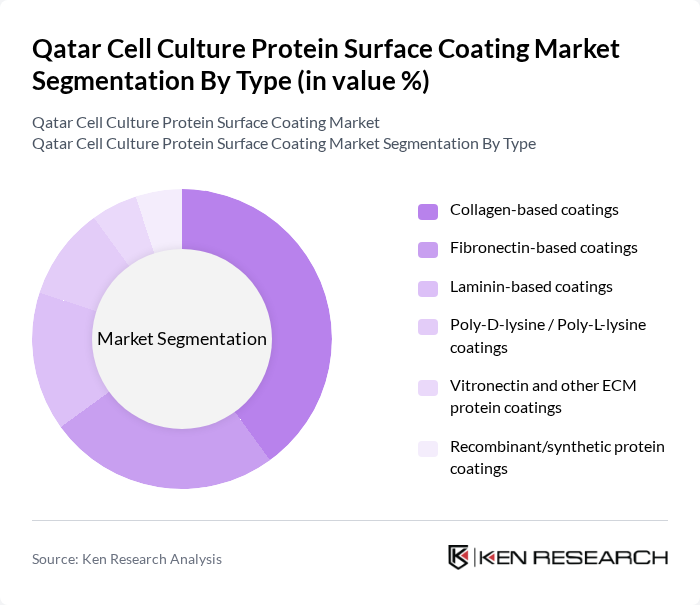
Qatar Cell Culture Protein Surface Coating Market segmentation by Type.

By End-User:The end-user segmentation includes pharmaceutical and biopharmaceutical companies, academic and research institutions, contract research and manufacturing organizations (CROs/CMOs), hospital and clinical laboratories, and government and non-profit research centers. Globally, pharmaceutical and biopharmaceutical companies are among the leading end-users of cell culture protein surface coatings due to their intensive use of cell-based assays, biologics development, and advanced therapies, and this segment is similarly important in Qatar as the country expands its biopharmaceutical and vaccine-related capabilities. Academic and research institutions also play a significant role, as they conduct extensive research in cell biology, stem cell science, and regenerative medicine, supported by national R&D funding programs and the presence of specialized research centers in Doha and Education City.
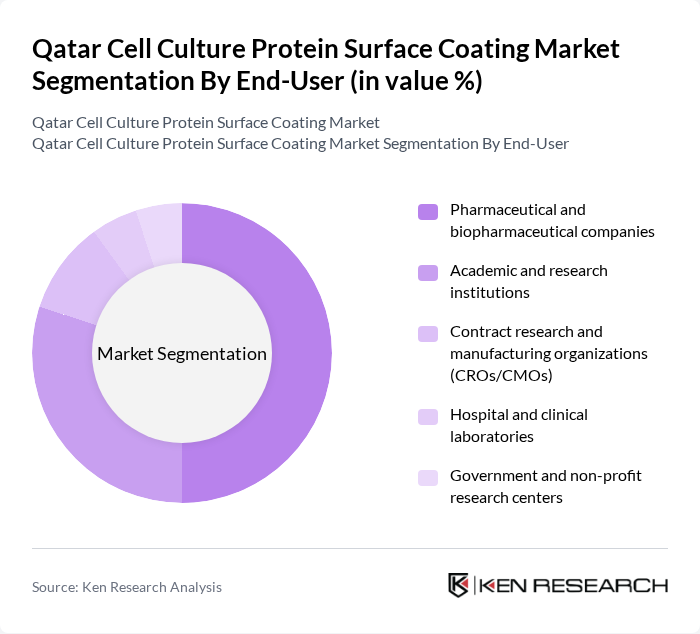
Qatar Cell Culture Protein Surface Coating Market segmentation by End-User.

Qatar Cell Culture Protein Surface Coating Market Competitive Landscape

The Qatar Cell Culture Protein Surface Coating Market is characterized by a dynamic mix of regional and international players. Leading participants such as Thermo Fisher Scientific Inc., Corning Incorporated, Merck KGaA (MilliporeSigma), BD Biosciences (Becton, Dickinson and Company), Lonza Group Ltd, Greiner Bio-One International GmbH, Eppendorf SE, Abcam plc, Sartorius AG, Promega Corporation, STEMCELL Technologies Inc., Bio-Rad Laboratories, Inc., VWR International, LLC (Avantor, Inc.), Qiagen N.V., and Kollodis BioSciences, Inc. contribute to innovation, geographic expansion, and service delivery in this space, supported by their global portfolios of pre-coated cultureware and extracellular matrix protein products for research, bioprocess development, and advanced therapy applications.

Thermo Fisher Scientific Inc.

1956

Waltham, Massachusetts, USA

Corning Incorporated

1851

Corning, New York, USA

Merck KGaA (MilliporeSigma)

1668

Darmstadt, Germany

BD Biosciences (Becton, Dickinson and Company)

1897

Franklin Lakes, New Jersey, USA

Lonza Group Ltd

1897

Basel, Switzerland

Company

Establishment Year

Headquarters

Group size (global revenue tier: Large / Medium / Small)

Revenue from cell culture protein surface coatings (Qatar, latest year)

3-year CAGR in cell culture protein surface coating revenue (global)

Market share in Qatar cell culture protein surface coating market (%)

Portfolio breadth (number of coating product lines / SKUs)

R&D intensity (R&D spend as % of total revenue)

Qatar Cell Culture Protein Surface Coating Market Industry Analysis

Growth Drivers

  • Increasing Demand for Biopharmaceuticals:The biopharmaceutical sector in Qatar is projected to reach $1.5 billion by future, driven by a growing population and rising healthcare needs. This surge in demand for biopharmaceuticals is propelling the need for advanced cell culture techniques, which rely heavily on protein surface coatings. The World Health Organization reported that biopharmaceuticals account for over 35% of total pharmaceutical sales, indicating a robust market for cell culture applications in this sector.
  • Advancements in Cell Culture Technologies:Qatar's investment in biotechnology has led to significant advancements in cell culture technologies, with over $200 million allocated for research and development in future. These innovations enhance the efficiency and effectiveness of cell culture processes, increasing the demand for specialized protein surface coatings. The Qatar National Research Fund supports numerous projects aimed at improving cell culture methodologies, further driving market growth in this area.
  • Rising Investments in Research and Development:The Qatari government has committed approximately $300 million to biotechnology research in future, fostering an environment conducive to innovation. This investment is expected to stimulate the development of new cell culture products and technologies, increasing the demand for protein surface coatings. The Qatar Science and Technology Park is a hub for biotech firms, further enhancing R&D activities and market potential in the cell culture sector.

Market Challenges

  • High Costs of Advanced Coating Materials:The cost of advanced protein surface coatings can exceed $600 per liter, posing a significant barrier for many research institutions and biotech firms in Qatar. This high expense limits accessibility and adoption, particularly for smaller companies with constrained budgets. As a result, the market may experience slower growth due to financial constraints faced by potential users of these technologies.
  • Regulatory Hurdles in Product Approval:The regulatory landscape in Qatar can be complex, with product approval processes taking up to 24 months. This lengthy timeline can deter companies from investing in new cell culture technologies, including protein surface coatings. Compliance with international quality standards, such as those set by the FDA and EMA, adds additional layers of complexity, further challenging market participants in navigating the approval landscape.

Qatar Cell Culture Protein Surface Coating Market Future Outlook

The future of the Qatar cell culture protein surface coating market appears promising, driven by ongoing advancements in biotechnology and increasing demand for personalized medicine. As the biopharmaceutical sector continues to expand, the need for innovative cell culture solutions will grow. Additionally, the integration of automation in laboratory processes is expected to enhance efficiency, further propelling market growth. The focus on sustainable practices will also shape product development, aligning with global trends towards eco-friendly solutions.

Market Opportunities

  • Expansion of Biotechnology Firms in Qatar:The establishment of over 30 new biotechnology firms in Qatar by future presents significant opportunities for protein surface coating suppliers. These firms are likely to require advanced coatings for their research and production processes, creating a robust demand for innovative solutions tailored to their specific needs.
  • Collaborations with Academic Institutions:Partnerships between biotech companies and academic institutions are expected to increase, with at least seven major collaborations anticipated in future. These collaborations will facilitate research and development of new cell culture technologies, driving demand for specialized protein surface coatings and fostering innovation in the market.

Scope of the Report

SegmentSub-Segments
By Type

Collagen-based coatings

Fibronectin-based coatings

Laminin-based coatings

Poly-D-lysine / Poly-L-lysine coatings

Vitronectin and other ECM protein coatings

Recombinant/synthetic protein coatings

By End-User

Pharmaceutical and biopharmaceutical companies

Academic and research institutions

Contract research and manufacturing organizations (CROs/CMOs)

Hospital and clinical laboratories

Government and non-profit research centers

By Application

Drug discovery and screening

Toxicity and ADME testing

Regenerative medicine and cell therapy

Biologics and vaccine development

Stem cell and cancer research

Others

By Material Source

Animal-derived protein materials

Human-derived protein materials

Synthetic and recombinant protein materials

Plant-derived protein materials

By Coating Method

Pre-coated cultureware

Self-coating (user-applied) solutions

Covalent bonding and cross-linked coatings

Self-assembled monolayers and advanced nanostructured coatings

Others

By Cell Type

Adherent mammalian cells

Stem cells (ESCs, iPSCs, MSCs)

Primary cells

Suspension cells

Others

By Region

Doha

Al Rayyan

Al Wakrah

Umm Salal

Al Khor and other municipalities

Key Target Audience

Investors and Venture Capitalist Firms

Government and Regulatory Bodies (e.g., Qatar Ministry of Public Health, Qatar Science and Technology Park)

Manufacturers and Producers

Distributors and Retailers

Biotechnology and Pharmaceutical Companies

Healthcare Providers and Laboratories

Industry Associations (e.g., Qatar Biotech Association)

Financial Institutions

Players Mentioned in the Report:

Thermo Fisher Scientific Inc.

Corning Incorporated

Merck KGaA (MilliporeSigma)

BD Biosciences (Becton, Dickinson and Company)

Lonza Group Ltd

Greiner Bio-One International GmbH

Eppendorf SE

Abcam plc

Sartorius AG

Promega Corporation

STEMCELL Technologies Inc.

Bio-Rad Laboratories, Inc.

VWR International, LLC (Avantor, Inc.)

Qiagen N.V.

Kollodis BioSciences, Inc.

Table of Contents

Market Assessment Phase

1. Executive Summary and Approach


2. Qatar Cell Culture Protein Surface Coating Market Overview

2.1 Key Insights and Strategic Recommendations

2.2 Qatar Cell Culture Protein Surface Coating Market Overview

2.3 Definition and Scope

2.4 Evolution of Market Ecosystem

2.5 Timeline of Key Regulatory Milestones

2.6 Value Chain & Stakeholder Mapping

2.7 Business Cycle Analysis

2.8 Policy & Incentive Landscape


3. Qatar Cell Culture Protein Surface Coating Market Analysis

3.1 Growth Drivers

3.1.1 Increasing demand for biopharmaceuticals
3.1.2 Advancements in cell culture technologies
3.1.3 Rising investments in research and development
3.1.4 Growing awareness of personalized medicine

3.2 Market Challenges

3.2.1 High costs of advanced coating materials
3.2.2 Regulatory hurdles in product approval
3.2.3 Limited availability of skilled workforce
3.2.4 Competition from alternative technologies

3.3 Market Opportunities

3.3.1 Expansion of biotechnology firms in Qatar
3.3.2 Collaborations with academic institutions
3.3.3 Development of innovative coating solutions
3.3.4 Increasing demand for 3D cell culture systems

3.4 Market Trends

3.4.1 Shift towards sustainable and eco-friendly coatings
3.4.2 Integration of automation in cell culture processes
3.4.3 Growth of personalized medicine applications
3.4.4 Rising focus on regenerative medicine

3.5 Government Regulation

3.5.1 Compliance with international quality standards
3.5.2 Regulations on biopharmaceutical manufacturing
3.5.3 Guidelines for cell culture practices
3.5.4 Policies promoting research and innovation

4. SWOT Analysis


5. Stakeholder Analysis


6. Porter's Five Forces Analysis


7. Qatar Cell Culture Protein Surface Coating Market Size, 2019-2024

7.1 By Value

7.2 By Volume

7.3 By Average Selling Price


8. Qatar Cell Culture Protein Surface Coating Market Segmentation

8.1 By Type

8.1.1 Collagen-based coatings
8.1.2 Fibronectin-based coatings
8.1.3 Laminin-based coatings
8.1.4 Poly-D-lysine / Poly-L-lysine coatings
8.1.5 Vitronectin and other ECM protein coatings
8.1.6 Recombinant/synthetic protein coatings

8.2 By End-User

8.2.1 Pharmaceutical and biopharmaceutical companies
8.2.2 Academic and research institutions
8.2.3 Contract research and manufacturing organizations (CROs/CMOs)
8.2.4 Hospital and clinical laboratories
8.2.5 Government and non-profit research centers

8.3 By Application

8.3.1 Drug discovery and screening
8.3.2 Toxicity and ADME testing
8.3.3 Regenerative medicine and cell therapy
8.3.4 Biologics and vaccine development
8.3.5 Stem cell and cancer research
8.3.6 Others

8.4 By Material Source

8.4.1 Animal-derived protein materials
8.4.2 Human-derived protein materials
8.4.3 Synthetic and recombinant protein materials
8.4.4 Plant-derived protein materials

8.5 By Coating Method

8.5.1 Pre-coated cultureware
8.5.2 Self-coating (user-applied) solutions
8.5.3 Covalent bonding and cross-linked coatings
8.5.4 Self-assembled monolayers and advanced nanostructured coatings
8.5.5 Others

8.6 By Cell Type

8.6.1 Adherent mammalian cells
8.6.2 Stem cells (ESCs, iPSCs, MSCs)
8.6.3 Primary cells
8.6.4 Suspension cells
8.6.5 Others

8.7 By Region

8.7.1 Doha
8.7.2 Al Rayyan
8.7.3 Al Wakrah
8.7.4 Umm Salal
8.7.5 Al Khor and other municipalities

9. Qatar Cell Culture Protein Surface Coating Market Competitive Analysis

9.1 Market Share of Key Players

9.2 Cross Comparison of Key Players

9.2.1 Company name and headquarters region
9.2.2 Group size (global revenue tier: Large / Medium / Small)
9.2.3 Revenue from cell culture protein surface coatings (Qatar, latest year)
9.2.4 3-year CAGR in cell culture protein surface coating revenue (global)
9.2.5 Market share in Qatar cell culture protein surface coating market (%)
9.2.6 Portfolio breadth (number of coating product lines / SKUs)
9.2.7 R&D intensity (R&D spend as % of total revenue)
9.2.8 Average selling price positioning in Qatar (Premium / Mid / Value)
9.2.9 Channel coverage in Qatar (direct vs distributor-based sales mix)
9.2.10 Number of key Qatar accounts (major hospitals, institutes, CROs served)
9.2.11 Regulatory and quality certifications relevant to Qatar (ISO, GMP, etc.)
9.2.12 Local service and technical support presence in Qatar/GCC

9.3 SWOT Analysis of Top Players

9.4 Pricing Analysis

9.5 Detailed Profile of Major Companies

9.5.1 Thermo Fisher Scientific Inc.
9.5.2 Corning Incorporated
9.5.3 Merck KGaA (MilliporeSigma)
9.5.4 BD Biosciences (Becton, Dickinson and Company)
9.5.5 Lonza Group Ltd
9.5.6 Greiner Bio-One International GmbH
9.5.7 Eppendorf SE
9.5.8 Abcam plc
9.5.9 Sartorius AG
9.5.10 Promega Corporation
9.5.11 STEMCELL Technologies Inc.
9.5.12 Bio-Rad Laboratories, Inc.
9.5.13 VWR International, LLC (Avantor, Inc.)
9.5.14 Qiagen N.V.
9.5.15 Kollodis BioSciences, Inc.

10. Qatar Cell Culture Protein Surface Coating Market End-User Analysis

10.1 Procurement Behavior of Key Ministries

10.1.1 Budget allocation for biotechnology
10.1.2 Procurement processes and timelines
10.1.3 Preferred suppliers and partnerships
10.1.4 Compliance requirements

10.2 Corporate Spend on Infrastructure & Energy

10.2.1 Investment in laboratory infrastructure
10.2.2 Funding for research initiatives
10.2.3 Expenditure on technology upgrades
10.2.4 Budget for training and development

10.3 Pain Point Analysis by End-User Category

10.3.1 Challenges in sourcing quality materials
10.3.2 Issues with regulatory compliance
10.3.3 Limitations in technical expertise
10.3.4 Need for cost-effective solutions

10.4 User Readiness for Adoption

10.4.1 Awareness of new technologies
10.4.2 Training programs availability
10.4.3 Infrastructure readiness
10.4.4 Financial readiness for investment

10.5 Post-Deployment ROI and Use Case Expansion

10.5.1 Measurement of performance metrics
10.5.2 Feedback mechanisms for improvement
10.5.3 Opportunities for scaling solutions
10.5.4 Long-term sustainability assessments

11. Qatar Cell Culture Protein Surface Coating Market Future Size, 2025-2030

11.1 By Value

11.2 By Volume

11.3 By Average Selling Price


Go-To-Market Strategy Phase

1. Whitespace Analysis + Business Model Canvas

1.1 Market gaps identification

1.2 Value proposition development

1.3 Revenue model exploration

1.4 Customer segmentation analysis

1.5 Competitive landscape overview

1.6 Key partnerships identification

1.7 Risk assessment and mitigation


2. Marketing and Positioning Recommendations

2.1 Branding strategies

2.2 Product USPs

2.3 Target audience identification

2.4 Communication strategies

2.5 Digital marketing initiatives

2.6 Trade show participation

2.7 Customer engagement tactics


3. Distribution Plan

3.1 Urban retail strategies

3.2 Rural NGO tie-ups

3.3 Online distribution channels

3.4 Direct sales approaches

3.5 Partnership with local distributors

3.6 Logistics and supply chain management

3.7 Inventory management strategies


4. Channel & Pricing Gaps

4.1 Underserved routes

4.2 Pricing bands analysis

4.3 Competitor pricing strategies

4.4 Customer willingness to pay

4.5 Discounting strategies

4.6 Bundling opportunities

4.7 Value-based pricing models


5. Unmet Demand & Latent Needs

5.1 Category gaps identification

5.2 Consumer segments analysis

5.3 Emerging trends exploration

5.4 Feedback collection from end-users

5.5 Innovation opportunities

5.6 Market entry barriers

5.7 Future demand forecasting


6. Customer Relationship

6.1 Loyalty programs design

6.2 After-sales service strategies

6.3 Customer feedback mechanisms

6.4 Relationship management tools

6.5 Community engagement initiatives

6.6 Customer education programs

6.7 Retention strategies


7. Value Proposition

7.1 Sustainability initiatives

7.2 Integrated supply chains

7.3 Unique selling propositions

7.4 Customer-centric approaches

7.5 Competitive advantages

7.6 Value delivery mechanisms

7.7 Long-term partnerships


8. Key Activities

8.1 Regulatory compliance

8.2 Branding strategies

8.3 Distribution setup

8.4 Market research activities

8.5 Training and development programs

8.6 Performance monitoring

8.7 Stakeholder engagement


9. Entry Strategy Evaluation

9.1 Domestic Market Entry Strategy

9.1.1 Product mix considerations
9.1.2 Pricing band analysis
9.1.3 Packaging strategies

9.2 Export Entry Strategy

9.2.1 Target countries identification
9.2.2 Compliance roadmap development

10. Entry Mode Assessment

10.1 Joint Ventures

10.2 Greenfield investments

10.3 Mergers & Acquisitions

10.4 Distributor Model

10.5 Risk assessment

10.6 Strategic fit evaluation

10.7 Long-term sustainability considerations


11. Capital and Timeline Estimation

11.1 Capital requirements analysis

11.2 Timelines for market entry

11.3 Budget allocation strategies

11.4 Financial forecasting

11.5 Resource allocation plans

11.6 Contingency planning

11.7 Milestone tracking


12. Control vs Risk Trade-Off

12.1 Ownership considerations

12.2 Partnerships evaluation

12.3 Risk management strategies

12.4 Control mechanisms

12.5 Long-term implications

12.6 Flexibility in operations

12.7 Stakeholder alignment


13. Profitability Outlook

13.1 Breakeven analysis

13.2 Long-term sustainability assessments

13.3 Profit margin optimization

13.4 Revenue growth strategies

13.5 Cost management techniques

13.6 Financial health monitoring

13.7 Investment return evaluations


14. Potential Partner List

14.1 Distributors identification

14.2 Joint Ventures opportunitie


Research Methodology

ApproachModellingSample

Phase 1: Approach1

Desk Research

  • Analysis of market reports from industry associations such as the Qatar Biotech Association
  • Review of scientific publications and journals focusing on cell culture technologies and protein surface coatings
  • Examination of government publications and trade statistics related to biotechnology and healthcare sectors in Qatar

Primary Research

  • Interviews with key opinion leaders in the biotechnology and pharmaceutical sectors
  • Surveys conducted with laboratory managers and researchers in academic and commercial institutions
  • Field interviews with suppliers and manufacturers of cell culture products and coatings

Validation & Triangulation

  • Cross-validation of findings through multiple data sources including market reports and expert interviews
  • Triangulation of quantitative data with qualitative insights from industry experts
  • Sanity checks through feedback from a panel of experts in the field of biotechnology

Phase 2: Market Size Estimation1

Top-down Assessment

  • Estimation of market size based on national healthcare expenditure and biotechnology investments
  • Segmentation of the market by application areas such as research, diagnostics, and therapeutics
  • Incorporation of trends in cell culture technology adoption across various sectors

Bottom-up Modeling

  • Collection of sales data from leading suppliers of protein surface coatings in Qatar
  • Estimation of market volume based on laboratory usage rates and product consumption
  • Analysis of pricing strategies and cost structures of key market players

Forecasting & Scenario Analysis

  • Development of forecasting models based on historical growth rates and emerging trends in biotechnology
  • Scenario analysis considering factors such as regulatory changes and technological advancements
  • Projections of market growth under baseline, optimistic, and pessimistic scenarios through 2030

Phase 3: CATI Sample Composition1

Scope Item/SegmentSample SizeTarget Respondent Profiles
Academic Research Institutions100Research Scientists, Lab Managers
Pharmaceutical Companies80Product Development Managers, Quality Assurance Officers
Biotechnology Startups60Founders, R&D Directors
Healthcare Providers70Clinical Researchers, Laboratory Technicians
Suppliers of Cell Culture Products90Sales Managers, Product Specialists

Frequently Asked Questions

What is the current value of the Qatar Cell Culture Protein Surface Coating Market?

The Qatar Cell Culture Protein Surface Coating Market is valued at approximately USD 67 million, reflecting growth driven by increased demand for advanced cell culture techniques in the pharmaceutical and biotechnology sectors.

What factors are driving the growth of the Qatar Cell Culture Protein Surface Coating Market?

Which city is the primary hub for the Qatar Cell Culture Protein Surface Coating Market?

What types of coatings are prevalent in the Qatar Cell Culture Protein Surface Coating Market?

Other Regional/Country Reports

Indonesia Cell Culture Protein Surface Coating Market

Malaysia Cell Culture Protein Surface Coating Market

KSA Cell Culture Protein Surface Coating Market

APAC Cell Culture Protein Surface Coating Market

SEA Cell Culture Protein Surface Coating Market

Vietnam Cell Culture Protein Surface Coating Market

Why Buy From Us?

Refine Robust Result (RRR) Framework

What makes us stand out is that our consultants follow Robust, Refine and Result (RRR) methodology. Robust for clear definitions, approaches and sanity checking, Refine for differentiating respondents' facts and opinions, and Result for presenting data with story.

Our Reach Is Unmatched

We have set a benchmark in the industry by offering our clients with syndicated and customized market research reports featuring coverage of entire market as well as meticulous research and analyst insights.

Shifting the Research Paradigm

While we don't replace traditional research, we flip the method upside down. Our dual approach of Top Bottom & Bottom Top ensures quality deliverable by not just verifying company fundamentals but also looking at the sector and macroeconomic factors.

More Insights-Better Decisions

With one step in the future, our research team constantly tries to show you the bigger picture. We help with some of the tough questions you may encounter along the way: How is the industry positioned? Best marketing channel? KPI's of competitors? By aligning every element, we help maximize success.

Transparency and Trust

Our report gives you instant access to the answers and sources that other companies might choose to hide. We elaborate each steps of research methodology we have used and showcase you the sample size to earn your trust.

Round the Clock Support

If you need any support, we are here! We pride ourselves on universe strength, data quality, and quick, friendly, and professional service.

Why Clients Choose Us?

400000+
Reports in repository
150+
Consulting projects a year
100+
Analysts
8000+
Client Queries in 2022