About the Report
Base Year 2024Qatar Enhanced Water Market Overview
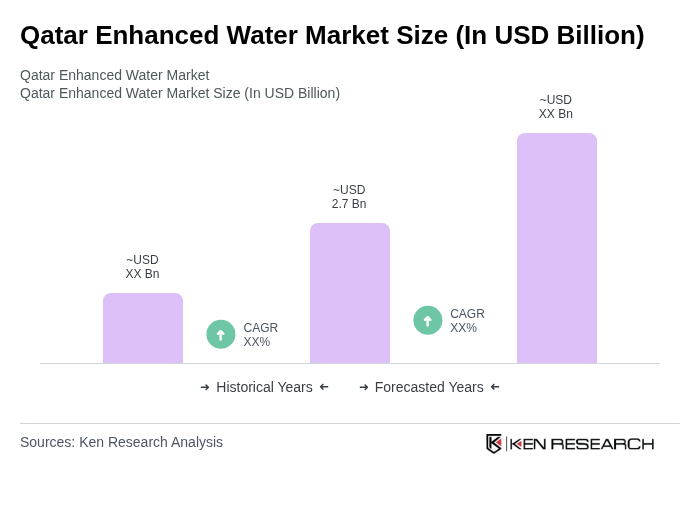
- The Qatar Enhanced Water Market is valued at USD 2.7 billion, based on a five-year historical analysis. This growth is primarily driven by increasing health consciousness among consumers, rising disposable incomes, and a growing preference for premium bottled water products. The market has seen a significant shift towards enhanced water options, including mineral and alkaline waters, as consumers seek healthier hydration alternatives. Key trends include a surge in demand for nutrient-enriched, pH-balanced, and electrolyte-infused bottled water, as well as a growing focus on sustainability and eco-friendly packaging solutions .
- Key players in this market are concentrated inDohaand surrounding urban centers, leveraging robust distribution networks and strong brand recognition. These cities benefit from high population density and a growing expatriate community, leading to increased demand for bottled water products, particularly in urban areas where convenience and premiumization are priorities .
- In 2023, the Qatari government introduced new requirements for bottled water packaging under theMinisterial Decision No. 143 of 2023 issued by the Ministry of Environment and Climate Change. This regulation mandates the use of eco-friendly packaging materials for bottled water products, aiming to reduce plastic waste and promote sustainability within the industry. Companies are required to adopt biodegradable or recyclable materials and enhance recycling practices as part of compliance .
Qatar Enhanced Water Market Segmentation
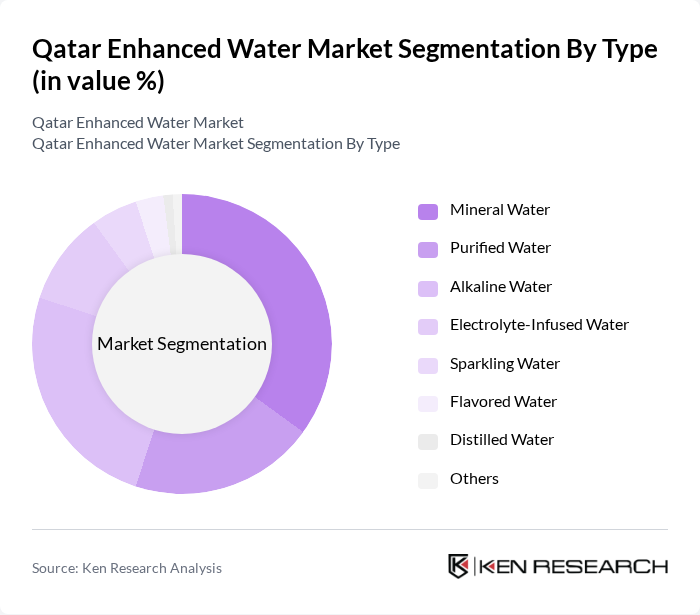
By Type:The market is segmented into various types of enhanced water, including mineral water, purified water, alkaline water, electrolyte-infused water, sparkling water, flavored water, distilled water, and others. Among these,mineral waterholds the largest share, driven by consumer belief in its superior hydration properties and natural mineral content.Alkaline waterandelectrolyte-infused waterare also gaining popularity, especially among health-conscious and active consumers. The demand for flavored and sparkling waters is rising, supported by product innovation and expanding premium beverage trends .
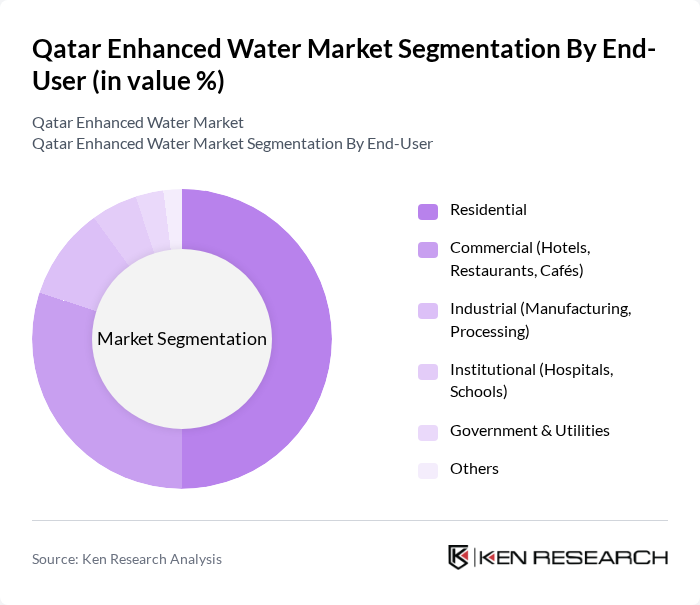
By End-User:The enhanced water market is segmented by end-user into residential, commercial (hotels, restaurants, cafés), industrial (manufacturing, processing), institutional (hospitals, schools), government & utilities, and others. Theresidential segmentleads the market, driven by increasing health awareness and the convenience of bottled water at home. Thecommercial segmentis also significant, as hotels and restaurants seek to offer premium water options to enhance customer experience. The industrial and institutional segments are supported by the need for high-quality water in manufacturing and public facilities .
Qatar Enhanced Water Market Competitive Landscape
The Qatar Enhanced Water Market is characterized by a dynamic mix of regional and international players. Leading participants such as Rayyan Mineral Water Company, Almas Water, Qatar Oasis, Wataniya Water, Safa Water, Nice Water, Al Manhal Water, Nestlé Waters Qatar, Aqua Gulf, Doha Water, Aqua Qatar, Qatar National Food Company (QNF), Gulf Water Company, Qatar Beverage Company, and Al-Ahli Water Company contribute to innovation, geographic expansion, and service delivery in this space .
Qatar Enhanced Water Market Industry Analysis
Growth Drivers
- Increasing Demand for Clean Water:The demand for clean water in Qatar is projected to reach 1.5 billion cubic meters in future, driven by population growth and urbanization. The country's population is expected to exceed 3 million, increasing the pressure on water resources. Additionally, the World Bank reports that Qatar's water consumption per capita is among the highest globally, necessitating enhanced water solutions to meet this growing demand effectively.
- Government Initiatives for Water Sustainability:The Qatari government has allocated approximately $1.5 billion for water sustainability projects in future, focusing on innovative water management and conservation technologies. Initiatives such as the Qatar National Vision 2030 emphasize sustainable water use, aiming to reduce water waste by 30% in future. These efforts are crucial in addressing the challenges posed by limited freshwater resources in the region.
- Technological Advancements in Water Treatment:Qatar's investment in advanced water treatment technologies is expected to exceed $600 million in future. Innovations such as reverse osmosis and membrane filtration are becoming increasingly prevalent, enhancing water quality and efficiency. The Qatar General Electricity and Water Corporation (Kahramaa) reports that these technologies can improve water recovery rates by up to 90%, significantly contributing to the overall water supply sustainability.
Market Challenges
- High Initial Investment Costs:The initial capital required for establishing enhanced water treatment facilities in Qatar can exceed $400 million, posing a significant barrier for new entrants. This high cost is primarily due to the advanced technology and infrastructure needed to ensure compliance with stringent water quality standards. As a result, many potential investors may hesitate to enter the market, limiting competition and innovation.
- Regulatory Compliance Issues:Navigating the complex regulatory landscape in Qatar can be challenging for water suppliers. The government enforces strict water quality standards, which require continuous monitoring and reporting. Non-compliance can lead to penalties exceeding $1.5 million, discouraging smaller companies from entering the market. This regulatory burden can stifle innovation and slow the adoption of new technologies in the enhanced water sector.
Qatar Enhanced Water Market Future Outlook
The Qatar Enhanced Water Market is poised for significant growth, driven by increasing investments in sustainable water technologies and government initiatives aimed at improving water quality. As the population continues to rise, the demand for innovative water solutions will intensify. Furthermore, the integration of smart technologies in water management systems is expected to enhance efficiency and reduce waste. These trends indicate a robust future for the enhanced water sector, with opportunities for both local and international players to contribute to sustainable water practices.
Market Opportunities
- Expansion into Untapped Regions:There are significant opportunities for enhanced water solutions in rural areas of Qatar, where access to clean water remains limited. Targeting these regions could lead to a potential market expansion worth approximately $250 million in future, addressing critical water needs and improving public health outcomes.
- Partnerships with Local Governments:Collaborating with local governments on water sustainability projects can unlock funding and resources. Such partnerships could facilitate the development of innovative water solutions, potentially generating an additional $200 million in revenue in future, while also enhancing community engagement and support for water initiatives.
Scope of the Report
| Segment | Sub-Segments |
|---|---|
| By Type | Mineral Water Purified Water Alkaline Water Electrolyte-Infused Water Sparkling Water Flavored Water Distilled Water Others |
| By End-User | Residential Commercial (Hotels, Restaurants, Cafés) Industrial (Manufacturing, Processing) Institutional (Hospitals, Schools) Government & Utilities Others |
| By Distribution Channel | Supermarkets/Hypermarkets Online Retail Convenience Stores Direct Sales (B2B, Institutional Supply) Foodservice & Hospitality Others |
| By Packaging Type | Plastic Bottles Glass Bottles Tetra Packs Bulk Packaging (Gallon, Dispenser) Others |
| By Source | Spring Water Well Water Municipal Water Desalinated Water Others |
| By Price Range | Premium Mid-Range Budget Others |
| By Consumer Demographics | Age Group Income Level Lifestyle Preferences (Health, Fitness, Convenience) Nationality (Qatari, Expatriate) Others |
Key Target Audience
Investors and Venture Capitalist Firms
Government and Regulatory Bodies (e.g., Qatar Ministry of Municipality and Environment)
Manufacturers and Producers of Water Treatment Technologies
Water Utility Companies
Environmental NGOs and Advocacy Groups
Infrastructure Development Agencies
Water Resource Management Authorities
Public-Private Partnership Entities
Players Mentioned in the Report:
Rayyan Mineral Water Company
Almas Water
Qatar Oasis
Wataniya Water
Safa Water
Nice Water
Al Manhal Water
Nestle Waters Qatar
Aqua Gulf
Doha Water
Aqua Qatar
Qatar National Food Company (QNF)
Gulf Water Company
Qatar Beverage Company
Al-Ahli Water Company
Table of Contents
Market Assessment Phase
1. Executive Summary and Approach
2. Qatar Enhanced Water Market Overview
2.1 Key Insights and Strategic Recommendations
2.2 Qatar Enhanced Water Market Overview
2.3 Definition and Scope
2.4 Evolution of Market Ecosystem
2.5 Timeline of Key Regulatory Milestones
2.6 Value Chain & Stakeholder Mapping
2.7 Business Cycle Analysis
2.8 Policy & Incentive Landscape
3. Qatar Enhanced Water Market Analysis
3.1 Growth Drivers
3.1.1 Increasing Demand for Clean Water
3.1.2 Government Initiatives for Water Sustainability
3.1.3 Technological Advancements in Water Treatment
3.1.4 Rising Awareness of Health Benefits
3.2 Market Challenges
3.2.1 High Initial Investment Costs
3.2.2 Regulatory Compliance Issues
3.2.3 Limited Consumer Awareness
3.2.4 Competition from Traditional Water Sources
3.3 Market Opportunities
3.3.1 Expansion into Untapped Regions
3.3.2 Partnerships with Local Governments
3.3.3 Development of Innovative Water Solutions
3.3.4 Increasing Export Potential
3.4 Market Trends
3.4.1 Shift Towards Eco-Friendly Packaging
3.4.2 Growth of Subscription-Based Water Services
3.4.3 Integration of Smart Technology in Water Management
3.4.4 Focus on Health and Wellness Products
3.5 Government Regulation
3.5.1 Water Quality Standards Enforcement
3.5.2 Incentives for Water Conservation Technologies
3.5.3 Regulations on Wastewater Treatment
3.5.4 Licensing Requirements for Water Suppliers
4. SWOT Analysis
5. Stakeholder Analysis
6. Porter's Five Forces Analysis
7. Qatar Enhanced Water Market Market Size, 2019-2024
7.1 By Value
7.2 By Volume
7.3 By Average Selling Price
8. Qatar Enhanced Water Market Segmentation
8.1 By Type
8.1.1 Mineral Water
8.1.2 Purified Water
8.1.3 Alkaline Water
8.1.4 Electrolyte-Infused Water
8.1.5 Sparkling Water
8.1.6 Flavored Water
8.1.7 Distilled Water
8.1.8 Others
8.2 By End-User
8.2.1 Residential
8.2.2 Commercial (Hotels, Restaurants, Cafés)
8.2.3 Industrial (Manufacturing, Processing)
8.2.4 Institutional (Hospitals, Schools)
8.2.5 Government & Utilities
8.2.6 Others
8.3 By Distribution Channel
8.3.1 Supermarkets/Hypermarkets
8.3.2 Online Retail
8.3.3 Convenience Stores
8.3.4 Direct Sales (B2B, Institutional Supply)
8.3.5 Foodservice & Hospitality
8.3.6 Others
8.4 By Packaging Type
8.4.1 Plastic Bottles
8.4.2 Glass Bottles
8.4.3 Tetra Packs
8.4.4 Bulk Packaging (Gallon, Dispenser)
8.4.5 Others
8.5 By Source
8.5.1 Spring Water
8.5.2 Well Water
8.5.3 Municipal Water
8.5.4 Desalinated Water
8.5.5 Others
8.6 By Price Range
8.6.1 Premium
8.6.2 Mid-Range
8.6.3 Budget
8.6.4 Others
8.7 By Consumer Demographics
8.7.1 Age Group
8.7.2 Income Level
8.7.3 Lifestyle Preferences (Health, Fitness, Convenience)
8.7.4 Nationality (Qatari, Expatriate)
8.7.5 Others
9. Qatar Enhanced Water Market Competitive Analysis
9.1 Market Share of Key Players
9.2 Cross Comparison of Key Players
9.2.1 Company Name
9.2.2 Group Size (Large, Medium, or Small as per industry convention)
9.2.3 Revenue in Qatar Enhanced Water Segment
9.2.4 Market Share in Qatar Enhanced Water Segment
9.2.5 CAGR of Enhanced Water Revenue (Last 3 Years)
9.2.6 Installed Base/Number of Distribution Points in Qatar
9.2.7 Product Portfolio Breadth (Number of Enhanced Water SKUs)
9.2.8 Pricing Strategy (Premium, Mid, Budget)
9.2.9 Brand Recognition Score (Survey-Based or Market Index)
9.2.10 Customer Satisfaction Index (NPS or Equivalent)
9.2.11 Sustainability Initiatives (Eco-Packaging, Water Stewardship)
9.2.12 Distribution Channel Coverage (Retail, Online, Foodservice, B2B)
9.3 SWOT Analysis of Top Players
9.4 Pricing Analysis
9.5 Detailed Profile of Major Companies
9.5.1 Rayyan Mineral Water Company
9.5.2 Almas Water
9.5.3 Qatar Oasis
9.5.4 Wataniya Water
9.5.5 Safa Water
9.5.6 Nice Water
9.5.7 Al Manhal Water
9.5.8 Nestlé Waters Qatar
9.5.9 Aqua Gulf
9.5.10 Doha Water
9.5.11 Aqua Qatar
9.5.12 Qatar National Food Company (QNF)
9.5.13 Gulf Water Company
9.5.14 Qatar Beverage Company
9.5.15 Al-Ahli Water Company
10. Qatar Enhanced Water Market End-User Analysis
10.1 Procurement Behavior of Key Ministries
10.1.1 Ministry of Municipality and Environment
10.1.2 Ministry of Public Health
10.1.3 Ministry of Education and Higher Education
10.1.4 Others
10.2 Corporate Spend on Infrastructure & Energy
10.2.1 Investment in Water Infrastructure
10.2.2 Budget Allocation for Sustainability Projects
10.2.3 Corporate Social Responsibility Initiatives
10.2.4 Others
10.3 Pain Point Analysis by End-User Category
10.3.1 Residential Users
10.3.2 Commercial Establishments
10.3.3 Industrial Users
10.3.4 Government Entities
10.3.5 Others
10.4 User Readiness for Adoption
10.4.1 Awareness Levels
10.4.2 Accessibility of Enhanced Water Products
10.4.3 Affordability Concerns
10.4.4 Others
10.5 Post-Deployment ROI and Use Case Expansion
10.5.1 Measurement of Water Quality Improvements
10.5.2 Cost Savings Analysis
10.5.3 User Feedback and Satisfaction
10.5.4 Others
11. Qatar Enhanced Water Market Future Size, 2025-2030
11.1 By Value
11.2 By Volume
11.3 By Average Selling Price
Go-To-Market Strategy Phase
1. Whitespace Analysis + Business Model Canvas
1.1 Market Gaps Identification
1.2 Business Model Development
2. Marketing and Positioning Recommendations
2.1 Branding Strategies
2.2 Product USPs
3. Distribution Plan
3.1 Urban Retail vs Rural NGO Tie-ups
4. Channel & Pricing Gaps
4.1 Underserved Routes
4.2 Pricing Bands
5. Unmet Demand & Latent Needs
5.1 Category Gaps
5.2 Consumer Segments
6. Customer Relationship
6.1 Loyalty Programs
6.2 After-sales Service
7. Value Proposition
7.1 Sustainability
7.2 Integrated Supply Chains
8. Key Activities
8.1 Regulatory Compliance
8.2 Branding
8.3 Distribution Setup
9. Entry Strategy Evaluation
9.1 Domestic Market Entry Strategy
9.1.1 Product Mix
9.1.2 Pricing Band
9.1.3 Packaging
9.2 Export Entry Strategy
9.2.1 Target Countries
9.2.2 Compliance Roadmap
10. Entry Mode Assessment
10.1 JV
10.2 Greenfield
10.3 M&A
10.4 Distributor Model
11. Capital and Timeline Estimation
11.1 Capital Requirements
11.2 Timelines
12. Control vs Risk Trade-Off
12.1 Ownership vs Partnerships
13. Profitability Outlook
13.1 Breakeven Analysis
13.2 Long-term Sustainability
14. Potential Partner List
14.1 Distributors
14.2 JVs
14.3 Acquisition Targets
15. Execution Roadmap
15.1 Phased Plan for Market Entry
15.1.1 Market Setup
15.1.2 Market Entry
15.1.3 Growth Acceleration
15.1.4 Scale & Stabilize
15.2 Key Activities and Milestones
15.2.1 Milestone Planning
15.2.2 Activity Tracking
Research Methodology
Phase 1: Approach1
Desk Research
- Analysis of government reports on water resource management in Qatar
- Review of academic publications on water market dynamics and pricing models
- Examination of industry white papers and market studies from relevant NGOs
Primary Research
- Interviews with water utility executives and regulatory bodies in Qatar
- Surveys with agricultural stakeholders regarding water usage and pricing
- Field interviews with local businesses involved in water distribution and management
Validation & Triangulation
- Cross-validation of findings through multiple data sources including government and industry reports
- Triangulation of qualitative insights from interviews with quantitative data from surveys
- Sanity checks through expert panel discussions with water market analysts
Phase 2: Market Size Estimation1
Top-down Assessment
- Estimation of total water consumption in Qatar based on national statistics
- Segmentation of water usage by sector: residential, commercial, and agricultural
- Incorporation of projected population growth and urbanization trends
Bottom-up Modeling
- Collection of data on water pricing from local utilities and private suppliers
- Estimation of average water consumption per household and business
- Calculation of total market size based on volume and pricing data
Forecasting & Scenario Analysis
- Development of forecasting models based on historical water usage trends
- Scenario analysis considering climate change impacts and policy changes
- Projections of market growth under different regulatory frameworks through 2030
Phase 3: CATI Sample Composition1
| Scope Item/Segment | Sample Size | Target Respondent Profiles |
|---|---|---|
| Residential Water Usage | 100 | Homeowners, Tenants |
| Agricultural Water Management | 40 | Farm Owners, Agricultural Consultants |
| Commercial Water Consumption | 60 | Facility Managers, Business Owners |
| Water Utility Operations | 50 | Utility Managers, Regulatory Officials |
| Water Pricing Strategies | 40 | Economists, Policy Makers |
Frequently Asked Questions
What is the current value of the Qatar Enhanced Water Market?
The Qatar Enhanced Water Market is valued at approximately USD 2.7 billion, reflecting a significant growth trend driven by increasing health consciousness, rising disposable incomes, and a preference for premium bottled water products among consumers.
What types of enhanced water are available in Qatar?
What are the key growth drivers for the Qatar Enhanced Water Market?
What challenges does the Qatar Enhanced Water Market face?
Other Regional/Country Reports
Indonesia Enhanced Water Market
Malaysia Enhanced Water Market
KSA Enhanced Water Market
APAC Enhanced Water Market
SEA Enhanced Water Market
Vietnam Enhanced Water Market
Other Adjacent Reports
South Africa Alkaline Water Market
Kuwait Electrolyte-Infused Water Market
UAE Mineral Water Market
Middle East Sparkling Water MarketIndonesia flavored water market Size, Share, Growth Drivers, Trends, Opportunities & Forecast 2025–2030Philippines Water Treatment Market
Indonesia Beverage Packaging Market Size, Share, Growth Drivers, Trends, Opportunities & Forecast 2025–2030Mexico Non-Alcoholic Beverage Market
Why Buy From Us?

What makes us stand out is that our consultants follow Robust, Refine and Result (RRR) methodology. Robust for clear definitions, approaches and sanity checking, Refine for differentiating respondents' facts and opinions, and Result for presenting data with story.

We have set a benchmark in the industry by offering our clients with syndicated and customized market research reports featuring coverage of entire market as well as meticulous research and analyst insights.

While we don't replace traditional research, we flip the method upside down. Our dual approach of Top Bottom & Bottom Top ensures quality deliverable by not just verifying company fundamentals but also looking at the sector and macroeconomic factors.

With one step in the future, our research team constantly tries to show you the bigger picture. We help with some of the tough questions you may encounter along the way: How is the industry positioned? Best marketing channel? KPI's of competitors? By aligning every element, we help maximize success.

Our report gives you instant access to the answers and sources that other companies might choose to hide. We elaborate each steps of research methodology we have used and showcase you the sample size to earn your trust.

If you need any support, we are here! We pride ourselves on universe strength, data quality, and quick, friendly, and professional service.