About the Report
Base Year 2024Qatar Fire Sprinkler Systems Market Overview
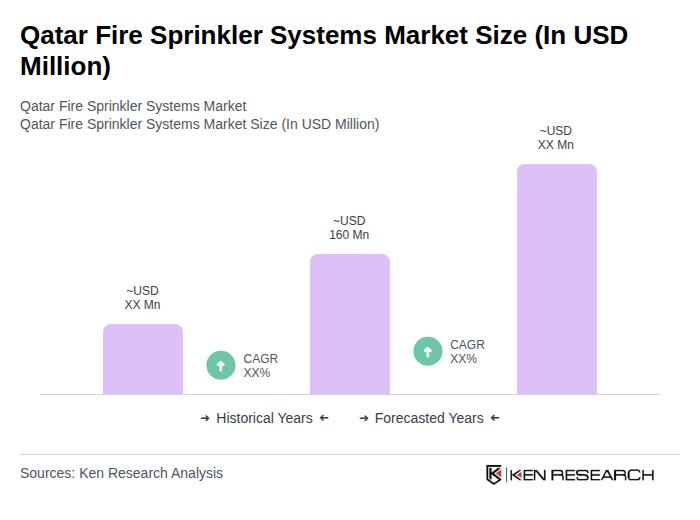
- The Qatar Fire Sprinkler Systems Market is valued at USD 160 million, based on a five-year historical analysis of fire protection and suppression demand in Qatar and GCC benchmarks for sprinkler-intensive segments. This growth is primarily driven by increasing construction activities linked to ongoing infrastructure, real estate, and industrial projects, stringent fire safety regulations, and heightened awareness of fire safety among businesses and homeowners. The market has seen a surge in demand for advanced fire protection systems, particularly in commercial, industrial, and logistics/warehouse sectors, as safety standards continue to evolve and adoption of smart, IoT-enabled fire suppression solutions increases.
- Doha is the dominant city in the Qatar Fire Sprinkler Systems Market, primarily due to its rapid urbanization and extensive infrastructure development projects, including commercial towers, mixed-use developments, logistics hubs, and transport infrastructure. The city's focus on hosting international events and enhancing public safety has led to increased investments in fire protection systems, particularly in warehouses, logistics parks, and large commercial complexes. Other notable areas include Al Rayyan and Al Wakrah, which are also experiencing significant growth in construction and development activities, especially in warehousing, industrial facilities, and residential communities that require compliant fire sprinkler and suppression solutions.
- In 2023, the Qatari government strengthened building and fire safety requirements for new developments through the Qatar Civil Defense Department (QCDD) application of the Qatar Construction Specifications (QCS) and the Fire Safety Requirements for Buildings, which mandate automatic sprinkler and fire suppression systems in a wide range of new commercial, industrial, and high-occupancy buildings above defined floor area thresholds. In particular, the QCDD Fire Safety Requirements for Buildings, 2015 (Ministry of Interior, Qatar Civil Defense Department) adopt NFPA-based standards and require automatic sprinkler protection in commercial and high?rise buildings once specified area and occupancy criteria are exceeded, with design, installation, and testing needing QCDD approval. This regulatory framework aims to enhance fire safety standards and reduce the risk of fire-related incidents, thereby driving sustained demand for fire sprinkler systems across the country, especially in new-build and major refurbishment projects.
Qatar Fire Sprinkler Systems Market Segmentation
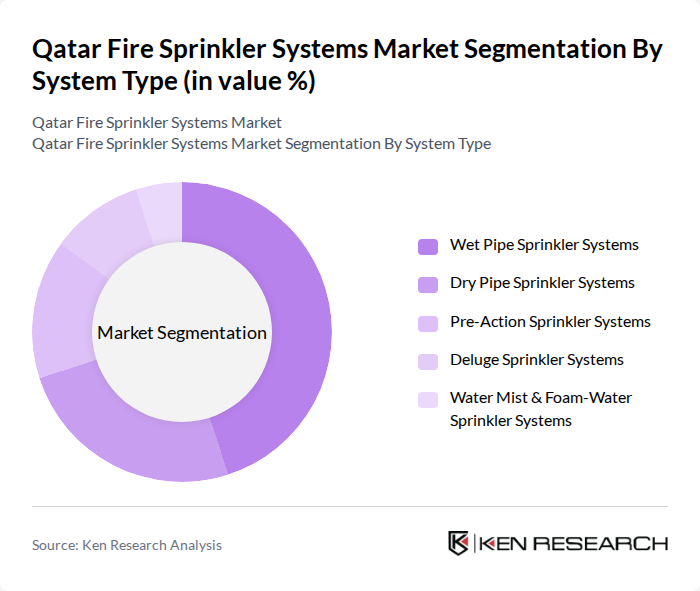
By System Type:The market is segmented into various system types, including Wet Pipe Sprinkler Systems, Dry Pipe Sprinkler Systems, Pre-Action Sprinkler Systems, Deluge Sprinkler Systems, and Water Mist & Foam-Water Sprinkler Systems. Among these, Wet Pipe Sprinkler Systems dominate the market due to their reliability and effectiveness in providing immediate fire suppression, in line with global trends where wet pipe systems are the most widely used for commercial and residential occupancies. The increasing adoption of these systems in residential, commercial, and mixed?use buildings is driven by their ease of installation and maintenance, their compatibility with NFPA and QCDD design requirements, and their cost-effectiveness compared with more complex dry or pre-action systems for non-freezing environments such as Qatar.
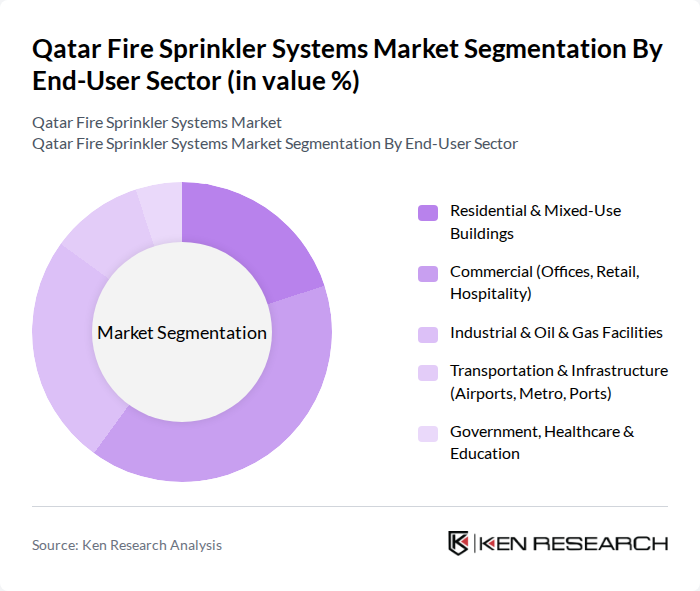
By End-User Sector:The market is segmented into Residential & Mixed-Use Buildings, Commercial (Offices, Retail, Hospitality), Industrial & Oil & Gas Facilities, Transportation & Infrastructure (Airports, Metro, Ports), and Government, Healthcare & Education. The Commercial sector leads the market, driven by the increasing number of office buildings, hotels, malls, and mixed-use developments that require advanced fire protection systems to comply with QCDD and international safety regulations and to protect assets and occupants. Industrial and oil & gas facilities, as well as warehouses and logistics centers, also represent a significant share due to higher fire risk classifications and the need for specialized sprinkler, deluge, and foam-water systems in line with regional fire suppression trends.
Qatar Fire Sprinkler Systems Market Competitive Landscape
The Qatar Fire Sprinkler Systems Market is characterized by a dynamic mix of regional and international players. Leading participants such as NAFFCO Qatar (National Fire Fighting Manufacturing FZCO), G4S Fire & Safety Systems Qatar, Johnson Controls – Tyco Fire & Security Qatar, SFFECO Global – Qatar Operations, Protec Fire & Security Group – Qatar, Desert Line Projects – Fire Protection Division, Redco International Trading & Contracting – Fire Protection, Al Jaber Engineering – MEP & Fire Protection, Boom General Contractors – Fire & Life Safety Systems, Qatar Fire Protection Services WLL, Al Aman Fire Protection & Safety, Al Asmakh Fire Protection Systems, Nasser Al Ali Enterprises – Fire Fighting Systems, EMCO Qatar (Engineering Maintenance Company) – Fire Systems, Al Tawasul Fire & Security Systems contribute to innovation, geographic expansion, and service delivery in this space, increasingly focusing on integrated fire and life-safety solutions, turnkey design–build packages, and long-term maintenance contracts.
Qatar Fire Sprinkler Systems Market Industry Analysis
Growth Drivers
- Increasing Urbanization:Qatar's urban population is projected to reach approximately 2.7 million in future, up from 2.5 million in 2020, according to the World Bank. This rapid urbanization drives the demand for fire safety systems in residential and commercial buildings. As new developments arise, the need for effective fire protection solutions, including sprinkler systems, becomes critical to ensure safety and compliance with local regulations, thereby propelling market growth.
- Stringent Fire Safety Regulations:The Qatari government has implemented rigorous fire safety regulations, mandating the installation of fire sprinkler systems in various building types. The Ministry of Interior reported that compliance with these regulations is essential for obtaining construction permits. As of in future, over 80% of new commercial buildings are expected to adhere to these standards, significantly boosting the demand for advanced fire sprinkler systems in the region.
- Technological Advancements in Fire Sprinkler Systems:The integration of smart technologies in fire sprinkler systems is transforming the market landscape. Innovations such as IoT-enabled systems allow for real-time monitoring and automated responses to fire incidents. By in future, it is estimated that smart fire safety solutions will account for 30% of the market, driven by increased investments in technology and a growing emphasis on proactive fire safety measures in Qatar's urban developments.
Market Challenges
- High Installation Costs:The initial costs associated with installing fire sprinkler systems can be a significant barrier for many businesses and property developers. Installation costs can range from QAR 100 to QAR 200 per square meter, depending on the complexity of the system. This financial burden can deter investment in fire safety solutions, particularly among smaller enterprises, limiting market growth in the region.
- Lack of Skilled Labor:The fire safety industry in Qatar faces a shortage of skilled labor, which hampers the installation and maintenance of fire sprinkler systems. According to the Qatar Chamber of Commerce, approximately 60% of companies report difficulties in finding qualified technicians. This skills gap can lead to delays in project completion and increased operational costs, posing a challenge to the market's expansion and efficiency.
Qatar Fire Sprinkler Systems Market Future Outlook
As Qatar continues to invest in infrastructure and urban development, the fire sprinkler systems market is poised for significant growth. The integration of smart technologies and eco-friendly materials will likely shape future innovations. Additionally, the government's commitment to enhancing fire safety regulations will further drive demand. By focusing on retrofitting existing buildings and expanding commercial real estate, the market is expected to adapt to evolving safety standards and consumer preferences, ensuring a robust future.
Market Opportunities
- Expansion in Commercial Real Estate:With Qatar's commercial real estate sector projected to grow by 15% annually, there is a substantial opportunity for fire sprinkler system providers. This growth will necessitate the installation of advanced fire safety solutions in new office buildings, shopping centers, and hotels, creating a lucrative market for suppliers and installers.
- Integration of Smart Technologies:The increasing adoption of smart technologies in fire safety systems presents a significant opportunity. By in future, it is anticipated that smart fire safety solutions will enhance operational efficiency and reduce response times, attracting investments from both public and private sectors. This trend will likely lead to a surge in demand for innovative fire sprinkler systems that incorporate these technologies.
Scope of the Report
| Segment | Sub-Segments |
|---|---|
| By System Type | Wet Pipe Sprinkler Systems Dry Pipe Sprinkler Systems Pre-Action Sprinkler Systems Deluge Sprinkler Systems Water Mist & Foam-Water Sprinkler Systems |
| By End-User Sector | Residential & Mixed-Use Buildings Commercial (Offices, Retail, Hospitality) Industrial & Oil & Gas Facilities Transportation & Infrastructure (Airports, Metro, Ports) Government, Healthcare & Education |
| By Project Type | New Construction Retrofit & Upgrades Operation & Maintenance Services Design & Engineering Services |
| By Installation Type | Above-Ground Piping & Sprinkler Networks Underground Piping & Water Supply Systems Pump Rooms & Control Valve Assemblies Integrated Fire & Life Safety Systems |
| By Region | Doha Al Rayyan Al Wakrah Al Khor & Al Thakhira |
| By Technology Level | Conventional (Stand-alone) Sprinkler Systems Addressable & Networked Sprinkler Systems IoT-Enabled / Smart Sprinkler Systems Integrated Fire Protection & Building Management Systems |
| By Service & Maintenance Type | Scheduled Inspection & Testing Corrective & Emergency Maintenance Retrofit, Upgrade & Compliance Services Annual Maintenance Contracts (AMCs) |
Key Target Audience
Investors and Venture Capitalist Firms
Government and Regulatory Bodies (e.g., Qatar Civil Defence, Ministry of Municipality and Environment)
Manufacturers and Producers of Fire Sprinkler Systems
Distributors and Retailers of Fire Safety Equipment
Construction and Engineering Firms
Fire Safety Consultants and Specialists
Insurance Companies and Risk Assessment Firms
Real Estate Developers and Property Management Companies
Players Mentioned in the Report:
NAFFCO Qatar (National Fire Fighting Manufacturing FZCO)
G4S Fire & Safety Systems Qatar
Johnson Controls Tyco Fire & Security Qatar
SFFECO Global Qatar Operations
Protec Fire & Security Group Qatar
Desert Line Projects Fire Protection Division
Redco International Trading & Contracting Fire Protection
Al Jaber Engineering MEP & Fire Protection
Boom General Contractors Fire & Life Safety Systems
Qatar Fire Protection Services WLL
Al Aman Fire Protection & Safety
Al Asmakh Fire Protection Systems
Nasser Al Ali Enterprises Fire Fighting Systems
EMCO Qatar (Engineering Maintenance Company) Fire Systems
Al Tawasul Fire & Security Systems
Table of Contents
Market Assessment Phase
1. Executive Summary and Approach
2. Qatar Fire Sprinkler Systems Market Overview
2.1 Key Insights and Strategic Recommendations
2.2 Qatar Fire Sprinkler Systems Market Overview
2.4 Evolution of Market Ecosystem
2.5 Timeline of Key Regulatory Milestones
2.6 Value Chain & Stakeholder Mapping
2.7 Business Cycle Analysis
2.8 Policy & Incentive Landscape
3. Qatar Fire Sprinkler Systems Market Analysis
3.1 Growth Drivers
3.1.1 Increasing Urbanization
3.1.2 Stringent Fire Safety Regulations
3.1.3 Rising Awareness of Fire Safety
3.1.4 Technological Advancements in Fire Sprinkler Systems
3.2 Market Challenges
3.2.1 High Installation Costs
3.2.2 Lack of Skilled Labor
3.2.3 Maintenance and Inspection Issues
3.2.4 Competition from Alternative Fire Safety Solutions
3.3 Market Opportunities
3.3.1 Expansion in Commercial Real Estate
3.3.2 Government Infrastructure Projects
3.3.3 Integration of Smart Technologies
3.3.4 Increased Investment in Safety Equipment
3.4 Market Trends
3.4.1 Adoption of Eco-Friendly Materials
3.4.2 Growth of Smart Fire Safety Systems
3.4.3 Enhanced Focus on Retrofitting Existing Buildings
3.4.4 Rise in Insurance Premiums Linked to Fire Safety Compliance
3.5 Government Regulation
3.5.1 National Fire Protection Association (NFPA) Standards
3.5.2 Local Building Codes and Regulations
3.5.3 Fire Safety Compliance Mandates
3.5.4 Incentives for Fire Safety Upgrades
4. SWOT Analysis
5. Stakeholder Analysis
6. Porter's Five Forces Analysis
7. Qatar Fire Sprinkler Systems Market Market Size, 2019-2024
7.1 By Value
7.2 By Volume
7.3 By Average Selling Price
8. Qatar Fire Sprinkler Systems Market Segmentation
8.1 By System Type
8.1.1 Wet Pipe Sprinkler Systems
8.1.2 Dry Pipe Sprinkler Systems
8.1.3 Pre-Action Sprinkler Systems
8.1.4 Deluge Sprinkler Systems
8.1.5 Water Mist & Foam-Water Sprinkler Systems
8.2 By End-User Sector
8.2.1 Residential & Mixed-Use Buildings
8.2.2 Commercial (Offices, Retail, Hospitality)
8.2.3 Industrial & Oil & Gas Facilities
8.2.4 Transportation & Infrastructure (Airports, Metro, Ports)
8.2.5 Government, Healthcare & Education
8.3 By Project Type
8.3.1 New Construction
8.3.2 Retrofit & Upgrades
8.3.3 Operation & Maintenance Services
8.3.4 Design & Engineering Services
8.4 By Installation Type
8.4.1 Above-Ground Piping & Sprinkler Networks
8.4.2 Underground Piping & Water Supply Systems
8.4.3 Pump Rooms & Control Valve Assemblies
8.4.4 Integrated Fire & Life Safety Systems
8.5 By Region
8.5.1 Doha
8.5.2 Al Rayyan
8.5.3 Al Wakrah
8.5.4 Al Khor & Al Thakhira
8.6 By Technology Level
8.6.1 Conventional (Stand-alone) Sprinkler Systems
8.6.2 Addressable & Networked Sprinkler Systems
8.6.3 IoT-Enabled / Smart Sprinkler Systems
8.6.4 Integrated Fire Protection & Building Management Systems
8.7 By Service & Maintenance Type
8.7.1 Scheduled Inspection & Testing
8.7.2 Corrective & Emergency Maintenance
8.7.3 Retrofit, Upgrade & Compliance Services
8.7.4 Annual Maintenance Contracts (AMCs)
9. Qatar Fire Sprinkler Systems Market Competitive Analysis
9.1 Market Share of Key Players
9.2 KPIs for Cross Comparison of Key Players
9.2.1 Installed Base of Sprinkler Systems in Qatar (No. of Projects)
9.2.2 Annual Revenue from Fire Sprinkler Systems in Qatar (USD Million)
9.2.3 3-Year Revenue CAGR in Qatar Fire Sprinkler Segment (%)
9.2.4 Share of Qatar Revenue in Middle East Fire Protection Portfolio (%)
9.2.5 Average Project Size (Contract Value per Project, USD Million)
9.2.6 Backlog of Qatar Fire Sprinkler Projects (USD Million)
9.2.7 Win Rate in Major Tenders / EPC Projects (%)
9.2.8 Coverage of Key Vertical Segments (No. of Sectors Served)
9.2.9 Compliance & Certification Footprint (NFPA, QCDD, LPCB, UL – No. of Certifications)
9.2.10 On-Time Project Delivery Rate (%)
9.2.11 Share of Service & AMC Revenue in Total Qatar Fire Sprinkler Revenue (%)
9.2.12 R&D and Localization Intensity (Spend or No. of Qatar-Specific Solutions)
9.3 SWOT Analysis of Top Players
9.4 Pricing Analysis
9.5 Detailed Profile of Major Companies
9.5.1 NAFFCO Qatar (National Fire Fighting Manufacturing FZCO)
9.5.2 G4S Fire & Safety Systems Qatar
9.5.3 Johnson Controls – Tyco Fire & Security Qatar
9.5.4 SFFECO Global – Qatar Operations
9.5.5 Protec Fire & Security Group – Qatar
9.5.6 Desert Line Projects – Fire Protection Division
9.5.7 Redco International Trading & Contracting – Fire Protection
9.5.8 Al Jaber Engineering – MEP & Fire Protection
9.5.9 Boom General Contractors – Fire & Life Safety Systems
9.5.10 Qatar Fire Protection Services WLL
9.5.11 Al Aman Fire Protection & Safety
9.5.12 Al Asmakh Fire Protection Systems
9.5.13 Nasser Al Ali Enterprises – Fire Fighting Systems
9.5.14 EMCO Qatar (Engineering Maintenance Company) – Fire Systems
9.5.15 Al Tawasul Fire & Security Systems
10. Qatar Fire Sprinkler Systems Market End-User Analysis
10.1 Procurement Behavior of Key Ministries
10.1.1 Ministry of Interior
10.1.2 Ministry of Municipality and Environment
10.1.3 Ministry of Education and Higher Education
10.1.4 Others
10.2 Corporate Spend on Infrastructure & Energy
10.2.1 Corporate Investments in Fire Safety
10.2.2 Budget Allocations for Safety Equipment
10.2.3 Trends in Corporate Spending
10.2.4 Others
10.3 Pain Point Analysis by End-User Category
10.3.1 Residential Users
10.3.2 Commercial Users
10.3.3 Industrial Users
10.3.4 Government Users
10.4 User Readiness for Adoption
10.4.1 Awareness Levels
10.4.2 Training and Support Needs
10.4.3 Financial Readiness
10.4.4 Others
10.5 Post-Deployment ROI and Use Case Expansion
10.5.1 ROI Measurement Techniques
10.5.2 Use Case Scenarios
10.5.3 Long-term Benefits
10.5.4 Others
11. Qatar Fire Sprinkler Systems Market Future Size, 2025-2030
11.1 By Value
11.2 By Volume
11.3 By Average Selling Price
Go-To-Market Strategy Phase
1. Whitespace Analysis + Business Model Canvas
1.1 Market Gaps Identification
1.2 Business Model Framework
2. Marketing and Positioning Recommendations
2.1 Branding Strategies
2.2 Product USPs
3. Distribution Plan
3.1 Urban Retail Strategies
3.2 Rural NGO Tie-ups
4. Channel & Pricing Gaps
4.1 Underserved Routes
4.2 Pricing Bands
5. Unmet Demand & Latent Needs
5.1 Category Gaps
5.2 Consumer Segments
6. Customer Relationship
6.1 Loyalty Programs
6.2 After-sales Service
7. Value Proposition
7.1 Sustainability Initiatives
7.2 Integrated Supply Chains
8. Key Activities
8.1 Regulatory Compliance
8.2 Branding Efforts
8.3 Distribution Setup
9. Entry Strategy Evaluation
9.1 Domestic Market Entry Strategy
9.1.1 Product Mix
9.1.2 Pricing Band
9.1.3 Packaging
9.2 Export Entry Strategy
9.2.1 Target Countries
9.2.2 Compliance Roadmap
10. Entry Mode Assessment
10.1 Joint Ventures
10.2 Greenfield Investments
10.3 Mergers & Acquisitions
10.4 Distributor Model
11. Capital and Timeline Estimation
11.1 Capital Requirements
11.2 Timelines
12. Control vs Risk Trade-Off
12.1 Ownership vs Partnerships
13. Profitability Outlook
13.1 Breakeven Analysis
13.2 Long-term Sustainability
14. Potential Partner List
14.1 Distributors
14.2 Joint Ventures
14.3 Acquisition Targets
15. Execution Roadmap
15.1 Phased Plan for Market Entry
15.1.1 Market Setup
15.1.2 Market Entry
15.1.3 Growth Acceleration
15.1.4 Scale & Stabilize
15.2 Key Activities and Milestones
15.2.1 Milestone Planning
15.2.2 Activity Tracking
Research Methodology
Phase 1: Approach1
Desk Research
- Analysis of industry reports from local fire safety associations and regulatory bodies
- Review of market trends and forecasts from construction and safety publications
- Examination of government regulations and standards related to fire safety in Qatar
Primary Research
- Interviews with fire safety engineers and consultants specializing in sprinkler systems
- Surveys with facility managers and safety officers in commercial and residential sectors
- Field interviews with installation contractors and maintenance service providers
Validation & Triangulation
- Cross-validation of findings through multiple expert interviews and industry reports
- Triangulation of data from regulatory sources, market surveys, and expert opinions
- Sanity checks through feedback from a panel of industry experts
Phase 2: Market Size Estimation1
Top-down Assessment
- Estimation of market size based on national construction spending and fire safety regulations
- Segmentation by end-user industries such as hospitality, healthcare, and residential
- Incorporation of growth rates from government infrastructure projects and urban development plans
Bottom-up Modeling
- Collection of data on installation volumes from leading sprinkler system manufacturers
- Operational cost analysis based on pricing models from service providers
- Volume x cost calculations for different types of sprinkler systems and installations
Forecasting & Scenario Analysis
- Multi-factor regression analysis incorporating economic growth, urbanization rates, and safety regulations
- Scenario modeling based on potential changes in fire safety legislation and market demand
- Development of baseline, optimistic, and pessimistic forecasts through 2030
Phase 3: CATI Sample Composition1
| Scope Item/Segment | Sample Size | Target Respondent Profiles |
|---|---|---|
| Commercial Building Fire Safety | 120 | Facility Managers, Safety Compliance Officers |
| Residential Fire Protection Systems | 90 | Homeowners, Property Managers |
| Industrial Fire Safety Solutions | 80 | Plant Managers, Safety Engineers |
| Hospitality Sector Fire Systems | 70 | Hotel Managers, Safety Coordinators |
| Government Infrastructure Projects | 60 | Project Managers, Urban Planners |
Frequently Asked Questions
What is the current value of the Qatar Fire Sprinkler Systems Market?
The Qatar Fire Sprinkler Systems Market is valued at approximately USD 160 million, driven by increasing construction activities, stringent fire safety regulations, and heightened awareness of fire safety among businesses and homeowners.
What factors are driving the growth of the fire sprinkler systems market in Qatar?
Which city is the largest market for fire sprinkler systems in Qatar?
What types of fire sprinkler systems are available in Qatar?
Other Regional/Country Reports
Indonesia Fire Sprinkler Systems Market
Malaysia Fire Sprinkler Systems Market
KSA Fire Sprinkler Systems Market
SEA Fire Sprinkler Systems Market
Vietnam Fire Sprinkler Systems Market
Other Adjacent Reports
Japan Fire Detection and Alarm Systems Market
Thailand Fire Extinguishing Equipment Market
Thailand Building Fire Safety Consulting Market
US Commercial Construction MarketBahrain Industrial Safety Equipment Market
Belgium Smart Building Technologies Market
Germany Emergency Response Services Market
Mexico Fire-Resistant Materials Market
Vietnam Insurance and Risk Management Market
Why Buy From Us?

What makes us stand out is that our consultants follow Robust, Refine and Result (RRR) methodology. Robust for clear definitions, approaches and sanity checking, Refine for differentiating respondents' facts and opinions, and Result for presenting data with story.

We have set a benchmark in the industry by offering our clients with syndicated and customized market research reports featuring coverage of entire market as well as meticulous research and analyst insights.

While we don't replace traditional research, we flip the method upside down. Our dual approach of Top Bottom & Bottom Top ensures quality deliverable by not just verifying company fundamentals but also looking at the sector and macroeconomic factors.

With one step in the future, our research team constantly tries to show you the bigger picture. We help with some of the tough questions you may encounter along the way: How is the industry positioned? Best marketing channel? KPI's of competitors? By aligning every element, we help maximize success.

Our report gives you instant access to the answers and sources that other companies might choose to hide. We elaborate each steps of research methodology we have used and showcase you the sample size to earn your trust.

If you need any support, we are here! We pride ourselves on universe strength, data quality, and quick, friendly, and professional service.