About the Report
Base Year 2024Qatar Gene Synthesis Research Use Market Overview
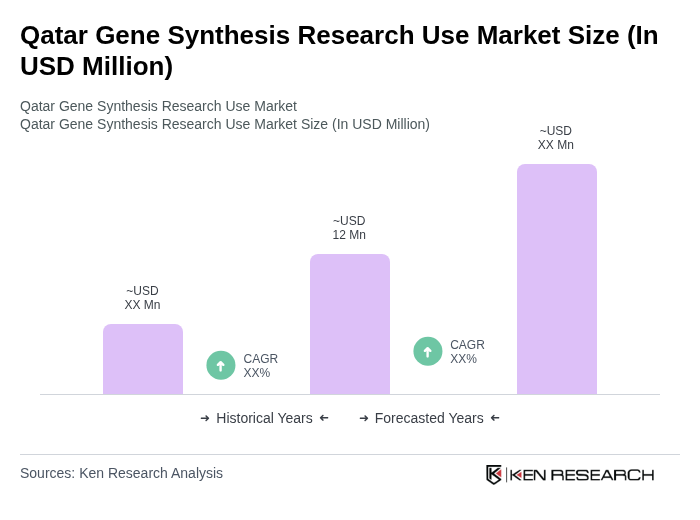
- The Qatar Gene Synthesis Research Use Market is valued at USD 12 million, based on a five-year historical analysis and its share within the broader Middle East DNA synthesis market. This growth is primarily driven by advancements in biotechnology, increasing investments in genomic research, and a rising demand for personalized medicine, in line with regional trends in DNA and gene synthesis. The market is further supported by the growing number of research institutions and collaborations in the region, including initiatives linked to the Qatar Genome Program and other national genomics efforts that utilize synthetic DNA and gene synthesis technologies.
- Key players in this market are largely international gene synthesis and DNA synthesis providers that supply Qatar-based universities, research centers, and healthcare institutions, with Doha serving as the central hub for biotechnology research and development in the country. The city benefits from significant government support and investment in health and research initiatives through entities such as Qatar Foundation, Hamad Medical Corporation, and Qatar University, making it a focal point for genomics and gene synthesis–related activities. Additionally, the presence of leading academic institutions and research centers, coupled with collaborations with global biotech companies, enhances the market's growth potential.
- Qatar’s biotechnology and genomics ecosystem is supported by national strategies and funding mechanisms for research, including programs under Qatar National Research Fund and large-scale initiatives such as the Qatar Genome Program, which promote genomics and related technologies including DNA and gene synthesis for research use. A key framework relevant to biotechnology and biomedical research is the National Research Ethics Committee system under the Ministry of Public Health and Qatar Foundation, operating in line with the Qatar National Research Ethics guidelines and the regulations of the Ministry of Public Health for research involving human subjects, which mandate institutional review board approval, informed consent, and compliance with biosafety and data protection requirements for genomics and gene-based research. These instruments collectively shape how gene synthesis and related genomic research are planned, funded, and conducted in the country.
Qatar Gene Synthesis Research Use Market Segmentation
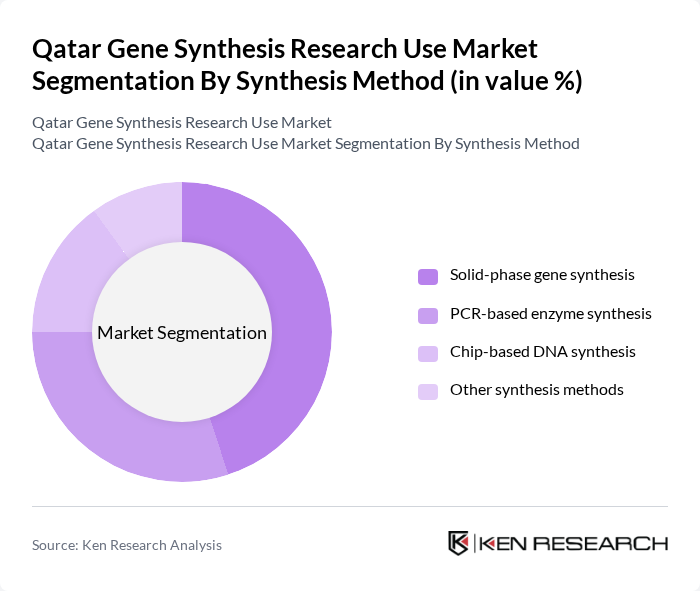
By Synthesis Method:The market is segmented based on various synthesis methods, including solid-phase gene synthesis, PCR-based enzyme synthesis, chip-based DNA synthesis, and other synthesis methods. Solid-phase gene synthesis is currently the leading method due to its efficiency, high accuracy, and scalability, making it the preferred choice for many researchers in line with global gene synthesis practice. PCR-based enzyme synthesis is also gaining traction, particularly in applications requiring high specificity, rapid turnaround, and high yield for shorter DNA fragments and cloning workflows.
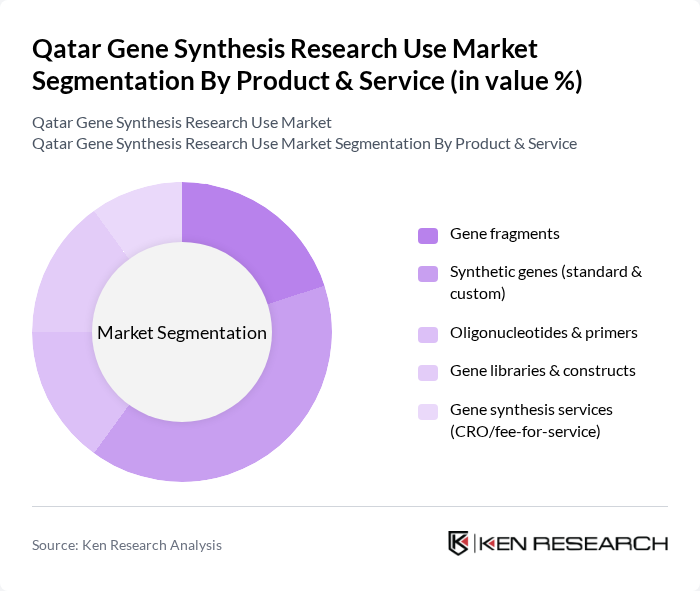
By Product & Service:The market is also segmented by product and service offerings, including gene fragments, synthetic genes (standard & custom), oligonucleotides & primers, gene libraries & constructs, and gene synthesis services (CRO/fee-for-service). Synthetic genes (standard and custom) are the dominant product category, driven by their application in various research fields, including vaccine development, therapeutic protein expression, functional genomics, and synthetic biology. Demand for oligonucleotides, primers, and gene fragments is also supported by expanding use in PCR, next-generation sequencing, and molecular diagnostics workflows.
Qatar Gene Synthesis Research Use Market Competitive Landscape
The Qatar Gene Synthesis Research Use Market is characterized by a dynamic mix of regional and international players, aligned with the broader Middle East DNA synthesis landscape where global companies supply synthetic genes, oligonucleotides, and related tools to academic, clinical, and industrial users in countries including Qatar. Leading participants such as Thermo Fisher Scientific Inc., Integrated DNA Technologies Inc. (IDT), GenScript Biotech Corporation, Eurofins Genomics (Eurofins Scientific), Twist Bioscience Corporation, Synthetic Genomics Inc. (now Viridos Inc.), Bioneer Corporation, Bio Basic Inc., ATUM (formerly DNA2.0), LGC Biosearch Technologies, QIAGEN N.V., F. Hoffmann-La Roche Ltd, Illumina Inc., Agilent Technologies Inc. contribute to innovation, geographic expansion, and service delivery in this space through high-throughput synthesis platforms, customized gene services, and regional partnerships.
Qatar Gene Synthesis Research Use Market Industry Analysis
Growth Drivers
- Increasing Demand for Synthetic Biology Applications:The synthetic biology market in Qatar is projected to reach $1.5 billion, driven by the rising need for innovative solutions in healthcare and agriculture. The World Bank reports that Qatar's investment in biotechnology has increased by 20% annually, reflecting a growing recognition of synthetic biology's potential. This demand is further fueled by the need for sustainable agricultural practices and advancements in bioengineering, which are critical for food security in the region.
- Advancements in Gene Editing Technologies:The global gene editing market is expected to exceed $15 billion, with significant contributions from Qatar's research institutions. The introduction of CRISPR technology has revolutionized gene editing, allowing for precise modifications at a lower cost. Qatar's National Research Fund has allocated $75 million for gene editing research, indicating strong governmental support. This investment is expected to enhance local capabilities and foster innovation in gene synthesis applications across various sectors.
- Rising Investment in Biotechnology Research:Qatar's biotechnology sector has seen a surge in funding, with investments reaching $250 million. This trend is supported by the Qatar Science and Technology Park, which aims to attract global biotech firms. The government’s commitment to diversifying the economy away from oil dependency has led to increased funding for research initiatives. As a result, the gene synthesis market is poised for growth, driven by enhanced research capabilities and collaboration opportunities.
Market Challenges
- High Costs Associated with Gene Synthesis:The cost of gene synthesis can be prohibitive, with prices ranging from $0.15 to $0.45 per base pair. This financial barrier limits access for smaller research institutions and startups in Qatar. According to the Qatar National Research Strategy, budget constraints have hindered the ability of many organizations to invest in advanced gene synthesis technologies. As a result, the high costs remain a significant challenge for market penetration and growth.
- Regulatory Hurdles in Genetic Research:The regulatory landscape for genetic research in Qatar is complex, with stringent guidelines that can delay project approvals. The Ministry of Public Health has established comprehensive regulations that require extensive documentation and ethical reviews. This process can take several months, impacting research timelines. As reported by the Qatar Biobank, navigating these regulations poses a challenge for researchers, potentially stifling innovation and slowing market growth.
Qatar Gene Synthesis Research Use Market Future Outlook
The future of the gene synthesis market in Qatar appears promising, driven by ongoing advancements in biotechnology and increasing collaboration between local and international research institutions. As the demand for personalized medicine and sustainable agricultural solutions grows, the market is expected to adapt and innovate. Furthermore, the integration of automation in gene synthesis processes will likely enhance efficiency and reduce costs, making gene synthesis more accessible to a broader range of researchers and institutions.
Market Opportunities
- Expansion of Research Institutions in Qatar:The establishment of new research centers, such as the Qatar Biomedical Research Institute, presents significant opportunities for gene synthesis applications. These institutions are expected to drive innovation and collaboration, enhancing the local research landscape and attracting international partnerships, which can lead to increased funding and resource sharing.
- Collaborations with International Biotech Firms:Qatar's strategic location and investment in biotechnology make it an attractive partner for global biotech firms. Collaborations can facilitate knowledge transfer and access to advanced technologies, enhancing local capabilities. Such partnerships are likely to foster innovation in gene synthesis, leading to the development of novel applications in healthcare and agriculture.
Scope of the Report
| Segment | Sub-Segments |
|---|---|
| By Synthesis Method | Solid-phase gene synthesis PCR-based enzyme synthesis Chip-based DNA synthesis Other synthesis methods |
| By Product & Service | Gene fragments Synthetic genes (standard & custom) Oligonucleotides & primers Gene libraries & constructs Gene synthesis services (CRO/fee-for-service) |
| By Application | Basic genetic & genomic research Drug discovery & vaccine development Synthetic biology & metabolic engineering Diagnostics & assay development Agricultural & environmental biotechnology research |
| By End-User | Academic & research institutes Hospitals & clinical research centers Biopharmaceutical & biotechnology companies Contract research organizations (CROs) Government & non-profit research entities |
| By Ordering / Delivery Channel | Direct manufacturer sales Distributors & local agents Online ordering platforms & e-commerce portals Strategic collaborations with local research hubs |
| By Research Domain in Qatar | Human genomics & precision medicine Infectious disease & vaccine research Oncology & rare disease research Agricultural, food, and environmental genomics |
| By Funding Source | Government programs & national initiatives Academic & institutional grants Private sector & corporate R&D budgets International collaborations & multilateral funding |
Key Target Audience
Investors and Venture Capitalist Firms
Government and Regulatory Bodies (e.g., Qatar Ministry of Public Health, Qatar National Research Fund)
Biotechnology and Pharmaceutical Companies
Healthcare Providers and Institutions
Bioresearch Organizations
Contract Research Organizations (CROs)
Biomanufacturing Facilities
Industry Associations and Trade Groups
Players Mentioned in the Report:
Thermo Fisher Scientific Inc.
Integrated DNA Technologies Inc. (IDT)
GenScript Biotech Corporation
Eurofins Genomics (Eurofins Scientific)
Twist Bioscience Corporation
Synthetic Genomics Inc. (now Viridos Inc.)
Bioneer Corporation
Bio Basic Inc.
ATUM (formerly DNA2.0)
LGC Biosearch Technologies
QIAGEN N.V.
F. Hoffmann-La Roche Ltd
Illumina Inc.
Agilent Technologies Inc.
Table of Contents
Market Assessment Phase
1. Executive Summary and Approach
2. Qatar Gene Synthesis Research Use Market Overview
2.1 Key Insights and Strategic Recommendations
2.2 Qatar Gene Synthesis Research Use Market Overview
2.3 Definition and Scope
2.4 Evolution of Market Ecosystem
2.5 Timeline of Key Regulatory Milestones
2.6 Value Chain & Stakeholder Mapping
2.7 Business Cycle Analysis
2.8 Policy & Incentive Landscape
3. Qatar Gene Synthesis Research Use Market Analysis
3.1 Growth Drivers
3.1.1 Increasing demand for synthetic biology applications
3.1.2 Advancements in gene editing technologies
3.1.3 Rising investment in biotechnology research
3.1.4 Growing focus on personalized medicine
3.2 Market Challenges
3.2.1 High costs associated with gene synthesis
3.2.2 Regulatory hurdles in genetic research
3.2.3 Limited awareness among potential end-users
3.2.4 Competition from established players
3.3 Market Opportunities
3.3.1 Expansion of research institutions in Qatar
3.3.2 Collaborations with international biotech firms
3.3.3 Development of cost-effective synthesis methods
3.3.4 Increasing applications in agriculture and environmental science
3.4 Market Trends
3.4.1 Rise of CRISPR technology in gene editing
3.4.2 Growth of synthetic genomics
3.4.3 Increased focus on ethical considerations in gene research
3.4.4 Adoption of automation in gene synthesis processes
3.5 Government Regulation
3.5.1 Guidelines for genetic research and applications
3.5.2 Compliance requirements for biotechnology firms
3.5.3 Funding programs for research initiatives
3.5.4 Intellectual property protections for innovations
4. SWOT Analysis
5. Stakeholder Analysis
6. Porter's Five Forces Analysis
7. Qatar Gene Synthesis Research Use Market Market Size, 2019-2024
7.1 By Value
7.2 By Volume
7.3 By Average Selling Price
8. Qatar Gene Synthesis Research Use Market Segmentation
8.1 By Synthesis Method
8.1.1 Solid-phase gene synthesis
8.1.2 PCR-based enzyme synthesis
8.1.3 Chip-based DNA synthesis
8.1.4 Other synthesis methods
8.2 By Product & Service
8.2.1 Gene fragments
8.2.2 Synthetic genes (standard & custom)
8.2.3 Oligonucleotides & primers
8.2.4 Gene libraries & constructs
8.2.5 Gene synthesis services (CRO/fee-for-service)
8.3 By Application
8.3.1 Basic genetic & genomic research
8.3.2 Drug discovery & vaccine development
8.3.3 Synthetic biology & metabolic engineering
8.3.4 Diagnostics & assay development
8.3.5 Agricultural & environmental biotechnology research
8.4 By End-User
8.4.1 Academic & research institutes
8.4.2 Hospitals & clinical research centers
8.4.3 Biopharmaceutical & biotechnology companies
8.4.4 Contract research organizations (CROs)
8.4.5 Government & non-profit research entities
8.5 By Ordering / Delivery Channel
8.5.1 Direct manufacturer sales
8.5.2 Distributors & local agents
8.5.3 Online ordering platforms & e-commerce portals
8.5.4 Strategic collaborations with local research hubs
8.6 By Research Domain in Qatar
8.6.1 Human genomics & precision medicine
8.6.2 Infectious disease & vaccine research
8.6.3 Oncology & rare disease research
8.6.4 Agricultural, food, and environmental genomics
8.7 By Funding Source
8.7.1 Government programs & national initiatives
8.7.2 Academic & institutional grants
8.7.3 Private sector & corporate R&D budgets
8.7.4 International collaborations & multilateral funding
9. Qatar Gene Synthesis Research Use Market Competitive Analysis
9.1 Market Share of Key Players
9.2 Cross Comparison of Key Players
9.2.1 Company name
9.2.2 Ownership & group size (global MNC, regional player, local/Qatar-based)
9.2.3 Qatar and Middle East gene synthesis revenue (USD, latest year)
9.2.4 3-year revenue CAGR in Qatar / Middle East gene synthesis
9.2.5 EBITDA margin from regional gene synthesis operations
9.2.6 Average deal size per research customer in Qatar
9.2.7 Number of active accounts in Qatar (universities, hospitals, companies)
9.2.8 Average annual orders per account
9.2.9 Average turnaround time (TAT) for gene synthesis orders
9.2.10 On-time delivery rate (%) for Qatar customers
9.2.11 Share of revenue from custom/high-complexity projects (%)
9.2.12 R&D intensity (% of revenue invested in R&D)
9.2.13 Local presence (sales office, technical team, or local partner in Qatar)
9.2.14 Pricing positioning vs global average (premium / parity / discount)
9.2.15 Customer satisfaction / NPS score for Qatar & GCC
9.3 SWOT Analysis of Top Players
9.4 Pricing Analysis
9.5 Detailed Profile of Major Companies
9.5.1 Thermo Fisher Scientific Inc.
9.5.2 Integrated DNA Technologies Inc. (IDT)
9.5.3 GenScript Biotech Corporation
9.5.4 Eurofins Genomics (Eurofins Scientific)
9.5.5 Twist Bioscience Corporation
9.5.6 Synthetic Genomics Inc. (now Viridos Inc.)
9.5.7 Bioneer Corporation
9.5.8 Bio Basic Inc.
9.5.9 ATUM (formerly DNA2.0)
9.5.10 LGC Biosearch Technologies
9.5.11 QIAGEN N.V.
9.5.12 F. Hoffmann-La Roche Ltd
9.5.13 Illumina Inc.
9.5.14 Agilent Technologies Inc.
10. Qatar Gene Synthesis Research Use Market End-User Analysis
10.1 Procurement Behavior of Key Ministries
10.1.1 Budget Allocation for Biotechnology
10.1.2 Decision-Making Processes
10.1.3 Preferred Suppliers
10.1.4 Compliance Requirements
10.2 Corporate Spend on Infrastructure & Energy
10.2.1 Investment Trends in Biotechnology
10.2.2 Infrastructure Development Plans
10.2.3 Energy Consumption Patterns
10.3 Pain Point Analysis by End-User Category
10.3.1 Budget Constraints
10.3.2 Technical Expertise Gaps
10.3.3 Supply Chain Issues
10.4 User Readiness for Adoption
10.4.1 Training and Support Needs
10.4.2 Technology Adoption Barriers
10.5 Post-Deployment ROI and Use Case Expansion
10.5.1 Measurement of Success Metrics
10.5.2 Future Expansion Plans
11. Qatar Gene Synthesis Research Use Market Future Size, 2025-2030
11.1 By Value
11.2 By Volume
11.3 By Average Selling Price
Go-To-Market Strategy Phase
1. Whitespace Analysis + Business Model Canvas
1.1 Market Gaps Identification
1.2 Business Model Components
2. Marketing and Positioning Recommendations
2.1 Branding Strategies
2.2 Product USPs
3. Distribution Plan
3.1 Urban Retail Strategies
3.2 Rural NGO Tie-Ups
4. Channel & Pricing Gaps
4.1 Underserved Routes
4.2 Pricing Bands
5. Unmet Demand & Latent Needs
5.1 Category Gaps
5.2 Consumer Segments
6. Customer Relationship
6.1 Loyalty Programs
6.2 After-Sales Service
7. Value Proposition
7.1 Sustainability Initiatives
7.2 Integrated Supply Chains
8. Key Activities
8.1 Regulatory Compliance
8.2 Branding Efforts
8.3 Distribution Setup
9. Entry Strategy Evaluation
9.1 Domestic Market Entry Strategy
9.1.1 Product Mix Considerations
9.1.2 Pricing Band Strategies
9.1.3 Packaging Options
9.2 Export Entry Strategy
9.2.1 Target Countries
9.2.2 Compliance Roadmap
10. Entry Mode Assessment
10.1 Joint Ventures
10.2 Greenfield Investments
10.3 Mergers & Acquisitions
10.4 Distributor Model
11. Capital and Timeline Estimation
11.1 Capital Requirements
11.2 Timelines for Implementation
12. Control vs Risk Trade-Off
12.1 Ownership Considerations
12.2 Partnerships Evaluation
13. Profitability Outlook
13.1 Breakeven Analysis
13.2 Long-Term Sustainability
14. Potential Partner List
14.1 Distributors
14.2 Joint Ventures
14.3 Acquisition Targets
15. Execution Roadmap
15.1 Phased Plan for Market Entry
15.1.1 Market Setup
15.1.2 Market Entry
15.1.3 Growth Acceleration
15.1.4 Scale & Stabilize
15.2 Key Activities and Milestones
15.2.1 Milestone Planning
15.2.2 Activity Tracking
Research Methodology
Phase 1: Approach1
Desk Research
- Analysis of published market reports and white papers on gene synthesis trends in Qatar
- Review of academic journals and articles focusing on advancements in gene synthesis technologies
- Examination of government publications and regulatory frameworks affecting the biotechnology sector in Qatar
Primary Research
- Interviews with key opinion leaders in the biotechnology and genomics fields
- Surveys targeting laboratory managers and researchers in academic and commercial settings
- Focus groups with stakeholders from biotech firms and research institutions in Qatar
Validation & Triangulation
- Cross-validation of findings through multiple data sources, including industry reports and expert insights
- Triangulation of quantitative data with qualitative insights from interviews and surveys
- Sanity checks conducted through expert panel reviews to ensure data accuracy and relevance
Phase 2: Market Size Estimation1
Top-down Assessment
- Estimation of the gene synthesis market size based on national biotechnology spending and investment trends
- Segmentation of the market by application areas such as pharmaceuticals, agriculture, and industrial biotechnology
- Incorporation of growth projections based on regional and global gene synthesis market trends
Bottom-up Modeling
- Collection of data on gene synthesis service pricing from leading providers in Qatar
- Estimation of market volume based on laboratory capacity and output from key players
- Analysis of customer demand patterns and project-based revenue generation in the sector
Forecasting & Scenario Analysis
- Development of forecasting models using historical data and market growth drivers
- Scenario analysis based on potential regulatory changes and technological advancements
- Creation of baseline, optimistic, and pessimistic forecasts through 2030
Phase 3: CATI Sample Composition1
| Scope Item/Segment | Sample Size | Target Respondent Profiles |
|---|---|---|
| Academic Research Institutions | 120 | Research Scientists, Lab Directors |
| Biotechnology Firms | 90 | Product Development Managers, R&D Heads |
| Pharmaceutical Companies | 80 | Clinical Research Coordinators, Regulatory Affairs Specialists |
| Government Regulatory Bodies | 50 | Policy Makers, Compliance Officers |
| Healthcare Providers | 60 | Genetic Counselors, Laboratory Technicians |
Frequently Asked Questions
What is the current value of the Qatar Gene Synthesis Research Use Market?
The Qatar Gene Synthesis Research Use Market is valued at approximately USD 12 million, reflecting its growth driven by advancements in biotechnology, increased genomic research investments, and the rising demand for personalized medicine.
What factors are driving the growth of the gene synthesis market in Qatar?
What are the main challenges faced by the Qatar Gene Synthesis Research Use Market?
Which synthesis methods are most commonly used in Qatar's gene synthesis market?
Other Regional/Country Reports
Other Adjacent Reports
UAE Next-Generation Sequencing Market
Philippines Molecular Diagnostics Market Size Share Growth Drivers Trends Opportunities & Forecast 2025–2030US personalized medicine market Size, Share, Growth Drivers, Trends, Opportunities & Forecast 2025–2030Bahrain Genomics Market Report Size Share Growth Drivers Trends Opportunities & Forecast 2025–2030Saudi Arabia biotechnology market Size, Share, Growth Drivers, Trends, Opportunities & Forecast 2025–2030South Africa Vaccine Development Market
Why Buy From Us?

What makes us stand out is that our consultants follow Robust, Refine and Result (RRR) methodology. Robust for clear definitions, approaches and sanity checking, Refine for differentiating respondents' facts and opinions, and Result for presenting data with story.

We have set a benchmark in the industry by offering our clients with syndicated and customized market research reports featuring coverage of entire market as well as meticulous research and analyst insights.

While we don't replace traditional research, we flip the method upside down. Our dual approach of Top Bottom & Bottom Top ensures quality deliverable by not just verifying company fundamentals but also looking at the sector and macroeconomic factors.

With one step in the future, our research team constantly tries to show you the bigger picture. We help with some of the tough questions you may encounter along the way: How is the industry positioned? Best marketing channel? KPI's of competitors? By aligning every element, we help maximize success.

Our report gives you instant access to the answers and sources that other companies might choose to hide. We elaborate each steps of research methodology we have used and showcase you the sample size to earn your trust.

If you need any support, we are here! We pride ourselves on universe strength, data quality, and quick, friendly, and professional service.