About the Report
Base Year 2024Qatar Micro LED Market Overview
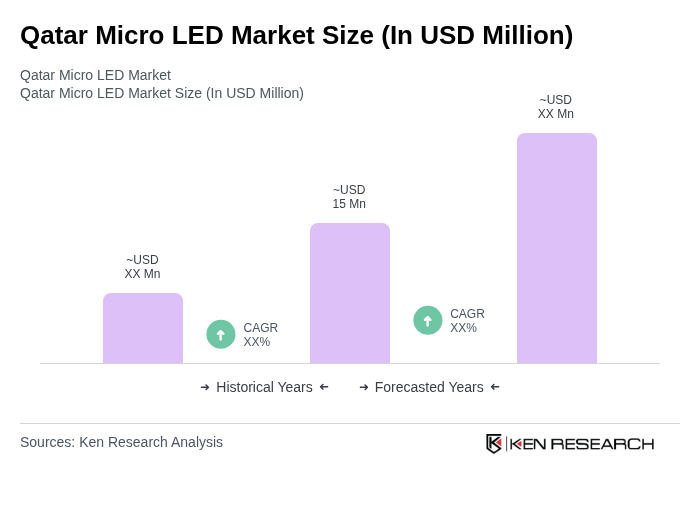
- The Qatar Micro LED Market is valued at USD 15 million, based on a five-year historical analysis. This growth is primarily driven by the increasing demand for high-resolution displays in consumer electronics and the rising adoption of Micro LED technology in applications such as automotive displays, digital signage, and premium wearables. The market is further supported by advancements in manufacturing processes, a growing focus on energy-efficient display solutions, and the integration of Micro LED in next-generation AR/VR devices.
- Key demand centers in this market include Doha, Al Rayyan, and Al Wakrah. These cities lead the market due to rapid urbanization, significant investments in infrastructure, and a burgeoning consumer electronics sector. The presence of major technology integrators and a supportive regulatory environment further enhance their competitive edge in the Micro LED landscape.
- The Qatari government has implemented the “Regulation for the Rationalization of Electricity and Water Consumption (Tarsheed),” issued by the Qatar General Electricity & Water Corporation (KAHRAMAA) in 2012, with ongoing amendments. This regulation mandates the adoption of energy-efficient technologies, including advanced lighting and display solutions such as Micro LED, in commercial and residential sectors. The regulation requires compliance with minimum energy performance standards and encourages manufacturers to innovate in sustainable display technologies, fostering growth in the Micro LED market.
Qatar Micro LED Market Segmentation
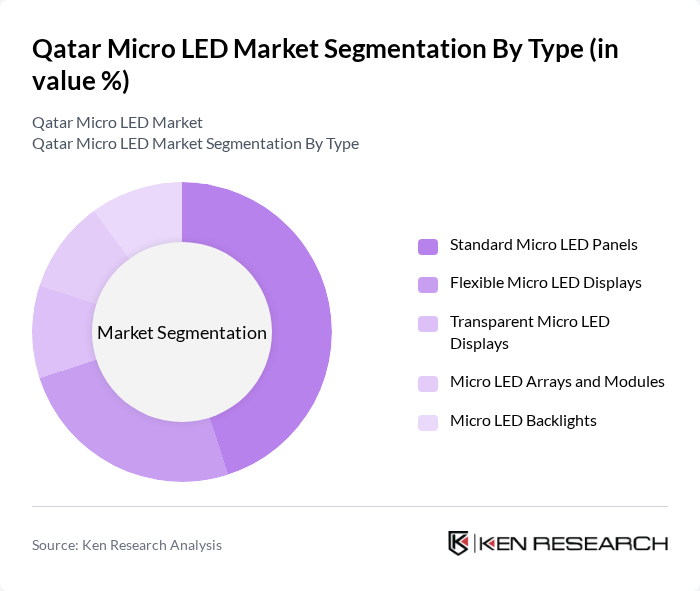
By Type:The Micro LED market can be segmented into Standard Micro LED Panels, Flexible Micro LED Displays, Transparent Micro LED Displays, Micro LED Arrays and Modules, and Micro LED Backlights. Among these, Standard Micro LED Panels are currently leading the market due to their widespread application in consumer electronics, particularly in televisions and smartphones. The demand for high-quality displays with superior brightness, energy efficiency, and color accuracy is driving the growth of this subsegment. Flexible Micro LED Displays are also gaining traction, especially in the automotive sector and next-generation wearables, where innovative designs and curved surfaces are increasingly in demand.
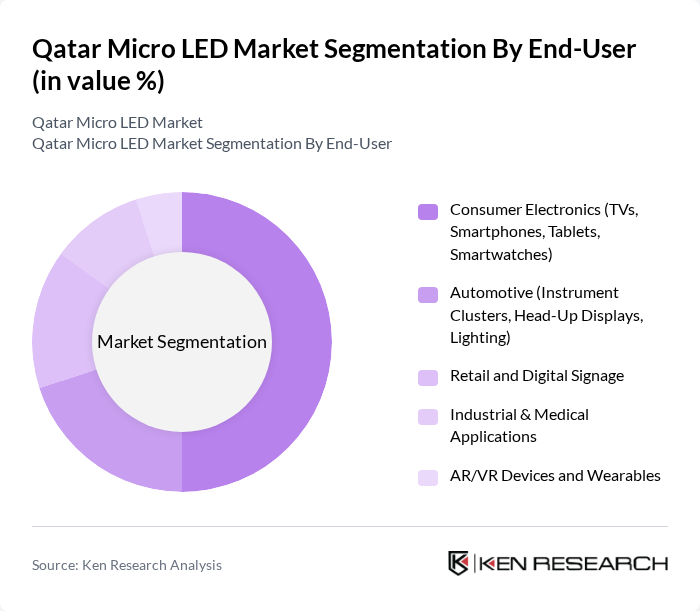
By End-User:The Micro LED market is segmented by end-user into Consumer Electronics, Automotive, Retail and Digital Signage, Industrial & Medical Applications, and AR/VR Devices and Wearables. The Consumer Electronics segment is the most dominant, driven by the increasing demand for high-definition televisions, smartphones, and tablets. The trend towards larger screen sizes, enhanced display quality, and energy efficiency is propelling this segment's growth. Automotive applications are also emerging as a significant contributor, with Micro LED technology being integrated into instrument clusters, head-up displays, and ambient lighting systems.
Qatar Micro LED Market Competitive Landscape
The Qatar Micro LED Market is characterized by a dynamic mix of regional and international players. Leading participants such as Samsung Electronics, LG Display, Sony Corporation, Apple Inc., AU Optronics, Epistar Corporation, X-Celeprint, Aledia, VueReal, PlayNitride, Innolux Corporation, JBD Inc. (Jade Bird Display), Micro LED Technologies Ltd., Rohm Semiconductor, Sharp Corporation, TCL CSOT, Leyard OptoElectronic, Konka Group, Lumens Co., Ltd., Lextar Electronics contribute to innovation, geographic expansion, and service delivery in this space.
Qatar Micro LED Market Industry Analysis
Growth Drivers
- Increasing Demand for High-Resolution Displays:The demand for high-resolution displays in Qatar is surging, driven by a projected increase in consumer electronics sales, which are expected to reach QAR 12 billion in future. This growth is fueled by the rising popularity of 4K and 8K televisions, which require advanced display technologies like Micro LED. Additionally, the gaming industry in Qatar is anticipated to grow by 16% annually, further propelling the need for superior display solutions that Micro LED technology can provide.
- Advancements in Micro LED Technology:Significant advancements in Micro LED technology are enhancing its appeal in Qatar's market. The development of smaller, more efficient Micro LEDs has led to improved brightness and color accuracy, with some products achieving over 1,200 nits of brightness. Furthermore, the reduction in manufacturing defects has improved yield rates to approximately 92%, making production more viable. These technological improvements are expected to attract investments exceeding QAR 600 million in the next two years, fostering market growth.
- Government Initiatives for Smart City Development:Qatar's government is heavily investing in smart city initiatives, with an estimated budget of QAR 60 billion allocated for infrastructure development in future. This includes the integration of advanced display technologies in public spaces and transportation systems. The Qatar National Vision 2030 emphasizes sustainable urban development, which is expected to drive demand for Micro LED displays in smart signage and information systems, creating a robust market environment for these technologies.
Market Challenges
- High Manufacturing Costs:The production of Micro LED displays involves high manufacturing costs, primarily due to the complex fabrication processes and the need for specialized equipment. Current estimates indicate that the cost of producing Micro LED panels can be up to QAR 1,300 per square meter, significantly higher than traditional display technologies. This financial barrier limits market entry for new players and can hinder widespread adoption among consumers and businesses in Qatar.
- Limited Availability of Raw Materials:The Micro LED industry faces challenges related to the availability of essential raw materials, such as gallium and indium, which are critical for LED production. Qatar's reliance on imports for these materials can lead to supply chain vulnerabilities, especially with global demand increasing. Reports indicate that the price of gallium has surged by 35% in the past year, impacting production costs and potentially stalling the growth of the Micro LED market in the region.
Qatar Micro LED Market Future Outlook
The future of the Micro LED market in Qatar appears promising, driven by technological advancements and increasing consumer awareness. As the government continues to invest in smart city projects, the integration of Micro LED displays in urban infrastructure is likely to expand. Additionally, the growing consumer electronics sector will further stimulate demand. With ongoing research and development, the market is expected to witness innovations that enhance product offerings, making Micro LED technology more accessible and appealing to a broader audience.
Market Opportunities
- Expansion in Automotive Display Applications:The automotive sector in Qatar is projected to grow by 12% annually, creating opportunities for Micro LED technology in vehicle displays. As manufacturers seek to enhance driver experiences with high-resolution dashboards and infotainment systems, Micro LEDs can provide superior image quality and energy efficiency, positioning them as a preferred choice in this evolving market.
- Growth in Wearable Technology:The wearable technology market in Qatar is expected to reach QAR 1.2 billion in future, driven by increasing health consciousness. Micro LED displays, known for their compact size and low power consumption, are ideal for smartwatches and fitness trackers. This presents a significant opportunity for manufacturers to innovate and capture a share of the burgeoning wearable tech market.
Scope of the Report
| Segment | Sub-Segments |
|---|---|
| By Type | Standard Micro LED Panels Flexible Micro LED Displays Transparent Micro LED Displays Micro LED Arrays and Modules Micro LED Backlights |
| By End-User | Consumer Electronics (TVs, Smartphones, Tablets, Smartwatches) Automotive (Instrument Clusters, Head-Up Displays, Lighting) Retail and Digital Signage Industrial & Medical Applications AR/VR Devices and Wearables |
| By Application | Large Display Panels (Billboards, Commercial Screens) Small & Medium Displays (Smartphones, Tablets, Laptops) Wearable Devices (Smartwatches, Fitness Bands) Automotive Displays (Dashboards, HUDs) Medical Imaging & Instrumentation |
| By Distribution Channel | Direct Sales (B2B) Distributors/Value-Added Resellers Online Retail Offline Retail System Integrators |
| By Region | Doha Al Rayyan Umm Salal Al Wakrah Others |
| By Technology | Chip-on-Board (COB) Flip Chip Micro LED on Silicon Monolithic Integration Others |
| By Market Segment | B2B B2C Government/Institutional Others |
Key Target Audience
Investors and Venture Capitalist Firms
Government and Regulatory Bodies (e.g., Ministry of Transport and Communications, Qatar National Research Fund)
Manufacturers and Producers
Distributors and Retailers
Technology Providers
Industry Associations (e.g., Qatar Chamber of Commerce)
Financial Institutions
Telecommunications Companies
Players Mentioned in the Report:
Samsung Electronics
LG Display
Sony Corporation
Apple Inc.
AU Optronics
Epistar Corporation
X-Celeprint
Aledia
VueReal
PlayNitride
Innolux Corporation
JBD Inc. (Jade Bird Display)
Micro LED Technologies Ltd.
Rohm Semiconductor
Sharp Corporation
TCL CSOT
Leyard OptoElectronic
Konka Group
Lumens Co., Ltd.
Lextar Electronics
Table of Contents
Market Assessment Phase
1. Executive Summary and Approach
2. Qatar Micro LED Market Overview
2.1 Key Insights and Strategic Recommendations
2.2 Qatar Micro LED Market Overview
2.3 Definition and Scope
2.4 Evolution of Market Ecosystem
2.5 Timeline of Key Regulatory Milestones
2.6 Value Chain & Stakeholder Mapping
2.7 Business Cycle Analysis
2.8 Policy & Incentive Landscape
3. Qatar Micro LED Market Analysis
3.1 Growth Drivers
3.1.1 Increasing Demand for High-Resolution Displays
3.1.2 Advancements in Micro LED Technology
3.1.3 Government Initiatives for Smart City Development
3.1.4 Rising Consumer Electronics Market
3.2 Market Challenges
3.2.1 High Manufacturing Costs
3.2.2 Limited Availability of Raw Materials
3.2.3 Competition from Alternative Display Technologies
3.2.4 Lack of Awareness Among Consumers
3.3 Market Opportunities
3.3.1 Expansion in Automotive Display Applications
3.3.2 Growth in Wearable Technology
3.3.3 Potential in Advertising and Signage
3.3.4 Collaborations with Tech Startups
3.4 Market Trends
3.4.1 Shift Towards Energy-Efficient Solutions
3.4.2 Integration of AI in Display Technologies
3.4.3 Customization and Personalization in Products
3.4.4 Increasing Focus on Sustainability
3.5 Government Regulation
3.5.1 Standards for Display Quality
3.5.2 Environmental Regulations on Manufacturing
3.5.3 Incentives for Renewable Energy Use
3.5.4 Import Tariffs on Electronic Components
4. SWOT Analysis
5. Stakeholder Analysis
6. Porter's Five Forces Analysis
7. Qatar Micro LED Market Market Size, 2019-2024
7.1 By Value
7.2 By Volume
7.3 By Average Selling Price
8. Qatar Micro LED Market Segmentation
8.1 By Type
8.1.1 Standard Micro LED Panels
8.1.2 Flexible Micro LED Displays
8.1.3 Transparent Micro LED Displays
8.1.4 Micro LED Arrays and Modules
8.1.5 Micro LED Backlights
8.2 By End-User
8.2.1 Consumer Electronics (TVs, Smartphones, Tablets, Smartwatches)
8.2.2 Automotive (Instrument Clusters, Head-Up Displays, Lighting)
8.2.3 Retail and Digital Signage
8.2.4 Industrial & Medical Applications
8.2.5 AR/VR Devices and Wearables
8.3 By Application
8.3.1 Large Display Panels (Billboards, Commercial Screens)
8.3.2 Small & Medium Displays (Smartphones, Tablets, Laptops)
8.3.3 Wearable Devices (Smartwatches, Fitness Bands)
8.3.4 Automotive Displays (Dashboards, HUDs)
8.3.5 Medical Imaging & Instrumentation
8.4 By Distribution Channel
8.4.1 Direct Sales (B2B)
8.4.2 Distributors/Value-Added Resellers
8.4.3 Online Retail
8.4.4 Offline Retail
8.4.5 System Integrators
8.5 By Region
8.5.1 Doha
8.5.2 Al Rayyan
8.5.3 Umm Salal
8.5.4 Al Wakrah
8.5.5 Others
8.6 By Technology
8.6.1 Chip-on-Board (COB)
8.6.2 Flip Chip
8.6.3 Micro LED on Silicon
8.6.4 Monolithic Integration
8.6.5 Others
8.7 By Market Segment
8.7.1 B2B
8.7.2 B2C
8.7.3 Government/Institutional
8.7.4 Others
9. Qatar Micro LED Market Competitive Analysis
9.1 Market Share of Key Players
9.2 Cross Comparison of Key Players
9.2.1 Company Name
9.2.2 Company Size (Large, Medium, Small)
9.2.3 Revenue Growth Rate (Qatar Micro LED Segment)
9.2.4 Market Penetration Rate (Qatar/Regional)
9.2.5 R&D Investment as % of Revenue
9.2.6 Product Portfolio Breadth (Micro LED SKUs)
9.2.7 Patent Count (Micro LED-related)
9.2.8 Local Partnerships/Projects in Qatar
9.2.9 Distribution Network Strength (Qatar)
9.2.10 Customer Satisfaction/Net Promoter Score (NPS)
9.3 SWOT Analysis of Top Players
9.4 Pricing Analysis
9.5 Detailed Profile of Major Companies
9.5.1 Samsung Electronics
9.5.2 LG Display
9.5.3 Sony Corporation
9.5.4 Apple Inc.
9.5.5 AU Optronics
9.5.6 Epistar Corporation
9.5.7 X-Celeprint
9.5.8 Aledia
9.5.9 VueReal
9.5.10 PlayNitride
9.5.11 Innolux Corporation
9.5.12 JBD Inc. (Jade Bird Display)
9.5.13 Micro LED Technologies Ltd.
9.5.14 Rohm Semiconductor
9.5.15 Sharp Corporation
9.5.16 TCL CSOT
9.5.17 Leyard OptoElectronic
9.5.18 Konka Group
9.5.19 Lumens Co., Ltd.
9.5.20 Lextar Electronics
10. Qatar Micro LED Market End-User Analysis
10.1 Procurement Behavior of Key Ministries
10.1.1 Government Procurement Policies
10.1.2 Budget Allocations for Technology
10.1.3 Evaluation Criteria for Suppliers
10.1.4 Collaboration with Local Firms
10.2 Corporate Spend on Infrastructure & Energy
10.2.1 Investment Trends in Technology
10.2.2 Budgeting for Upgrades
10.2.3 Long-term Contracts with Suppliers
10.2.4 Focus on Sustainable Solutions
10.3 Pain Point Analysis by End-User Category
10.3.1 Cost Constraints
10.3.2 Technology Integration Issues
10.3.3 Supply Chain Disruptions
10.3.4 Quality Assurance Challenges
10.4 User Readiness for Adoption
10.4.1 Awareness of Micro LED Benefits
10.4.2 Training and Support Needs
10.4.3 Infrastructure Compatibility
10.4.4 Financial Readiness
10.5 Post-Deployment ROI and Use Case Expansion
10.5.1 Measurement of ROI
10.5.2 Case Studies of Successful Implementations
10.5.3 Scalability of Solutions
10.5.4 Future Use Cases
11. Qatar Micro LED Market Future Size, 2025-2030
11.1 By Value
11.2 By Volume
11.3 By Average Selling Price
Go-To-Market Strategy Phase
1. Whitespace Analysis + Business Model Canvas
1.1 Market Gaps Identification
1.2 Business Model Development
2. Marketing and Positioning Recommendations
2.1 Branding Strategies
2.2 Product USPs
3. Distribution Plan
3.1 Urban Retail vs Rural NGO Tie-ups
4. Channel & Pricing Gaps
4.1 Underserved Routes
4.2 Pricing Bands
5. Unmet Demand & Latent Needs
5.1 Category Gaps
5.2 Consumer Segments
6. Customer Relationship
6.1 Loyalty Programs
6.2 After-sales Service
7. Value Proposition
7.1 Sustainability
7.2 Integrated Supply Chains
8. Key Activities
8.1 Regulatory Compliance
8.2 Branding
8.3 Distribution Setup
9. Entry Strategy Evaluation
9.1 Domestic Market Entry Strategy
9.1.1 Product Mix
9.1.2 Pricing Band
9.1.3 Packaging
9.2 Export Entry Strategy
9.2.1 Target Countries
9.2.2 Compliance Roadmap
10. Entry Mode Assessment
10.1 JV
10.2 Greenfield
10.3 M&A
10.4 Distributor Model
11. Capital and Timeline Estimation
11.1 Capital Requirements
11.2 Timelines
12. Control vs Risk Trade-Off
12.1 Ownership vs Partnerships
13. Profitability Outlook
13.1 Breakeven Analysis
13.2 Long-term Sustainability
14. Potential Partner List
14.1 Distributors
14.2 JVs
14.3 Acquisition Targets
15. Execution Roadmap
15.1 Phased Plan for Market Entry
15.1.1 Market Setup
15.1.2 Market Entry
15.1.3 Growth Acceleration
15.1.4 Scale & Stabilize
15.2 Key Activities and Milestones
15.2.1 Milestone Planning
15.2.2 Activity Tracking
Research Methodology
Phase 1: Approach1
Desk Research
- Industry reports from market research firms focusing on Micro LED technology
- Government publications and white papers on technology adoption in Qatar
- Academic journals and conference proceedings related to Micro LED advancements
Primary Research
- Interviews with technology experts and R&D heads in the Micro LED sector
- Surveys targeting manufacturers and suppliers of Micro LED components
- Field interviews with end-users in sectors such as consumer electronics and automotive
Validation & Triangulation
- Cross-validation of data from multiple industry sources and expert opinions
- Triangulation of market trends with sales data and technology adoption rates
- Sanity checks through feedback from a panel of industry veterans
Phase 2: Market Size Estimation1
Top-down Assessment
- Analysis of the overall display market size in Qatar and its growth trajectory
- Segmentation of the Micro LED market by application areas such as signage and consumer electronics
- Incorporation of government initiatives promoting smart technologies and digital displays
Bottom-up Modeling
- Estimation of production capacities and sales volumes from key Micro LED manufacturers
- Cost analysis based on component pricing and manufacturing expenses
- Volume x price calculations to derive revenue projections for different segments
Forecasting & Scenario Analysis
- Multi-variable regression analysis incorporating factors like consumer demand and technological advancements
- Scenario planning based on potential regulatory changes and market entry of new players
- Development of baseline, optimistic, and pessimistic forecasts through 2030
Phase 3: CATI Sample Composition1
| Scope Item/Segment | Sample Size | Target Respondent Profiles |
|---|---|---|
| Consumer Electronics Manufacturers | 100 | Product Managers, R&D Directors |
| Advertising and Signage Companies | 80 | Marketing Managers, Operations Heads |
| Automotive Display Integrators | 70 | Engineering Managers, Procurement Specialists |
| Retail Technology Providers | 60 | Business Development Managers, Technical Leads |
| Government and Regulatory Bodies | 50 | Policy Makers, Technology Advisors |
Frequently Asked Questions
What is the current value of the Qatar Micro LED Market?
The Qatar Micro LED Market is valued at approximately USD 15 million, driven by the increasing demand for high-resolution displays in consumer electronics and the adoption of Micro LED technology in various applications such as automotive displays and digital signage.
What are the key demand centers for Micro LED technology in Qatar?
How does the Qatari government support the Micro LED market?
What are the main types of Micro LED displays available in Qatar?
Other Regional/Country Reports
Other Adjacent Reports
Indonesia OLED Display Market
Vietnam Mini LED Display Market
South Korea LCD Display Market
UAE Semiconductor Materials MarketNew Zealand Consumer Electronics Market Size Share Growth Drivers Trends Opportunities & Forecast 2025–2030Thailand Automotive Display Market
Middle East Digital Signage Market Report Size Share Growth Drivers Trends Opportunities & Forecast 2025–2030Belgium AR/VR Devices Market
Qatar Wearable Technology Market Report Size Share Growth Drivers Trends Opportunities & Forecast 2025–2030KSA Smart Lighting Market
Why Buy From Us?

What makes us stand out is that our consultants follow Robust, Refine and Result (RRR) methodology. Robust for clear definitions, approaches and sanity checking, Refine for differentiating respondents' facts and opinions, and Result for presenting data with story.

We have set a benchmark in the industry by offering our clients with syndicated and customized market research reports featuring coverage of entire market as well as meticulous research and analyst insights.

While we don't replace traditional research, we flip the method upside down. Our dual approach of Top Bottom & Bottom Top ensures quality deliverable by not just verifying company fundamentals but also looking at the sector and macroeconomic factors.

With one step in the future, our research team constantly tries to show you the bigger picture. We help with some of the tough questions you may encounter along the way: How is the industry positioned? Best marketing channel? KPI's of competitors? By aligning every element, we help maximize success.

Our report gives you instant access to the answers and sources that other companies might choose to hide. We elaborate each steps of research methodology we have used and showcase you the sample size to earn your trust.

If you need any support, we are here! We pride ourselves on universe strength, data quality, and quick, friendly, and professional service.