About the Report
Base Year 2024Qatar Oil And Gas Upstream Market Overview
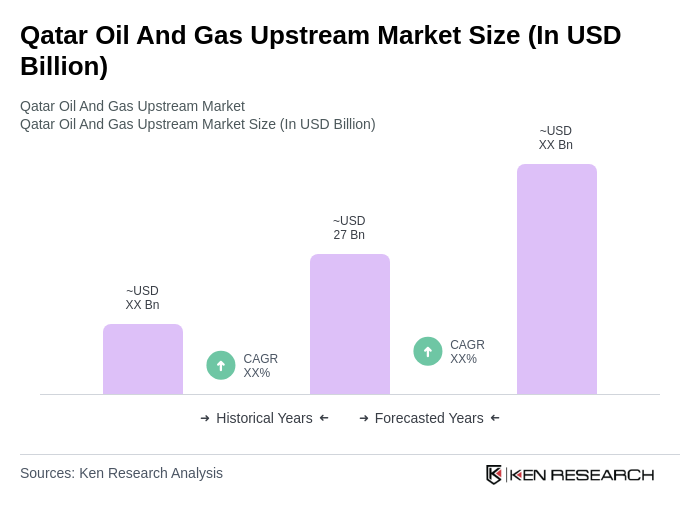
- The Qatar Oil and Gas Upstream Market is valued at USD 27 billion, based on a five-year historical analysis. This level reflects Qatar’s vast natural gas endowment in the North Field and sustained global LNG demand, alongside continued investment in upstream technology and efficiency programs.
- Qatar is a dominant upstream player due to its large reserves and production capacity centered on the North Field, one of the world’s largest non-associated gas fields, underpinning its position among leading LNG exporters and its extensive joint ventures with international oil companies in North Field expansion and offshore oil assets.
- In 2023, Qatar advanced policy initiatives supporting decarbonization in oil and gas, including company- and project-level methane and CO2 reduction programs aligned with national net?zero by mid?century ambitions and deployment of technologies such as CCS and operational efficiency to cut emissions intensity.
Qatar Oil And Gas Upstream Market Segmentation
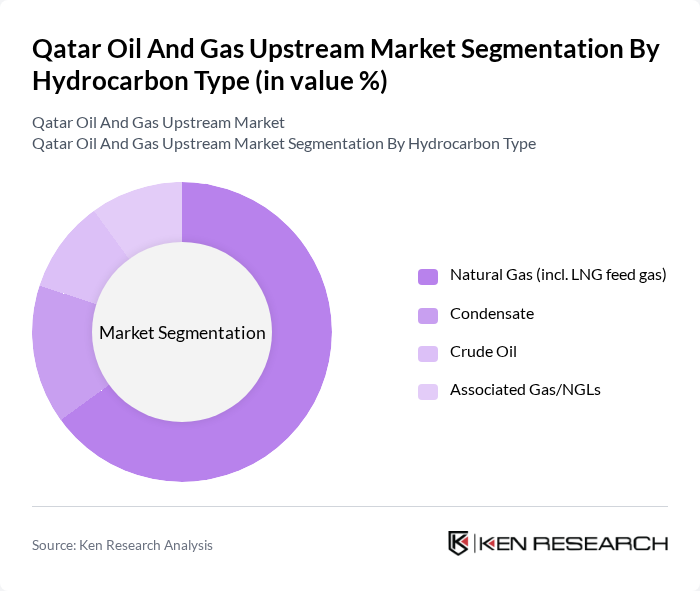
By Hydrocarbon Type:The hydrocarbon type segmentation includes Natural Gas (incl. LNG feed gas), Condensate, Crude Oil, and Associated Gas/NGLs. Natural gas, particularly LNG feed, dominates due to Qatar’s large North Field resources and LNG leadership, supported by global gas demand and its role as a transition fuel. Condensate and crude oil remain material, especially from offshore fields like Al?Shaheen where oil is accompanied by associated gas and NGL streams.
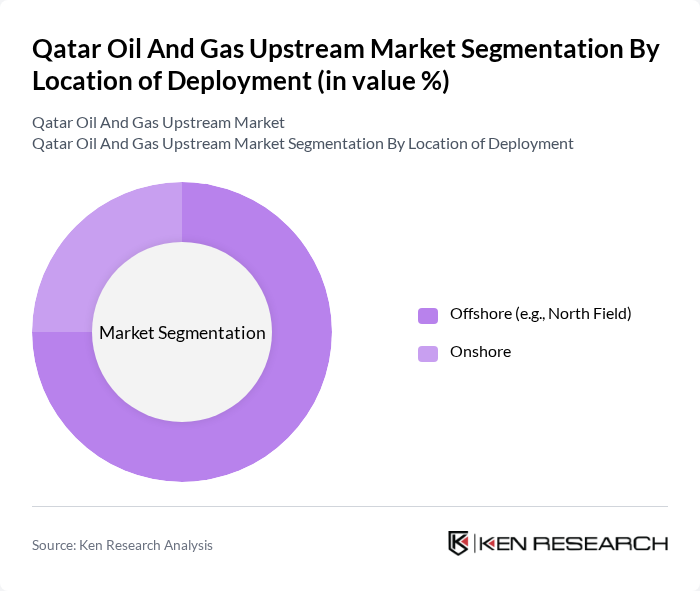
By Location of Deployment:The location of deployment segmentation includes Offshore (e.g., North Field) and Onshore. Offshore operations dominate due to the North Field’s scale and the concentration of major oil production at offshore fields such as Al?Shaheen, supported by sustained investment and IOC partnerships; onshore output is comparatively smaller and more oil?focused.
Qatar Oil And Gas Upstream Market Competitive Landscape
The Qatar Oil And Gas Upstream Market is characterized by a dynamic mix of regional and international players. Leading participants such as QatarEnergy, QatarEnergy LNG (formerly Qatargas), North Oil Company (QatarEnergy & TotalEnergies JV for Al?Shaheen), ExxonMobil, TotalEnergies, Shell, ConocoPhillips, Eni, Wintershall Dea, Occidental, Chevron Phillips Chemical Qatar (for upstream?linked condensate/NGL integration), Mitsui & Co., Ltd. (LNG/JV partner), Marubeni Corporation (LNG/JV partner), JERA Co., Inc. (offtake/JV partner), DNO ASA contribute to innovation, geographic expansion, and service delivery in this space.
Qatar Oil And Gas Upstream Market Industry Analysis
Growth Drivers
- Increasing Global Energy Demand:The global energy demand is projected to reach 600 exajoules in the future, driven by population growth and industrialization, particularly in Asia. Qatar, as one of the leading LNG exporters, is positioned to benefit significantly from this trend. The International Energy Agency (IEA) anticipates that natural gas will account for 25% of the global energy mix, further solidifying Qatar's role in meeting this demand through its extensive reserves and production capabilities.
- Technological Advancements in Exploration:Qatar's upstream sector is increasingly leveraging advanced technologies such as 3D seismic imaging and enhanced oil recovery techniques. In the future, investments in these technologies are expected to exceed $1 billion, improving extraction efficiency and reducing operational costs. The Qatar Petroleum Corporation has reported a 15% increase in recovery rates due to these innovations, enabling the country to maximize its hydrocarbon resources effectively.
- Strategic Investments in Infrastructure:Qatar's government has committed over $20 billion to enhance its oil and gas infrastructure in the future. This includes expanding LNG facilities and upgrading pipelines, which are crucial for increasing production capacity. The Qatar National Vision 2030 emphasizes infrastructure development, aiming to boost the oil and gas sector's contribution to GDP, which is projected to remain around 50% in the coming years, ensuring sustained economic growth.
Market Challenges
- Volatility in Oil Prices:The oil market remains susceptible to fluctuations, with prices projected to range between $60 and $80 per barrel in the future. This volatility poses a significant challenge for Qatar's upstream sector, impacting revenue stability and investment decisions. The World Bank has indicated that sustained low prices could lead to budget deficits, affecting government spending on critical infrastructure and social programs, thereby hindering long-term growth.
- Environmental Regulations:Increasingly stringent environmental regulations are impacting the oil and gas industry globally. Qatar faces pressure to comply with international standards, which may require investments of approximately $500 million in the future for compliance and mitigation strategies. The need for environmental impact assessments and sustainable practices could slow down project timelines and increase operational costs, challenging the sector's profitability and growth potential.
Qatar Oil And Gas Upstream Market Future Outlook
The future of Qatar's oil and gas upstream market appears promising, driven by ongoing technological advancements and a commitment to sustainability. As the country enhances its LNG export capabilities, it is likely to solidify its position as a key player in the global energy landscape. Furthermore, strategic partnerships with international firms are expected to foster innovation and investment, ensuring that Qatar remains competitive in a rapidly evolving market. The focus on decarbonization initiatives will also shape the sector's trajectory, aligning with global energy transition goals.
Market Opportunities
- Expansion of LNG Exports:Qatar's LNG exports are projected to increase by 10% in the future, driven by rising demand from Asia and Europe. This expansion presents a significant opportunity for revenue growth, with potential earnings exceeding $30 billion. The country's strategic location and established trade routes further enhance its competitive advantage in the global LNG market.
- Investment in Renewable Energy Integration:Qatar is investing approximately $1.5 billion in renewable energy projects in the future, aiming to diversify its energy portfolio. This integration of renewables not only supports sustainability goals but also enhances energy security. The government’s commitment to achieving 20% of its energy from renewable sources by 2030 presents a unique opportunity for innovation and collaboration in the energy sector.
Scope of the Report
| Segment | Sub-Segments |
|---|---|
| By Hydrocarbon Type | Natural Gas (incl. LNG feed gas) Condensate Crude Oil Associated Gas/NGLs |
| By Location of Deployment | Offshore (e.g., North Field) Onshore |
| By Basin/Field Cluster | North Field (North Field East, South, and Expansion) Al?Shaheen Dukhan Bul Hanine & Maydan Mahzam |
| By Upstream Activity | Exploration & Appraisal Development (drilling, well services) Production & Lifting Enhanced Oil Recovery/Reservoir Management |
| By Contracting/Operating Model | National Oil Company Operated (QatarEnergy and subsidiaries) Joint Ventures/PSAs with IOCs Service Contracts (EPC/EPIC, drilling, subsea) Independent/Partner?operated fields |
| By Capex Category | Drilling & Well Construction Subsurface/Seismic & Reservoir Studies Offshore Facilities & Subsea Production Facilities & Flowlines |
| By End Use of Produced Hydrocarbons | LNG Liquefaction Feedstock Domestic Power & Industry Export Pipelines/Petrochemicals Feedstock Condensate/NGLs to Refining & Trading |
Key Target Audience
Investors and Venture Capitalist Firms
Government and Regulatory Bodies (e.g., Ministry of Energy and Industry, Qatar Petroleum)
Oil and Gas Exploration Companies
Drilling Contractors
Equipment and Technology Suppliers
Environmental and Safety Regulatory Agencies (e.g., Qatar Environmental Regulatory Authority)
Local and International Oilfield Service Companies
Energy Policy Makers and Advisors
Players Mentioned in the Report:
QatarEnergy
QatarEnergy LNG (formerly Qatargas)
North Oil Company (QatarEnergy & TotalEnergies JV for AlShaheen)
ExxonMobil
TotalEnergies
Shell
ConocoPhillips
Eni
Wintershall Dea
Occidental
Chevron Phillips Chemical Qatar (for upstreamlinked condensate/NGL integration)
Mitsui & Co., Ltd. (LNG/JV partner)
Marubeni Corporation (LNG/JV partner)
JERA Co., Inc. (offtake/JV partner)
DNO ASA
Table of Contents
Market Assessment Phase
1. Executive Summary and Approach
2. Qatar Oil And Gas Upstream Market Overview
2.1 Key Insights and Strategic Recommendations
2.2 Qatar Oil And Gas Upstream Market Overview
2.3 Definition and Scope
2.4 Evolution of Market Ecosystem
2.5 Timeline of Key Regulatory Milestones
2.6 Value Chain & Stakeholder Mapping
2.7 Business Cycle Analysis
2.8 Policy & Incentive Landscape
3. Qatar Oil And Gas Upstream Market Analysis
3.1 Growth Drivers
3.1.1 Increasing Global Energy Demand
3.1.2 Technological Advancements in Exploration
3.1.3 Strategic Investments in Infrastructure
3.1.4 Favorable Government Policies
3.2 Market Challenges
3.2.1 Volatility in Oil Prices
3.2.2 Environmental Regulations
3.2.3 Geopolitical Risks
3.2.4 Limited Skilled Workforce
3.3 Market Opportunities
3.3.1 Expansion of LNG Exports
3.3.2 Investment in Renewable Energy Integration
3.3.3 Development of Unconventional Resources
3.3.4 Strategic Partnerships with International Firms
3.4 Market Trends
3.4.1 Digital Transformation in Operations
3.4.2 Focus on Sustainability Practices
3.4.3 Increasing Use of AI and Data Analytics
3.4.4 Shift Towards Decarbonization Initiatives
3.5 Government Regulation
3.5.1 Local Content Requirements
3.5.2 Environmental Impact Assessments
3.5.3 Tax Incentives for Exploration
3.5.4 Licensing and Permitting Processes
4. SWOT Analysis
5. Stakeholder Analysis
6. Porter's Five Forces Analysis
7. Qatar Oil And Gas Upstream Market Market Size, 2019-2024
7.1 By Value
7.2 By Volume
7.3 By Average Selling Price
8. Qatar Oil And Gas Upstream Market Segmentation
8.1 By Hydrocarbon Type
8.1.1 Natural Gas (incl. LNG feed gas)
8.1.2 Condensate
8.1.3 Crude Oil
8.1.4 Associated Gas/NGLs
8.2 By Location of Deployment
8.2.1 Offshore (e.g., North Field)
8.2.2 Onshore
8.3 By Basin/Field Cluster
8.3.1 North Field (North Field East, South, and Expansion)
8.3.2 Al?Shaheen
8.3.3 Dukhan
8.3.4 Bul Hanine & Maydan Mahzam
8.4 By Upstream Activity
8.4.1 Exploration & Appraisal
8.4.2 Development (drilling, well services)
8.4.3 Production & Lifting
8.4.4 Enhanced Oil Recovery/Reservoir Management
8.5 By Contracting/Operating Model
8.5.1 National Oil Company Operated (QatarEnergy and subsidiaries)
8.5.2 Joint Ventures/PSAs with IOCs
8.5.3 Service Contracts (EPC/EPIC, drilling, subsea)
8.5.4 Independent/Partner?operated fields
8.6 By Capex Category
8.6.1 Drilling & Well Construction
8.6.2 Subsurface/Seismic & Reservoir Studies
8.6.3 Offshore Facilities & Subsea
8.6.4 Production Facilities & Flowlines
8.7 By End Use of Produced Hydrocarbons
8.7.1 LNG Liquefaction Feedstock
8.7.2 Domestic Power & Industry
8.7.3 Export Pipelines/Petrochemicals Feedstock
8.7.4 Condensate/NGLs to Refining & Trading
9. Qatar Oil And Gas Upstream Market Competitive Analysis
9.1 Market Share of Key Players
9.2 KPIs for Cross Comparison of Key Players
9.2.1 Operator/JV role (operator, non?operator, equity %)
9.2.2 Net upstream production in Qatar (boe/d; LNG mtpa equity share)
9.2.3 Reserves booked in Qatar (1P/2P, mmboe)
9.2.4 Capex commitments in Qatar (USD, by project/phase)
9.2.5 Lifting costs and unit opex (USD/boe)
9.2.6 Realized price mix (gas, condensate, crude; USD/boe equivalent)
9.2.7 Development cycle time (FID?to?first gas/oil, months)
9.2.8 Drilling performance (average days per well, NPT %)
9.2.9 Facility uptime/availability (%) and unplanned downtime
9.2.10 Emissions intensity (kg CO?e/boe; methane intensity %)
9.2.11 Local content/workforce metrics (% Qatari, suppliers)
9.2.12 HSE performance (TRIR, process safety Tier 1/2)
9.2.13 Return on capital employed (ROCE) for Qatar projects
9.2.14 Reserve replacement ratio (RRR) and F&D cost (USD/boe)
9.3 SWOT Analysis of Top Players
9.4 Pricing Analysis
9.5 List of Major Companies
9.5.1 QatarEnergy
9.5.2 QatarEnergy LNG (formerly Qatargas)
9.5.3 North Oil Company (QatarEnergy & TotalEnergies JV for Al?Shaheen)
9.5.4 ExxonMobil
9.5.5 TotalEnergies
9.5.6 Shell
9.5.7 ConocoPhillips
9.5.8 Eni
9.5.9 Wintershall Dea
9.5.10 Occidental
9.5.11 Chevron Phillips Chemical Qatar (for upstream?linked condensate/NGL integration)
9.5.12 Mitsui & Co., Ltd. (LNG/JV partner)
9.5.13 Marubeni Corporation (LNG/JV partner)
9.5.14 JERA Co., Inc. (offtake/JV partner)
9.5.15 DNO ASA
10. Qatar Oil And Gas Upstream Market End-User Analysis
10.1 Procurement Behavior of Key Ministries
10.1.1 Ministry of Energy
10.1.2 Ministry of Finance
10.1.3 Ministry of Environment
10.2 Corporate Spend on Infrastructure & Energy
10.2.1 Investment in Oil Infrastructure
10.2.2 Spending on Renewable Energy Projects
10.2.3 Budget Allocation for Exploration
10.3 Pain Point Analysis by End-User Category
10.3.1 Supply Chain Disruptions
10.3.2 Regulatory Compliance Costs
10.3.3 Skilled Labor Shortages
10.4 User Readiness for Adoption
10.4.1 Technology Adoption Rates
10.4.2 Training and Development Needs
10.4.3 Infrastructure Readiness
10.5 Post-Deployment ROI and Use Case Expansion
10.5.1 Performance Metrics
10.5.2 Long-term Sustainability Goals
10.5.3 Expansion into New Markets
11. Qatar Oil And Gas Upstream Market Future Size, 2025-2030
11.1 By Value
11.2 By Volume
11.3 By Average Selling Price
Go-To-Market Strategy Phase
1. Whitespace Analysis + Business Model Canvas
1.1 Market Gaps Identification
1.2 Value Proposition Development
1.3 Revenue Streams Analysis
1.4 Cost Structure Evaluation
1.5 Key Partnerships Exploration
1.6 Customer Segmentation
1.7 Channels of Distribution
2. Marketing and Positioning Recommendations
2.1 Branding Strategies
2.2 Product USPs
2.3 Target Market Positioning
2.4 Communication Strategies
2.5 Digital Marketing Approaches
3. Distribution Plan
3.1 Urban Retail Strategies
3.2 Rural NGO Tie-ups
3.3 Logistics and Supply Chain Management
3.4 Distribution Partnerships
4. Channel & Pricing Gaps
4.1 Underserved Routes
4.2 Pricing Bands Analysis
4.3 Competitive Pricing Strategies
5. Unmet Demand & Latent Needs
5.1 Category Gaps
5.2 Consumer Segments Analysis
5.3 Emerging Trends Identification
6. Customer Relationship
6.1 Loyalty Programs
6.2 After-sales Service
6.3 Customer Feedback Mechanisms
7. Value Proposition
7.1 Sustainability Initiatives
7.2 Integrated Supply Chains
7.3 Competitive Advantages
8. Key Activities
8.1 Regulatory Compliance
8.2 Branding Efforts
8.3 Distribution Setup
9. Entry Strategy Evaluation
9.1 Domestic Market Entry Strategy
9.1.1 Product Mix Considerations
9.1.2 Pricing Band Strategy
9.1.3 Packaging Options
9.2 Export Entry Strategy
9.2.1 Target Countries
9.2.2 Compliance Roadmap
10. Entry Mode Assessment
10.1 Joint Ventures
10.2 Greenfield Investments
10.3 Mergers & Acquisitions
10.4 Distributor Model
11. Capital and Timeline Estimation
11.1 Capital Requirements
11.2 Timelines for Implementation
12. Control vs Risk Trade-Off
12.1 Ownership vs Partnerships
13. Profitability Outlook
13.1 Breakeven Analysis
13.2 Long-term Sustainability
14. Potential Partner List
14.1 Distributors
14.2 Joint Ventures
14.3 Acquisition Targets
15. Execution Roadmap
15.1 Phased Plan for Market Entry
15.1.1 Market Setup
15.1.2 Market Entry
15.1.3 Growth Acceleration
15.1.4 Scale & Stabilize
15.2 Key Activities and Milestones
15.2.1 Milestone Planning
15.2.2 Activity Tracking
Research Methodology
Phase 1: Approach1
Desk Research
- Analysis of government reports and publications from the Qatar Ministry of Energy and Industry
- Review of industry reports from organizations such as the Qatar Petroleum and the Qatar Chamber of Commerce
- Examination of market trends and forecasts from international energy agencies and consultancy firms
Primary Research
- Interviews with senior executives from major oil and gas companies operating in Qatar
- Surveys conducted with field engineers and project managers in upstream operations
- Focus group discussions with industry analysts and market experts specializing in the Gulf region
Validation & Triangulation
- Cross-validation of data through multiple sources including trade publications and financial reports
- Triangulation of findings from primary interviews with secondary data insights
- Sanity checks through expert panel reviews to ensure data accuracy and relevance
Phase 2: Market Size Estimation1
Top-down Assessment
- Estimation of total upstream market size based on national oil production statistics
- Segmentation of market by exploration, drilling, and production activities
- Incorporation of government investment plans and international partnerships in the sector
Bottom-up Modeling
- Collection of operational data from leading upstream companies regarding production volumes
- Cost analysis based on drilling and extraction technologies employed in the region
- Volume x cost calculations to derive revenue estimates for various upstream segments
Forecasting & Scenario Analysis
- Multi-factor regression analysis incorporating oil price fluctuations and global demand trends
- Scenario modeling based on geopolitical factors and regulatory changes affecting the sector
- Development of baseline, optimistic, and pessimistic forecasts through 2030
Phase 3: CATI Sample Composition1
| Scope Item/Segment | Sample Size | Target Respondent Profiles |
|---|---|---|
| Exploration and Production Companies | 100 | CEOs, Operations Managers |
| Drilling Services Providers | 80 | Technical Directors, Project Managers |
| Oilfield Equipment Manufacturers | 70 | Product Development Managers, Sales Directors |
| Regulatory Bodies and Government Agencies | 50 | Policy Makers, Regulatory Affairs Managers |
| Consulting Firms Specializing in Oil & Gas | 60 | Industry Analysts, Market Researchers |
Frequently Asked Questions
What is the current value of the Qatar Oil and Gas Upstream Market?
The Qatar Oil and Gas Upstream Market is valued at approximately USD 27 billion, reflecting the country's significant natural gas reserves in the North Field and sustained global demand for LNG, alongside ongoing investments in technology and efficiency programs.
What are the main hydrocarbon types produced in Qatar's upstream sector?
How does Qatar's geographical location impact its oil and gas market?
What technological advancements are influencing Qatar's upstream oil and gas sector?
Other Regional/Country Reports
Indonesia Oil And Gas Upstream Market
Malaysia Oil And Gas Upstream Market
Why Buy From Us?

What makes us stand out is that our consultants follow Robust, Refine and Result (RRR) methodology. Robust for clear definitions, approaches and sanity checking, Refine for differentiating respondents' facts and opinions, and Result for presenting data with story.

We have set a benchmark in the industry by offering our clients with syndicated and customized market research reports featuring coverage of entire market as well as meticulous research and analyst insights.

While we don't replace traditional research, we flip the method upside down. Our dual approach of Top Bottom & Bottom Top ensures quality deliverable by not just verifying company fundamentals but also looking at the sector and macroeconomic factors.

With one step in the future, our research team constantly tries to show you the bigger picture. We help with some of the tough questions you may encounter along the way: How is the industry positioned? Best marketing channel? KPI's of competitors? By aligning every element, we help maximize success.

Our report gives you instant access to the answers and sources that other companies might choose to hide. We elaborate each steps of research methodology we have used and showcase you the sample size to earn your trust.

If you need any support, we are here! We pride ourselves on universe strength, data quality, and quick, friendly, and professional service.