About the Report
Base Year 2024Qatar Power to Gas Market Overview
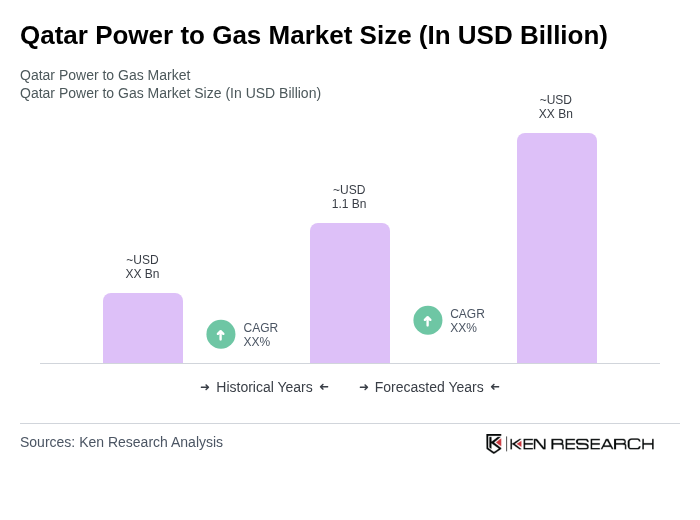
- The Qatar Power to Gas Market is valued at USD 1.1 billion, based on a five-year historical analysis, reflecting early-stage but growing activity around low?carbon hydrogen, synthetic fuels and related infrastructure in the broader power and gas value chain. This growth is primarily driven by the increasing demand for sustainable energy solutions, Qatar National Vision 2030 objectives, and the government's commitment to diversifying the energy mix away from a dominant natural gas base. The market is further supported by rapid build?out of renewable and clean power capacity (including large solar projects led by Kahramaa and Siraj Energy) and ongoing digitization of the grid, which enable more efficient conversion processes and integration of power?to?gas pilots with existing energy systems.
- Key hubs relevant to this market include Doha and Ras Laffan Industrial City, which are central due to their strategic locations, LNG and petrochemical complexes, power plants, and established energy infrastructure. The presence of major energy companies such as QatarEnergy, QatarEnergy LNG, Nebras Power and Kahramaa, along with industrial clusters in Ras Laffan and Mesaieed, and ongoing investments in solar power and grid modernization, support these areas as natural locations for early power?to?hydrogen and synthetic fuel initiatives.
- In 2023, Qatar advanced policies and strategies to develop low?carbon and clean hydrogen, building on its National Climate Change Action Plan 2030 and its public commitment to achieve net?zero greenhouse gas emissions by 2050. These initiatives are complemented by energy?sector decarbonization programs under Qatar National Vision 2030 and regulatory instruments such as the Environment Protection Law No. 30 of 2002 issued by the Ministry of Environment and Climate Change, which sets environmental standards and emissions controls for industrial and energy projects and underpins permitting requirements for future green hydrogen and synthetic fuel facilities. Incentives linked to large renewable power tenders, efficiency standards, and voluntary emissions?reduction measures adopted by state?owned energy companies are expected to support the scale?up of Power to Gas projects over time.
Qatar Power to Gas Market Segmentation
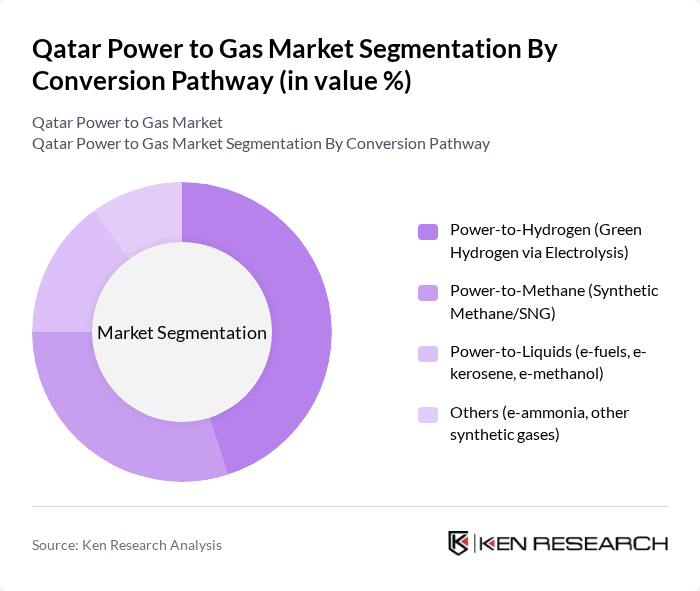
By Conversion Pathway:The Power to Gas market can be segmented into four main pathways: Power-to-Hydrogen, Power-to-Methane, Power-to-Liquids, and Others. In line with global and regional trends, Power-to-Hydrogen is emerging as the leading subsegment, driven by the increasing focus on hydrogen as a clean energy carrier for decarbonizing industry, power, and mobility. In Qatar, this is reinforced by the country’s strong natural gas and LNG base, existing industrial demand for hydrogen and ammonia, and interest in future export opportunities for low?carbon hydrogen and derivatives. The growing potential demand for hydrogen in refining, petrochemicals, fertilizers and, over the longer term, heavy transport and shipping is propelling this segment forward.
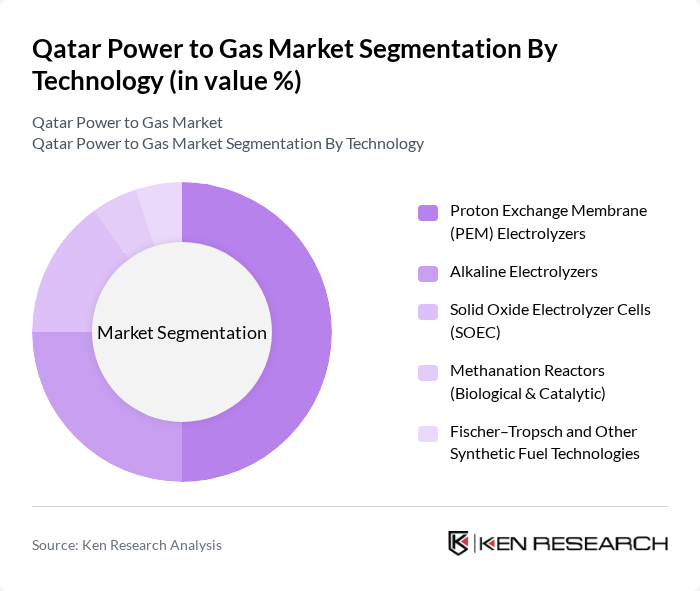
By Technology:The market can also be segmented by technology, including PEM Electrolysis, Alkaline Electrolysis, SOEC, Methanation, and Synthetic Fuel Synthesis. Globally, Proton Exchange Membrane (PEM) and Alkaline electrolyzers account for the majority of installed electrolysis capacity, with PEM favored in applications that require flexible operation and rapid response to variable renewable power. In the context of Qatar’s early?stage projects and feasibility studies, PEM Electrolyzers are positioned to lead future deployments due to their efficiency, compact footprint, and suitability for integration with utility?scale solar plants and industrial users. The increasing global adoption of PEM technology in commercial green hydrogen projects, combined with Qatar’s ongoing solar expansion and grid digitalization, is a significant factor supporting its dominance in the prospective technology mix.
Qatar Power to Gas Market Competitive Landscape
The Qatar Power to Gas Market is characterized by a dynamic mix of regional and international players embedded in the wider power, gas, LNG and industrial ecosystem. Leading participants such as QatarEnergy (including QatarEnergy Renewable Solutions), QatarEnergy LNG (formerly Qatargas), Nebras Power Q.P.S.C., Qatar General Electricity & Water Corporation (Kahramaa), Qatar Electricity & Water Company Q.P.S.C. (QEWC), Siraj Energy, Qatar Solar Technologies (QSTec), Ras Laffan Power Company Limited Q.S.C., Mesaieed Power Company Q.S.C., Qatar Fertiliser Company (QAFCO), Qatar Fuel (WOQOD), QatarGas Transport Company Ltd. (Nakilat), Siemens Energy Qatar, ABB Qatar W.L.L., Shell Qatar contribute to innovation, geographic expansion, and service delivery in this space through large?scale power generation, LNG and gas processing, solar generation, grid infrastructure and industrial demand centers that can anchor future Power to Gas projects.
Qatar Power to Gas Market Industry Analysis
Growth Drivers
- Increasing Demand for Renewable Energy Sources:The global shift towards renewable energy is evident, with Qatar's renewable energy capacity projected to reach about 5,000 MW in future. This demand is driven by Qatar's commitment to the Paris Agreement, aiming for a 30% reduction in greenhouse gas emissions by 2030. The country's investment in solar energy, expected to exceed several hundred million to over $1 billion, further supports the transition to cleaner energy sources, enhancing the viability of Power to Gas technologies.
- Government Initiatives Promoting Sustainability:Qatar's National Vision 2030 emphasizes sustainable development, with the government allocating approximately $5 billion for renewable energy projects. Initiatives such as the Qatar Green Building Council aim to promote energy efficiency and sustainability. The establishment of regulatory frameworks, including the Renewable Energy Law, facilitates investments in Power to Gas technologies, fostering a conducive environment for growth in this sector.
- Technological Advancements in Gas Conversion:Innovations in gas conversion technologies are enhancing the efficiency of Power to Gas systems. For instance, advancements in electrolysis technology have improved hydrogen production efficiency by 20% over the past five years. Qatar's investment in research and development, estimated at $200 million annually, supports these technological advancements, making Power to Gas solutions more economically viable and attractive to investors.
Market Challenges
- High Initial Capital Investment:The Power to Gas sector requires substantial upfront capital, with initial investments estimated at around $1.5 billion for large-scale projects. This financial barrier can deter potential investors, especially in a market where traditional energy sources remain cheaper. The high costs associated with infrastructure development and technology deployment pose significant challenges to the widespread adoption of Power to Gas solutions in Qatar.
- Regulatory Uncertainties:The evolving regulatory landscape in Qatar presents challenges for the Power to Gas market. Uncertainties regarding policy frameworks and compliance requirements can hinder investment decisions. For instance, the lack of clear guidelines on carbon pricing and emissions trading schemes creates ambiguity for investors, potentially delaying project timelines and increasing operational risks in the sector.
Qatar Power to Gas Market Future Outlook
The future of the Qatar Power to Gas market appears promising, driven by increasing investments in renewable energy and technological advancements. In future, the integration of Power to Gas systems is expected to enhance energy security and sustainability. Additionally, the government's commitment to achieving carbon neutrality by 2030 will likely accelerate the adoption of innovative energy solutions, positioning Qatar as a leader in the transition to a low-carbon economy.
Market Opportunities
- Expansion of Green Hydrogen Initiatives:Qatar's focus on green hydrogen presents significant opportunities for the Power to Gas market. With an estimated potential to produce 1 million tons of green hydrogen by 2030, investments in this area could enhance energy diversification and create new revenue streams for the energy sector.
- Collaborations with International Energy Firms:Strategic partnerships with global energy companies can facilitate technology transfer and investment in Qatar's Power to Gas sector. Collaborations could lead to the development of innovative solutions, leveraging expertise and resources to enhance project viability and accelerate market growth.
Scope of the Report
| Segment | Sub-Segments |
|---|---|
| By Conversion Pathway (Power-to-Hydrogen, Power-to-Methane, Power-to-Liquids, Others) | Power-to-Hydrogen (Green Hydrogen via Electrolysis) Power-to-Methane (Synthetic Methane/SNG) Power-to-Liquids (e-fuels, e-kerosene, e-methanol) Others (e-ammonia, other synthetic gases) |
| By Technology (PEM Electrolysis, Alkaline Electrolysis, SOEC, Methanation & Synthetic Fuel Synthesis) | Proton Exchange Membrane (PEM) Electrolyzers Alkaline Electrolyzers Solid Oxide Electrolyzer Cells (SOEC) Methanation Reactors (Biological & Catalytic) Fischer–Tropsch and Other Synthetic Fuel Technologies |
| By Renewable Power Source for P2G (Solar PV, Solar CSP, Wind, Grid-Mix/Other) | Utility-Scale Solar PV (e.g., Al Kharsaah Solar PV) Distributed/Rooftop Solar PV Solar CSP and Hybrid Solar-Gas Plants Wind and Other Renewable Sources Grid-Mix / Surplus Power |
| By End-Use Sector (Gas Grid Injection, Industrial Feedstock, Mobility & Transport, Power & Heat, Export-Oriented Projects) | Injection into Natural Gas Grid & LNG Value Chain Industrial Feedstock (Refining, Petrochemicals, Steel, Ammonia) Mobility & Transport (Shipping, Heavy-Duty Vehicles, Aviation e-fuels) Power & Heat Generation (Re-electrification, CHP) Export-Oriented Green Hydrogen/Ammonia Projects |
| By Project Scale (Pilot/Demonstration, Commercial-Scale, Utility-Scale/Complex-Integrated) | Pilot and Demonstration Projects Commercial-Scale Distributed P2G Systems Utility-Scale and Industrial Cluster-Integrated Projects |
| By Ownership & Business Model (Government-Owned, IPPs, PPPs, Industrial Captive) | Government-Owned & State Utility-Led Projects Independent Power Producers (IPPs) & Clean Energy Developers Public–Private Partnerships (PPPs) Captive Industrial & Refinery/Petrochemical-Integrated Projects |
| By Geography | Ad Dawhah (Doha & Ras Laffan Industrial Area) Al Rayyan Al Wakrah (including Mesaieed Industrial City) Other Municipalities (Al Khor, Al Shamal, Dukhan, etc.) |
Key Target Audience
Investors and Venture Capitalist Firms
Government and Regulatory Bodies (e.g., Qatar Ministry of Energy and Industry)
Energy Producers and Suppliers
Infrastructure Development Agencies (e.g., Qatar General Electricity and Water Corporation)
Environmental Agencies (e.g., Qatar Ministry of Environment and Climate Change)
Utility Companies
Energy Technology Developers
International Energy Organizations
Players Mentioned in the Report:
QatarEnergy (including QatarEnergy Renewable Solutions)
QatarEnergy LNG (formerly Qatargas)
Nebras Power Q.P.S.C.
Qatar General Electricity & Water Corporation (Kahramaa)
Qatar Electricity & Water Company Q.P.S.C. (QEWC)
Siraj Energy
Qatar Solar Technologies (QSTec)
Ras Laffan Power Company Limited Q.S.C.
Mesaieed Power Company Q.S.C.
Qatar Fertiliser Company (QAFCO)
Qatar Fuel (WOQOD)
QatarGas Transport Company Ltd. (Nakilat)
Siemens Energy Qatar
ABB Qatar W.L.L.
Shell Qatar
Table of Contents
Market Assessment Phase
1. Executive Summary and Approach
2. Qatar Power to Gas Market Overview
2.1 Key Insights and Strategic Recommendations
2.2 Qatar Power to Gas Market Overview
2.3 Definition and Scope
2.4 Evolution of Market Ecosystem
2.5 Timeline of Key Regulatory Milestones
2.6 Value Chain & Stakeholder Mapping
2.7 Business Cycle Analysis
2.8 Policy & Incentive Landscape
3. Qatar Power to Gas Market Analysis
3.1 Growth Drivers
3.1.1 Increasing demand for renewable energy sources
3.1.2 Government initiatives promoting sustainability
3.1.3 Technological advancements in gas conversion
3.1.4 Rising investments in infrastructure development
3.2 Market Challenges
3.2.1 High initial capital investment
3.2.2 Regulatory uncertainties
3.2.3 Competition from traditional energy sources
3.2.4 Limited public awareness and acceptance
3.3 Market Opportunities
3.3.1 Expansion of green hydrogen initiatives
3.3.2 Collaborations with international energy firms
3.3.3 Development of new technologies for efficiency
3.3.4 Increasing global focus on carbon neutrality
3.4 Market Trends
3.4.1 Growing integration of Power to Gas systems
3.4.2 Shift towards decentralized energy production
3.4.3 Enhanced focus on energy storage solutions
3.4.4 Rising interest in circular economy practices
3.5 Government Regulation
3.5.1 Renewable Energy Law
3.5.2 Emission Reduction Targets
3.5.3 Incentives for Renewable Energy Projects
3.5.4 Standards for Safety and Environmental Compliance
4. SWOT Analysis
5. Stakeholder Analysis
6. Porter's Five Forces Analysis
7. Qatar Power to Gas Market Market Size, 2019-2024
7.1 By Value
7.2 By Volume
7.3 By Average Selling Price
8. Qatar Power to Gas Market Segmentation
8.1 By Conversion Pathway (Power-to-Hydrogen, Power-to-Methane, Power-to-Liquids, Others)
8.1.1 Power-to-Hydrogen (Green Hydrogen via Electrolysis)
8.1.2 Power-to-Methane (Synthetic Methane/SNG)
8.1.3 Power-to-Liquids (e-fuels, e-kerosene, e-methanol)
8.1.4 Others (e-ammonia, other synthetic gases)
8.2 By Technology (PEM Electrolysis, Alkaline Electrolysis, SOEC, Methanation & Synthetic Fuel Synthesis)
8.2.1 Proton Exchange Membrane (PEM) Electrolyzers
8.2.2 Alkaline Electrolyzers
8.2.3 Solid Oxide Electrolyzer Cells (SOEC)
8.2.4 Methanation Reactors (Biological & Catalytic)
8.2.5 Fischer–Tropsch and Other Synthetic Fuel Technologies
8.3 By Renewable Power Source for P2G (Solar PV, Solar CSP, Wind, Grid-Mix/Other)
8.3.1 Utility-Scale Solar PV (e.g., Al Kharsaah Solar PV)
8.3.2 Distributed/Rooftop Solar PV
8.3.3 Solar CSP and Hybrid Solar-Gas Plants
8.3.4 Wind and Other Renewable Sources
8.3.5 Grid-Mix / Surplus Power
8.4 By End-Use Sector (Gas Grid Injection, Industrial Feedstock, Mobility & Transport, Power & Heat, Export-Oriented Projects)
8.4.1 Injection into Natural Gas Grid & LNG Value Chain
8.4.2 Industrial Feedstock (Refining, Petrochemicals, Steel, Ammonia)
8.4.3 Mobility & Transport (Shipping, Heavy-Duty Vehicles, Aviation e-fuels)
8.4.4 Power & Heat Generation (Re-electrification, CHP)
8.4.5 Export-Oriented Green Hydrogen/Ammonia Projects
8.5 By Project Scale (Pilot/Demonstration, Commercial-Scale, Utility-Scale/Complex-Integrated)
8.5.1 Pilot and Demonstration Projects
8.5.2 Commercial-Scale Distributed P2G Systems
8.5.3 Utility-Scale and Industrial Cluster-Integrated Projects
8.6 By Ownership & Business Model (Government-Owned, IPPs, PPPs, Industrial Captive)
8.6.1 Government-Owned & State Utility-Led Projects
8.6.2 Independent Power Producers (IPPs) & Clean Energy Developers
8.6.3 Public–Private Partnerships (PPPs)
8.6.4 Captive Industrial & Refinery/Petrochemical-Integrated Projects
8.7 By Geography
8.7.1 Ad Dawhah (Doha & Ras Laffan Industrial Area)
8.7.2 Al Rayyan
8.7.3 Al Wakrah (including Mesaieed Industrial City)
8.7.4 Other Municipalities (Al Khor, Al Shamal, Dukhan, etc.)
9. Qatar Power to Gas Market Competitive Analysis
9.1 Market Share of Key Players(Micro, Small, Medium, Large Enterprises)
9.2 Cross Comparison of Key Players
9.2.1 Company Name
9.2.2 Core Role in Value Chain (Developer, Offtaker, Technology Provider, EPC, Financing Entity)
9.2.3 Installed / Announced P2G Capacity (MW of Electrolyzers or Equivalent)
9.2.4 Annual Low-Carbon Hydrogen / Synthetic Gas Output (Tonnes per Year)
9.2.5 Share of Renewable Power in P2G Input Mix (%)
9.2.6 Levelized Cost of Hydrogen / Synthetic Gas (USD/kg or USD/MMBtu)
9.2.7 Capex per Unit of Installed Capacity (USD/kW)
9.2.8 Opex Intensity (Opex as % of Revenue)
9.2.9 Project Pipeline (Number of Projects by Stage: Pilot, Under Development, Operational)
9.2.10 Strategic Partnerships & Technology Collaborations (Count, Type)
9.2.11 Carbon Abatement Potential (ktCO?e per Year)
9.2.12 Revenue Exposure to P2G & Clean Hydrogen (% of Total Company Revenue)
9.3 SWOT Analysis of Top Players
9.4 Pricing Analysis(By Class and Payload)
9.5 Detailed Profile of Major Companies
9.5.1 QatarEnergy (including QatarEnergy Renewable Solutions)
9.5.2 QatarEnergy LNG (formerly Qatargas)
9.5.3 Nebras Power Q.P.S.C.
9.5.4 Qatar General Electricity & Water Corporation (Kahramaa)
9.5.5 Qatar Electricity & Water Company Q.P.S.C. (QEWC)
9.5.6 Siraj Energy
9.5.7 Qatar Solar Technologies (QSTec)
9.5.8 Ras Laffan Power Company Limited Q.S.C.
9.5.9 Mesaieed Power Company Q.S.C.
9.5.10 Qatar Fertiliser Company (QAFCO)
9.5.11 Qatar Fuel (WOQOD)
9.5.12 QatarGas Transport Company Ltd. (Nakilat)
9.5.13 Siemens Energy Qatar
9.5.14 ABB Qatar W.L.L.
9.5.15 Shell Qatar
10. Qatar Power to Gas Market End-User Analysis
10.1 Procurement Behavior of Key Ministries
10.1.1 Ministry of Energy and Industry
10.1.2 Ministry of Municipality and Environment
10.1.3 Ministry of Finance
10.1.4 Others
10.2 Corporate Spend on Infrastructure & Energy
10.2.1 Energy Sector Investments
10.2.2 Infrastructure Development Budgets
10.2.3 Sustainability Initiatives Funding
10.2.4 Others
10.3 Pain Point Analysis by End-User Category
10.3.1 Residential Users
10.3.2 Commercial Users
10.3.3 Industrial Users
10.3.4 Government Entities
10.3.5 Others
10.4 User Readiness for Adoption
10.4.1 Awareness Levels
10.4.2 Financial Readiness
10.4.3 Technical Capability
10.4.4 Others
10.5 Post-Deployment ROI and Use Case Expansion
10.5.1 ROI Measurement Techniques
10.5.2 Use Case Development
10.5.3 Performance Metrics
10.5.4 Others
11. Qatar Power to Gas Market Future Size, 2025-2030
11.1 By Value
11.2 By Volume
11.3 By Average Selling Price
Go-To-Market Strategy Phase
1. Whitespace Analysis + Business Model Canvas
1.1 Market Gaps Identification
1.2 Business Model Development
2. Marketing and Positioning Recommendations
2.1 Branding Strategies
2.2 Product USPs
3. Distribution Plan
3.1 Urban Retail vs Rural NGO Tie-ups
4. Channel & Pricing Gaps
4.1 Underserved Routes
4.2 Pricing Bands
5. Unmet Demand & Latent Needs
5.1 Category Gaps
5.2 Consumer Segments
6. Customer Relationship
6.1 Loyalty Programs
6.2 After-sales Service
7. Value Proposition
7.1 Sustainability
7.2 Integrated Supply Chains
8. Key Activities
8.1 Regulatory Compliance
8.2 Branding
8.3 Distribution Setup
9. Entry Strategy Evaluation
9.1 Domestic Market Entry Strategy
9.1.1 Product Mix
9.1.2 Pricing Band
9.1.3 Packaging
9.2 Export Entry Strategy
9.2.1 Target Countries
9.2.2 Compliance Roadmap
10. Entry Mode Assessment
10.1 JV
10.2 Greenfield
10.3 M&A
10.4 Distributor Model
11. Capital and Timeline Estimation
11.1 Capital Requirements
11.2 Timelines
12. Control vs Risk Trade-Off
12.1 Ownership vs Partnerships
13. Profitability Outlook
13.1 Breakeven Analysis
13.2 Long-term Sustainability
14. Potential Partner List
14.1 Distributors
14.2 JVs
14.3 Acquisition Targets
15. Execution Roadmap
15.1 Phased Plan for Market Entry
15.1.1 Market Setup
15.1.2 Market Entry
15.1.3 Growth Acceleration
15.1.4 Scale & Stabilize
15.2 Key Activities and Milestones
15.2.1 Milestone Planning
15.2.2 Activity Tracking
Research Methodology
Phase 1: Approach1
Desk Research
- Analysis of government publications and energy policies related to the Power to Gas sector in Qatar
- Review of industry reports from energy organizations and think tanks focusing on renewable energy and hydrogen production
- Examination of academic journals and white papers discussing technological advancements in Power to Gas technologies
Primary Research
- Interviews with key stakeholders in the energy sector, including executives from energy companies and regulatory bodies
- Surveys targeting engineers and project managers involved in Power to Gas projects
- Field interviews with researchers and academics specializing in renewable energy technologies
Validation & Triangulation
- Cross-validation of findings through multiple data sources, including market reports and expert opinions
- Triangulation of quantitative data from industry statistics with qualitative insights from expert interviews
- Sanity checks through peer reviews and feedback from industry experts
Phase 2: Market Size Estimation1
Top-down Assessment
- Estimation of the total addressable market for Power to Gas based on national energy consumption data
- Segmentation of the market by application areas such as transportation, industrial use, and energy storage
- Incorporation of government initiatives and funding programs aimed at promoting hydrogen and renewable energy
Bottom-up Modeling
- Collection of data on existing Power to Gas facilities and their production capacities in Qatar
- Operational cost analysis based on technology types and energy inputs used in the conversion process
- Volume estimates derived from projected energy demand and conversion efficiency rates
Forecasting & Scenario Analysis
- Development of forecasting models using historical data on energy trends and renewable energy adoption rates
- Scenario analysis based on varying levels of government support and technological advancements
- Creation of baseline, optimistic, and pessimistic forecasts for market growth through 2035
Phase 3: CATI Sample Composition1
| Scope Item/Segment | Sample Size | Target Respondent Profiles |
|---|---|---|
| Energy Sector Executives | 120 | CEOs, CTOs, and Senior Management from energy companies |
| Regulatory Bodies | 40 | Policy Makers, Energy Regulators, and Government Officials |
| Technology Providers | 75 | Product Managers, Engineers, and R&D Heads from technology firms |
| Academic Researchers | 40 | Professors, Research Scientists, and Graduate Students in energy studies |
| Industry Consultants | 60 | Consultants specializing in energy transition and sustainability |
Frequently Asked Questions
What is the current value of the Qatar Power to Gas Market?
The Qatar Power to Gas Market is valued at approximately USD 1.1 billion, reflecting early-stage growth in low-carbon hydrogen and synthetic fuels, driven by increasing demand for sustainable energy solutions and government initiatives under Qatar National Vision 2030.
What are the key drivers of growth in the Qatar Power to Gas Market?
Which conversion pathways are prominent in the Qatar Power to Gas Market?
What technologies are used in the Qatar Power to Gas Market?
Other Regional/Country Reports
Indonesia Power To Gas Market
Malaysia Power To Gas Market
KSA Power To Gas Market
APAC Power To Gas Market
SEA Power To Gas Market
Vietnam Power To Gas Market
Other Adjacent Reports
UAE Synthetic Fuels Market
UAE Energy Storage MarketSouth Korea Electrolysis Technology Market
Bahrain Carbon Capture Market
KSA LNG Infrastructure Market
Germany Grid Modernization Market
Middle East Solar Power MarketUAE Industrial Gas MarketWhy Buy From Us?

What makes us stand out is that our consultants follow Robust, Refine and Result (RRR) methodology. Robust for clear definitions, approaches and sanity checking, Refine for differentiating respondents' facts and opinions, and Result for presenting data with story.

We have set a benchmark in the industry by offering our clients with syndicated and customized market research reports featuring coverage of entire market as well as meticulous research and analyst insights.

While we don't replace traditional research, we flip the method upside down. Our dual approach of Top Bottom & Bottom Top ensures quality deliverable by not just verifying company fundamentals but also looking at the sector and macroeconomic factors.

With one step in the future, our research team constantly tries to show you the bigger picture. We help with some of the tough questions you may encounter along the way: How is the industry positioned? Best marketing channel? KPI's of competitors? By aligning every element, we help maximize success.

Our report gives you instant access to the answers and sources that other companies might choose to hide. We elaborate each steps of research methodology we have used and showcase you the sample size to earn your trust.

If you need any support, we are here! We pride ourselves on universe strength, data quality, and quick, friendly, and professional service.