About the Report
Base Year 2024Qatar Professional Service Robots Market Overview
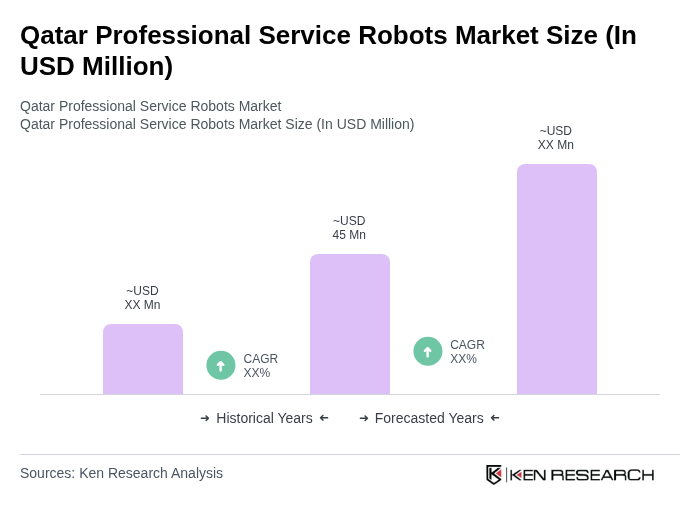
- The Qatar Professional Service Robots Market is valued at USD 45 million, based on a five-year historical analysis. This growth is primarily driven by increasing demand for automation in sectors such as healthcare, hospitality, and retail, alongside rising labor costs and the push for smart, contactless solutions. The market also benefits from technological advancements including AI-enabled autonomous cleaning, concierge, and delivery robots, reflecting a broader digital transformation trend in the region.
- Key players in this market include Fetch Robotics, GreyOrange, Locus Robotics, Amazon Robotics, DJI, Kiva Systems, and Omron Adept. These companies play a significant role in driving growth and maintaining high standards in service robotics, particularly in logistics and hospitality sectors, where automation is increasingly adopted to enhance operational efficiency and customer experience.
- A key policy influencing the service robotics landscape is Qatar’s National Artificial Intelligence Strategy promulgated by the Ministry of Transport and Communications, which encourages the adoption of robotics and AI in logistics and supports safety and operational standards. This regulatory framework, part of Qatar National Vision initiatives, underpins technological modernization and sustainability in automated sectors.
Qatar Professional Service Robots Market Segmentation
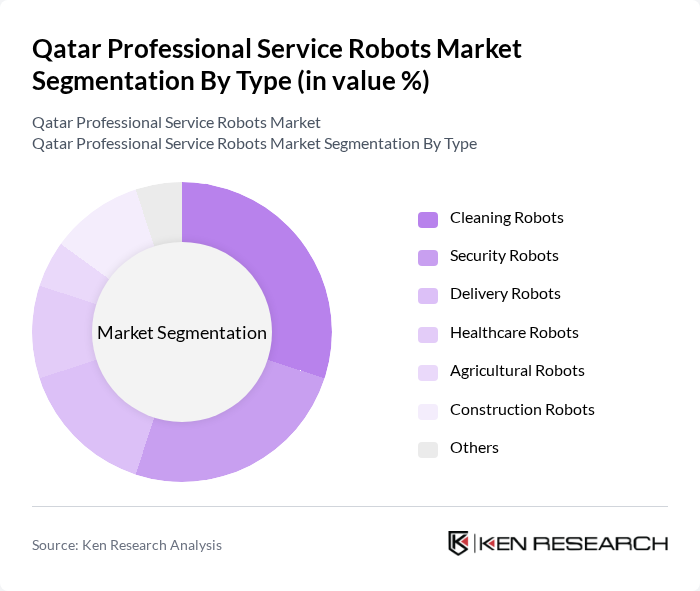
By Type:The market is segmented into various types of professional service robots, including cleaning robots, delivery robots, security robots, inspection robots, agricultural robots, medical robots, and others. Among these, cleaning robots are currently dominating the market due to their widespread adoption in commercial spaces such as hotels and hospitals, driven by the need for hygiene and efficiency. Delivery robots are also gaining traction, particularly in urban areas, as they offer innovative solutions for last-mile delivery challenges.
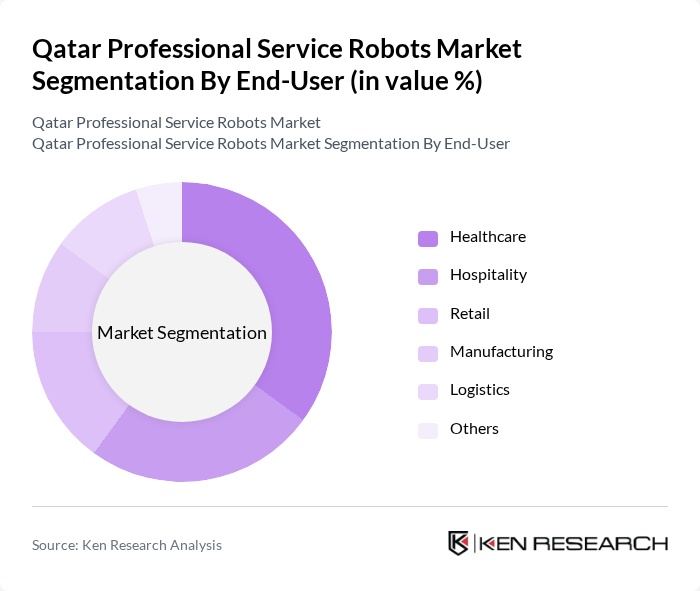
By End-User:The end-user segmentation includes healthcare, hospitality, retail, manufacturing, education, and others. The healthcare sector is the leading end-user of professional service robots, driven by the increasing need for automation in patient care and hospital management. The hospitality industry follows closely, where robots are utilized for tasks such as room service and concierge functions, enhancing guest experiences and operational efficiency.
Qatar Professional Service Robots Market Competitive Landscape
The Qatar Professional Service Robots Market is characterized by a dynamic mix of regional and international players. Leading participants such as ABB Robotics, KUKA AG, iRobot Corporation, Intuitive Surgical, Inc., Boston Dynamics, Fanuc Corporation, Yaskawa Electric Corporation, Clearpath Robotics, SoftBank Robotics, DJI Technology Co., Ltd., Savioke, Fetch Robotics, Aethon, Omron Adept Technologies, Universal Robots contribute to innovation, geographic expansion, and service delivery in this space.
Qatar Professional Service Robots Market Industry Analysis
Growth Drivers
- Strong GDP and High Per Capita Income:Qatar's nominal GDP reached USD 300 billion in future, with a GDP per capita of USD 85,000. This economic strength provides substantial consumer spending power and institutional capacity to invest in advanced technologies, including professional service robots. The high income levels enable both public and private sectors to allocate resources towards automation, enhancing operational efficiency across various industries.
- IoT Sector Revenue Bolstering Smart Infrastructure:Qatar's IoT sector is projected to generate USD 1.5 billion (QAR 5.45 billion) in future, with automotive IoT alone accounting for USD 400 million (QAR 1.45 billion). This growth in IoT infrastructure is crucial for the connectivity required by professional service robots, particularly in sectors like healthcare, logistics, and smart buildings, facilitating seamless operations and data exchange.
- Advanced Digital Infrastructure & Inclusion:Over 99 percent of Qatar's population has access to 5G and fiber-optic services, with 90 percent engaged in basic digital activities. Additionally, more than 2 million migrant workers have received training in digital safety and literacy. This widespread connectivity and digital literacy create a favorable environment for deploying service robots across various sectors, including healthcare and hospitality, enhancing service delivery and operational efficiency.
Market Challenges
- Limited Adoption & Skilled Workforce Constraints:According to Statista, the limited adoption of digital technologies and the high initial costs hinder the growth of professional service robots in Qatar. Additionally, the lack of skilled labor restricts the deployment of complex robotic systems, particularly in sensitive sectors like healthcare, where trained personnel are essential for effective integration and operation.
- Early-Stage Digital Inclusion Among Certain Demographics:The Digital Inclusion Index indicates challenges in integrating advanced technologies for demographics with lower digital proficiency. This uneven digital readiness across segments of society may limit the broad adoption of service robots in consumer-oriented settings, creating disparities in access to technological advancements and their benefits.
Qatar Professional Service Robots Market Future Outlook
The convergence of AI and smart infrastructure is expected to significantly influence the professional service robots market in Qatar. With the AI market projected to reach USD 700 million in future, advancements in AI technologies will enhance the capabilities of service robots, making them more autonomous and efficient. Additionally, clear policy frameworks and robust infrastructure will facilitate the responsible deployment of these technologies, ensuring they meet regulatory standards and public expectations, thus driving market growth.
Market Opportunities
- Smart City Deployments in Lusail and Msheireb:The Lusail Metropolis, valued at QAR 200 billion (USD ~55 billion), and Msheireb Downtown Doha at QAR 25 billion (USD ~6.9 billion) present prime environments for deploying professional service robots. These smart city developments will enhance urban services, maintenance, hospitality, and public safety, creating significant opportunities for robotics integration.
- Human Capital Development via Academic-Industry Collaboration:With over 2 million migrant workers trained through digital programs, initiatives like the AI ICT Lab launched by Huawei and Hamad Bin Khalifa University are crucial. These efforts will build a skilled workforce capable of operating and maintaining service robot systems, fostering innovation and growth in the robotics sector.
Scope of the Report
| Segment | Sub-Segments |
|---|---|
| By Type | Cleaning Robots Delivery Robots Security Robots Inspection Robots Agricultural Robots Medical Robots Others |
| By End-User | Healthcare Hospitality Retail Manufacturing Education Others |
| By Application | Surveillance and Security Cleaning and Maintenance Logistics and Delivery Healthcare Assistance Agricultural Tasks Others |
| By Industry | Healthcare Retail Manufacturing Hospitality Education Others |
| By Technology | AI-Driven Robots Autonomous Navigation Robots Teleoperated Robots Hybrid Robots Others |
| By Region | Doha Al Rayyan Umm Salal Al Wakrah Others |
| By Policy Support | Government Grants Tax Incentives Research Funding Regulatory Support Others |
Key Target Audience
Investors and Venture Capitalist Firms
Government and Regulatory Bodies (e.g., Qatar Ministry of Transport and Communications)
Manufacturers and Producers of Robotics Technology
Distributors and Retailers of Robotics Solutions
Healthcare Providers and Institutions
Hospitality and Service Industry Operators
Logistics and Supply Chain Companies
Telecommunications Companies
Players Mentioned in the Report:
ABB Robotics
KUKA AG
iRobot Corporation
Intuitive Surgical, Inc.
Boston Dynamics
Fanuc Corporation
Yaskawa Electric Corporation
Clearpath Robotics
SoftBank Robotics
DJI Technology Co., Ltd.
Savioke
Fetch Robotics
Aethon
Omron Adept Technologies
Universal Robots
Table of Contents
Market Assessment Phase
1. Executive Summary and Approach
2. Qatar Professional Service Robots Market Overview
2.1 Key Insights and Strategic Recommendations
2.2 Qatar Professional Service Robots Market Overview
2.3 Definition and Scope
2.4 Evolution of Market Ecosystem
2.5 Timeline of Key Regulatory Milestones
2.6 Value Chain & Stakeholder Mapping
2.7 Business Cycle Analysis
2.8 Policy & Incentive Landscape
3. Qatar Professional Service Robots Market Analysis
3.1 Growth Drivers
3.1.1 Increasing demand for automation in various sectors
3.1.2 Government initiatives promoting robotics technology
3.1.3 Rising labor costs and skill shortages
3.1.4 Advancements in AI and machine learning technologies
3.2 Market Challenges
3.2.1 High initial investment costs
3.2.2 Limited awareness and understanding of robotics
3.2.3 Regulatory hurdles and compliance issues
3.2.4 Integration challenges with existing systems
3.3 Market Opportunities
3.3.1 Expansion in healthcare and medical applications
3.3.2 Growth in logistics and supply chain automation
3.3.3 Development of smart cities and infrastructure
3.3.4 Increasing investment in research and development
3.4 Market Trends
3.4.1 Rise of collaborative robots (cobots)
3.4.2 Integration of IoT with robotics
3.4.3 Focus on sustainability and energy efficiency
3.4.4 Customization and personalization of robotic solutions
3.5 Government Regulation
3.5.1 Safety standards for robotic operations
3.5.2 Incentives for R&D in robotics
3.5.3 Import/export regulations for robotic technologies
3.5.4 Compliance with international robotics standards
4. SWOT Analysis
5. Stakeholder Analysis
6. Porter's Five Forces Analysis
7. Qatar Professional Service Robots Market Market Size, 2019-2024
7.1 By Value
7.2 By Volume
7.3 By Average Selling Price
8. Qatar Professional Service Robots Market Segmentation
8.1 By Type
8.1.1 Cleaning Robots
8.1.2 Delivery Robots
8.1.3 Security Robots
8.1.4 Inspection Robots
8.1.5 Agricultural Robots
8.1.6 Medical Robots
8.1.7 Others
8.2 By End-User
8.2.1 Healthcare
8.2.2 Hospitality
8.2.3 Retail
8.2.4 Manufacturing
8.2.5 Education
8.2.6 Others
8.3 By Application
8.3.1 Surveillance and Security
8.3.2 Cleaning and Maintenance
8.3.3 Logistics and Delivery
8.3.4 Healthcare Assistance
8.3.5 Agricultural Tasks
8.3.6 Others
8.4 By Industry
8.4.1 Healthcare
8.4.2 Retail
8.4.3 Manufacturing
8.4.4 Hospitality
8.4.5 Education
8.4.6 Others
8.5 By Technology
8.5.1 AI-Driven Robots
8.5.2 Autonomous Navigation Robots
8.5.3 Teleoperated Robots
8.5.4 Hybrid Robots
8.5.5 Others
8.6 By Region
8.6.1 Doha
8.6.2 Al Rayyan
8.6.3 Umm Salal
8.6.4 Al Wakrah
8.6.5 Others
8.7 By Policy Support
8.7.1 Government Grants
8.7.2 Tax Incentives
8.7.3 Research Funding
8.7.4 Regulatory Support
8.7.5 Others
9. Qatar Professional Service Robots Market Competitive Analysis
9.1 Market Share of Key Players
9.2 Cross Comparison of Key Players
9.2.1 Company Name
9.2.2 Group Size (Large, Medium, or Small as per industry convention)
9.2.3 Revenue Growth Rate
9.2.4 Market Penetration Rate
9.2.5 Customer Retention Rate
9.2.6 Pricing Strategy
9.2.7 Product Innovation Rate
9.2.8 Operational Efficiency
9.2.9 Brand Recognition
9.2.10 Customer Satisfaction Score
9.3 SWOT Analysis of Top Players
9.4 Pricing Analysis
9.5 Detailed Profile of Major Companies
9.5.1 ABB Robotics
9.5.2 KUKA AG
9.5.3 iRobot Corporation
9.5.4 Intuitive Surgical, Inc.
9.5.5 Boston Dynamics
9.5.6 Fanuc Corporation
9.5.7 Yaskawa Electric Corporation
9.5.8 Clearpath Robotics
9.5.9 SoftBank Robotics
9.5.10 DJI Technology Co., Ltd.
9.5.11 Savioke
9.5.12 Fetch Robotics
9.5.13 Aethon
9.5.14 Omron Adept Technologies
9.5.15 Universal Robots
10. Qatar Professional Service Robots Market End-User Analysis
10.1 Procurement Behavior of Key Ministries
10.1.1 Budget Allocation for Robotics
10.1.2 Decision-Making Process
10.1.3 Preferred Suppliers
10.1.4 Evaluation Criteria
10.2 Corporate Spend on Infrastructure & Energy
10.2.1 Investment Trends in Robotics
10.2.2 Budgeting for Automation
10.2.3 Long-term Contracts
10.2.4 Cost-Benefit Analysis
10.3 Pain Point Analysis by End-User Category
10.3.1 Operational Inefficiencies
10.3.2 Labor Shortages
10.3.3 High Operational Costs
10.3.4 Compliance Issues
10.4 User Readiness for Adoption
10.4.1 Training Requirements
10.4.2 Technology Acceptance
10.4.3 Infrastructure Readiness
10.4.4 Support and Maintenance Needs
10.5 Post-Deployment ROI and Use Case Expansion
10.5.1 Performance Metrics
10.5.2 Scalability of Solutions
10.5.3 User Feedback and Iteration
10.5.4 Future Investment Plans
11. Qatar Professional Service Robots Market Future Size, 2025-2030
11.1 By Value
11.2 By Volume
11.3 By Average Selling Price
Go-To-Market Strategy Phase
1. Whitespace Analysis + Business Model Canvas
1.1 Market Gaps Identification
1.2 Value Proposition Development
1.3 Revenue Streams
1.4 Cost Structure
1.5 Key Partnerships
1.6 Customer Segments
1.7 Channels
2. Marketing and Positioning Recommendations
2.1 Branding Strategies
2.2 Product USPs
3. Distribution Plan
3.1 Urban Retail vs Rural NGO Tie-ups
4. Channel & Pricing Gaps
4.1 Underserved Routes
4.2 Pricing Bands
5. Unmet Demand & Latent Needs
5.1 Category Gaps
5.2 Consumer Segments
6. Customer Relationship
6.1 Loyalty Programs
6.2 After-sales Service
7. Value Proposition
7.1 Sustainability
7.2 Integrated Supply Chains
8. Key Activities
8.1 Regulatory Compliance
8.2 Branding
8.3 Distribution Setup
9. Entry Strategy Evaluation
9.1 Domestic Market Entry Strategy
9.1.1 Product Mix
9.1.2 Pricing Band
9.1.3 Packaging
9.2 Export Entry Strategy
9.2.1 Target Countries
9.2.2 Compliance Roadmap
10. Entry Mode Assessment
10.1 JV
10.2 Greenfield
10.3 M&A
10.4 Distributor Model
11. Capital and Timeline Estimation
11.1 Capital Requirements
11.2 Timelines
12. Control vs Risk Trade-Off
12.1 Ownership vs Partnerships
13. Profitability Outlook
13.1 Breakeven Analysis
13.2 Long-term Sustainability
14. Potential Partner List
14.1 Distributors
14.2 JVs
14.3 Acquisition Targets
15. Execution Roadmap
15.1 Phased Plan for Market Entry
15.1.1 Market Setup
15.1.2 Market Entry
15.1.3 Growth Acceleration
15.1.4 Scale & Stabilize
15.2 Key Activities and Milestones
Research Methodology
Phase 1: Approach1
Desk Research
- Analysis of market reports from industry associations and government publications
- Review of academic journals and white papers on robotics and automation trends in Qatar
- Examination of trade publications and news articles focusing on the adoption of professional service robots
Primary Research
- Interviews with key stakeholders in the robotics industry, including manufacturers and distributors
- Surveys targeting end-users in sectors such as healthcare, hospitality, and logistics
- Focus group discussions with industry experts and technology consultants
Validation & Triangulation
- Cross-validation of findings through multiple data sources, including market size estimates and growth projections
- Triangulation of qualitative insights from interviews with quantitative data from surveys
- Sanity checks conducted through expert panel reviews to ensure data reliability
Phase 2: Market Size Estimation1
Top-down Assessment
- Estimation of the total addressable market based on national economic indicators and technology adoption rates
- Segmentation of the market by application areas such as healthcare, retail, and logistics
- Incorporation of government initiatives promoting automation and robotics in various sectors
Bottom-up Modeling
- Collection of sales data from leading robotics manufacturers operating in Qatar
- Estimation of market penetration rates based on industry-specific adoption curves
- Calculation of revenue projections based on unit sales and average selling prices of service robots
Forecasting & Scenario Analysis
- Development of forecasting models using historical data and market trends
- Scenario analysis based on varying levels of economic growth and technological advancements
- Creation of baseline, optimistic, and pessimistic forecasts through 2030
Phase 3: CATI Sample Composition1
| Scope Item/Segment | Sample Size | Target Respondent Profiles |
|---|---|---|
| Healthcare Robotics Adoption | 100 | Hospital Administrators, Medical Equipment Managers |
| Hospitality Service Robots | 80 | Hotel Managers, Operations Directors |
| Logistics Automation Solutions | 90 | Warehouse Managers, Supply Chain Analysts |
| Retail Robotics Implementation | 70 | Store Managers, Retail Technology Specialists |
| Educational Robotics Integration | 60 | School Administrators, Curriculum Developers |
Frequently Asked Questions
What is the current value of the Qatar Professional Service Robots Market?
The Qatar Professional Service Robots Market is valued at approximately USD 45 million, reflecting a significant growth trend driven by increasing automation demands in sectors like healthcare, hospitality, and retail, alongside technological advancements in robotics.
What are the main drivers of growth in the Qatar Professional Service Robots Market?
Which sectors are leading in the adoption of professional service robots in Qatar?
What types of professional service robots are prevalent in Qatar?
Other Regional/Country Reports
Indonesia Professional Service Robots Market
Malaysia Professional Service Robots Market
KSA Professional Service Robots Market
APAC Professional Service Robots Market
SEA Professional Service Robots Market
Vietnam Professional Service Robots Market
Other Adjacent Reports
Egypt Medical Robotics Market
Brazil Hospitality Automation Market
Bahrain Retail Automation MarketKSA logistics automation market report Size, Share, Growth Drivers, Trends, Opportunities & Forecast 2025–2030Germany Security Systems Market
Indonesia Agricultural Robotics Market
Kuwait Smart City Technologies Market
Why Buy From Us?

What makes us stand out is that our consultants follow Robust, Refine and Result (RRR) methodology. Robust for clear definitions, approaches and sanity checking, Refine for differentiating respondents' facts and opinions, and Result for presenting data with story.

We have set a benchmark in the industry by offering our clients with syndicated and customized market research reports featuring coverage of entire market as well as meticulous research and analyst insights.

While we don't replace traditional research, we flip the method upside down. Our dual approach of Top Bottom & Bottom Top ensures quality deliverable by not just verifying company fundamentals but also looking at the sector and macroeconomic factors.

With one step in the future, our research team constantly tries to show you the bigger picture. We help with some of the tough questions you may encounter along the way: How is the industry positioned? Best marketing channel? KPI's of competitors? By aligning every element, we help maximize success.

Our report gives you instant access to the answers and sources that other companies might choose to hide. We elaborate each steps of research methodology we have used and showcase you the sample size to earn your trust.

If you need any support, we are here! We pride ourselves on universe strength, data quality, and quick, friendly, and professional service.