About the Report
Base Year 2024Qatar Reciprocating Pumps Market Overview
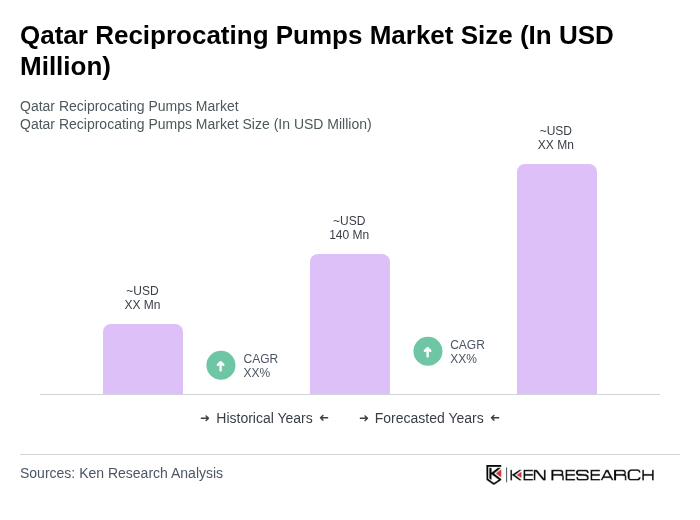
- The Qatar Reciprocating Pumps Market is valued at USD 140 million, based on a five-year historical analysis and correlation with Qatar’s share of the Middle East pumps and positive displacement pump demand in oil and gas, water, and industrial applications. This growth is primarily driven by the increasing demand for efficient fluid handling solutions across oil and gas, water and wastewater / desalination, and chemical processing, supported by Qatar’s strong upstream and LNG expansion program and large-scale water infrastructure. The market is also supported by ongoing infrastructure and industrial projects under Qatar National Vision 2030, which require reliable high-pressure and metering pumping systems for critical services.
- Doha is the dominant city in the Qatar Reciprocating Pumps Market, primarily due to its status as the capital and economic hub of the country and the location of major industrial zones and corporate headquarters. The concentration of oil and gas operators, EPC contractors, water utilities, and processing industries around Greater Doha, along with significant investments in infrastructure and utility networks, contribute to the city's leading position in the market. Other notable regions include Al Rayyan and Al Wakrah, which also host logistics, industrial, and utility assets linked to oil and gas, construction, and municipal services.
- In 2023, the Qatari government continued to advance policy measures aimed at enhancing the efficiency and sustainability of industrial operations, including pumping systems. Key instruments include the Qatar Construction Specifications (QCS 2014) and subsequent updates issued by the Ministry of Municipality and Environment and the Public Works Authority (Ashghal), which reference energy and water efficiency requirements for building services and infrastructure systems, and the National Climate Change Action Plan 2030 issued by the Ministry of Environment and Climate Change in 2021, which commits sectors to improve energy efficiency and reduce emissions. In practice, major public and industrial projects increasingly specify high?efficiency and optimized pump solutions (including reciprocating pumps for high-pressure and metering duties) to comply with these efficiency, carbon?reduction, and lifecycle performance objectives.
Qatar Reciprocating Pumps Market Segmentation
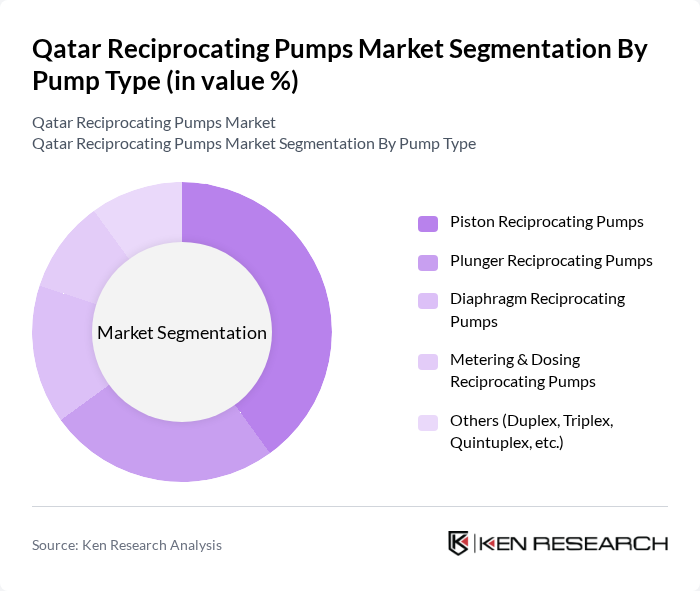
By Pump Type:The market is segmented into various pump types, including Piston Reciprocating Pumps, Plunger Reciprocating Pumps, Diaphragm Reciprocating Pumps, Metering & Dosing Reciprocating Pumps, and Others (Duplex, Triplex, Quintuplex, etc.). This classification is consistent with global reciprocating pump segmentation used in leading industry studies. Among these, Piston Reciprocating Pumps are widely used in Qatar’s industrial base due to their versatility and efficiency in handling a wide range of relatively clean fluids at moderate to high pressures, making them suitable for many utility and process duties. However, for the most demanding high-pressure services in oil and gas (such as well service, injection, and certain chemical dosing applications), plunger and diaphragm reciprocating pumps are also critical, given their superior pressure capabilities and sealing performance; together, these three types form the core of high?pressure and metering applications in the country.
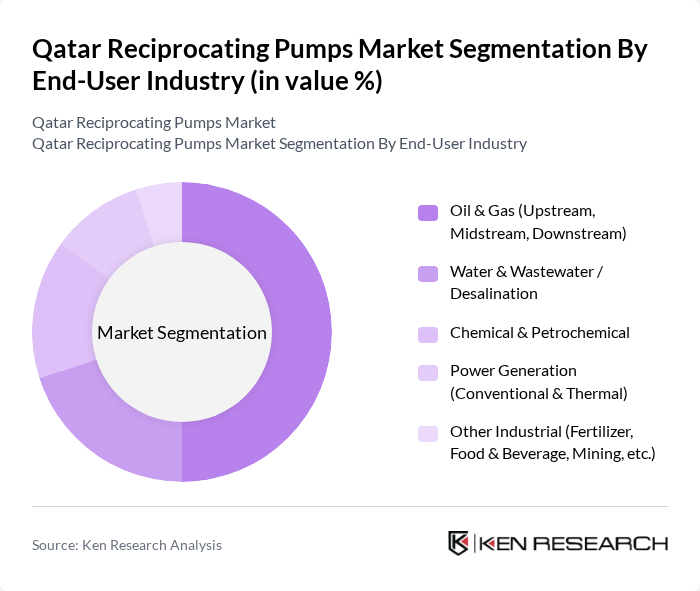
By End-User Industry:The market is segmented by end-user industries, including Oil & Gas (Upstream, Midstream, Downstream), Water & Wastewater / Desalination, Chemical & Petrochemical, Power Generation (Conventional & Thermal), and Other Industrial (Fertilizer, Food & Beverage, Mining, etc.). This segmentation reflects the primary applications of reciprocating pumps observed globally and across the Middle East. The Oil & Gas sector is the leading end-user in Qatar, driven by the need for reliable high-pressure pumping, chemical injection, and process transfer solutions in exploration, production, gas processing, and LNG operations. The increasing focus on water management and treatment, including large-scale desalination and wastewater treatment, also boosts demand in the Water & Wastewater / Desalination sector, where positive displacement and reciprocating pumps are used for dosing, sludge handling, and high-pressure services within broader pump systems.
Qatar Reciprocating Pumps Market Competitive Landscape
The Qatar Reciprocating Pumps Market is characterized by a dynamic mix of regional and international players. Leading participants such as Flowserve Corporation, Sulzer Ltd, KSB SE & Co. KGaA, Ebara Corporation, Weir Group PLC, SPX Flow, Inc., ITT Inc., Xylem Inc., Ruhrpumpen Group, National Oilwell Varco, Inc. (NOV), LEWA GmbH, Milton Roy (Ingersoll Rand Inc.), Grundfos Holding A/S, KSB Qatar / KSB Service LLC (Local Entity), Flowserve Qatar (Local Service & Sales Entity) contribute to innovation, geographic expansion, and service delivery in this space.
Qatar Reciprocating Pumps Market Industry Analysis
Growth Drivers
- Increasing Demand for Water Management Solutions:Qatar's water consumption is projected to reach 1.8 billion cubic meters in future, driven by population growth and urbanization. The government aims to enhance water management systems, investing approximately $2 billion in water infrastructure projects. This surge in demand for efficient water management solutions directly boosts the reciprocating pumps market, as these pumps are essential for effective water distribution and management in various sectors.
- Expansion of Industrial Sectors:Qatar's industrial sector is expected to grow by 5% annually, with significant investments in manufacturing and construction. The Qatar National Vision 2030 emphasizes diversifying the economy, leading to increased demand for reciprocating pumps in industries such as oil and gas, chemicals, and food processing. This industrial expansion necessitates reliable pumping solutions, further driving market growth and creating opportunities for manufacturers.
- Government Investments in Infrastructure:The Qatari government allocated $25 billion for infrastructure development in future, focusing on transportation, utilities, and energy sectors. This investment is expected to enhance the demand for reciprocating pumps, particularly in water supply and wastewater treatment facilities. As infrastructure projects progress, the need for efficient pumping systems will rise, providing a significant boost to the market and attracting foreign investments.
Market Challenges
- High Initial Investment Costs:The upfront costs associated with reciprocating pumps can be substantial, often exceeding $120,000 for large-scale installations. This financial barrier can deter small and medium-sized enterprises from investing in advanced pumping solutions. Additionally, the long payback periods associated with these investments may lead to reluctance in adopting new technologies, hindering market growth in the short term.
- Competition from Alternative Pumping Technologies:The market faces stiff competition from centrifugal and submersible pumps, which are often perceived as more cost-effective and easier to maintain. In future, alternative technologies are expected to capture approximately 35% of the market share, posing a challenge for reciprocating pump manufacturers. This competition necessitates innovation and differentiation to maintain market relevance and attract customers.
Qatar Reciprocating Pumps Market Future Outlook
The future of the Qatar reciprocating pumps market appears promising, driven by technological advancements and increasing demand for energy-efficient solutions. As industries prioritize sustainability, the integration of smart technologies and IoT in pump systems is expected to enhance operational efficiency. Furthermore, the government's commitment to infrastructure development will likely create a favorable environment for market growth, encouraging investments in innovative pumping solutions that meet evolving industry needs.
Market Opportunities
- Growth in the Oil and Gas Sector:Qatar's oil and gas sector is projected to contribute $70 billion to the economy in future, creating substantial demand for reciprocating pumps. These pumps are critical for various applications, including drilling and production processes, presenting a lucrative opportunity for manufacturers to expand their market presence and cater to this vital industry.
- Development of Smart Pump Technologies:The increasing focus on automation and smart technologies in the pumping industry presents a significant opportunity. In future, the market for smart pumps is expected to grow by 20%, driven by the demand for real-time monitoring and predictive maintenance solutions. This trend offers manufacturers a chance to innovate and provide advanced products that enhance efficiency and reduce operational costs.
Scope of the Report
| Segment | Sub-Segments |
|---|---|
| By Pump Type | Piston Reciprocating Pumps Plunger Reciprocating Pumps Diaphragm Reciprocating Pumps Metering & Dosing Reciprocating Pumps Others (Duplex, Triplex, Quintuplex, etc.) |
| By End-User Industry | Oil & Gas (Upstream, Midstream, Downstream) Water & Wastewater / Desalination Chemical & Petrochemical Power Generation (Conventional & Thermal) Other Industrial (Fertilizer, Food & Beverage, Mining, etc.) |
| By Application | High-Pressure Injection (Water / Chemical / Polymer) Process & Transfer Pumping Metering & Dosing Cooling, Boiler Feed & Utility Services Other Specialized Applications (Hydrotesting, Firefighting Skids, etc.) |
| By Material of Construction | Carbon Steel Stainless Steel & Duplex / Super Duplex High-Alloy / Corrosion-Resistant Alloys Non-Metallic & Lined (PTFE, Rubber, etc.) Others |
| By Power Rating | Up to 50 kW –200 kW –500 kW Above 500 kW |
| By Sales Channel | Direct OEM / EPC Sales Local Distributors & Trading Companies Aftermarket / Service & Spares Others |
| By Region | Doha Al Rayyan Al Wakrah Others (Umm Salal, Al Khor, Al Daayen, Al Shamal, etc.) |
Key Target Audience
Investors and Venture Capitalist Firms
Government and Regulatory Bodies (e.g., Qatar Ministry of Energy and Industry)
Manufacturers and Producers
Distributors and Retailers
Oil and Gas Companies
Water and Wastewater Management Authorities
Construction and Infrastructure Development Firms
Financial Institutions
Players Mentioned in the Report:
Flowserve Corporation
Sulzer Ltd
KSB SE & Co. KGaA
Ebara Corporation
Weir Group PLC
SPX Flow, Inc.
ITT Inc.
Xylem Inc.
Ruhrpumpen Group
National Oilwell Varco, Inc. (NOV)
LEWA GmbH
Milton Roy (Ingersoll Rand Inc.)
Grundfos Holding A/S
KSB Qatar / KSB Service LLC (Local Entity)
Flowserve Qatar (Local Service & Sales Entity)
Table of Contents
Market Assessment Phase
1. Executive Summary and Approach
2. Qatar Reciprocating Pumps Market Overview
2.1 Key Insights and Strategic Recommendations
2.2 Qatar Reciprocating Pumps Market Overview
2.3 Definition and Scope
2.4 Evolution of Market Ecosystem
2.5 Timeline of Key Regulatory Milestones
2.6 Value Chain & Stakeholder Mapping
2.7 Business Cycle Analysis
2.8 Policy & Incentive Landscape
3. Qatar Reciprocating Pumps Market Analysis
3.1 Growth Drivers
3.1.1 Increasing demand for water management solutions
3.1.2 Expansion of industrial sectors
3.1.3 Government investments in infrastructure
3.1.4 Technological advancements in pump efficiency
3.2 Market Challenges
3.2.1 High initial investment costs
3.2.2 Competition from alternative pumping technologies
3.2.3 Regulatory compliance complexities
3.2.4 Limited local manufacturing capabilities
3.3 Market Opportunities
3.3.1 Growth in the oil and gas sector
3.3.2 Increasing focus on sustainable solutions
3.3.3 Expansion into emerging markets
3.3.4 Development of smart pump technologies
3.4 Market Trends
3.4.1 Shift towards energy-efficient pumps
3.4.2 Integration of IoT in pump systems
3.4.3 Rise in demand for customized solutions
3.4.4 Focus on maintenance and service contracts
3.5 Government Regulation
3.5.1 Environmental protection standards
3.5.2 Safety regulations for industrial pumps
3.5.3 Quality assurance mandates
3.5.4 Import/export regulations for pump technologies
4. SWOT Analysis
5. Stakeholder Analysis
6. Porter's Five Forces Analysis
7. Qatar Reciprocating Pumps Market Market Size, 2019-2024
7.1 By Value
7.2 By Volume
7.3 By Average Selling Price
8. Qatar Reciprocating Pumps Market Segmentation
8.1 By Pump Type
8.1.1 Piston Reciprocating Pumps
8.1.2 Plunger Reciprocating Pumps
8.1.3 Diaphragm Reciprocating Pumps
8.1.4 Metering & Dosing Reciprocating Pumps
8.1.5 Others (Duplex, Triplex, Quintuplex, etc.)
8.2 By End-User Industry
8.2.1 Oil & Gas (Upstream, Midstream, Downstream)
8.2.2 Water & Wastewater / Desalination
8.2.3 Chemical & Petrochemical
8.2.4 Power Generation (Conventional & Thermal)
8.2.5 Other Industrial (Fertilizer, Food & Beverage, Mining, etc.)
8.3 By Application
8.3.1 High-Pressure Injection (Water / Chemical / Polymer)
8.3.2 Process & Transfer Pumping
8.3.3 Metering & Dosing
8.3.4 Cooling, Boiler Feed & Utility Services
8.3.5 Other Specialized Applications (Hydrotesting, Firefighting Skids, etc.)
8.4 By Material of Construction
8.4.1 Carbon Steel
8.4.2 Stainless Steel & Duplex / Super Duplex
8.4.3 High-Alloy / Corrosion-Resistant Alloys
8.4.4 Non-Metallic & Lined (PTFE, Rubber, etc.)
8.4.5 Others
8.5 By Power Rating
8.5.1 Up to 50 kW
8.5.2 51–200 kW
8.5.3 201–500 kW
8.5.4 Above 500 kW
8.6 By Sales Channel
8.6.1 Direct OEM / EPC Sales
8.6.2 Local Distributors & Trading Companies
8.6.3 Aftermarket / Service & Spares
8.6.4 Others
8.7 By Region
8.7.1 Doha
8.7.2 Al Rayyan
8.7.3 Al Wakrah
8.7.4 Others (Umm Salal, Al Khor, Al Daayen, Al Shamal, etc.)
9. Qatar Reciprocating Pumps Market Competitive Analysis
9.1 Market Share of Key Players
9.2 Cross Comparison of Key Players
9.2.1 Company Name
9.2.2 Global Reciprocating Pump Revenue (Latest FY, USD Million)
9.2.3 Estimated Revenue from Qatar / GCC (USD Million)
9.2.4 Group Size (Large Multinational, Regional, Local)
9.2.5 Installed Base in Qatar (Number of Units / Major Sites)
9.2.6 Market Share in Qatar Reciprocating Pumps (%)
9.2.7 3-Year Revenue CAGR in Reciprocating Pumps (%)
9.2.8 Key End-User Coverage in Qatar (Oil & Gas, Water, Power, etc.)
9.2.9 Average Lead Time for Supply & Commissioning (Weeks)
9.2.10 Service Network Depth in Qatar (Service Centers / Field Engineers)
9.2.11 Product Portfolio Breadth (API/ISO-Compliant Models, Pressure/Flow Range)
9.2.12 Technology & Innovation Indicators (Digital Monitoring, Energy Efficiency, Patents)
9.2.13 Major EPC / Operator Relationships in Qatar
9.3 SWOT Analysis of Top Players
9.4 Pricing Analysis
9.5 Detailed Profile of Major Companies
9.5.1 Flowserve Corporation
9.5.2 Sulzer Ltd
9.5.3 KSB SE & Co. KGaA
9.5.4 Ebara Corporation
9.5.5 Weir Group PLC
9.5.6 SPX Flow, Inc.
9.5.7 ITT Inc.
9.5.8 Xylem Inc.
9.5.9 Ruhrpumpen Group
9.5.10 National Oilwell Varco, Inc. (NOV)
9.5.11 LEWA GmbH
9.5.12 Milton Roy (Ingersoll Rand Inc.)
9.5.13 Grundfos Holding A/S
9.5.14 KSB Qatar / KSB Service LLC (Local Entity)
9.5.15 Flowserve Qatar (Local Service & Sales Entity)
10. Qatar Reciprocating Pumps Market End-User Analysis
10.1 Procurement Behavior of Key Ministries
10.1.1 Ministry of Energy and Industry
10.1.2 Ministry of Municipality and Environment
10.1.3 Ministry of Transport and Communications
10.1.4 Others
10.2 Corporate Spend on Infrastructure & Energy
10.2.1 Investment Trends in Infrastructure
10.2.2 Energy Sector Expenditure
10.2.3 Budget Allocations for Water Management
10.2.4 Others
10.3 Pain Point Analysis by End-User Category
10.3.1 Industrial Sector Challenges
10.3.2 Government Sector Needs
10.3.3 Commercial Sector Issues
10.3.4 Others
10.4 User Readiness for Adoption
10.4.1 Awareness of Pump Technologies
10.4.2 Training and Support Needs
10.4.3 Financial Readiness
10.4.4 Others
10.5 Post-Deployment ROI and Use Case Expansion
10.5.1 Performance Metrics
10.5.2 Case Studies of Successful Implementations
10.5.3 Long-term Benefits Analysis
10.5.4 Others
11. Qatar Reciprocating Pumps Market Future Size, 2025-2030
11.1 By Value
11.2 By Volume
11.3 By Average Selling Price
Go-To-Market Strategy Phase
1. Whitespace Analysis + Business Model Canvas
1.1 Market Gaps Identification
1.2 Business Model Development
2. Marketing and Positioning Recommendations
2.1 Branding Strategies
2.2 Product USPs
3. Distribution Plan
3.1 Urban Retail Strategies
3.2 Rural NGO Tie-ups
4. Channel & Pricing Gaps
4.1 Underserved Routes
4.2 Pricing Bands Analysis
5. Unmet Demand & Latent Needs
5.1 Category Gaps
5.2 Consumer Segments
6. Customer Relationship
6.1 Loyalty Programs
6.2 After-sales Service
7. Value Proposition
7.1 Sustainability Initiatives
7.2 Integrated Supply Chains
8. Key Activities
8.1 Regulatory Compliance
8.2 Branding Efforts
8.3 Distribution Setup
9. Entry Strategy Evaluation
9.1 Domestic Market Entry Strategy
9.1.1 Product Mix Considerations
9.1.2 Pricing Band Strategy
9.1.3 Packaging Solutions
9.2 Export Entry Strategy
9.2.1 Target Countries Identification
9.2.2 Compliance Roadmap Development
10. Entry Mode Assessment
10.1 Joint Ventures
10.2 Greenfield Investments
10.3 Mergers & Acquisitions
10.4 Distributor Model Evaluation
11. Capital and Timeline Estimation
11.1 Capital Requirements
11.2 Timelines for Implementation
12. Control vs Risk Trade-Off
12.1 Ownership vs Partnerships
13. Profitability Outlook
13.1 Breakeven Analysis
13.2 Long-term Sustainability
14. Potential Partner List
14.1 Distributors
14.2 Joint Ventures
14.3 Acquisition Targets
15. Execution Roadmap
15.1 Phased Plan for Market Entry
15.1.1 Market Setup
15.1.2 Market Entry
15.1.3 Growth Acceleration
15.1.4 Scale & Stabilize
15.2 Key Activities and Milestones
15.2.1 Milestone Planning
15.2.2 Activity Tracking
Research Methodology
Phase 1: Approach1
Desk Research
- Analysis of industry reports from Qatar's Ministry of Energy and Industry
- Review of market studies published by regional trade associations
- Examination of academic journals focusing on pump technology and applications
Primary Research
- Interviews with key stakeholders in the oil and gas sector
- Surveys conducted with manufacturers and distributors of reciprocating pumps
- Field visits to major industrial sites utilizing reciprocating pumps
Validation & Triangulation
- Cross-validation of data from multiple industry sources and reports
- Triangulation of findings from primary interviews and secondary data
- Sanity checks through expert panels comprising industry veterans
Phase 2: Market Size Estimation1
Top-down Assessment
- Estimation of market size based on national energy consumption statistics
- Segmentation by application areas such as oil & gas, water treatment, and power generation
- Incorporation of government initiatives promoting industrial growth
Bottom-up Modeling
- Volume estimates derived from production capacities of leading manufacturers
- Cost analysis based on pricing models of reciprocating pumps
- Calculation of market size using unit sales and average selling prices
Forecasting & Scenario Analysis
- Multi-variable regression analysis considering economic growth and industrial demand
- Scenario planning based on potential regulatory changes and technological advancements
- Development of baseline, optimistic, and pessimistic forecasts through 2030
Phase 3: CATI Sample Composition1
| Scope Item/Segment | Sample Size | Target Respondent Profiles |
|---|---|---|
| Oil & Gas Sector | 120 | Operations Managers, Procurement Specialists |
| Water Treatment Facilities | 90 | Plant Managers, Environmental Engineers |
| Power Generation Plants | 80 | Maintenance Supervisors, Technical Directors |
| Manufacturing Industries | 70 | Production Managers, Quality Control Officers |
| Research & Development Departments | 60 | R&D Managers, Product Development Engineers |
Frequently Asked Questions
What is the current value of the Qatar Reciprocating Pumps Market?
The Qatar Reciprocating Pumps Market is valued at approximately USD 140 million, driven by the demand for efficient fluid handling solutions in sectors such as oil and gas, water management, and industrial applications.
What factors are driving the growth of the Qatar Reciprocating Pumps Market?
Which cities in Qatar dominate the Reciprocating Pumps Market?
What are the main types of reciprocating pumps used in Qatar?
Other Regional/Country Reports
Indonesia Reciprocating Pumps Market
Malaysia Reciprocating Pumps Market
KSA Reciprocating Pumps Market
APAC Reciprocating Pumps Market
SEA Reciprocating Pumps Market
Vietnam Reciprocating Pumps Market
Other Adjacent Reports
Singapore Oil and Gas Equipment Market
Global Water and Wastewater Treatment Market Size, Share & Forecast, By Treatment Type, Technology & End User, 2026-2031Oman Desalination Technology Market
Malaysia Chemical Processing Equipment Market
KSA Power Generation Equipment Market
India Industrial Valves Market Size, Share & Forecast, By Valve Type, End-Use Industry & Technology, 2026-2031Kuwait Pump Accessories and Components Market
Global LNG Infrastructure Market Size, Share & Forecast 2026-2031Why Buy From Us?

What makes us stand out is that our consultants follow Robust, Refine and Result (RRR) methodology. Robust for clear definitions, approaches and sanity checking, Refine for differentiating respondents' facts and opinions, and Result for presenting data with story.

We have set a benchmark in the industry by offering our clients with syndicated and customized market research reports featuring coverage of entire market as well as meticulous research and analyst insights.

While we don't replace traditional research, we flip the method upside down. Our dual approach of Top Bottom & Bottom Top ensures quality deliverable by not just verifying company fundamentals but also looking at the sector and macroeconomic factors.

With one step in the future, our research team constantly tries to show you the bigger picture. We help with some of the tough questions you may encounter along the way: How is the industry positioned? Best marketing channel? KPI's of competitors? By aligning every element, we help maximize success.

Our report gives you instant access to the answers and sources that other companies might choose to hide. We elaborate each steps of research methodology we have used and showcase you the sample size to earn your trust.

If you need any support, we are here! We pride ourselves on universe strength, data quality, and quick, friendly, and professional service.