About the Report
Base Year 2024Qatar Search Rescue Helicopter Market Overview
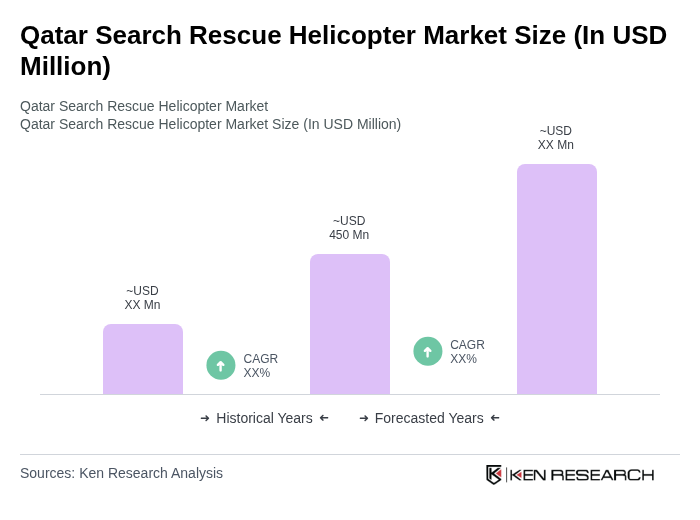
- The Qatar Search Rescue Helicopter Market is valued at USD 450 million, based on a five-year historical analysis. This growth is primarily driven by increasing investments in emergency response capabilities, advancements in helicopter technology including advanced sensor technologies and multi-mission capabilities, and the rising demand for efficient search and rescue operations in both urban and offshore environments.
- Key players in this market include Doha, which serves as a central hub for aviation and emergency services, and the surrounding regions that benefit from strategic investments in infrastructure and technology. The presence of major oil and gas companies also contributes to the demand for specialized search and rescue services.
- The Civil Aviation Safety and Security Standards Regulations, 2011 issued by the Qatar Civil Aviation Authority (QCAA), mandate that all search and rescue helicopters must be equipped with advanced avionics including night vision systems, FLIR, and satellite communication, with compliance requiring annual certification and operational readiness thresholds for missions exceeding 50 nautical miles.
Qatar Search Rescue Helicopter Market Segmentation
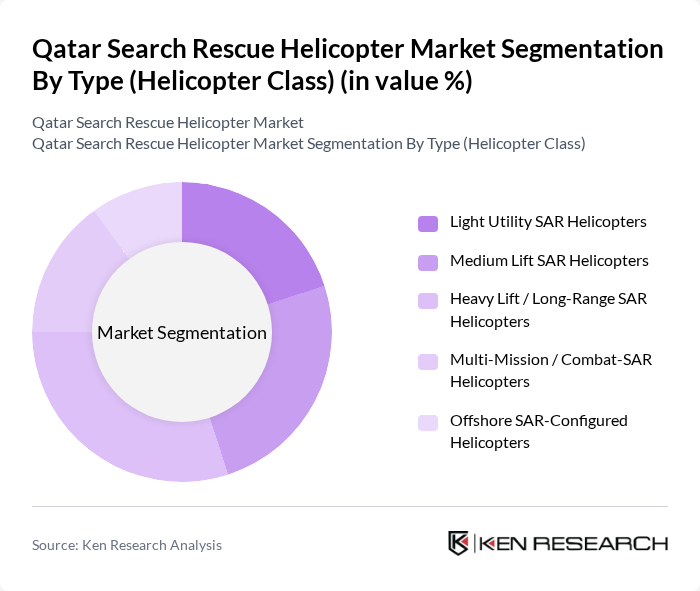
By Type (Helicopter Class):The market is segmented into various helicopter classes, each serving specific operational needs. The Light Utility SAR Helicopters are favored for their versatility in urban environments, while Medium Lift SAR Helicopters are preferred for their balance of capacity and range. Heavy Lift / Long-Range SAR Helicopters dominate in offshore operations due to their ability to cover vast distances and carry larger payloads. Multi-Mission / Combat-SAR Helicopters are increasingly utilized for specialized missions, and Offshore SAR-Configured Helicopters are essential for oil and gas operations.
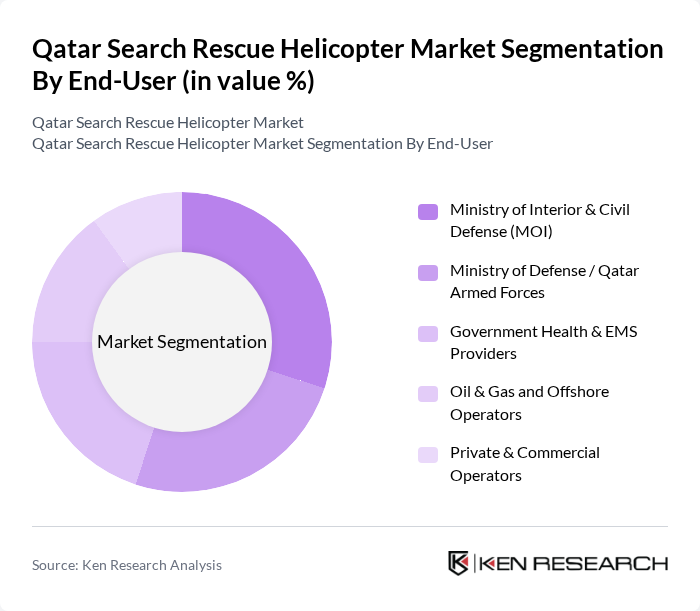
By End-User:The end-user segmentation includes various government and private entities that utilize search and rescue helicopters. The Ministry of Interior & Civil Defense (MOI) is a significant user due to its responsibility for public safety. The Ministry of Defense / Qatar Armed Forces also plays a crucial role, utilizing helicopters for military operations. Government Health & EMS Providers are increasingly relying on air medical services, while Oil & Gas and Offshore Operators require helicopters for emergency response in remote locations. Private & Commercial Operators are also emerging as key players in this market.
Qatar Search Rescue Helicopter Market Competitive Landscape
The Qatar Search Rescue Helicopter Market is characterized by a dynamic mix of regional and international players. Leading participants such as Gulf Helicopters Company (GHC), Barzan Holdings (Military Aviation & ISR Programs), Leonardo S.p.A. (AW139 / AW189 SAR Platforms in Qatar), Airbus Helicopters (H145 / H225 SAR and HEMS Platforms), Qatar Emiri Air Force (QEAF) – Search & Rescue Wing, Ministry of Interior – Air Operations Department, Hamad Medical Corporation – Ambulance Service (Air Ambulance Operations), Qatar Civil Aviation Authority – Aviation Safety & Regulation, Qatar Civil Defence – Search & Rescue and Firefighting Aviation Units, North Oil Company & Offshore Operators (Offshore SAR Contracting), Qatar Red Crescent Society – Air-Supported Humanitarian & Disaster Response, Ministry of Transport – Air Navigation & Rescue Coordination, National Command Center – Joint Search & Rescue Coordination, International Contractors (e.g., Bristow Group, Babcock International) Supporting Gulf SAR Operations, Local and Regional MRO Providers for SAR Helicopter Fleets contribute to innovation, geographic expansion, and service delivery in this space.
Qatar Search Rescue Helicopter Market Industry Analysis
Growth Drivers
- Increasing Demand for Emergency Medical Services:The demand for emergency medical services in Qatar is projected to rise significantly, with the healthcare sector budget reaching QAR 25 billion in future. This increase is driven by a growing population and a higher incidence of medical emergencies, necessitating rapid response capabilities. The integration of helicopters into emergency services is crucial, as they can reduce transport time to hospitals by up to 50%, thereby improving patient outcomes and survival rates.
- Government Investment in Disaster Management:Qatar's government has allocated approximately QAR 2 billion for disaster management initiatives in future. This investment aims to enhance the country's preparedness for natural disasters and emergencies, including search and rescue operations. The establishment of the Qatar Civil Defense and the National Emergency Management Agency underscores the commitment to improving response capabilities, which directly boosts the demand for search and rescue helicopters in the region.
- Technological Advancements in Helicopter Design:The helicopter manufacturing sector is witnessing rapid technological advancements, with investments in R&D exceeding QAR 600 million in future. Innovations such as improved fuel efficiency, enhanced avionics, and advanced safety features are making helicopters more reliable and cost-effective. These advancements are expected to increase the operational capabilities of search and rescue helicopters, making them more attractive to both public and private sectors in Qatar.
Market Challenges
- High Operational Costs:The operational costs associated with search and rescue helicopters in Qatar can exceed QAR 1.2 million annually per unit. This includes maintenance, fuel, and personnel expenses, which can deter investment in new helicopters. The high costs are compounded by the need for specialized equipment and training, making it challenging for organizations to justify expenditures, especially in a competitive market with limited budgets.
- Limited Availability of Skilled Personnel:The search and rescue helicopter sector in Qatar faces a significant challenge due to a shortage of skilled personnel. Currently, there are only about 250 certified helicopter pilots and rescue technicians in the country, which is insufficient to meet the growing demand. This shortage can lead to delays in response times and increased operational risks, ultimately affecting the effectiveness of rescue missions.
Qatar Search Rescue Helicopter Market Future Outlook
The future of the Qatar search and rescue helicopter market appears promising, driven by ongoing government initiatives and technological advancements. As the population grows and urbanization increases, the need for efficient emergency response systems will intensify. Additionally, the integration of advanced communication technologies and hybrid helicopters is expected to enhance operational efficiency. The focus on sustainability will also shape future investments, leading to more eco-friendly practices in rescue operations, ensuring a robust market environment.
Market Opportunities
- Expansion of Private Sector Involvement:The private sector's involvement in search and rescue operations is anticipated to grow, with investments projected to reach QAR 400 million by future. This expansion can lead to innovative solutions and improved service delivery, as private companies often bring advanced technologies and operational efficiencies to the market.
- Partnerships with International Rescue Organizations:Collaborations with international rescue organizations can enhance Qatar's capabilities, providing access to best practices and advanced training. Such partnerships are expected to facilitate knowledge transfer and improve operational standards, potentially increasing the effectiveness of local search and rescue missions significantly.
Scope of the Report
| Segment | Sub-Segments |
|---|---|
| By Type (Helicopter Class) | Light Utility SAR Helicopters Medium Lift SAR Helicopters Heavy Lift / Long-Range SAR Helicopters Multi-Mission / Combat-SAR Helicopters Offshore SAR-Configured Helicopters |
| By End-User | Ministry of Interior & Civil Defense (MOI) Ministry of Defense / Qatar Armed Forces Government Health & EMS Providers Oil & Gas and Offshore Operators Private & Commercial Operators |
| By Mission Profile | Air Medical & HEMS (Helicopter Emergency Medical Services) Maritime & Offshore Search and Rescue Combat Search and Rescue (CSAR) Disaster Relief & Humanitarian Support Border Security & Coastal Surveillance Support |
| By Payload / Seating Capacity | Up to 6 Passengers / Light Payload –12 Passengers / Medium Payload Above 12 Passengers / Heavy Payload Dedicated Cargo & Special Equipment Configurations |
| By Operating Base | Land-Based SAR Units (Airfields & Heliports) Offshore Platform & Rig-Based Operations Naval Vessel-Based SAR Detachments Joint Operations & Multi-Agency Coordination Centers |
| By Avionics & Systems Technology | Basic IFR / VFR-Equipped SAR Helicopters Advanced SAR Avionics (NVG, FLIR, Radar, AIS) Satellite-Enabled & Network-Centric SAR Platforms Integration with Unmanned Aerial Systems (Manned-Unmanned Teaming) |
| By Funding & Procurement Model | Direct Government Procurement Public–Private Partnership (PPP) Contracts Outsourced SAR Services / Long-Term Service Contracts Donor, Multilateral & International Support Programs |
Key Target Audience
Investors and Venture Capitalist Firms
Government and Regulatory Bodies (e.g., Qatar Civil Aviation Authority, Ministry of Interior)
Search and Rescue Operations Agencies
Emergency Medical Services (EMS) Providers
Military and Defense Organizations
Aviation Safety and Standards Organizations
Helicopter Manufacturers and Suppliers
Insurance Companies Specializing in Aviation
Players Mentioned in the Report:
Gulf Helicopters Company (GHC)
Barzan Holdings (Military Aviation & ISR Programs)
Leonardo S.p.A. (AW139 / AW189 SAR Platforms in Qatar)
Airbus Helicopters (H145 / H225 SAR and HEMS Platforms)
Qatar Emiri Air Force (QEAF) Search & Rescue Wing
Ministry of Interior Air Operations Department
Hamad Medical Corporation Ambulance Service (Air Ambulance Operations)
Qatar Civil Aviation Authority Aviation Safety & Regulation
Qatar Civil Defence Search & Rescue and Firefighting Aviation Units
North Oil Company & Offshore Operators (Offshore SAR Contracting)
Qatar Red Crescent Society Air-Supported Humanitarian & Disaster Response
Ministry of Transport Air Navigation & Rescue Coordination
National Command Center Joint Search & Rescue Coordination
International Contractors (e.g., Bristow Group, Babcock International) Supporting Gulf SAR Operations
Local and Regional MRO Providers for SAR Helicopter Fleets
Table of Contents
Market Assessment Phase
1. Executive Summary and Approach
2. Qatar Search Rescue Helicopter Market Overview
2.1 Key Insights and Strategic Recommendations
2.2 Qatar Search Rescue Helicopter Market Overview
2.3 Definition and Scope
2.4 Evolution of Market Ecosystem
2.5 Timeline of Key Regulatory Milestones
2.6 Value Chain & Stakeholder Mapping
2.7 Business Cycle Analysis
2.8 Policy & Incentive Landscape
3. Qatar Search Rescue Helicopter Market Analysis
3.1 Growth Drivers
3.1.1 Increasing demand for emergency medical services
3.1.2 Government investment in disaster management
3.1.3 Technological advancements in helicopter design
3.1.4 Rising awareness of search and rescue operations
3.2 Market Challenges
3.2.1 High operational costs
3.2.2 Limited availability of skilled personnel
3.2.3 Regulatory compliance complexities
3.2.4 Competition from alternative rescue methods
3.3 Market Opportunities
3.3.1 Expansion of private sector involvement
3.3.2 Partnerships with international rescue organizations
3.3.3 Development of advanced training programs
3.3.4 Integration of drones in rescue operations
3.4 Market Trends
3.4.1 Increasing use of hybrid helicopters
3.4.2 Focus on sustainability and eco-friendly operations
3.4.3 Enhanced communication technologies in rescue missions
3.4.4 Growth in public-private partnerships
3.5 Government Regulation
3.5.1 Safety and operational standards
3.5.2 Licensing requirements for operators
3.5.3 Environmental regulations
3.5.4 Funding and grants for rescue operations
4. SWOT Analysis
5. Stakeholder Analysis
6. Porter's Five Forces Analysis
7. Qatar Search Rescue Helicopter Market Market Size, 2019-2024
7.1 By Value
7.2 By Volume
7.3 By Average Selling Price
8. Qatar Search Rescue Helicopter Market Segmentation
8.1 By Type (Helicopter Class)
8.1.1 Light Utility SAR Helicopters
8.1.2 Medium Lift SAR Helicopters
8.1.3 Heavy Lift / Long-Range SAR Helicopters
8.1.4 Multi-Mission / Combat-SAR Helicopters
8.1.5 Offshore SAR-Configured Helicopters
8.2 By End-User
8.2.1 Ministry of Interior & Civil Defense (MOI)
8.2.2 Ministry of Defense / Qatar Armed Forces
8.2.3 Government Health & EMS Providers
8.2.4 Oil & Gas and Offshore Operators
8.2.5 Private & Commercial Operators
8.3 By Mission Profile
8.3.1 Air Medical & HEMS (Helicopter Emergency Medical Services)
8.3.2 Maritime & Offshore Search and Rescue
8.3.3 Combat Search and Rescue (CSAR)
8.3.4 Disaster Relief & Humanitarian Support
8.3.5 Border Security & Coastal Surveillance Support
8.4 By Payload / Seating Capacity
8.4.1 Up to 6 Passengers / Light Payload
8.4.2 7–12 Passengers / Medium Payload
8.4.3 Above 12 Passengers / Heavy Payload
8.4.4 Dedicated Cargo & Special Equipment Configurations
8.5 By Operating Base
8.5.1 Land-Based SAR Units (Airfields & Heliports)
8.5.2 Offshore Platform & Rig-Based Operations
8.5.3 Naval Vessel-Based SAR Detachments
8.5.4 Joint Operations & Multi-Agency Coordination Centers
8.6 By Avionics & Systems Technology
8.6.1 Basic IFR / VFR-Equipped SAR Helicopters
8.6.2 Advanced SAR Avionics (NVG, FLIR, Radar, AIS)
8.6.3 Satellite-Enabled & Network-Centric SAR Platforms
8.6.4 Integration with Unmanned Aerial Systems (Manned-Unmanned Teaming)
8.7 By Funding & Procurement Model
8.7.1 Direct Government Procurement
8.7.2 Public–Private Partnership (PPP) Contracts
8.7.3 Outsourced SAR Services / Long-Term Service Contracts
8.7.4 Donor, Multilateral & International Support Programs
9. Qatar Search Rescue Helicopter Market Competitive Analysis
9.1 Market Share of Key Players
9.2 Cross Comparison of Key Players
9.2.1 Fleet Size (Number of SAR-Configured Helicopters in Qatar)
9.2.2 Share of Missions Flown in Qatar SAR Market (%)
9.2.3 Average Annual Flight Hours per SAR Helicopter
9.2.4 Revenue from SAR and HEMS Operations in Qatar (USD Million)
9.2.5 Contract Portfolio (Number of Active Government & Oil and Gas SAR Contracts)
9.2.6 Average Mission Response Time (Minutes from Call-Out to Take-Off)
9.2.7 Fleet Modernity (Average Helicopter Age and % with Advanced SAR Avionics)
9.2.8 Mission Success Rate (% of Missions Completed as Planned)
9.2.9 Safety Record (Incidents per 10,000 Flight Hours)
9.2.10 Localization Level (% of Operations Staffed and Supported Locally)
9.3 SWOT Analysis of Top Players
9.4 Pricing Analysis
9.5 Detailed Profile of Major Companies
9.5.1 Gulf Helicopters Company (GHC)
9.5.2 Barzan Holdings (Military Aviation & ISR Programs)
9.5.3 Leonardo S.p.A. (AW139 / AW189 SAR Platforms in Qatar)
9.5.4 Airbus Helicopters (H145 / H225 SAR and HEMS Platforms)
9.5.5 Qatar Emiri Air Force (QEAF) – Search & Rescue Wing
9.5.6 Ministry of Interior – Air Operations Department
9.5.7 Hamad Medical Corporation – Ambulance Service (Air Ambulance Operations)
9.5.8 Qatar Civil Aviation Authority – Aviation Safety & Regulation
9.5.9 Qatar Civil Defence – Search & Rescue and Firefighting Aviation Units
9.5.10 North Oil Company & Offshore Operators (Offshore SAR Contracting)
9.5.11 Qatar Red Crescent Society – Air-Supported Humanitarian & Disaster Response
9.5.12 Ministry of Transport – Air Navigation & Rescue Coordination
9.5.13 National Command Center – Joint Search & Rescue Coordination
9.5.14 International Contractors (e.g., Bristow Group, Babcock International) Supporting Gulf SAR Operations
9.5.15 Local and Regional MRO Providers for SAR Helicopter Fleets
10. Qatar Search Rescue Helicopter Market End-User Analysis
10.1 Procurement Behavior of Key Ministries
10.1.1 Ministry of Interior
10.1.2 Ministry of Public Health
10.1.3 Ministry of Defense
10.1.4 Ministry of Municipality and Environment
10.2 Corporate Spend on Infrastructure & Energy
10.2.1 Investment in Emergency Services
10.2.2 Budget Allocation for Search and Rescue Operations
10.3 Pain Point Analysis by End-User Category
10.3.1 Government Agencies
10.3.2 NGOs
10.3.3 Private Sector
10.4 User Readiness for Adoption
10.4.1 Training and Skill Development Needs
10.4.2 Technology Adoption Challenges
10.5 Post-Deployment ROI and Use Case Expansion
10.5.1 Evaluation of Operational Efficiency
10.5.2 Expansion of Service Offerings
11. Qatar Search Rescue Helicopter Market Future Size, 2025-2030
11.1 By Value
11.2 By Volume
11.3 By Average Selling Price
Go-To-Market Strategy Phase
1. Whitespace Analysis + Business Model Canvas
1.1 Market Gaps Identification
1.2 Business Model Development
2. Marketing and Positioning Recommendations
2.1 Branding Strategies
2.2 Product USPs
3. Distribution Plan
3.1 Urban Retail vs Rural NGO Tie-ups
4. Channel & Pricing Gaps
4.1 Underserved Routes
4.2 Pricing Bands
5. Unmet Demand & Latent Needs
5.1 Category Gaps
5.2 Consumer Segments
6. Customer Relationship
6.1 Loyalty Programs
6.2 After-sales Service
7. Value Proposition
7.1 Sustainability
7.2 Integrated Supply Chains
8. Key Activities
8.1 Regulatory Compliance
8.2 Branding
8.3 Distribution Setup
9. Entry Strategy Evaluation
9.1 Domestic Market Entry Strategy
9.1.1 Product Mix
9.1.2 Pricing Band
9.1.3 Packaging
9.2 Export Entry Strategy
9.2.1 Target Countries
9.2.2 Compliance Roadmap
10. Entry Mode Assessment
10.1 JV
10.2 Greenfield
10.3 M&A
10.4 Distributor Model
11. Capital and Timeline Estimation
11.1 Capital Requirements
11.2 Timelines
12. Control vs Risk Trade-Off
12.1 Ownership vs Partnerships
13. Profitability Outlook
13.1 Breakeven Analysis
13.2 Long-term Sustainability
14. Potential Partner List
14.1 Distributors
14.2 JVs
14.3 Acquisition Targets
15. Execution Roadmap
15.1 Phased Plan for Market Entry
15.1.1 Market Setup
15.1.2 Market Entry
15.1.3 Growth Acceleration
15.1.4 Scale & Stabilize
15.2 Key Activities and Milestones
15.2.1 Activity Planning
15.2.2 Milestone Tracking
Research Methodology
Phase 1: Approach1
Desk Research
- Analysis of government reports on aviation and emergency services in Qatar
- Review of industry publications and white papers on search and rescue operations
- Examination of market trends and forecasts from aviation regulatory bodies
Primary Research
- Interviews with key stakeholders in the Qatar Civil Aviation Authority
- Surveys with helicopter service providers and emergency response teams
- Field interviews with pilots and rescue operation coordinators
Validation & Triangulation
- Cross-validation of data through multiple industry reports and expert opinions
- Triangulation of findings from primary interviews and secondary data sources
- Sanity checks conducted through expert panel discussions and feedback
Phase 2: Market Size Estimation1
Top-down Assessment
- Estimation of total market size based on national emergency response budgets
- Segmentation by types of search and rescue operations (land, sea, air)
- Incorporation of government initiatives and funding for emergency services
Bottom-up Modeling
- Volume estimates based on historical data of helicopter missions in Qatar
- Operational cost analysis derived from service pricing and maintenance expenses
- Calculation of market size based on mission frequency and average costs
Forecasting & Scenario Analysis
- Multi-factor regression analysis considering population growth and tourism trends
- Scenario modeling based on potential changes in government policy and funding
- Baseline, optimistic, and pessimistic forecasts through 2030
Phase 3: CATI Sample Composition1
| Scope Item/Segment | Sample Size | Target Respondent Profiles |
|---|---|---|
| Government Emergency Services | 100 | Emergency Response Coordinators, Policy Makers |
| Private Helicopter Operators | 80 | Operations Managers, Fleet Supervisors |
| Search and Rescue NGOs | 60 | Program Directors, Field Operations Managers |
| Aviation Regulatory Bodies | 50 | Regulatory Officers, Safety Inspectors |
| Training Institutions for Pilots | 40 | Training Coordinators, Curriculum Developers |
Frequently Asked Questions
What is the current value of the Qatar Search Rescue Helicopter Market?
The Qatar Search Rescue Helicopter Market is valued at approximately USD 450 million, reflecting a five-year historical analysis. This growth is attributed to increased investments in emergency response capabilities and advancements in helicopter technology.
What factors are driving the growth of the Qatar Search Rescue Helicopter Market?
Who are the major players in the Qatar Search Rescue Helicopter Market?
What types of helicopters are used in the Qatar Search Rescue Helicopter Market?
Other Regional/Country Reports
Indonesia Search Rescue Helicopter Market
Malaysia Search Rescue Helicopter Market
KSA Search Rescue Helicopter Market
APAC Search Rescue Helicopter Market
SEA Search Rescue Helicopter Market
Vietnam Search Rescue Helicopter Market
Other Adjacent Reports
Belgium Helicopter Maintenance Repair Overhaul Market
New Zealand Air Ambulance Services Market Report Size Share Growth Drivers Trends Opportunities And Forecast 2025–2030Thailand Offshore Oil Gas Support Market
Oman Military Aviation Equipment Market
Singapore Aviation Avionics Systems Market
Emergency Medical Services MarketQatar Disaster Management Solutions Market
Kuwait Maritime Rescue Equipment Market
Brazil Satellite Communication Technology Market
Philippines Pilot Training Simulation Market
Why Buy From Us?

What makes us stand out is that our consultants follow Robust, Refine and Result (RRR) methodology. Robust for clear definitions, approaches and sanity checking, Refine for differentiating respondents' facts and opinions, and Result for presenting data with story.

We have set a benchmark in the industry by offering our clients with syndicated and customized market research reports featuring coverage of entire market as well as meticulous research and analyst insights.

While we don't replace traditional research, we flip the method upside down. Our dual approach of Top Bottom & Bottom Top ensures quality deliverable by not just verifying company fundamentals but also looking at the sector and macroeconomic factors.

With one step in the future, our research team constantly tries to show you the bigger picture. We help with some of the tough questions you may encounter along the way: How is the industry positioned? Best marketing channel? KPI's of competitors? By aligning every element, we help maximize success.

Our report gives you instant access to the answers and sources that other companies might choose to hide. We elaborate each steps of research methodology we have used and showcase you the sample size to earn your trust.

If you need any support, we are here! We pride ourselves on universe strength, data quality, and quick, friendly, and professional service.