Saudi Arabia AI-Powered Healthcare Telemedicine Remote Monitoring Market

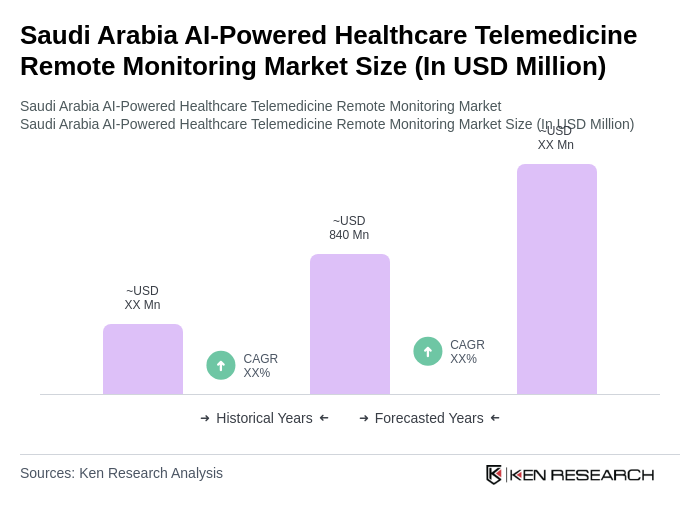
Saudi Arabia AI-Powered Healthcare Telemedicine Remote Monitoring Market, valued at USD 840 million, grows with government support, AI integration, and rising remote care needs.

Region:Middle East

Author(s):Rebecca

Product Code:KRAC1842

Pages:95

Published On:October 2025
About the Report

Base Year 2024

Saudi Arabia AI-Powered Healthcare Telemedicine Remote Monitoring Market Overview

  • The Saudi Arabia AI-Powered Healthcare Telemedicine Remote Monitoring Market is valued at USD 840 million, based on a five-year historical analysis. This growth is primarily driven by the increasing adoption of digital health solutions, rising healthcare costs, and the need for efficient patient management systems. The integration of AI technologies in telemedicine has further enhanced the capabilities of remote monitoring, making healthcare more accessible and efficient. Key growth drivers include expanding government support for digital health, rapid advancements in AI-powered diagnostics, and the rising prevalence of chronic diseases necessitating remote care solutions .
  • Key cities such as Riyadh, Jeddah, and Dammam dominate the market due to their advanced healthcare infrastructure and high population density. These urban centers are home to numerous hospitals and healthcare facilities that are increasingly adopting telemedicine solutions to improve patient care and operational efficiency. The presence of tech-savvy populations in these cities also contributes to the rapid adoption of AI-powered healthcare solutions .
  • In 2023, the Saudi Arabian government implemented the "Telemedicine Regulation" (Telemedicine Rules, 2023 issued by the Saudi Ministry of Health) to enhance the quality and accessibility of healthcare services. This regulation mandates that all telemedicine providers must comply with specific standards for data security, patient privacy, and service delivery. The initiative requires licensed providers to use secure data transmission protocols, maintain patient confidentiality, and adhere to defined service quality benchmarks for remote monitoring technologies .
Saudi Arabia AI-Powered Healthcare Telemedicine Remote Monitoring Market Size

Saudi Arabia AI-Powered Healthcare Telemedicine Remote Monitoring Market Segmentation

By Type:The market is segmented into various types, including Remote Patient Monitoring Devices, Telehealth Software Solutions, AI Analytics Tools, Communication Platforms, Wearable Health Devices, Mobile Health Applications, Virtual Care Platforms, and Others. Each of these sub-segments plays a crucial role in enhancing the efficiency and effectiveness of healthcare delivery.
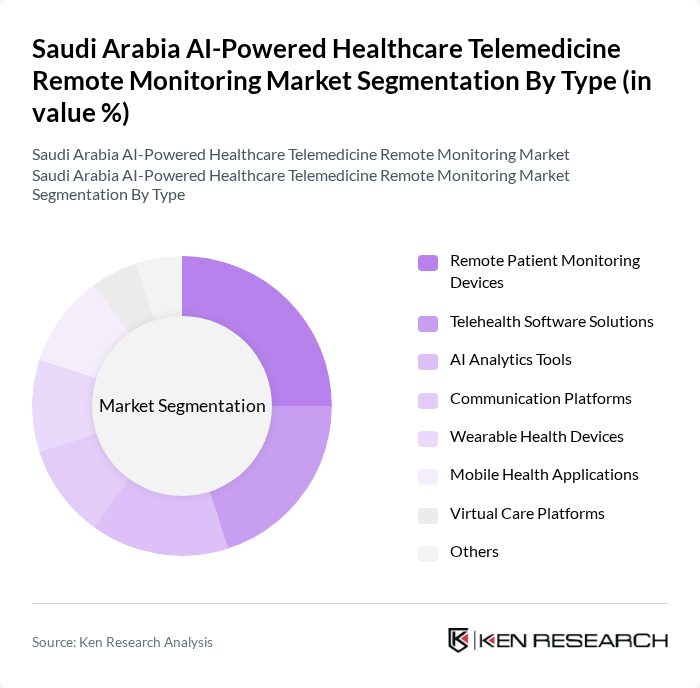
Saudi Arabia AI-Powered Healthcare Telemedicine Remote Monitoring Market segmentation by Type.

By End-User:The end-user segmentation includes Hospitals, Clinics, Home Healthcare Providers, Insurance Companies, Government Health Agencies, Patients, and Others. Each segment has unique needs and requirements that drive the adoption of telemedicine solutions.
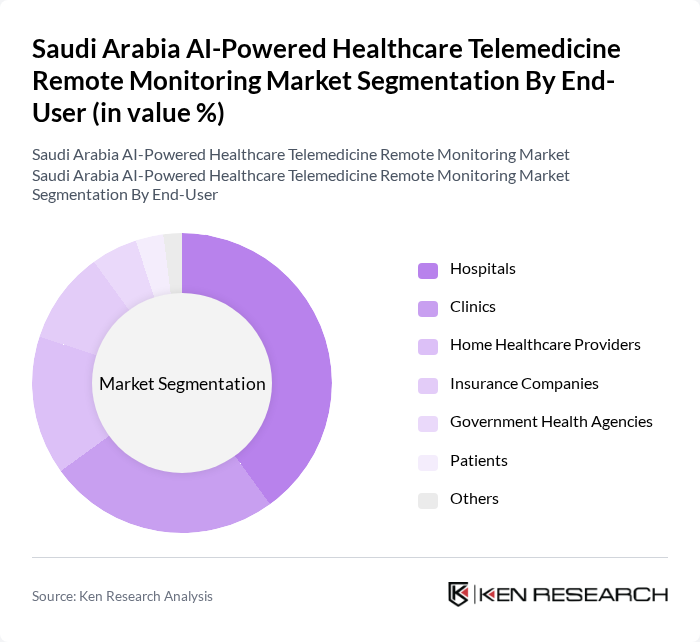
Saudi Arabia AI-Powered Healthcare Telemedicine Remote Monitoring Market segmentation by End-User.

Saudi Arabia AI-Powered Healthcare Telemedicine Remote Monitoring Market Competitive Landscape

The Saudi Arabia AI-Powered Healthcare Telemedicine Remote Monitoring Market is characterized by a dynamic mix of regional and international players. Leading participants such as Philips Healthcare, Siemens Healthineers, Cerner Corporation (Oracle Health), GE Healthcare, Medtronic, IBM Watson Health, Allscripts Healthcare Solutions (Altera Digital Health), Teladoc Health, Amwell, DarioHealth Corp., OMRON Healthcare, ResMed, HealthTap, Babylon Health, Seha Virtual Hospital (Ministry of Health, Saudi Arabia), Altibbi, Vezeeta, Aster DM Healthcare (myAster), Synyi AI, King Faisal Specialist Hospital & Research Centre (KFSH&RC) Digital Health contribute to innovation, geographic expansion, and service delivery in this space.

Philips Healthcare

1891

Amsterdam, Netherlands

Siemens Healthineers

1847

Erlangen, Germany

Cerner Corporation (Oracle Health)

1979

North Kansas City, Missouri, USA

GE Healthcare

1892

Chicago, Illinois, USA

Medtronic

1949

Dublin, Ireland

Company

Establishment Year

Headquarters

Group Size (Large, Medium, or Small as per industry convention)

Revenue Growth Rate (Saudi Arabia Market)

Number of Active Users/Patients Monitored

Market Penetration Rate (Saudi Arabia)

Customer Retention Rate

Average Response Time (Virtual Consultations)

Saudi Arabia AI-Powered Healthcare Telemedicine Remote Monitoring Market Industry Analysis

Growth Drivers

  • Increasing Demand for Remote Patient Monitoring:The demand for remote patient monitoring in Saudi Arabia is surging, driven by a healthcare system that recorded over 1.5 million telehealth consultations in future. This trend is expected to continue as the population ages, with 20% of Saudis projected to be over 60 in future. The Ministry of Health's initiatives to enhance telemedicine services further support this growth, aiming to improve access to healthcare for all citizens.
  • Government Initiatives Promoting Telemedicine:The Saudi government has invested approximately $1.5 billion in digital health initiatives as part of its Vision 2030 plan. This includes the establishment of the Saudi Health Information Exchange, which aims to facilitate telemedicine services across the nation. By future, the government plans to increase telehealth service availability by 40%, significantly enhancing healthcare access, especially in underserved regions.
  • Rising Prevalence of Chronic Diseases:Chronic diseases are on the rise in Saudi Arabia, with diabetes affecting over 4 million individuals as of future. The World Health Organization projects that in future, the number of diabetes cases will increase by 15%. This growing health crisis necessitates effective remote monitoring solutions, driving demand for AI-powered telemedicine services that can provide continuous patient management and support.

Market Challenges

  • Data Privacy and Security Concerns:Data privacy remains a significant challenge in the Saudi telemedicine market, with 75% of healthcare providers expressing concerns over data breaches. The lack of robust cybersecurity measures has led to hesitance in adopting telehealth solutions. In future, the Saudi Cybersecurity Authority reported over 1,200 cyber incidents in healthcare, highlighting the urgent need for improved data protection regulations to foster trust in telemedicine.
  • Limited Internet Connectivity in Rural Areas:Approximately 25% of rural areas in Saudi Arabia still lack reliable internet access, which poses a barrier to effective telemedicine implementation. The Saudi Communications and Information Technology Commission reported that only 65% of rural households have broadband connectivity. This digital divide limits the reach of telehealth services, making it challenging to provide equitable healthcare access across the nation.

Saudi Arabia AI-Powered Healthcare Telemedicine Remote Monitoring Market Future Outlook

The future of the AI-powered healthcare telemedicine remote monitoring market in Saudi Arabia appears promising, driven by technological advancements and increasing healthcare demands. In future, the integration of AI technologies is expected to enhance diagnostic accuracy and patient engagement. Additionally, the growing acceptance of telehealth services among patients and providers will likely lead to more innovative solutions, improving healthcare delivery and accessibility across the nation, particularly in underserved areas.

Market Opportunities

  • Expansion of Healthcare Infrastructure:The Saudi government is investing heavily in healthcare infrastructure, with plans to build 35 new hospitals by future. This expansion will create opportunities for telemedicine providers to integrate their services into new facilities, enhancing patient care and operational efficiency.
  • Integration of AI with Existing Healthcare Systems:There is a significant opportunity for AI integration within existing healthcare systems, with over 60% of hospitals in Saudi Arabia expressing interest in adopting AI solutions. This integration can streamline operations, improve patient outcomes, and reduce costs, making telemedicine more effective and appealing to healthcare providers.

Scope of the Report

SegmentSub-Segments
By Type

Remote Patient Monitoring Devices

Telehealth Software Solutions

AI Analytics Tools

Communication Platforms

Wearable Health Devices

Mobile Health Applications

Virtual Care Platforms

Others

By End-User

Hospitals

Clinics

Home Healthcare Providers

Insurance Companies

Government Health Agencies

Patients

Others

By Application

Chronic Disease Management

Post-Surgery Monitoring

Mental Health Services

Maternal and Child Health

Emergency Care

Preventive Health Monitoring

Others

By Distribution Channel

Direct Sales

Online Platforms

Distributors

Retail Pharmacies

Others

By Device Type

Wearable Devices

Implantable Devices

Stationary Devices

Mobile Devices

Others

By Technology

Cloud-Based Solutions

On-Premise Solutions

Hybrid Solutions

AI-Driven Platforms

Others

By Pricing Model

Subscription-Based

Pay-Per-Use

One-Time Purchase

Insurance-Covered

Others

Key Target Audience

Investors and Venture Capitalist Firms

Government and Regulatory Bodies (e.g., Saudi Ministry of Health, Saudi Food and Drug Authority)

Healthcare Providers and Hospitals

Telemedicine Solution Developers

Health Insurance Companies

Medical Device Manufacturers

Pharmaceutical Companies

Healthcare IT Companies

Players Mentioned in the Report:

Philips Healthcare

Siemens Healthineers

Cerner Corporation (Oracle Health)

GE Healthcare

Medtronic

IBM Watson Health

Allscripts Healthcare Solutions (Altera Digital Health)

Teladoc Health

Amwell

DarioHealth Corp.

OMRON Healthcare

ResMed

HealthTap

Babylon Health

Seha Virtual Hospital (Ministry of Health, Saudi Arabia)

Altibbi

Vezeeta

Aster DM Healthcare (myAster)

Synyi AI

King Faisal Specialist Hospital & Research Centre (KFSH&RC) Digital Health

Table of Contents

Market Assessment Phase

1. Executive Summary and Approach


2. Saudi Arabia AI-Powered Healthcare Telemedicine Remote Monitoring Market Overview

2.1 Key Insights and Strategic Recommendations

2.2 Saudi Arabia AI-Powered Healthcare Telemedicine Remote Monitoring Market Overview

2.3 Definition and Scope

2.4 Evolution of Market Ecosystem

2.5 Timeline of Key Regulatory Milestones

2.6 Value Chain & Stakeholder Mapping

2.7 Business Cycle Analysis

2.8 Policy & Incentive Landscape


3. Saudi Arabia AI-Powered Healthcare Telemedicine Remote Monitoring Market Analysis

3.1 Growth Drivers

3.1.1 Increasing demand for remote patient monitoring
3.1.2 Government initiatives promoting telemedicine
3.1.3 Rising prevalence of chronic diseases
3.1.4 Advancements in AI technology

3.2 Market Challenges

3.2.1 Data privacy and security concerns
3.2.2 Limited internet connectivity in rural areas
3.2.3 Resistance to change among healthcare providers
3.2.4 Regulatory hurdles

3.3 Market Opportunities

3.3.1 Expansion of healthcare infrastructure
3.3.2 Integration of AI with existing healthcare systems
3.3.3 Growing acceptance of telehealth services
3.3.4 Partnerships with technology firms

3.4 Market Trends

3.4.1 Increased investment in digital health solutions
3.4.2 Shift towards patient-centric care models
3.4.3 Rise of wearable health technology
3.4.4 Focus on preventive healthcare

3.5 Government Regulation

3.5.1 Telemedicine licensing requirements
3.5.2 Data protection regulations
3.5.3 Reimbursement policies for telehealth services
3.5.4 Standards for remote monitoring devices

4. SWOT Analysis


5. Stakeholder Analysis


6. Porter's Five Forces Analysis


7. Saudi Arabia AI-Powered Healthcare Telemedicine Remote Monitoring Market Market Size, 2019-2024

7.1 By Value

7.2 By Volume

7.3 By Average Selling Price


8. Saudi Arabia AI-Powered Healthcare Telemedicine Remote Monitoring Market Segmentation

8.1 By Type

8.1.1 Remote Patient Monitoring Devices
8.1.2 Telehealth Software Solutions
8.1.3 AI Analytics Tools
8.1.4 Communication Platforms
8.1.5 Wearable Health Devices
8.1.6 Mobile Health Applications
8.1.7 Virtual Care Platforms
8.1.8 Others

8.2 By End-User

8.2.1 Hospitals
8.2.2 Clinics
8.2.3 Home Healthcare Providers
8.2.4 Insurance Companies
8.2.5 Government Health Agencies
8.2.6 Patients
8.2.7 Others

8.3 By Application

8.3.1 Chronic Disease Management
8.3.2 Post-Surgery Monitoring
8.3.3 Mental Health Services
8.3.4 Maternal and Child Health
8.3.5 Emergency Care
8.3.6 Preventive Health Monitoring
8.3.7 Others

8.4 By Distribution Channel

8.4.1 Direct Sales
8.4.2 Online Platforms
8.4.3 Distributors
8.4.4 Retail Pharmacies
8.4.5 Others

8.5 By Device Type

8.5.1 Wearable Devices
8.5.2 Implantable Devices
8.5.3 Stationary Devices
8.5.4 Mobile Devices
8.5.5 Others

8.6 By Technology

8.6.1 Cloud-Based Solutions
8.6.2 On-Premise Solutions
8.6.3 Hybrid Solutions
8.6.4 AI-Driven Platforms
8.6.5 Others

8.7 By Pricing Model

8.7.1 Subscription-Based
8.7.2 Pay-Per-Use
8.7.3 One-Time Purchase
8.7.4 Insurance-Covered
8.7.5 Others

9. Saudi Arabia AI-Powered Healthcare Telemedicine Remote Monitoring Market Competitive Analysis

9.1 Market Share of Key Players

9.2 Cross Comparison of Key Players

9.2.1 Company Name
9.2.2 Group Size (Large, Medium, or Small as per industry convention)
9.2.3 Revenue Growth Rate (Saudi Arabia Market)
9.2.4 Number of Active Users/Patients Monitored
9.2.5 Market Penetration Rate (Saudi Arabia)
9.2.6 Customer Retention Rate
9.2.7 Average Response Time (Virtual Consultations)
9.2.8 Regulatory Compliance Certifications (e.g., Saudi FDA, CBAHI)
9.2.9 AI Algorithm Accuracy/Clinical Validation Rate
9.2.10 Service Level Agreement (SLA) Compliance
9.2.11 Partnership/Integration with Saudi Health Platforms (e.g., Seha Virtual Hospital, Sehhaty)
9.2.12 Average Order Value
9.2.13 Return on Investment (ROI)
9.2.14 Pricing Strategy

9.3 SWOT Analysis of Top Players

9.4 Pricing Analysis

9.5 Detailed Profile of Major Companies

9.5.1 Philips Healthcare
9.5.2 Siemens Healthineers
9.5.3 Cerner Corporation (Oracle Health)
9.5.4 GE Healthcare
9.5.5 Medtronic
9.5.6 IBM Watson Health
9.5.7 Allscripts Healthcare Solutions (Altera Digital Health)
9.5.8 Teladoc Health
9.5.9 Amwell
9.5.10 DarioHealth Corp.
9.5.11 OMRON Healthcare
9.5.12 ResMed
9.5.13 HealthTap
9.5.14 Babylon Health
9.5.15 Seha Virtual Hospital (Ministry of Health, Saudi Arabia)
9.5.16 Altibbi
9.5.17 Vezeeta
9.5.18 Aster DM Healthcare (myAster)
9.5.19 Synyi AI
9.5.20 King Faisal Specialist Hospital & Research Centre (KFSH&RC) Digital Health

10. Saudi Arabia AI-Powered Healthcare Telemedicine Remote Monitoring Market End-User Analysis

10.1 Procurement Behavior of Key Ministries

10.1.1 Budget Allocation for Telemedicine
10.1.2 Decision-Making Processes
10.1.3 Evaluation Criteria for Vendors

10.2 Corporate Spend on Infrastructure & Energy

10.2.1 Investment in Telehealth Infrastructure
10.2.2 Spending on AI Technologies
10.2.3 Budget for Training and Development

10.3 Pain Point Analysis by End-User Category

10.3.1 Challenges in Remote Monitoring
10.3.2 Issues with Data Integration
10.3.3 User Experience Concerns

10.4 User Readiness for Adoption

10.4.1 Awareness of Telemedicine Benefits
10.4.2 Training Needs for Healthcare Providers
10.4.3 Patient Acceptance Levels

10.5 Post-Deployment ROI and Use Case Expansion

10.5.1 Measurement of ROI
10.5.2 Expansion into New Use Cases
10.5.3 Long-Term Sustainability of Solutions

11. Saudi Arabia AI-Powered Healthcare Telemedicine Remote Monitoring Market Future Size, 2025-2030

11.1 By Value

11.2 By Volume

11.3 By Average Selling Price


Go-To-Market Strategy Phase

1. Whitespace Analysis + Business Model Canvas

1.1 Market Gaps Identification

1.2 Business Model Development


2. Marketing and Positioning Recommendations

2.1 Branding Strategies

2.2 Product USPs


3. Distribution Plan

3.1 Urban Retail vs Rural NGO Tie-Ups


4. Channel & Pricing Gaps

4.1 Underserved Routes

4.2 Pricing Bands


5. Unmet Demand & Latent Needs

5.1 Category Gaps

5.2 Consumer Segments


6. Customer Relationship

6.1 Loyalty Programs

6.2 After-Sales Service


7. Value Proposition

7.1 Sustainability

7.2 Integrated Supply Chains


8. Key Activities

8.1 Regulatory Compliance

8.2 Branding

8.3 Distribution Setup


9. Entry Strategy Evaluation

9.1 Domestic Market Entry Strategy

9.1.1 Product Mix
9.1.2 Pricing Band
9.1.3 Packaging

9.2 Export Entry Strategy

9.2.1 Target Countries
9.2.2 Compliance Roadmap

10. Entry Mode Assessment

10.1 JV

10.2 Greenfield

10.3 M&A

10.4 Distributor Model


11. Capital and Timeline Estimation

11.1 Capital Requirements

11.2 Timelines


12. Control vs Risk Trade-Off

12.1 Ownership vs Partnerships


13. Profitability Outlook

13.1 Breakeven Analysis

13.2 Long-Term Sustainability


14. Potential Partner List

14.1 Distributors

14.2 JVs

14.3 Acquisition Targets


15. Execution Roadmap

15.1 Phased Plan for Market Entry

15.1.1 Market Setup
15.1.2 Market Entry
15.1.3 Growth Acceleration
15.1.4 Scale & Stabilize

15.2 Key Activities and Milestones

15.2.1 Milestone Planning
15.2.2 Activity Tracking

Research Methodology

ApproachModellingSample

Phase 1: Approach1

Desk Research

  • Analysis of government healthcare reports and telemedicine regulations in Saudi Arabia
  • Review of industry publications and white papers on AI applications in healthcare
  • Examination of market trends and forecasts from healthcare analytics firms

Primary Research

  • Interviews with healthcare providers utilizing telemedicine solutions
  • Surveys with technology vendors specializing in AI-powered healthcare systems
  • Focus groups with patients using remote monitoring services

Validation & Triangulation

  • Cross-validation of findings through multiple data sources including government and private sector reports
  • Triangulation of insights from primary interviews with secondary data trends
  • Sanity checks conducted through expert panels comprising healthcare professionals and technology experts

Phase 2: Market Size Estimation1

Top-down Assessment

  • Estimation of total healthcare expenditure in Saudi Arabia as a baseline for telemedicine market size
  • Segmentation of the market by service type, including remote monitoring and virtual consultations
  • Incorporation of growth rates from telehealth adoption statistics and demographic trends

Bottom-up Modeling

  • Collection of data on the number of telemedicine users and frequency of service usage
  • Cost analysis of telemedicine services based on pricing models from leading providers
  • Calculation of revenue potential by multiplying user base with average service fees

Forecasting & Scenario Analysis

  • Development of predictive models using historical growth data and current adoption rates
  • Scenario planning based on potential regulatory changes and technological advancements
  • Creation of multiple forecasts (baseline, optimistic, and pessimistic) through 2030

Phase 3: CATI Sample Composition1

Scope Item/SegmentSample SizeTarget Respondent Profiles
Healthcare Providers Using Telemedicine85Doctors, Clinic Managers, Telehealth Coordinators
Patients Engaged in Remote Monitoring65Chronic Disease Patients, Elderly Users, Caregivers
Technology Vendors in Healthcare55Product Managers, Sales Directors, Technical Support Leads
Healthcare Policy Makers45Health Ministry Officials, Regulatory Affairs Specialists
Insurance Providers Offering Telehealth Coverage50Underwriters, Claims Managers, Product Development Officers

Frequently Asked Questions

What is the current value of the Saudi Arabia AI-Powered Healthcare Telemedicine Remote Monitoring Market?

The Saudi Arabia AI-Powered Healthcare Telemedicine Remote Monitoring Market is valued at approximately USD 840 million, reflecting significant growth driven by the adoption of digital health solutions and the integration of AI technologies in healthcare delivery.

What are the key growth drivers for the telemedicine market in Saudi Arabia?

Which cities in Saudi Arabia are leading in telemedicine adoption?

What regulations govern telemedicine in Saudi Arabia?

Other Regional/Country Reports

Indonesia AI-Powered Healthcare Telemedicine Remote Monitoring Market

Malaysia AI-Powered Healthcare Telemedicine Remote Monitoring Market

KSA AI-Powered Healthcare Telemedicine Remote Monitoring Market

APAC AI-Powered Healthcare Telemedicine Remote Monitoring Market

SEA AI-Powered Healthcare Telemedicine Remote Monitoring Market

Vietnam AI-Powered Healthcare Telemedicine Remote Monitoring Market

Why Buy From Us?

Refine Robust Result (RRR) Framework

What makes us stand out is that our consultants follow Robust, Refine and Result (RRR) methodology. Robust for clear definitions, approaches and sanity checking, Refine for differentiating respondents' facts and opinions, and Result for presenting data with story.

Our Reach Is Unmatched

We have set a benchmark in the industry by offering our clients with syndicated and customized market research reports featuring coverage of entire market as well as meticulous research and analyst insights.

Shifting the Research Paradigm

While we don't replace traditional research, we flip the method upside down. Our dual approach of Top Bottom & Bottom Top ensures quality deliverable by not just verifying company fundamentals but also looking at the sector and macroeconomic factors.

More Insights-Better Decisions

With one step in the future, our research team constantly tries to show you the bigger picture. We help with some of the tough questions you may encounter along the way: How is the industry positioned? Best marketing channel? KPI's of competitors? By aligning every element, we help maximize success.

Transparency and Trust

Our report gives you instant access to the answers and sources that other companies might choose to hide. We elaborate each steps of research methodology we have used and showcase you the sample size to earn your trust.

Round the Clock Support

If you need any support, we are here! We pride ourselves on universe strength, data quality, and quick, friendly, and professional service.

Why Clients Choose Us?

400000+
Reports in repository
150+
Consulting projects a year
100+
Analysts
8000+
Client Queries in 2022








