Saudi Arabia Appliance Adhesive Market Report Size Share Growth Drivers Trends Opportunities & Forecast 2025–2030

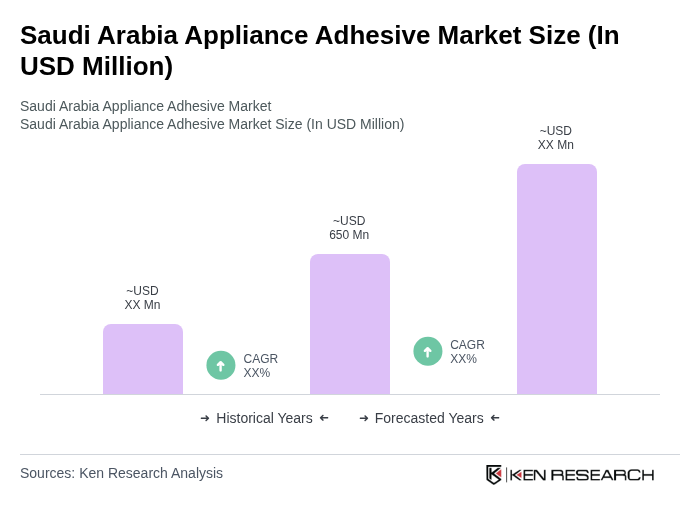
Saudi Arabia appliance adhesive market valued at $650M, driven by packaging, construction, and automotive industries.

Region:Middle East

Author(s):Shubham

Product Code:KRAD1416

Pages:91

Published On:December 2025
About the Report

Base Year 2024

Saudi Arabia Appliance Adhesive Market Overview

  • The Saudi Arabia Appliance Adhesive Market is valued at USD 650 million, based on a five-year historical analysis. This growth is primarily driven by expanding end-user industries such as packaging, construction, healthcare, and automotive, which increasingly rely on advanced adhesive bonding solutions for lightweight materials and efficient assembly processes. Furthermore, rising consumer goods demand and e-commerce expansion foster greater usage of adhesives in packaging and appliances, underpinned by rapid urbanization and infrastructure development.
  • Key cities dominating the market include Riyadh, Jeddah, and Dammam, which are central to the country's economic activities. Riyadh, as the capital, leads in construction and infrastructure projects, while Jeddah serves as a commercial hub with a strong demand for consumer goods. Dammam, being an industrial center, supports the automotive and manufacturing sectors, driving the need for appliance-grade adhesives.
  • The Saudi Standards, Metrology and Quality Organization (SASO) mandates that adhesives must undergo conformity assessment, including testing for volatile organic compound limits, chemical safety, and appropriate bilingual labeling, with certification via the SABER platform required before market entry; without these certificates, shipments risk rejection at customs.
Saudi Arabia Appliance Adhesive Market Size

Saudi Arabia Appliance Adhesive Market Segmentation

By Type:The appliance adhesive market is segmented into various types, including Polyurethane Adhesives, Epoxy Adhesives, Silicone Adhesives, Acrylic Adhesives, Hot Melt Adhesives, Pressure Sensitive Adhesives, and Others. Among these, Polyurethane Adhesives are leading due to their versatility and strong bonding capabilities, making them ideal for various applications in the appliance sector. The demand for Epoxy and Silicone Adhesives is also significant, driven by their durability and resistance to environmental factors.
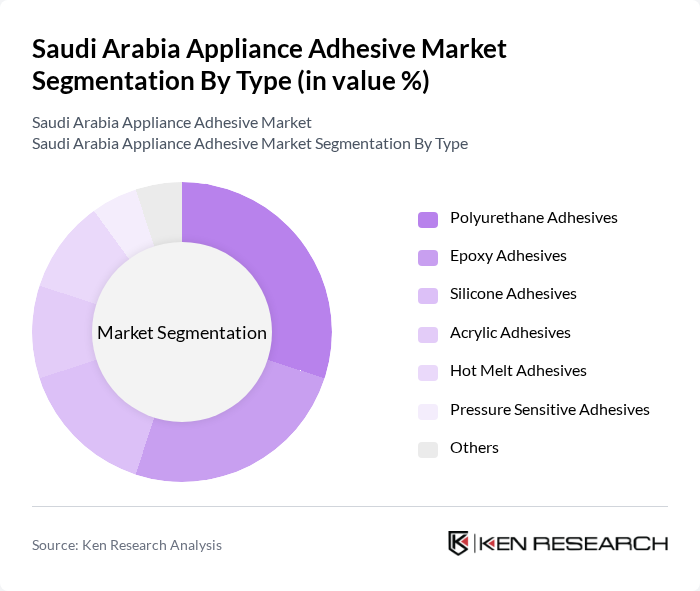
Saudi Arabia Appliance Adhesive Market segmentation by Type.

By End-User:The market is segmented by end-user into Residential, Commercial, Industrial, Government & Utilities, and Others. The Residential segment is the largest due to the increasing demand for home appliances and DIY projects. The Commercial sector follows closely, driven by the growth in retail and service industries, which require reliable adhesive solutions for various applications.
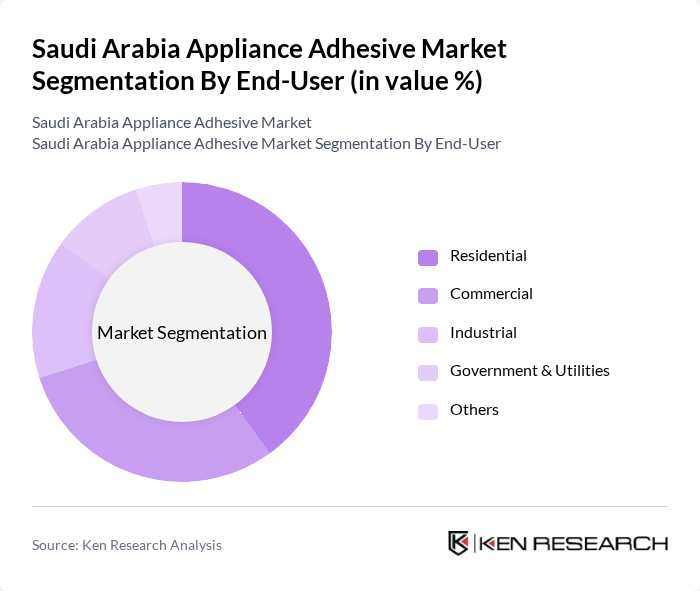
Saudi Arabia Appliance Adhesive Market segmentation by End-User.

Saudi Arabia Appliance Adhesive Market Competitive Landscape

The Saudi Arabia Appliance Adhesive Market is characterized by a dynamic mix of regional and international players. Leading participants such as Henkel AG & Co. KGaA, 3M Company, Sika AG, Bostik SA, H.B. Fuller Company, Dow Inc., Avery Dennison Corporation, RPM International Inc., Arkema S.A., Momentive Performance Materials Inc., ITW (Illinois Tool Works Inc.), Lord Corporation, Franklin International, Permabond LLC, Titebond (Franklin International) contribute to innovation, geographic expansion, and service delivery in this space.

Henkel AG & Co. KGaA

1876

Düsseldorf, Germany

3M Company

1902

Maplewood, Minnesota, USA

Sika AG

1910

Baar, Switzerland

Bostik SA

1889

Colombes, France

H.B. Fuller Company

1887

Saint Paul, Minnesota, USA

Company

Establishment Year

Headquarters

Group Size (Large, Medium, or Small as per industry convention)

Revenue Growth Rate

Market Penetration Rate

Customer Retention Rate

Pricing Strategy

Product Quality Index

Saudi Arabia Appliance Adhesive Market Industry Analysis

Growth Drivers

  • GDP Growth and Non?Oil Sector Expansion:In future, Saudi Arabia's real GDP is projected to rise by 1.3 percent, with the non-oil sector expanding by 4.3 percent. This growth is crucial as it offsets a 4.5 percent decline in the oil sector, stimulating demand in manufacturing and construction. Consequently, this diversification supports increased adhesive consumption in appliances, driven by a robust economic environment. Source: Reuters (via Saudi General Authority for Statistics).
  • Strong Macro?Economic Base (GDP Nominal):The nominal GDP of Saudi Arabia is estimated at USD 1.10 trillion in future, with a GDP per capita of approximately USD 35,057. This high economic output and income level enhance purchasing power for durable goods, including appliances. As a result, the demand for adhesives used in assembly and repair is expected to rise significantly, reflecting the country's economic strength. Source: IMF/Statisticstimes.
  • Urbanization and Large Metro Populations:With an urban population rate of around 85 percent, major cities like Riyadh (7.97 million) and Jeddah (4.84 million) are experiencing rapid growth. This urbanization drives appliance penetration, leading to increased demand for assembly adhesives in manufacturing and repair services. The concentration of populations in urban areas creates a favorable market for appliance adhesives. Source: CIA World Factbook.

Market Challenges

  • Fiscal Pressure from Low Oil Revenues:In future, Saudi Aramco's profits dropped to USD 106.25 billion, with revenues falling to USD 436 billion. A projected fiscal deficit of USD 27 billion indicates that reduced oil-related income may constrain public and private investments in manufacturing. This fiscal pressure could negatively impact demand for adhesives in the appliance sector, posing a significant challenge. Source: AP News and Reuters.
  • Regional Economic Disparities (Disposable Income Gap):The average monthly disposable income in Riyadh households is approximately SAR 26,000 (USD 6,933), which is more than double that of households in less affluent regions like Najran. This uneven income distribution may limit appliance adoption and related services in lower-income areas, thereby restricting adhesive market growth across the Kingdom. Source: Financial Times.

Saudi Arabia Appliance Adhesive Market Future Outlook

The future of the Saudi Arabia appliance adhesive market appears promising, driven by the increasing adoption of smart appliances and IoT integration. Investments in smart city infrastructure and digital transformation are expected to enhance the demand for specialty adhesives. Additionally, as sustainability becomes a priority, manufacturers are likely to focus on developing eco-friendly adhesives, aligning with global trends. Collaborations between local manufacturers and international suppliers may further boost innovation and market growth.

Market Opportunities

  • Smart & Connected Appliance Segment:The rapid digitalization of the Saudi market opens significant demand for adhesives that facilitate the integration of electronics, sensors, and IoT modules into appliances. This trend presents a lucrative opportunity for adhesive manufacturers to innovate and cater to the evolving needs of smart appliances.
  • Regional Expansion outside Riyadh:As urbanization continues to grow in cities beyond Riyadh, such as Jeddah and Dammam, there is substantial potential for adhesive manufacturers to expand their market presence. Bridging the income gap in these regions can enhance appliance adoption, thereby increasing the demand for adhesives in retail and repair services.

Scope of the Report

SegmentSub-Segments
By Type

Polyurethane Adhesives

Epoxy Adhesives

Silicone Adhesives

Acrylic Adhesives

Hot Melt Adhesives

Pressure Sensitive Adhesives

Others

By End-User

Residential

Commercial

Industrial

Government & Utilities

Others

By Application

Appliance Assembly

Repair and Maintenance

Packaging

Automotive

Others

By Distribution Channel

Online Retail

Offline Retail

Direct Sales

Distributors

Others

By Region

Central Region

Eastern Region

Western Region

Southern Region

By Product Formulation

Water-Based Adhesives

Solvent-Based Adhesives

Reactive Adhesives

Others

By Packaging Type

Bottles

Tubes

Pails

Others

Key Target Audience

Investors and Venture Capitalist Firms

Government and Regulatory Bodies (e.g., Saudi Standards, Metrology and Quality Organization)

Manufacturers and Producers

Distributors and Retailers

Construction and Building Contractors

Home Appliance Manufacturers

Industry Associations (e.g., Saudi Arabian Chemical and Petrochemical Manufacturers Association)

Financial Institutions

Players Mentioned in the Report:

Henkel AG & Co. KGaA

3M Company

Sika AG

Bostik SA

H.B. Fuller Company

Dow Inc.

Avery Dennison Corporation

RPM International Inc.

Arkema S.A.

Momentive Performance Materials Inc.

ITW (Illinois Tool Works Inc.)

Lord Corporation

Franklin International

Permabond LLC

Titebond (Franklin International)

Table of Contents

Market Assessment Phase

1. Executive Summary and Approach


2. Saudi Arabia Appliance Adhesive Market Overview

2.1 Key Insights and Strategic Recommendations

2.2 Saudi Arabia Appliance Adhesive Market Overview

2.3 Definition and Scope

2.4 Evolution of Market Ecosystem

2.5 Timeline of Key Regulatory Milestones

2.6 Value Chain & Stakeholder Mapping

2.7 Business Cycle Analysis

2.8 Policy & Incentive Landscape


3. Saudi Arabia Appliance Adhesive Market Analysis

3.1 Growth Drivers

3.1.1 Increasing demand for energy-efficient appliances
3.1.2 Growth in the construction and renovation sectors
3.1.3 Rising consumer awareness about product quality
3.1.4 Technological advancements in adhesive formulations

3.2 Market Challenges

3.2.1 Fluctuating raw material prices
3.2.2 Stringent regulatory requirements
3.2.3 Competition from alternative bonding solutions
3.2.4 Limited awareness among end-users

3.3 Market Opportunities

3.3.1 Expansion of e-commerce platforms
3.3.2 Increasing investments in R&D for innovative products
3.3.3 Collaborations with appliance manufacturers
3.3.4 Growing demand for eco-friendly adhesives

3.4 Market Trends

3.4.1 Shift towards sustainable and biodegradable adhesives
3.4.2 Increasing automation in manufacturing processes
3.4.3 Rising popularity of DIY home improvement projects
3.4.4 Enhanced focus on product safety and compliance

3.5 Government Regulation

3.5.1 Compliance with Saudi Standards, Metrology and Quality Organization (SASO)
3.5.2 Environmental regulations on chemical usage
3.5.3 Safety standards for consumer products
3.5.4 Import regulations for adhesive materials

4. SWOT Analysis


5. Stakeholder Analysis


6. Porter's Five Forces Analysis


7. Saudi Arabia Appliance Adhesive Market Market Size, 2019-2024

7.1 By Value

7.2 By Volume

7.3 By Average Selling Price


8. Saudi Arabia Appliance Adhesive Market Segmentation

8.1 By Type

8.1.1 Polyurethane Adhesives
8.1.2 Epoxy Adhesives
8.1.3 Silicone Adhesives
8.1.4 Acrylic Adhesives
8.1.5 Hot Melt Adhesives
8.1.6 Pressure Sensitive Adhesives
8.1.7 Others

8.2 By End-User

8.2.1 Residential
8.2.2 Commercial
8.2.3 Industrial
8.2.4 Government & Utilities
8.2.5 Others

8.3 By Application

8.3.1 Appliance Assembly
8.3.2 Repair and Maintenance
8.3.3 Packaging
8.3.4 Automotive
8.3.5 Others

8.4 By Distribution Channel

8.4.1 Online Retail
8.4.2 Offline Retail
8.4.3 Direct Sales
8.4.4 Distributors
8.4.5 Others

8.5 By Region

8.5.1 Central Region
8.5.2 Eastern Region
8.5.3 Western Region
8.5.4 Southern Region

8.6 By Product Formulation

8.6.1 Water-Based Adhesives
8.6.2 Solvent-Based Adhesives
8.6.3 Reactive Adhesives
8.6.4 Others

8.7 By Packaging Type

8.7.1 Bottles
8.7.2 Tubes
8.7.3 Pails
8.7.4 Others

9. Saudi Arabia Appliance Adhesive Market Competitive Analysis

9.1 Market Share of Key Players

9.2 Cross Comparison of Key Players

9.2.1 Company Name
9.2.2 Group Size (Large, Medium, or Small as per industry convention)
9.2.3 Revenue Growth Rate
9.2.4 Market Penetration Rate
9.2.5 Customer Retention Rate
9.2.6 Pricing Strategy
9.2.7 Product Quality Index
9.2.8 Distribution Efficiency
9.2.9 Brand Recognition Score
9.2.10 Innovation Rate

9.3 SWOT Analysis of Top Players

9.4 Pricing Analysis

9.5 Detailed Profile of Major Companies

9.5.1 Henkel AG & Co. KGaA
9.5.2 3M Company
9.5.3 Sika AG
9.5.4 Bostik SA
9.5.5 H.B. Fuller Company
9.5.6 Dow Inc.
9.5.7 Avery Dennison Corporation
9.5.8 RPM International Inc.
9.5.9 Arkema S.A.
9.5.10 Momentive Performance Materials Inc.
9.5.11 ITW (Illinois Tool Works Inc.)
9.5.12 Lord Corporation
9.5.13 Franklin International
9.5.14 Permabond LLC
9.5.15 Titebond (Franklin International)

10. Saudi Arabia Appliance Adhesive Market End-User Analysis

10.1 Procurement Behavior of Key Ministries

10.1.1 Key procurement policies
10.1.2 Budget allocation trends
10.1.3 Supplier selection criteria
10.1.4 Contract management practices

10.2 Corporate Spend on Infrastructure & Energy

10.2.1 Investment trends in infrastructure
10.2.2 Energy efficiency initiatives
10.2.3 Budgeting for adhesive procurement
10.2.4 Corporate sustainability goals

10.3 Pain Point Analysis by End-User Category

10.3.1 Challenges faced by residential users
10.3.2 Issues in commercial applications
10.3.3 Industrial user pain points
10.3.4 Government procurement challenges

10.4 User Readiness for Adoption

10.4.1 Awareness of adhesive technologies
10.4.2 Training and support needs
10.4.3 Adoption barriers
10.4.4 User feedback mechanisms

10.5 Post-Deployment ROI and Use Case Expansion

10.5.1 Measuring ROI post-implementation
10.5.2 Case studies of successful deployments
10.5.3 Opportunities for product expansion
10.5.4 Long-term user engagement strategies

11. Saudi Arabia Appliance Adhesive Market Future Size, 2025-2030

11.1 By Value

11.2 By Volume

11.3 By Average Selling Price


Go-To-Market Strategy Phase

1. Whitespace Analysis + Business Model Canvas

1.1 Market gaps identification

1.2 Value proposition development

1.3 Revenue model exploration

1.4 Key partnerships and resources

1.5 Customer segments analysis

1.6 Cost structure evaluation

1.7 Channels and customer relationships


2. Marketing and Positioning Recommendations

2.1 Branding strategies

2.2 Product USPs

2.3 Target market identification

2.4 Communication strategies

2.5 Digital marketing initiatives

2.6 Trade show participation

2.7 Customer engagement tactics


3. Distribution Plan

3.1 Urban retail strategies

3.2 Rural NGO tie-ups

3.3 E-commerce integration

3.4 Logistics and supply chain management

3.5 Distributor partnerships

3.6 Inventory management practices

3.7 Customer service enhancements


4. Channel & Pricing Gaps

4.1 Underserved routes

4.2 Pricing bands analysis

4.3 Competitor pricing strategies

4.4 Value-based pricing models

4.5 Discounts and promotions

4.6 Price elasticity considerations

4.7 Customer feedback on pricing


5. Unmet Demand & Latent Needs

5.1 Category gaps identification

5.2 Consumer segments analysis

5.3 Product development opportunities

5.4 Market entry strategies for new products

5.5 Customer pain points exploration

5.6 Future trends forecasting

5.7 Competitive landscape assessment


6. Customer Relationship

6.1 Loyalty programs

6.2 After-sales service enhancements

6.3 Customer feedback mechanisms

6.4 Community engagement initiatives

6.5 Customer education programs

6.6 Relationship management tools

6.7 Personalization strategies


7. Value Proposition

7.1 Sustainability initiatives

7.2 Integrated supply chains

7.3 Cost-saving measures

7.4 Quality assurance practices

7.5 Innovation in product offerings

7.6 Customer-centric approaches

7.7 Competitive advantages


8. Key Activities

8.1 Regulatory compliance

8.2 Branding strategies

8.3 Distribution setup

8.4 Marketing campaigns

8.5 Training and development

8.6 Performance monitoring

8.7 Stakeholder engagement


9. Entry Strategy Evaluation

9.1 Domestic Market Entry Strategy

9.1.1 Product mix considerations
9.1.2 Pricing band analysis
9.1.3 Packaging strategies

9.2 Export Entry Strategy

9.2.1 Target countries identification
9.2.2 Compliance roadmap development

10. Entry Mode Assessment

10.1 Joint Ventures

10.2 Greenfield investments

10.3 Mergers & Acquisitions

10.4 Distributor Model

10.5 Risk assessment

10.6 Strategic fit evaluation

10.7 Long-term partnership considerations


11. Capital and Timeline Estimation

11.1 Capital requirements

11.2 Timelines for market entry

11.3 Financial projections

11.4 Funding sources

11.5 Budget allocation

11.6 Milestone tracking

11.7 Risk management strategies


12. Control vs Risk Trade-Off

12.1 Ownership considerations

12.2 Partnership dynamics

12.3 Risk mitigation strategies

12.4 Control mechanisms

12.5 Long-term sustainability

12.6 Exit strategies

12.7 Stakeholder alignment


13. Profitability Outlook

13.1 Breakeven analysis

13.2 Long-term sustainability

13.3 Profit margin projections

13.4 Cost management strategies

13.5 Revenue growth forecasts

13.6 Market share objectives

13.7 Financial health indicators


14. Potential Partner List

14.1 Distributors

14.2 Joint Ventures

14.3 Acquisition targets

14.4 Strategic alliances

14.5 Supplier partnerships

14.6 Industry associations

14.7 Research institutions


15. Execution Roadmap

15.1 Phased Plan for Market Entry

15.1.1 Market Setup
15.1.2 Market Entry
15.1.3 Growth Acceleration
15.1.4 Scale & Stabilize

15.2 Key Activities and Milestones

15.2.1 Activity tracking
15.2.2 Milestone achievements
15.2.3 Performance evaluations
15.2.4 Adjustments and pivots

Research Methodology

ApproachModellingSample

Phase 1: Approach1

Desk Research

  • Analysis of market reports from industry associations and government publications
  • Review of academic journals and white papers on adhesive technologies and applications
  • Examination of trade statistics and import/export data specific to appliance adhesives

Primary Research

  • Interviews with product managers at leading adhesive manufacturers in Saudi Arabia
  • Surveys with end-users in the appliance manufacturing sector to understand adhesive preferences
  • Field visits to manufacturing plants to observe adhesive application processes

Validation & Triangulation

  • Cross-validation of findings through multiple data sources including trade publications and expert opinions
  • Triangulation of market size estimates using both qualitative and quantitative data
  • Sanity checks conducted through expert panel discussions to ensure data reliability

Phase 2: Market Size Estimation1

Top-down Assessment

  • Estimation of total market size based on national adhesive consumption statistics
  • Segmentation of the market by appliance type and adhesive application method
  • Incorporation of growth trends in the appliance manufacturing sector in Saudi Arabia

Bottom-up Modeling

  • Collection of sales data from key adhesive suppliers and manufacturers
  • Estimation of adhesive usage rates per appliance category based on industry standards
  • Calculation of market size based on production volumes and adhesive consumption ratios

Forecasting & Scenario Analysis

  • Development of forecasts using historical data and projected growth rates in the appliance sector
  • Scenario analysis based on potential regulatory changes affecting adhesive formulations
  • Assessment of market dynamics under different economic conditions and consumer trends

Phase 3: CATI Sample Composition1

Scope Item/SegmentSample SizeTarget Respondent Profiles
Appliance Manufacturers100Production Managers, Quality Control Supervisors
Adhesive Suppliers80Sales Directors, Product Development Managers
Industry Experts50Consultants, Market Analysts
Regulatory Bodies30Policy Makers, Compliance Officers
End-Users in Appliance Sector70Procurement Managers, Operations Heads

Frequently Asked Questions

What is the current value of the Saudi Arabia Appliance Adhesive Market?

The Saudi Arabia Appliance Adhesive Market is valued at approximately USD 650 million, reflecting a robust growth trajectory driven by increasing demand from various end-user industries such as packaging, construction, healthcare, and automotive.

Which cities are key players in the Saudi Arabia Appliance Adhesive Market?

What types of adhesives are prominent in the Saudi Arabia Appliance Adhesive Market?

What are the main end-user segments in the Saudi Arabia Appliance Adhesive Market?

Other Regional/Country Reports

Indonesia Appliance Adhesive Market

Malaysia Appliance Adhesive Market

KSA Appliance Adhesive Market

APAC Appliance Adhesive Market

SEA Appliance Adhesive Market

Vietnam Appliance Adhesive Market

Other Adjacent Reports

Why Buy From Us?

Refine Robust Result (RRR) Framework

What makes us stand out is that our consultants follow Robust, Refine and Result (RRR) methodology. Robust for clear definitions, approaches and sanity checking, Refine for differentiating respondents' facts and opinions, and Result for presenting data with story.

Our Reach Is Unmatched

We have set a benchmark in the industry by offering our clients with syndicated and customized market research reports featuring coverage of entire market as well as meticulous research and analyst insights.

Shifting the Research Paradigm

While we don't replace traditional research, we flip the method upside down. Our dual approach of Top Bottom & Bottom Top ensures quality deliverable by not just verifying company fundamentals but also looking at the sector and macroeconomic factors.

More Insights-Better Decisions

With one step in the future, our research team constantly tries to show you the bigger picture. We help with some of the tough questions you may encounter along the way: How is the industry positioned? Best marketing channel? KPI's of competitors? By aligning every element, we help maximize success.

Transparency and Trust

Our report gives you instant access to the answers and sources that other companies might choose to hide. We elaborate each steps of research methodology we have used and showcase you the sample size to earn your trust.

Round the Clock Support

If you need any support, we are here! We pride ourselves on universe strength, data quality, and quick, friendly, and professional service.

Why Clients Choose Us?

400000+
Reports in repository
150+
Consulting projects a year
100+
Analysts
8000+
Client Queries in 2022








