About the Report
Base Year 2024Listen to the audio summary
Saudi Arabia Automotive Active Safety System Market Overview
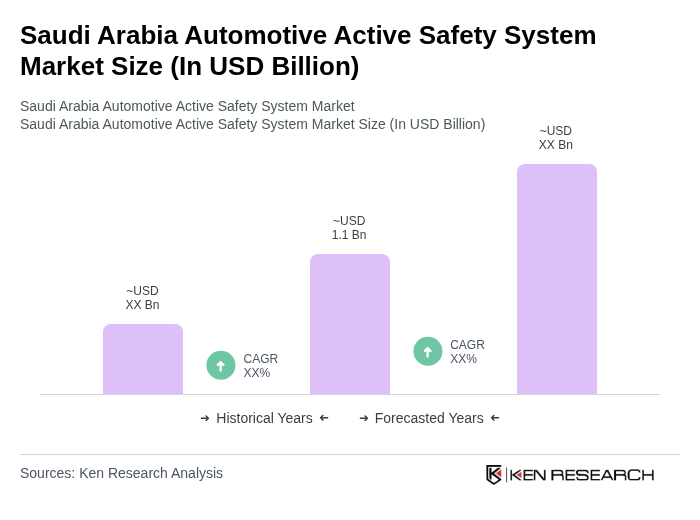
- The Saudi Arabia Automotive Active Safety System Market is valued at USD 1.1 billion, based on a five-year historical analysis. This market growth is primarily driven by increasing road safety awareness, stringent government regulations mandating advanced safety features, and rising consumer demand for enhanced vehicle safety technologies. The sector is further supported by the robust expansion of the automotive industry and the entry of international automotive manufacturers into the region. The surge in vehicle sales, particularly in urban centers, and the adoption of advanced driver-assistance systems (ADAS) are notable trends shaping the market’s trajectory.
- Key cities such as Riyadh, Jeddah, and Dammam continue to dominate the market due to their substantial population density, elevated vehicle ownership rates, and ongoing urban development initiatives. These metropolitan areas serve as pivotal hubs for automotive sales and aftersales services, making them critical for the widespread adoption of active safety systems in vehicles.
- In 2023, the Saudi Arabian government enacted the Technical Regulation for Vehicle Safety Systems, issued by the Saudi Standards, Metrology and Quality Organization (SASO). This regulation requires all new vehicles sold in the Kingdom to be equipped with advanced safety features, including electronic stability control and automatic emergency braking systems. The regulation’s operational scope covers passenger and commercial vehicles, with compliance enforced at the point of import and local assembly. These measures aim to enhance road safety and reduce traffic accidents, thereby accelerating demand for active safety systems in the automotive sector.
Saudi Arabia Automotive Active Safety System Market Segmentation
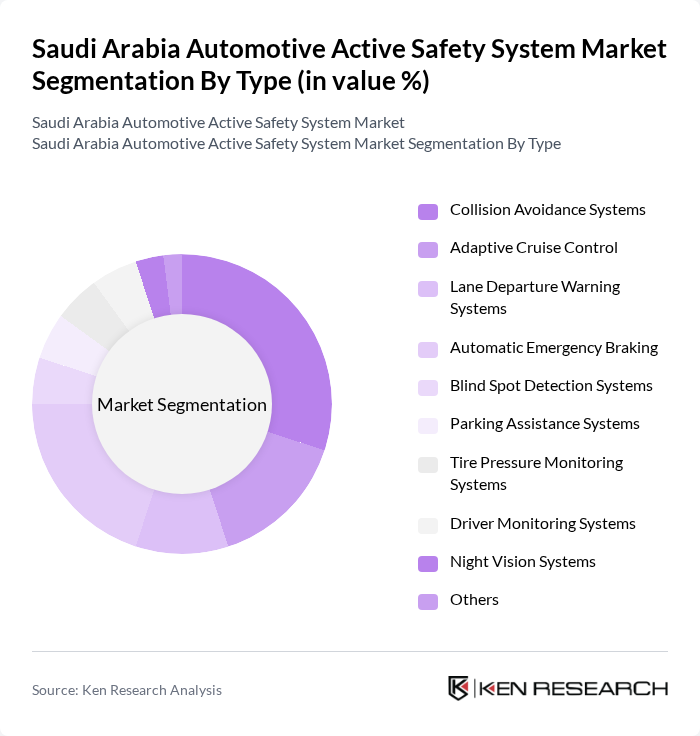
By Type:The market is segmented into various types of active safety systems, each designed to address specific safety requirements and consumer preferences. The subsegments include Collision Avoidance Systems, Adaptive Cruise Control, Lane Departure Warning Systems, Automatic Emergency Braking, Blind Spot Detection Systems, Parking Assistance Systems, Tire Pressure Monitoring Systems, Driver Monitoring Systems, Night Vision Systems, and Others. Among these, Collision Avoidance Systems hold the leading position due to their essential role in accident prevention and driver protection. The integration of sensor-based technologies and real-time data analytics is further enhancing the effectiveness of these systems.
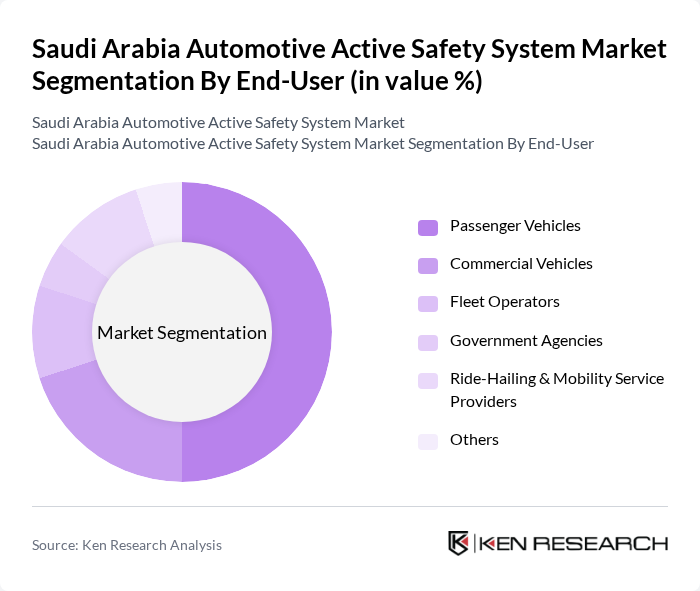
By End-User:The end-user segmentation includes Passenger Vehicles, Commercial Vehicles, Fleet Operators, Government Agencies, Ride-Hailing & Mobility Service Providers, and Others. The Passenger Vehicles segment remains dominant, supported by heightened consumer awareness of safety features and a rising trend in personal vehicle ownership. The increasing frequency of road accidents and the growing emphasis on safety by both consumers and regulatory bodies are driving the adoption of active safety systems in passenger vehicles.
Saudi Arabia Automotive Active Safety System Market Competitive Landscape
The Saudi Arabia Automotive Active Safety System Market is characterized by a dynamic mix of regional and international players. Leading participants such as Bosch, Continental AG, Denso Corporation, ZF Friedrichshafen AG, Mobileye (an Intel Company), Aptiv PLC, Valeo SA, Hyundai Mobis Co., Ltd., NXP Semiconductors N.V., Autoliv Inc., Magna International Inc., Panasonic Corporation, Texas Instruments Incorporated, Infineon Technologies AG, Siemens AG, STMicroelectronics N.V., Hella GmbH & Co. KGaA, Aisin Corporation, Local Saudi Distributors & Integrators (e.g., Al-Jomaih Automotive, Al-Futtaim Motors Saudi Arabia) contribute to innovation, geographic expansion, and service delivery in this space.
Saudi Arabia Automotive Active Safety System Market Industry Analysis
Growth Drivers
- Increasing Road Safety Awareness:The Saudi Arabian government reported a significant rise in road safety campaigns, with over 1,200 initiatives launched in the recent past alone. This heightened awareness has led to a 15% increase in public participation in safety programs. The World Health Organization estimates that road traffic injuries cost the country approximately $3.75 billion annually, prompting a push for advanced safety systems to mitigate these costs and enhance overall road safety.
- Government Initiatives for Vehicle Safety:In the recent past, the Saudi government allocated $500 million to improve vehicle safety standards, including the implementation of mandatory active safety systems in new vehicles. This initiative aims to reduce traffic fatalities by 30% over the next five years. Additionally, the Ministry of Interior has introduced stricter regulations for vehicle inspections, further driving the demand for advanced safety technologies in the automotive sector.
- Technological Advancements in Safety Systems:The automotive sector in Saudi Arabia is witnessing rapid technological advancements, with investments exceeding $300 million in research and development for active safety systems in the recent past. Innovations such as collision avoidance systems and lane-keeping assistance are becoming standard features. The integration of AI and machine learning into these systems is expected to enhance their effectiveness, leading to a projected 20% increase in adoption rates among consumers.
Market Challenges
- High Cost of Implementation:The initial investment for integrating advanced active safety systems in vehicles can exceed $2,000 per unit, which poses a significant barrier for manufacturers and consumers alike. This high cost is compounded by the need for ongoing maintenance and updates, making it challenging for many consumers to justify the expense. As a result, the adoption rate of these systems remains lower than anticipated, hindering market growth.
- Lack of Consumer Awareness:Despite the benefits of active safety systems, consumer awareness remains low, with only 35% of drivers in Saudi Arabia familiar with these technologies. This lack of knowledge is a significant challenge, as it directly impacts demand. Educational campaigns are essential to inform consumers about the advantages of these systems, but current efforts are limited, resulting in slower market penetration and adoption rates.
Saudi Arabia Automotive Active Safety System Market Future Outlook
The future of the automotive active safety system market in Saudi Arabia appears promising, driven by increasing government support and technological advancements. As the nation continues to invest in smart city initiatives and electric vehicle infrastructure, the demand for advanced safety systems is expected to rise. Furthermore, partnerships between automotive manufacturers and tech companies will likely accelerate innovation, enhancing the integration of AI and connectivity features in vehicles, ultimately improving road safety and consumer confidence.
Market Opportunities
- Expansion of Electric Vehicle Market:The electric vehicle market in Saudi Arabia is projected to grow significantly, with an estimated 200,000 electric vehicles expected on the roads in future. This growth presents a unique opportunity for active safety system manufacturers to develop tailored solutions that cater specifically to electric vehicles, enhancing their appeal and safety features.
- Partnerships with Technology Providers:Collaborations between automotive manufacturers and technology firms are becoming increasingly common, with over 50 partnerships established in the recent past. These alliances can facilitate the development of cutting-edge safety technologies, such as AI-driven systems, which can significantly enhance vehicle safety and performance, creating a competitive advantage in the market.
Scope of the Report
| Segment | Sub-Segments |
|---|---|
| By Type | Collision Avoidance Systems Adaptive Cruise Control Lane Departure Warning Systems Automatic Emergency Braking Blind Spot Detection Systems Parking Assistance Systems Tire Pressure Monitoring Systems Driver Monitoring Systems Night Vision Systems Others |
| By End-User | Passenger Vehicles Commercial Vehicles Fleet Operators Government Agencies Ride-Hailing & Mobility Service Providers Others |
| By Vehicle Type | Sedans SUVs Trucks Buses Light Commercial Vehicles (LCVs) Others |
| By Distribution Channel | OEMs Aftermarket Online Sales Authorized Dealers Others |
| By Technology | Radar Systems Camera Systems Lidar Systems Ultrasonic Sensors Infrared Sensors Others |
| By Region | Central Region Eastern Region Western Region Southern Region Northern Region |
| By Policy Support | Government Subsidies Tax Incentives Research Grants Regulatory Mandates Others |
Key Target Audience
Investors and Venture Capitalist Firms
Government and Regulatory Bodies (e.g., Saudi Standards, Metrology and Quality Organization)
Automotive Manufacturers and Producers
Automotive Component Suppliers
Insurance Companies
Technology Providers and Software Developers
Automotive Industry Associations
Financial Institutions and Banks
Players Mentioned in the Report:
Bosch
Continental AG
Denso Corporation
ZF Friedrichshafen AG
Mobileye (an Intel Company)
Aptiv PLC
Valeo SA
Hyundai Mobis Co., Ltd.
NXP Semiconductors N.V.
Autoliv Inc.
Magna International Inc.
Panasonic Corporation
Texas Instruments Incorporated
Infineon Technologies AG
Siemens AG
STMicroelectronics N.V.
Hella GmbH & Co. KGaA
Aisin Corporation
Local Saudi Distributors & Integrators (e.g., Al-Jomaih Automotive, Al-Futtaim Motors Saudi Arabia)
Table of Contents
Market Assessment Phase
1. Executive Summary and Approach
2. Saudi Arabia Automotive Active Safety System Market Overview
2.1 Key Insights and Strategic Recommendations
2.2 Saudi Arabia Automotive Active Safety System Market Overview
2.3 Definition and Scope
2.4 Evolution of Market Ecosystem
2.5 Timeline of Key Regulatory Milestones
2.6 Value Chain & Stakeholder Mapping
2.7 Business Cycle Analysis
2.8 Policy & Incentive Landscape
3. Saudi Arabia Automotive Active Safety System Market Analysis
3.1 Growth Drivers
3.1.1 Increasing Road Safety Awareness
3.1.2 Government Initiatives for Vehicle Safety
3.1.3 Technological Advancements in Safety Systems
3.1.4 Rising Demand for Advanced Driver Assistance Systems (ADAS)
3.2 Market Challenges
3.2.1 High Cost of Implementation
3.2.2 Lack of Consumer Awareness
3.2.3 Regulatory Compliance Issues
3.2.4 Limited Availability of Skilled Workforce
3.3 Market Opportunities
3.3.1 Expansion of Electric Vehicle Market
3.3.2 Partnerships with Technology Providers
3.3.3 Growth in E-commerce and Delivery Services
3.3.4 Increasing Investment in Smart City Projects
3.4 Market Trends
3.4.1 Integration of AI in Safety Systems
3.4.2 Shift Towards Autonomous Vehicles
3.4.3 Enhanced Connectivity Features in Vehicles
3.4.4 Focus on Sustainable and Eco-friendly Solutions
3.5 Government Regulation
3.5.1 Mandatory Safety Standards for Vehicles
3.5.2 Incentives for Safety Technology Adoption
3.5.3 Regulations on Vehicle Testing and Certification
3.5.4 Policies Promoting Research and Development in Safety Technologies
4. SWOT Analysis
5. Stakeholder Analysis
6. Porter's Five Forces Analysis
7. Saudi Arabia Automotive Active Safety System Market Market Size, 2019-2024
7.1 By Value
7.2 By Volume
7.3 By Average Selling Price
8. Saudi Arabia Automotive Active Safety System Market Segmentation
8.1 By Type
8.1.1 Collision Avoidance Systems
8.1.2 Adaptive Cruise Control
8.1.3 Lane Departure Warning Systems
8.1.4 Automatic Emergency Braking
8.1.5 Blind Spot Detection Systems
8.1.6 Parking Assistance Systems
8.1.7 Tire Pressure Monitoring Systems
8.1.8 Driver Monitoring Systems
8.1.9 Night Vision Systems
8.1.10 Others
8.2 By End-User
8.2.1 Passenger Vehicles
8.2.2 Commercial Vehicles
8.2.3 Fleet Operators
8.2.4 Government Agencies
8.2.5 Ride-Hailing & Mobility Service Providers
8.2.6 Others
8.3 By Vehicle Type
8.3.1 Sedans
8.3.2 SUVs
8.3.3 Trucks
8.3.4 Buses
8.3.5 Light Commercial Vehicles (LCVs)
8.3.6 Others
8.4 By Distribution Channel
8.4.1 OEMs
8.4.2 Aftermarket
8.4.3 Online Sales
8.4.4 Authorized Dealers
8.4.5 Others
8.5 By Technology
8.5.1 Radar Systems
8.5.2 Camera Systems
8.5.3 Lidar Systems
8.5.4 Ultrasonic Sensors
8.5.5 Infrared Sensors
8.5.6 Others
8.6 By Region
8.6.1 Central Region
8.6.2 Eastern Region
8.6.3 Western Region
8.6.4 Southern Region
8.6.5 Northern Region
8.7 By Policy Support
8.7.1 Government Subsidies
8.7.2 Tax Incentives
8.7.3 Research Grants
8.7.4 Regulatory Mandates
8.7.5 Others
9. Saudi Arabia Automotive Active Safety System Market Competitive Analysis
9.1 Market Share of Key Players
9.2 Cross Comparison of Key Players
9.2.1 Company Name
9.2.2 Market Share in Saudi Arabia Automotive Active Safety System Market
9.2.3 Revenue from Saudi Arabia Automotive Active Safety System Segment (USD Million)
9.2.4 CAGR in Saudi Arabia (Last 3 Years)
9.2.5 Number of OEM Partnerships in Saudi Arabia
9.2.6 Number of Active Safety System Patents (Relevant to Saudi Market)
9.2.7 Product Portfolio Breadth (Active Safety Systems)
9.2.8 Local Presence (Manufacturing/Assembly/Distribution in Saudi Arabia)
9.2.9 Average Time-to-Market for New Safety Technologies
9.2.10 Customer Satisfaction Index (Saudi Arabia)
9.2.11 After-Sales Service Network Coverage (Saudi Arabia)
9.2.12 Regulatory Compliance Score (Saudi Arabia)
9.3 SWOT Analysis of Top Players
9.4 Pricing Analysis
9.5 Detailed Profile of Major Companies
9.5.1 Bosch
9.5.2 Continental AG
9.5.3 Denso Corporation
9.5.4 ZF Friedrichshafen AG
9.5.5 Mobileye (an Intel Company)
9.5.6 Aptiv PLC
9.5.7 Valeo SA
9.5.8 Hyundai Mobis Co., Ltd.
9.5.9 NXP Semiconductors N.V.
9.5.10 Autoliv Inc.
9.5.11 Magna International Inc.
9.5.12 Panasonic Corporation
9.5.13 Texas Instruments Incorporated
9.5.14 Infineon Technologies AG
9.5.15 Siemens AG
9.5.16 STMicroelectronics N.V.
9.5.17 Hella GmbH & Co. KGaA
9.5.18 Aisin Corporation
9.5.19 Local Saudi Distributors & Integrators (e.g., Al-Jomaih Automotive, Al-Futtaim Motors Saudi Arabia)
10. Saudi Arabia Automotive Active Safety System Market End-User Analysis
10.1 Procurement Behavior of Key Ministries
10.1.1 Ministry of Interior
10.1.2 Ministry of Transport
10.1.3 Ministry of Municipal and Rural Affairs
10.1.4 Others
10.2 Corporate Spend on Infrastructure & Energy
10.2.1 Investment in Road Safety Initiatives
10.2.2 Budget Allocation for Vehicle Safety Programs
10.2.3 Corporate Partnerships for Safety Technology
10.2.4 Others
10.3 Pain Point Analysis by End-User Category
10.3.1 Fleet Operators
10.3.2 Government Agencies
10.3.3 Private Vehicle Owners
10.3.4 Others
10.4 User Readiness for Adoption
10.4.1 Awareness of Active Safety Systems
10.4.2 Willingness to Invest in Safety Technologies
10.4.3 Training and Support Needs
10.4.4 Others
10.5 Post-Deployment ROI and Use Case Expansion
10.5.1 Measurement of Safety Improvements
10.5.2 Cost Savings from Reduced Accidents
10.5.3 Expansion of Use Cases in Different Vehicle Types
10.5.4 Others
11. Saudi Arabia Automotive Active Safety System Market Future Size, 2025-2030
11.1 By Value
11.2 By Volume
11.3 By Average Selling Price
Go-To-Market Strategy Phase
1. Whitespace Analysis + Business Model Canvas
1.1 Market Gaps Identification
1.2 Business Model Development
2. Marketing and Positioning Recommendations
2.1 Branding Strategies
2.2 Product USPs
3. Distribution Plan
3.1 Urban Retail Strategies
3.2 Rural NGO Tie-ups
4. Channel & Pricing Gaps
4.1 Underserved Routes
4.2 Pricing Bands Analysis
5. Unmet Demand & Latent Needs
5.1 Category Gaps
5.2 Consumer Segments
6. Customer Relationship
6.1 Loyalty Programs
6.2 After-sales Service
7. Value Proposition
7.1 Sustainability Initiatives
7.2 Integrated Supply Chains
8. Key Activities
8.1 Regulatory Compliance
8.2 Branding Efforts
8.3 Distribution Setup
9. Entry Strategy Evaluation
9.1 Domestic Market Entry Strategy
9.1.1 Product Mix Considerations
9.1.2 Pricing Band Strategy
9.1.3 Packaging Approaches
9.2 Export Entry Strategy
9.2.1 Target Countries
9.2.2 Compliance Roadmap
10. Entry Mode Assessment
10.1 Joint Ventures
10.2 Greenfield Investments
10.3 Mergers & Acquisitions
10.4 Distributor Model
11. Capital and Timeline Estimation
11.1 Capital Requirements
11.2 Timelines for Implementation
12. Control vs Risk Trade-Off
12.1 Ownership Considerations
12.2 Partnerships Evaluation
13. Profitability Outlook
13.1 Breakeven Analysis
13.2 Long-term Sustainability Strategies
14. Potential Partner List
14.1 Distributors
14.2 Joint Ventures
14.3 Acquisition Targets
15. Execution Roadmap
15.1 Phased Plan for Market Entry
15.1.1 Market Setup
15.1.2 Market Entry
15.1.3 Growth Acceleration
15.1.4 Scale & Stabilize
15.2 Key Activities and Milestones
15.2.1 Activity Planning
15.2.2 Milestone Tracking
Research Methodology
Phase 1: Approach1
Desk Research
- Analysis of industry reports from automotive safety organizations and regulatory bodies in Saudi Arabia
- Review of market studies and white papers published by automotive research firms
- Examination of government publications and safety standards related to automotive active safety systems
Primary Research
- Interviews with automotive safety engineers and product managers from leading manufacturers
- Surveys conducted with fleet operators and automotive service providers
- Focus group discussions with consumers to understand perceptions of active safety systems
Validation & Triangulation
- Cross-validation of findings through multiple data sources including sales data and expert opinions
- Triangulation of insights from primary interviews with secondary research findings
- Sanity checks through expert panel reviews comprising industry veterans and safety analysts
Phase 2: Market Size Estimation1
Top-down Assessment
- Estimation of market size based on national automotive sales data and growth trends
- Segmentation of the market by vehicle type and safety system technology
- Incorporation of government initiatives promoting active safety systems in vehicles
Bottom-up Modeling
- Collection of data on unit sales and installation rates of active safety systems from manufacturers
- Estimation of average selling prices for various active safety technologies
- Calculation of market size based on volume of installations and revenue per unit
Forecasting & Scenario Analysis
- Multi-factor regression analysis considering economic indicators and consumer adoption rates
- Scenario modeling based on potential regulatory changes and technological advancements
- Development of baseline, optimistic, and pessimistic forecasts through 2030
Phase 3: CATI Sample Composition1
| Scope Item/Segment | Sample Size | Target Respondent Profiles |
|---|---|---|
| Automotive Manufacturers | 60 | Product Development Managers, Safety Compliance Officers |
| Fleet Operators | 50 | Fleet Managers, Safety Directors |
| Automotive Service Providers | 40 | Service Managers, Technicians |
| Consumer Insights | 100 | Car Owners, Potential Buyers |
| Regulatory Bodies | 40 | Policy Makers, Safety Inspectors |
Frequently Asked Questions
What is the current value of the Saudi Arabia Automotive Active Safety System Market?
The Saudi Arabia Automotive Active Safety System Market is valued at approximately USD 1.1 billion, reflecting a significant growth driven by increased road safety awareness, government regulations, and consumer demand for advanced safety technologies.
What are the key factors driving the growth of the automotive active safety system market in Saudi Arabia?
Which cities in Saudi Arabia are leading in the automotive active safety system market?
What regulations has the Saudi Arabian government implemented regarding vehicle safety systems?
Other Regional/Country Reports
Indonesia Automotive Active Safety System Market
Malaysia Automotive Active Safety System Market
KSA Automotive Active Safety System Market
APAC Automotive Active Safety System Market
SEA Automotive Active Safety System Market
Vietnam Automotive Active Safety System Market
Other Adjacent Reports
Oman Automotive Passive Safety System Market
Saudi Arabia Advanced Driver Assistance System Market Report Size Share Growth Drivers Trends Opportunities & Forecast 2025–2030KSA Automotive Sensor Market
Qatar Vehicle Telematics Market
Kuwait Automotive Electronics (ECUs, Sensors, Controllers) Market Size, Share, Growth Drivers, Trends, Opportunities, Competitive Landscape & Forecast 2025–2030Qatar Electric Vehicle Safety System Market
Mexico Autonomous Driving Technology Market
Bahrain Tire Pressure Monitoring System MarketMiddle East Automotive Software Market Report Size, Share, Growth Drivers, Trends, Opportunities & Forecast 2025–2030Vietnam Collision Avoidance System Market
Why Buy From Us?

What makes us stand out is that our consultants follow Robust, Refine and Result (RRR) methodology. Robust for clear definitions, approaches and sanity checking, Refine for differentiating respondents' facts and opinions, and Result for presenting data with story.

We have set a benchmark in the industry by offering our clients with syndicated and customized market research reports featuring coverage of entire market as well as meticulous research and analyst insights.

While we don't replace traditional research, we flip the method upside down. Our dual approach of Top Bottom & Bottom Top ensures quality deliverable by not just verifying company fundamentals but also looking at the sector and macroeconomic factors.

With one step in the future, our research team constantly tries to show you the bigger picture. We help with some of the tough questions you may encounter along the way: How is the industry positioned? Best marketing channel? KPI's of competitors? By aligning every element, we help maximize success.

Our report gives you instant access to the answers and sources that other companies might choose to hide. We elaborate each steps of research methodology we have used and showcase you the sample size to earn your trust.

If you need any support, we are here! We pride ourselves on universe strength, data quality, and quick, friendly, and professional service.